
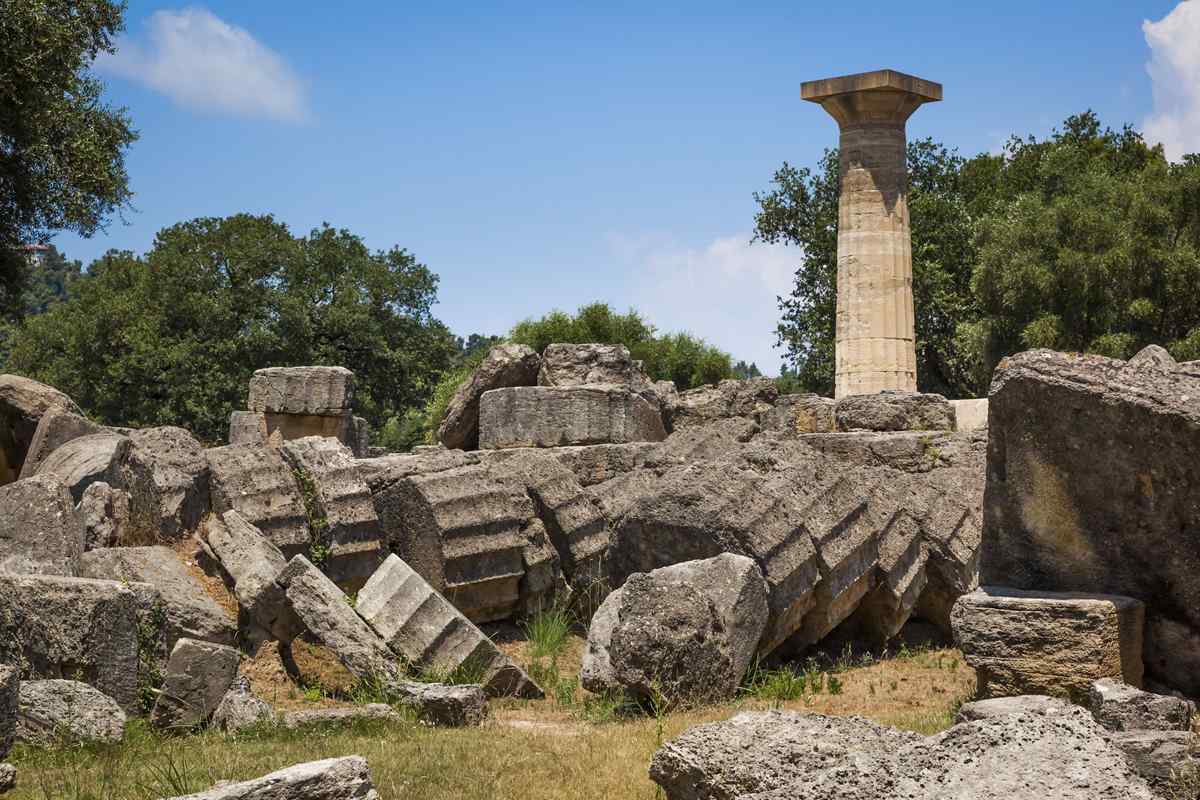
Greek mythology places are real mountains, caves, rivers, springs, towns and islands tied to ancient tales. Outings with a host take place across Greece, from Thessaly and Epirus to the Peloponnese. Mount Olympus, Mount Cithaeron, the Ilisos in Athens, the Achelous, the Acheron and Cape Matapan open the list. Towns, sanctuaries and islands of myth follow them. Related pages cover Delphi tours, Mycenae tours and Olympia tours. Further trips sit under Greece tours.
Bookings made through the GetYourGuide widgets on this page earn Classical Greece Tours a commission, at no extra cost to the traveller.
What are Greek mythology places?
Greek mythology places are real peaks, caves, rivers and springs that ancient tales tied to gods. By the fifth century BC, Mount Olympus in Thessaly stood as the shared Greek seat of the gods. A seat here means a home and throne of power.
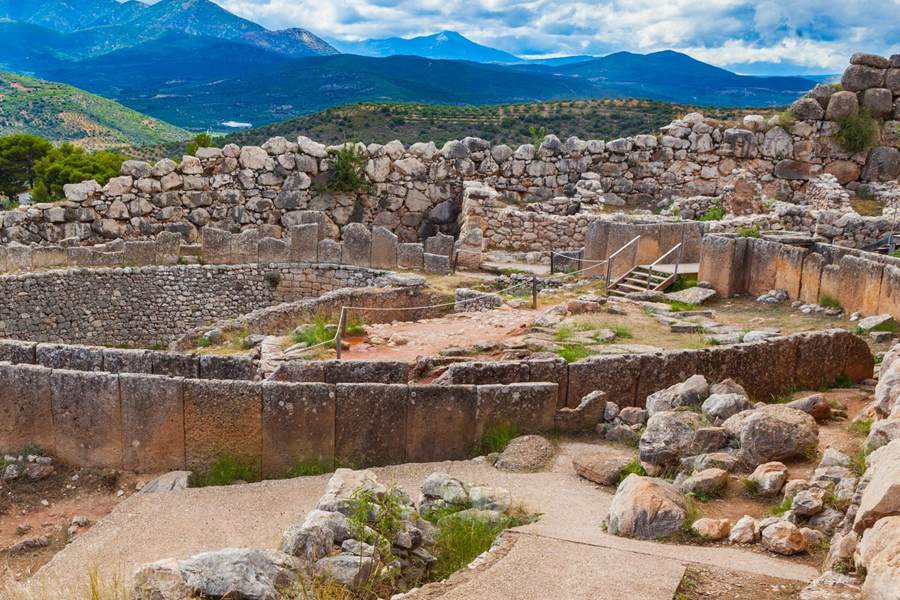
The name Olympus never belonged to one mountain alone. A tribe is a group of families who share descent and customs. In each region that Greek tribes settled, the highest local summit tended to carry that name. Ancient peaks called Olympus also stood in Attica, Euboea, Ionia and Lesbos, among other lands.
In the Odyssey, the form Oulumpos means the seat of the gods, not one named peak. Among Greek mythology places on Olympus, Agios Antonios is the third highest peak, at 2,817 metres. Finds from 1961 show that Zeus had a sanctuary there. Sanctuary here means sacred ground set aside for a deity.
The writer Pausanias recorded that lions lived in the Olympus region in ancient times. Brown bears lived on the mountain until at least the 16th century. Pimblia and Leivithra, two towns nearby, are Greek mythology places tied to Orpheus and the Orphic mysteries. Mysteries were secret rites kept for people who had joined them.
- Sky: Homer also used the word olympos as a plain noun for the sky itself.
- Orpheus: Tradition makes Orpheus, born to Apollo and the Muse Calliope, teach Dionysus worship here.
- Coin: A Greek coin minted in 2005 shows the War of the Titans on Olympus.
Greek mythology places on Olympus share the slopes with later Christian sites. At 2,803 metres, the Prophet Elias chapel stands higher than any other chapel of Orthodox Christianity. Greek tradition links this prophet with mountaintops, and the summit bears his name.
Which myths unfolded on Mount Cithaeron, one of the mainland Greek mythology places?
Greek mythology places on the mainland gain a stage for Dionysus in Mount Cithaeron. This range was held especially sacred to him. It divides Boeotia in the north from Attica in the south. Old tales set events of myth on its slopes.
Among Greek mythology places of Central Greece, Cithaeron rises to 1,409 metres and consists mainly of limestone. Limestone is a hard, pale kind of rock. The mountain called Pastra forms the north-east side of the range. In the Middle Ages, Myoupolis, a village on its slopes, held a monastery that Meletios the Younger founded.
In the Bacchae, a play by Euripides, Dionysus leads his dances and rites on Cithaeron with his bacchants. Bacchants were women who served Dionysus as his priestesses. Oedipus was left exposed on the mountain. To expose a child meant leaving it out in the wild to die. Actaeon and Pentheus were both torn apart on its slopes.
Greek mythology places tied to Heracles include this range, where he or Alcathous killed the Lion of Cithaeron. The people of Plataea pictured the mountain as a person, their primal king Cithaeron. Primal means first in time. In their view, King Cithaeron named the mountain, and King Asopus named the river.
- Contest: One tale sets Cithairon against Helikon in a singing match judged by the Muses.
- Garlands: Cithairon won, and the Muses crowned him with garlands, rings of flowers and leaves.
- Broken boulder: Helikon, furious at losing, broke a great boulder on his own slopes.
History also reached these Greek mythology places. In 479 BC, the range rose behind the Battle of Plataea. Small clashes broke out on its slopes before the main battle. Later, Athens and Thebes disputed the range and built forts at Plataea and Erythrai.
Why does the Ilisos river belong among Greek mythology places in Athens?
Greek mythology places in Athens line the banks of the Ilisos. This river once fed the Kifisos and now flows to the sea. Ilisos himself was held to be a demi-god, a son of Poseidon and Demetra. A demi-god is partly divine.
In ancient times, the Ilisos flowed outside the city walls of Athens. Plato wrote in Critias that the river marked one border of the old walls. Its grassy banks lay in the shade of plane trees, tall trees with broad, spreading leaves. Socrates favoured these banks for his walks and his teaching.
Greek mythology places along the river included a sanctuary where Ilisos himself was worshipped. It stood on Ardittos hill, next to the present Panathinaiko Stadium. In antiquity this district bore the name Cynosarges. The spring of Kallirrhoe rose there too. A spring is a natural outflow of water from the earth.
Among Greek mythology places by the river stands a shrine of Pan, with his carved relief. A relief is a carving raised from a flat stone. Others identify the spot as the Shrine of the Nymphs and Achelous. Nymphs were spirits of nature in female form. Plato set Socrates and Phaedros talking there.
- Pan: This god of wild nature received regular worship in caves and rocky ground.
- Lesser Mysteries: Yearly rites on the hill of Agrai prepared people for the Great Mysteries of Eleusis.
- Hecate: The church of Aghia Foteini, founded in 1872, rests on ruins of her ancient temple.
The Ilisos, one of the Greek mythology places of Athens, drains the western flanks of Mount Hymettus. Near the spring of Kallirrhoe, the river once spread into shallow marshland. The Greek name for that marsh means Frog Island. A marsh is low, wet ground where reeds grow.
What does the Achelous River add to Greek mythology places in western Greece?
Greek mythology places of western Greece follow the Achelous, a river 220 km long. It flows out to the Ionian Sea. In antiquity, people honoured its spirit as the river god Achelous. A river god is a river’s spirit pictured as a god.
The Achelous begins high on the eastern slope of Lakmos, at about 2,000 metres. Lakmos belongs to the Pindus range. Its waters run whitish yellow or cream in colour. That shade gave it a later name, Aspropotamo, meaning the White river. Among Greek mythology places, the Achelous also served as an ancient border between Acarnania and Aetolia.
In antiquity, the Achelous was the largest and best-known river in Greece. Of the river gods tied to Greek mythology places, Achelous alone won Panhellenic worship. Panhellenic means shared by all Greeks. His worship had a close link with the oracle at Dodona. An oracle was a shrine where a god answered questions.
Hesiod made Achelous a son of the Titans Oceanus and Tethys. Titans were an elder race of gods in Greek myth. In the shape of a bull, Achelous wrestled Heracles for the right to marry Deianeira. He lost the match, and Heracles married her. The poet Pindar added that Heracles snapped off one of his horns.
- Amalthea: Pindar also says the god won his horn back by trading a horn of Amalthea.
- Horn of plenty: Greeks linked his broken horn with the cornucopia, the horn of plenty.
- Sirens: Myth also named Achelous as the father of the Sirens and of nymphs.
Greek mythology places near the river mouth include the Echinades Islands. Ovid wrote that these islands were once five local nymphs. They left Achelous out of their offerings, or gifts to the gods. His angry flood then swept them away into the sea.
How does the Acheron river fit into Greek mythology places of the underworld?
Greek mythology places tied to the dead have a real river in Epirus: the Acheron, in northwest Greece. Ancient myth named it the river of woe, one of five rivers in the underworld. The underworld was the realm of the dead beneath the earth.
The Acheron, among the Greek mythology places of the northwest, collects rain from 705 square kilometres of land. The origin of its name remains uncertain. At times, the word Acheron stood for Hades itself, the whole realm of the dead. Such use of a part to name the whole is called synecdoche.
Homeric poems set the Acheron among Greek mythology places of the dead, as a river of Hades. Two other rivers, Cocytus and Phlegethon, flowed into it. In his Phaedo, Plato placed it second among the world’s rivers, behind Oceanus alone. He wrote that it ran beneath the earth, against the flow of Oceanus.
Propertius, Ovid and Statius, three Roman poets, gave the name Styx to this river. Virgil, another Roman poet, instead called the Acheron the main river of Tartarus. Tartarus was the deep pit of the underworld in myth. In his account, both the Styx and the Cocytus sprang from it.
- Swamp: Greek writers, Aristophanes in The Frogs among them, at times called it a lake or swamp.
- Family: Ancient sources name Acheron as father of Ascalaphus, by either Orphne or Gorgyra.
- Antarctica: Acheron Lake in Antarctica takes its name from the river of myth.
Virgil’s Aeneid carries Greek mythology places into Roman verse. In it, Juno vows to move Acheron if heaven will not bend. Freud later chose the same Latin words to open The Interpretation of Dreams as its motto. A motto is a short saying at the start of a book.
Why is Cape Matapan counted among Greek mythology places linked to Hades?
Greek mythology places in the far south include Cape Matapan, also called Tainaron. The cape marks the far end of the Mani Peninsula, in the Peloponnese. Greek legends held that a cave near ancient Taenarum was the home of Hades, god of the dead.
In mainland Europe, only one point lies further south than Cape Matapan. It divides the Messenian Gulf to the west from the Laconian Gulf to the east. A gulf is a large arm of the sea set deep into the coast. Birds bound for Africa pass along it on their migration route.
Myth names Taenarus as the founder-hero of the ancient city. A founder-hero is the legendary first settler who gives a town his name. He was credited with setting up its important temple of Poseidon. Among Greek mythology places of the Mani, the temple honoured Poseidon Asphaleius, meaning Poseidon of Safety.
Two ancient writers described the Greek mythology places at Tainaron. Strabo wrote of the sanctuary as a sacred grove beside a cave. A grove is a small wood. Pausanias described a temple shaped like a cave, with a statue of Poseidon at its mouth. The temple ruins and their precinct, or sacred enclosure, are now a protected archaeological site.
- Tainarian evil: Greeks used this phrase for a great and unlawful wrong against suppliants, or people seeking protection.
- Stelae: Four inscribed stone slabs, or stelae, record the release of slaves at the sanctuary.
- Mercenaries: Tainaron served as a centre where soldiers for hire were recruited.
The Greek mythology places of Tainaron also figure in the account of the 464 BCE earthquake at Sparta. People read the disaster as Poseidon’s anger. Spartan ephors, or chief officials, had killed helots who sought refuge in his sanctuary. Helots were unfree workers under Spartan rule.
Why does the Sanctuary of the Great Gods rank among Greek mythology places?
Greek mythology places in Thrace include the island of Samothrace and its Sanctuary of the Great Gods. It counts among the leading Pan-Hellenic religious sanctuaries. Pan-Hellenic means shared by all Greeks, and a sanctuary is a holy area set aside for worship.
Among Greek mythology places, this sanctuary won fame for its Mystery religion across Ancient Greece. A mystery religion keeps its central rites secret. It shows them only to initiates, people admitted through a ceremony. Speaking the names of the gods honoured there was taboo, or strictly forbidden. Their identity therefore remains largely a puzzle.
Ancient Greek writers grouped these gods under one shared name, the Cabeiri. Inscriptions found on the site itself use a simpler title, the Great Gods. That title marks a rank or condition rather than a true personal name. An inscription means lettering carved into stone, metal or another hard surface.
Samothracian coins, meaning coins struck on the island, show one goddess, the Great Mother, seated beside a lion. At this site among Greek mythology places, initiates wore rings of magnetic iron. The rings served as signs of recognition between members. Magnetic iron is iron with a natural pull on other iron.
- Sash: Each initiate received a crimson, or deep red, sash tied at the waist as a protective charm.
- Rotunda: The Arsinoe Rotunda, a round hall 20 m wide, was the largest covered circular space of ancient Greece.
- Name: In a legend told by Diodorus Siculus, Myrina named the island Samothrace, meaning Sacred Island.
For Greek mythology places with secret rites, Samothrace differed from Eleusis in its openness. Unlike the Eleusinian Mysteries, its initiation set no rule at all on age, gender, status or nationality. Status here means a person’s rank or position in society.
How does Skyros fit among Greek mythology places?
Greek mythology places in the Aegean Sea include Skyros, an island of the Sporades. No inhabited island of that group lies farther south. The Sporades form an archipelago, meaning a cluster of islands. Myth links Skyros with Achilles, his son Neoptolemus and Theseus.
In the tales behind Greek mythology places, Skyros is where Achilles set out for Troy. Odysseus had earlier discovered him at the royal court of Lycomedes. A court is the household and hall of a ruler. On the east coast, a bay called Achili is said to mark where Achilles left with the Greeks.
Neoptolemus, the son of Achilles, also came from Skyros. Book Nineteen of the Iliad says so, and so does Sophocles in his play Philoctetes. Cimon later claimed he had found the remains of Theseus on Skyros. He then returned them to Athens. Remains here means the bones of a dead person.
Skyros, one of the Greek mythology places of the Aegean, has carried other names. Around the 2nd millennium BC, people called it the Island of the Magnetes. A millennium means a period of one thousand years. Later still it took the names Pelasgia and Dolopia, and finally Skyros.
- Size: At 209 square kilometres, Skyros is the largest island in the whole Sporades group.
- Name: One account links the name Skyros to skyron or skiron, words meaning stone debris.
- Stone: The island earned a name for its decorative stone, meaning stone prized for ornament.
Among Greek mythology places, Skyros has a forested north and a bare, rocky south. The south rises to Kochila, the highest mountain, at 792 m. The island also keeps a native breed, the Skyrian pony. A pony is a horse of a small type.
Which founding story makes the Cadmea one of the Greek mythology places?
Greek mythology places tied to city founders include the Cadmea, the citadel of ancient Thebes. A citadel is a fortified high point that guards a city. The name honours Cadmus, whom legend calls the founder of the Greek city of Thebes.
The story of the Cadmea, a site among the Greek mythology places of Boeotia, begins at Delphi. There the oracle told Cadmus to follow a cow and build a town where she lay down. An oracle is a shrine where a god was thought to answer questions. Pelagon, King of Phocis, supplied the cow.
Cadmus sent companions to the Ismenian spring for water, but its guardian water-dragon killed them. Cadmus then destroyed the dragon. On the instruction of Athena, he sowed its teeth in the ground. Fierce armed men sprang up from the sown teeth. They were called the Spartoi, a Greek name meaning sown.
Five of the Spartoi survived and helped Cadmus build the Cadmea. They founded the noblest families of Thebes. This site among Greek mythology places has been settled since at least the early Bronze Age, experts think. Reliable dates begin around 1400 BC, in the late Mycenaean period. Mycenaean means of the Bronze Age culture named after Mycenae.
- Role: In classical times, the Cadmea served Thebes in the way the Acropolis served Athens.
- Loss: Alexander the Great destroyed the Cadmea in 335 BC, along with the city of Thebes.
- Rebuilding: Cassander, a Macedonian general, rebuilt the Cadmea in 316 BC after Alexander’s death.
Outside the world of Greek mythology places, the word cadmea has a second meaning. In ancient use, it was a name for calamine, which is zinc carbonate. Calamine is a mineral, a natural solid found in rock, that holds the metal zinc.
What part does Aulis play among Greek mythology places?
Greek mythology places linked to the Trojan War include Aulis, a port town of ancient Boeotia. In Homer’s Iliad, the Greek fleet gathered there to set off for Troy. Aulis faced the island of Euboea across the Euripus, a narrow sea channel.
Among Greek mythology places, Aulis is where Artemis held back the Greek departure for the Trojan War. She halted the winds as a punishment for Agamemnon. He had slain a deer inside a sacred grove, a wood set apart for a god. He then boasted that he was a better hunter than Artemis.
The ancient geographer Strabo wrote that the harbour of Aulis had room for only fifty ships. A geographer studies and records the lands and places of the earth. Strabo therefore held that the Greek fleet must have gathered in a large port close by. That port bore the Greek name Bathys limen, literally deep sea.
Aulis seems to have stood on a rocky height. Homer calls it rocky Aulis, while Strabo calls it a stone village. Aulis, among the Greek mythology places of Boeotia, never grew into a fully independent polis. A polis is a Greek city-state. It belonged to Thebes and then to Tanagra.
- Distance: The writer Livy placed Aulis 3 miles, or 4.8 km, from Chalcis.
- Imitation: In 396 BCE the Spartan king Agesilaus II chose Aulis as his starting point for Asia, imitating Agamemnon.
- Potters: In the days of Pausanias, a travel writer, Aulis held only a small group of potters.
Of the Greek mythology places tied to Troy, Aulis kept a temple of Artemis. Tradition credits Agamemnon with founding it. The temple was still standing when Pausanias came to the place. A temple is a building for worshipping a god.
Which legend links Ikaria with Greek mythology places?
Greek mythology places near Samos include Ikaria, an island of the Aegean Sea, 19 km to its southwest. Tradition names it after Icarus, son of Daedalus. Legend holds that he plunged into the nearby sea and was laid to rest on Ikaria.
The ancient Greeks used the name Icaria or Ikaria, the same as today. They held that Icarus came down in the waters south of the island while flying from Crete. A second theory traces the name to Phoenician words for fish or for sheep. Either root points to plentiful natural life.
Among Greek mythology places, Ikaria lies beside seas that the ancients feared, above all to the north. Homer used them in the Iliad as an image of a restless crowd. He compared a stirred gathering to the long swell of the Ikarian main. Main is an old poetic word for the open sea.
At Nas, among the Greek mythology places of Ikaria, Artemis had a temple under the title Tauropolos. It rose inside the cove, a sheltered bay, around the 6th century BC. There she was honoured as a patron of seafarers, meaning a protector of sailors. Legend says the temple’s marble remains are buried beneath the sand at Nas beach.
- Old names: Ichthyoessa and Anemoessa, two earlier names, pointed to plentiful fish and harsh winds.
- Cities: Later tradition lists four major cities: Oenoe, Thermae, Drakanon and Tauropolion.
- Coins: Coins of the city of Oenoe showed the goddess Artemis together with a bull.
The ancient historian Arrian, quoting the writer Aristobulus, records an order from Alexander the Great. Failaka Island, in the Persian Gulf, was to be named Icarus. The name came from Ikaria itself, one of the Greek mythology places of the Aegean.
What do travellers ask about Greek mythology places, and what are the answers?
Greek mythology places of the mainland include four towns from Homer: Anthedon, Phthia, Trachis and Pherae. Homer is the ancient Greek poet credited with the Iliad and the Odyssey, two long tales of heroes. A sea-god, kings and Heracles himself appear in their stories.
Among Greek mythology places, how is Anthedon tied to the sea?
Anthedon is first named in the Catalogue of Ships, a list of Greek forces in the Iliad. It calls the town furthermost, meaning the remotest in Boeotia. Its people traced their origin to the sea-god Glaucus. Outside its walls stood a temple of Dionysus, plus a place known as the leap of Glaucus.
Why does Phthia matter among Greek mythology places?
The Iliad repeatedly names Phthia as the home of the Myrmidons, the troops Achilles led. Aeacus, the grandfather of Achilles, founded the town, which was also home to Peleus, father of Achilles. In Plato’s Crito, Socrates dreams of a woman in white. She wishes that he reach fertile Phthia on the third day.
Which hero links Trachis to Greek mythology places?
Trachis gave Heracles a home in exile after he killed Iphitus. Exile means forced life away from one’s home city. Homer counts the town among the cities subject to Achilles, meaning under his rule. Legend places the death of Heracles on the mountain above the town, which is Mount Oeta.
Who ruled at Pherae, one of the Greek mythology places?
Homer makes Pherae the seat, or home, of King Admetus and of Alcestis, his wife and queen. Their son Eumelus commanded the Achaean troops from Pherae and Iolcus at Troy. Achaean is the name Homer gives to the Greeks. Today the ancient site falls within the modern community of Velestino.