
Greece luxury tours are high-comfort trips with a host across Greece, from Athens to the far north. The topics here run from the Old Royal Palace, the Presidential Mansion and the Maximos Mansion to Tatoi. Further sections cover the National Library of Greece, Theophil Hansen, Ernst Ziller, Ampelakia and the mansions of Siatista. Spa towns, fine crafts and fine foods follow, with short answers at the end. Wider plans sit under Greece tour packages, Greece island hopping tours and Greece small group tours. Every trip on the site starts from Greece tours.
Bookings made through the GetYourGuide widgets on this page earn Classical Greece Tours a commission, at no extra cost to the traveller.
What are Greece luxury tours?
Greece luxury tours are high-comfort trips through the country with a host. After the Kingdom of Greece began in 1832, its architecture mostly followed the neoclassical style. Neoclassical buildings borrow forms from the temples of ancient Greece and Rome.
Neoclassical architecture also goes by the name Classical Revival architecture. A revival is the return of an older style after a long gap. The word neoclassical means new classical, from the Greek neos, meaning new. The style grew into a leading way of building across the Western world. The Western world means Europe and the lands settled by Europeans.
From about 1800, etchings and engravings of Greek buildings sparked the Greek Revival, a new strand of neoclassicism. Etchings and engravings are prints made from lines cut into metal. A print is a picture pressed onto paper from an inked surface. Greece luxury tours happen in a land whose ancient buildings Western Europe barely knew before the mid-18th century.
For Greece luxury tours in Athens, the modern city plan came from architects Stamatios Kleanthis and Eduard Schaubert. King Otto I, the first King of Greece, gave them that task. Ernst Ziller later designed private mansions in central Athens, and these gradually became public, chiefly through donations. A mansion is a big and stately home.
- Aim: The movement sought a purer, more authentic classical style, fitted to modern purposes.
- Change: In the 19th century, the style lost its strict early purity, as in the French Empire style.
- Research: In 1751, James Stuart and Nicholas Revett led a research journey that began serious study of Greek remains.
Greece luxury tours run through Athens, the capital of Greece. There, the first important public building to rise was the Old Royal Palace, between 1836 and 1843. A public building serves the state or the people, not a private owner.
Why does the Old Royal Palace of Athens matter for Greece luxury tours?
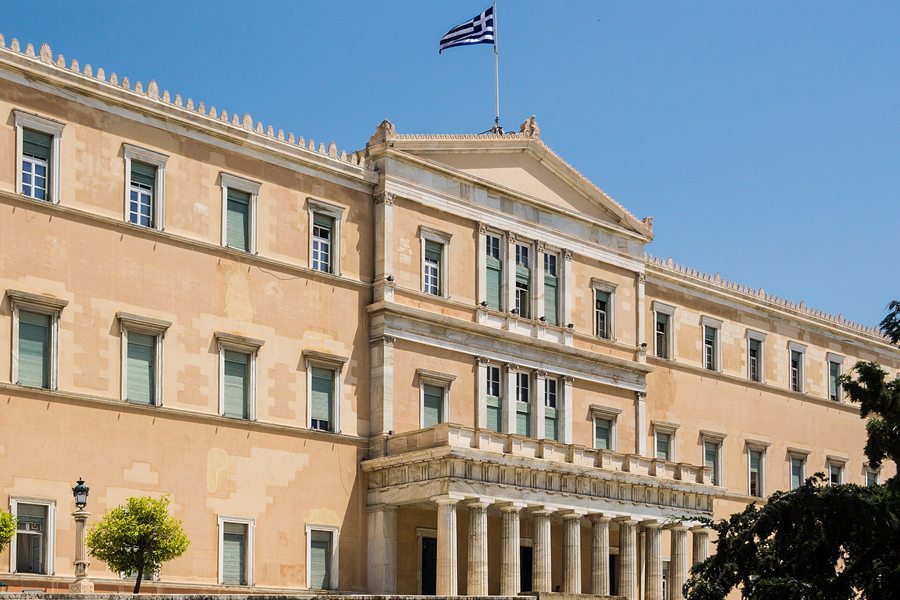
Greece luxury tours have a royal landmark in the Old Royal Palace of Athens. Built as the chief home of the Greek royal family, it has housed Parliament since 1929. A parliament is the elected assembly that passes a nation’s laws.
For Greece luxury tours, the palace links to 1843, when King Otto and Queen Amélie moved in. Friedrich von Gärtner, the palace’s Bavarian architect, planned the future National Garden beside it with the queen. Bavarian means from Bavaria, a region of southern Germany. An architect plans buildings and the spaces around them.
The palace marble came mainly from Penteli, with lesser amounts from Hymettus, Tinos and Paros. Carrara and Genoa, in Italy, sent a small share as well. Marble is a hard stone that takes a high polish. For Greece luxury tours, the palace also links to Evia, the island that supplied its wood.
King Ludwig of Bavaria rejected Gärtner’s rich facade designs to save money and keep classical simplicity. A facade is the outer face of a building. Doric porticoes frame the entrances, while the southern side has Ionic porticoes. A portico is a porch held up by columns. Doric and Ionic name two classical orders, or column styles, from ancient Greece.
- Central wing: The central wing’s upper storey stands 14.20 metres high and held the official reception rooms.
- Conversion: The architect Andreas Kriezis carried out the change of the palace into the Parliament building.
- Archives: The Parliament’s library and archives are kept in a separate building, the former Tobacco Factory.
For Greece luxury tours, 2003 marks the unveiling of statues of Charilaos Trikoupis and Eleftherios Venizelos here. Both men served as prime ministers, or heads of government, in Greece. A statue is a carved or cast figure of a person.
Which royal past lies behind the Presidential Mansion on Greece luxury tours?
Greece luxury tours in Athens share the city centre with a former royal palace, the Presidential Mansion. It is where the president of the Hellenic Republic officially lives. The Hellenic Republic is the formal name of the Greek state.
On Greece luxury tours, the name behind the house is Ernst Ziller, the architect chosen by the state. At first, the building was known as the Crown Prince’s Palace. A crown prince is the son of a king who is next in line for the throne. Building work began in 1891 and was complete by 1897.
King George I wanted a modest building, not too pretentious, that matched the other mansions on its street. Pretentious means showy, as if trying to seem grander. Ziller’s answer was a three-storey, symmetrical, neoclassical mansion. Symmetrical means the two halves match like mirror images. A storey is a single level of a house.
For Greece luxury tours, the mansion garden counts as a green haven of about 25,000 square metres. A haven is a calm, safe place. Plane trees, lindens, palms and cypresses soften its formal design. A linden is a broad-leaved tree, also called a lime tree. Cypresses are slim evergreen trees that grow tall.
- Credentials Lounge: In 1909, Ziller designed a ballroom wing for the palace, now named the Credentials Lounge.
- Reception Hall: In 1962, architect Alexander Baltatzis designed the Reception Hall, the largest room in the palace.
- Old use: In the mid-19th century, the grounds served as the vegetable garden of the Royal Palace.
Each year on 24 July, the president holds a reception to mark the restoration of democracy in 1974. Democracy is rule by the people through elected leaders. For Greece luxury tours, this yearly custom at the mansion dates from the mid-1970s.
How does the Maximos Mansion fit into Greece luxury tours?
Greece luxury tours unfold in a capital where one private house became the heart of government. Since 1982, the Maximos Mansion has served as the formal base of the Greek Prime Minister. The Prime Minister heads the elected government of the country.
For Greece luxury tours, the house dates to 1912, begun by Alexandros Michalinos, a rich shipowner from Chios. A shipowner owns merchant vessels for trade. Before the building rose, its plot served as a garden for the Royal Palace. A plot is a piece of land set aside for building.
In 1916, his widow, Irene Manoussis, sold the unfinished house to another shipowner, Leonidas Embirikos. She bought it back in 1921. A widow is a woman whose husband has died. Dimitrios Maximos, her banker husband, finished the house in the early 1920s and moved in. For Greece luxury tours, his surname is the one the mansion still bears.
From 1941 to 1944, the house was the home of the German Admiral of the Aegean Sea. An admiral holds top rank among naval officers. After the war, the house briefly served as the residence of the United States ambassador in Athens. An ambassador speaks for a country’s government abroad.
- Address: The mansion stands at Herodes Atticus Street 19, beside the Presidential Mansion and the National Garden.
- Guesthouse: From the mid-1950s until 1982, the house hosted foreign leaders, among them Marshal Tito and Margaret Thatcher.
- Earlier office: Before 1982, the prime minister’s office was inside the Parliament building.
In 1952, Dimitrios Maximos sold the house to the state of Greece. Greece luxury tours take place in a capital where that sale turned a private home into state property. Property means land or buildings that a person or body owns.
What makes Tatoi Palace a royal story within Greece luxury tours?
Greece luxury tours link to royal country life at Tatoi, former summer palace of Greece’s royal family. The estate lies 27 kilometres from central Athens. A summer palace is a royal home used in the hot months of the year.
For Greece luxury tours, Dekeleia is the official name of the area, in ancient times and today. An estate is a large country property with a main house and land. The architect Ernst Ziller is listed as the designer of the royal palace at Tatoi. An architect is the expert who plans a building.
In the 1920s, under the republic, the state confiscated the larger part of the estate. A republic is a state led by elected leaders rather than a king. Confiscated means taken over by the state. Around 1929-1930, the government let Dimitrios Gaziadis film The Apaches of Athens on the grounds.
The estate was left fully abandoned in 1973. For Greece luxury tours, the estate’s collection counts 17,000 remaining objects, including antiquities and old masters. Antiquities are objects from the ancient world. Old masters are paintings by leading European artists of earlier centuries. The Ministry of Culture now keeps these objects in storage.
- Cars: In 2015, ten cars kept on the royal estate were declared cultural monuments.
- Royal grave: Constantine II of Greece, who lived from 1940 to 2023, is buried in the Tatoi Royal Cemetery.
- Friends: A friends’ association, founded in 2012, aims to restore the estate and open it as a museum.
For Greece luxury tours, plans aim to turn the main house into a museum of the royal family. A museum keeps and displays objects of historical or artistic value. The royal family here means the kings and queens of Greece and their relatives.
How does the National Library of Greece connect with Greece luxury tours?
Greece luxury tours share Athens with the main public library of the country, the National Library of Greece. Ioannis Kapodistrias founded it in 1832. A public library is open to all readers and keeps books and records for study.
The idea for a national library came from Johann Jakob Meyer, a philhellene. He proposed it in an August 1824 newspaper article. A philhellene is a foreigner who loves and supports Greece. At first, the library shared a building on Aegina that was then an orphanage. An orphanage is a home for children who have lost their parents.
For Greece luxury tours, the foundation stone of the marble library went down on 16 March 1888. A foundation stone is the first block set when building work begins. Theophil von Hansen drew the design, and Ernst Ziller supervised the construction. To supervise means to watch over work and check that it goes right.
For Greece luxury tours, the library holds 5,500 Greek manuscripts, one of the greatest such collections. A manuscript is a text written by hand. Its holdings also include Flora Graeca Sibthorpiana by the English botanist John Sibthorp. Flora Graeca is Latin for the plants of Greece. A botanist is an expert on plant life.
- Move: In 1903, the library moved into the Vallianeion Megaron, megaron being Greek for a great hall.
- Art: Beyond books, the library also owns over 4,000 works of art.
- First stock: At the end of 1830, the collection held 1,018 printed volumes.
Over 1.1 million items sit in the library, with over 15,000 newspaper and magazine titles. A title here means one newspaper or magazine series. For Greece luxury tours, its stated mission is to collect and preserve the evidence of Greek culture.
Who was Theophil Hansen, and why does he matter to Greece luxury tours?
Greece luxury tours bring up Theophil Hansen, an architect from Denmark who later took Austrian citizenship. He lived from 13 July 1813 to 17 February 1891. Citizenship means full legal membership of a country, with its rights and duties.
Hansen was born in Copenhagen, in Denmark. He trained with the Prussian architect Karl Friedrich Schinkel and studied for a time in Vienna. Prussian means from Prussia, a former kingdom in the north of Germany. For Greece luxury tours, his Athens story begins in 1837, when he moved there.
In Athens, Hansen focused closely on Byzantine architecture. Byzantine describes the culture of the Eastern Roman Empire, whose capital was Constantinople. For Greece luxury tours, the Academy of Athens stands as his work, begun from 1856. An academy is a body of leading scholars and scientists. Scholars are people who study a subject in depth.
Georgios Sinas, a Greek-Austrian businessman, called Hansen to Vienna in 1846. Sinas was also the donor of the National Observatory of Athens, Hansen’s first building. A donor gives money or goods as a gift. An observatory is a building for watching the stars. In Vienna, Hansen designed the Holy Trinity Greek Orthodox Church, built from 1858 to 1861.
- Style: Hansen counts as an outstanding representative of Neoclassicism and Historicism, which revived past styles.
- Vienna: His best-known work, the Austrian Parliament building, takes the form of an ancient temple.
- Title: In 1884, Emperor Franz Joseph made Hansen a baron, a rank of nobility.
In Vienna, Hansen’s Musikverein is a concert hall famed for its design and acoustics. Acoustics means the way sound travels and carries in a room. For Greece luxury tours, his story closes in Vienna, where he died in 1891.
Which legacy does Ernst Ziller give Greece luxury tours?
Greece luxury tours take place amid the work of Ernst Ziller, an architect born in Germany. In time he became a Greek national. His designs number an estimated 700 buildings around Greece. A national, in this sense, is a legal citizen of a country.
Ziller came from Serkowitz, a country village near Radebeul in the old Kingdom of Saxony. Saxony is a region of eastern Germany. In 1858 he completed his studies at Dresden’s Academy of Fine Arts, then worked for Theophil Hansen. For Greece luxury tours, his Greek chapter opens in 1861, when Hansen sent him to Athens.
In 1872, he became a professor at the Royal School of Arts in Athens. That school is now the National Technical University of Athens. A professor is a senior university teacher. Ziller married a Greek woman, Sofia Doudou. Their daughter, Iosifina Dimas-Ziller, became an impressionist painter. Impressionism is a style of painting that captures light and passing moments.
In 1885, Ziller designed his own three-storey neoclassical home, where the family lived until 1912. The banker Dionysios Loverdos later acquired the residence. Today it is known as the Ziller-Loverdos Mansion. For Greece luxury tours in Athens, his list of buildings also includes the National Theatre of Greece. A theatre is a building for staged plays.
- Life: Ernst Ziller was born on 22 June 1837 and died on 4 November 1923.
- Islands: Ziller’s work reached the islands too, including the Metropolitan Theater of Zakynthos.
- Burial: Ziller died in Athens, and his grave lies in the First Cemetery of Athens.
Ziller ranked among the leading designers of royal and civic buildings in Athens, Patras and other Greek cities. Civic means belonging to a town or a city and its people. For Greece luxury tours, his buildings are chiefly neoclassical in style.
What does the Georgios Schwartz Mansion in Ampelakia add to Greece luxury tours?
Greece luxury tours open a Thessaly chapter with the Georgios Schwartz Mansion of Ampelakia. This Ottoman-era home rose near the end of the 18th century. Today it serves as a folklore museum, which shows village crafts and customs.
Ottoman-era means from the centuries of Ottoman Turkish rule. Georgios Mavros, who lived from 1738 to 1824, managed the Ampelakia cooperative. Mavros had this imposing home built in the village. A cooperative is a business owned and run by its own members. Its 6,000 members produced and sold red cotton threads.
For Greece luxury tours, the house rises in three storeys, each with its own role. The ground floor held the cooperative’s treasury, an arched hall for gold and precious documents. The second storey served as the family’s winter home. The third storey, used in summer, has sachnisi, a bay window typical of Ottoman mansions in the Balkans.
Ioannis Zerbinos made the woodwork of the mansion. Woodwork means the shaped and fitted wooden parts of a house. The frescos show views of Istanbul, geometric shapes and country scenes. In fresco work, paint is laid on fresh, wet plaster. For Greece luxury tours, the wall paintings bear the name of a painter recorded as L. Loli.
- Purchase: The Greek state became the owner in 1965, when the government bought the building.
- Repairs: Restoration work, meaning careful repair to the original state, took place in 1986.
- Art: Inside, the mansion is an exceptional piece of Ottoman art on Greek soil.
For Greece luxury tours, the mansion’s large library held works of Enlightenment philosophy. The Enlightenment was a European movement that put reason first. It also held a copy of the Map of Greece by the philosopher Rigas Feraios. Feraios was a regular visitor to Ampelakia.
Why does Siatista stand out for mansions and furs on Greece luxury tours?
Greece luxury tours in Western Macedonia point to Siatista, a mansion town of the Kozani regional unit. The town sits on the southern slope of Mount Velia, about 930 metres up. A regional unit is a district within a larger Greek region.
In the 17th and 18th centuries, trade with Central Europe made Siatista prosperous. Those ties let residents build mansions and churches with frescos and icons. An icon is a holy image painted on wood. Merchants who came home built big houses with thick walls, stained glass and lively folk paintings.
For Greece luxury tours, a number of those mansions still stand in good shape in the old city. The town’s first name was Kalyvia, recorded in the archives of the Zavordas Monastery. In 1745, Joseph, Archbishop of Ohrid, named the city in an official document. An archbishop ranks above ordinary bishops in a church.
Siatista’s economy rests chiefly on the fur trade and its long craft tradition. A furrier is a craftsperson who makes clothing and goods from animal fur. Mink, fox, sable and chinchilla, all high-quality furs, pass through the hands of local furriers. For Greece luxury tours, Siatista’s furriers serve both domestic and international luxury markets.
- School libraries: The Trampatzeion Gymnasium, a secondary school funded in 1888, held libraries of 5,000 and 2,000 books.
- 15 August: On the Assumption feast, men parade with their horses to a chapel and bring back an icon.
- 23 December: For Klatharies, residents build tall cone-shaped mounds of brush and set them alight at night.
For Greece luxury tours, Siatista sits 28 kilometres to the southwest of Kozani. In 2021, the Greek census counted 5,057 people living in the town. In a census, the state records the number of its residents. The composer Spyridon Samaras had a father who was a native of Siatista.
What spa history does Aidipsos give Greece luxury tours?
Greece luxury tours meet a long spa past in Aidipsos, a village and former municipality in Euboea. Greece has 752 hot springs, and 80 of them lie there. That makes the town a popular tourist destination. A spa is a place for bathing in mineral water.
Ancient Aedepsus stood on the northwestern coast of Euboea. It lay 160 stadia from Cynus, on the opposite coast. Stadia were a Greek measure of length in ancient times. Aedepsus held warm baths that were sacred to Heracles. The Roman dictator Sulla used them. In Rome, a dictator was a leader given full power in a crisis.
On Greece luxury tours, those warm baths are still found about 1.5 km above today’s town. The ruins of Aedepsus lie inside the borders of today’s municipal unit. Ruins are the walls, floors and objects left from old buildings. In Greece, a municipal unit forms one section of a larger municipality.
The municipality of Aidipsos was founded in 1997. It joined the old municipality of Loutra Aidipsou with the communities of Agios and Gialtra. For Greece luxury tours, Loutra means baths in Greek, so the old name means the Baths of Aidipsos. A community is a village or a small group of villages.
- Age: The spas of Aidipsos have a history of over 20,000 years.
- Area: The municipal unit of Aidipsos covers an area of 115.461 square kilometres.
- Council: Since the 2011 reform, Aidipsos forms one municipal unit of Istiaia-Aidipsos.
Greece luxury tours are trips through Greece, and Aidipsos has a long list of famous visitors. Lucius Cornelius Sulla, Sir Winston Churchill and Eleutherios Venizelos all visited the town. Maria Callas, Kostis Palamas and Marika Kotopouli came as well.
Why does silk tie Soufli to Greece luxury tours?
Greece luxury tours have a silk story in Soufli, a town in the Evros regional unit of Greece. Its silk industry flourished in the 19th century. Silk is a soft, shining thread spun by silkworms, the young of a moth.
Soufli rises on the east side of Prophet Elias, a hill with two tops. The hill is among the easternmost spurs of the Rhodope range. A spur is a ridge that runs out from a larger range of mountains. The town centre lies just 500 m from the Evros River.
Louis Pasteur found a method to fight the diseases of silkworm cocoons. A cocoon is a shell of silk thread around a resting silkworm. His discovery helped sericulture, the breeding of silkworms, grow fast. Greece luxury tours take place in a land where this work once kept farmers, merchants and craftsmen busy. It gave them a significant income.
Synthetic silk is a fibre made in factories instead of by silkworms. Its invention, together with a fall in cocoon prices, led sericulture into decline. A fibre is a fine strand that can be spun into thread. Greece luxury tours are trips through Greece, a country that once counted Soufli among its silk towns.
- Carts: Cartwrights, or cart makers, from Soufli supplied all of Thrace with very stable ox-carts.
- Wine: Viniculture, the growing of grapes for wine, was the second industry of Soufli after silk.
- Museum: The older Silk Museum of Soufli opened in 1990 inside a mansion built in 1883.
Soufli carries the nickname Town of Silk. The town is also famous for its wine and its cooked meats. A nickname is an informal name given to a person or place. On Greece luxury tours, the name Town of Silk points to Soufli.
Where do the Pozar Baths near Aridaia fit into Greece luxury tours?
Greece luxury tours gain a thermal name in the Pozar Baths, 10 km from Aridaia. Aridaia is a town in the Pella regional unit. The baths hold thermal waters in a setting of natural beauty. Thermal water is water warmed naturally deep underground.
Aridaia sits at the far northwest of the Pella regional unit. It shares a border with the south of North Macedonia. Its land also meets the northeast corner of Florina regional unit. Greece splits each of its regions into regional units like this one. For Greece luxury tours, this corner marks the northern edge of the country.
The name Aridaia has two possible origins. One says it grew out of Ardea, the old name of the town. Ardea comes from a Greek verb meaning to irrigate, or water farmland. Rivers, streams and canals in the area support that view. The other theory links it to Philip III Arrhidaeus, a half-brother to Alexander the Great.
The town went by the name Ardea until 24 April 1951. Earlier still, until 9 June 1922, its name was Soumboskon. On Greece luxury tours, Aridaia is also known as the old capital of the Almopia eparchy. An eparchy was an old Greek province. A province is a large area run as one unit of government.
- Castle: The Byzantine Castle of Chrysi, 7 km from Aridaia, goes back to the 8th century AD.
- Monastery: North of Aridaia stands the Holy Monastery of Saint Hilarion, a bishop of Moglena.
- People: At the 2021 census, Aridaia proper had 7,118 people and its municipal unit 18,864.
Since the 2011 reform, Aridaia forms a municipal unit of the Almopia municipality. A municipality is a self-governing area run by a mayor and council. Greece luxury tours run through Greece, where Almopia names this corner of Pella.
Why is Stemnitsa linked with gold and silver on Greece luxury tours?
Greece luxury tours have a long jewellery tradition to draw on in Stemnitsa. This mountain village lies in Arcadia, in the Peloponnese. Its gold- and silversmiths, along with other craftsmen, made the village well known. A smith is a worker who shapes metal by hand.
Stemnitsa sits on the western fringe of the Mainalo mountains. Its houses rise to about 1050 m above sea level. For Greece luxury tours, above sea level means height counted upward from the sea. A silversmith works silver into objects such as rings, trays and belt buckles.
Scholars have identified the village with Hypsous, an ancient city of Arcadia. To identify a site is to match it with a place named in old texts. Hypsous was already in ruins in the 2nd century AD. Pausanias, an ancient Greek writer, saw it in that state on his visit there.
Bafero church was built in 1185, while the Zoodochos church followed in 1433. A Venetian census once listed Stemnitsa as the largest village in Gortynia, with 925 people. In a census, officials record every resident of an area. For Greece luxury tours, Venetian means linked to the old Republic of Venice in Italy.
- Workshop: The folklore museum of Stemnitsa includes a jeweller’s workshop and a display on candle making.
- Collection: The museum also houses old costumes, Byzantine icons, guns, jewellery and copper-ware.
- Library: Until the Greek War of Independence, the library of Stemnitsa held around 5,000 volumes.
The name Stemnitsa has Slavic roots and means woodland. Woodland is land covered with trees. Slavic refers to the Slavs, a large group of peoples of eastern Europe. On Greece luxury tours, Stemnitsa therefore carries a name tied to forest.
What makes Ypati a spa name for Greece luxury tours?
Greece luxury tours link to an ancient spa story at Ypati, a village in Phthiotis, central Greece. Famous springs from ancient times rise around 3 km to its northwest. A spring is water that comes up naturally from under the ground.
Herodotus wrote about the nearby hot springs, now called Loutra Ypatis. People visited them in Antiquity, the era of the old Greek and Roman worlds. Herodotus was a historian of ancient Greece. In Antiquity the town was called Hypate or Hypata. Scholars trace the name to hypo Oita, meaning near Mount Oeta.
The town was founded in the late 5th or early 4th century BC. It served as the capital of the Aenianes, an ancient Greek tribe. A tribe is a group of people joined by shared ancestry and customs. On Greece luxury tours, Hypata is recorded as the leading Thessalian city of the 2nd century AD.
Under the emperor Augustus, the city won the right to call itself Hypata Augusta. The city kept that title through the Roman Imperial period. For Greece luxury tours, an emperor was the supreme ruler of the Roman state. Augusta is the female form of Augustus, used here as an honour.
- Museum: The Byzantine Museum of Phthiotis fills an old barracks building put up in 1836.
- Monastery: The 15th-century Agathonos Monastery stands about 3 km west of the town.
- Village size: In 2021 the settlement of Ypati itself had 440 residents.
The city reappears in records in the 9th century under the name Neai Patrai. In Greek, that name means New Patras. A record here is a written source, such as a church list or chronicle. On Greece luxury tours, the town goes by Ypati.
How do Zante currants connect with Greece luxury tours?
Greece luxury tours share their home country with the Zante currant, a famous Greek raisin. These currants come from the Black Corinth cultivar, a small, sweet and seedless grape. Raisins are dried grapes, and a cultivar is a variety kept by growers.
Its name goes back to raisins de Corinthe, an Anglo-French phrase for grapes of Corinth. Anglo-French was the form of French used in medieval England. Zante is another name for Zakynthos, one of the Ionian islands. Black, red and white currants are a separate fruit altogether. They grow on Ribes shrubs, a different plant group.
Pliny the Elder wrote down the first account of this grape in 75 AD. He described a tiny, juicy grape with thin skin and small bunches. Pliny was a Roman writer. By the 14th century, the raisins sold on the English market as Reysyns de Corauntz. For Greece luxury tours, a label means the trade name written on goods.
Currants have been a key part of British cooking for centuries. Britain brought them in from Mediterranean lands as sweet luxury goods. Cane sugar was still scarce at that time. Cane sugar comes from the juice of sugar cane. On Greece luxury tours, a luxury good is an item bought for pleasure rather than need.
- Greek village: Around 1901, David Fairchild imported fine cuttings from Panariti, a renowned Greek producer village.
- Berries: Black Corinth berries are very small and round, with a reddish black colour.
- Output: Greece still grows about 80% of the world’s Zante currants, more than any other country.
Black Corinth is called an almost male variety. Its flowers have well-developed male parts, called anthers. Their female parts, the ovaries, stay tiny and underdeveloped. For Greece luxury tours, a variety is one named type within a plant species.
Which thermal past does Lagkadas add to Greece luxury tours?
Greece luxury tours have a well-known thermal spa name in Lagkadas. The town is also a municipality in the northeast part of the Thessaloniki regional unit. Thermal here means fed by naturally hot water from deep in the ground.
On Greece luxury tours, Lagkadas lies about 20 km from the centre of Thessaloniki. It stands at about 130 m, in the middle of the Mygdonia valley. A valley is low land lying between hills. Alexander the Great passed through this valley on his campaigns. The Apostle Paul crossed it on his way to Thessaloniki and Athens.
For Greece luxury tours, the municipality of Lagkadas counts 37,022 residents. Of these, 8,447 live in the community of Lagkadas itself, by the 2021 count. A community is a local unit made up of a town or village. A large share of the people descend from Greek refugees from Kosti, a village in Bulgaria.
The people of Lagkadas took part in the revolution of 1821. Their best-known fighter was Stavros Tzanis, who fought in battles in southern Greece. The revolution of 1821 was the Greek War of Independence. In Greece luxury tours, a revolution is an uprising that aims to change who rules a country.
- Merger: The municipality of Lagkadas formed in 2011 when 7 former municipalities joined.
- Area: The municipality covers 1,222.65 square kilometres, and the community itself 31.761 square kilometres.
- Climate: Lagkadas has a continental climate, with wide gaps between winter and summer heat.
Lagkadas is also the birthplace of Zübeyde Hanım, mother of Mustafa Kemal Atatürk. She lived from 1857 to 1923. A birthplace is the town where a person was born. The singer Antonis Remos was also born in Lagkadas.
What do the hot springs of Sidirokastro add to Greece luxury tours?
Greece luxury tours have a hot-spring town in Sidirokastro, in the Serres regional unit of Greece. Its hot springs reach a temperature of 45 °C. A hot spring is ground water heated naturally before it reaches the surface.
The town grew up close to the rich farmland of the Strymonas valley. It sits on the bank of the Krousovitis River. A bank is the raised ground along the side of a river. On Greece luxury tours, Sidirokastro lies 25 km northwest of the town of Serres. The Vrontous and Angistro mountains rise to its north.
The Issari Fort was built by Emperor Basil II. It stands 155 metres tall above the town’s northwest quarter. A fort is a walled stronghold built for defence. The town takes its name from this fort. Sidirokastro means iron castle in the Greek language. Demir Hisar, its Turkish name, means the same.
Each year, thousands of people come to these hot springs near the town. They come for recreation or for therapy. Recreation means rest and enjoyment in free time. Therapy is treatment that aims to improve health. On Greece luxury tours, a hot spring of this kind is also called a thermal spring.
- Bridges: The Krousovitis splits the town in two, and the Stavrou and Kalkani bridges join the halves.
- Old past: Palaeolithic, or Old Stone Age, ruins lie here, and Homer and Herodotus both refer to the area.
- First people: The earliest people of the area were Sintians, a tribe that gave Sintiki its name.
The Agios Dimitrios church in Sidirokastro is carved into rock. Agios means saint in Greek. A rock-cut church is hollowed out of solid stone rather than built. On Greece luxury tours, Dimitrios is how Greeks write the name Demetrius.
What do travellers ask about Greece luxury tours, and what are the answers?
Greece luxury tours lead to four questions on fine Greek goods. They cover the flokati rug, Menalou vanilia fir honey, kefalotyri cheese and the smithery school at Stemnitsa. Fine goods are items made with skill and care. A smithery is a workshop where metal is shaped.
Before Greece luxury tours, what makes a flokati rug Greek?
A flokati is a thick, soft and shaggy rug of woven wool. Its name comes from floc, an Aromanian word that goes back to Latin floccus. Greek ministries defined the term for a rug hand woven in Greece from 100% wool. It must hold at least 1800 grams of wool per square metre.
On Greece luxury tours, what is Menalou vanilia fir honey?
Menalou vanilia fir honey is a Greek honey with protected designation of origin status. This status ties the name to one area. At least 80% of it comes from the black pine. Flower honey from the same region makes up the rest. It is produced in 24 municipalities and communities of Arcadia.
For Greece luxury tours, how is kefalotyri cheese named and made?
Kefalotyri, a white cheese of Greece and Cyprus, is hard and salty. Makers use sheep milk, goat milk or both. Hard cheese is cheese pressed dry until it is firm. Its colour shifts between yellow and white with the milk mixture. The name joins kephali, meaning head, and turi, meaning cheese.
Within Greece luxury tours, what does the Stemnitsa smithery school teach?
The Stemnitsa Silver-Gold Smithery School is a publicly funded school. Students there learn to make jewellery from silver and gold. Publicly funded means paid for by the state. The school stands in Stemnitsa, a village of Arcadia in southern Greece. It opened in the 1970s, and Lambis Katsoulis served as its first director.