
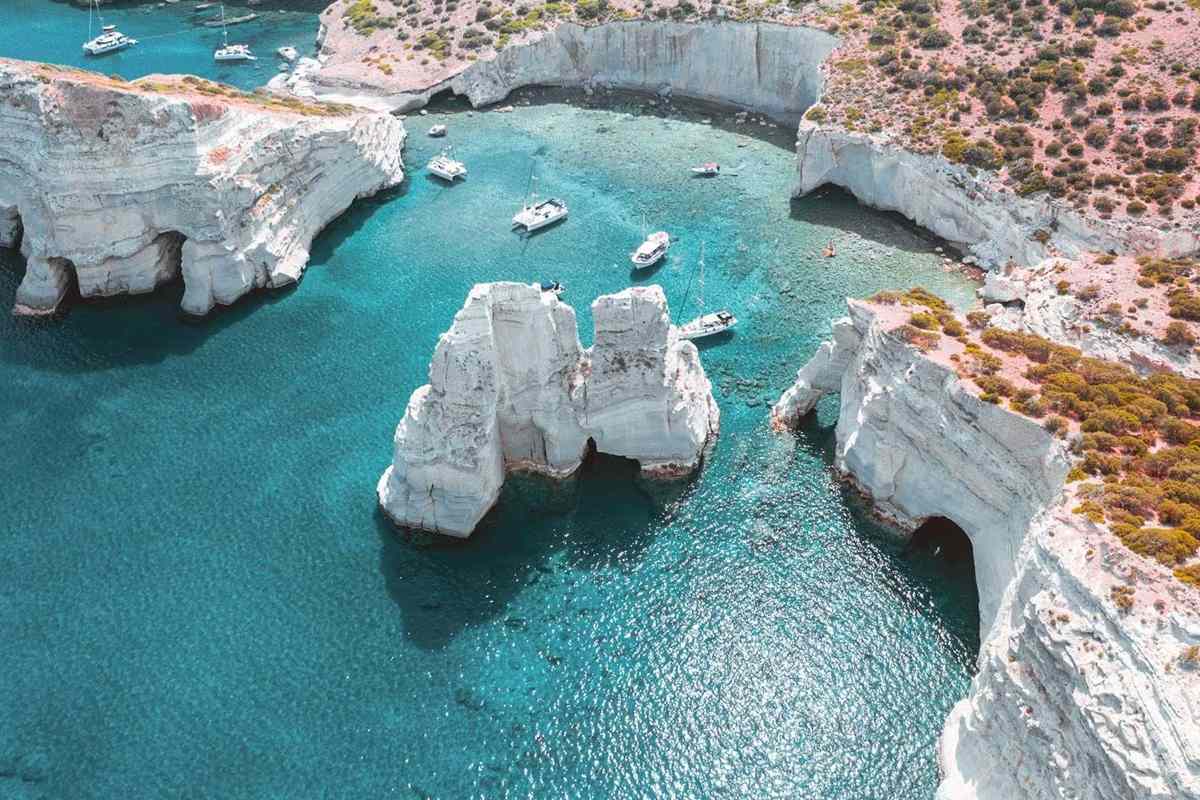
Greece sailing tours are trips under sail through the seas, gulfs and channels of Greece. The Ionian Sea opens the page, followed by the Corinth, Ambracian, Thermaic and Patras gulfs. Next come the Anemoi, the Greek wind gods, and the myth behind the halcyon days. The trireme, the caïque and the admiral Konstantinos Kanaris close the main part, before four short answers. Trips by sea also appear under Greece island hopping tours, Milos tours and Corfu tours. The full range of outings sits on the page for Greece tours.
Bookings made through the GetYourGuide widgets on this page earn Classical Greece Tours a commission, at no extra cost to the traveller.
What are Greece sailing tours?
Greece sailing tours are trips through Greek waters aboard craft that the wind moves. Sailing uses wind acting on sails, wing sails or kites. That force moves the craft over a chosen course across the surface of the water.
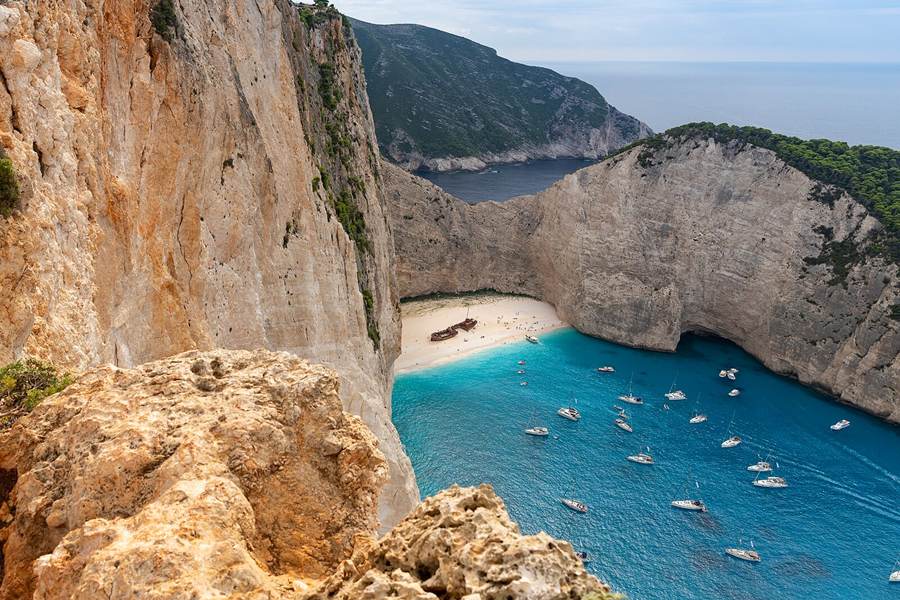
Scholars believe two or more regions of the world invented sailing separately. Separately means each region found the idea without help from the others. One of those regions was the Mediterranean, with the Nile and other Middle Eastern rivers. Egypt holds the oldest known picture of a sail, from around 3100 BCE.
Before the 19th century improved land transport, water travel was faster, cheaper and safer than land travel. Early Phoenician, Greek and Roman galleys fought by ramming each other. Galleys were long ships moved mostly by rowers with oars. To ram is to drive the front of one ship into another. Such fights called for galleys with speed.
In the 21st century, sailing serves mainly as recreation or sport. Greece sailing tours belong to the recreational side. Recreation means activity done for pleasure. Like all recreational sailing, Greece sailing tours divide into day-sailing and cruising. On a day-sail, everyone leaves the boat for the night. In cruising, the people on board stay aboard overnight.
- Cruising grounds: Coastal cruising grounds include parts of the Mediterranean Sea and the Black Sea.
- Tacking: Tacking is a turn in which the wind crosses over the bow, the front of the craft.
- Early sailors: Traces of early sailors also come from Turkey, Syria and Minoa, among other places.
Greece sailing tours rely on the wind to move. On any course, sails are set at the angle that gets the best power from the wind. That angle depends on the apparent wind. The apparent wind is the wind as felt from a moving vessel.
Which old names does the Ionian Sea lend to Greece sailing tours?
Greece sailing tours take place in a country whose west coast, including the Peloponnese, borders the Ionian Sea. The main islands of that sea all sit on its eastern side. Each one of those islands belongs to the Greek state.
For Greece sailing tours, the name Ionian goes back to the Greek word Ionion. Nobody knows where that older word came from. Ancient Greek writers, Aeschylus above all, linked the sea with Io, a figure of myth. In ancient Greek, the sea earned the adjective Ionios because Io swam across it.
Another legend gives the name to Ionius, a son of Adrias. Adrias, in turn, gave his name to the Adriatic Sea. Legends are old stories passed on from parent to child. For Greece sailing tours, the Ionian Sea meets that Adriatic Sea to the north. Southern Italy, Calabria and Sicily included, bounds the sea on the west.
The southern edge of the sea follows a line from Cape Matapan to Cape Passero. Cape Passero is the southern point of Sicily. Each cape here is a tip of land pushing out into open water. Ancient Greek colonisers sailed across this sea no later than the 8th century BC. They were founding colonies in Italy.
- Eastern limit: The eastern edge runs from the Butrinto River mouth in Albania down to Cape Matapan.
- Odysseus: The sea is famous for the voyages of Odysseus, the hero who ruled Ithaca.
- Dyrrhachus: A third story makes Ionius a son of Dyrrhachus instead of Adrias.
Greece sailing tours belong to the wider Mediterranean. The Ionian Sea is a long, drawn-out bay of that larger sea. A bay is a stretch of water that the shore wraps around in part. Since 1861, the western section has been under Italian control.
How did the Gulf of Corinth form, for Greece sailing tours?
Greece sailing tours roam a country where the Gulf of Corinth parts the Peloponnese from the mainland. The gulf is an inlet, or arm, of the Ionian Sea. In Greek, its name is Korinthiakós Kólpos, meaning the Corinthian Gulf.
In the Middle Ages, people called the gulf the Gulf of Lepanto. Lepanto is the Italian form of the old name Naupactus. The Middle Ages form the long era that came after ancient times. For Greece sailing tours, shipping routes from Piraeus to western Mediterranean ports pass along this gulf.
The gulf was created as a tectonic rift grew wider. Tectonic describes the slow movement of the crust of the Earth. A rift is a crack where that crust pulls apart. The push came from the Anatolian Plate, a slab of crust moving west. For Greece sailing tours, the gulf still widens by 10 millimetres each year.
Faults around the gulf can cause earthquakes of up to about magnitude 6.5. Faults are cracks in the crust along which rock can slip. On 15 June 1995, a 6.2 magnitude earthquake hit close to the city of Aigion. Magnitude is a number for the size of an earthquake.
- Northern margin: Much of the north side of the gulf slopes gently, at 10 to 20 degrees.
- Southern margin: The south side mostly drops steeply, at angles of 30 to 40 degrees.
- Trizonia: Trizonia is the one island in this gulf with people living on it.
For Greece sailing tours, the ground beneath the gulf moves much like parts of Iceland and Turkey. Fin whales and dolphins are known to enter the gulf from time to time. Both are cetaceans, the group of sea mammals that includes whales.
What makes the Ambracian Gulf stand out for Greece sailing tours?
Greece sailing tours run through a land whose northwest holds the Ambracian Gulf. It is one of the biggest enclosed gulfs in Greece. It also carries the names Gulf of Actium and Gulf of Arta. An enclosed gulf is a bay almost ringed by land.
For Greece sailing tours, the gulf measures about 40 kilometres long and 15 kilometres wide. Greece lists it as a national park because of its ecological importance. Ecological means tied to living things and their homes. A national park is land or water that a state protects by law.
The way in is a channel 700 metres wide. It runs between Aktio, once Actium, on the south and Preveza on the north. Two rivers, the Louros and the Arachthos, drain into the gulf. As a result, its water is warmer than the Ionian and carries less salt. A current also flows out into the sea.
The gulf is famous for a large local shrimp. In Greek, this shrimp is called gabari. Melibe viridis, a kind of sea slug, also lives there. For Greece sailing tours, its lagoons are a magnet for birds such as pelicans and flamingoes. Each lagoon is a calm, shallow body of salt water behind a strip of land.
- Sea life: Sea turtles and dolphins make regular appearances in the waters of the gulf.
- Border: From 1832 until 1913, the gulf marked part of the line between Greece and the Ottoman Empire.
- Northern shore: Marshes break up the northern shore and form an estuary, where river water meets the sea.
For Greece sailing tours, the gulf also holds a place in Roman history. The Battle of Actium took place in these waters. In that battle, the forces of Augustus defeated Mark Antony and Cleopatra. In 1538, the Battle of Preveza was fought on the same gulf.
Where does the Thermaic Gulf fit into Greece sailing tours?
Greece sailing tours unfold in a country where Thessaloniki sits at the northeastern tip of the Thermaic Gulf. The gulf also goes by the names Gulf of Thessaloniki and Macedonian Gulf. Gulfs are large bays that cut deep into a coast.
Pieria, Imathia and Larissa form the western side of the gulf. On the east lies the Chalkidiki peninsula. Cape Kassandra marks its southeastern corner. A peninsula juts from the mainland with sea on nearly every side. Narrower definitions draw the western edge at the mouth of the Axios. By that measure, the gulf is only about 15 kilometres long.
For Greece sailing tours, the gulf also carries old Latin names. The Romans called it Thermaicus sinus, which means the Gulf of Therma. In Latin, sinus can mean a bay or a gulf. Another Roman name was Macedonicus sinus, the Gulf of Macedon. Latin was the language of the ancient Romans.
For Greece sailing tours, five rivers empty into the gulf: the Gallikos, Axios, Pineios, Loudias and Aliakmon. River mud has caused extensive silting in the north and west. Silting happens when mud and sand settle out of moving water. On the northwest coast there are no beaches. Wetlands stretch there instead, from Methone to the suburb of Kalochori.
- Ports: Besides the main port of Thessaloniki, twelve small ports serve sea transport on the gulf.
- Shore places: Sani, ancient Potidaea, Methoni and Pydna all lie on the shores of the gulf.
- Gulf of Salonica: The smaller Gulf of Salonica ends at a line from the Gallikos mouth to Mikro Emvolo.
For Greece sailing tours, the gulf also sits within a road network. The A1 motorway between Athens and Thessaloniki circles its western portion. The A24 motorway almost circles the eastern part. A motorway is a major road built for fast traffic.
What naval history do Greece sailing tours find in the Gulf of Patras?
Greece sailing tours cross a country whose western waters include the Gulf of Patras. The gulf is a branch of the Ionian Sea. In Greek it is called Patraikós Kólpos. On the east, the Strait of Rion closes it off between capes Rio and Antirrio.
For Greece sailing tours, a line from Oxeia island to Cape Araxos marks the western edge. Aetolia-Acarnania lines its northern shore. Achaea, in the Peloponnese, lines its southern shore. The gulf measures 40 to 50 kilometres in length. Its width runs from 10 to 20 kilometres. Straits are narrow necks of water that link two larger seas.
For Greece sailing tours, the gulf covers an area of 350 to 400 square kilometres. The port city of Patras stands on the southeast shore of this gulf. It is the only major port on the gulf. The old ports of Rio and Antirrio sit at the eastern end.
Major naval battles took place in the Gulf of Patras. The Battle of Lepanto was fought there in 1571. It was among the biggest sea battles ever fought. The town of Lepanto stands farther east, on the Gulf of Corinth. The Battle of Patras followed in 1772. Naval means to do with warships and the navy.
- Sea life: Fish and molluscs, among them sea snails and clams, are plentiful in the gulf.
- Evinos: The Evinos river flows into the gulf from its northern side.
- Missolonghi: On the northern shore, the town of Missolonghi also has a port of its own.
For Greece sailing tours, the southern shore of the gulf has its own rivers. Among them are the Peiros, the Glafkos and the Charadros. The Meilichos and the Panagitsa flow in on the same side. Each of these rivers ends in the gulf itself.
Who were the Anemoi, the wind gods behind Greece sailing tours?
Greece sailing tours depend on wind, and each wind had its own god in ancient Greece. Those gods were the Anemoi, and each one held a cardinal direction. A cardinal direction is one of the main compass points, such as north or west.
For Greece sailing tours, the myth names Eos and Astraeus as parents of the Anemoi. Eos ruled the dawn as its goddess, while Astraeus was the god of dusk. Clay tablets in Linear B record Mycenaean words that mean priestess of the winds. Linear B is a script that the Mycenaean Greeks used for writing.
The Anemoi were minor gods, and they answered to Aeolus. Aeolus was a storm god who kept them in his stables. In those images, the winds took the form of horses. Reports say the Spartans offered a horse to the winds as a sacrifice, on Mount Taygetus. A sacrifice is a gift given up to honour a god.
Boreas was the north wind and the bringer of cold winter air. Zephyrus, the west wind, was the gentlest of them all. Greeks called him the messenger of spring. Zephyrus was thought to live in a cave in Thrace. For Greece sailing tours, the light breezes of spring and early summer belonged to Zephyrus.
- Notus: The south wind Notus brought storms at the end of summer and the start of autumn.
- Eurus: Eurus was a stormy wind, said to toss ships about on the sea.
- Lips: Lips, god of the southwest wind, holds the stern, or rear, of a ship in art.
For Greece sailing tours, the Roman versions of these gods were the Venti. Venti is the Latin word for winds. The Roman gods had other names but closely matched the Greek ones. Ptolemy’s world map listed 12 winds in all.
How does the myth of Alcyone and Ceyx give Greece sailing tours the phrase halcyon days?
Greece sailing tours borrow a phrase from old Greek myth: halcyon days. The story comes from Alcyone and Ceyx, a wife and husband who angered the god Zeus. The word halcyon grew out of a misspelling of her name.
For Greece sailing tours, the story starts with Alcyone, a princess from Thessaly. Her father was King Aeolus of Aeolia. She became queen of Trachis after she married King Ceyx. Ceyx was the son of Eosphorus, a name translated in English as Lucifer. In one account, the pair called each other Zeus and Hera.
That angered Zeus. Ceyx had gone to sea to consult an oracle, according to Ovid. An oracle was a holy source of advice from a god. While Ceyx was at sea, Zeus struck him dead with a thunderbolt. Morpheus, the god of dreams, then took the shape of Ceyx. He told Alcyone what had happened to her husband.
Out of pity, the gods turned the pair into halcyon birds, or common kingfishers. For Greece sailing tours, Ovid and Hyginus tie this change to the phrase halcyon days. These were fourteen days each year, seven on each side of the shortest day. Aeolus, god of the winds, held the winds back to keep the waves calm.
- Meaning today: The phrase halcyon days has since come to mean any peaceful time.
- First use: The Greek form of the phrase first appears in The Birds, a play by Aristophanes.
- Real birds: Kingfishers do not live by the sea, so the tale does not rest on real sightings.
The name Alcyone comes from alkyón, the ancient Greek word for a sea-bird with a mournful song. It can also mean the kingfisher in particular. Mournful means sad. For Greece sailing tours, the phrase keeps its old sense of a bright spell amid hard times.
What was the trireme in the sea history behind Greece sailing tours?
Greece sailing tours move by sail, but the ancient trireme relied mainly on its rowers. Its Latin name means with three banks of oars. A trireme was a galley, a ship used above all by Phoenicians, ancient Greeks and Romans.
From the 7th century BC until the 4th, the trireme was the leading warship in the Mediterranean. Thucydides wrote that the Corinthians brought it to Greece late in the 8th century BC. Ameinocles, a man of Corinth, built four such ships for the Samians. A warship is a ship built to fight at sea.
The main power of the ship came from 170 oars set in three rows. Each oar had one man to pull it. Like Greece sailing tours, the trireme also used sail, with two masts and square sails. At the stern, meaning the rear of the ship, two steering oars kept it on course.
For Greece sailing tours, the full crew of a trireme numbered about 200. Of these, 170 were rowers. Thalamian, zygian and thranite are the English names for oarsmen of the lowest, middle and top files. A file is a line of rowers at one level. Rich and poor rowed side by side in Athenian triremes.
- Trierarch: The trierarch, the commander, sat at the rear and sent orders through the rowmaster.
- Speed: Classical sources say the ship held steady speeds of around 6 knots at easy rowing.
- Horse transports: Triremes fitted to carry horses had only 60 oarsmen, leaving the rest of the ship for horses.
For Greece sailing tours, triremes played a vital part in the Persian Wars. They also helped build the Athenian sea empire and shared in its fall in the Peloponnesian War. An empire joins different lands and peoples under one rule.
How is a caïque built, in the world of Greece sailing tours?
Greece sailing tours come from a land with a traditional wooden boat, the caïque, or kaiki in Greek. The word came into Greek from the Ottoman Turkish kayık. A caïque carries its widest part far towards the back, with a long, sharp bow.
For Greece sailing tours, boatbuilders make caïques from pine wood, in yards on the foreshore. The foreshore is the shore between high and low tide. Sawn ribs and a timber keel form the hull. A keel is the backbone along the bottom of a boat. Builders coat the frame in orange primer, which protects and seals the timber.
For Greece sailing tours, the steering gear of the caïque is a wooden tiller at the stern. A tiller is a bar that turns the rudder. Carvers sometimes shape these tillers like the head of a dog or other animal. In Greek, the bow is the proura or plowri, close to the English prow.
Caïques are mainly painted white to counter the strong sun. Their strakes and upper sides wear vivid colours. A strake is one line of planking along the hull. Each boat carries its name on a painted or carved tablet below the bow. Builders work from craft and memory, not from plans.
- Bow post: The bow post marks out the caïque from other working boats of the Mediterranean.
- Dying craft: The boatbuilder’s art is fading as plastic and fibreglass boats take over from wood.
- Name: The word caïque has no link at all with the word kayak.
Fishing and trawling were the traditional work of the caïque. Trawling means dragging a net through the water behind a boat. Lately, the caïque has also become a short excursion vessel on busy islands. An excursion is a short trip for pleasure, like Greece sailing tours.
Why does Konstantinos Kanaris belong to the story of Greece sailing tours?
Greece sailing tours belong to a sea history that includes Konstantinos Kanaris. He was an admiral and statesman, and a national hero of the War of Independence. Greeks see him as the sea leader of the revolutionaries in that war.
For Greece sailing tours, Kanaris grew up on Psara, an island close to Chios. Navy records give 1795 for his birth, while modern historians favour 1790 or 1793. He lost his parents young and became a seaman, like the majority of his family. As a boy, he worked on his uncle’s brig, a ship with two masts.
In early 1821, as the revolution began, Kanaris was in Odessa. He hurried back to Psara and was there when it joined the uprising on 10 April 1821. For Greece sailing tours, Kanaris soon made his name as a fire ship captain. A fire ship was a vessel set on fire and sent into enemy ships.
On the moonless night of 6–7 June 1822, his forces destroyed the Ottoman flagship off Chios. A flagship is the lead ship of a fleet, with its commander on board. Kanaris became the second prime minister of the Kingdom of Greece in 1844. In 1854, he took the post of minister of the navy.
- Constitutions: As head of government, he ratified the first two Greek constitutions, of 1844 and 1864.
- Death: Kanaris died on 2 September 1877, while he still served as prime minister.
- New Zealand: Kanáris Sound, part of Chalky Inlet in Fiordland, New Zealand, carries his name.
For Greece sailing tours, Kanaris also lives on in Greek money and art. He appeared on a Greek coin and on a Greek banknote. A statue of him by Lazaros Fytalis stands in Athens. David d’Angers made a bust of him as well.
What do travellers ask about Greece sailing tours, and what are the answers?
Greece sailing tours lead to four questions, each about a wind, a sea or a ship. One concerns the sirocco, a warm wind. Two concern the Myrtoan Sea and the Thracian Sea. The last concerns the penteconter, an ancient oared warship.
Before Greece sailing tours, what is the sirocco?
The sirocco is a Mediterranean wind that blows out of the Sahara desert. A desert is a dry land with very little rain. In Greek, people call it sorókos or sirókos. The wind reaches its peak in March and again in November. Those are the third and eleventh months of the year.
Where does the Myrtoan Sea get its name, for fans of Greece sailing tours?
One story names the sea after Myrtilus, a hero of myth. An enraged Pelops threw him into these waters. A second view takes the name from Myrtus, a small island. A third links it to Myrto, a young unmarried woman of legend. Mythical means belonging to myth rather than history.
What is the Thracian Sea, in the context of Greece sailing tours?
The Thracian Sea links to the Black Sea through three waters. They are the Bosphorus, the Marmara Sea and the Dardanelles. The 40th parallel runs south of the entire sea. A parallel is an east-west line drawn on maps of the globe. Its northern part is home to the endangered Black Sea harbour porpoise.
For travellers on Greece sailing tours, what was a penteconter?
The penteconter was an ancient Greek galley, in use from the archaic period onwards. Archaic means very old, from an early age of history. The ship carried one bank of twenty-five oars on each side, fifty in all. A mast in the middle of the ship also held a sail for a favourable wind.