
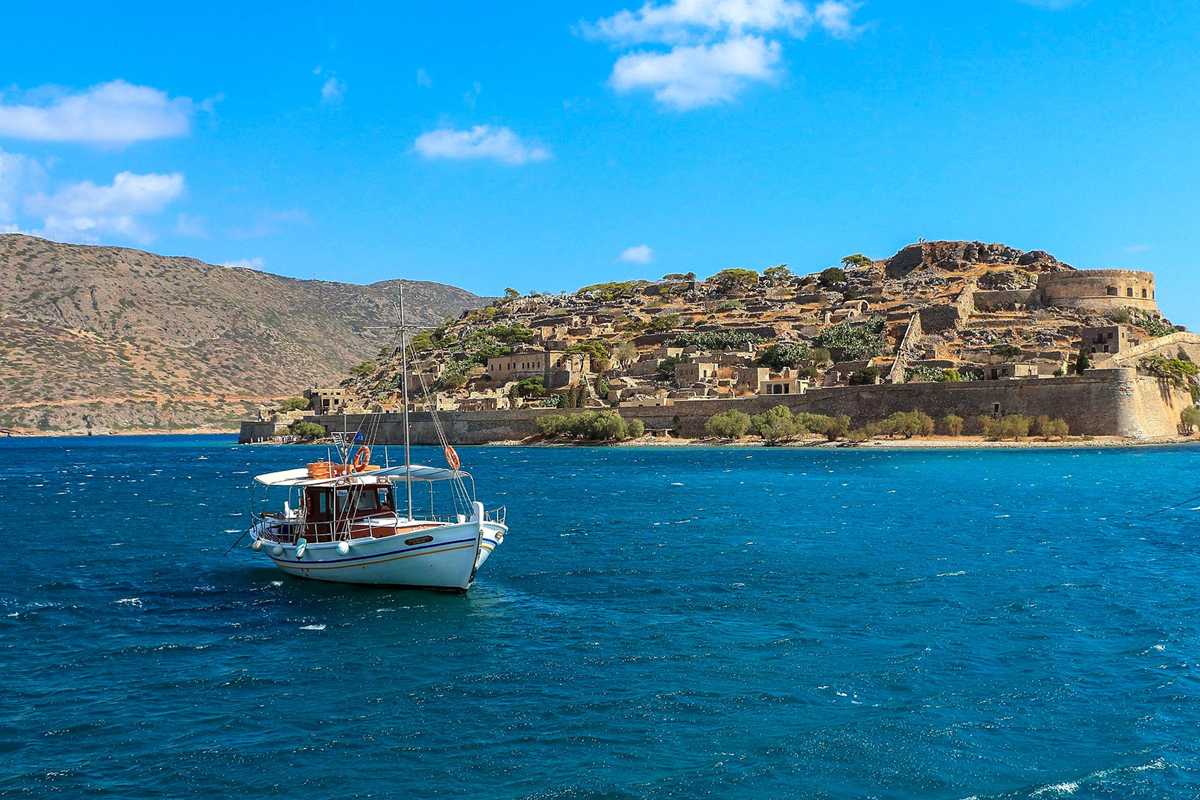
Greece weather in October forms the backdrop for trips through Greece’s mainland cities and islands. Outings with a host take place in both settings. The topics run from Athens and Mykonos to Ioannina, Zakynthos, Larissa, Samos and Rhodes. Each figure names its weather station. October events, harvests and holidays follow. Related pages cover a 10 day Greece itinerary and Greece island hopping tours. Further trips appear under Greece tours.
Bookings made through the GetYourGuide widgets on this page earn Classical Greece Tours a commission, at no extra cost to the traveller.
What is Greece weather in October like?
Greece weather in October belongs to a country whose climate is, above all, Mediterranean. That climate type pairs hot, dry summers with mild, wet winters. A weather station, a site with instruments for heat, rain and wind, supplies each table figure.
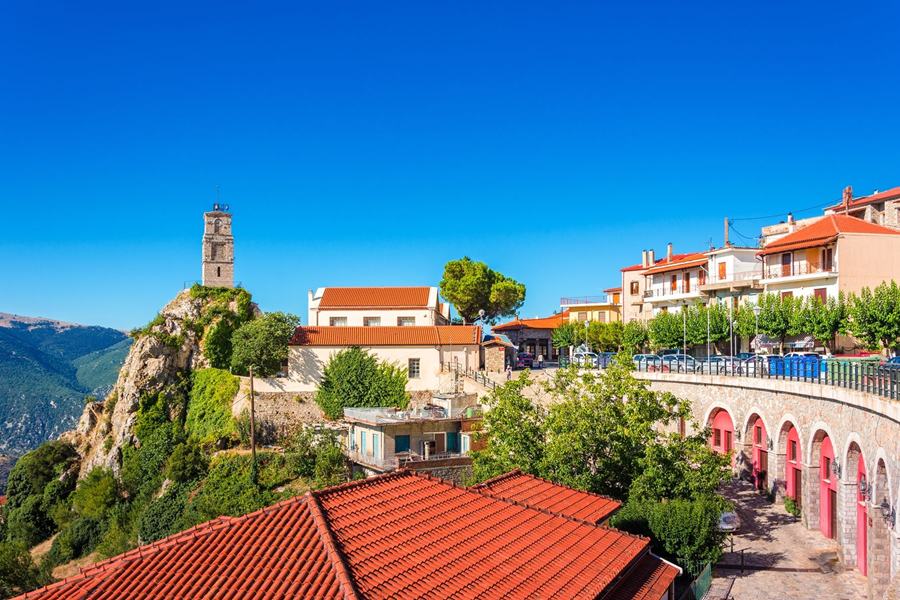
West of the Pindus, a long chain of mountains, the climate is wetter and carries maritime traits. Maritime means shaped by the nearby sea. The etesians are seasonal winds that can stay active from the fifth month until October. Their peak falls in July and August, and October closes their season.
At the Aristotle University of Thessaloniki station, Greece weather in October brings average lows of 13.4 °C. A low is the coldest reading of a day, averaged across the month. The university station holds an October record low of 1.4 °C, its coldest October reading on file. Its extremes run from 1930 onwards.
Greece weather in October at the Araxos station for Patras includes 83.8 mm of rain. A millimetre of rain means water one millimetre deep across flat ground. Precipitation is the wider word for water falling as rain, hail or snow. A rain day, in these tables, is a day with a measurable fall of rain.
- Araxos rain days: The Araxos station spreads its October rain across 9.4 rain days on average.
- Theodoriana: The Theodoriana station, at 962 m, records 213.6 mm of October precipitation.
- Kaimaktsalan: Greece weather in October at the Kaimaktsalan Ski Center station averages a high of 7.9 °C.
The Köppen system sorts climates by heat and rainfall. It gives Greece 11 climate types, more than any other European country of a similar size. An average high pools the top reading of every day. Each type carries a short letter code, such as Csa.
How does Athens shape Greece weather in October?
Greece weather in October in Athens unfolds within the hot-summer Mediterranean type, which the Köppen scheme labels Csa. In that code, C stands for mild winters and s for a dry summer. The final a stands for a hot summer.
Elliniko, on the southern side of Athens, lies in a transitional zone between Csa and BSh. A transitional zone is a belt where one climate type shades into another. BSh means a hot semi-arid climate, dry but short of a desert. The Saronic Gulf, an arm of the sea, softens the temperature swings of those southern districts.
For Greece weather in October, the downtown Athens station records a 20.3 °C daily mean. A daily mean blends the warmest and coldest readings into one figure. The same downtown station, with extremes since 1890, holds an October record high of 36.5 °C. A record high is the warmest reading ever logged for that month.
The Neos Kosmos station stands 85 m above sea level. Above sea level means height measured up from the surface of the sea. Neos Kosmos is a neighbourhood of downtown Athens, and the station carries its name. At Neos Kosmos, Greece weather in October brings an average low of 17.6 °C.
- Humidity: The downtown Athens station logs 66% average humidity in October, a measure of moisture in the air.
- Neos Kosmos peak: The Neos Kosmos station has logged 32.6 °C as its October record high.
- Coastal cold: Elliniko, a coastal station, sets its October record low at 3.0 °C.
Greece weather in October at the Elliniko station includes 8.6 rain days on average. Elliniko lies in coastal Athens, and its normals run from 1955 to 2010. Normals are long-term averages that climate scientists use as a baseline.
What does Mykonos show about Greece weather in October?
Greece weather in October on Mykonos belongs to the hot semi-arid group, coded BSh. The National Observatory of Athens gives that label because of the island’s low overall precipitation. Semi-arid describes land that receives little rain, yet more than a desert.
The low rainfall on Mykonos is the result of a rain shadow cast by the Pindus range. A rain shadow is the dry side of a mountain range, where passing winds have lost their moisture. The Aegean Sea also exerts a strong influence on the island. The Aegean is the arm of the Mediterranean between mainland Greece and Turkey.
The Mykonos station of the National Observatory of Athens stands only 10 m above sea level. At that station, Greece weather in October means island nights that average 18.9 °C at their coolest. An observatory is a site where scientists watch and measure the sky or the weather.
Vegetation on Mykonos begins to grow around mid-autumn and ends at the start of summer. Vegetation means the plant cover of an area, from grasses to low shrubs. Mid-autumn is the middle of autumn, which comes after summer and before winter. So the island’s plants grow through autumn, winter and spring.
- October peak: Greece weather in October at the Mykonos station peaks at a record 30.8 °C.
- October floor: The lowest October reading at the Mykonos station stands at 11.2 °C.
- Hardiness zone: Coastal Mykonos falls in zone 10b/11a, a band based on the coldest winter nights.
Greece weather in October, as logged by the Mykonos station, adds up to 24.3 mm of rain. The station catches that rain in a gauge, an open container. One millimetre of rain amounts to a litre spread over a square metre.
Which figures does Ioannina add to Greece weather in October?
Greece weather in October in Ioannina comes from a borderline climate. It sits between hot-summer Mediterranean, coded Csa, and humid subtropical, coded Cfa. Humid subtropical means hot summers with rain spread across the year. The f in Cfa marks the absence of a dry season.
No mainland Greek city above 50,000 inhabitants is wetter than Ioannina. Mainland means the land of a country attached to the continent, not its islands. Wettest here means the largest yearly total of rain, snow and hail. An inhabitant is someone whose home lies in a given town or city.
Greece weather in October at the Ioannina station reaches an average high of 20.6 °C. The Ioannina station puts the average October low at 8.6 °C. Degrees Celsius, shown as °C, measure heat on a scale where water freezes at zero. Water boils at one hundred degrees on that scale.
Greece weather in October, as measured at the Ioannina station, includes 107.5 mm of precipitation. At the Ioannina station, that total falls over 9.7 precipitation days. A precipitation day is a day on which enough rain, snow or hail falls to be measured. Hail falls as small balls of ice.
- Daily mean: Across an average October, the Ioannina station records a daily mean of 14.9 °C.
- Humidity: Air at the Ioannina station holds 70.8% average humidity in October.
- Sunshine: Greece weather in October brings the Ioannina station 160.4 hours of bright sunshine.
The Ioannina station of the national weather service sits 475 m above sea level. Its normals span the period from 1956 to 2010. Normals are averages taken over a long run of years, so one odd year carries little weight.
How does Zakynthos fit into Greece weather in October?
Greece weather in October reaches Zakynthos, also called Zante, an island in the Ionian Sea. Its climate is the hot-summer Mediterranean type, or Csa. Summers on the island are hot and dry, and winters range from mild to cool with rain.
Zakynthos, like the greater part of the Ionian Islands, collects sizeable precipitation through the winter. The Ionian Islands are a group of islands that lie off the western shores of Greece. Sizeable means large in amount. Winter here covers the coldest months of the year, from December to February.
Greece weather in October at the Zakynthos station has a daily mean of 19.6 °C. At the same Zakynthos station, the average October low is 15.7 °C. A daily mean is the midpoint of each day’s highest and lowest readings, averaged over the month. A thermometer is the instrument that measures those readings.
Humidity on Zakynthos stays fairly high across the whole year, even through the summer months. Humidity measures the water vapour that the air holds. Water vapour is water in the form of an invisible gas. Weather tables give it as relative humidity, a percentage of the full amount the air can hold.
- Record heat: For Greece weather in October, the Zakynthos station table tops out at 32.0 °C.
- Record cold: At the Zakynthos station, October temperatures have fallen as low as 5.2 °C.
- Data years: The Zakynthos station table, sourced from NOAA, uses normals from 1961 to 1990.
The Zakynthos station logs an average humidity of 71.7% for Greece weather in October. A percentage shows a share out of one hundred parts. The figure is an October average, so individual days can sit above or below it.
What do the Larissa records say about Greece weather in October?
Greece weather in October in Larissa sits within a cold semi-arid climate, coded BSk. Larissa serves as the capital of Thessaly and is its largest city. Mediterranean traits remain, such as drier summers. The k in BSk marks the cold form of a dry climate.
The Larissa station of the national weather service gives an October average high of 22.4 °C. Capital here means the city that houses the government of the region. A region is a large unit of local government in the country. The national weather service is a state body that runs a network of stations.
Greece weather in October at the Larissa station has reached a record 36.8 °C. Its extremes have been kept since 1955. The same Larissa station has also fallen to an October record low of −2.4 °C. A minus sign shows a temperature below the freezing point of water.
In an average October, the Larissa station counts 7.2 precipitation days. In the Köppen scheme, the letter B marks dry climates, where evaporation outweighs rain. Evaporation is the change of water from liquid into vapour. The S in BSk stands for steppe, a wide and dry grassland.
- Daily mean: The October daily mean at the Larissa station is 16.4 °C.
- Humidity: For Greece weather in October, the Larissa station gives an average humidity of 68%.
- Sunshine: The Larissa station records 167.4 hours of sunshine in an average October.
Greece weather in October brings the Larissa station an average low of 10.4 °C. Each day’s coldest reading feeds into that average. An average is a total divided by the number of values that make it up. Here the values are the days of the month.
Where does Samos stand in Greece weather in October?
Greece weather in October on Samos follows the hot-summer Mediterranean pattern, labelled Csa. The island’s winters stay mild and wet, while its summers turn hot and dry. The island’s climate table draws on figures from the Samos Airport weather station.
Samos air is driest in summer and dampest at the close of autumn. At the Samos Airport station, Greece weather in October holds an average humidity of 63.1%. Autumn, in the northern half of the globe, spans September to November. That share means the air holds under two thirds of its full vapour load.
Greece weather in October at the Samos Airport station peaks at an average high of 23.5 °C. Lows at the same airport station average 15.5 °C in October. An airport station is a weather station at an airfield, where pilots need exact readings. An airfield is a site for aircraft to take off and touch down.
The Samos Airport station collects 35.8 mm of precipitation in an average October. The Hellenic National Meteorological Service supplies the station’s temperature and precipitation data. Meteorological means having to do with weather and the air. Hellenic is the formal adjective for Greek, taken from the name Greeks give their country.
- Record high: The Samos Airport station has logged an October record high of 36.0 °C.
- Record low: October readings at the Samos Airport station have dropped as far as 7.0 °C.
- Daily mean: October’s daily mean at the Samos Airport station works out at 19.4 °C.
For Greece weather in October, the Samos Airport station counts 5.0 precipitation days on average. The decimal point appears because the figure averages the counts from a long run of Octobers. A precipitation day counts once, however much rain falls on it.
Which readings does Rhodes give Greece weather in October?
Greece weather in October on Rhodes follows a hot-summer Mediterranean climate, Csa in the Köppen scheme. Its winters stay mild, and its summers run hot. The island’s Rhodes Airport table joins the normals of two sites, Maritsa and Paradeisi.
For Greece weather in October, the Rhodes Airport station sets the daily mean at 20.7 °C. An integrated table blends the records of two stations into one series. That method fills gaps when a station moves from one site to another. A series here means a long, unbroken run of readings over the years.
Greece stands among the last countries to rely only on Campbell-Stokes sunshine recorders. Those recorders undercount the yearly total of sunshine at each station. A Campbell-Stokes recorder is a glass ball that focuses sunlight and burns a trace on a card. The length of the burnt trace gives the hours of bright sunshine.
The Rhodes Port station sits a mere 4 m above the sea. Greece weather in October at Rhodes Port keeps the average low at 21.3 °C. At the Rhodes Airport station, the October average low comes to 17.4 °C. A port is a harbour town or quay where ships load and unload.
- Record high: The Rhodes Airport station holds 33.2 °C as its top October reading.
- Record low: No October reading at the Rhodes Airport station has fallen below 7.2 °C.
- Humidity: Greece weather in October at the Rhodes Airport station carries 67.5% average humidity.
Rain falls on 6.7 days of an average October at the Rhodes Airport station. The table counts a rain day only when the gauge collects a measurable amount. A sprinkle too small to measure does not count toward that total.
Where does saffron fit into Greece weather in October?
Greece weather in October matches the bloom of the saffron crocus. Its flowers appear only in this month. They open after other flowering plants have already released their seeds. Saffron, the spice, comes from the slender red threads inside each flower.
Greece weather in October reaches Kozani, in Macedonia, the main area for growing saffron in modern Greece. Greece ranks as the third largest saffron producer. Spain follows Greece in that list, although Spain led world output in the nineteenth century. Iran and India join Greece among the main producer countries.
Each flower opens at dawn and then wilts quickly as the day passes. For that reason, the saffron harvest has to be a fast task. Stigmas are best picked in mid-morning, once the flowers stand fully open. A stigma is the tip at the centre of a flower that receives pollen. Saffron is made from these tips.
The plant grows from a corm, a swollen underground stem that sends up leaves and the flower stalk. After resting through the summer, the corms push up narrow leaves and begin to bud in early autumn. Rain just before flowering raises saffron yields. Cold or rainy spells during flowering bring disease and lower the crop.
- Colour: During Greece weather in October, the petals range from pale lilac to a darker, streaked mauve.
- Scent: Saffron crocus flowers give off a sweet fragrance that recalls honey.
- Growers: Greek, Moroccan and Spanish farmers each use planting depths and spacings suited to their land.
Harold McGee states that saffron was domesticated in or near Greece during the Bronze Age. To domesticate a plant is to adapt it to farming. Amid Greece weather in October, flowering plants stand 20 to 30 cm tall with up to four blooms.
Which bean feast did ancient Athens hold during Greece weather in October?
Greece weather in October overlaps Pyanepsion, a month of ancient Athens that ran across October and November. On its seventh day, Athenians held the Pyanopsia in honour of the god Apollo. The festival name means bean-stewing, after one of its sacred offerings.
Amid Greece weather in October, each Athenian home cooked a stew of boiled beans, grains and cereals. The households then ate it together as part of public feasting in the city. Public feasting meant shared meals held for the whole community. The festival also gave its name to the month in which it fell, Pyanepsion.
The second offering was the eiresione. This Greek word names an olive branch bound with purple or white wool. Seasonal fruit, pastries and small jars of honey, oil and wine hung from it. Olive branches stood for life in Athens, because of their links with Athena and the city’s wealth.
Singing boys carried the main eiresione in a procession to the Athenian Temple of Apollo. There they hung it on the gate. Boys also left smaller branches at private homes, and in return they received presents. During Greece weather in October, each household kept its branch until the next Pyanopsia replaced it.
- Myth: The bean stew recalled the meal cooked by the crew of Theseus after landing back in Attica.
- Seasons: Athenians appear to have honoured the Horae, goddesses of the seasons, and Helios, god of the sun.
- Start: The procession departed from the sacred hearth inside the Prytaneion, a building of the old city centre.
Greece weather in October held the Pyanopsia, but Apollo had a second farming feast in Attica. That festival, the Thargelia, took place in the spring. Attica is the region around Athens. Children of Athens staged offerings with music at both festivals.
When did women hold the Thesmophoria in Greece weather in October?
Greece weather in October closes with the dates of the ancient Thesmophoria. By the modern calendar, the festival fell in late October. In Athens, it ran from the eleventh to the thirteenth of Pyanepsion. That was the time of the Greek year for sowing seeds.
The name joins two Greek words, thesmos, meaning divine law, and phoros, meaning carrier or bearer. During Greece weather in October, the festival celebrated both human and agricultural fertility. Fertility is the power to produce children or crops. The people of Boeotia, says Plutarch, called it the Festival of Sorrow.
Only adult women took part, and the rites stayed secret. Every wife in Attica was expected to join, and taking part served as proof of marriage. During Greece weather in October, the women set up tents on the first day. They then stayed in these tents, not at home, until the festival ended.
The first day was called anodos, a Greek word for ascent. The second day, nesteia, was a fast. It copied the grief of the goddess Demeter for her lost daughter. To fast is to go without food. On the third day, kalligeneia, a name meaning fair birth, women prayed for their own fertility.
- Pits: Rotting pig remains from pits called megara were spread on sown fields, in hope of a good harvest.
- Comedy: The play Thesmophoriazusae by Aristophanes parodies the festival, which means it mocks it for laughs.
- Egypt: The historian Herodotus compared the festival with a similar secret ritual from Egypt.
Outside Athens, the dates did not always match Greece weather in October. On Delos and at Thebes, the festival seems to have taken place in summer. There it was linked with the harvest rather than with sowing. A harvest is the gathering of ripe crops.
Which saint’s feast does Greece weather in October bring to Thessaloniki?
Greece weather in October brings the feast of Saint Demetrius on the 26th of the month. Churches on the old calendar mark the same feast on 8 November instead. A feast day is the date on which a church honours a particular saint.
Demetrius was a Greek believer, martyred for his Christian faith early in the fourth century AD. A martyr is someone killed because of a faith. In the Middle Ages, he came to be revered as one of the leading Orthodox military saints. He is frequently paired with Saint George of Lydda.
His title Myroblyte means the Myrrh-Gusher or the Myrrh-Streamer. Myrrh is a fragrant resin. His relics were accepted as genuine once they began to give off a liquid, strong-scented myrrh. Relics are the bodily remains of a saint. During Greece weather in October, the skull of the saint came back to Thessaloniki, on 23 October 1978.
Rural Greeks in the Middle Ages also honoured Demetrius as patron of farming, peasants and shepherds. Historian Hans Kloft says the saint inherited this role from the pagan goddess Demeter. Pagan here means part of the old religion before Christianity. After Demeter’s cult faded in the fourth century, country people slowly passed her rites to him.
- City feast: During Greece weather in October, Thessaloniki opens its Ohi Day celebrations with his feast on the 26th.
- Festival: The Dimitria cultural festival, named after Agios Dimitrios, has run every September to December since 1966.
- Icons: Byzantine icons show him in military dress, standing or riding a horse, frequently holding a spear.
Outside Greece, Orthodox churches in Bulgaria and Romania honour Demetrius on 26 October as well. The Serbian and Macedonian churches keep his day on 8 November. Greece weather in October therefore lines up with the Bulgarian and Romanian date, not the Serbian one.
What happened in Thessaloniki in 1912 during Greece weather in October?
Greece weather in October spans a 1912 anniversary in Thessaloniki. Greece captured the city on 27 and 28 October that year, during the First Balkan War. The city then lay in Ottoman territory. In that war, the Balkan League countries attacked the Ottoman Empire.
On 20 October 1912, Greek forces under Crown Prince Constantine first set off towards Northern Epirus. A sharp disagreement then arose between Constantine and Prime Minister Eleftherios Venizelos. As a result, the troops turned towards Thessaloniki instead. The aim was to stop the Bulgarian army, which also sought the city and access to the Aegean.
During Greece weather in October that year, the Greek advance followed victories at Giannitsa and Sarantaporos. By 25 October 1912, Greek troops had surrounded Thessaloniki. On the 26th, the Ottoman general Hasan Tahsin Pasha agreed to discuss surrender terms. The surrender agreement was signed in the village of Topsin, now called Thessaloniki Bridge.
On 27 October, Tahsin signed the surrender protocol, backdated to the 26th to mislead the Bulgarian side. A protocol is a written agreement. He gave up the city without conditions, along with 25,000 prisoners. Greece weather in October 1912 then saw Constantine reach the city by train before dawn on the 28th.
- Athens: An unsigned telegram reached Athens on the 26th, and bells, hymns and prayers filled the churches.
- Cannon: During Greece weather in October 1912, 101 cannon shots were fired from the Pnyx, as Venizelos had promised.
- Parade: On 29 October, King George and Constantine led a grand parade at an official changing of the guard.
Constantine then attended a doxology, a church hymn of praise. At the time, Macedonia was disputed between Greeks and Bulgarians. The new Greek territory there later became the cause of the Second Balkan War. The Bulgarians were not satisfied with the lands they held.
How do Greeks mark Ohi Day amid Greece weather in October?
Greece weather in October reaches a national holiday each year on the 28th, Ohi Day. Greece and Cyprus both observe it, and so does the Greek diaspora, meaning Greek communities living abroad. In Greek, the name means Anniversary of the No.
Ohi Day recalls events of Greece weather in October 1940. In the early hours of the 28th, an ultimatum came from the government of Benito Mussolini. An ultimatum is a final demand backed by a threat. It told Greece to open the Greek-Albanian border to Axis troops, or else face war.
Ioannis Metaxas, the leader of Greece, turned it down in French, then the common tongue of diplomacy. Diplomacy is the formal dealing between states. His answer was “Alors, c’est la guerre”, which means “Then, it is war”. The word ochi, Greek for no, became the popular emblem of the refusal. Metaxas himself seems never to have used it.
The anniversary was first marked in 1941, in occupied Athens, as an act of resistance. By a decree of 24 October 1944, the Papandreou government made the 28th a national holiday. A decree is an official order with the force of law. Since then, Greece weather in October has included the holiday every year.
- Military parade: Thessaloniki hosts the chief event, a military parade watched by the President of the Republic.
- School parades: In Athens and other towns, schoolchildren march, and the Greek flag hangs from private and public buildings.
- Flag bearer: The pupil with the top marks in each school carries its flag.
In Thessaloniki, the student parade of Greece weather in October comes a day early, on the 27th. That leaves room for the military parade the next day. Military parades in Greece go back to the 1870s. Student parades were added later, during the Metaxas regime.
What do travellers ask about Greece weather in October, and what are the answers?
Greece weather in October shares the 28th with a church feast beside a national holiday. Ancient Athens held a festival for bronze-workers and vine rites for Dionysus in the same season. Greek law also sets clear rules for holidays that fall on Sundays.
Which church feast falls on the 28th during Greece weather in October?
The Church of Greece shifted the Protection of the Theotokos from 1 October to 28 October in 1952. Theotokos, a Greek word, is a title of Mary as Mother of God. The Greek name of the feast, Skepi, means a cloak and also protection. Tradition sets her appearance at the Blachernae church in Constantinople.
What was the Chalkeia, an Athenian feast close to Greece weather in October?
The Chalkeia, also spelled Chalceia, was the festival of bronze-workers in ancient Athens. It honoured the goddess Athena and the god Hephaestus. The date was the last day of Pyanepsion, which fell in October or November. Under the title Athena Ergane, the goddess was patron of crafts, weaving above all.
How did Athens honour the vine during Greece weather in October?
The Oschophoria were Athenian rites held during Pyanepsion, an autumn month. They honoured Dionysus, the god of the vine. Two young men in women’s clothes carried grape-laden branches to a shrine of Athena Skiras. A carved calendar band, now in the Panagia Gorgoepikoos church in Athens, is identified as showing the procession.
During Greece weather in October, what happens when a holiday falls on a Sunday?
Greek law already makes every Sunday a public holiday. A holiday that lands on a Sunday keeps its date and does not shift. The one exception is the opening day of the fifth month. Towns also keep local days, such as a patron saint’s day or a Liberation Day. Schools by custom close on such days.