
Best time to visit Greece questions shape small-group trips with a tour leader on the mainland and islands. Its climate is mainly Mediterranean, as logged by the HNMS and the National Observatory of Athens. The Horae were the old goddesses of its seasons. Feasts follow: the Theophany, the Xanthi Carnival, 25 March and the Anastenaria. Summer brings 15 August, while autumn and winter bring a film festival and the kalanta carols. Plans can draw on a 10 day Greece itinerary, Greece island hopping tours and Greece tour packages. More trips sit under Greece tours.
Bookings made through the GetYourGuide widgets on this page earn Classical Greece Tours a commission, at no extra cost to the traveller.
When is the best time to visit Greece?
The best time to visit Greece sits inside a mainly Mediterranean climate, coded Csa on the Köppen scale. That scale is a world system that sorts climates by heat and rain. Winters here run mild to cool and wet, while summers stay hot and dry.
Along the coast, the best time to visit Greece meets this same Mediterranean pattern. It covers the majority of coastal places, from Athens to the Cyclades and the Dodecanese. The Cyclades and the Dodecanese are two island groups. The Peloponnese, the large southern peninsula, shares the pattern, and so do the Ionian Islands.
The Pindus mountain range has a strong hand in the climate of the whole country. West of the range, the land runs wetter on average, because south-westerly weather systems bring moisture in. East of it, a rain shadow keeps the land drier. A rain shadow is a dry zone on the sheltered side of high ground.
Parts of the Athens Riviera and of the Cyclades fall in the hot semi-arid class, coded BSh. Semi-arid means dry, with only a little more rain than a desert. Thessaloniki and Larissa, two northern cities, have the cold form of that class, coded BSk. Across the best time to visit Greece, both codes mark land with little rain.
- Alpine heights: Higher parts of Epirus and Thessaly have an Alpine, or mountain, climate with heavy winter snow.
- Humid north: Inland northern Greece has a humid, or moist, subtropical climate with cold, damp winters and hot summers.
- Yearly snow: Snow falls every year in the Greek mountains and across the northern areas of the country.
Even low-lying southern ground, such as Athens, can see brief spells of snowy weather. Low-lying ground means land that sits not far above the sea. The best time to visit Greece therefore spans hot, dry coasts and mountains with heavy snow.
Which weather service tracks the best time to visit Greece in its records?
The best time to visit Greece shows in the work of the HNMS, the Hellenic National Meteorological Service. This government agency makes the weather forecasts and observations for the country. Meteorology, the word inside its name, means the science of weather and climate.
The agency was set up in 1931 within the Ministry of Aviation of that time. Aviation means the flying of aircraft. Its base sits at Elliniko, on the site of the former Athens International Airport. Former means no longer in use. Forecasts for the best time to visit Greece go out from that base.
The HNMS works under the Hellenic Air Force, the air arm of the Greek military. Its staff mixes military and civilian personnel. Civilian here means not serving in the armed forces. Hellenic means Greek. For the best time to visit Greece, its weather posts reach almost every part of the country.
Newspapers reported 49.0 °C at the HNMS station in Almyros on 10 July 1977. The sign °C stands for degrees Celsius. That Almyros figure was never confirmed. A weather station is a fixed post with instruments that measure the air. Heat readings for the best time to visit Greece come from posts like this one.
- Older roots: The service grew from a weather network set up by the National Observatory of Athens in 1890.
- World links: It entered the International Meteorological Organization in 1935, then the World Meteorological Organization in 1949.
- Tatoi reading: On 10 July 1977, the Tatoi station of the National Observatory of Athens recorded 48.7 °C.
Volos, Velestino and Messara each logged 48.0 °C at their stations that day. Like the Almyros figure, these readings were not confirmed. Each name marks the site of a station. Press records for the best time to visit Greece list all three sites.
What does the best time to visit Greece owe to the National Observatory of Athens?
The best time to visit Greece meets science at the National Observatory of Athens, or NOA. Its founding year was 1842, and no research body in Greece is older. An observatory is a centre for the study of the sky and its objects.
Julius Schmidt reorganised the meteorological service of the Athens Observatory. Meteorological means linked to the weather. He took weather readings in a large number of places across Greece. On a regular basis, he sent his data to the Observatory of Paris. Data on the best time to visit Greece thus reached France in his day.
His results came out in 1864 in a German-language book on the physical geography of Greece. Physical geography studies land, water and climate. The title reads Beiträge zur physikalischen Geographie von Griechenland. In English, that means Contributions to the Physical Geography of Greece. That 1864 book put his weather records on the best time to visit Greece into print.
A special law of 19 June 1890 turned the Athens Observatory into a government research body. The same law set up a Meteorological Institute and a Seismological Institute. Seismology is the study of earthquakes. The weather side of the best time to visit Greece gained its own institute in 1890.
- Three institutes: Today the NOA is made up of three research institutes, with facilities across the country.
- Calendar change: Director Demetrios Eginitis swapped the old Julian calendar for the Gregorian one as the national standard.
- Clock time: Eginitis also brought the Eastern European Time zone into use in Greece.
Eginitis also reorganised the weather network and added about a hundred new stations to it. A network here means a linked set of stations across the land. Figures on the best time to visit Greece came from that larger chain of posts.
Which ancient goddesses tie the best time to visit Greece to the seasons?
The best time to visit Greece has an old echo in the Horae of Greek myth. These goddesses stood for the seasons and for the natural portions of time. Myths are old tales of gods and heroes, told to make sense of the world.
The writer Karl Kerenyi noted that hora, the singular form, means the correct moment. The best time to visit Greece thus carries an old Greek term for the right moment. In symbol, the turning of the seasons was the dance of the Horae. A symbol is a sign that stands for an idea.
One trio of Horae, Thallo, Auxo and Carpo, stood for the three seasons the Greeks recognised. Those seasons were spring, summer and autumn. Trio means a set of three. Rural farmers throughout Greece gave this trio the bulk of their worship. Across the best time to visit Greece, their three seasons ran from spring to autumn.
Thallo was the goddess of spring, of buds and of blooms. Her name comes from thallein, a Greek verb meaning to sprout or grow. The verb was used above all of fruit trees. She also protected youth. In myth, the spring part of the best time to visit Greece belonged to her.
- Auxo: As one of the Horae, Auxo was the goddess of summer and a protector of plants.
- Carpo: Named from a word for bearing fruit, Carpo had charge of autumn, ripening and the harvest.
- In art: Greeks showed the seasons chiefly as women, though certain old monuments show them as winged children.
By tradition, the Horae guarded the gates of Olympus, the home of the gods. They also made the earth fertile and gathered the stars and constellations. Fertile means able to grow rich crops. In those stories, the seasons of the best time to visit Greece had keepers.
How does the Theophany of 6 January mark the best time to visit Greece each winter?
The best time to visit Greece in winter includes 6 January. On that date, Eastern churches keep the feast of Epiphany, also called Theophany. Theophany is a Greek word for an appearance of God to people. Epiphany comes from a Greek word for appearance.
In Greece, people also use the everyday name Phota, which means Lights. In parts of western Macedonia, it ranks as the biggest festival of the year. Macedonia here is the wide region across the north of Greece. For the best time to visit Greece, western Macedonia gives this feast top rank.
Across the bulk of Greece, a ritual called Protagiasi takes place on the eve of the feast. It is also known as the small sanctification, which means making a place holy. A priest goes from door to door with a cross and a branch of basil. He sprinkles the rooms with holy water, water that a priest has blessed.
On the feast day, the Cross is dipped into the sea or into a nearby river or lake. Immersion, the word for this act, means dipping under water. Across the best time to visit Greece, 6 January brings this rite to coasts, rivers and lakes. A rite is a fixed religious act or ceremony.
- Race for the cross: Men race to bring back a cross cast into the water, for good luck.
- Washed tools: People in a large number of areas then wash farm tools, and even holy pictures called icons.
- Sailing resumes: The feast marks the end of the old custom that banned sailing through the winter.
Until the fourth century, Christians held their New Year on this same day. A century means a block of one hundred years. The best time to visit Greece in January thus meets a feast that once opened the Christian year.
What does the Xanthi Carnival bring to the best time to visit Greece before Lent?
The best time to visit Greece before Lent holds the Xanthi Carnival. No event of this type in northern Greece is larger. In the whole country, only the Patras Carnival is bigger. Lent is the strict fasting season before Easter.
The carnival took its formal shape in 1966. Each year, the Cultural Center of the Xanthi town council stages it. Carnival means a festive season of parades and costumes before a fast. On the calendar of the best time to visit Greece, the event returns every year.
Folk clubs set off from different points of the city and march while they dance. They then gather at the Central Square. There, all the clubs dance folk dances together. A folk dance is a traditional dance handed down among ordinary people. In the best time to visit Greece before Lent, this march ends in a shared dance.
The Night Carnival Parade takes place on the last Saturday evening. It falls on the eve of the Grand Parade. The Grand Parade starts at the entrance of the city. The decorated floats of the clubs and the people in new costumes march in it. Both parades fall within the best time to visit Greece before Lent.
- Burning the Tzaros: The closing ceremony burns a figure called the Tzaros in the river Kosynthos.
- No summer fleas: Folk belief held that burning the Tzaros on the last Carnival Sunday kept fleas away in summer.
- A crackling name: The name Tzaros came from the odd sound that the burning bush made.
On Clean Monday, which opens Lent, the event passes to villages such as Stavroupoli, Polysitos and Avdira. Each village adds its own local customs and events. For the best time to visit Greece before Lent, these villages close the carnival season.
Why does 25 March stand out in the best time to visit Greece each spring?
The best time to visit Greece in spring includes 25 March. On that date each year, Greeks celebrate the Greek Revolution of 1821. A revolution is an uprising against a ruling power. The day also carries a less common name, Independence Day.
Greece and Cyprus both mark the day as a public holiday. A public holiday is a day off set by law. The holiday dates from 1838. King Otto’s government set it up by Royal Decree, a formal order of the king. The best time to visit Greece has kept this date since then.
The biggest event of the day is a military parade in Athens. Military means linked to the armed forces. A parade is a public march through the streets. On the day before, schools across the country hold their own celebrations. For the best time to visit Greece, 24 March thus belongs to the schools.
Local school parades are a common feature of the day in villages, towns and cities. The children wear old Greek folk dress and carry the national flag as they march. Folk dress is the old style of clothing of a region. These school marches belong to the best time to visit Greece in late March.
- A shared cry: On the day, people commonly say Zito i Ellas, which means Long live Greece.
- Army parade: In 1875 the army first paraded in front of the palace on this holiday.
- Student march: The earliest known mention of a student parade on the day dates from 1899.
The date also falls on the Feast of the Annunciation. The Annunciation is the Christian feast of the news given to Mary that she was to bear Jesus. The best time to visit Greece on 25 March therefore joins a national day and a church feast.
In the best time to visit Greece, which fire-walking ritual marks the fifth month?
The best time to visit Greece in late spring holds the Anastenaria, a traditional barefoot fire-walking ritual. It comes with ecstatic dance in villages of northern Greece and southern Bulgaria. Ecstatic dance is dancing in a state of deep, trance-like joy.
The yearly ritual cycle runs from the 21st to the 23rd day of the fifth month. Its central figures are Saint Constantine and Saint Helen. A saint is a holy person whom the church honours after death. For the best time to visit Greece, the cycle returns every year on these dates.
Each community keeps a shrine called the konaki, where its holy icons are placed. A shrine is a holy place, and an icon is a holy picture. On the eve of the saints’ day, the members gather at the konaki. They dance to a Thracian lyre and a drum. A lyre is a string instrument.
After dancing in a circle around the fire, the dancers step over the hot coals. These dancers are called anastenarides. In their belief, the saint moves each one across the coals. Coals are the glowing remains of burnt wood. Across the best time to visit Greece, the coal walk returns with each yearly cycle.
- Winter rite: The ritual also takes place in January, for Saint Athanasius, with the fire-walking held indoors.
- Five villages: The ritual survives in its truer form in five villages of northern Greece, Langadas and Kerkini among them.
- Ancient roots: Certain scholars of folk customs argue the Anastenaria are traces of ancient cults of Dionysus.
In 2009, the ritual entered the UNESCO lists of Intangible Cultural Heritage. UNESCO is a United Nations agency for culture. Intangible heritage means living customs, such as songs, dances and rites, rather than buildings. The best time to visit Greece thus includes a rite on that list.
How does the feast of 15 August shape the best time to visit Greece each summer?
The best time to visit Greece in summer includes 15 August. On that date falls the Dormition feast of Mary, Mother of God. It honours her falling asleep, meaning her death. It also marks how she was taken up into heaven.
In this feast, Mary bears the Greek title Theotokos. The title means Mother of God or, word for word, God-bearer. A title here is a name of honour. Orthodox names the Eastern family of Christian churches. Her feast sits in high summer within the best time to visit Greece.
Holy scripture calls death a falling asleep, koimesis in Greek. From that Greek root came the word cemetery, meaning a place of sleeping. In Western churches, the matching feast is the Assumption of Mary. Assumption means being taken up. The best time to visit Greece thus shares its mid-August feast with the West.
A fast called the Dormition Fast leads up to the feast. It runs from 1 August to 14 August, both days included. Orthodox and Eastern Catholic Christians keep it. A fast is a time of giving up certain foods for religious reasons. The fast days end on the eve of the feast.
- Foods given up: During the fast, the faithful give up red meat, poultry, dairy, fish, oil and wine.
- A lighter day: The Transfiguration on 6 August falls in the fast, and fish, wine and oil are allowed.
- Wide feast: Eastern Catholic churches, and both Orthodox families of the East, count the Dormition as a Great Feast.
In Greece, 15 August is one of four mandatory official public holidays. The other three are 25 March, Easter Monday and Christmas Day on 25 December. Mandatory means fixed by law for all. The best time to visit Greece in summer therefore meets a national day off.
Which November film festival marks the best time to visit Greece in autumn?
The best time to visit Greece in late autumn includes the Thessaloniki International Film Festival, or TIFF. This festival takes place every November in Thessaloniki, a city of northern Greece. Festival means a series of public events built on one theme.
TIFF puts its focus on independent cinema and on new filmmakers from around the world. Independent cinema means films made outside the large studios. Its audience tops 80,000 people. Within the best time to visit Greece, these film screenings fall in November. A screening is a public showing of a film.
TIFF screens films at the historic Olympion theatre on central Aristotelous Square. Since 1999, it has also used four theatres in two restored warehouses at the port. Warehouses are big halls for storing goods. Across the best time to visit Greece, the port halls have served the festival since then.
The festival began in 1960 as a national event called Greek Film Week. The Techni Macedonian Art Society helped to launch it. Techni is the Greek word for art. A national festival is one built around the films of a single country. For the best time to visit Greece, 1960 marks the start of this film event.
- Festival hub: The central hub of the festival is Warehouse C, which stands at the city port.
- Organiser: The Thessaloniki Film Festival body runs TIFF, under the Greek Ministry of Culture.
- Spring sister: The same body holds the Thessaloniki Documentary Festival, for factual films, every March.
TIFF turned into an international festival in 1992, at its 33rd edition. An edition here is one yearly round of the event. International means open to films from every country. The best time to visit Greece in November has drawn world cinema to Thessaloniki since then.
Which carols ring through the best time to visit Greece at Christmas and New Year?
The best time to visit Greece in December brings the Kalanta Christougenon, a traditional Greek Christmas carol. A carol is a joyful song for a church feast. Kalanta is the Greek word for such carols. Traditional means handed down from one generation to the next.
In English, its name translates simply as Christmas Carol. Two other common titles are Kalin esperan, meaning good evening, and Christos gennatai, meaning Christ is born. A title is the name given to a song. Within the best time to visit Greece, these two Greek titles both point to the same carol.
Across the best time to visit Greece, the carol is commonly sung around Christmas. Light percussion, like the triangle, goes with it, along with the guitar. Percussion means instruments that are struck or shaken. The carol first took shape in the Byzantine Empire. That empire was the eastern Roman state, ruled from Constantinople.
Performances by the singer Nana Mouskouri across Europe gave the carol a large audience beyond Greece. A performance is a show given in front of an audience, such as a concert. Beyond Greece here means in other countries. The best time to visit Greece thus shares one of its carols with listeners far from Greece.
- Theophany carol: The Kalanta of the Theophany is a traditional Greek carol, known in English as Theophany Kalanta.
- Drums and santouri: It is sung around the Theophany with drums and the santouri.
- New Year carol: Another carol, the Kalanta of the New Year, is commonly sung around the turn of the year.
The New Year carol uses light percussion such as the triangle, and also the santouri. The santouri is a string instrument struck with small hammers. Each of these three carols thus marks its own feast in the best time to visit Greece.
What do travellers ask about best time to visit Greece, and what are the answers?
The best time to visit Greece has an ancient answer in the myth of Persephone. The Greeks of old told her story to explain where the four seasons came from. Persephone was a goddess, the daughter of Demeter. Demeter was the goddess of the harvest.
Which myth explains winter within the best time to visit Greece?
Having tasted underworld food, Persephone had to spend a third of each year below. That third was the winter months. The underworld was the land of the dead beneath the earth. While she was below, Demeter let the earth go barren and covered it with snow. Barren means bare, with no crops growing.
What is Tsiknopempti in the best time to visit Greece before Lent?
Tsiknopempti is the second-to-last Thursday ahead of Lent. Its name can be rendered as Smoky Thursday or Charred Thursday. The day centres on eating plenty of grilled and roasted meat before the fast begins. Its first part, tsikna, names the smell of meat on the grill, and Pempti means Thursday. Charred means scorched.
Which pasta belongs to Cheese Week in the best time to visit Greece?
Gogges are an egg-free pasta from the Peloponnese, above all from Argolis and Laconia. They were made fresh for Tirini, or Cheese Week, during Apokries, the Greek Carnival. For Tirini, gogges are eaten as a light bite or meze, with oil and mizithra. Meze means small shared dishes; mizithra is a Greek cheese.
Who are the kallikantzaroi of the best time to visit Greece at Christmas?
The kallikantzaros is a malevolent creature of modern Greek folklore. Malevolent means wishing harm, and folklore means old popular beliefs. These creatures are believed to live underground. There, they saw at the huge tree that holds up the earth. They come to the surface between 25 December and 6 January, the feast of Theophany.
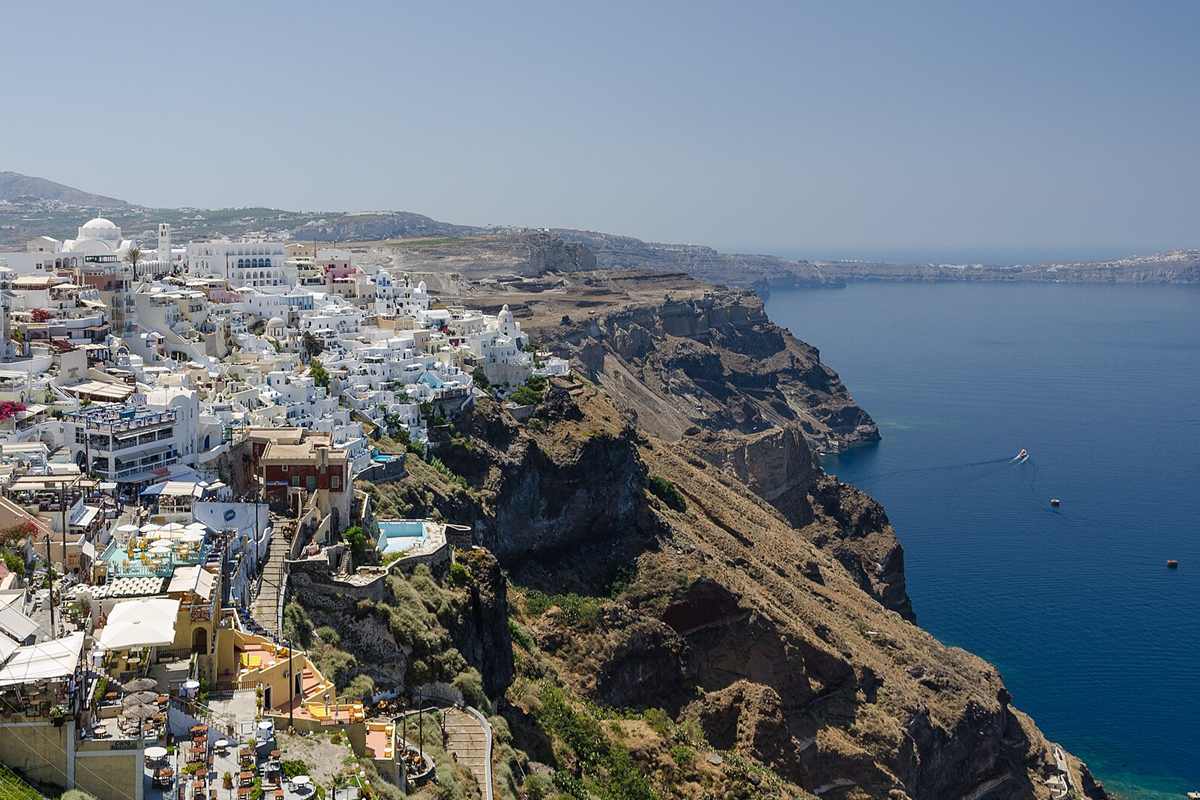
Featured photo: Norbert Nagel, CC BY-SA 3.0, via Wikimedia Commons (File:Crater rim – Fira – Santorini – Greece – 10.jpg).