
Poros tours are host-led trips on two joined islands in the Saronic Gulf, south of Athens. The topics run from Poros town and its Archaeological Museum to Sphaeria and the Temple of Poseidon. Demosthenes, Samuel Wide, the Monastery of Zoodochos Pigi, Troezen, Galatas and Methana follow. Nearby choices appear under Greek islands near Athens, a 5 day Greece itinerary and day trips from Athens. Wider choices sit under Greece tours.
Bookings made through the GetYourGuide widgets on this page earn Classical Greece Tours a commission, at no extra cost to the traveller.
What are Poros tours?
Poros tours are trips with a host to a small island pair in the southern Saronic Gulf. An island pair is a set of two islands that count as one place. Poros lies about 58 km south of the port of Piraeus.
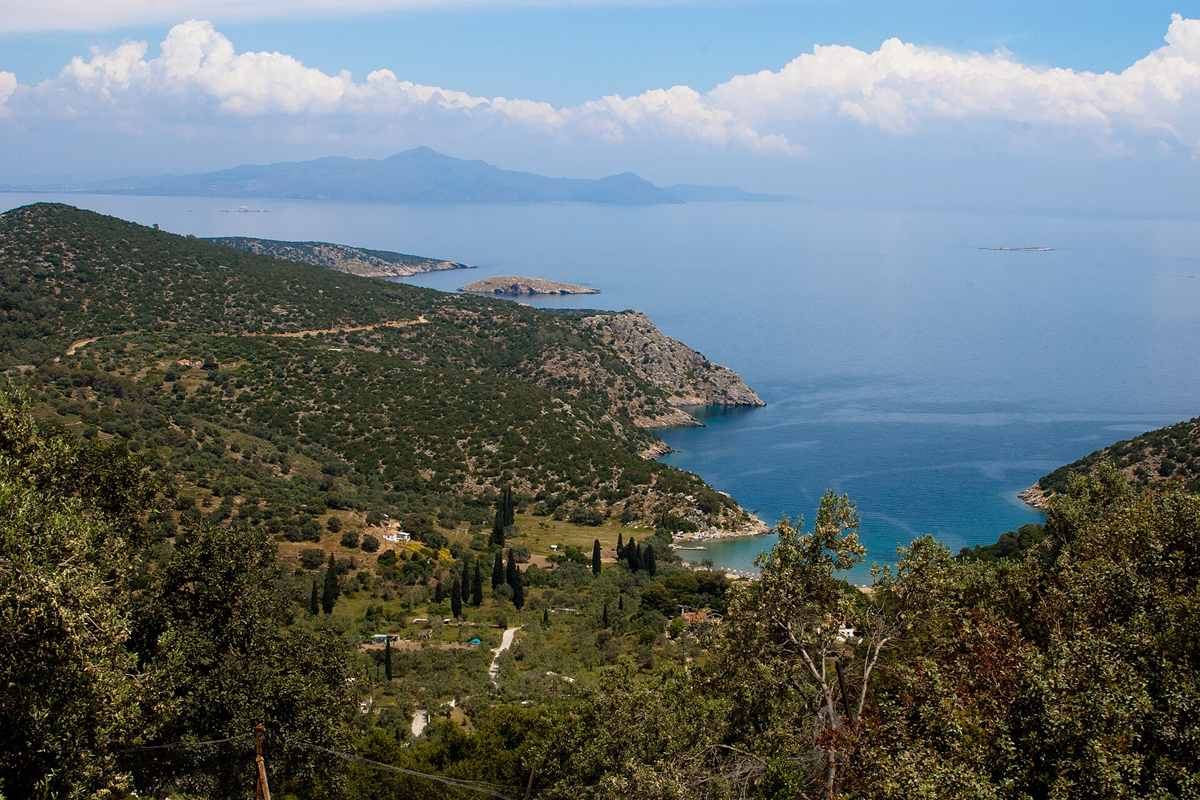
Poros has a very hilly, mountainous landscape. The island behind Poros tours has large areas of old pine forest. These woods cover the south and the middle of the island. A pine is an evergreen tree, so it keeps its green needles all year round. Hilly ground rises and falls in a series of slopes.
Poros has a central massif, a big block of limestone hills. Caves with stalactites lie inside this limestone. A stalactite is a stone spike that hangs down from a cave roof. Visible marine fossils turn up mainly in the same rock. A marine fossil is what remains, turned to stone, of a sea creature from long ago.
For Poros tours, the sandy beaches lie only along the south coast of Poros. The north has one exception to this rule, a bay called Vayionia. A bay is a stretch of coast that curves inwards around a body of sea water. Sandy beaches anywhere else on the island face the south.
- Villages: Besides the main village of Poros, the island holds the smaller villages Agios Nektarios and Kyani Akti.
- Weekends: Like other Saronic ports, Poros is a popular weekend destination for travellers from Athens.
- Name: Kalaureia, the larger northern part of Poros, carries a name that means ‘gentle breeze’.
Much of the northern side of Poros is bushy, as are the far eastern and western edges. Bushy land is covered in low, thick shrubs rather than tall trees. Poros tours share their name with an island of scrub, pine woods, caves and southern sands.
What makes Poros town the heart of Poros tours?
Poros tours come to an island whose main town has neoclassical buildings. Neoclassical means ‘new classical’, a fashion in building that borrows from Greek and Roman antiquity. Builders in this fashion used columns and triangular gables like those of old temples.
The American writer Henry Miller wrote about Poros in his book The Colossus of Maroussi. In one passage, he describes his boat coming into the town. He wrote that he suddenly realised his boat was moving along the streets themselves. Poros tours unfold in the same town that gave Miller this sudden thought.
Miller also wrote that arriving at Poros gives the illusion of a deep dream. An illusion is something that seems real but is not. The dream he loved above all others, he explained, was that of sailing on land. In his account, the land closes in on all sides as the boat arrives.
Alexandros Koryzis was born on the small island of Poros. He was a Greek politician who served briefly as prime minister in 1941. A prime minister heads the government of a country and leads its ministers. Poros tours belong to the small island that gave modern Greece this head of government.
- Museum: A museum on Poros today is dedicated to the life and contribution of Koryzis.
- Windows: Miller saw the men and women of Poros leaning out of windows just above the boat.
- Quay: In his account, idle loungers on the quay, the stone landing place, kept pace with the boat.
The houses of Poros town rise up the slopes of a hill in amphitheatre fashion. An amphitheatre is a theatre whose seats climb in curved rows around a central space. Poros tours take place in a town laid out in this way, across one hillside.
Which finds link the Archaeological Museum of Poros to Poros tours?
Poros tours reach an island that has its own Archaeological Museum. The building stands on Koryzis Square, in the main town of the island. An archaeological museum displays objects that experts have dug up from the ground at ancient sites.
The museum building went up in the 1960s. The Koryzis family gave the plot of land on which it stands. A plot here means a marked-out piece of ground for a single building. For Poros tours, this family gift of land now holds the ancient finds of the whole area.
The displays cover a long span of time, from the Mycenaean era to Roman times. The word Mycenaean comes from Mycenae, an ancient city in the Peloponnese. The museum also holds a notable collection of objects found at Troezen. Diggers from the French Archaeological School brought those objects out of the ground.
The museum also houses findings from the Sanctuary of Poseidon on Poros. A sanctuary is a sacred precinct, where people came to pray and offer gifts to a god. Poseidon ruled the sea and its waves, according to ancient Greek religion. The island of Poros tours is the same island where that sanctuary once stood.
- Excavations: Konsolaki has dug at Troezen, Poros and Methana, along the south-western shore of the Saronic Gulf.
- Magoula: Near Galatas, she investigated the Mycenaean Magoula Acropolis and found Mycenaean buildings there.
- Minoan links: Her work showed that the Troezen area had connections with the Minoan civilisation of Crete.
Eleni Konsolaki, a Greek archaeologist, has worked for the Archaeological Museum of Poros. An archaeologist learns about past ages from objects and walls dug out of the earth. Poros tours are trips to the island where she has both worked and dug.
Where does the old island of Sphaeria fit into Poros tours?
Poros tours take place on land that once included Sphaeria, a former island of ancient Argolis. Argolis was the region around the city of Argos in the north-east Peloponnese. The name also appears in old texts under the spelling Sphairia.
Pausanias, an ancient Greek writer, put Sphaeria right beside Calaureia, the larger island. Calaureia is an older spelling of Kalaureia, the northern part of Poros today. A strait divided Sphaeria from the Peloponnese mainland. It was narrow and shallow enough for people to cross on foot. A strait is a narrow passage of sea between two coasts.
Pausanias also wrote that the tomb of Sphaerus, the chariot driver of Pelops, stood there. A legend tells that the goddess Athena spoke to Aethra in a dream. She told Aethra to go to the island and bring offerings to Sphaerus. Poros tours are linked to the island of this tomb and this dream.
After her dream, Aethra set up a temple of Athena Apaturia on the island. Apaturia was a title of the goddess, meaning ‘the Deceitful’. Because of this, the island’s name changed to Hiera, Greek for ‘Sacred’. Poros tours carry visitors to the island that once bore this holy name.
- Aethra: Aethra, the woman at the centre of this legend, was the mother of the hero Theseus.
- Sandbank: Poros today is one island made of two hilly peninsulas, linked by a thin bank of sand.
- Leake: The scholar William Martin Leake judged that this sandbank formed in fairly recent times.
The geology of Sferia, the modern form of the name, includes Neogene volcanic rocks. Neogene is the name of a late period in the long history of the Earth. Poros tours happen on ground where this volcanic island once stood apart.
What is known about the Temple of Poseidon behind Poros tours?
Poros tours belong to an island with the ruins of a sanctuary of Poseidon. These remains stand on a hilltop near the town of Poros. The site served as an asylum, a sacred refuge for anyone fleeing from harm.
The scholar Thomas Kelly studied the remains of the site. He dated the founding of its sacred league to about 680 to 650 BC. A league is a group of cities bound together by an agreement. Before then, the site held virtually no remains. Poros tours unfold where this holy site saw little use before that time.
A wall enclosing the sanctuary was raised together with the temple. Archaeologists found no traces of any earlier buildings. The temple’s main entrance faced east. A second entrance, smaller than the first, opened towards the south. Poros tours are based on the island where this walled holy ground stood.
Experts read Building E as the propylon, the gateway of the sanctuary. Besides the entrance, it had two rooms. These rooms possibly served as a bouleuterion, a council house for meetings. Another reading makes them the seat of the amphictyony. An amphictyony was a religious league of neighbouring cities that shared a holy place.
- Stoa C: Stoa C, a long covered hall, had an outer Doric and an inner Ionic row of columns.
- City: In later times, the city of Kalaureia grew all around the holy ground of Poseidon.
- Pithoi: Large pithoi, big storage jars of clay, suggest that one building nearby filled a communal role.
A dictionary by Stephanus of Byzantium names Geraistos, Tainaros and Kalauros as sons of Zeus. Geraistos, Tainaros and Kalaureia were all sanctuaries of the sea god Poseidon. Poros tours take place on the island pair that holds Kalaureia, the third of these holy places.
Why is Demosthenes part of the story behind Poros tours?
Poros tours have a setting tied to Demosthenes, a famous orator of ancient Athens. An orator is a person known for making powerful speeches to crowds. Demosthenes fled to a sanctuary on Kalaureia, part of today’s Poros, and died there.
His opponent was Antipater, the successor of Alexander the Great in this region. Antipater required Athens to give up Demosthenes and Hypereides to him. Both men were leading speakers against the rule of Macedon. Antipater then sent his men to track Demosthenes down. The search ended on the island now known for Poros tours.
Archias of Thurii, a confidant of Antipater, found him in the sanctuary. A confidant is a trusted friend. Demosthenes took poison out of a reed before his capture. He pretended that he only wished to write home to his family. A reed is a hollow plant stem, used in ancient times as a pen.
Plutarch, a Greek writer, recorded his last words. Demosthenes told Archias to begin acting the role of Creon from the tragedy. A tragedy is a solemn stage drama that ends in sorrow. He added that Archias was free to cast out his body unburied. These words were spoken in a sanctuary on the island of Poros tours.
- Neptune: Feeling the poison work, he called on gracious Neptune, the Roman name for Poseidon.
- Temple: He said Antipater and the Macedonians had spared not even the temple from pollution.
- Altar: Rising to leave the sacred place, he walked past the altar, collapsed and died.
The poison he took was hemlock, and the year was 322 BC. Hemlock is a highly poisonous plant. He was fleeing from the Macedonian governor Antipatros, another spelling of Antipater. Poros tours take place where this flight came to its end.
Who was Samuel Wide, and why does he matter to Poros tours?
Poros tours lie on an island whose sanctuary of Poseidon was dug by Samuel Wide of Sweden. Wide worked as a classical archaeologist, an ancient historian and a philologist. A philologist studies languages and literature through their old written texts.
Wide was born at Stora Tuna, in Kopparberg County in Sweden. In 1888 he earned a PhD in Greek language and literature at Uppsala University. A PhD is the highest university degree, earned through long years of research. Poros tours tie in with the later work of this scholar from Sweden.
In 1909 Wide became Uppsala’s first professor in the joint field of classical archaeology and ancient history. A professor holds the top teaching rank in a university subject. Classical archaeology studies what survives from Greek and Roman antiquity. Ancient history is the study of the past from the earliest written records onwards.
In 1894, Wide and Lennart Kjellberg directed fieldwork in the Sanctuary of Poseidon at Kalaureia. Fieldwork means research done at the site itself. The German archaeologist Wilhelm Dörpfeld had proposed Kalaureia as a place to dig. He also acted as an advisor to the project. Poros tours are held on the island that these three men visited together.
- Remains: When the three men first visited, only a small part of the ruins showed above ground.
- Finds: The finds included bronze statuettes, inscriptions and votives, objects offered up to a god.
- Pause: No further digging took place at Kalaureia after this until the year 1997.
Wide himself initiated the Kalaureia project and raised the funds to pay for it. To initiate a project means to start it and then push it forward. Poros tours run on the island where his plan was finally carried out.
What story does the Monastery of Zoodochos Pigi bring to Poros tours?
Poros tours head to an island with a monastery set on a pine-covered slope. A monastery is a community of monks who share a life of prayer and work. Pines are cone-bearing trees that stay green right through the winter.
Zoodochos Pigi is Greek for ‘Life-giving Spring’. Zoodochos means ‘life-giving’, and Pigi means ‘spring’. A spring is a spot where ground water rises to the surface by itself. On the island of Poros tours, this name belongs to the Holy Monastery of Zoodochos Pigi. The same name is used for churches and monasteries in other parts of Greece.
In 1814, the monastery gave shelter to a band of monks who had come from Mount Athos. Mount Athos is a mountain in northern Greece known for its monasteries. Shelter here means a safe place to stay away from danger. Later, the same monks built a monastery of the same name at Longovarda, on Paros.
The katholiko takes the form of a basilica with a dome. It also has a tower-like belfry, a part that holds the bells. A katholikon, or katholiko, is the chief church of a monastery. A basilica is a long church built around a central hall. Poros tours share an island with this main church of the monastery.
- Feast: The feast of the Life-giving Spring falls on Bright Friday, the Friday after Easter.
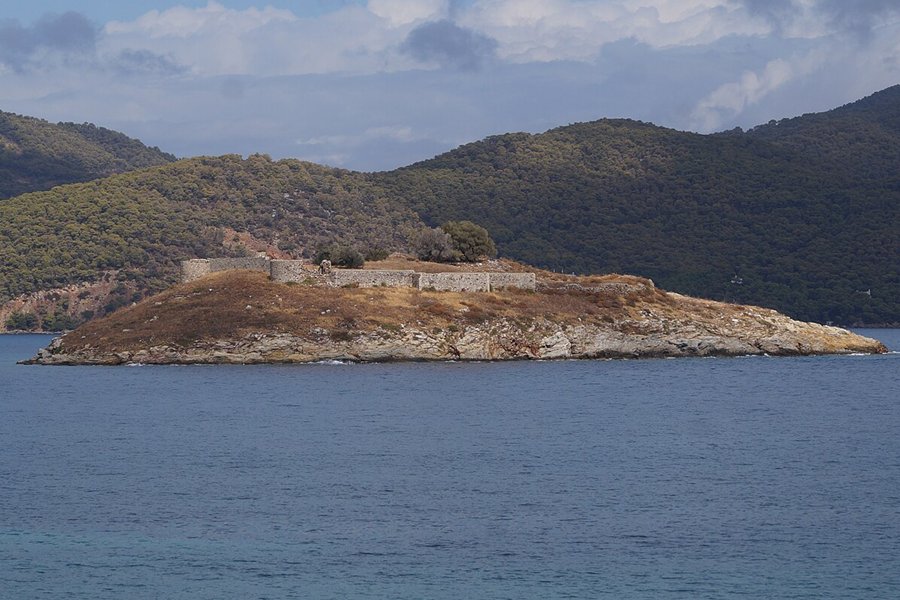
- Bourtzi: From 1770, Antonios Serfos gave the small islet of Bourtzi to the Poros monastery.
- Old church: The Bourtzi castle was later built on the site of an older church of St. Constantine.
The Life-giving Spring is an epithet of the Holy Theotokos. An epithet is an added name. Theotokos honours the Virgin Mary, and its Greek sense is Mother of God. Poros tours are rooted in an island where a whole monastery bears this title.
Which myths of King Pittheus of Troezen belong to Poros tours?
Poros tours carry the tale of Pittheus, a king of Troezen in Greek myth. He was a son of Pelops and Dia. His daughters were Aethra and Henioche, and his grandson was Theseus. In a myth, gods and heroes act in old tales handed down.
The playwright Euripides described Pittheus as a wise man. He also called him the son of Pelops with the greatest devotion to the gods. A playwright writes plays. King Aegeus of Athens once came to Troezen to ask Pittheus about an oracle. An oracle is a message from a god, given through a priestess.
For Poros tours, Pittheus also stands as a teacher of the art of speaking. Ancient accounts say he even wrote a book on it. Aristotle, a Greek philosopher, credited him with one wise saying. It holds that a payment promised to a dear friend must be ample and certain. Ample means full and generous.
A Troezen legend behind Poros tours places Heracles in the house of Pittheus. Heracles laid his lion-skin on a couch, and it looked alive. Theseus, then seven years old, walked in with his schoolmates. The other children fled, but Theseus took an axe from a guard and struck the skin. A legend is a traditional story.
- Advice: Pittheus urged Theseus to travel to Athens by sea, away from roadside bandits.
- Heir: Pittheus raised his great-grandson Hippolytus as heir to the throne of Troezen.
- Tomb: For a long time, Troezen showed the tomb of Pittheus and the chair where he judged cases.
For Poros tours, Pittheus counts as a newcomer to Troezen from the district of Pisatis in Elis. His brother Troezen came with him. After the death of Troezen, Pittheus ruled the land as its sole king. A sole king rules alone.
How does Hippolytus, the tragedy by Euripides, tie Troezen to Poros tours?
Poros tours meet ancient drama through Hippolytus, a Greek tragedy by Euripides about the son of Theseus. The play takes place in Troezen, a coastal settlement of the north-eastern Peloponnese. In a tragedy, the main story moves towards suffering and loss.
Athens first saw the play in 428 BC, at the festival called the City Dionysia. This Athenian festival honoured the god Dionysus. On Poros tours, Hippolytus holds a winning record, since it took first prize as part of a trilogy. A set of three plays shown together forms a trilogy.
Euripides had first told the myth in an earlier play, Hippolytos Kalyptomenos, meaning Hippolytus Veiled. That first version is lost; only fragments of it remain. Fragments are surviving pieces of a lost text. The surviving play is known as Hippolytus Stephanophoros, or Hippolytus the wreath bearer. The name comes from the garlands he wears in honour of Artemis.
His mother was one of the Amazons, a people of warrior women in myth. He honours Artemis, the goddess of the hunt, but not Aphrodite, the goddess of love. For Poros tours, the play holds a local link: its chorus is young married women of Troezen. A chorus is a group that sings and comments on the action.
- Sophrosyne: Hippolytus links Artemis with sophrosyne, translated as wisdom, chastity, moderation or character.
- Ending: Near the close, Hippolytus forgives his father, and then he dies.
- Later version: Racine wrote the tragic play Phèdre in 1677 as a version of this story.
In this Troezen play linked with Poros tours, Theseus calls on his father, the god Poseidon. Poseidon has promised to grant Theseus three wishes. Theseus uses one to curse his son with death or exile. A curse is a wish for harm.
Why does the Decree of Themistocles from Troezen matter for Poros tours?
Poros tours reach back to the Greco-Persian Wars through the Decree of Themistocles. Its other name is the Troezen Inscription. This ancient Greek text was found at Troezen and discusses Greek strategy in those wars. Words carved into stone like this form an inscription.
The decree claims to come from the Athenian assembly, led by the statesman Themistocles. An assembly is a meeting where citizens vote on laws. Michael Jameson, a professor at the University of Pennsylvania, saw the slab in Troezen. A year later, he published its text with a translation and notes.
The decree plans the removal of Athenian women, children and elderly people from the city. Such a removal of people from danger is called an evacuation. For Poros tours, one line of the decree names Troizen, another spelling of Troezen. Athenians were to place their children and wives there. Old people and goods were to go to Salamis.
Treasurers and priestesses were to stay on the Acropolis and guard the holy objects of the gods. In the Troezen text tied to Poros tours, 200 ships were to be manned. Each ship was to have a trierarch, a captain who commanded one warship. Trierarchs had to be men aged no more than fifty.
- Carving date: The shapes of its letters date the carving to the 3rd century BC, in its first half.
- Early mention: Demosthenes records that Aeschines read a matching decree aloud in 347 BC.
- One view: The scholar John Fine judged the decree, if genuine, a blend of decrees from different times.
For Poros tours, the stone shows a style called stoichedon, with 42 letters in each line. In this style, the letters line up in rows and columns, as on a grid. Before the end of the decree, the text on the slab becomes unreadable.
Which volcanic past does Methana bring to Poros tours?
Poros tours touch volcanic history through Methana, a peninsula with about 32 volcanoes. One of them is the Methana volcano. Water lies on three sides of a peninsula. A volcano is a place where melted rock from deep underground breaks out.
These volcanoes are mainly lava domes made of andesite and dacite. A lava dome is a rounded hill formed when thick lava piles up. Andesite and dacite are two kinds of volcanic rock. A major fault crosses Methana town, running west to east. A fault is a break where blocks of rock meet and slide.
For Poros tours, three writers, Ovid, Strabo and Pausanias, each wrote about a lava dome erupting at Methana. That dome lies by Kameni Chora, a village in the northwest of the peninsula. Pausanias also wrote of hot springs after the eruption. In an eruption, lava, ash or gas bursts out.
Poros tours also link to a human past on Methana reaching back to about 10,000 BC. The first settlements there date from about 6,000 BC. Settlements are groups of homes where people live together. Objects dated to about 1500-1200 BC now sit in museums. Those museums stand on Poros island and in Piraeus.
- Temple: A Geometric era temple near Kounoupitsa village belongs to the period of 800-700 BC.
- Later buildings: New buildings and sanctuaries rose near Vathy village, at Paliocastro hill and around it.
- Arsinoe: A Phoenician base named Arsinoe once stood on the Methana peninsula.
Within the Poros tours story, Methana counts two ancient acropoleis, Paliocastro and Oga. An acropolis is a fortified high town, and acropoleis is its plural. Ancient farm sites also dot the peninsula. A farm site is a place where ancient people grew crops and kept animals.
Where does the Conference of Poros of 1828 fit into Poros tours?
Poros tours hold a chapter of modern Greek history in the Conference of Poros of 1828. At that meeting, British, French and Russian diplomats sought the borders of an independent Greece. A diplomat is an official who acts for a country abroad.
In 1821, the Greeks rose up against Ottoman rule. Their hard struggle drew much sympathy. Talks in London failed to settle the borders. The ambassadors to the Sublime Porte were then told to meet on Poros. The Sublime Porte was the name for the Ottoman government. An ambassador is a senior diplomat posted to another country.
For Poros tours, the island’s 1828 debate had two main options. One gave Greece all land south of a line from the Gulf of Volos to Arta. The other limited Greece to the Peloponnese. In a memorandum, Governor Ioannis Kapodistrias asked for a border from Delvino to Thessaloniki. A memorandum is a written note of proposals.
After long talks, the three ambassadors proposed a Greece reaching from Arta to the Gulf of Volos. Their plan added the islands of Euboea and Samos, and possibly Crete. They reported that no other line was easier to defend. For Poros tours, Stratford Canning stands out as the leading pro-Greek voice there.
- Form of state: The meeting also settled on a monarchy, a state led by a king, for Greece.
- London’s reply: Britain’s prime minister, the Duke of Wellington, turned down the conference report.
- A throne refused: Prince Leopold refused the Greek throne in 1830 without the borders set at Poros.
For Poros tours, the Treaty of Adrianople followed in September 1829. Under it, the Ottomans promised to accept the decision of the London Conference. That promise came after Russia defeated them in the Russo-Turkish conflict of 1828-29. Treaties are formal pacts that states sign.
How did the frigate Hellas reach its end in the history of Poros tours?
Poros tours belong to an island where Hellas, flagship of the Revolutionary Hellenic Navy, met its end. Admiral Andreas Miaoulis burned this frigate there in 1831. A frigate is a fast warship, and a flagship carries the commander of a fleet.
The ship’s story began in 1825, while Greece fought its War of Independence. Greek agents in London ordered two frigates from a shipyard in New York City. Ships are built at a shipyard. The Greek government then defaulted, which means it failed to pay. One ship was sold to fund the other.
For Poros tours, the voyage of the frigate began in New York in early October 1826. On the way, the crew tried to murder the captain and a Greek agent. Their plan was to sell the ship in Colombia. The mutiny, a revolt by the crew, failed, and the ship reached Nafplion about 25 November 1826.
Admiral Andreas Miaoulis, with 30 local mariners, then took control of the ship. A mariner is a sailor. Renamed Hellas, she became the flagship, since no ship in the navy was more powerful. For Poros tours, her list of captains includes Cochrane, Antonios Miaoulis and Konstantinos Kanaris. Antonios was the son of the admiral.
- Delivery: Three admirals, from Hydra, Psara and Spetses, formally received the frigate at Nafplion.
- Refusal: Miaoulis refused an order to hand the fleet to the Russian admiral Pyotr Ricord.
- Burning: When Ricord attacked Poros on 13 August, Miaoulis set fire to the small fleet.
Along with Hellas, two corvettes were scuttled, or sunk on purpose by their own side. A corvette is a small warship. For Poros tours, the island keeps a naval role: the Hellenic Navy still trains staff there today.
What do travellers ask about Poros tours, and what are the answers?
Poros tours link with Troezen, a mainland town a short way south of Methana. Galatas was the seat of the former Troezen municipality. In Greece, each municipality runs local affairs from its seat, the town where its council meets.
Before Poros tours, which older names did Troezen carry?
In ancient times, Troezen also bore the name Apollonia. Under later Frankish rule, people knew the town as Damalet or Elamala. The Franks were crusaders from Western Europe. The Ottoman Empire conquered Troezen before the 16th century. In an empire, one ruler holds power over a wide area of lands.
Ahead of Poros tours, what have finds on the Methana peninsula shown?
The first survey of Methana was made by Michael Deffner, who found a large throne. Ancient sites came to light in a survey of the 1980s. The University of Liverpool ran it with the British School at Athens. Ruins of basilicas, or long hall churches, date from the late 6th century or the early 7th.
For Poros tours, where does Megalochori sit on Methana?
Megalochori is a village in the western part of the Methana peninsula. It lies 3 km northwest of Methana town. Its community also takes in Vathy, Kaimeni Chora and Megalo Potami. A community here means a small local council unit. Pausanias described the ancient Acropolis of Methana, which lies near Megalochori.
On Poros tours, what is the mountain village of Ano Fanari?
Ano Fanari is a mountain village in the northeastern Peloponnese, in Greece. It belongs to the Troizinia-Methana municipality, the local council area. A small acropolis, or fortified high point, rises above the village. Ano Fanari stands on the old road from Galatas to Agia Eleni and Epidavros.
Featured photo: Robin Iversen Rönnlund, CC BY-SA 3.0, via Wikimedia Commons.