
Milos tours are small-group, expert-led or skippered outings on the Cycladic island that sits farthest southwest. Its story runs from Bronze Age Phylakopi to the Venus de Milo and the catacombs. Four short answers then turn to Sarakiniko, obsidian and the clay reliefs of ancient Melos. Milos also fits into Greece island hopping tours and wider Greece tour packages. More trips appear under Greece tours.
Bookings made through the GetYourGuide widgets on this page earn Classical Greece Tours a commission, at no extra cost to the traveller.
What are Milos tours?
Milos tours are expert-led, skippered or small-group trips to a Greek island formed by volcanoes in the Aegean. Within the Cyclades group, no island lies farther to the southwest. Volcanic means made by eruptions that pour out molten rock.
Sculptures found on Milos include the Venus de Milo, the Poseidon of Melos and the Asclepius of Milos. The Asclepius of Milos now stands in London, at the British Museum. An archaic statue of Apollo from the island is kept in Athens. Archaic describes the early age of Greek art, before the Classical period.
Milos tours unfold on an island where nearly all the empty west is a Natura 2000 site. That label names a protected site in a Europe-wide nature network. It holds over 800 taxa, or kinds of living things, and 35 occur only in Greece. A local survey of plant uses named Greek sage ahead of all others.
On 11 April 1821, the opening sea battle of Greece’s War of Independence was fought off Milos. A sea battle pits warships against each other. The island’s population reached its peak in 1928, with 6,562 people. Records on medicinal plants, part of the island story behind Milos tours, date back to the 16th century.
- Trees: Arbutus, juniper, tamarisk, cypress, olive and orange trees all grow on Milos.
- Crops: Grapes, cotton and barley rank as the main crops grown on Milos.
- Pigment: Ancient artists used Melian earth from the island as a pigment, or colouring.
Milos tours take their name from an island whose notable people include Melanippides, a 5th-century BC poet. Diagoras, a philosopher of the same century, also came from the island. A philosopher reasons about big questions of knowledge and life.
Why is the Venus de Milo part of the story of Milos tours?
Milos tours share their island with the Venus de Milo, also called the Aphrodite of Melos. The statue is believed to show Aphrodite, a goddess the Romans called Venus. Melos is the ancient Greek name of the island of Milos.
The figure linked with Milos tours rests her weight on her right leg and raises the left one. Her head turns to the left. Her flesh is polished smooth, while chisel marks remain on other surfaces. A chisel is a metal tool with a sharp edge for cutting stone. Her lips part slightly to show her teeth.
The sculpture behind Milos tours mixes classical and Hellenistic art. Her torso shape and her deeply cut drapery belong to the Hellenistic style. Hellenistic refers to the late age of ancient Greek art. A filled hole below her right breast once held a metal tenon for the right arm. A tenon is a joining peg.
Dumont D’Urville wrote that the statue lay in a quadrangular niche. Quadrangular means having four corners and four sides. An inscription found with it recorded a gift by Bakchios, son of Satios, an assistant gymnasiarch. A gymnasiarch ran a training ground for young men. These clues suggest the statue once stood in the gymnasium of Melos.
- Wartime move: During the First World War, the statue left Paris for the Church of the Jacobins in Toulouse.
- Other ideas: Scholars have also proposed that the figure shows a Muse, Nemesis or Sappho.
- Lost arms: Wilhelm Fröhner suggested in 1876 that her right hand held slipping drapery and the left an apple.
Without its arms, the first look of the statue linked to Milos tours remains unclear. Proposed restorations show her holding wreaths, a dove or spears. In the 1880s, a new pedestal let viewers rotate the sculpture in the Louvre.
What did digging at Phylakopi reveal for Milos tours?
Milos tours tell of Phylakopi, a settlement of the Bronze Age on the northern coast of Milos. It serves as a type-site for studying periods of the Aegean Bronze Age. A type-site is the model site that defines a phase of the past.
The settlement behind Milos tours holds a megaron, a great hall of the kind built in Mycenaean palaces. Its main room measured roughly 8.6 metres by 6.2 metres, with a hearth at its centre. Entry to the hall crossed a threshold of poros stone 2.20 metres long. Poros is a soft limestone used in Greek building.
Infants at Phylakopi were buried beneath the floors of houses. In 1911, Dawkins and Droop reported eight child burials in pithoi. Pithoi are large clay jars once used for storage. Excavators at the site linked with Milos tours found the jars laid on their sides. At times, a basin or another pot sealed the jar’s mouth.
The Pillar Rooms Complex spans about 21 metres west to east and 13 metres north to south. Its flying fish frieze, a fresco, now hangs in the National Museum in Athens. In fresco work, colours go onto fresh, damp plaster. A frieze runs as a long strip of decoration along a wall.
- Monkey eye: One fragment preserves the eye of a blue monkey painted on plaster.
- Rare image: In this period, monkey images also appear only at Knossos and Thera.
- Offering bowls: Five pierced bowls on pedestals stood at the base of a column in the West Room.
Digging at the site behind Milos tours resumed in summer 1974, after a gap of 63 years. That season brought to light a shrine with Aegean figurines, among them the Lady of Phylakopi. The sea has washed away part of the site.
What do travellers ask about Milos tours, and what are the answers?
Milos tours prompt four questions about the island. Sarakiniko faces the sea on the island’s north side. Christians buried their dead in the catacombs. Milos supplied obsidian to cultures in and around Greece. Melian clay reliefs ceased after Sparta took control of the island.
On Milos tours, what is Sarakiniko?
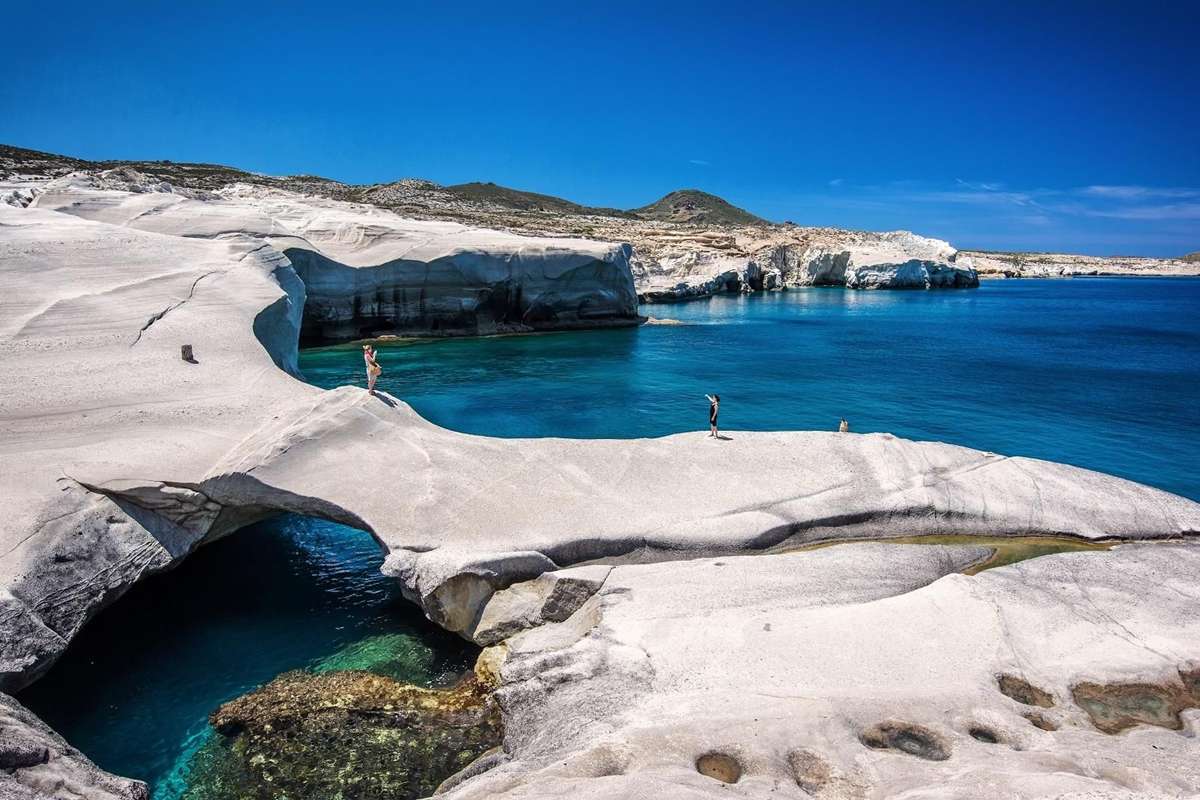
Local people call the landscape of Sarakiniko by the name Lunar. Lunar means of or like the Moon. The west side of the site has this moon-like look. The east side, by contrast, is a desert. A desert is dry, rocky land with little plant life.
Before Milos tours, what are the Catacombs of Milos?
Trypiti, the name of the nearby village, means made with holes. The name refers to caves cut into the soft volcanic stone around it. Local people still keep those caves as storerooms and stables. The galleries are 1 to 5 metres across. Their height varies from 1.6 metres up to 2.5 metres.
Why does obsidian matter to Milos tours?
Obsidian forms as glass when lava pours from a volcano and cools very quickly. Fast cooling leaves almost no time for crystals to grow inside it. Lava means liquid rock that has left a volcano. In ancient times, the Aegean had two sources of obsidian: Milos and Gyali.
In the history of Milos tours, what were the Melian reliefs?
Terracotta is clay that has been baked hard. The Melians exported such reliefs from at least 470 BC until the siege of 416 BC. In a relief, the carved figures rise from a flat background. They served as ornaments for doors and chests and showed scenes from myth.