
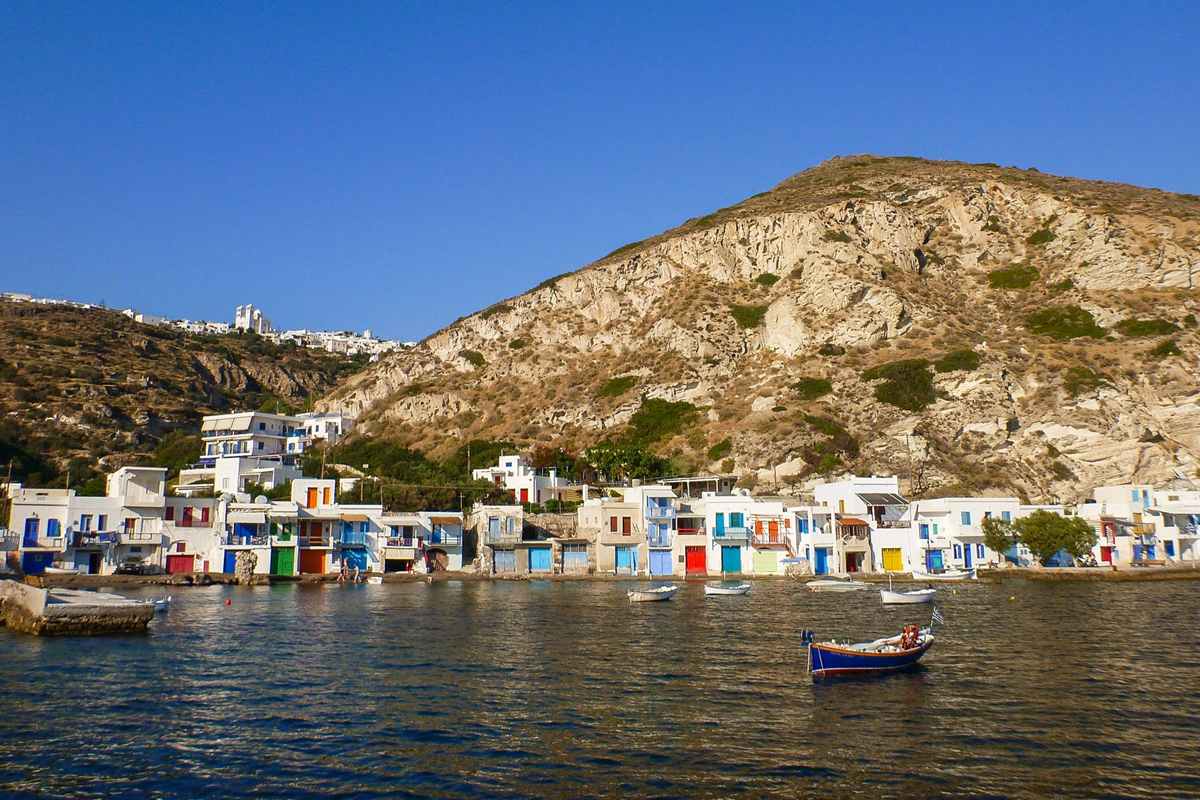
Greek island cruises are boat trips for pleasure around the islands of Greece. They take place mainly in the Aegean and Ionian seas. Harbours and straits come first, from the Port of Thessaloniki and Alexandroupolis to the Hellespont. Myrina on Lemnos, Chios town and the ancient harbour of Samos follow. Sea life, lighthouses, shipwrecks and maritime history complete the set, and four short answers end it. Related pages cover Greece island hopping tours, Milos tours and Naxos tours. A wider range of trips sits under Greece tours.
Bookings made through the GetYourGuide widgets on this page earn Classical Greece Tours a commission, at no extra cost to the traveller.
What are Greek island cruises?
Greek island cruises are pleasure trips by boat among the islands of Greece. A cruise is a sea journey made for enjoyment rather than for transport. Estimates put the islands of Greece at 1,200 to 6,000. The figure depends on the smallest size counted.
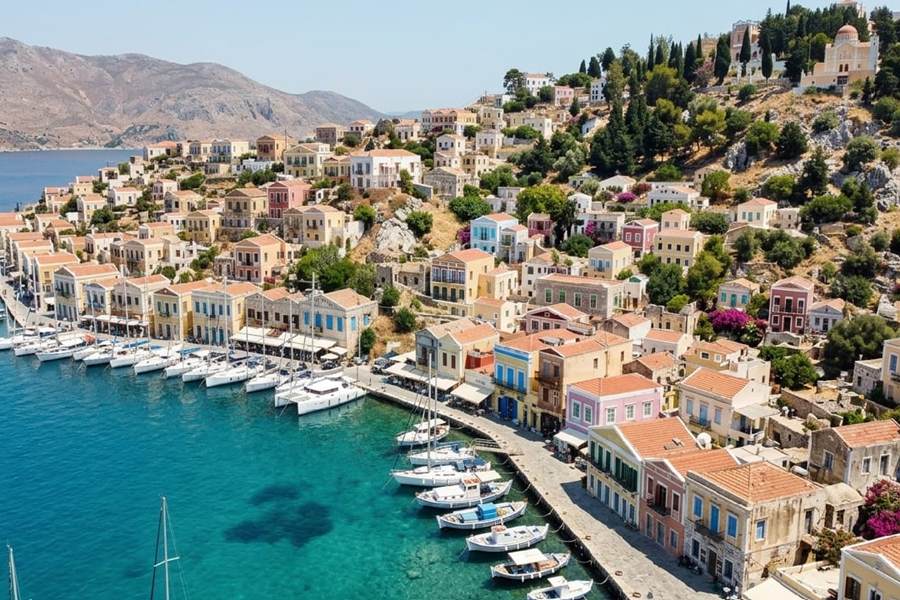
Between 166 and 227 of these islands are cited as inhabited, which means people live on them. Greek island cruises take place among islands sorted into traditional clusters. A cluster is a group of things set close together. These clusters include the Cyclades, the Dodecanese, the Sporades and the Saronic Islands near Athens.
Lying between Europe and Asia, the Aegean Sea forms a long, narrow arm of the Mediterranean. Its length from north to south comes to about 670 kilometres. Greek island cruises happen on a sea that measures about 390 kilometres across. Its northern section is the Thracian Sea, while the Icarian Sea lies to the east.
Plenty of Aegean islands have safe harbours and bays. In a harbour, boats rest in calm water shielded from wind and waves. Greek island cruises sail a sea bordered by nine of Greece’s twelve administrative regions. Each such region is a division of the country that runs its own local affairs.
- Island sizes: Lesbos and Rhodes come third and fourth in size among the Greek islands.
- Island chains: One chain of islands reaches Chios, and another crosses Euboea to Samos.
- Ionian side: The Ionian Islands sit chiefly to the west of mainland Greece, in the Ionian Sea.
Long before Greek island cruises, travel by sea through the Aegean was easier than crossing the rough mainland. Rough ground here means steep, broken land that slows travel on foot. The Aegean islands also helped contact between local peoples, and between Europe and Asia.
Why does the Port of Thessaloniki matter for Greek island cruises?
Greek island cruises share the northern Aegean with Thessaloniki and its large port. The port is the main sea gateway to Southeast, Central and Eastern Europe. It serves passengers on cruise ships and ferries alike. A gateway is a main point of entry.
For Greek island cruises, the port offers a passenger terminal ranked among the largest in the Aegean. The terminal stands in a building that once served as the customs house. A customs house is where officials once checked goods arriving by sea. Eli Modiano, a local architect, built it from 1909 to 1912.
Greek island cruises belong to a sea where this harbour ranks second among Greek container ports. A container port loads goods packed in large metal boxes of one standard size. The harbour is also the largest export port of the country. An export port sends goods out of a country for sale abroad.
Its container terminal measures 550 metres in length and 340 metres in width. The terminal sits inside the free zone, an area with its own tax and customs rules. The quay walls of the port reach a total length of 4,200 metres. A quay is a stone platform where ships tie up.
- Quays: Fourteen quays handle every type of bulk and loose cargo at the port.
- Design: The terminal for Greek island cruises followed plans by Alexander Vallaury, an architect of French roots.
- Vardaris: The area above the port carries the traditional name of Vardaris.
Thessaloniki, a northern city linked to Greek island cruises, keeps its port very close to the city centre. Rail services also run from the port to a dry port in Sofia, Bulgaria. A dry port is an inland depot linked to a seaport by rail or road.
What role does Alexandroupolis play in Greek island cruises?
Greek island cruises sail a sea whose northern coast holds Alexandroupolis, a port city in Greek Thrace. It is the capital of the Evros regional unit and the largest city in Eastern Macedonia and Thrace. Greek Thrace forms the north-eastern corner of the country.
The modern city began in the early 19th century as a small fishing village. Fishermen from Ainos, Makri and Maroneia founded it. Fishermen from Samothrace, across the water, had long used the spot as a landing ground. A landing ground is a stretch of shore where small boats come in.
Under Ottoman rule, the town was known as Dedeagach. The name supposedly honours an old Turkish wise man, called a dede in Turkish. He spent long hours in the shade of a tree, an ağaç, and lies buried beside it. For Greek island cruises, the present name dates from 1920 and honours King Alexander of Greece.
The modern city stands near the site of ancient Sale. Sale was a colony of Samothrace. A colony is a town set up by settlers from another place. Travellers have been the main users of the port of Alexandroupolis. On Greek island cruises in the north-east, the city waterfront is the centre of commercial activity.
- Lighthouse: The lighthouse was built in 1850 and first operated in 1880, beside the harbour.
- Light beam: Its beam reaches 24 nautical miles, about 44 kilometres, with three white blinks every 15 seconds.
- First new name: In 1920 local authorities first chose the name Neapoli, meaning new city.
The city holds a central place on land and sea routes between Greece and Turkey. Greek island cruises share these waters with its harbour on the Thracian coast. A route is a fixed way that travellers or goods follow between places.
Which legends tie the Hellespont to Greek island cruises?
Greek island cruises sail the Aegean, which joins the Sea of Marmara at the Hellespont. That strait now goes by the name Dardanelles. In plain words, a strait is a slim sea passage linking two seas. The ancient Greek name means the Sea of Helle.
Helle was the daughter of King Athamas in Greek myth. She fell from a flying golden ram and drowned in these waters. The tale belongs to the Golden Fleece legend. Fleece means the wool that covers a sheep or a ram. The modern name is thought to come from Dardanus, an ancient city on the Asian shore.
For Greek island cruises, the strait is also the scene of the tale of Hero and Leander. In the legend, Leander swam the strait each night to meet Hero, a priestess. A storm drowned him in the end. In 1810 the poet Lord Byron swam across the strait from Europe to Asia.
The strait beside the waters of Greek island cruises is 61 kilometres long. Its width ranges from 1.2 to 6 kilometres. It averages 55 metres deep and reaches 103 metres at its narrowest point. At the surface, water moves from the Black Sea towards the Aegean. Below it, a saltier current runs the opposite way.
- Troy: Ancient Troy stood close to the western mouth of the strait.
- Sailing ships: Ships under sail wait at anchor for ideal conditions before they enter the strait.
- Open-water swim: Swimmers recreate the crossing of Lord Byron each year in an open-water swimming event.
Through the Bosporus, the Dardanelles gives ships a sea link from the Black Sea to the Mediterranean. The Bosporus is a second strait, on which the city of Istanbul lies. Greek island cruises take place at the Mediterranean end of that chain of waters.
How does the harbour town of Myrina fit Greek island cruises?
Greek island cruises sail waters where the town of Myrina serves as the capital of Lemnos. Fish taverns ring the traditional harbour along the stretch of coast called the Turkish Shore. Caiques, the small wooden fishing boats of Greek waters, lie moored there.
For Greek island cruises, Myrina keeps its Town Hall in the harbour. It stands near the Port Authority, which runs the port. The Tchas quarter lies just behind the harbour area. Tchas is held to derive from the Russian word for sentry. Russian soldiers were stationed there for a short time in the late 18th century.
In the census of 2001, Myrina counted 3,022 regular dwellings, or homes. A census tallies the people and homes of a place for official records. Of these dwellings, 30.4% were built of stone. Red-tile pitched roofs covered 75.6% of them. A pitched roof slopes down on two or more sides.
For Greek island cruises, the Roman Shore marks where the Greek community had its homes in Ottoman times. This lasted until the capture of Lemnos in 1912, a step in the First Balkan War. The Turkish community lived along the Turkish Shore until Greece and Turkey exchanged their populations. That exchange moved people between the two countries.
- Nea Madetos: This quarter, built after 1980, holds houses of workers and fishermen on a hill.
- Museum: Exhibits in the archaeological museum of the town come from the prehistoric past, before written history.
- Climate: Myrina falls in the hot-summer Mediterranean group, labelled Csa in the Köppen system.
Greek island cruises share the sea with a town where plenty of streets are stone-paved alleys. An alley is a narrow lane between buildings. During the summer, Myrina holds outdoor theatre and music events. Theatre here means stage plays performed before an audience.
What links Chios town and the Chios Strait to Greek island cruises?
Greek island cruises in the eastern Aegean share the sea with Chios town. It is the main port and the seat of government of its island. Its site on the eastern shore faces Çeşme, a coastal town in Turkey, across the water.
For Greek island cruises, Chios town began beside a natural harbour, on its northern edge. By the 16th century, Genoese rulers had turned the walled Byzantine town into a massive castle. The Genoese came from the Italian city of Genoa. The word Byzantine names the eastern Roman state of medieval times.
A severe earthquake struck in 1881, and much of the town rose again in neoclassical style. Neoclassical buildings copy the columns and clean lines of ancient Greek and Roman design. The promenade and its buildings show the influence of nearby Smyrna, on the coast of Asia Minor. In 1885 the town had about 13,000 people.
The Chios Strait measures about 3 nautical miles across. Sailors measure distances over water in nautical miles. Çeşme is the Turkish city closest to Chios, and nearly its whole coast lies on the strait. Greek island cruises share a sea where this strait is a common area for tourism and boating.
- Town centre: The town centre lies between the port and the castle, with museums and gardens.
- Vrontados: Vrontados is a suburb on the northern side of Chios town.
- Landmarks: Landmarks of the town include the Maritime Museum of Chios and the Korais Library.
The island holds eight municipal units, and Chios town is one of them. Each municipal unit forms a local district inside a larger municipality. Greek island cruises share the eastern Aegean with this unit of 22.823 square kilometres.
Where does the ancient harbour of Samos sit in the story of Greek island cruises?
Greek island cruises in the North Aegean sail waters where ancient Samos once kept its main harbour. The harbour lay at the town of Samos, known today as Pythagoreio. Herodotus ranked its mole among the three finest engineering works of the Greek world.
A mole is a massive stone barrier pushed out from the shore to guard a harbour. Herodotus wrote that the mole reached over two stades into the sea, more than 400 metres. A stade was an ancient Greek measure of length. He also gave its depth as about 20 metres.
Samos rose to rank among the leading naval powers of the Aegean in the sixth century BC. Its peak came under the tyrant Polycrates. A tyrant here means a sole ruler who seized power. Greek island cruises share waters where the harbour stayed a major naval base under Roman rule. In AD 262, an earthquake seriously damaged the harbour.
The modern breakwater of Pythagoreio gave way in 1988. Repair work then revealed signs of the ancient mole. A breakwater is a barrier that breaks the force of waves. Eleven divers dug under water that year, led by the archaeologist Angeliki Simossi. Research has traced a mole 480 metres long beneath the water.
- Oldest port: For Greek island cruises, Pythagoreio is said to hold the oldest man-made port in the Mediterranean.
- New harbour: Between 1859 and 1866, a new harbour rose on the site of the ancient one.
- Byzantine era: In the Byzantine era, the harbour of Samos kept its importance.
In ancient times, storms and earthquakes damaged the mole again and again. Each repair heaped fresh stones over the older layers, so the remains are hard to date. For Greek island cruises, the present mole of Pythagoreio dates from the 19th century.
What does the Antikythera wreck add to Greek island cruises?
Greek island cruises are trips on Greek seas, and the Antikythera wreck lies off one Greek island. Sponge divers found it off Point Glyphadia on Antikythera in 1900. This Roman-era ship dates from the first century BC, within that century’s second quarter.
The divers wore the standard diving dress of their time. That dress meant waterproofed canvas suits and copper helmets. Diver Elias Stadiatis went down to a depth of 45 metres. He came back up fast and spoke of corpses and horses on the seabed. The captain dived next and returned with a bronze arm from a statue.
Greek island cruises run in a country whose navy backed this salvage from November 1900 through 1901. Divers raised bronze statues and thirty-six marble sculptures by the middle of 1901. A sounding lead is a weight lowered on a line to measure depth. Its sounding leads are the only ones found on any ancient Aegean wreck.
Greek island cruises take place in Greece, and its National Archaeological Museum in Athens displays the finds. Hull planks showed a ship built of elm, a wood the Romans used. Coins found in the 1970s were struck between 76 and 67 BC. A weapon called a dolphin, a lead bulb of 100 kilograms, also came up.
- War dolphin: Tipped with an iron spike, this weapon is the only war dolphin ever found.
- Pamphilos: A human skeleton 2000 years old, nicknamed Pamphilos, turned up at the wreck in 2016.
- Boulders: In 2022 teams moved three boulders of 8.5 tons each that partly covered the wreck.
Greek island cruises operate in Greece, whose government allowed new dives around all of Antikythera in 2012. Rebreathers, sets that recycle a diver’s breath, let the team reach 70 metres. That survey found a second ancient wreck hundreds of metres to the south.
Which facts about the Mediterranean monk seal suit Greek island cruises?
Greek island cruises take place in a country with 250 to 300 Mediterranean monk seals. The Aegean Sea is one of only two key sites for the species. Experts estimate that 800 to 1000 of these seals survive in all.
Experts believe the seal has the shortest hair of any pinniped. A pinniped is a flipper-footed sea mammal, such as a seal or walrus. Adults grow to an average length of 2.4 metres. Pups have dark brown to black hair and a white belly stripe. Females tend to show a rectangular stripe, and males a butterfly shape.
Monk seals are diurnal, which means they are active by day. They eat octopus, squid, lobsters, mullets, sardines and eels, up to 3 kg a day. Observers have even seen these seals lift slabs of rock to reach prey. Greek island cruises share Greek seas with this seal, also found off Croatia, Cyprus, Albania and Turkey.
Pregnant seals give birth in sea caves that people can hardly reach. Old accounts show births on open beaches up to the 18th century. Sea storms that strike the caves are a major cause of death among pups. Greek island cruises take place in Greece, where the law is very strict towards seal hunting.
- Teeth: Each jaw of the Mediterranean monk seal holds eight pairs of teeth.
- Nostrils: Its short, flat snout carries long nostrils that face upwards, unlike its Hawaiian relative.
- Old fears: Ancient Greeks and Romans seem to have feared the seal for its form and smell.
In 2020 a monk seal was filmed on a sunlounger on the Greek island of Samos. In 2023 the IUCN, a world conservation body, moved it from endangered to vulnerable. Greece, home of Greek island cruises, has set aside a large area to protect the seal.
How does the Battle of Salamis fit the sea story behind Greek island cruises?
Greek island cruises sail Greek seas, and the Battle of Salamis was a sea battle of 480 BC. The fighting filled the narrow waters between the mainland and the island of Salamis. A Greek alliance under Themistocles beat the bigger Persian fleet of Xerxes.
Greek island cruises are trips among islands like Salamis, a Saronic Gulf island close to Athens. In 482 BC Athens chose to build a big fleet of triremes. Such a warship, the trireme, had three banks of oars. In late autumn of 481 BC, allied Greek states gathered at Corinth and formed a league.
The Persian fleet entered the channel and tried to close both of its ends. The cramped water turned the huge Persian numbers into a hindrance. Aeschylus claims the Persians heard a Greek battle hymn, or paean, before seeing the fleet. Herodotus says one Greek ship then darted ahead to strike the closest Persian vessel.
In the history behind Greek island cruises, both fleets carried marines, soldiers who fight from a deck. The Greek marines were fully armed hoplites, or heavy foot soldiers. Early in the fight the Persian admiral Ariabignes, a brother of Xerxes, was killed. In the centre, a Greek wedge split the Persian fleet in two.
- Artemisia: The Queen of Halicarnassus led the Carian ships on the Persian side of the battle.
- Size: It has a fair claim to be the biggest sea battle of the ancient world.
- Aftermath: The next year, Greek forces defeated the Persian army at Plataea and the navy at Mycale.
Greek island cruises happen in Greece, where this battle was a turning point of the Persian invasion. After the battle, Xerxes went back to Asia with much of his army. From then on, the Greek poleis took the offensive. Poleis means city-states in ancient Greek.
What links the loggerhead sea turtle with Greek island cruises?
Greek island cruises run around Greece, the leading Mediterranean country for loggerhead nesting sites. On Zakynthos lies the largest nesting area, and Kyparissia Bay comes second. The loggerhead is a marine reptile whose skin ranges from yellow to brown.
Greek island cruises take place in a land that bans night flights on Zakynthos for the nesting turtles. The English name loggerhead refers to the animal’s large head. In 1758 Carl Linnaeus named the species Testudo caretta, its first scientific name. Its present name, Caretta caretta, was first used in 1873.
A grown loggerhead averages around 90 cm along its carapace, the upper shell. Grown males have thicker tails than females and shorter plastrons, or lower shells. The turtle feeds mainly on bottom-dwelling invertebrates, which are animals without a backbone. Besides Greece, the land of Greek island cruises, the coasts of Cyprus and Turkey are common nesting sites.
Nest temperature decides the sex of each loggerhead hatchling. Eggs kept at a steady 32 °C become females, and eggs at 28 °C become males. A temperature of 30 °C gives equal numbers of each. Hatchlings dig up through the sand, mostly at night. They find the sea by heading for the brighter horizon over the water.
- Weight: Adults weigh about 135 kg, and the biggest specimens reach about 200 kg.
- Hatchlings: At hatching, a young loggerhead measures roughly 4.6 cm and weighs roughly 20 g.
- Roots: Loggerheads of the North Atlantic and the Mediterranean trace their descent to turtles from Tongaland, South Africa.
Greek island cruises take place on the Mediterranean, which serves as a nursery for young loggerheads. Almost 45% of the young turtles there arrived from the Atlantic. Turtles of the Mediterranean are smaller, on average, than those in the Atlantic. The IUCN lists the species as vulnerable.
Which story does Posidonia oceanica give Greek island cruises?
Greek island cruises are trips on the Mediterranean, and Posidonia oceanica is a seagrass endemic to that sea. Endemic means it grows naturally nowhere else. Its common names are Neptune grass and Mediterranean tapeweed. It forms large meadows under water.
Greek island cruises belong to a country whose myths made Poseidon god of the seas. The genus Posidonia, a group of related species, takes its name from him. The plant grows at depths of 1 to 35 metres, depending on how clear the water is. Its ribbon-like leaves grow in tufts of six or seven.
Meadows close to the surface flower in September and October. Its flowers are hermaphroditic, which means each holds both male and female parts. The fruit, known locally as the sea olive, floats thanks to an oily substance. When the fruit rots, its seed sinks and can sprout into a new plant.
Greek island cruises take place within the Mediterranean basin, and this plant covers about 3% of that basin. That share equals about 38,000 square kilometres. Its presence marks water free of pollution, since it grows best in clean seas. Rising temperatures slow its growth, and anchors damage the meadows.
- Neptune balls: Balls of fibre from its leaves, called egagropili, wash up on nearby shores.
- Slow growth: Its horizontal rhizomes, or creeping stems, grow just 1 to 6 centimetres a year.
- Family: Posidonia is the sole genus in its own family, the Posidoniaceae.
Greek island cruises are outings on the Mediterranean, where meadows of this plant are in decline. Bacteria, algae and bryozoans settle on its leaves and rhizomes. Bryozoans are tiny water animals that live in colonies. Dead rhizomes mixed with olive-mill waste serve as compost.
What do travellers ask about Greek island cruises, and what are the answers?
Greek island cruises prompt questions about four names from the sea history of Greece. Two are a lighthouse off Lesbos and an old way of diving with a stone. The other two are a classical wreck near Alonissos and a museum in Piraeus.
Before Greek island cruises, what is the Megalonisi Lighthouse?
The Megalonisi Lighthouse stands on the island of Megalonisi, about 1.5 kilometres west of Sigri. That village lies near the western tip of Lesbos, a Greek island. The lighthouse is a circular tower 13.4 metres tall with a one-storey keeper’s house. Its light first shone in 1861, with oil as its fuel.
Where does skandalopetra diving come from, for fans of Greek island cruises?
Skandalopetra diving dates from ancient Greece, when sponge fishermen used it. It has since returned as a freediving discipline. Freediving means diving on a single breath, with no air tank. Each dive uses a skandalopetra, a stone on a rope. In competition, it is a team sport for a diver and a rope tender.
What is the Peristera shipwreck, in the context of Greek island cruises?
A cautious estimate gives the cargo of this wreck as 4200 amphoras, or clay jars. They weighed 126 metric tons. The find proves that Greeks built ships for loads up to 150 tons from the fifth century BC. In 2020 the wreck site became the Alonissos Underwater Museum, the first in Greece.
For travellers on Greek island cruises, how did the Hellenic Maritime Museum begin?
The first attempt to found the museum came in 1867, in the young Greek state. That year Gerasimos Zochios, a navy master, proposed collecting objects of Greek sea history. On 7 April 1949, Piraeus citizens and naval officers signed a memorandum of association. Such a memorandum is the founding paper of a society.