
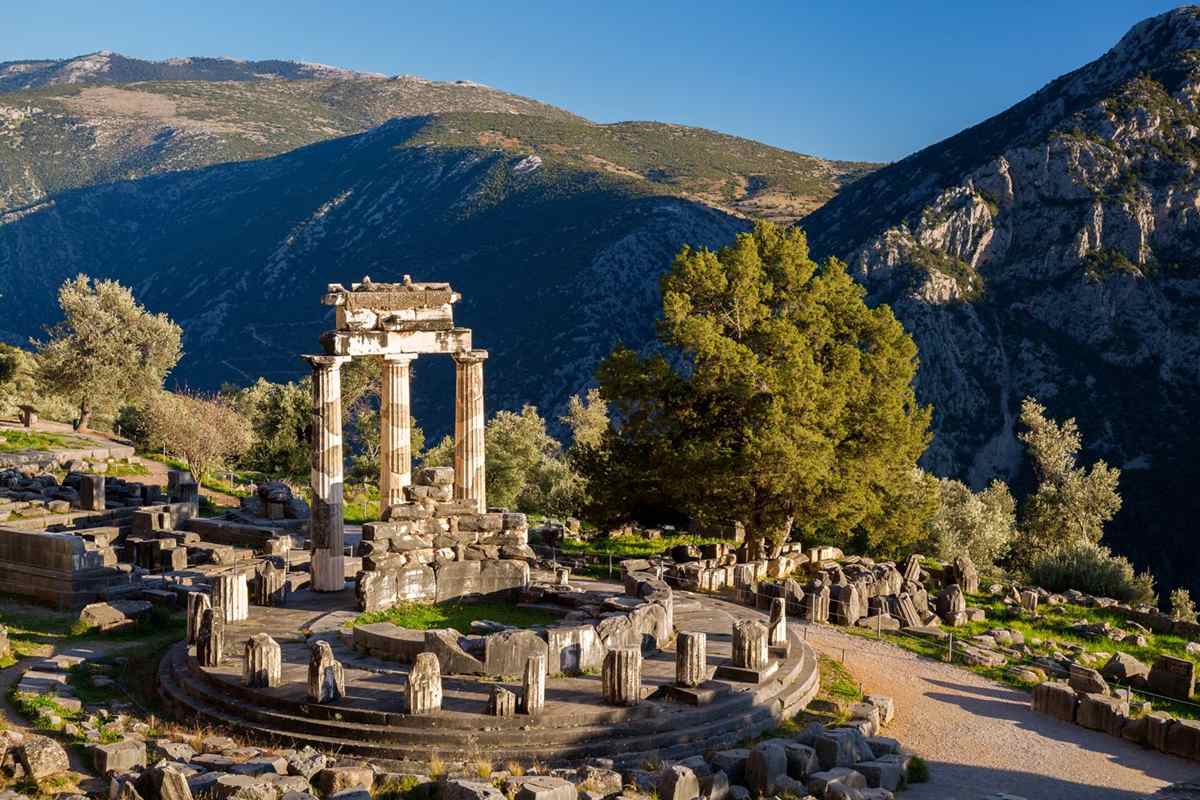
Delphi tours are expert-led and small-group trips to Delphi, the old home of the oracle of Apollo. Its ruins rest on the southwestern flank of Mount Parnassus, a mountain range of central Greece. Key themes are the Pythia, the Temple of Apollo, the Charioteer, the Pythian Games and Parnassus myths. Four short answers cover the museum, the omphalos, the theatre and the Castalian Spring. Delphi also fits a classical Greece tour and the wider range of Greece small group tours. Trips across the whole country appear under Greece tours.
Bookings made through the GetYourGuide widgets on this page earn Classical Greece Tours a commission, at no extra cost to the traveller.
What are Delphi tours?
Delphi tours are small-group or expert-led trips to Delphi, a holy precinct of ancient central Greece. Legend gave the place an older name, Pytho. The ancient Greeks believed that the centre of the whole world lay at Delphi.
The precinct served as the seat of the Pythia, a major oracle. An oracle was a priestess believed to speak the answers of a god. The name behind Delphi tours shares a root with delphys, the Greek word for womb. A root is the core part of a word, which related words share.
UNESCO lists the precinct as a World Heritage Site, a place of value to all humanity. The listing rests on the great influence Delphi had in the ancient world. The larger share of the ruins tied to Delphi tours dates from the sixth century BC. That century marked the peak of activity at the site.
Bernard Haussoullier carried out the first brief excavation of the site in 1880. Excavation means careful digging that uncovers remains buried in the ground. Buildings once stood inside the sacred precinct. The modern town of Delphi was created after those buildings were removed. Their removal allowed the ancient precinct to be excavated.
- Chian altar: The people of Chios paid for and built the chief altar, which stands before the temple.
- Black stone: Black marble forms the whole altar, apart from its base and its cornice, or top moulding.
- Repair: Workers carried out restoration work on the Chian altar in the year 1920.
People across the ancient classical world consulted the oracle behind Delphi tours about important decisions. Classical here refers to the age of ancient Greek and Roman culture. Those who came carried their questions to the Pythia in the sacred precinct.
Who was the Pythia in the story of Delphi tours?
Delphi tours recall the Pythia, the priestess who served as oracle at the Temple of Apollo. English writers once rendered her title as the Pythoness. People kept on consulting her right up to the late 4th century AD.
The oracle behind Delphi tours ranks among the best-documented religious institutions of the classical Greeks. Herodotus, who wrote in the fifth century BC, says she gave answers in dactylic hexameter. Hexameter is a line of verse built from six metrical units. A dactyl is one long syllable followed by two short ones.
Tradition names Phemonoe as the first woman to hold the title. Later holders seem to have come from a guild of priestesses, all natives of Delphi. A guild is a body of people sharing a trade or a role. Each candidate needed a sober life and a good character. Sober here means calm and moderate.
Priestesses, the Pythia among them, enjoyed freedom from taxation and the right to own property. At the peak of the oracle, up to three women served as Pythia. Two took turns giving prophecies, while a third waited in reserve. In the history behind Delphi tours, Plutarch said that service to Apollo shortened her life.
- Prophet: The English word prophet comes from prophetes, a title for officials who served the oracle.
- Holy ones: Five officials called hosioi, or holy ones, served the oracle, though their duties remain unknown.
- Clear speech: Scholars Joseph Fontenrose and Lisa Maurizio argue that ancient sources show her speaking clearly.
For Delphi tours, the title Pythia traces back to pythia hiereia. Those Greek words mean priestess of the Pythian Apollo. Pythios was an epithet of Apollo, a descriptive name added to a god. The epithet grew from Pytho, the old name of the site in myth.
Which legends shaped the Temple of Apollo behind Delphi tours?
Delphi tours share their setting with the Temple of Apollo, which was also known as the Apollonion. Its god, Apollo, presided over archery, music, light, prophecy, the arts and healing. Prophecy is the telling of events that still lie ahead.
Greek tradition behind Delphi tours speaks of five different temples on the site. In myth, the second temple rose from beeswax and feathers. Beeswax is the soft material that bees make for their combs. The third, the story says, was made of bronze by Hephaestus. The writer Pausanias doubted that Hephaestus played any part in it.
The temple at the heart of Delphi tours was rebuilt after an earthquake in 330 BC. Pediments are the low triangular spaces under the roof at each end of a temple. The sculptor Praxias began the carved pediments of this fifth temple. After his death, another sculptor, Androsthenes, finished the work.
The eastern pediment of the temple showed Apollo with Artemis and Leto. The three figures stood beside a rising and a setting sun. The western pediment turned to another god, Dionysus. He appeared among his female votaries, known as the Thyiades. A votary is a devoted worshipper bound to a god by vows.
- Cella floor: Blue-grey limestone slabs formed the floor of the cella, the main hall inside the temple.
- Metopes: Five carved panels, called metopes, showed gods and heroes winning battles against monsters.
- Hydra scene: One panel showed Heracles and Iolaus overcoming the monster known as the Lernaean Hydra.
The outer walls of the temple behind Delphi tours also carried shields. Persian shields, taken by the Athenians in the battle at Marathon in 490 BC, hung there. Gallic shields followed after an invasion by the Gauls in 279 BC was driven back.
Why does the Charioteer of Delphi matter to Delphi tours?
Delphi tours tell of the Charioteer, a bronze statue also called Heniokhos, or the rein-holder. It was dedicated in honour of a victory in the Pythian Games. A charioteer is the person who drives a horse-drawn chariot.
The driver known from Delphi tours appears after the race, during the victory parade. He wears the headband of a champion. His fingers still curve around the reins. Unusually for that era, the Charioteer is clothed from head to foot. Athletes of the time were mostly shown nude in art. Nude means without any clothes.
The statue survived because debris from a great earthquake in 373 BC buried it. Debris is the broken rock and rubble left after a disaster. When it came to light, the bronze had a blue colour. After a century indoors, it has turned a shade of green. The lower torso still keeps its blue tone.
The statue linked with Delphi tours counts as one of the finest surviving works in the Severe style. That style led Greek art between 490 and 450 BC. The Severe style is also known as Early Classical. It is a rare Greek bronze that still keeps its inlaid glass eyes. Inlaid means set into the surface.
- Three pieces: When found, the statue lay in three parts: upper body with head, lower body and right arm.
- Analavos: Straps called the analavos kept the long tunic from billowing in the wind during a race.
- Sculptor: The work has been linked with Pythagoras of Rhegion, who worked in Sicily, and with Calamis.
In ancient times, the naturalistic feet of the statue behind Delphi tours won great admiration. Naturalistic means true to life. The slight turn of his head to the right marks a break with the Archaic style. Archaic art came before the Classical period.
How do the Pythian Games fit into Delphi tours?
Delphi tours carry the story of the Pythian Games, known in Ancient Greek as Ta Pythia. The festival honoured the god Apollo at his sanctuary in Delphi. Contests in art and dance formed the original heart of the whole festival.
Before each festival, nine Delphian theoroi went out to all the Greek cities to announce it. Theoroi were sacred envoys of a sanctuary. Their message also declared the Sacred Truce, known as the Hieromenia. A truce is a halt to fighting that both sides accept. Under it, all violent conflict had to end for safe passage.
Any city in armed conflict during the truce faced a ban. Its citizens were barred from the sanctuary, the games and the oracle. The festival fell around August and September. Records from Aristotle say the games behind Delphi tours opened with a reenactment of Apollo’s victory over Python. A reenactment is a staged repeat of a past event.
Female competitors at the games tied to Delphi tours entered both athletic and artistic contests. The only surviving record of a female winner names Tryphosa. She won the girls’ stadion, a short sprint race. In music, Pythocritus of Sicyon won the aulos contest at six festivals in a row. The aulos was a double-reeded wind instrument.
- Painting: Painting competitions entered the programme around the mid-5th century BC.
- Crown games: In 582 BC the festival became stephanitic, a Greek term for crown games.
- Victory odes: Pindar wrote 12 poems for Pythian winners, and these bear the title Pythionikoi.
The games behind Delphi tours later passed to the Delphic Amphictyony. That body was a council of twelve Greek tribes. A tribe is a people linked by shared descent. Under its care, the festival gained new music events and, in time, athletic contests.
Which stories tie Mount Parnassus to Delphi tours?
Delphi tours belong to the land of Mount Parnassus, a mountain range in Central Greece. The Oracle of Delphi sat on its southern slopes. Homer’s Iliad, a work of early Greek literature, names a number of its ancient communities.
The philologist Leonard Robert Palmer traced the name Parnassus to Luwian, one of the Anatolian languages. A philologist studies languages through their written records. In Luwian, parna meant house, or temple. On this view, the name marks a mountain belonging to the house of a god. No historical or archaeological find ties the name to Anatolian people.
Greek myth behind Delphi tours links the name to Parnassos, son of the nymph Kleodora and Cleopompus. In Greek belief, nymphs were female spirits of the natural world. In certain versions of the flood myth, Deucalion’s ark comes to rest on these slopes. Ovid tells this version in his Metamorphoses. An ark is a large, sturdy boat.
In tradition, the mountain of Delphi tours housed the Muses, and so poetry, music and learning. Greek myth made the Muses the goddesses who inspired the arts. Montparnasse, a district of Paris on the Seine’s left bank, took its name from the mountain. Artists and poets once met there to recite their poems in public.
- Neighbours: Mount Giona joins Parnassus to the northwest, and Mount Kirphi joins it to the south.
- Wildlife: Wolves, boars, badgers and weasels live within the national park on the mountain.
- Park size: Protected land in the national park on Parnassus spans about 150 square kilometres.
The mountain behind Delphi tours was once home to Dorian states in the region of Phocis. Their speech was Phokian, one Doric dialect of the old Greek tongue. A dialect means a regional variety of one language. Its highest peaks lie outside the national park.
What do travellers ask about Delphi tours, and what are the answers?
Delphi tours raise questions about a museum, a stone, a theatre and a spring. The museum holds finds from Mycenaean to early Byzantine times. The omphalos stone marked the navel of the Earth. The theatre held music contests, and two fountains survive at the Castalian Spring.
Before Delphi tours, what is the Delphi Archaeological Museum?
The museum offers more than 2270 square metres of floor space for its exhibits. A square metre is a patch of ground one metre long on each side. Golden treasures found beneath the Sacred Way form part of its collection. The Sacred Way was the ancient path that wound up through the sanctuary.
On Delphi tours, what was the omphalos?
In the Theogony, Hesiod tells how Zeus set up a stone at Mount Parnassus for worship. Rhea, his mother, had handed this stone to Kronos, his father, to swallow instead of Zeus. A simplified copy of the omphalos now stands at the spot where it was found.
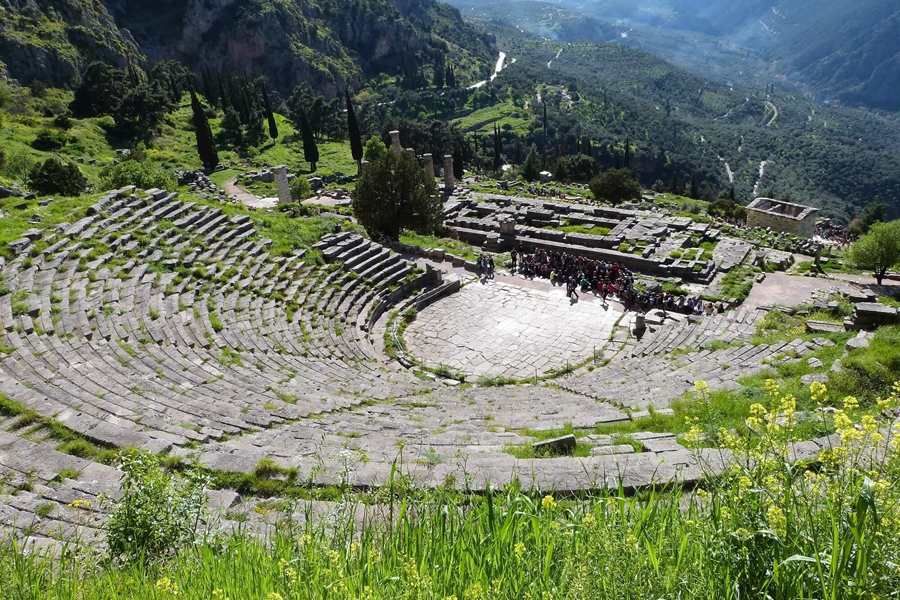
In the story of Delphi tours, what was the ancient theatre?
The orchestra, the flat floor before the seats, first formed a complete circle, seven metres wide. Its side passages are called parodoi. Their walls carry a large number of manumission inscriptions. Manumission is the legal freeing of a slave. The inscriptions describe pretend sales, in which slaves were sold to the god.
What survives of the Castalian Spring for Delphi tours?
The later, Roman fountain had seven bronze spouts along its facade. A facade is the front face of a building. One of the niches cut into its rock was later turned into a church. That church was dedicated to Saint John the Baptist. A niche is a shallow hollow carved into a wall.