
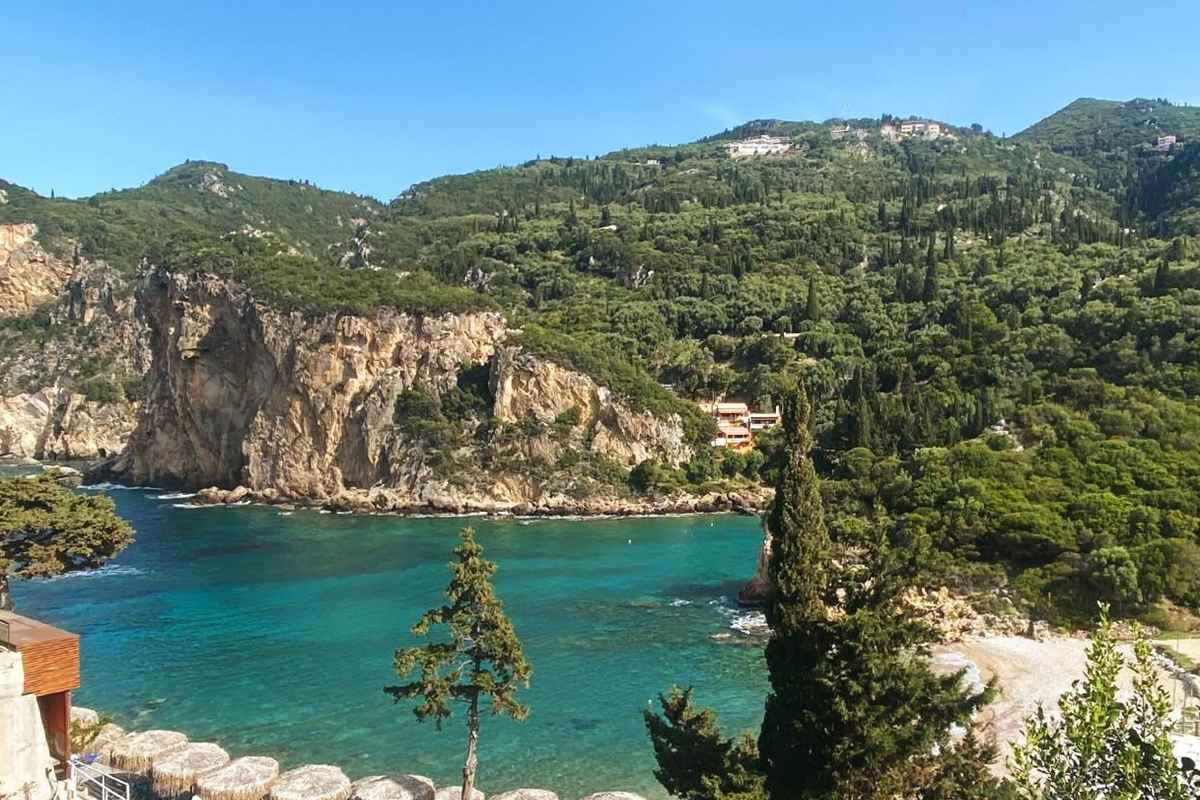
Corfu tours bring small groups to Corfu with a local host or a skipper. The island lies among the Ionian Islands of western Greece. Its story takes in nineteen wind bands, the Ionian School of music and the Museum of Asian Art. Four short answers cover Angelokastro, Kassiopi Castle, the composer Nikolaos Mantzaros and the Antivouniotissa Museum. Trips across more islands appear under Greece island hopping tours and Greece tour packages. The full range of trips sits under Greece tours.
Bookings made through the GetYourGuide widgets on this page earn Classical Greece Tours a commission, at no extra cost to the traveller.
What are Corfu tours?
Corfu tours are small-group, skippered or expert-led trips on a Greek island that keeps nineteen marching wind bands. A wind band is a group whose instruments are played by blowing air. On Corfu, Philharmonic Societies run the bands and teach music for free.
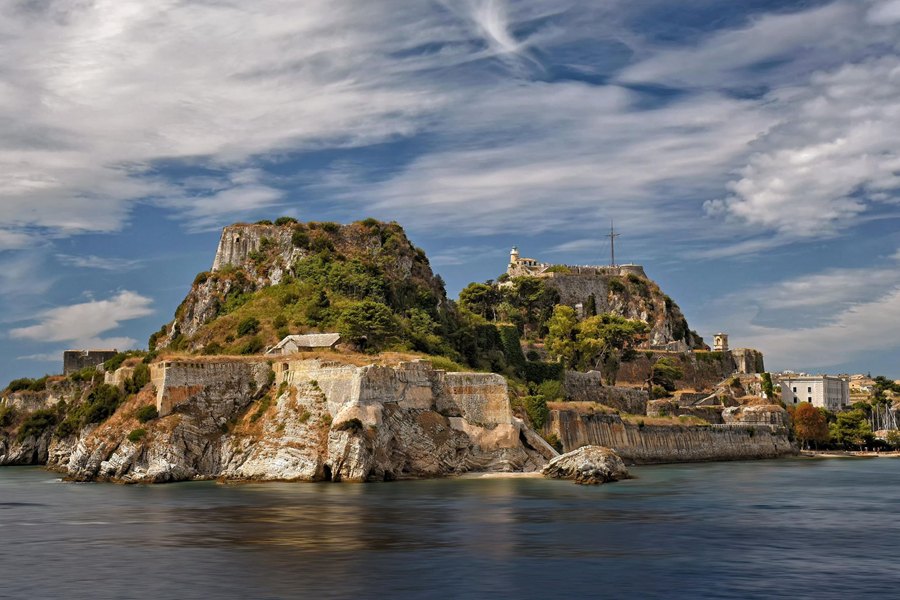
Corfu city is home to three leading bands, listed by seniority. The senior one is the Philharmonic Society of Corfu, founded on 12 September 1840. Locals call it the Paliá, which is Greek for Old. Each of the three keeps a main marching band. On grand occasions, such a band fields up to 200 musicians.
Corfu tours unfold on the island at the centre of the Ionian School of music. That school was the musical output of a group of Heptanesian composers. Heptanesian means from the Ionian Islands. The school flourished between the early 19th century and around the 1950s. It was Greece’s first school of classical music.
Corfu tours have an island setting with a rich and varied mix of dragonflies. Of Europe’s 143 dragonfly species, 39 are confirmed to breed on Corfu. Their larvae, the young stage of the insect, react strongly to pollution. Eurasian otters, furry mammals that hunt in water, still live in Corfu’s streams and lagoons.
- Ginger beer: Tzitzibíra, the local ginger beer of Corfu, is a remnant of the British era.
- Salami: Noúmboulo is a Corfu salami made from pork and lard, with orange peel and herbs for flavour.
- Carnival: Ta Karnavalia, the Corfu carnival, is Venetian in origin, with a large-headed figure called Karnavalos.
Corfu tours belong to an island whose festive march, the Graikoí, works as its anthem. An anthem is a song that stands for a people or a place. It was written while Venice ruled Corfu. Its lyrics include the words Greeks, never fear.
Why does the Museum of Asian Art matter for Corfu tours?
Corfu tours run on an island with Greece’s sole museum devoted to Asian art. The Museum of Asian Art holds Chinese, Japanese and Indian art, among others. Its home is a palace that was built during the years of British rule.
In the history behind Corfu tours, Gregorios Manos, a Greek ambassador to Austria, built the first collection. He bought about 9,500 objects from China, Korea and Japan at auctions held in Vienna and Paris. He is regarded as Greece’s first expert on Far Eastern art. Far Eastern means from East Asia.
In 1919, he gave it to Greece, on condition that Corfu got a museum. It opened in 1927 as a museum of Sino-Japanese, meaning Chinese and Japanese, art. Later, N. Chatzivasileiou, once Greece’s ambassador to India and Japan, made a second gift. Its objects came from Tibet, Siam (now Thailand), India, Pakistan and Northeast Asia.
Corfu tours unfold where that second gift reshaped the museum. Its focus had been mainly Chinese and Japanese, so it was renamed the Museum of Asian Art. Ch. Chiotakis, a Greek trader based in the Netherlands, made the third major gift. Petros Almanachos, Giannis Kollas and Iordanis Siniosoglou gave smaller gifts.
- Size: Around eleven thousand objects make up the collection, with the earliest from the 11th century BC.
- Holdings: Japanese printed pictures, Chinese porcelain and Indian bronze sculptures form part of the collections.
- Network: The Asia-Europe Museum Network counts the Corfu museum among its members.
For Corfu tours, the museum’s rooms keep ornate, or richly decorated, furniture of the British period. The museum ranks as a Special Regional Service under the Ministry of Culture. That service researches and protects the heritage of Asia. It promotes that heritage in Greece and Europe.
What do travellers ask about Corfu tours, and what are the answers?
Corfu tours share an island with Angelokastro, which Venetian papers called Castel Sant’Angelo. Bohemund of Taranto seized Kassiopi Castle in 1081. The composer Nikolaos Mantzaros was born in Corfu in 1795. The Antivouniotissa Museum fills a church thought to date from the late 15th century.
Before Corfu tours, what is worth knowing about Angelokastro?
One theory links the castle’s name to the Komnenoi Angeloi, the Despots of Epirus. Despot was a Byzantine title for a high-ranking ruler. In the 19th century, the French scholar Jean Alexandre Buchon visited the site. He noted that its walls seemed to have been built in a rush.
Why does Kassiopi Castle matter to the island story of Corfu tours?
In 1084, the fortress passed to Alexios I Komnenos. He had beaten the Norman fleet in three naval battles in the Corfu Channel. A channel is a slim strip of sea that lies between two coasts. Later, the Venetians ordered the castle destroyed. Its defenders had resisted the Venetian takeover of Corfu in 1386.
For Corfu tours, who was the composer Nikolaos Mantzaros?
Mantzaros taught the young people of Corfu for no profit. He never saw himself as a professional composer, one who earns a living from music. In 1827, he set to music the Aria Greca, the first concert aria in the Greek language. A concert aria is a solo song written for the concert stage.
Ahead of Corfu tours, what is the Antivouniotissa Museum?
The old church is dedicated to the Holy Mother of God Antivouniotissa. In Greek, the word Antivouniotissa means facing the mountain. Melina Merkouri, then Minister of Culture, opened the museum there in 1984. A minister is a government member placed in charge of one field of public work.