
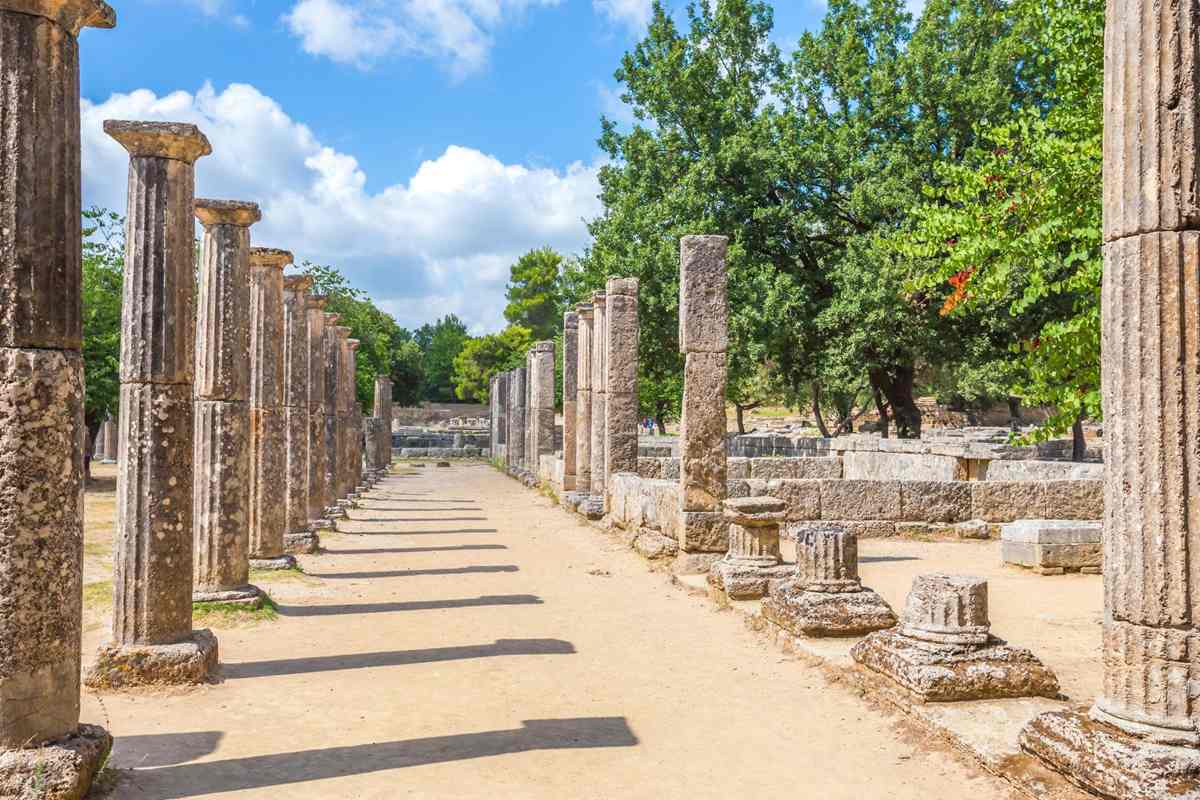
Ancient Greece tours are trips through Greece that centre on its Archaic, Classical and Hellenistic past. Their setting is mainland Greece together with its islands. Its story includes the Dorians, the lawmaker Solon, the poet Sappho and the statesman Pericles. It also includes Herodotus, Socrates, Plato, Aristotle, Alexander the Great and the Hellenistic period. Similar outings include a classical Greece tour, Greece archaeological tours and trips to ancient Greek sites. All of them sit within the broader world of Greece tours.
Bookings made through the GetYourGuide widgets on this page earn Classical Greece Tours a commission, at no extra cost to the traveller.
What are ancient Greece tours?
Ancient Greece tours are trips through the homeland of the ancient Greeks and their cities. Their story runs through the Archaic, Classical and Hellenistic ages. The archaic age ran from around 800 BC to 480 BC, when Persia invaded Greece again.
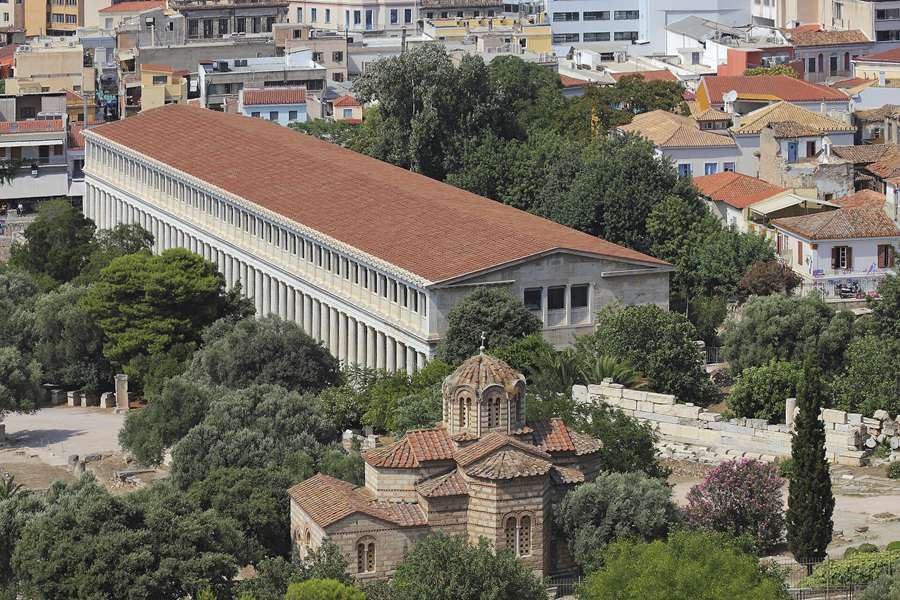
The name archaic comes from archaios, the Greek word for “old”. In this age, the polis became the main unit of political life. A polis was a city-state, meaning a town that governed itself and its land. Ancient Greece tours take place in the same land where these early city-states rose.
The oldest Greek literature still in existence was written in the archaic age. Monumental sculpture, meaning statues on a very large scale, also began in Greece then. Red-figure pottery, a vase style with red figures on a black ground, started then too. Ancient Greece tours are set in the country where these arts began.
Every piece of archaic Greek art that survives today is an original work. Much of what is known about classical art, by contrast, comes from later Roman copies. On farms, olives and grapes were cash crops, meaning crops grown to sell. Across the land of Ancient Greece tours, farmers turned these fruits into oil and wine.
- Population: During the eighth century BC, the number of people in Greece doubled.
- Houses: By the end of the archaic age, the average house covered about 125 square metres.
- Trade: Sixth-century BC pottery from Laconia, the region of Sparta, has been found in Marseille and Carthage.
Scholars long treated the archaic age as less important than the classical age that followed. Today, historians value it for what it achieved on its own terms. Ancient Greece tours deal with this age alongside the Classical and Hellenistic ages that came after it.
Which people do the Dorians add to Ancient Greece tours?
Ancient Greece tours lead into the world of the Dorians, a main people of classical Greece. Classical Greeks divided themselves into four ethnic groups: Ionians, Achaeans, Aeolians and Dorians. Members of each group shared descent, customs and a sense of belonging.
The Odyssey holds the earliest written mention of the Dorians. The epic poem already places them on the island of Crete. The Dorians stood apart from other Greeks through the Doric dialect. Their dialect was a regional way of speaking Greek. Ancient Greece tours unfold in the country where this dialect was once spoken.
Dorian states lived in very different ways. Corinth was a busy trading city with ornate, or richly decorated, art and buildings. Sparta, by contrast, was a military state that kept to itself. Doris was a small mountain state in west central Greece. Ancient Greece tours run through the land where Corinth and Sparta were Dorian states.
Unlike other Greek women, Dorian women were allowed to own property. They were also free to manage their husbands’ estates and to hand household tasks to slaves. An estate is the land and goods that a family owns. These rights belonged to Dorian women in the Greece of Ancient Greece tours.
- Settlements: The Dorians settled mainly in the Peloponnese, and also on Rhodes, Sicily and southern Italy.
- Language: Tsakonian, a speech descended from Doric, is still spoken in parts of the southern Argolid coast.
- Name: The scholar Julius Pokorny traced the name to doris, a Greek word for woodland or upland.
A man’s name, Dorieus, appears on Linear B tablets found at Pylos. Linear B is an early script, meaning a system of writing, used for Greek. Pylos itself stands among the Greek places linked with Ancient Greece tours.
How does Solon the lawmaker fit into Ancient Greece tours?
Ancient Greece tours take place in the home city of Solon, an archaic statesman of Athens. He was also a lawmaker, a poet and a thinker on politics. A statesman is a leader who shapes the laws and affairs of a state.
In 594 BC, Athens chose Solon as archon. An archon was a chief magistrate, or top official. Solon then cancelled every law made by the earlier lawgiver Draco. Only the laws on homicide, meaning the killing of a person, stayed in force. Ancient Greece tours are set in the Athens where these changes were made.
Solon’s changes brought relief to Athenians weighed down by debt. A debt is money that one person owes to another. Athenians later honoured this relief under the name seisachtheia. In Greek, the word means the shaking off of burdens. A burden is a heavy load, here the weight of money owed.
Solon later travelled abroad, and his first stop was Egypt. Later he sailed to Cyprus and oversaw the building of a new capital for a local ruler. The ruler named the city Soloi to thank him. Ancient Greece tours happen in the Greece that Solon left behind on these journeys.
- Advice: Solon told King Croesus to count no man happy until his death.
- Writings: Solon’s own writings survive today only as fragments, meaning broken pieces of text.
- Democracy: Solon is credited with laying the groundwork for democracy, or rule by citizens, in Athens.
Solon died in Cyprus at around the age of 70. As his will asked, his ashes were scattered around Salamis. Salamis was also the island where he was born. Ancient Greece tours unfold in the land where his story began and ended.
Why does the poet Sappho matter to Ancient Greece tours?
Ancient Greece tours reach back to Sappho, a celebrated ancient Greek poet. She came from either Eresos or Mytilene, two towns of the island Lesbos. A poet is a writer of verse, meaning lines set to a regular rhythm.
Sappho is best known for her lyric poetry. Lyric poetry is verse written to be sung, here with music playing along. The word lyric comes from the lyre, a small stringed instrument. Its strings make sound when they are plucked. Ancient Greece tours are set in the Greece that gave rise to such sung poems.
Sappho was a very productive poet. Scholars put the size of her work at roughly 10,000 lines. Her work is known for its clear language and vivid images. It also has immediacy, meaning it feels close and direct to the reader. Ancient Greece tours happen in the homeland of this body of verse.
Sappho praised her brother Larichos for his post as a cupbearer at the Mytilene town hall. A cupbearer served drinks at the town hall, a post kept for boys of leading families. Around 600 BC, Sappho was sent into exile in Sicily. To be in exile is to be made to live far from home.
- Canon: In Hellenistic Alexandria, she was one of the Nine Lyric Poets that scholars ranked highest.
- Spelling: In her own surviving poems, her name appears in the form Psappho.
- Fame: In ancient times, she ranked among the greatest lyric poets of the Greek world.
Two common English words come from her life story. Sapphic comes from the name of Sappho herself. Lesbian comes from Lesbos, the island she called home. On Ancient Greece tours, both words trace back to one poet of ancient Greece.
What part does Pericles play in Ancient Greece tours?
Ancient Greece tours take place in the Athens of Pericles, a Greek statesman and general. He led the city in its Golden Age, roughly from 461 to 429 BC. Those years are known to historians as the Age of Pericles.
Pericles was born in Athens around 495 BC. His skull was unusually large in size. Comic playwrights of his day mocked it with the nickname Squill-head. A squill is a sea-onion, a plant with a large bulb. Ancient Greece tours unfold in the city where these jokes were heard.
Pericles was always shown wearing a helmet. Plutarch claimed the helmet hid his oddly shaped head. In fact, the helmet was the sign of his official rank as strategos. Strategos is the Greek word for a general, meaning an army commander. Ancient Greece tours belong to the Athens that gave him this rank.
In 472 BC, Pericles staged The Persians, a play by Aeschylus. He paid for it at the Greater Dionysia, a festival of the god Dionysus with drama contests. This kind of payment was a liturgy, a public duty for the richest citizens. It showed that Pericles was among the wealthier men of Athens.
- Title: The historian Thucydides, who lived at the same time, called him the first citizen of Athens.
- Culture: Mainly through his efforts, Athens became known as the cultural and learning centre of Greece.
- Speech: His Funeral Oration is now linked with civic pride and democracy in which citizens take part.
Pericles died in 429 BC in the Plague of Athens. The plague was an epidemic, an outbreak of illness that passes quickly from person to person. Members of his family died of it too. Ancient Greece tours take place in the city that lost him.
How does Herodotus shape the history behind Ancient Greece tours?
Ancient Greece tours run through lands written about by Herodotus, a Greek historian and geographer. His home city was Halicarnassus, which is now Bodrum in Türkiye. Geography, his second field, looks at lands, regions and the peoples living there.
Herodotus wrote the Histories. The work tells the story of the Greco-Persian Wars in detail. These were wars fought between Greek city-states and the Persian Empire. Such an empire unites varied peoples and lands under one ruling power. Ancient Greece tours happen in the land these conflicts reached.
The historian Thucydides, who wrote about the Peloponnesian War, accused him of inventing tales for entertainment. In that war, Athens and its partners fought Sparta and her allies. Herodotus replied that he wrote down what he saw and what others told him. Ancient Greece tours are trips through the Greece that both historians wrote about.
Around 447 BC, Herodotus moved to Athens in the time of Pericles. He openly admired its people and its democratic institutions. An institution is a body such as an assembly or court. In 443 BC or soon after, he moved again, to Thurii in modern Calabria. It was a colony sponsored by Athens.
- Title: The Roman orator Cicero gave Herodotus the title Father of History.
- Dialect: He wrote in the Ionian dialect, though he was born in a Dorian settlement.
- Readings: He shared his research through spoken readings before crowds of listeners.
The Histories also stray from the main story. They add background on cultures, peoples, places and the writing of history. Ethnography means writing that records how peoples live and what customs they keep. Ancient Greece tours take place in the lands these side stories describe.
What is the story of Socrates on Ancient Greece tours?
Ancient Greece tours are set in the birthplace of Socrates, a philosopher who lived in Classical Athens. A philosopher is a thinker who searches for the truth about life and right conduct. Conduct here means the way a person chooses to behave.
Socrates was born in 470 or 469 BC in Alopece. Alopece was a deme of Athens, meaning a local district of the city’s land. His father, Sophroniscus, worked as a stoneworker. His mother, Phaenarete, was a midwife, a woman who helps mothers give birth. Ancient Greece tours run through the Athens where this family lived.
Socrates wrote no texts of his own. Knowledge of him comes mainly from accounts by his students Plato and Xenophon. In Athenian politics, he backed neither the democrats nor the oligarchs. He criticised both sides. An oligarch is a member of a small group that holds power in a state.
Socrates is linked with a way of questioning called the Socratic method. Its Greek name is elenchus. It tests an idea through a chain of short questions and answers. Socrates declared that he was only sure that he did not know. Ancient Greece tours happen in the city where this method took shape.
- Genre: Written accounts of his talks gave rise to a new kind of writing, the Socratic dialogue.
- Habits: He walked barefoot and owned just one worn and ragged coat.
- Comedy: The comic playwright Aristophanes made Socrates a central figure in his play The Clouds.
Socrates died in Athens in 399 BC. His death followed a trial on a charge of impiety. Impiety means a lack of respect for the gods. Athens, the city of that trial, lies within the lands of Ancient Greece tours.
What legacy links Plato to Ancient Greece tours?
Ancient Greece tours unfold in the city of Plato, an ancient philosopher of classical Athens. He is widely regarded as the founding thinker of Western philosophy. Philosophy is the careful study of knowledge, of truth and of how to live well.
Plato was born into a noble and powerful family of Athens. Through his mother, Perictione, he descended from the lawmaker Solon. As a young man, he wrote poems and tragedies. He burnt them after meeting Socrates and turned to philosophy instead. Tragedies are grave stage plays that close in suffering or loss.
Around 383 BC, Plato founded his school, the Academy. Its site lay beside an olive grove sacred to Hecademus. A grove is a small wood or group of trees. At first, the property was just a house with a garden. The Athens of Ancient Greece tours was home to this school.
Plato’s best-known idea is his Theory of Forms. The theory is also called the Theory of Ideas. It aims to solve the problem of universals. A universal is a quality, such as roundness, shared by more than one thing. Ancient Greece tours are trips through the country that produced this theory.
- Survival: Plato’s complete works are thought to have survived, unlike those of nearly all his peers.
- Parody: A comic fragment shows two Academy students arguing hotly over the type of a pumpkin.
- Legacy: Alfred North Whitehead called European philosophy a series of footnotes to Plato.
Plato died in 348 or 347 BC. He was buried in his own garden at the Academy. A burial is the placing of a body in the ground. Ancient Greece tours unfold in the city that held both his school and his grave.
Who was Aristotle, and where does he stand in Ancient Greece tours?
Ancient Greece tours unfold in the world of Aristotle, an ancient Greek thinker, philosopher and polymath. His life ran from 384 to 322 BC. A polymath is a person whose learning stretches across a very wide range of subjects.
Aristotle’s father, Nicomachus, served King Amyntas of Macedon as his personal doctor. Macedon was an ancient Greek kingdom lying to the north. At about eighteen, Aristotle joined Plato’s Academy in Athens. He remained there until about 347 BC. Ancient Greece tours are set in the city where he studied under Plato for years.
Aristotle wrote on natural science, philosophy, linguistics, economics, politics, psychology and the arts. Linguistics is the study of language and how it works. Only about a third of his original writing has survived. None of the surviving texts was meant for publication. Ancient Greece tours cross the land where these works were written.
Aristotle’s Prior Analytics holds the earliest systematic study of logic. Logic is the study of sound reasoning, meaning how a good argument holds together. Systematic means done step by step, by a clear and orderly method. His idea of logic stayed the main Western form until mathematical logic advanced in the 19th century.
- Science: Writers have called Aristotle the first scientist, meaning someone who studies nature by careful method.
- Title: Medieval Christian thinkers such as Thomas Aquinas called him simply The Philosopher.
- Works: His major treatises include Poetics, Politics, Physics, Metaphysics, On the Soul and Nicomachean Ethics.
Aristotle died of natural causes in the city of Chalcis, on the island of Euboea. Natural causes means death from illness or old age, rather than from violence or accident. Ancient Greece tours happen in the same Greece that holds Chalcis today.
In what way does Alexander the Great belong to Ancient Greece tours?
Ancient Greece tours belong to the Greek world of Alexander the Great, the famous Macedonian king. He held the throne of Macedon from 336 BC until the day he died. A throne stands for the power and office of a ruler.
Pella, the royal capital of Macedon, was the birthplace of Alexander. His birth date is thought to be 20 July 356 BC. His father was King Philip II, and his mother was Olympias. Olympias was a daughter of King Neoptolemus I of Epirus. In the land of Ancient Greece tours, Pella was the seat of Macedonian kings.
Alexander grew up in the manner of noble Macedonian boys. He learned to read and to play the lyre. He also learned to ride, fight and hunt. A noble is a member of a family of high rank and wealth. Ancient Greece tours unfold in the Greek world where this young prince was raised.
Under Aristotle’s teaching, Alexander grew fond of Homer’s works, above all the Iliad. Aristotle gave him a copy with notes written in it. Alexander later took this copy on his campaigns. He knew lines of Euripides by heart as well. Euripides was a playwright of tragedies, serious plays with sad endings.
- Cities: Alexander founded more than twenty cities, the best known being Alexandria in Egypt.
- Empire: By the age of 30, his empire stretched from Greece to northwestern India.
- Childhood: As a small child, he was raised by a nurse named Lanike.
After Alexander, Greek turned into the lingua franca across the region. Lingua franca names a bridge language used between speakers of different tongues. Greek remained the main Byzantine language until 1453 AD. Ancient Greece tours unfold in Greece, the old heartland of that language.
What marks the Hellenistic period for Ancient Greece tours?
Ancient Greece tours cover a land whose Hellenistic age followed the age of Classical Greece. That period opened in 323 BC, the year Alexander the Great died. It closed nearly three centuries later, when Cleopatra VII died in 30 BC.
The name Hellenistic comes from Hellas, the ancient Greek word that came to mean Greece. Hellenistic is not the same as Hellenic. Hellenic refers to Greece itself. Hellenistic covers all the lands that came under strong Greek influence after Alexander’s conquests. Ancient Greece tours unfold in Hellas itself, the land behind the name.
Two new kinds of literature grew in the Hellenistic age: Alexandrian poetry and New Comedy. Alexandrian poetry is named after the city of Alexandria. New Comedy brought scenes from daily life onto the stage. Three schools of philosophy also arose: Stoicism, Epicureanism and Pyrrhonism. Pyrrhonism is a school of doubt about whether true knowledge can be reached.
Athens remained the leading seat of higher learning in the Hellenistic world. Its fame rested above all on philosophy and rhetoric. Rhetoric is the art of persuasive speaking. The Roman public speaker Cicero was educated in Athens. Mark Antony received his education on Rhodes. Both cities lie within the lands of Ancient Greece tours.
- Sculpture: Hellenistic sculpture is known for strong emotion and lively, dramatic movement.
- Rhodes: Rhodes kept full independence from every Hellenistic kingdom, a rare feat among city-states.
- Drama: Hellenistic Greeks saved the dramas of Euripides, Sophocles and Aeschylus for later readers.
During this age, Greek culture had its widest reach, both around the Mediterranean and further afield. Culture here means the arts, ideas and ways of life of a people. That culture spread outward from the Greece of Ancient Greece tours.
What do travellers ask about Ancient Greece tours, and what are the answers?
Ancient Greece tours raise questions about famous Greek minds such as Pythagoras, Hippocrates, the playwright Sophocles and Archimedes. A mind here means a person known for deep thought, skill or learning. A playwright is a person who writes plays for the theatre.
Before Ancient Greece tours, who was Pythagoras of Samos?
Pythagoras of Samos was an Ionian Greek philosopher and polymath. He founded Pythagoreanism, named after him. Tradition says he was the first person to describe himself as a philosopher, or lover of wisdom. His best-attested teaching is metempsychosis. It holds that every soul is immortal and passes into a new body at death.
On Ancient Greece tours, why does Hippocrates of Kos still matter?
Hippocrates of Kos was a physician and philosopher who lived in classical Greece. His studies laid out early ideas behind modern fields such as surgery, neurology and orthopaedics. His school made medicine a profession separate from theurgy and philosophy. Theurgy means rituals that seek help from the gods.
For Ancient Greece tours, what is left of the plays of Sophocles?
Sophocles wrote more than 120 plays, yet just seven survive in full. He entered 30 drama contests and won 24. He never finished lower than second place. He also brought in a third actor, which reduced the role of the chorus. A chorus was a group that sang and spoke together on stage.
Ahead of Ancient Greece tours, what did Archimedes discover?
Archimedes came from the Greek city of Syracuse on Sicily. He worked as a mathematician, physicist, engineer, astronomer and inventor. He set out the law of buoyancy now called Archimedes’ principle. Buoyancy is the upward push of a liquid on an object. His tomb bore a sphere and a cylinder, as he had asked.