
Greece weather in November frames hosted trips on the mainland, on Crete and among the islands. Station records follow for Athens, Thessaloniki, Corfu, Patras, Kalamata, Kythira, Sitia and Florina. Then come the olive harvest, the Athens Classic Marathon, the feast of 21 November and Saint Andrew’s day. Related reading covers the best time to visit Greece, Greece weather in October and Greek food. More outings sit on the Greece tours page.
Bookings made through the GetYourGuide widgets on this page earn Classical Greece Tours a commission, at no extra cost to the traveller.
What is Greece weather in November like?
Greece weather in November changes from place to place. A complex geography splits the country into a broad mix of micro-climates and local differences. A micro-climate is the local weather of one small spot, such as a valley.
For Greece weather in November, the downtown Athens station gives normals for 1991–2020 and extremes since 1890. A normal is the long-term average of a weather value. Extremes mean the top and bottom readings ever logged. This station sets the average November high at 18.9 °C, where °C means degrees Celsius.
Rain in downtown Athens adds up to 70.8 mm across an average November. That figure is a long-term mean, not the total for one single year. The letters mm are short for millimetres. Rainfall is measured as the depth of water that collects on a flat, open surface outdoors.
In the north of Greece, the climate is transitional, mixing continental, Mediterranean and humid subtropical features. In Thessaloniki, Greece weather in November is tracked by the Aristotle University station, which stands at 32 m. Its November mean is 12.8 °C. The mean blends every reading of the day and the night into one figure.
- Athens peak: The top November value ever measured at the downtown Athens station is 30.5 °C.
- Thessaloniki precipitation: The Aristotle University station in Thessaloniki records 40.9 mm of precipitation in November.
- Athens humidity: Air in downtown Athens holds an average humidity of 72.0% in November.
Greece weather in November gives downtown Athens an average low of 12.2 °C. Humidity is the share of water vapour in the air. Precipitation covers rain, sleet, hail and snow. The average low takes the coldest point of every night and spreads it over the month.
How wet does Greece weather in November get on Corfu?
Greece weather in November on Corfu delivers 187.1 mm of rain in an average month. The Hellenic National Meteorological Service runs the island station, set 1 m above sea level. Its records cover the years 1955 to 2010.
The Köppen system files Corfu under the code Csa, a Mediterranean type with hot summers. Köppen is a world climate scheme. The letters here stand for a mild, dry-summer climate with hot summers. Island winters run from mild to cool, with a great deal of rain. They are much wetter than winters on other Greek islands.
In Greece weather in November, rain falls on 14.7 days of an average Corfu month. A rain day counts any date on which the gauge records rain. A rain gauge is an open container that collects and measures falling rain. The count is an average over decades, so it carries a decimal.
For Greece weather in November, the same station gives Corfu an average high of 18.7 °C. The average low for the month is 10.2 °C. Each day’s warmest moment feeds the average high. Each night’s coldest moment feeds the average low in the same way. Temperatures here are in degrees Celsius, shown as °C.
- Record high: The warmest November reading on file at the Corfu station is 27.8 °C.
- Record low: The coldest November reading at the same station stands at −2.2 °C, below freezing.
- Humidity: Relative humidity on Corfu averages 77.5% in November at the national service station.
Sunshine also forms part of Greece weather in November on Corfu. Records for 1961 to 1990 give the island 133.5 hours of sun in the month. Sunshine hours count the time with direct sunlight. A sunshine recorder is an instrument that marks how long the sun shines.
Which figures describe Greece weather in November at Patras?
Greece weather in November at Patras gives the port an average high of 19.8 °C. The figure comes from the Patras Port station. The National Observatory of Athens publishes its readings in monthly bulletins, which are regular data reports.
Patras shows the usual wet, mild winters and dry, hot summers of its climate type. Spring and autumn act as pleasant transitional seasons between the two. Autumn in Patras is wetter than spring, however. In weather records, autumn means September, October and November. A transitional season is one that links summer heat with winter cold.
Greece weather in November brings 111.1 mm of rain to the Patras Port station. One millimetre of rain is a layer of water one millimetre deep on level ground. The total is a monthly average built from the station’s bulletins. Rain gauges catch the water and record its depth.
The Araxos station, listed for Patras, stands 11 m above sea level. Its data, from 1955 to 2010, come from the national weather service. For Greece weather in November, Araxos logs 129.9 mm of rain over 12.6 rain days. Each rain day is a date on which the gauge registers rain.
- Average low: The Patras Port station sets its average November low at 14.6 °C.
- Record low: The lowest November reading at the Patras Port station is 7.4 °C.
- Snow: Snowfall is extremely rare on the coast but more common in the mountains around Patras.
In the wider picture of Greece weather in November, humidity in Patras is high during the winter months. It falls lower during the summer. Humidity measures the moisture carried in the air. A high figure means the air holds a lot of water vapour.
What does the Kalamata airport station say about Greece weather in November?
Greece weather in November at Kalamata brings 141.7 mm of precipitation to the airport station. The Hellenic National Meteorological Service keeps that station near the city. Its normals cover the years 1971 to 2010. Precipitation means rain, hail, sleet or snow.
The airport station gives Kalamata a Csa climate, the hot-summer Mediterranean type. That code belongs to the Köppen system, a world map of climate types. In the code, the s points to a dry summer. Winter brings Kalamata plenty of precipitation. Summers there are hot and mostly dry, with plenty of sunshine.
For Greece weather in November, the Kalamata airport station sets the average high at 19.6 °C. Its average low is 9.4 °C. The difference between high and low is known as the daily temperature range. Both figures are long-term normals, not readings from a single year.
Greece weather in November at Kalamata includes 12.8 precipitation days in an average month. A precipitation day is one on which the gauge catches rain, hail or snow. The record behind this count spans 1971 to 2010. Hail is ice that falls from storm clouds as small, hard pellets.
- Mean: The Kalamata airport station gives a November mean temperature of 14.1 °C.
- Record high: The highest November value in the airport record is 29.0 °C.
- Record low: The airport’s lowest November value sits just below freezing, at −0.4 °C.
Sunshine forms part of Greece weather in November at Kalamata as well. The airport station logs 150.6 hours of sun in the month. Hours of sun measure how long direct sunlight falls on the station’s recorder. The figure comes from the national weather service.
Where does Kythira sit in Greece weather in November?
Greece weather in November on Kythira gives the island an average high of 17.9 °C. That value comes from the Kythira Island station, run by the Hellenic National Meteorological Service. The service is the national weather office of Greece.
Kythira faces the south-eastern point of the Peloponnese, a large peninsula. Water surrounds a peninsula on three sides, while its fourth side meets the mainland. Tradition lists Kythira as one of the seven main Ionian Islands. Even so, it stands distant from the main group of that chain. Its position, between Crete and the Greek mainland, is a strategic one.
Greece weather in November on Kythira brings 90.3 mm of precipitation to the island station. Precipitation is the water that falls from clouds in any form. The station figure is a long-run monthly average. In other words, the total shows the usual amount for the month, not a forecast.
On Kythira, Greece weather in November includes 10.3 days with precipitation at the station. A day is counted when the gauge holds enough water to measure. The decimal appears because the count is averaged across years. A gauge is the open cup or funnel that gathers the falling water.
- Average low: The Kythira Island station sets the November average low at 13.9 °C.
- Mean: Taking day and night together, the island’s November mean is 15.9 °C.
- Record low: Kythira’s lowest recorded November value is 2.0 °C, well above freezing.
Greece weather in November on Kythira also carries an average humidity of 73.4%. The figure is relative humidity, a percentage of the moisture the air can hold at that temperature. The value comes from the national weather service station on the island.
How does Greece weather in November play out at Sitia on Crete?
Greece weather in November at Sitia gives the town an average high of 20.1 °C. The Hellenic National Meteorological Service measured that normal across the years 1960 to 2010. A normal is a value averaged over a long run of years.
Sitia lies on Crete, east of Agios Nikolaos and northeast of Ierapetra. Sitia falls in the Csa class, the hot-summer Mediterranean type of the Köppen scheme. In the code, C marks a mild climate, s a dry summer and a a hot summer. Köppen sorts the climates of the world by heat and rainfall.
After the fall of the major Minoan settlements, Sitia became a place of refuge for native Cretans. The Minoans, named after the legendary King Minos, were Bronze Age islanders of Crete. Later, the town prospered as one of the chief ports of the island. That run lasted through the Classical, Hellenistic, Roman and Byzantine periods.
Greece weather in November at Sitia brings 59.5 mm of precipitation to the station. Precipitation here counts rain together with any hail or snow. The amount is a long-term average for the month, based on the 1960 to 2010 records. The abbreviation mm stands for millimetres.
- Average low: The Sitia station gives a November average low of 14.0 °C.
- Mean: The daily mean for November at Sitia, day and night combined, is 16.9 °C.
- Humidity: Greece weather in November at Sitia holds humidity at an average of 70.9%.
Greece weather in November at Sitia includes 8.2 days with precipitation in an average month. Each such day is one with a measurable fall of water at the station. The count comes from the same national weather service records.
How cold can Greece weather in November turn in Florina?
Greece weather in November at Florina holds the average high to 12.2 °C. That normal comes from station records for 1961 to 2010. Florina ranks among the coldest Greek towns, because of its height and its position.
Under the Köppen scheme, Florina has a humid subtropical climate, coded Cfa. It borders on a humid continental climate, coded Dfa. In both codes, the letter f means no season is dry. The letter D marks a group with colder winters than the C group. Humid means moist, with plenty of water in the air.
For Greece weather in November, the Florina station sets the average low at 2.6 °C. The mean of all readings across the month is 7.2 °C. Water turns to ice at its freezing point. Both values are long-term normals, drawn from the years 1961 to 2010.
Snow already appears in Greece weather in November at Florina, on 1.8 days of an average month. A snow day is a day on which snow falls at the station. The count is a long-term average, so it is not a whole number. Snow forms when water vapour freezes into ice crystals inside cold clouds.
- Record low: The lowest November reading in the Florina record is −12.6 °C.
- Precipitation: Florina receives 71.3 mm of rain, sleet and snow in an average November.
- Humidity: Moisture in the Florina air averages 77.8% humidity across November.
Greece weather in November comes just before the winter months in Florina. In winter, snowfalls, thick fog and below-freezing temperatures are common there. The snow is sometimes heavy. Fog is a cloud that forms at ground level. Below freezing means colder than the freezing point.
How does the olive harvest fit into Greece weather in November?
Greece weather in November arrives while the olive harvest is under way. Across the Mediterranean region, olives are picked in the autumn, from October onwards. An olive is the small stone fruit of the evergreen olive tree, pressed for oil or cured.
Greece weather in November therefore falls within that autumn picking span. In parts of Greece, Italy and Croatia, olives are harvested by hand. The terrain there is too mountainous for machines. Hand picking leaves the fruit unbruised, so the finished product turns out superior. A bruise is a damaged patch of crushed flesh.
Olives grown for the table need gentler handling at harvest, since damaged fruit turns bitter. Workers carry baskets that hang around the neck for this job. In another method, harvesters climb a ladder with a sack fixed at the waist. They then milk the olives into the sack.
A harvest is the gathering of a ripe crop. The olive harvest runs through Greece weather in November. The pericarp is the fleshy wall of the fruit around the stone. It is normally 60–70% oil. Oil content differs widely from one cultivar to the next. A cultivar is a plant variety kept by growers.
- Branches: The hand method involves sawing off branches, which is healthy for future production.
- Ripe fruit: Black, or ripe, olives come off the tree fully mature, with purple, brown or black skins.
- Yield: A typical olive tree yields 1.5–2.2 kg of oil each year.
Wind and rain both form part of Greece weather in November. In the olive gathering season, gales and long-continued rains cause damage. A gale is a very strong wind. Long-continued rain is rain that keeps falling for days without a break.
When does the Athens Classic Marathon fall within Greece weather in November?
Greece weather in November frames the Athens Classic Marathon, a yearly road race in Athens. The race normally takes place in early November, so runners meet Greece weather in November on the course. A marathon means a running race of long distance on roads.
The race draws on an old feat of the Athenian army. Its soldiers ran from Marathon to Athens after their battle there. In the spirit of the Olympic Torch, the race has its own Marathon Flame. The flame is first lit at the battle’s tomb. Then it travels to the stadium in Marathon before each race.
The 2015 race, held during Greece weather in November, attracted 43,000 competitors. Of those, 16,000 ran the full 42.195 km course. Both figures were all-time records. The other runners joined 5 and 10 km road races on the same day. A racewalking contest, a race at walking pace, ran alongside them.
The race began in 1972 as a joint venture. A joint venture is a project that two bodies set up and run together. The partners were the Greek tourist board and the athletics association. A tourist board is a public body that promotes travel to a country.
- Championship: Since 1990, the race has at times served as the Greek national marathon championship.
- Symposium: An international marathon symposium, a meeting of experts, takes place the day before the race.
- Runner statue: The course passes a statue of a runner in the city centre before the finish.
The 1983 race, run in Greece weather in November, carried the name Athens Peace Marathon. That year, it first offered both a popular race and an elite race. A popular race is open to amateur runners. An elite race gathers top athletes.
Which feast on 21 November falls within Greece weather in November?
Greece weather in November reaches 21 November, the date of the Presentation of Mary. In the East, the feast is called the Entry of the All-Holy Theotokos into the Temple. Theotokos is a Greek title of Mary, meaning God-bearer.
The story behind this Greece weather in November feast comes from the Protoevangelium of James. The New Testament does not tell it. That text is apocryphal, meaning it stands outside the accepted books of the Bible. In it, Mary’s parents, Joachim and Anne, had been childless. A heavenly message then told them a child was coming.
In thanks for their daughter, Joachim and Anne brought Mary to the temple in Jerusalem. She was three years old at the time. They meant to consecrate her to God. To consecrate means to set apart for holy service. The temple was the chief house of worship in ancient Jerusalem.
In the Orthodox Church, the feast always falls during the Nativity Fast. The Nativity Fast prepares for Christmas, the feast of the birth of Jesus. In the Byzantine tradition, the fast runs from 15 November to 24 December. Greece weather in November therefore covers the first weeks of that fast.
- Great Feast: The Eastern Orthodox Church counts this day among its twelve Great Feasts.
- Calendar shift: Churches on the older Julian calendar mark 21 November on 4 December of the Gregorian calendar.
- Fast eased: On the feast day, fasting rules relax so that fish, wine and oil are allowed.
The feast grew out of the dedication of the New Church of the Theotokos in Jerusalem. Byzantine builders raised it in 543 under Emperor Justinian I. Greece weather in November brings the feast round again on the 21st. A dedication formally opens a church for worship.
Who is Saint Andrew, honoured in Patras at the close of Greece weather in November?
Greece weather in November closes with the feast of Saint Andrew on 30 November. That date is his primary feast day in the church year. Andrew was an apostle, one of the first followers of Jesus. An apostle is a messenger sent out to spread a faith.
Andrew is said to have been martyred by crucifixion at Patras, in Achaea, in AD 60. A later tradition holds that he died on an X-shaped cross. That shape is called a saltire, now known as a Saint Andrew’s Cross. Martyred means killed for refusing to give up a faith.
Andrew is the patron saint of Patras in Greece. He is also patron of Scotland, Romania, Russia, Ukraine and Barbados, among others. In Christian belief, patron saints act as heavenly protectors of a place or a group of people. For Patras, Greece weather in November ends on the day of its own patron.
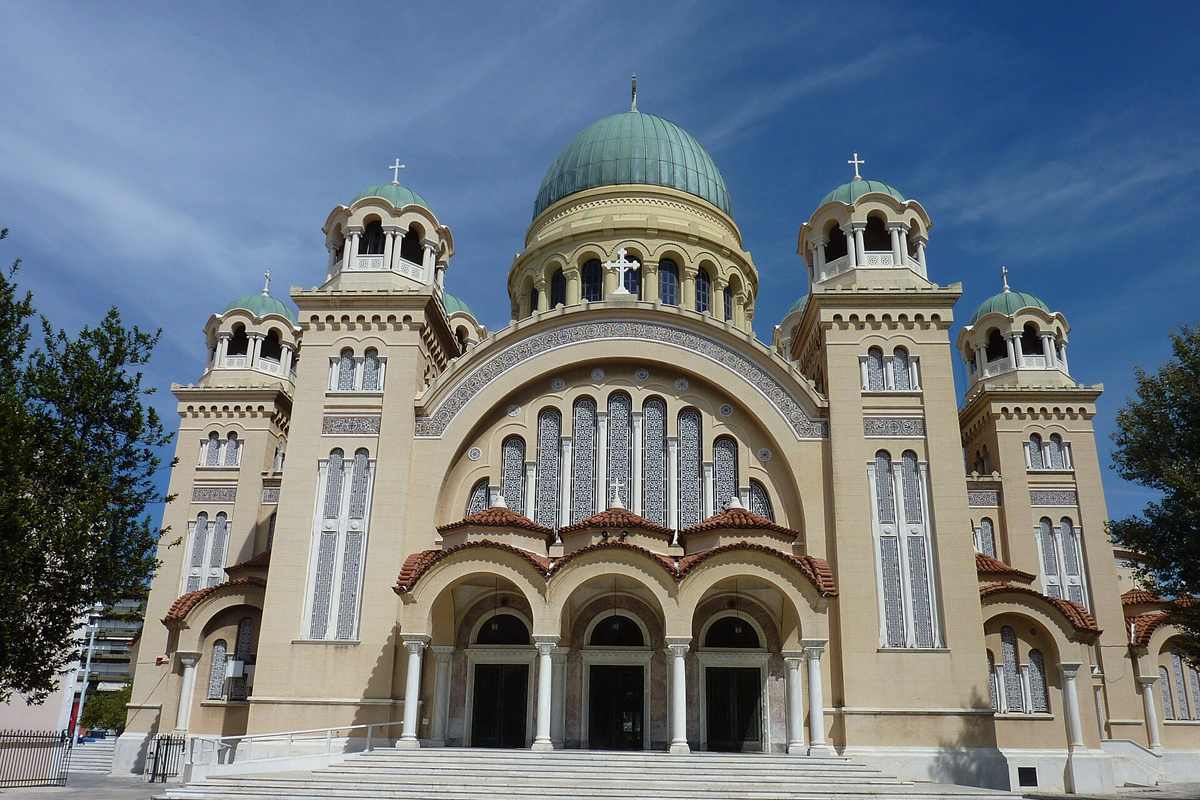
The Cathedral of Saint Andrew is a Greek Orthodox basilica on the west side of central Patras. Here, basilica means a big church built around one long main hall. Work on the building began in 1908. It was inaugurated 66 years later, in 1974. Inaugurated means formally opened for its purpose.
- Capacity: The Cathedral of Saint Andrew in Patras has room for 7,000 people.
- Relic: In September 1964, Pope Paul VI had the apostle’s skull sent to Patras from Rome.
- Synaxis: During Greece weather in November, the Sunday before the 30th honours the Saints of Achaea together.
On the last day of Greece weather in November, Orthodox churches honour Andrew as Protokletos. The Greek title means First-Called. It stems from the Gospel of John. There, Andrew follows Jesus and introduces his brother, Simon Peter, to him.
What do travellers ask about Greece weather in November, and what are the answers?
The Greece weather in November picture runs from near-freezing heights to mild lowlands. Four stations answer the common questions. They are Kaimaktsalan Ski Center at 2090 m and Theodoriana at 962 m. Lindos sits at 65 m and Ioannina at 475 m above sea level.
How cold is Greece weather in November on the Kaimaktsalan heights?
The Kaimaktsalan Ski Center station stands 2090 m above sea level. Its November average high is 4.6 °C. The average low falls to −0.5 °C, just under freezing. Precipitation there reaches 113.1 mm in the month. Its records cover the years 2008 to 2023. A ski centre is a mountain area for skiing.
How wet is Greece weather in November at the Theodoriana station?
The Theodoriana station sits 962 m above sea level. It logs 381.6 mm of precipitation in an average November. Its mean temperature for the month is 9.3 °C. The average high reaches 13.4 °C. Precipitation counts every form of water that falls from the sky, from drizzle to snow.
How mild is Greece weather in November at Lindos?
The Lindos weather station is placed at 65 m above sea level. Day and night together, its November mean is 19.4 °C. The average low holds at 16.7 °C. Rain at the station totals 77.0 mm in the month. The figures come from the network of the National Observatory of Athens.
What does Greece weather in November bring to Ioannina?
Among mainland Greek cities of more than 50,000 people, Ioannina counts as the wettest. The city is the capital of Epirus, a region of Greece. Its station, at 475 m, logs 168.8 mm of precipitation in November. Sunshine reaches 98.1 hours in the month. Those normals run from 1956 to 2010.
Featured photo: Xocolatl, Public domain, via Wikimedia Commons (File:Hagios Andreas Seitenansicht.jpg).