
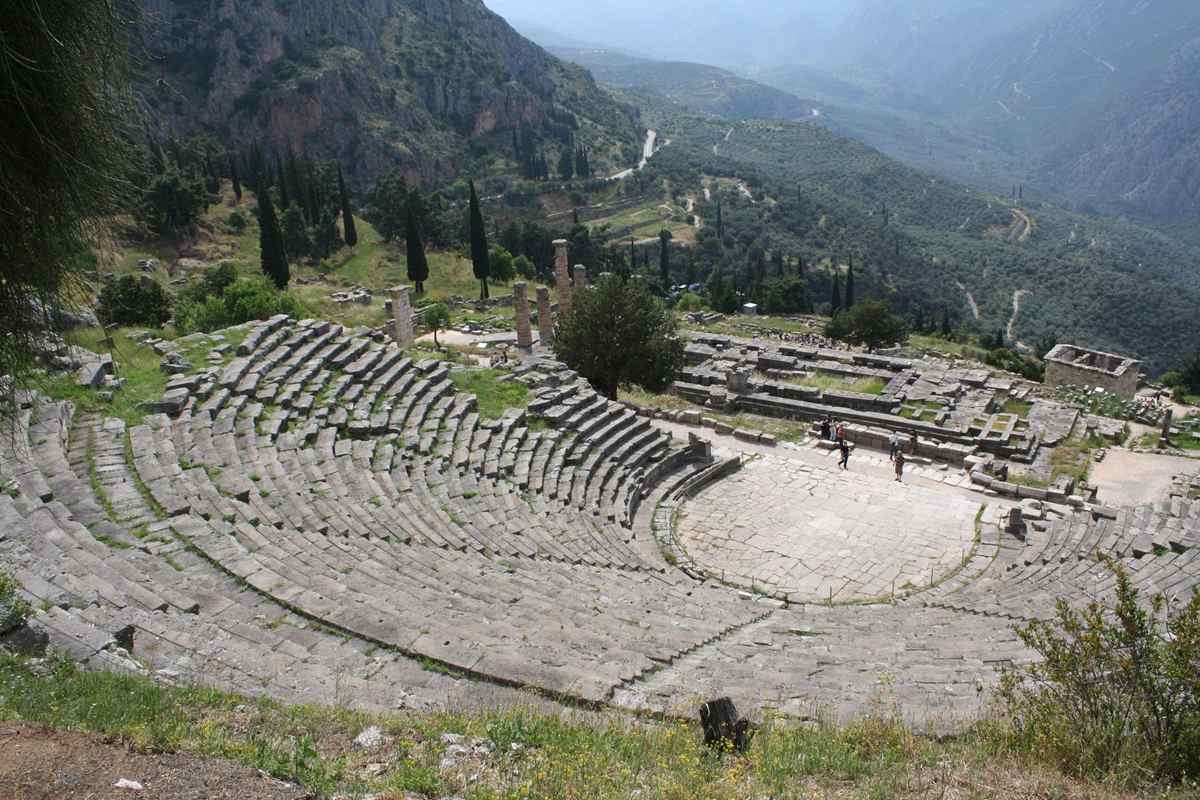
Day trips from Athens are single-day journeys out of the Greek capital, each led by a host. They take place across Attica and the regions around it. Attica comes first, with Eleusis, Daphni Monastery, Rhamnous, the Vari Cave and Kaisariani Monastery. The Amphiareion of Oropos follows, then places in Boeotia, on Euboea and in the Saronic Gulf. Four short answers end the page. Related pages: the Delphi day trip from Athens, Mycenae and Epidaurus day trip, and Meteora tour from Athens. Other trips around Greece sit under Greece tours.
Bookings made through the GetYourGuide widgets on this page earn Classical Greece Tours a commission, at no extra cost to the traveller.
What are day trips from Athens?
Day trips from Athens start in the Greek capital, the core city of its metropolitan area. That whole area sits within Attica, an old historical region also known as the Attic Peninsula. Boeotia lies on its northern border, and Megaris on its western one.
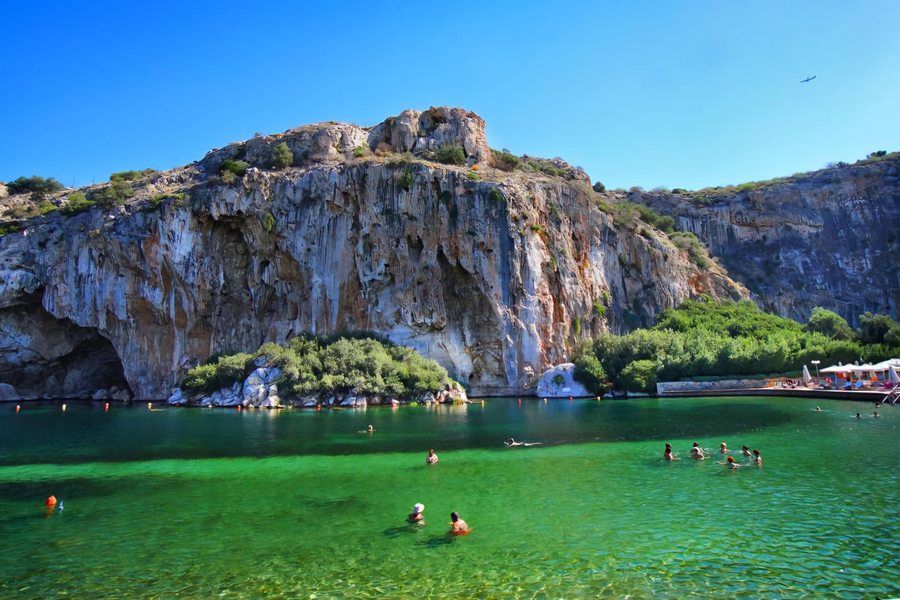
All day trips from Athens begin on a peninsula, which means land almost surrounded by water. Attica juts into the Aegean Sea. Its southwestern shore is the Athens Riviera, and a riviera is a coast lined with seaside towns. That shore forms the eastern rim of the Saronic Gulf, whose waters make a broad bay.
The Mycenaean period was an early stage of Greek history. In that age, Attica’s people lived in self-governing farming communities. Self-governing means run by their own members. Prehistoric remains have been found at Marathon, Rafina, Nea Makri, Thorikos and Agios Kosmas. Prehistoric means from before written records. Each of these settlements thrived in Mycenaean times.
Attica, the home region of day trips from Athens, held a festival called the Chalceia every autumn. The Chalceia honoured Hephaestus, the Greek god of fire, and Athena Ergane. Ergane is Athena’s title as patron of crafts. The Athmoneia games were held at Athmonon, a deme in today’s Marousi. In ancient Attica, a deme meant a local district.
- Fortresses: Ancient Attica had fortresses at Oenoe, Decelea, Phyle and Aphidnae, among others.
- Revolt: During the Greek War of Independence, Attica’s peasants were the first to revolt, in April 1821.
- Old names: Ancient place names such as Marathon, Eleusis, Oropos and Dionysus have survived in Attica.
Day trips from Athens start in a region that tradition once split into twelve small communities. These belonged to the reign of Cecrops, a legendary king of Athens. Tradition says Theseus, a mythical king, later merged them into one Athenian state.
What does Eleusis add to day trips from Athens?
Day trips from Athens have a western neighbour in Eleusis, also spelled Elefsina. This suburban city sits in the Thriasio Plain, at the northern tip of the Saronic Gulf. Eleusis is the birthplace of Aeschylus, the ancient playwright of tragedy.
Hesychius of Alexandria, an ancient Greek writer, reports that Eleusis once bore the older name Saesara. In myth, Saesara was a daughter of Celeus, king of Eleusis when Demeter first came. Demeter was worshipped by the Greeks as the harvest goddess. Myth names one coastal cave as the spot where Hades seized Persephone, her daughter.
At the spot of that abduction stood the Ploutonion, a sanctuary for Hades and Persephone. A sanctuary is a holy place. Eleusis later became an Attic deme, yet it kept the title of polis, or city-state. It also struck its own coins. Among Attic towns, only Athens, the base for day trips from Athens, shared that right.
Water reached Roman Eleusis through an aqueduct, a channel for carrying water, completed in about 160 AD. Those planning day trips from Athens can note a Roman bridge over the Kephissus river. It once carried the Sacred Way, the main road from Athens. Its main span is 30 m long with 4 arches.
- Festival: Founded in 1975, the Aeschylia is the longest-standing cultural event run by an Attica municipality.
- Stage: Its stage is Palaio Elaiourgeio, a former soap factory on the seafront that serves as an open theatre.
- Culture title: Elefsina was named European Capital of Culture for 2021, a title that took effect in 2023.
In 1829, after the Greek War of Independence, Elefsina had about 250 inhabitants. It is now a major centre of industry, home to the biggest oil refinery in Greece. Today Eleusis is a suburb of Athens, where day trips from Athens begin.
Which story does Daphni Monastery give day trips from Athens?
Day trips from Athens set off from a city with a Byzantine monastery close at hand. Daphni stands in the suburb of Chaidari. A forest of the same name covers about 18 square kilometres and rings a laurel grove.
Readers planning day trips from Athens can learn that Byzantine means of the later Eastern Roman state. The first monastery at Daphni rose near the close of the sixth century AD. It was built on a Sanctuary of Apollo that the Goths had desecrated in 395. To desecrate is to damage a holy place with deep disrespect.
Those weighing day trips from Athens can note one surviving Ionic column at Daphni. It is one of four from Apollo’s sanctuary, reused by the monastery builders. Ionic is a column style crowned with scroll shapes. Thomas Bruce, Earl of Elgin, carried the other columns to London. The British Museum holds them today.
Frankish crusaders, knights from western Europe, sacked Daphni in 1205. The monastery then fell into decline. Othon de la Roche, lord of the Duchy of Athens, gave Daphni to Bellevaux Abbey. Bellevaux was a Cistercian abbey, a house of Catholic monks. They added a cloister, or covered walkway, and twin pointed Gothic arches.
- Burials: In the Cistercian era, Daphni grew popular as a burial ground for knights.
- Departure: The Cistercians left Daphni in 1458, right after Sultan Mehmed II visited Athens.
- Masonry: The church walls use cloisonné work, with each stone block set inside a brick frame on all sides.
Mosaics are pictures built from small pieces of glass or stone. At Daphni, Christ Pantocrator, meaning Lord of the Universe, gazes down from the crown of the dome. Sixteen prophets ring its base. Day trips from Athens start near this UNESCO World Heritage Site.
How does Rhamnous fit into day trips from Athens?
Day trips from Athens begin in the same region as Rhamnous, an ancient Greek city. Its site lies on the shore above the Euboean Strait, northwest of Agia Marina. Rhamnous is the best-preserved site of an Attic deme, or local district.
People weighing day trips from Athens can learn that buckthorn, a thick prickly shrub, gave Rhamnous its name. The shrub still grows at the site. In antiquity the place was famous for its sanctuary of Nemesis, the avenging goddess. It was her chief sanctuary in all of ancient Greece. Antiquity means the ancient past.
Day trips from Athens start in the city that kept a permanent garrison, or troop base, at Rhamnous. The soldiers watched over shipping from a small enclosure high on the hill. Two small harbours flank the fortified acropolis, the walled hilltop citadel. During the Peloponnesian War, grain for Athens came in through them.
Building on the bigger Nemesis temple started between about 460 and 450 BC. The Peloponnesian War seems to have halted the work, and the column flutes were never carved. Flutes are the shallow upright grooves cut into a column. Its statue of the goddess, about 4 m high, was carved by Agorakritos, pupil of the sculptor Phidias.
- Walls: The city walls of Rhamnous were built of local marble from Agia Marina.
- Hill: The fortified acropolis of Rhamnous sits on a hill about 28 m high.
- Orator: Rhamnous was the birthplace of Antiphon, an orator, meaning a skilled public speaker.
Varro, a Roman historian, rated the Nemesis statue the finest example of Greek sculpture. Its base shows Nemesis presenting Helen to her mother, Leda. Day trips from Athens begin in a land where these ruins have stayed visible since antiquity.
What sets the Vari Cave apart for day trips from Athens?
Day trips from Athens start on a plain ringed by mountains, and Mount Hymettus is one of them. The Vari Cave, also called the Nympholyptos Cave, lies near the top of a southern spur of Hymettus. It sits almost 300 metres above sea level.
In classical antiquity, Apollo, Pan and the Nymphs shared this shrine. Pan was a god of the wild, and Nymphs were nature spirits. Near Athens, the starting city for day trips from Athens, Pan had five caves, this among them. Pan and the Nymphs were worshipped widely in Attica, including on Parnes and Hymettus.
Anyone comparing day trips from Athens finds that inscriptions name Archedemus of Thera as the builder. He called himself a nympholept, one seized by the Nymphs. He said the Nymph had advised him to create the shrine. Archedemus also appears on a relief from about 400 BC. Such a relief is a carving raised from a flat panel.
Inside, the cave holds two rooms divided by a large wall of rock. The largest shrine honours Pan and roughly copies the front of a temple. Lower down sits a shrine to Apollo Hersus, cut from the rock. Beside it, a carved figure shows Archedemus as a stonecutter with tools.
- Years of use: Coins show that people used the cave without a break from about 600 BC to 150 BC.
- First report: In 1765, Richard Chandler became the first scientist to report on the cave.
- Excavation: The 1901 dig was led by Charles Heald Weller from the American School at Athens.
Day trips from Athens set out near Hymettus, which two late writers link with Plato. They say his parents, Ariston and Perictione, carried him there as a baby. The parents offered sacrifices to Pan, Apollo, the Nymphs and the Muses.
Why does Kaisariani Monastery matter for day trips from Athens?
Day trips from Athens leave a city with Kaisariani Monastery close by, on Mount Hymettus. This Eastern Orthodox monastery stands on the northern flank of the mountain. Its founding is placed around 1100, the date of its surviving main church.
Travellers comparing day trips from Athens can find that the site is thought to have honoured Aphrodite. Greeks honoured Aphrodite as their goddess of love. Christians took the site over in the 5th or 6th century AD. A large early Christian basilica, a long hall-shaped church, once stood to the west.
When the Turks took Attica in 1458, the Ottoman ruler Mehmed II went to the monastery. Jacob Spon, a French doctor, wrote that Mehmed received the key to the city there. The monks lived on the produce of olive groves, grape vines and beehives. They were also famous for making medicine from herbs. Their library was renowned.
Those weighing day trips from Athens can note the high wall around the monastery buildings. Inside stand the main church, the refectory, the bathhouse and the cells, or monks’ rooms. A refectory is a dining hall. The main church, or katholikon, follows the Byzantine cross-in-square plan. That plan places a cross-shaped space inside a square outline.
- Frescoes: Ioannis Ypatos painted the frescoes, or wall paintings, in 1682 for the wealthy Benizelos family.
- Earthquake: The great earthquake of 1981 badly damaged the bath house and the refectory.
- Restoration: Between 1952 and 1955, the Philodasiki society restored the whole monastery complex.
In 1678, Patriarch Dionysius IV of Constantinople declared Kaisariani stauropegic. The word means free and independent of the local senior bishop. Its only duty was to perform funeral rites. Day trips from Athens begin in the city whose Metropolitan, or chief bishop, regained control in 1792.
What healing story does the Amphiareion of Oropos bring to day trips from Athens?
Day trips from Athens start 37.2 km from the Amphiareion of Oropos. This sanctuary stands at a sacred spring north-northeast of the city. It honoured the hero Amphiaraos from the late 5th century BCE. Pilgrims came to it seeking healing and oracles.
An oracle was a holy place where a god or hero answered questions. Amphiaraos descended from Melampos, a seer, or person who sees the future. In certain versions of his myth, the earth opened and swallowed his chariot. That made him a chthonic hero, one tied to the world under the ground.
A plague in Athens, the home city of day trips from Athens, raised the shrine’s healing fame. A plague is a fast-spreading, deadly sickness. Herodotus, a Greek historian, says this shrine gave one of only two correct answers to a test. Croesus, king of Lydia, had put that test to all the oracles.
Readers comparing day trips from Athens can note that Pausanias described the dream ritual here. Pausanias was a Greek travel writer of the 2nd century CE. Visitors first cleansed themselves by making a sacrifice to the god. Next they sacrificed a ram, then lay on its fleece until a dream came.
- Spring: Pausanias says worshippers threw coins into the sacred spring once a disease was healed.
- Games: Every fifth year, the Greater Amphiareia festival held athletic games at the sanctuary.
- Water clock: The site keeps a klepsydra, or water clock, from the 4th century BC in unusually good condition.
Like the starting point of day trips from Athens, the site lies in Attica, east of Markopoulo Oropou. Its stoa, a long roofed hall lined with columns, measured 11 by 110 m. Its 39 outer columns were Doric, and its 17 inner columns Ionic, two classical styles.
How does Chalcis fit into day trips from Athens?
Day trips from Athens share central Greece with Chalcis, the main city on the island of Euboea. It stands on the Euripus Strait, at the spot where the channel is at its narrowest. A strait is a thin strip of sea between two shores.
The name Chalcis comes from the Greek word chalkos, which means copper or bronze. Even so, no trace of any mines has been found in the area. In the late Middle Ages, the city was known as Negropont, an Italian name. The same name was later applied to the whole island of Euboea as well.
The earliest record of Chalcis comes from the Iliad. For day trips from Athens, the Iliad is the old epic poem of the Trojan War. The poem names Chalcis and its rival Eretria together in one line. The Romans at first called all Greeks Chalcidians. Settlers from Chalcis were the first Greeks the Romans met.
The Etruscans, an ancient people of central Italy, took over the Chalcidian form of the alphabet. They adapted it to write their own language. Each letter in an alphabet stands for a sound of speech. On day trips from Athens, the word Chalcidian means anything that comes from Chalcis.
- Aristotle: The philosopher came to Chalcis in 323 BC and died a year later at his mother’s house.
- Karababa Fortress: The Ottomans, rulers of a Turkish empire, built this castle in 1684 to guard the city against Venice.
- Saint Paraskevi: The church’s central arch shows the best Italian Gothic carving in Greece, Gothic being a medieval style.
A railway link to Athens and its port, Piraeus, opened in 1904 and lifted the town’s exports. Exports are goods sold and sent to other places. For day trips from Athens, Piraeus is the port city on the coast beside the capital.
Why does Eretria matter to day trips from Athens?
Day trips from Athens begin in Attica, the region whose coast Eretria faces across the South Euboean Gulf. That stretch of water is narrow. Eretria is a town on Euboea, and its Greek name literally means city of the rowers.
Eretria was a leading Greek polis across the 6th and the 5th centuries BC. The Greek word polis stands for a city-state, a city that governed itself and the nearby land. For day trips from Athens, the letters BC mark years counted back from the birth of Christ.
The temple of Apollo Daphnephoros counts as the leading monument of Eretria. For day trips from Athens, Apollo was a chief god of the ancient Greeks. Close to it stood the Daphniforio, a name that means space with laurels. This building is the oldest one found in Eretria. A laurel is an evergreen shrub with fragrant leaves.
The ancient theatre of Eretria seated 6,300 spectators. A vaulted tunnel ran under the stage to the middle of the orchestra, the round floor for actors. In all likelihood it was the charonian stairway, also called the stairs of Hades. Hades was the Greek world of the dead. Actors playing the dead used it to appear.
- House of the Mosaics: Its floors hold pictures made of pebbles: sea nymphs called Nereids on a seahorse, griffins, sphinxes and panthers.
- Nea Psara: Refugees from Psara founded modern Eretria in 1824 and named it Nea Psara, meaning New Psara.
- Eretria Museum: A Swiss archaeological school in Greece founded the town museum, which displays finds from Eretria.
For day trips from Athens, an excavation means a careful dig that uncovers buried remains. Excavations at the ancient city began in the 1890s. Since 1964, the Greek Archaeological Service and the Swiss school have led that work together.
Which story does Kymi give day trips from Athens?
Day trips from Athens begin on the mainland, and Kymi is a coastal town on Euboea. It bears the name of an ancient Greek town, also called Kyme. The ancient and modern towns share one name in two spellings.
The town sits high on a hill near the coast, on the Aegean flank of Euboea. The Aegean is the arm of the Mediterranean between Greece and Turkey. Thanks to this vantage point, Kymi sometimes goes by the name Balcony of the Aegean. A vantage point is a high spot that looks out over a wide area.
In ancient times, Kyme was a harbour town linked to Chalcis and Eretria. Writers sometimes name it as the mother city of Cumae, an early Euboean colony in Italy. Such a colony was a fresh settlement founded overseas by people from another city. For day trips from Athens, a mother city means the town that sent those settlers.
The town keeps the house of George Papanicolaou, a noted pathologist and researcher. For day trips from Athens, a pathologist is a doctor who studies disease in tissue and cells. Papanicolaou invented the Pap smear, a test that collects cells from the neck of the womb. Doctors check those cells for early signs of disease.
- Old map: Benedetto Bordone’s woodcut map of 1528, printed from carved wood, lists the town as Chimi.
- Farm produce: Figs, cherries and olive oil are the best-known farm products of the Kymi area.
- Cocoon craft: Local makers turn cocoons, the silk cases that silkworms spin, into handicrafts.
A Bronze Age settlement has come to light at Mourteri, a place near Kymi. For day trips from Athens, the Bronze Age is the era when bronze tools were in wide use. Bronze itself blends copper with tin to make a hard metal.
Where does Tanagra stand among day trips from Athens?
Day trips from Athens start in a capital that lies to the south of Tanagra. Tanagra is both a town and a municipality in Boeotia. Each municipality in Greece runs its own local affairs through an elected council. Boeotia is a region of central Greece.
Tanagra figurines are small clay figures, made in large numbers from the later fourth century BC. Makers pressed clay into moulds and fired them in a kiln, a hot oven. Before firing, the figures got a coat of white slip, a thin liquid clay. A share were later painted, like the Lady in Blue at the Louvre.
The figures are not portraits, yet they show real women and a smaller number of men and boys. These people wear smart everyday clothes with hats, wreaths or fans. The usual height runs from 10 to 20 centimetres. For day trips from Athens, a portrait means a likeness of one real, named person.
The Greek word necropolis means city of the dead, so it names an old cemetery. In the early 1870s, looters stripped the Tanagra necropolis and took figurines from around 10,000 tombs. For day trips from Athens, a looter is a thief who robs a site such as a grave.
- Fighting cocks: The ancient writer Pausanias recorded Tanagra’s fame for a breed of birds raised to fight.
- Corinna: The poet Corinna came from Tanagra, and a picture of her hung in its gymnasium, a training ground.
- Wine: The writer Dicaearchus said the land around Tanagra produced the best wine in Boeotia.
Pausanias placed the ancient city of Graea at Tanagra. Graea gave its name to the Graikoi, a tribe of Boeotia. Their name led to the Latin word Graecus, meaning Greek. Day trips from Athens take place in a land whose English name, Greece, stems from that word.
Which legacy does Plataea leave for day trips from Athens?
Day trips from Athens start in Attica, and Plataea was an ancient city-state across the border in Boeotia. It lay at the foot of Mount Cithaeron. A city-state was an independent city with its own lands and its own laws.
The city carries the name of a daughter of Asopus, an ancient king. The nearby river, also called the Asopus, takes its name from him. The geographer Pausanias recorded a local belief that the first Plataeans sprang from the soil. The term for such people is autochthonous, meaning native to the land itself.
In 479 BC, the Persians lost the Battle of Plataea to a league of Greek city-states. The Persians were the people of a great empire based in Iran. Afterwards the Plataeans held a festival called the Eleutheria every four years. For day trips from Athens, Eleutheria is the Greek word for freedom.
The writer Pausanias came to Plataea in the 2nd century AD. For day trips from Athens, AD marks the years after the birth of Christ. He named three temples there, for Hera, for Athena Areia and for Demeter Eleusinia. Hera was queen of the gods, Athena the goddess of wisdom and Demeter the goddess of grain.
- Pheidias: The Athenian sculptor Pheidias made the statue of the goddess in the temple of Athena Areia.
- Rebuilt city: Plataea was destroyed and rebuilt more than once in the Classical period of Greece.
- Plataies: Today the town of Plataies stands right beside the ancient ruins.
In the end, Plataea formed a close alliance with Athens. Its people stayed loyal to that bond for the rest of their history. For day trips from Athens, an alliance means a formal bond between states that promise mutual help.
What part does Thespiae play in day trips from Athens?
Day trips from Athens set out south of Boeotia, where Thespiae was an ancient Greek city. In Greek terms it was a polis, a self-ruling state of one town and its farmland. Boeotia lies on the mainland, north-west of Attica and its capital.
The citizens of this Boeotian city were called Thespians. That name has no link at all with the English noun thespian, which means an actor. The noun comes instead from Thespis, said to be the very first actor. Legendary figures like him are known from old stories, not from firm records.
According to the ancient writer Pausanias, Eros was the god worshipped above all others at Thespiae. For day trips from Athens, Eros is the Greek god of love and desire. The sculptor Praxiteles made a statue of the god for the city from Parian marble. Parian marble is fine white stone from the island of Paros.
The emperor Caligula carried the marble Eros off to Rome. Claudius, a later emperor, returned it to Thespiae. Then the emperor Nero claimed the statue once again. A Roman emperor was the sole ruler of the Roman state and its lands. For day trips from Athens, Rome means the Italian capital of that ancient empire.
- Erotidia: The Erotidia, or festivals of Eros, took place at Thespiae once every five years.
- Phryne: The famous courtesan Phryne was born at Thespiae in the 4th century BCE.
- Narcissus: In myth, this Thespian youth fell in love with his own reflection in a pool.
The ancient writer Strabo listed Thespiae as one of two places that deserved the name of city. The other place on that short list was Tanagra. For day trips from Athens, both names belong to Boeotia, the region north of the capital.
What do travellers ask about Day trips from Athens, and what are the answers?
Day trips from Athens begin on the northern shore of the Saronic Gulf. The urban area of Athens lies along that shore. Urban here describes the built-up zone of houses, streets and suburbs. Suburbs are the home districts on the edge of a city.
Before day trips from Athens, what is the Saronic Gulf?
The Saronic Gulf, or Gulf of Aegina, has the Attica peninsula on one side and Argolis opposite. Its waters belong to the Aegean Sea. A peninsula juts out, with water on three sides. Its name honours Saron, a king in myth who drowned in Lake Psiphaea. Today that lake is called Psifta.
For day trips from Athens, how large is the island of Euboea?
Only Crete is a larger Greek island than Euboea, by area and by population. In the whole Mediterranean Sea, Euboea ranks sixth by size. The island is about 180 km long. Its width shifts between 50 km and just 6 km. The name Euboea means land of oxen that are well fed.
Ahead of day trips from Athens, why is the Euripus Strait famous?
The Euripus Strait has strong tidal currents that change direction about four times a day. A tidal current is a flow of sea water moved by the tides. At its peak, the water runs at about 12 kilometres per hour. The old sliding bridge spans the narrowest point, which is only 38 m wide.
When planning day trips from Athens, what is Karystos?
Karystos is a small town on the coast of Euboea. Once the Greek War of Independence was over, a Bavarian engineer named Bierbach drew its street plan. That work dates from the middle of the 19th century. The area also holds the Cave of Agia Triada, the largest cave in southern Euboea.