
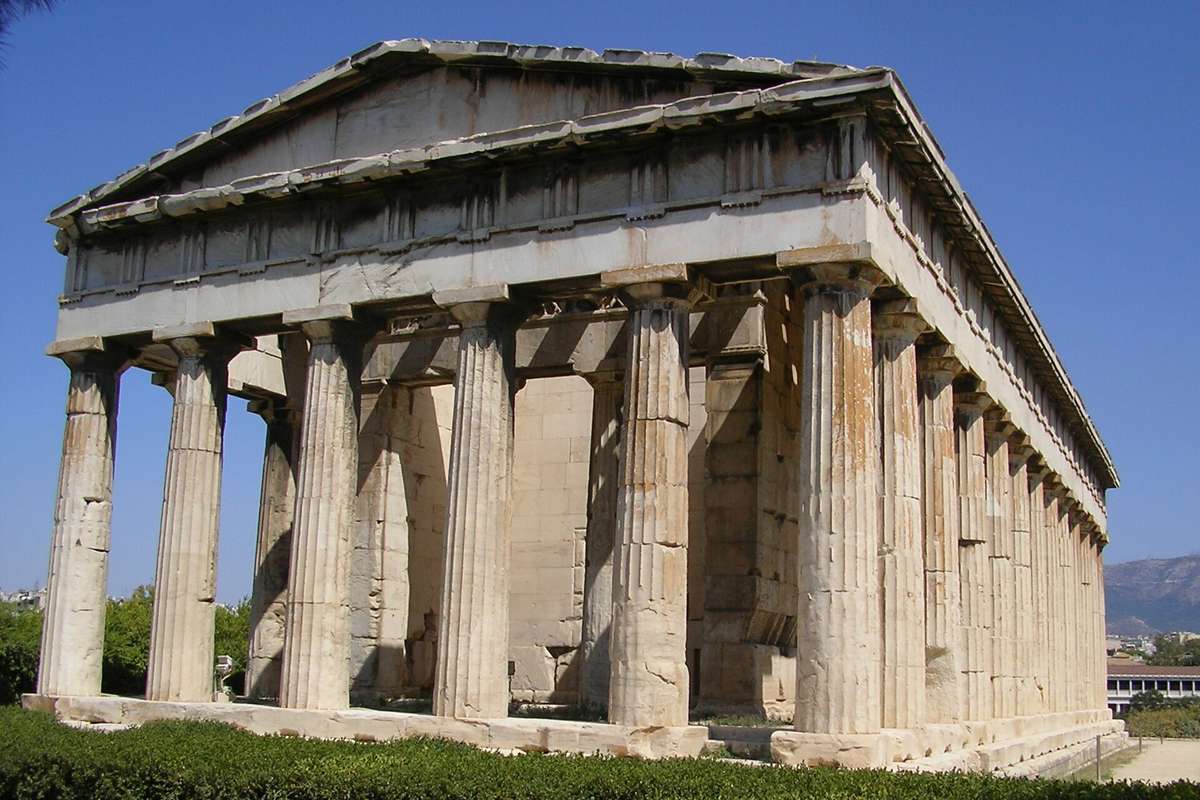
Ancient Greek sites are the ruined cities, sanctuaries and theatres of the Greek past. Expert-led trips run from Athens, Nafplio and the cruise port of Katakolo. Among the sites are the Theatre of Dionysus, the Odeon of Herodes Atticus, Lycosura, Megalopolis and Kalaureia. Helike, Aigeira, Abae, Ptoion, Eleutherna and Gournia join them. Related pages cover the classical Greece tour, Mycenae tours and the Epidaurus tour. Wider choices sit under Greece tours.
Bookings made through the GetYourGuide widgets on this page earn Classical Greece Tours a commission, at no extra cost to the traveller.
What are the ancient Greek sites?
Ancient Greek sites hold the remains of a civilisation that began in the Greek Dark Ages. It lasted until the end of classical antiquity, the era of the Greeks and Romans. Its ruins include whole cities, sacred precincts and open-air theatres set into hills.
Scholars mark the start of ancient Greece with Mycenaean Greece. Three centuries after that world declined, Greek urban city-states started to form, in the 8th century BC. The Greek word for a city-state is polis, and its plural is poleis. Urban means belonging to a town or city. Ancient Greek sites from both ages survive.
Each polis had its own constitution, the basic set of laws for its government. It also demanded loyalty from its citizens, the members with full rights in the city. Loyalty means faithful support. Ancient Greek sites keep the ruins of these self-governing towns, each once ruled by its own laws.
Holy ground at ancient Greek sites lay inside a temenos. This Greek word names a piece of land set apart from daily use and given to a god. A temenos was normally fenced off by a wall, a ditch or a line of stones. A sanctuary is a holy place of this kind, kept for worship.
- Theatron: Builders set theatre seats into a hill slope, so the hillside itself formed the theatron, or viewing area.
- Flat towns: In cities without a suitable hill, workers heaped up banks of earth to carry the seats.
- Asylum: A Greek inside a sanctuary was able to claim asylum, meaning safety under its god’s protection.
Ancient Greek sites come from a crowded map of separate states. Historians know of about 1,500 such city-states. The core lay in Greece and in Asia Minor, the land that is now Asian Turkey. Greeks also founded poleis around the Mediterranean and the Black Sea.
Why does the Theatre of Dionysus stand out among ancient Greek sites?
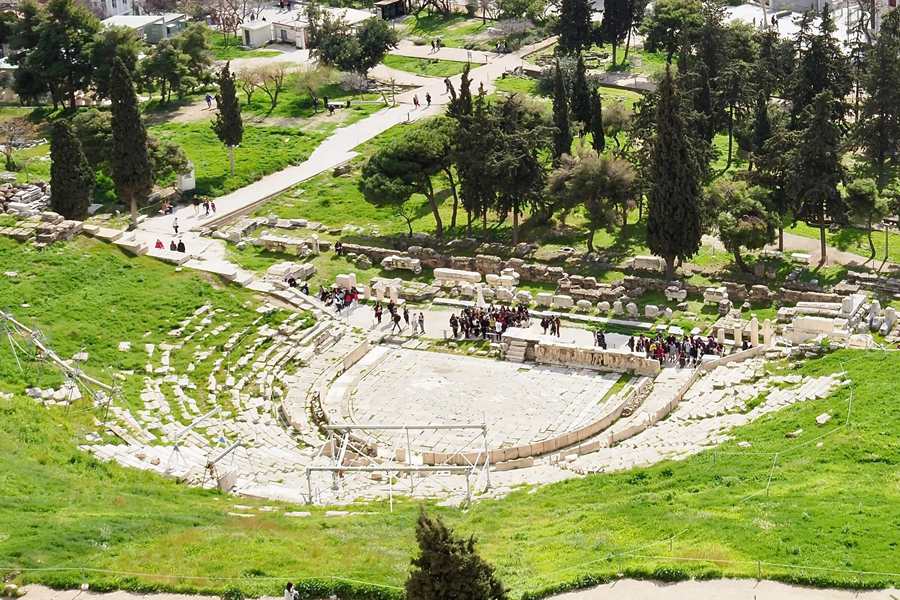
Ancient Greek sites in Athens include the Theatre of Dionysus, set into the southern side of the Acropolis. It began as part of the sanctuary of Dionysus Eleuthereus. That title means Dionysus the Liberator, or the one who sets people free.
Records tell of wooden bleachers, set up for plays in the Agora, that collapsed. The Agora was the public square of Athens. The Greeks called those wooden benches ikria. By the 70th Olympiad, dated to 499/496 BC, the plays had moved to the sanctuary. An Olympiad was the four-year span between two Olympic Games.
Among ancient Greek sites, this theatre staged plays by Sophocles, Aristophanes and Euripides. All three were writers of Greek drama. In its stone phase, twelve narrow stairways split the seating. They created thirteen wedge-shaped blocks, which the Greeks called kerkides. A wedge is a shape that narrows to a point.
Each seat had a depth of 33 cm and a height of 33 cm, across seventy-eight rows. In theatres at ancient Greek sites, the orchestra was the floor where the chorus sang. During the Roman period, this orchestra was sometimes flooded to imitate sea battles. This staging was called a naumachia, Greek for a sea fight.
- First terrace: Wilhelm Dörpfeld found multi-sided polygonal stonework in its first orchestra terrace, a sign of early date.
- Quarry: After the late 5th century AD the theatre was left empty, and its seats became a stone quarry.
- Excavation: Serious digging at the theatre began with the excavation led by Rousopoulos in 1861.
Among ancient Greek sites, this theatre also changed in the Hellenistic period. That period followed the death of Alexander the Great. A stone proskenion then rose here, fronted with fourteen columns. A proskenion was the front wall of the stage building, facing the audience.
How does the Odeon of Herodes Atticus fit among ancient Greek sites?
Ancient Greek sites under the Acropolis include the Odeon of Herodes Atticus. This stone theatre rises on the southwest slope of the hill. Its name honours Herodes Atticus, an Athenian rhetorician, or trained public speaker, and Roman senator. He lived from AD 101 to 177.
At first it was a steep theatre with a stone front wall three storeys high. Its wooden roof was made of costly cedar from Lebanon. Inside lay a semicircular cavea, the curved bank of seats. It held 33 rows of marble seats, and the scenery structures stood 28 metres high.
Niches in its walls held statues, and the entrance portico had a mosaic floor. Niches at ancient Greek sites are shallow hollows set into walls. A portico is a porch with a roof held up by columns. Among ancient Greek sites of Athens, this one was ruined by the Heruli in AD 267.
In the 1950s the audience stands and the stage were restored with Pentelic marble. That stone takes its name from Mount Pentelicus in Attica. Since then the Odeon has served as the main venue of the Athens Festival. During that festival in 1957, the singer Maria Callas performed on its stage.
- Mythodea: Vangelis’ work Mythodea had its first performance here in July 1993.
- Teacher: Herodes Atticus taught rhetoric to the future emperors Marcus Aurelius and Lucius Verus.
- Birthplace: Herodes Atticus was born on his family’s estate at Marathon, in Attica.
Among ancient Greek sites still used for concerts, the Odeon welcomed Frank Sinatra in 1962. The singer gave two benefit concerts there. A benefit concert is a show held to raise money for a cause. His two shows were for the city of Athens.
Which mystery does Lycosura add to ancient Greek sites in Arcadia?
Ancient Greek sites in southern Arcadia include Lycosura, a city of the Parrhasia region. Pausanias, a Greek travel writer, called it the oldest city in the world. Yet no evidence for the town survives from before the fourth century BC.
Lycosura’s sanctuary of Despoina, one of the ancient Greek sites of Arcadia, held a colossal group of statues. Despoina and Demeter sat on a throne, with Artemis and the Titan Anytos standing at each side. A Titan was an elder god of Greek myth. Artemis and Anytos went to Athens, where the National Archaeological Museum displays them.
The Arcadians worshipped the goddess as Despoina, a title meaning the Mistress. Early belief made her the daughter of Demeter and Poseidon Hippios, or Poseidon of horses. Only people initiated into her mysteries at Lycosura learned her real name. Mysteries at ancient Greek sites were secret rites for chosen members.
In 368 or 367 BC, towns of the region were joined into the new city of Megalopolis. The citizens of Lycosura refused to move there. They were spared out of reverence for the sanctuary, where they had sought asylum. In 1889 the Greek Archaeological Service uncovered the temple and much of the statue group.
- Temple front: The temple of Despoina had six Doric columns, a plain Greek style, on its front only.
- Seats: South of the temple, a theatre-like area holds ten rows of stone seats.
- Stoa: A Doric stoa, or covered colonnade, stood northeast of the temple and measured 14 by 64 m.
Ancient Greek sites such as Lycosura also appear on old coins. Coins of Megalopolis from the Severan period seem to depict its statue group. That period fell early in the third century AD. The Severans were a family of Roman emperors.
Why do ancient Greek sites include Megalopolis and its huge theatre?
Ancient Greek sites in Arcadia include the ruins of Megalopolis, which lie northwest of the modern town centre. They stretch across both banks of the river Elisson. The ancient writer Pausanias described their theatre as the largest in Greece.
Between 371 and 368 BC, twenty to forty neighbouring communities joined together to found the city. Megalopolis is one of the ancient Greek sites linked to the Arcadian League, a union of Arcadian cities. It belonged to that league until the federation finally broke up in 362 BC.
In 353 BC the Spartans tried to take the city, but the Thebans sent help and rescued it. In 317 BC Polyperchon, regent of the Macedonian Empire, laid siege to Megalopolis. The city had sided with his rival Cassander. A regent rules in place of a king. Polyperchon’s siege failed.
In 235 BC the tyrant Lydiadas gave up his rule, and the city joined the Achaean League. A tyrant was a ruler who seized power alone. In 222 BC the Spartan king Cleomenes III burnt the city down. It was rebuilt in the following years, and its ruins stand among ancient Greek sites of Arcadia.
- Thersileon: The theatre is linked to the Thersileon, a hall of 67 pillars with possible cultural and political uses.
- Zeus Soter: A sanctuary thought to be of Zeus Soter, the Saviour, holds a Doric-Ionic temple and two gateways.
- Stoa Myropolis: On the east side of the agora stood the Stoa Myropolis, about 125 m long.
Ancient Greek sites at Megalopolis sit on far older ground. The extinct human species Homo heidelbergensis lived in the area around 500,000 to 400,000 years ago. Evidence shows that these early humans butchered straight-tusked elephants. Species is the scientific word for one sort of living creature.
Where does Kalaureia on Poros fit among ancient Greek sites of Poseidon?
Ancient Greek sites on Poros include the sanctuary of Poseidon on Kalaureia. Kalaureia is an island lying near Troezen on the mainland, and it forms part of modern Poros. A Doric temple of Poseidon rose there, possibly around 520 BC.
Among ancient Greek sites of Poseidon, this temple had a footprint of 27.4 by 14.4 m. Six columns stood along each short side and twelve along each long side. Doric columns have plain, sturdy shafts. Builders used mainly poros stone, a soft limestone, and set a low wall around the temple.
Strong evidence shows that Poseidon was worshipped here under the epithet Geraistos. An epithet is an extra title joined to a god’s name. The word Geraistos comes from an unknown language older than Greek. Another old tale claims Poseidon gained this site from Apollo. In return, he handed over his share of Delphi.
For a time the island bore the name Eirene, a Greek word for peace. Swedish archaeologists first excavated the ancient Greek sites on Kalaureia in 1894. By then the temple had been almost entirely stripped of its stone. When modern work started, only foundation trenches and roof tiles were left.
- Stoa A: Its walls were polygonal stonework coated in red plaster, and an Ionic colonnade stood inside.
- Roman trade: In Roman times, Stoa A housed small sheds used for buying and selling goods.
- Asklepios: Finds from Building G included a small statue of Asklepios, the god of healing.
At Kalaureia, as at other ancient Greek sites, buildings had practical uses. An inscription suggests that Stoa C worked as an archive. An archive is a store for official papers and records. The same inscription points to other administrative uses for the building.
What happened to Helike, the lost city among ancient Greek sites?
Ancient Greek sites in Achaea include Helike, a city-state drowned by a tsunami in 373 BC. A tsunami is a giant sea wave raised by an earthquake. The city stood two kilometres from the Corinthian Gulf, near the town of Boura.
The ancient Greek sites of Helike have a long past. Their oldest finds go back to the Early Bronze Age, around 3000 to 2200 BC. In the Iliad, the poet Homer lists Helike among the forces of Agamemnon in the Trojan War. Later the city led the Achaean League, which joined twelve neighbouring cities.
Helike’s coins carried the head of Poseidon, its patron god, and his trident on the reverse. The city also founded colonies, among them Priene in Asia Minor and Sybaris in southern Italy. Among ancient Greek sites, its sanctuary of Helikonian Poseidon ranked second only to Delphi in religious importance.
Ancient accounts describe warning signs before the disaster. Immense columns of flame appeared, those accounts say. Five days earlier, all the animals and vermin left the city, heading towards Keryneia. Vermin are small pests, such as rats and mice. When the wave struck, ten Spartan ships at anchor in its harbour sank along with the city.
- Bronze Poseidon: About 150 years later, Eratosthenes reported a bronze Poseidon standing underwater, a danger to net fishers.
- Pausanias: Around 174 AD Pausanias saw the city walls underwater, worn by salt water.
- Atlantis: Adalberto Giovannini argued that Helike’s fate inspired Plato to end his Atlantis story with its sinking.
Helike’s remains came to light again in 2001, buried in an ancient lagoon near the village of Rizomylos. Lagoons are calm, shallow waters sealed off behind a strip of land. Excavations at these ancient Greek sites are now revealing parts of the city.
How did Aigeira get its name among ancient Greek sites of Achaea?
Ancient Greek sites in northeastern Achaea include Aigeira. Its ruins lie about 6 km from the modern town. Austrian archaeologists have excavated the site since 1916. Its remains reach from the Mycenaean age to later periods, and the Hellenistic layers are extensive.
People first settled at the ancient Greek sites of Aigeira in the Neolithic, around 5500 BC. The Neolithic was the late Stone Age. Their pottery includes vessels thought to have served for making cheese. Obsidian blades also turned up, made from stone brought from Melos. Obsidian is a dark volcanic glass.
Pausanias tells of a raid from Sicyon. The people gathered all their goats and tied burning torches to their horns. The raiders took the lights for an allied army and turned home. So the town took its name from aiges, the Greek word for goats. A temple to Artemis the Huntress marked where the lead goat lay.
In the Iliad, the town bore the older name Hyperesia. In the early fourth century BC, Aigai seems to have emptied, and its citizens joined Aigeira. Aigeira’s coins then took up the goat symbol once used by Aigai. Around 280 BC a theatre joined the ancient Greek sites, with a small shrine, or naiskos, beside it.
- Growth: In the Hellenistic period the settlement grew by as much as fourteen times.
- Zeus: Fragments of a colossal Zeus by the Athenian sculptor Eucleides now rest in the National Archaeological Museum.
- Harbour: A ground uplift in the 3rd century AD stranded the harbour about four metres above sea level.
Among the finds at these ancient Greek sites is a hoard of nearly 600 silver coins. It lay in the so-called guest house. Scholars think the coins were hidden there during an Aetolian raid in 219 BC. Hoard here means a secret stash of money.
Which oracle gives Abae its place among ancient Greek sites?
Ancient Greek sites in Phocis include Abae, a town in the northeastern corner of that ancient region. Its oracle of Apollo Abaeus was consulted by Croesus, king of Lydia. An oracle was a shrine where a god answered questions.
Legend says Abae was built by Abas, an Argive, or man from Argos. The story points to a town that already existed in the Bronze Age. The oracle site, among the ancient Greek sites of Phocis, was found again near Kalapodi. Digs there show unbroken settlement between the Early Bronze Age and Roman times.
Before the Persian invasion, the temple was rich in treasuries and votive offerings. Votive offerings were gifts given to a god. Fire destroyed the temple twice. The Persians burned it in 480 BC, and the Boeotians burned it again in 346 BC. Later the emperor Hadrian had a smaller temple built near the ruins.
Inside the new temple stood three ancient brass statues of Apollo, Leto and Artemis. Even after the town’s destruction, the oracle at these ancient Greek sites still drew visitors. The Thebans consulted it before the Battle of Leuctra in 371 BC. The shrine’s holiness won the people of Abae special rights, later confirmed by the Romans.
- Kalapodi: The sanctuary near Kalapodi served for worship without a break from early Mycenaean to Roman times.
- Old faith: It was the first site where digs confirmed that Mycenaean religion carried on into Classical Greece.
- Drama: The oracle of Abae earns a mention in the play Oedipus Rex.
Ancient Greek sites at Abae were not only sacred. The town also had an agora and a theatre, and both still stood in the time of Pausanias. An agora was the open public square at the heart of a Greek town.
What does Mount Ptoion add to ancient Greek sites in Boeotia?
Ancient Greek sites in Boeotia include Ptoion, a mountain chain in the northeast of the region. The range is famed for an oracle of Apollo. Its seat was the sanctuary of Apollo Ptoios, on the western edge of the range.
The chain stretches from Akraiphia, beside the former Lake Copais, to the Gulf of Euboea. Its peaks reach 781 m in the east. Up to the Persian Wars, this oracle ranked among the leading ancient Greek sites of prophecy. The Persian Wars were conflicts between Greeks and Persians. The oracle lay three kilometres northeast of Akraiphia.
Pausanias reports that the oracle first belonged to Ptoios, a local hero. He was the son of Athamas and Themisto, and Apollo later displaced him. A hero in this sense was a figure of legend given worship. His own small sanctuary, one of the ancient Greek sites of the range, lay on the Kastraki.
Herodotus tells of a visit by Mys of Europos, sent by the Persian general Mardonius. The community sent three local men to record the reply. At once the seer spoke in a non-Greek tongue. Mys took their tablet and wrote the words himself, saying the language was Carian. A seer was a person who spoke the god’s answers.
- Early life: Mount Ptoios keeps the remains of a Mycenaean fortress and an older Neolithic-Helladic settlement.
- Ptoia: From 227 BC a music contest for Apollo, the Ptoia, took place near the oracle every five years.
- Monastery: In Byzantine times a Christian monastery called Agia Pelagia took the place of the sanctuary.
Among ancient Greek sites of prophecy, Ptoion had gone quiet by the second century AD. When the travel writer Pausanias came in that century, the oracle was no longer active. An active oracle was one that still gave replies to those who asked.
How does Eleutherna on Mount Ida join the ancient Greek sites of Crete?
Ancient Greek sites on Crete include Eleutherna, a city-state also known as Apollonia. The site lies 25 km southeast of Rethymno. The city crowned a slim ridge on the north side of Ida, the tallest peak on Crete.
Among ancient Greek sites of Crete, Eleutherna controlled two ports, Stavromenos and Panormos. It also lay on the way to Idaion Andron, a holy cave close to the summit of Ida. A narrow route, watched by a tower, led up to the acropolis. The nearby hill, Pyrgi, takes its name from pyrgos, the Greek for tower.
Digs on the central plateau of Pyrgi found hundreds of small obsidian pieces. They date to the Early Minoan period, the first stage of Bronze Age Crete. Flakes, cores and blades were among them. South of a later church stood a temple raised in the 7th century BC. It stayed in use until the 2nd century AD.
The historian Cassius Dio writes that the Romans took Eleutherna by deception. He says residents coated a strong brick tower with vinegar at night. The vinegar made the tower brittle. Under Roman rule, builders added a bathhouse and an aqueduct to the ancient Greek sites on the plateau. Aqueducts were water channels.
- Priestesses: Anagnostis Agelarakis helped trace an Iron Age line of related women, called a dynasty of priestesses.
- Bull figure: One ritual pit held a handmade bull figure with its nostrils, eyes and mouth marked in red.
- Last coin: The newest coin from the central plateau, a follis, was struck under Leo III and Constantine V.
For a 2004 exhibition in Athens on these ancient Greek sites, the Louvre lent the Lady of Auxerre. This statue dates from the seventh century BC. Comparable finds at Eleutherna now give it a definite Cretan context. The Louvre is a large art museum.
What did Harriet Boyd uncover at Gournia, one of the ancient Greek sites of Crete?
Ancient Greek sites on Crete include Gournia, a Minoan palace complex in the Lasithi regional unit. Minoan describes the Bronze Age culture of Crete. Its present name refers to stone troughs found there, while its ancient name is lost.
Over three seasons, in 1901, 1903 and 1904, Harriet Boyd Hawes dug the Minoan village. Her team laid bare nearly the entire town, one of the ancient Greek sites of the Minoans. Sixty houses came to light, with the cemetery and the roads joining them all. They also found a central building, which Boyd named the palace.
Similar palatial complexes exist across Crete. Palatial means like a palace. Recent scholars dispute Boyd’s reading, yet the term palatial complex has stayed in use. In 1973 a lost notebook of Hawes came to light, full of detailed notes on her finds. Vance Watrous later surveyed the site and its surroundings from 1992 to 1994.
Among ancient Greek sites of Crete, Gournia gained its palace complex in the Middle Minoan III rebuilding. At its peak the settlement spread across roughly 1.68 hectares of ground. Its public square covered 500 square metres. Cobbled streets wound on for over half a kilometre in all.
- New digs: After cleaning seasons, Vance Watrous excavated at Gournia from 2010 until 2014.
- Mycenaeans: In the Late Minoan III period, Mycenaeans resettled the site and built a megaron, a great hall.
- Grave goods: Burials at Sphoungaras held complete vases, jewellery and seals carved from ivory.
Ancient Greek sites such as Gournia were studied in stages, over decades. Harriet Boyd first excavated the burials at the Sphoungaras cemetery. Richard Seager revisited them in 1910. Jeffrey Soles and Costis Davaras then went back to them in 1970.
What do travellers ask about ancient Greek sites, and what are the answers?
Ancient Greek sites raise questions about their Greek building terms and about the old writer who recorded them. Stoa, agora and acropolis are three such terms. Each names one part of a Greek city, from a roofed walkway to a hilltop citadel.
Who wrote first-hand about ancient Greek sites in Roman times?
Pausanias, a Greek traveller and geographer, lived from about 110 to 180 AD. A geographer describes places. From about 150 until his death, he travelled across mainland Greece. His Description of Greece describes the country from his own observations. He wrote about monuments, sacred spaces and notable geographical sites on the way.
What is a stoa at ancient Greek sites?
A stoa is a covered walkway or porch, meant for public use. Its roof rests on a line of columns. Later stoas rose two storeys high, with inner rows of columns. Shops, or at times offices, sat inside them. The Stoic school of philosophy takes its name from the stoa.
What was the agora at ancient Greek sites?
In a Greek city-state, the agora served as the main open public space. Early on, free-born citizens assembled there for military service. They also gathered there whenever the king or council made statements. Later the agora worked as a marketplace too. Merchants kept stalls or shops there, amid covered arcades.
Why do ancient Greek sites tend to include an acropolis?
An acropolis was the upper part of an ancient Greek city, commonly a hill with steep sides. Such heights were chosen mainly for defence. Almost all Greek cities possessed one. They served as religious centres where people worshipped. They also acted as forts and as homes for royal and high-status people.
Featured photo: Tommi Nikkilä, CC BY-SA 3.0, via Wikimedia Commons.