
Greek wine regions are districts of Greece whose names appear on wine labels. Outings with a host to these areas take place on the Greek mainland and on the islands. The sections below cover Naousa, Goumenissa, Zitsa, Ampelonas, Maroneia and ancient Mende. They also cover the old island wines of Chios, Lesbos and Kos. A final part explains the PDO label for protected place names. Related trips appear on the 5 day classical tour and Greece small group tours pages. Wider choices sit under Greece tours.
Bookings made through the GetYourGuide widgets on this page earn Classical Greece Tours a commission, at no extra cost to the traveller.
What are the Greek wine regions?
Greek wine regions are the named districts whose wine carries the name of its home ground. Greece ranks with the earliest wine lands of Europe. Traces of its wine reach back 6,500 years. Trade carried that wine across the Mediterranean.
The main wine growing regions of Greece are known as appellations, the legal names for wine districts. Macedonia holds Naoussa, Goumenissa, Amyntaio, Epanomi, Chalkidiki and Pieria. The Peloponnese holds Mantineia, Nemea, Monemvassia-Malvasia and Patras. Among Greek wine regions on the Aegean islands, the list names Santorini, Samos, Paros, Lemnos and Rhodes.
Wine culture followed the spread of Greek civilisation through the Mediterranean. Greek settlers made wine in colonies they founded across Italy, Sicily, southern France and Spain. Under the Roman Empire, Italians held Greek wine in particularly high regard. In ancient Greece, the fame of a wine rested on its region, not on one grower.
Greek poets acted much like early wine critics. They praised wines from these Greek wine regions: Chios, Lesbos, Kos, Thasos, Naxos, Mende, Ismaros, Chalkidike and Peparethos. Peparethos is the old name for present-day Skopelos. Poets also lauded Bibline, a wine whose origin is unknown. It was thought to copy a Phoenician wine from Byblos.
- Ionian Islands: Corfu, Lefkada, Kefalonia and Zakynthos form the appellations of the Ionian group.
- Central Greece: The list gives this part of the mainland two names, Attica and Atalanti.
- Wine Institute: A Wine Institute for Greece opened in 1937 under the Ministry of Agriculture.
Medieval wine from Crete, Monemvasia and other Greek ports was prized in northern Europe. Laws passed in 1971 and 1972 then fixed the appellation rules for Greek wine regions. An appellation is a protected place name that appears on the label of a wine.
Why does Naousa stand out among Greek wine regions?
Greek wine regions take in Naousa, a city of Central Macedonia in the Imathia regional unit. Its red wine, sold under the name Naoussa, has won awards in Greece and abroad. Greek regions split into smaller districts called regional units.
Within a century, Naousa’s population almost doubled. The town also gained a name for its wines and its schools. Such success caught the eye of Ali Pasha of Ioannina, an ambitious ruler. From 1795 he made repeated attempts to annex the city, by siege or trickery. To annex a city means to bring it under one’s own rule.
Naousa keeps a Wine and Vine Museum on the history and process of wine production. The museum sits in a neoclassical building from 1908. Neoclassical describes a style that borrows columns and shapes from the temples of ancient Greece. The building also houses the BIBON oenological library, a collection on the science of wine.
Ali Pasha reached his goal in 1804. Eight years later, an order from the sultan forced him to leave the city. Among Greek wine regions, Naousa gained a European PDO label for a special local grape variety. This European label, known in full as protected designation of origin, ties a product to one named area.
- Orchards: Beyond wine, this corner of the Greek wine regions grows high quality peaches, apples and cherries.
- Carnival: The Naousa carnival stages dances of the Boules and the Genitsari and draws visitors.
- Industry: Naousa gained its first cotton spinning mill, a factory that turns cotton into thread, in 1875.
In the 17th century, the Ottoman traveller Evliya Çelebi visited Naousa. He described a well-known urban centre of about one thousand houses at that time. The present-day list of Greek wine regions names Naoussa as one of the appellations of Macedonia.
How did Goumenissa earn its place among Greek wine regions?
Greek wine regions stretch to Goumenissa, a small, traditional Macedonian town in the Kilkis regional unit. Among Greek wine regions, its wine area carries the label of a superior-quality appellation of origin. Its wines have enjoyed a name for quality across hundreds of years.
Goumenissa, one of the Greek wine regions of Macedonia, stands on the southeastern side of the Paiko range. The town lies 69 km northwest of Thessaloniki. Its traditional wineries prove the skill of this small country town in making good quality wine. Local tradition holds that the name means place of the Abbot, the head of a monastery.
The name Goumenissa first appears in a record from 1346. In an imperial act of that year, the region passed to Iviron Abbey on Mount Athos. The Ottomans captured Goumenissa in 1387. Under their rule, the town won privileges for its large output of buckram. Buckram is a stiff cloth, and here it went into army uniforms.
In the 19th century, Goumenissa prospered. It grew into the economic, cultural and religious centre of its region. Its famed wine found favour across the Ottoman Empire and further afield, above all in Central Europe. Goumenissa also has a name for its folklore museum and its impromptu brass bands. Impromptu means unplanned.
- Greek state: Goumenissa became part of the Kingdom of Greece on 23 October 1912, in the First Balkan War.
- French fountain: During the First World War, a French division built the fountain in Central Square.
- Monastery: The Monastery of the Virgin Mary at Goumenissa dates its founding to 1100.
Beyond its wine, Goumenissa holds a church role among the Greek wine regions of the north. The Orthodox diocese that covers Goumenissa, Axioupoli and Polykastro has its seat in the town. A diocese is a district under the care of a bishop.
What history does Zitsa bring to Greek wine regions?
Greek wine regions reach Epirus at Zitsa, a village that belongs to the Ioannina regional unit. In the Ottoman era, Zitsa prospered and grew into a centre of wine production. Among Greek wine regions, the village is still renowned for that wine.
The first written mention of Zitsa comes from the Chronicle of Ioannina in 1382. Such a chronicle sets down past events year by year. Western Europeans wrote about this corner of the Greek wine regions in their travel books. Those writers include Henry Holland in 1813, and both Lord Byron and William Martin Leake in 1809.
Lord Byron, the English poet, spent two nights in the monastery of Zitsa. He was so taken with the village that he later wrote a stanza about it. The stanza appears in his long poem Childe Harold’s Pilgrimage. A stanza is a group of lines that forms one unit of a poem.
Zitsa joined the Greek state in 1913. Heavy fighting took place there in the Greek Civil War. In the post-war era, new roads were built and the economy changed direction. Together these shrank Zitsa’s sway over the surrounding area. Wine making and tourism are still the two pillars of its economy.
- Merger: Five earlier municipalities were joined in 2011 to create the present municipality of Zitsa.
- Area: The whole municipality of Zitsa covers 565.566 square kilometres of land.
- Seat: The seat of the municipality lies in the village of Eleousa, not in Zitsa.
On the list of Greek wine regions, Zitsa appears under Epirus together with Metsovo. Jeremias I, Patriarch of Constantinople, who died in 1546, appears among its notable people. A patriarch is a senior bishop who leads a major Orthodox church.
Which festival ties Ampelonas to Greek wine regions?
Greek wine regions in Thessaly include Ampelonas, a village within the Tyrnavos municipality. Tyrnavos itself is a major wine producing centre. Grapes, wine and tsipouro are the chief products of Ampelonas. Its Wine Festival has taken place in the village every year since 1959.
Tsipouro is a strong spirit made by fermenting and distilling grape pomace. Pomace is the skins and pips left after pressing. Ampelonas, a wine village of the Greek wine regions, dates from the early 15th century. At that time, Sultan Murad II settled 5,000 to 6,000 Yörüks from Konya there. Yörüks were nomadic Turkish herders.
The 1881 Convention of Constantinople passed Thessaly to Greece. A convention here is a treaty, a formal agreement between states. After that change, the Turkish families of the village sold their holdings and left for Asia Minor. Greeks then moved into the area. Until 1928, the village bore the name Kazaklar.
Today the municipal unit groups four communities: Ampelonas, Deleria, Rodia and Vryotopos. The community of Ampelonas itself counts 6,083 people. In this part of the Greek wine regions, fields also grow peaches, pears, almonds, corn, cereals and cotton. The farmland of southern Tyrnavos forms part of the Thessalian Plain and the Titarisios valley.
- River: Tyrnavos town has the Titarisios running through it, a tributary that feeds the Pineios.
- Name: Tyrnavos takes its name from Trnovo, a common Balkan place name meaning place of thorns.
- Province: The old province of Tyrnavos, part of the Larissa Prefecture, was abolished in 2006.
Tyrnavos is a town in the Larissa regional unit of Thessaly. The town alone counts 11,210 residents, so it ranks second in size within that unit. Ampelonas and Tyrnavos together form this Thessaly corner of the Greek wine regions.
How does Maroneia link Homer with Greek wine regions?
Greek wine regions of antiquity included Maroneia. Today it is a village in the Rhodope regional unit of Thrace. In ancient Greek and Roman times, it was famous for its wine. Across the Greek wine regions and beyond, that wine was esteemed.
Legend says that Maron, a son of the wine god Dionysus, founded the city. Another account, by Pseudo-Scymnus, credits settlers from Chios with its founding in 540 BC. Its ancient home stood on the hill of Agios Charalampos. Maroneia also joined the Delian League, which Athens led as head of allied Greek cities.
Maroneia lay close to Ismaros, a place named by Homer in the Odyssey. In that poem, Odysseus plunders the city but spares Maron, a priest of Apollo. Maron then hands Odysseus a gift of wine, along with gold and silver. The Odyssey is the ancient epic about the long voyage home of Odysseus.
Among Greek wine regions, Maroneia had a wine said to smell of nectar, the drink of the gods. It was said to stand mixing with twenty or more times its own amount of water. The people honoured Dionysus, as a famous sanctuary and the city’s coins both show. The foundations of that Dionysian sanctuary are still visible today.
- Colony: Maroneia ranked as the largest and leading ancient Greek colony of Western Thrace.
- Modern village: Today’s village of Maroneia stands on the hillside of Mount Ismaros.
- Piracy: The settlement moved to that hillside in the 17th century because of the threat of piracy.
Herodotus wrote that Maroneia belonged to the Cicones, a people of Thrace. Among the ancient Greek wine regions, it was also home to the Cynic philosopher Metrocles. His sister Hipparchia was a Cynic philosopher too. Cynics urged a simple life, free of wealth and show.
What did ancient Mende give to Greek wine regions?
Greek wine regions of the ancient north included Mende. This city lay on the Pallene peninsula of Chalkidiki, along its western shore. From this corner of the Greek wine regions, its famous wine Mendaeos oinos reached Greek colonies in Italy. Oinos is the Greek word for wine.
Mende was named after the minthe plant, a kind of mint that still grows there. Rich timber and mines of silver, gold and lead drove its rapid growth. Across the narrow Thermaic Gulf, Mende looked toward the shore of Pieria. A gulf is a deep inlet of the sea.
From the 6th century BC, Mende shared control of trade routes along the coast of Thrace. In the 5th century BC, it became a leading ally of Athens and joined the Delian League. In 423 BC, Mende rose against Athenian rule. Athens soon crushed the revolt. After the war between Athens and Sparta ended, Mende regained its independence.
In 315 BC, the people of Mende were forced to resettle in Cassandreia. King Cassander had built that new city on the site of Poteidaea. William Martin Leake matched the site of Mende with modern Kalandra in 1835. Systematic digs at this site of the ancient Greek wine regions ran from 1986 to 1994.
- Site: The main archaeological area measures 1,200 by 600 metres beside the sea.
- Tombs: Diggers opened 241 tombs, mostly child burials inside engraved ceramic vases.
- Suburb: The Proasteion, or suburb, held the harbour, and the historian Thucydides mentions it.
This old corner of the Greek wine regions saw unbroken settlement from the 9th to the 4th century. The digs also showed a settlement with heavy Euboean influence from the 11th century. Euboean means linked to Euboea, a large Greek island.
Why was Chian wine so prized among the Greek wine regions?
Greek wine regions of classical antiquity produced Chian wine, made on the island of Chios. It ranked among the wines held in highest esteem in that whole age. The name Chian marks wine from Chios, an island of the eastern Aegean.
According to the historian Theopompus and to Greek myth, Chian was the first red wine. People then called red wine black wine. From around the 5th century BC, Chios shipped great quantities of it to Athens. Modern digs in Athens have found large numbers of Chian amphorae, tall clay jars for wine.
In the 5th century BC, the poet Hermippus praised the quality of Chian wine. The writer Athenaios quotes his words. Centuries later, the geographer Strabo singled out Ariusium among Greek wine regions. He judged the wine of this Chian district the finest in Greece. A geographer is a scholar who describes lands and peoples.
Far from the Greek wine regions, Chian wine was rare in ancient Rome before the 1st century AD. Romans mainly prescribed it in small amounts as a medicine. Otherwise it counted as an extreme luxury. In his Satires, the poet Horace has a character named Nasidienus serve it. The scene is a far too lavish dinner party.
- Roman feasts: From about the 1st century AD, lavish Roman festivities served it more widely.
- Roman writers: Galen and Pliny ranked Chian wine among the finest wines of their day.
- Medicine: Romans kept valuing it for medicinal purposes after it grew more common.
Roman connoisseurs preferred wine with no sea water added. Pliny and Galen both strongly recommended pure wines from Greek wine regions such as Chios. A connoisseur is an expert judge of taste. Pure here means unmixed with salt water or other additions.
What role did Lesbian wine play in the history of Greek wine regions?
Greek wine regions in the Aegean Sea include Lesbos, home of Lesbian wine. Winemaking on the island goes back at least to the 7th century BC. Homer mentioned the island’s wine in his works at that time. Lesbian here means from Lesbos.
An apocryphal tale makes one brother of the poet Sappho a wine merchant. Apocryphal means widely told but not proven. He traded Lesbian wine with Naucratis, a Greek colony in Egypt. The best-known Lesbian wine bore the name Pramnian. The writer Athenaeus used the name loosely, for any dark and fine wine that aged well.
The warm Mediterranean climate of Lesbos suits the growing of vines. For Pramnian, grapes stayed on the vine until they reached full ripeness. Workers then piled the bunches high in large containers. The weight crushed the grapes below, so free run juice flowed without any press. Free run juice flows from grapes before any pressing.
In the early 19th century, phylloxera spread to Lesbos. Phylloxera is a tiny insect that attacks the roots of vines. The island also came to specialise in ouzo, an anise spirit. Together these stalled wine production on this island of the Greek wine regions. After that, only farmers made wine there, privately, until 1997.
- Roman fame: Lesbian wine stayed popular in Roman times, valued beside Greek wine regions such as Chios, Thasos and Kos.
- Nectar: The free run juice for Pramnian was said to be very thick, a kind of nectar.
- Other places: The Pramnian name was also tied to wines from Smyrna and Icaria.
In the modern Greek wine regions, Lesbos has revived a local grape saved from extinction. It grows on the sulfuric lava that formed the Petrified Forest of Lesbos. Petrified means turned to stone. That soil favours organic farming, which uses no man-made chemicals.
How did salty Coan wine spread through Greek wine regions?
Greek wine regions of the ancient Aegean included Kos, home of Coan wine. Invented on the island in classical antiquity, the style was known for saltiness. Coan describes things from Kos. From about the 4th century BC, Kos exported it in large quantities.
The Roman writer Pliny says a slave invented the style by accident. To reach his set amount of work, he poured sea water into the must. Must is freshly pressed grape juice that has not yet become wine. The result proved popular, and nearby Greek wine regions such as Rhodes copied it.
Salt water tended to hide any local character. Other regions therefore began making amphorae in the Coan style for their copies. In time, the name Coan wine covered a style made at a wide range of places. Strabo named Coan wine together with the respected wines of Chios and Lesbos, two other Greek wine regions.
Two accounts of how to make Coan-style wine survive. One comes from Cato the Elder, in his farming book De agri cultura. The other, credited to Berytius, sits in the Byzantine collection called Geoponica. Byzantine describes the eastern Roman state. One Berytius recipe boils 3 parts must with 1 part sea water until a third has gone.
- Sea water: Cato’s recipe takes sea water far from the shore, where no fresh water mixes in.
- Calm day: The recipe draws that water on a calm day, when no wind is blowing.
- Ripe grapes: Cato wanted the grapes left on the vine until they ripened thoroughly.
Within the Greek wine regions of classical Greece, Coan wine enjoyed a fairly good name. A second Berytius recipe begins with white wine. Into it go salt, boiled-down must, vetch flour, sweet clover, apples and Celtic nard. Nard is a sweet-smelling plant.
What do travellers ask about Greek wine regions, and what are the answers?
Greek wine regions sit inside a European scheme of protected names that also covers wine. The protected designation of origin, or PDO, is a geographical indication of the European Union. Its aim is to guard the place names of food-related products.
Before a trip to Greek wine regions, when did the PDO label begin?
The PDO designation dates from 1992, when the European Union created it. A geographical indication is a name that links a product to its place. A PDO marks goods produced, processed and developed within one named area. Makers must follow the skills of local producers and use ingredients from that region.
Where are the protected names of Greek wine regions recorded?
Every PDO product must carry the official PDO logo, since its use is compulsory. The logo documents the link between a product and its home ground. Protected names enter the EU Quality Register kept by the European Commission. Since 1 April 2019, the online eAmbrosia database lists protected wines, spirits and foods.
Did people in the ancient Greek wine regions drink their wine mixed?
Greeks almost always diluted their wine before drinking it. Water was the usual partner, while snow went in when the wine was served cold. Greeks believed that only barbarians drank wine unmixed. Barbarians, to the Greeks, were peoples who did not speak Greek. Mixing wine with water counted as a sign of civilised behaviour.
What were the wines of the ancient Greek wine regions like?
Sweet, aromatic wine was the commonest style, though drier wines were made as well. Colours ran from dark, inky black through tawny to nearly clear. Tawny means orange-brown. Oxidation, damage caused by contact with air, was hard to control. As a result, a good share of wines lost their quality before the next vintage.
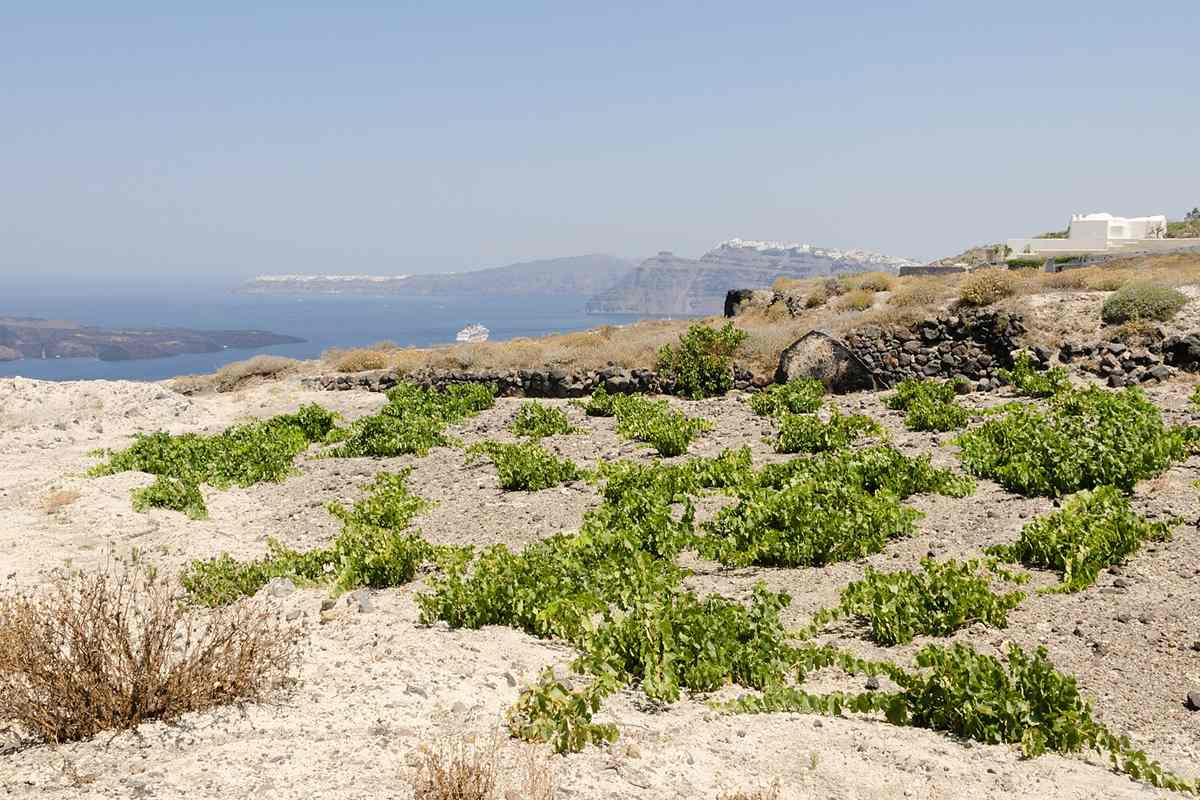
Featured photo: Norbert Nagel, CC BY-SA 3.0, via Wikimedia Commons (File:Winegrowing between crater rim and Megalochori – Santorini – Greece.jpg).