
Greece shore excursions are trips ashore for cruise passengers at the ports of call of Greece. The sections cover ancient Pheia beside Katakolo and the Spianada square of Corfu. They also cover Souda Island in its Cretan bay and the island of Cranae off Gytheio. Short answers follow on Panagia Paraportiani, the hill of Munichia, Chania Lighthouse and the Kamares of Kavala. Related reading covers Greek island cruises, day trips from Athens and Corfu tours. Wider ideas sit among the full range of Greece tours.
Bookings made through the GetYourGuide widgets on this page earn Classical Greece Tours a commission, at no extra cost to the traveller.
What are Greece shore excursions?
Greece shore excursions are trips on land for people who reach a port aboard a cruise liner. A cruise ship is a large passenger vessel, used mainly for holidays. It calls at ports along its route, and passengers there can step ashore for an excursion.
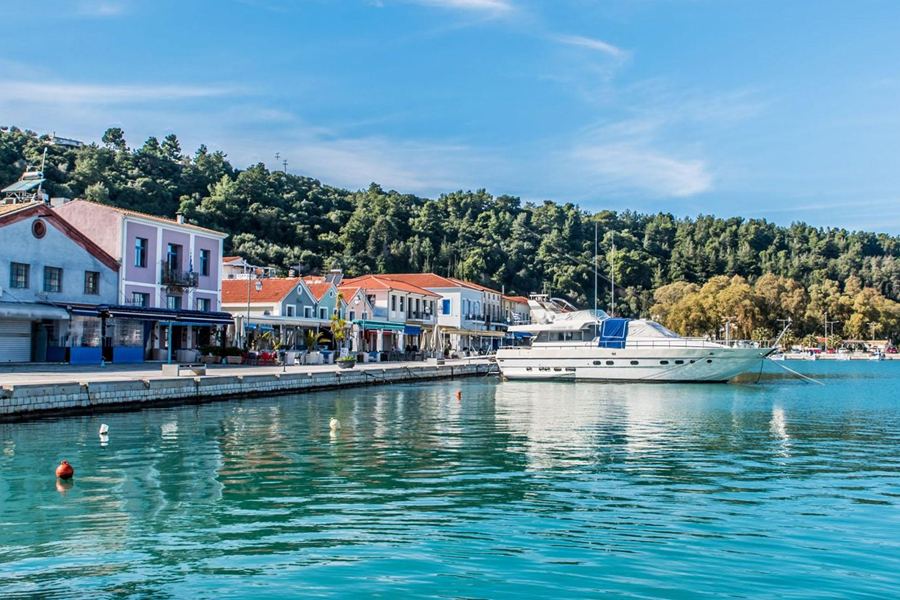
Every such stop is a port of call, a halt partway through a ship’s sailing plan. The plan itself, an ordered list of ports, is called an itinerary. Greece shore excursions begin at these halts. Certain ports serve mainly passenger ferries and cruise ships. A ferry is a boat that carries people over water on a fixed run.
An early cruise sailed from Naples in 1833. Nobles, officials and royal princes from all over Europe joined it. The ship’s ports of call included Corfu, Patras, Delphi, Zante and Athens. Zante is the Italian name of Zakynthos, an island off western Greece. Nobles are people born into families with titles, such as counts.
In 1844, sea tours were advertised from Southampton, with Gibraltar, Malta and Athens among the stops. A voyage of 1891 round the Mediterranean and the Near East carried 241 passengers. Writers widely name that voyage the first cruise of all. Near East is an old term for south-west Asia and nearby lands.
- Shift: From the late 19th century, the cruise trade slowly turned from the Mediterranean to the Caribbean.
- Excursion: An excursion is a short outing that ends back at the point where it began.
- Shore: In Greece shore excursions, the shore is the strip of land where the sea meets the coast.
Cruise ships sail mainly in the Caribbean or the Mediterranean. The Mediterranean is the sea between southern Europe, western Asia and North Africa. The Caribbean is a sea between North and South America. Greece shore excursions belong to the Mediterranean side of that holiday trade.
What does ancient Pheia add to Greece shore excursions from Katakolo?
Greece shore excursions from Katakolo begin on a cape that ancient writers called Ichthys, the fish. Pheia stood on the isthmus that joins this cape to the mainland. It was a city of ancient Elis, in a district called the Pisatis.
On an isthmus, two shores squeeze the land into a narrow link. Homer names Pheia and places it near the Iardanus, a mountain stream. Two harbours flank Ichthys, the cape now called Cape Katakolo. The northern harbour, a small creek, was the port of Pheia. Greece shore excursions from Katakolo use the broad southern bay instead.
A sharp peak rises on the isthmus of Ichthys, and a ruined castle stands on its top. The castle, Pontikokastro, dates from the Middle Ages. Its builders set it on the old Hellenic walls of Pheia. Hellenic is another word for Greek. The Middle Ages fall between the end of the ancient world and modern times.
Greece shore excursions from Katakolo take place beside a town that now lies under the sea. In 1959 Nikos Yalouris explored the underwater remains of Pheia. A marine survey of 1973 found the town in the bay of Agios Andreas. The ruins lay 5 metres below sea level. A survey is a careful study that maps a site.
- Tsunami: In 551 Pheia was destroyed by a tsunami, a giant wave raised by an earthquake.
- Wider damage: The same earthquake ruined Patras and finished off the Temple of Zeus at Olympia.
- Headland: A headland is a raised spur of coast that pushes out into the sea.
Two Cycladic marble figures from the Bronze Age were found on the headland. The Bronze Age is the period when people made tools of bronze. Cycladic means linked with the Cyclades islands. Greece shore excursions from Katakolo begin on that same headland.
Why does the Spianada of Corfu matter on Greece shore excursions?
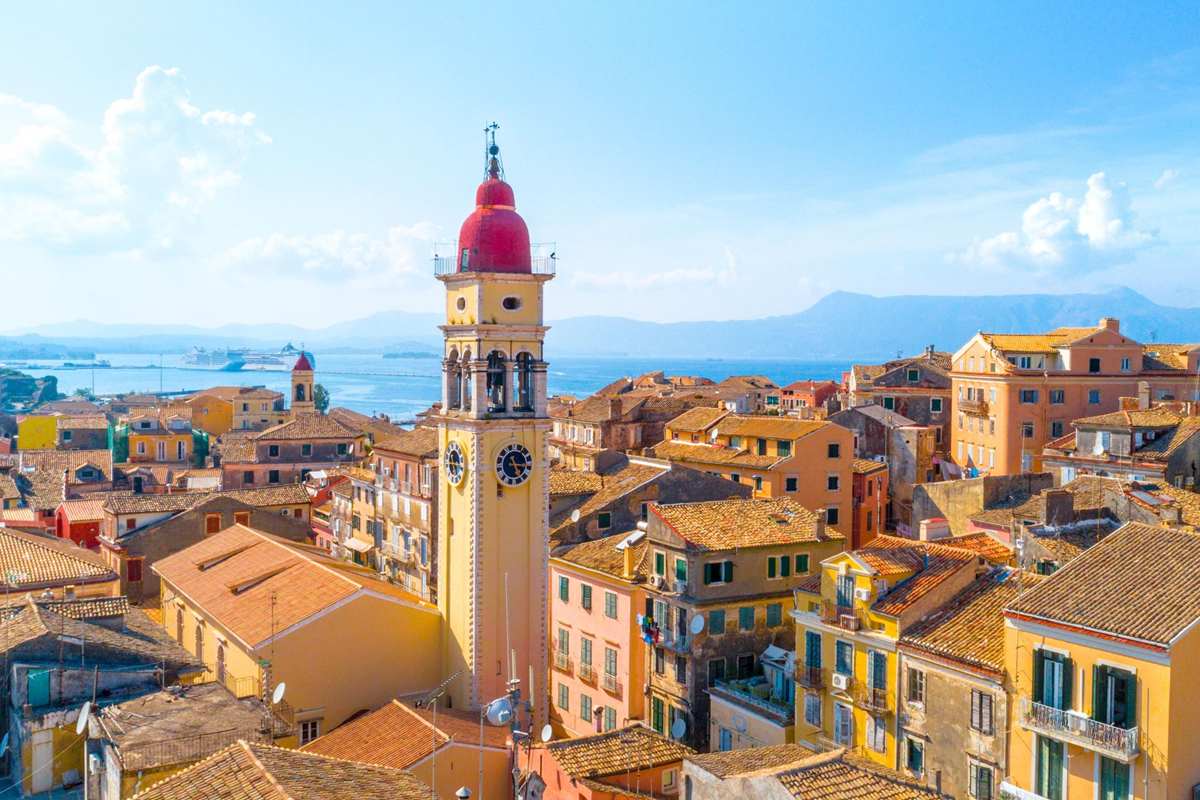
Greece shore excursions on Corfu take place in a city with the largest square in Greece. Its name, Spianada, is the Greek word for esplanade. An esplanade is an open space for walking. The Spianada lies at the centre of Corfu town.
For Greece shore excursions on Corfu, the square lies directly in front of the Old Fortress. Its southern half is the Upper Square, called Pano Plateia in Greek. Dense plants, flower beds and walkways fill this part. The round Maitland Rotunda stands at its centre, beside a covered stage called the Palko. Local philharmonic societies give concerts there.
The Lower Square, or Kato Plateia, is a flat, open lawn that holds the city’s cricket field. Cricket is a bat-and-ball game played by two teams on grass. Love of the game on Corfu dates from the British Protectorate of 1814 to 1864. A protectorate is a territory guarded and partly run by a stronger state.
The name Spianada goes back to a Venetian term for a level, open space. That word recalls four centuries of Venetian rule over the island. The present shape of the square dates from a French occupation of the Ionian Islands. That occupation took place during the Napoleonic Wars, fought by the French emperor Napoleon and his rivals.
- Liston: The Liston is a street and district for walkers on the western edge of the square.
- Philharmonic: A philharmonic society is a music club that keeps its own town band.
- Rotunda: In Greece shore excursions to Corfu, a rotunda is a building with a round plan.
Mathieu de Lesseps, the French imperial commissioner, built the Liston in 1807. A commissioner is an official put in charge of a territory. Greece shore excursions on Corfu belong to the town that holds the Spianada and the Liston.
Which story does Souda Island give Greece shore excursions on Crete?
Greece shore excursions on Crete take place around Souda Bay, on the island’s northwest coast. Souda is an islet in that bay. Among the small islands near the bay’s mouth, it is the biggest. The bay also takes its name from it.
In ancient times, Souda was one of two islets known as the Leukai. Leukai is Greek for the white ones. The second islet, almost round, appears as Rabbit Island on medieval Venetian maps. Its names today are Nisi and Leon. The word islet names a tiny island. Medieval refers to the Middle Ages.
Between 1570 and 1573, Venice built fortifications on Souda Island. They built the works against Ottoman raiders and pirates. The fortress controlled the entrance to the bay’s anchorage. An anchorage is a calm area of water where ships can drop anchor. Greece shore excursions on Crete start in a bay that this fort once guarded.
While Venice held the fort, the island served as a refuge for Cretan insurgents. An insurgent is a person who takes up arms against the rulers of a land. In 1913, Souda Island saw the events that marked the union of Crete and Greece. Union, in this sense, means two lands joining into one state.
- Venetian: Venetian describes the people or the state of Venice, a city in northern Italy.
- Ottoman: Ottoman describes the Turkish empire ruled by the sultans from Constantinople.
- Fortified: In Greece shore excursions, a fortified place is one protected by walls, towers or guns.
A local stamp showing Souda Island came out on 15 November 1913, to honour the union. Cretan post offices alone sold it, and its common name is the Souda Issue. Greece shore excursions on Crete begin beside the bay that holds this islet.
How does Cranae at Gytheio fit into Greece shore excursions?
Greece shore excursions at Gytheio begin in a port town that the ancients called Gythium. Just off its coast lies the island of Cranae, also known as Marathonisi. Marathonisi means fennel island, because fennel grew wild there. Fennel is a herb.
Cranae, or Kranai, has a name with two explanations. One links it to Kranaos, a legendary king of Athens who followed Kekropas. In Homer, the word kranaos means rocky, ragged or hard. Others therefore read Kranai as rock or rocky. Legendary describes a figure from old tales, not from firm records.
Gythium became the main port of ancient Sparta. Cranae then served traders as a place to rest. Sparta was a leading power of ancient Greece, in the south of the Peloponnese. In Ottoman times, the Beys of Mani built a tower house on the island for defence. A bey was a local chief or governor under the Ottomans.
A chapel of Agios Petros, or Saint Peter, stands on the island. Couples favour it for their weddings. A lighthouse 23 metres high rises there too, built in 1873. Its builders used fine marble from Tainaro, in the south of the Mani peninsula. Greece shore excursions at Gytheio begin across the water from this lighthouse.
- Chapel: A chapel is a modest place of worship, smaller than a parish church.
- Lighthouse: A lighthouse is a tower whose bright lamp warns ships at night.
- Port town: In Greece shore excursions, a port town is a settlement built beside a harbour for ships.
The Tzannetakis family built the tower on Cranae in 1829. A tower house is a tall, thick-walled home made for defence. In Greece shore excursions, Gytheio is the modern name and Gythium the ancient name of one port.
What do travellers ask about Greece shore excursions, and what are the answers?
Greece shore excursions start at ports such as Mykonos, Piraeus, Chania and Kavala. Each of these port towns has a landmark of note. Mykonos has an old church, and Piraeus has the hill of Munichia. Chania has a harbour lighthouse, and Kavala has an aqueduct.
For Greece shore excursions on Mykonos, what is Panagia Paraportiani?
Panagia Paraportiani is a whitewashed church on Mykonos. Builders started it in 1425, yet it stood complete only in the 17th century. Five separate churches make up the building. Four sit at ground level and carry a fifth church on top. Panagia, meaning all-holy, is how Greeks address the Virgin Mary.
Which story does the hill of Munichia give Greece shore excursions from Piraeus?
Munichia is what ancient Greeks called a steep hill inside Piraeus. Athenian democrats beat the forces of the Thirty Tyrants there in 404 BCE. Historians call the fight the Battle of Munychia. The Thirty Tyrants were a council that briefly held power in Athens. The hill also hosted a local festival to Artemis in antiquity.
What marks the entrance to the port of Chania on Greece shore excursions?
Chania Lighthouse marks the mouth of the harbour of Chania, on Crete. Its tower of stone masonry rises 26 metres above the bay. Masonry is stonework laid by hand. Since 1962 the tower has held protected status as an archaeological monument in Greece. Such status keeps a site safe under heritage law.
Why is the Kamares aqueduct a landmark on Greece shore excursions to Kavala?
Kavala’s aqueduct is well preserved and is a city landmark. Locals call it the Kamares, Greek for arches. An aqueduct is a raised channel for water. Scholars think an early 14th-century Byzantine wall there also carried water. The present arches date best to between 1530 and 1536.