
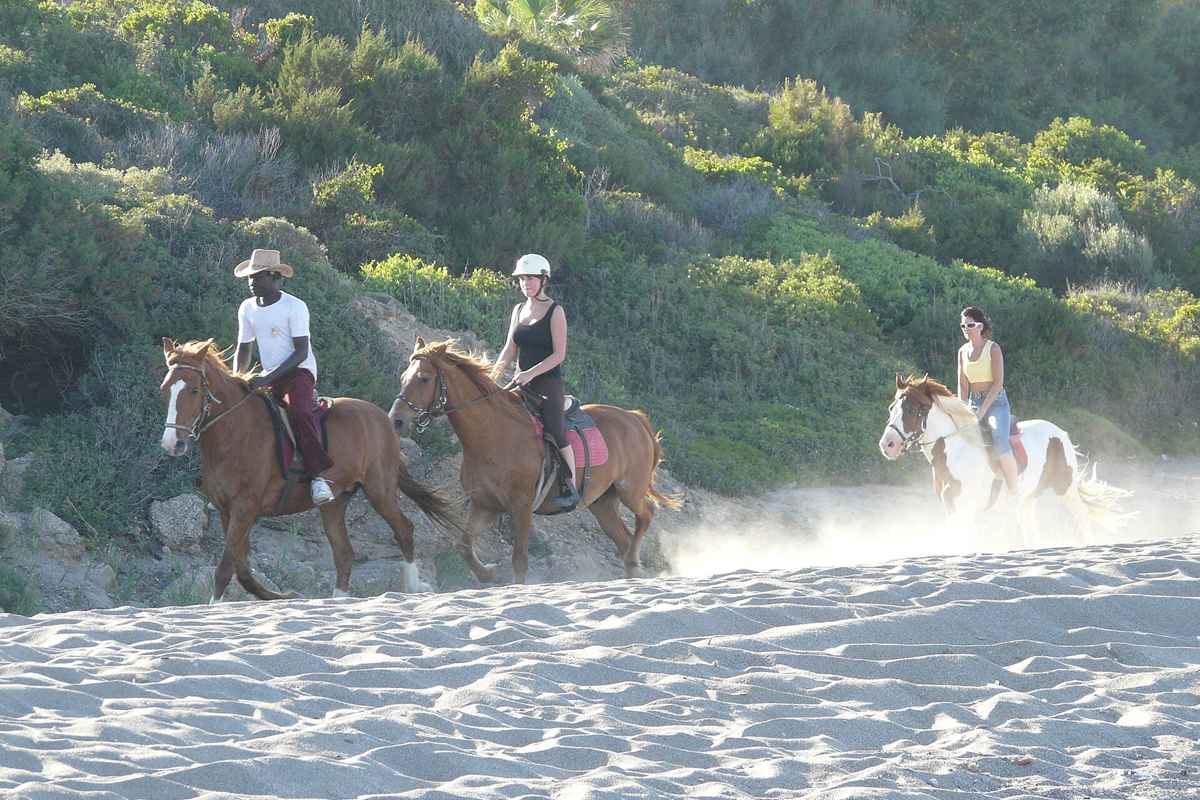
Horse riding in Greece is offered as hosted small-group rides on islands such as Kos, Paros and Zakynthos. Mainland rides also start near Thessaloniki. The country keeps six recognised horse breeds and herds of wild horses. The sections below look at early Greek horses, the Zakynthos horse and the Peneia Pony. They also cover the aravani gait and the hippeis, the horsemen of ancient Athens. Walks, family trips and the Pelion peninsula appear on Greece hiking tours, Greece family tours and Pelion tours. Outings across the whole country gather on Greece tours.
Bookings made through the GetYourGuide widgets on this page earn Classical Greece Tours a commission, at no extra cost to the traveller.
What is horse riding in Greece like?
Horse riding in Greece takes place in a country with six recognised horse breeds. Alongside them live feral horse populations, meaning herds of once-tame horses that now live wild. A breed is a group of animals with shared, inherited looks.
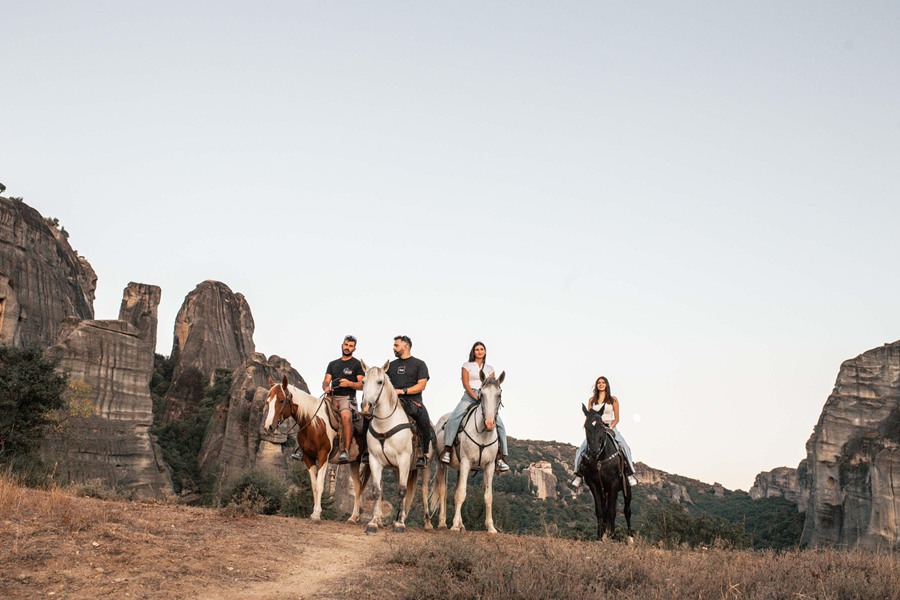
The earliest horse remains from mainland Greece are bones from no earlier than 1800 BC. The first known Greek pictures of horses lie in Mycenaean shaft graves, from about 1650 to 1550 BC. Mycenaean refers to Bronze Age mainland Greece. A shaft grave is a deep burial pit. Objects in those graves also record chariots.
In ancient times, horse riding in Greece went on without saddles or stirrups. Stirrups are loops that hold a rider’s feet. Ancient horse riding in Greece did use the spur and a simple bridle. A spur is a small spike fixed to a rider’s heel. A bridle is a set of straps around a horse’s head.
Horses also marked rank. They stood for the wealth, prestige and nobility of their owners. In the Iliad, Homer’s poem of the Trojan War, King Nestor counts captured horses as precious loot. Greece, like other European countries, saw its horse numbers fall steeply in the twentieth century. The drop came with motor transport.
- Population: In 2011 Greece held about 30,000 horses, and the majority of its breeds faced extinction.
- Wild herds: Greek feral herds descend from horses abandoned or escaped as villages emptied and farming mechanised.
- Rhodope: About 1,000 horses roam the southern Rhodope Mountains in the north of Greece.
Long before modern horse riding in Greece, horses filled Greek literature, art and mythology. This holds from the Mycenaean age through later Greek civilisations. Mythology means the old stories of gods and heroes. Literature covers poems, plays and other written works.
Where does the Zakynthos horse fit into horse riding in Greece?
Horse riding in Greece has an island breed of its own in the Zakynthos, or Zante horse. Its horses are mostly black and suit both the saddle and combined driving. Combined driving is a sport for carriages pulled by horses.
Horse riding in Greece gained this breed only recently, since it dates from the 20th century. Zante is the English name for the Ionian island of Zakynthos. The horse belongs to the Anglo-Arabian type, a mix of Arabian and Thoroughbred blood. In its genes, it stands close to the Andravida, another Greek breed.
In the 4th century BC, the poet Simonides of Zakynthos stated that horse-breeding did not suit his island. Dr Richard Rawles reads this as a nod to Homer, whose texts place horses on other Greek islands. Records of horse riding in Greece on Zante include horse races, mentioned on the island in 1835.
The Greek Civil War left the horse population of Greece in collapse. By one account, Greek emigrants in the USA then shipped a black Percheron stallion to Zakynthos. It went to their relatives and friends there. A Percheron is a heavy French horse breed used for pulling. A stallion is an adult male horse kept for breeding.
- Phaetons: Zante horses pull phaetons, light open carriages, for tourists on the island.
- Andravida fair: Since the 1930s, the breed has entered the Andravida horse fair and won prizes.
- Status: The breed has no written standard and no official recognition from the Greek Ministry of Agriculture.
On Zakynthos, beach horse riding in Greece has drawn concern from researchers. Studies show that trampling hooves can destroy the nesting grounds of loggerhead sea turtles. The loggerhead, Caretta caretta, is a large sea turtle that lays its eggs in sand.
How does the aravani gait of the Peneia Pony shape horse riding in Greece?
Horse riding in Greece has a rare pony breed from the southern Peloponnese, the Peneia Pony. It first came from the old prefecture of Elis, which took in the village of Peneia. A prefecture was a former administrative area of Greece.
Peneias stand between 10.1 and 14 hands high. Hands are a unit for measuring a horse’s height at the shoulder. Their coats are mostly bay, black, chestnut or grey, though other colours appear. Bay is a reddish-brown coat with a black mane and tail. Chestnut is a reddish coat with no black mane or tail.
The natural gait of the Peneia is rather stilted, or stiff. A gait is the pattern of steps in which a horse moves. Peneias are therefore commonly taught a smoother gait called the aravani. The aravani makes horse riding in Greece on a Peneia more comfortable for the rider.
The breed grew from a native Greek variety, quite possibly related to the Pindos pony. Breeders later crossed it with Anglo-Arab, Anglo-Norman and Nonius horses. In a study of gaited horses, 97.1% of Peneias carried a gene change linked to smooth gaits. A gaited horse moves in a special smooth step.
- Herdbook: The breed’s herdbook, its official record of family lines, opened only in 1995.
- Home range: Peneias live in Elis and Achaea, two areas of the north-western Peloponnese.
- Hinnies: Peneia stallions also serve in breeding hinnies, the offspring of a male horse and female donkey.
As of 2017, only about one hundred Peneias existed, so the breed faced extinction. In horse riding in Greece, Peneias serve as mounts for riding and jumping. Jumping, in horse riding in Greece and beyond, means a horse leaping over fences with a rider.
Who were the hippeis, and what part did they play in horse riding in Greece?
Horse riding in Greece had a military side long ago, named hippeis, the Greek term for cavalry. Cavalry means troops who fight on horseback. The singular form, hippeus, names one horseman. Singular means the form of a word used for just one person or thing.
In Athens, the hippeis also formed a social class after the reforms of Solon, the city’s lawgiver. It ranked second highest of the four classes. Its members earned at least 300 medimnoi a year, or its equal in value. A medimnos was an ancient Greek measure for dry goods such as grain.
The Athenian cavalry took shape after the Greco-Persian War of the 5th century BC. It started with 300 men. After the Golden Age of Athens, its size rose to 1,200 men. The Golden Age was the city’s peak of power and culture. In peacetime, the hippeis kept up horse riding in Greece through regular drills.
In ancient horse riding in Greece, the Thessalians were held to be the best riders. Thessaly lies in central Greece. Greek riders had no true saddle. The nearest thing was a saddle cloth or a piece of felt, tied firmly under the horse’s belly. Felt is a thick cloth of pressed wool.
- Sparta: In Sparta, the hippeis were a royal guard of honour of 300 youths under thirty.
- Upkeep: Each Athenian horseman received equipment money and a grant for a groom, or stable hand, and two horses.
- Alexander: In the later army of Alexander the Great, horsemen made up nearly a sixth of the force.
Mounted warfare, the military side of horse riding in Greece, first became important in the Macedonian army. That change came under Philip II of Macedon and his son, Alexander the Great. Macedon was an ancient kingdom in the north of Greece.
What do travellers ask about horse riding in Greece, and what are the answers?
Horse riding in Greece counts the Andravida, a light pulling breed from Ilia, among its horses. The Pindos pony is native to the Pindus mountains of Thessaly and Epirus. Feral horses live in the Axios delta. An Olympic venue for horse sports stands outside Athens.
Within horse riding in Greece, how did the Andravida horse come about?
The Andravida grew from crosses of Anglo-Norman horses with local breeds. Nonius stallions added more blood after 1920. The breed is thought to trace back to the cavalry horses of ancient Greece. In the early 1990s, a stallion renamed Pegasus saved the breed. He fathered 50 healthy foals, or young horses.
For horse riding in Greece, what is the Pindos pony like?
Hardy and frugal, the Pindos gets by on little food and has good stamina. It serves for riding and for driving, which means pulling a carriage. Its hooves are narrow and boxy, yet strong enough to need shoes only rarely. It stands about 132 cm at the withers, the ridge between the shoulders.
How do the feral Axios horses relate to horse riding in Greece?
The Axios horses have no owner, since they live wild. Studies of the herd saw them as a way to develop equestrian tourism in Greece. Equestrian tourism means travel centred on horses and horse riding. In 2010 fewer than a hundred of these horses were counted. That made the breed critically endangered.
What did the Olympic venue for horse riding in Greece host?
The centre hosted the equestrian events of the 2004 Summer Olympics in Athens. Builders finished it in December 2003, and it opened officially on 12 August 2004. Its seating holds 10,000 people for jumping and 8,100 for dressage. Dressage is a contest of precise, trained horse movements.
Featured photo: User:Piotrus, CC BY-SA 3.0, via Wikimedia Commons (File:Lardosbeach03.JPG).