
Greece weather in March frames tours on the mainland, the Ionian islands and Crete. Such tours are expert-led trips through Greek towns, islands and ancient sites. This page reads March station tables for Athens, Thessaloniki, Othonoi, Paxos, Desfina, Matala, Kymi and Soufli. It also covers the Judas tree, bee orchids, the feast of the Forty Martyrs and the ancient Pandia. Related pages cover the best time to visit Greece, Greece in spring and Greece weather in April. More choices sit under Greece tours.
Bookings made through the GetYourGuide widgets on this page earn Classical Greece Tours a commission, at no extra cost to the traveller.
What is Greece weather in March like?
Greece weather in March can be read from climate tables kept at city stations. Downtown Athens shows a March mean daily maximum of 17.0 °C. This figure averages the top reading of every March day over the years.
The Downtown Athens record high for March stands at 28.2 °C. No March reading in that series has gone higher. The March record low at the same station is −2.6 °C. No March reading there has dropped lower. Both extremes come from a record kept in central Athens since 1890.
Rainfall is one part of Greece weather in March. March rain in Downtown Athens averages 45.6 mm. A millimetre of rain equals a layer one millimetre deep on flat ground. Further figures come from the Aristotle University of Thessaloniki, which runs its own weather station. The station sits 32 m above sea level.
Greece weather in March also has a second long record in Thessaloniki. The Thessaloniki station gives a March mean daily maximum of 15.6 °C. Such a table value is a normal, an average built from years of daily readings. Normals let one month be compared with another on the same scale.
- Thessaloniki nights: The station lists a March mean daily minimum of 6.8 °C.
- Thessaloniki extreme: The coldest March reading in the Thessaloniki record is −8.2 °C.
- Thessaloniki rain: The city averages 39.5 mm of precipitation, meaning rain and snow together, in March.
In Downtown Athens, the March mean daily minimum is 9.2 °C. That value averages the lowest point reached each night. Greece weather in March is set out in each table through both a daytime and a night-time average.
Which figures does Othonoi give Greece weather in March?
Greece weather in March on Othonoi is set out in a climate table for the island. That Othonoi island table gives a March average high of 15.2 °C. An average high is the typical top temperature of a day in that month.
The climate of Othonoi is mild, warm and temperate. Temperate means free from long spells of great heat or great cold. Winters on the island are rainier than summers. Climate scientists file Othonoi under the Köppen-Geiger class Csa. That code marks a Mediterranean climate with a hot, dry summer.
Greece weather in March forms one part of the yearly pattern on Othonoi. The average temperature on the island is 16.7 °C. Each year, about 1026 mm of precipitation reaches the island. Precipitation covers every form of water from the sky, including rain, hail and snow. A yearly total adds up all twelve months.
Greece weather in March shares its month with a treaty date in the history of Othonoi. Under a treaty signed on 29 March 1864, the Ionian and Diapontian islands passed to Greek sovereignty. Sovereignty means the full right of a state to govern a territory. Islanders speak a dialect close to that of Corfu, heavily influenced by Italian.
- Night average: The island’s March average low stands at 7.9 °C in the same record.
- March rain: The same table lists 92 mm of rain for the whole month.
- Settlements: Othonoi holds more than 20 settlements, each a separate cluster of homes.
Greece weather in March on Othonoi is drawn from that single island table. The School of Othonoi at Ammos dates from 1912. Ammos is a district of the island, and in Greek the word means sand.
Where does the Judas tree fit into Greece weather in March?
Greece weather in March has a floral side in Cercis siliquastrum. In English, this tree is known as the Judas tree. The species is noted for a lavish show of deep pink flowers in spring. Its native range covers Southern Europe and Western Asia.
The Judas tree grows to a height of 12 m and a spread of 10 m. Its deep pink blossoms open on wood at least a year old, even on the trunk. Each flower carries five free petals and joined sepals, a pea-family shape. Sepals are the small leaf-like parts that wrap a flower bud.
In the setting of Greece weather in March, the leaves unfold shortly after the first flowers appear. The flowers are edible, with a taste described as sweet and tart. Tart means sharp and slightly sour. Bees pollinate the blossoms, drawn in by nectar. Pollen from the stamens rides on the bee to the next flower.
Carl Linnaeus gave the species its formal name in 1753. The second word, siliquastrum, comes from the Latin siliqua, meaning pod. In French, the tree was called arbre de Judée, which means Judea’s tree. That name pointed to hilly country in Judea, where the tree used to be common. Greece weather in March brings the same spring season.
- Other name: The tree also goes by the alternative common name of love tree.
- Timber: Its hard wood shows an attractive grain and polishes well for veneers.
- Seed pods: The tree produces long, flat pods that hang straight down from the branches.
A cultivar named ‘Alba’ bears white flowers in place of the usual pink. A cultivar is a plant variety raised and kept by gardeners. Greece weather in March belongs to spring, the season when this tree is noted for flowering.
What does Paxos add to Greece weather in March?
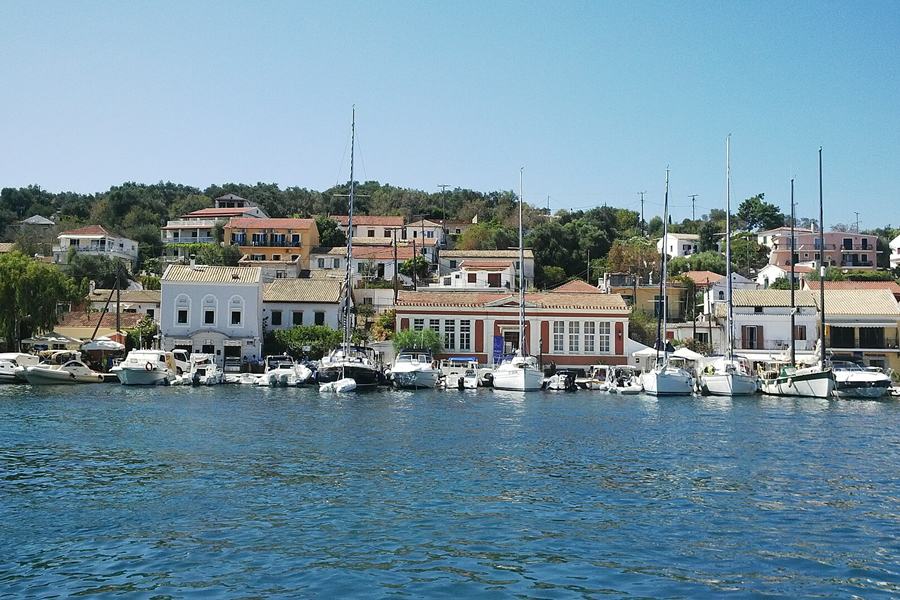
Greece weather in March on Paxos is tracked by a climate table for Loggos. Loggos is a settlement on the island. The Loggos figures give a March average high of 16.0 °C. The Norwegian Meteorological Institute supplies those temperatures.
The Loggos row also covers the months on either side. February has an average high of 14.3 °C. April has an average high of 19.0 °C. Each of these values averages the daily peak over a run of years. Greece weather in March on Paxos can be read against both of those months.
The March average low at Loggos is 6.8 °C. Paxos lies in the Ionian Sea, just south of Corfu. Together with Antipaxos and nearby islets, the group goes by the plural name Paxi or Paxoi. Paxoi was once a province of the Corfu Prefecture, abolished in 2006. Greece weather in March figures from Loggos come from that group.
Research papers from 2014 and 2017 confirmed five reptile species on Paxos and Antipaxos. One of them is Hemidactylus turcicus, a small gecko. Another is Zamenis longissimus, a long, slim snake. No amphibians, such as frogs or newts, have been reported on the islands. Amphibians are animals that live part of their life in water and part on land.
- More reptiles: Mediodactylus kotschyi and Algyroides nigropunctatus also appear on the confirmed reptile list.
- Old reports: Earlier reports of Lacerta viridis on the islands were not confirmed by the later work.
- A writer: Actor Peter Bull, author of It Isn’t All Greek to Me, lived on Paxos part-time.
Actress Susannah York was another semi-permanent British resident of Paxos. Semi-permanent means living in a place for long spells, without moving there for good. Greece weather in March on the island is summed up in the Loggos climate table.
How does Desfina measure Greece weather in March?
Greece weather in March at Desfina is summed up in a short climate table for the town. The Desfina figures put the March average high at 14.12 °C. The value is given to two decimal places, meaning hundredths of a degree.
Greece weather in March at Desfina comes from a table with three March rows. The March average low there is 5.29 °C. The same table counts 7.7 rain days in the month. On a rain day, a gauge collects a measurable amount of rain. A count such as 7.7 is an average across years.
The municipal unit of Desfina covers 148.992 km2. Such a unit is a former municipality, now kept as a local district. Desfina lies 30 km west of Livadeia. In the past, local people lived mainly by breeding farm animals. Greece weather in March at Desfina is stated in degrees Celsius.
The Cultural Association of Desfina, called I Proodos, was founded on 6 July 1979. Its Greek name means The Progress. The association today numbers 200 members. The choir of Desfina, founded in 1999, has an adult section and a children’s section. A choir is a group that sings together.
- Monastery: The Monastery of Honest Precursor in Desfina won distinction during the revolution of 1821.
- Football: Isaias Desfina dates from 1973, and Doxa Desfina dates from 1986.
- Painter: The painter Spyros Papaloukas appears among the notable people of Desfina.
The Temple of the Taxiarches stands among the landmarks of Desfina. Taxiarches is a Greek title for the archangels Michael and Gabriel. Greece weather in March at Desfina leaves out record highs and record lows for the month.
Which feast of the Forty Martyrs falls within Greece weather in March?
Greece weather in March meets the church calendar on 9 March, feast of the Forty Martyrs of Sebaste. Orthodox Churches on the Julian calendar place the day inside Great Lent. Great Lent is the fasting season that leads up to Easter.
The number forty carries a double meaning. It counts the martyrs, and it also counts the days of the fast. A custom on the day is baking skylarks, pastries shaped like the songbird. Behind it lies a belief that birds sing at this time to announce spring. That belief ties the feast to Greece weather in March.
The Forty were Roman soldiers in the unit Legio XII Fulminata. Their deaths for the Christian faith are dated to 320 AD. Their feast places the memory of that year inside Greece weather in March. They died near Sebaste, now Sivas in Turkey. The earliest account comes from Bishop Basil of Caesarea, in a sermon on their feast day.
Basil wrote that the soldiers stood on an icy pond near Sebaste through a freezing night. One man gave up and left the ice. A guard named Aglaius took his place among them. In this way the number forty stayed complete. A martyr is a person killed for holding to a faith.
- Wedding prayer: A prayer naming the Forty Martyrs forms part of the Orthodox wedding service.
- Greek name: In Demotic Greek, the everyday modern form, they are called Agioi Saranta.
- Western date: In the West, the feast fell on 10 March and was suppressed in 1969.
Gregory of Nyssa was especially devoted to the Forty Martyrs. He laid his own parents to rest beside their relics. Relics are remains of a holy person, kept with honour. Greece weather in March shares its ninth day with this old feast every year.
What does the Matala table show about Greece weather in March?
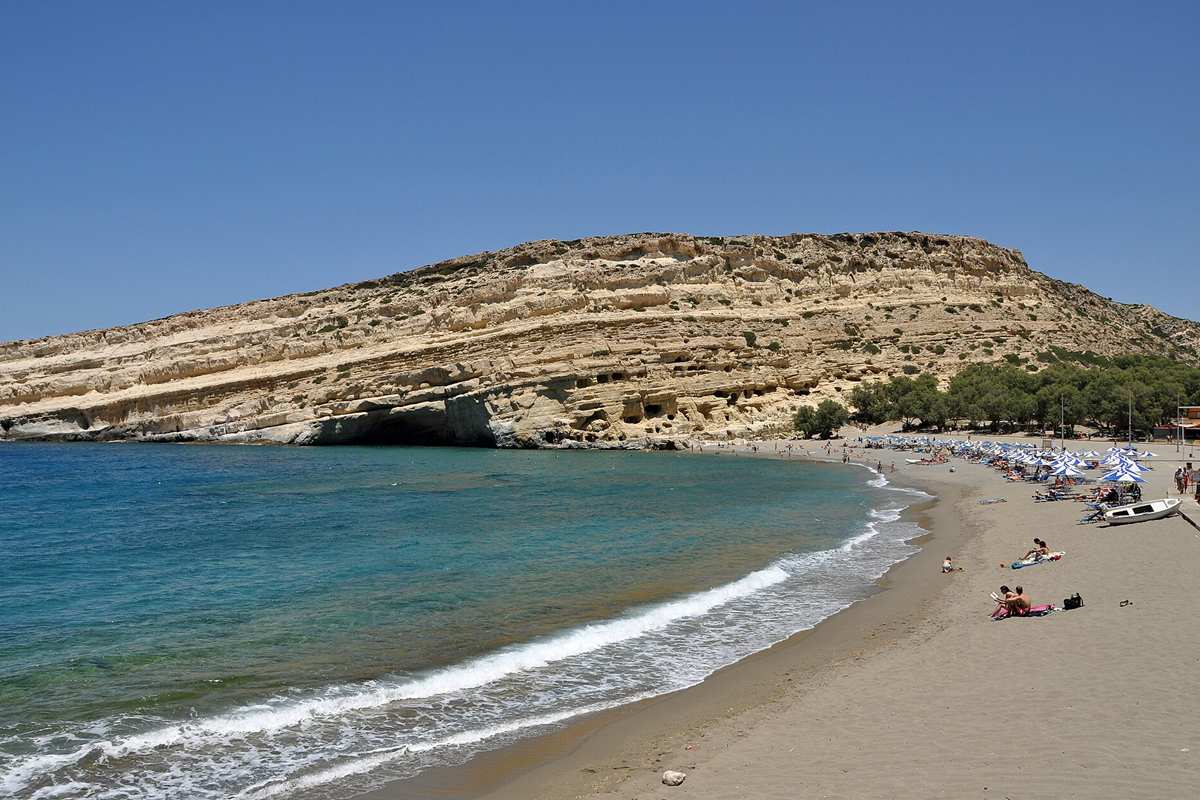
Greece weather in March at Matala in Crete comes from modelled normals for 1971-2000. Modelled means worked out by computer. The Hellenic National Meteorological Service supplies that table. It gives a March mean high of 16.79 °C for the village.
Greece weather in March at Matala has a daily mean of 13.80 °C. The daily mean sits halfway between the day’s high and low. The mean low for the month is 10.84 °C. Precipitation in March totals 52.39 mm. That total covers rain and every other kind of water falling from the sky.
Greece weather in March at Matala includes 206.30 hours of sunshine. Sunshine hours measure how long bright, direct sun reaches a recording instrument. The Köppen system files Matala under Csa, a hot-summer Mediterranean type. Its summers run hot and very dry. Winters there are wet but very mild.
Scholars once suggested that the cliff caves at Matala served as tombs. Their large size points instead to use as living spaces. Matala later became a fishing village. Since 2011, the three-day Matala Beach Festival has taken place there every June. The event honours the hippie past of the village each summer.
- February: The same Matala table gives a February mean high of 15.57 °C.
- April: The April mean high at Matala rises to 19.93 °C in the table.
- In fiction: The Gladiator, a novel by Simon Scarrow, has its heroes beach a tsunami-damaged ship near Matala.
Matala belongs to the community of Pitsidia, inside the municipal unit of Tympaki. A community here means a small local district inside a larger unit. Greece weather in March at Matala is drawn from one modelled table for this village.
How do bee orchids fit into Greece weather in March?
Greece weather in March falls in the growing season of Ophrys, the bee orchids. Ophrys is a large group of orchids. In Greek, ophrys means eyebrow. The word refers to the furry edges on the lip of the flower.
The common name bee orchid comes from the look of the flowers. In certain species, the bloom resembles the furry body of a bee. Pliny the Elder first mentioned Ophrys in his Natural History. The flowers mimic female insects so closely that males try to mate with them. That contact carries pollen from flower to flower.
Greece weather in March lies in the months when Ophrys plants stand above ground. Every Ophrys orchid depends on its own pollinator insect. A pollinator is an animal that carries pollen between flowers. Just about one plant in ten, or 10%, ends up pollinated. Each plant still yields about 12,000 tiny seeds.
In summer the orchids rest underground as tubers, or food-storing roots. In late summer or autumn, each plant grows a rosette of leaves. A rosette is a flat ring of leaves at ground level. When spring returns, the time of Greece weather in March, the flower stalk begins to rise. Two to twelve flowers open along that upright stem.
- Protection: Every orchid species falls under CITES II, a world treaty list that limits trade.
- Argolis: Ophrys argolica carries the English name Argolian bee-orchid, after the Argolis area.
- Crete: Ophrys cretica is known in English as the Cretan bee-orchid, named after Crete.
Ophrys orchids rely on soil fungi, above all when their seeds first sprout. That first sprouting is called germination. Their range runs from Europe and North Africa to the Middle East and Turkmenistan. Greece weather in March sits inside that range.
What do the Kymi figures say about Greece weather in March?
Greece weather in March at Kymi has its own short climate table for the town. That table gives Kymi a March average high of 14.1 °C. Its March mean, the midpoint between day and night readings, is 11.7 °C.
The March average low in the Kymi table is 9.0 °C. Greece weather in March at Kymi is given without a rainfall figure. Kymi counted 6,706 inhabitants in 2021. Since 2011, the town has formed a municipal unit of Kymi-Aliveri. Such a unit used to be a separate municipality. The unit covers 167.616 km2.
The geographer Strabo wrote that Hippocles of Cyme came from Kymi. Hippocles was an oecist, the leader who founds a new colony. With Megasthenes of Chalcis, he founded a colony in the area where Rome later flourished. That colony passed on its Euboean alphabet to the region. Those letters went on to become the Latin alphabet.
Certain modern authors believe ancient Kyme was only a village under Chalkis or Eretria. Today Kymi has its own port, set below the hilltop town. Three small Byzantine churches stand in Oxilithos. The word Byzantine points to the medieval empire whose capital was Constantinople. The Kymi table for Greece weather in March gives no station height.
- Museum: The Folklore Museum of Kymi is listed among the attractions of the town.
- Admiral: Admiral Nikolaos Pappas, from Kymi, later served as Chief of the Greek Navy.
- Major: Major Ioannis Velissariou of Kymi is remembered as a Balkan Wars military hero.
The Monastery of the Transfiguration is another sight of Kymi. The Transfiguration is the Gospel scene where Christ shone with light on a mountain. Greece weather in March at Kymi has no record high or low in its table.
How did the Pandia festival mark Greece weather in March in ancient Athens?
Greece weather in March once framed the Pandia, an ancient state festival held each year at Athens. It fell in spring, after the City Dionysia, in the middle of the month Elaphebolion. That month ran across late March and early April.
The festival is attested as early as the time of Demosthenes, the Athenian speaker. Attested means recorded in surviving texts or inscriptions. It was, in all probability, a festival for Zeus. The Byzantine scholar Photius also states that it was held for Zeus. The City Dionysia, held just before it in Greece weather in March, honoured Dionysus with drama.
The exact date of the Pandia within Greece weather in March and early April is much discussed. A speech by Demosthenes, Against Midias, places a meeting on the City Dionysia after the Pandia. One view ties the festival to the full moon, on 14 Elaphebolion. Modern scholars now lean towards the 16th or 17th day of that month.
The name Pandia is linked with Selene, the goddess of the moon. Pandion, a legendary king of Athens, lent his name to Pandionis, one of the citizen tribes of Athens. An inscription from about 386 BC praises a priest of Pandion for his work at the Pandia.
- Same name: A festival of the same name is recorded for Plotheia, a local district or deme.
- Name origin: Certain scholars think Pandion took his name from the festival as its founder.
- Moon title: On one view, Pandia began as a title of the goddess Selene herself.
The scholar Robert Parker judges the link with Zeus to be, in all probability, a correct etymological guess. Etymology traces the origins and history of words. Greece weather in March and early April once brought this festival round each year at Athens.
What does Soufli show about Greece weather in March in Thrace?
Greece weather in March at Soufli appears in a simple climate table headed Soufli, Greece. The table gives the town a March average high of 13 °C. Its March average low is 6 °C. An average low is the typical bottom reading of a day.
The Soufli table also lists the months around March. For February, it shows an average high of 10 °C. April climbs to an average high of 17 °C. Greece weather in March at Soufli appears there in whole degrees, with no decimal part. Alexandroupoli lies 65 km to the south, and Orestiada 50 km to the north-east.
Around 1667, the Ottoman traveller Evliya Çelebi described Soufli as a large village free from taxation. He used its Turkish name, Sofulu. That name, on the usual view, comes from a nearby dervish monastery. A dervish is a member of a Muslim religious order. The railway and the town’s station of 1872 helped Soufli grow richer.
In 1877 Soufli had around 4,680 inhabitants. By 1900 the population had risen to 10,000. Nineteenth-century wine production in the town reached just under 2,000,000 litres. Soufli is also famous for tsipouro, a strong local alcoholic drink. The Soufli table for Greece weather in March gives no rainfall row.
- Theatre: A Dramatic society of Soufli was already active in the year 1878.
- Silk museum: The Art of Silk Museum opened in September 2008 in a Neoclassical, or ancient-style, building of 1886.
- Floods: Low-lying parts of Soufli flooded in the 1960s, 1998, 2005 and 2006.
Two churches, Saint George and Saint Athanassios, were built in Soufli before the mid-19th century. Both are still standing in the town. Greece weather in March at Soufli comes from a table with only two March rows.
What do travellers ask about Greece weather in March, and what are the answers?
The Greece weather in March row at the Platanoulia station gives a March mean of 10.6 °C. The station sits 90 m above sea level. It records 41.5 mm of rain in March. Its March record high stands at 27.9 °C.
Before a trip, what does Platanoulia add to Greece weather in March?
Platanoulia, a village, belongs to the municipality of Tyrnavos. In Greece, a municipality joins towns and villages under one council. Its station gives a March average high of 17.5 °C. The coldest March reading on its record is −5.3 °C. A record low is the lowest value logged since the station began.
How warm does Moires get in Greece weather in March?
The Moires table, covering 2010–2019, gives a March average high of 19.2 °C. The same table lists 45.0 mm of rain for March. Over a full year, the Moires climate is dry, with average precipitation of 445 mm. Precipitation means rain and any other water from the sky.
Which early iris belongs to Greece weather in March?
Iris unguicularis, the Algerian iris, is native to Algeria, Greece, Turkey, Western Syria and Tunisia. Native means growing there naturally. Its flowers appear in winter and early spring. They are pale lilac or purple, with a central band of yellow. The word iris comes from the Greek word for rainbow.
What is the widow iris in the story of Greece weather in March?
Iris tuberosa carries the common names snake’s-head, widow iris, black iris and velvet flower-de-luce. Flower-de-luce is an old English name for the iris. It can be found in Albania, France, Greece and Italy. It is a common ornamental garden plant that flowers in early spring. Ornamental means grown for its looks.
Featured photo: Marc Ryckaert (MJJR), CC BY 3.0, via Wikimedia Commons (File:Matala Beach R03.jpg).