
Scuba diving in Greece means expert-led trips below the surface of the sea. They take place off Crete, Rhodes, Kos, Naxos, Zakynthos, Halkidiki and the Athens coast. Topics run from the Britannic and Burdigala wrecks off Kea to HMS Perseus, the Mentor and the Thérèse. Red coral, the dusky grouper, the silver-cheeked toadfish, marine parks and sponge diving also feature. Related trips include Greece sailing tours, Greece kayaking tours and Greek island cruises. Each of them is part of a wider range of Greece tours.
Bookings made through the GetYourGuide widgets on this page earn Classical Greece Tours a commission, at no extra cost to the traveller.
What is scuba diving in Greece like?
Scuba diving in Greece takes place in seas where a single state body cares for sunken heritage. The Ephorate of Underwater Antiquities was founded in 1976 and covers all of Greece. It is a Ministry of Culture department for underwater archaeology.
The word scuba in scuba diving in Greece is an acronym. An acronym is a word built from the first letters of a phrase. Here the phrase is self-contained underwater breathing apparatus. The term first appeared in a 1952 patent by Christian J. Lambertsen. Each scuba diver carries a personal supply of breathing gas.
An ephorate is a Greek state office that looks after antiquities, meaning objects from ancient times. The Ephorate runs two regional offices, based in Thessaloniki and Heraklion. In 2003 its remit grew to take in every ship or aircraft wreck over fifty years old. A remit is the range of tasks an office handles.
Scuba diving in Greece happens along coasts where the Ephorate has excavated ancient harbours. Excavation means careful digging that uncovers buried remains. One was the port of old Toroni in Chalcidice. Another was the port of ancient Phalasarna in Crete. A Museum of Underwater Antiquities is being planned for the harbour of Piraeus.
- Actium: The Ephorate has searched for warships sunk at the Battle of Actium in 31 BC.
- Methone: Its excavations include the ancient city of Methone in southern Messenia.
- Abdera: The Ephorate has also excavated the port of ancient Abdera in Thrace.
Scuba diving in Greece forms one part of a wider activity done for leisure and for work. Scientific and military roles also rely on scuba equipment. Recreational diving means diving for pleasure rather than as a job. Professional diving is diving carried out as paid work.
What does the wreck of the Britannic add to scuba diving in Greece?
Scuba diving in Greece has a link to the Britannic, a liner that sank near Kea. No intact passenger ship on any seabed in the world is larger. An ocean liner is a large ship built to carry passengers across seas.
In the story of scuba diving in Greece, Britannic stands out as the third and last Olympic-class liner. Her older sisters were the Olympic and the Titanic. From 1915 she served as a hospital ship, a vessel fitted out to treat the sick and wounded. At that time she ranked as the world’s largest hospital ship.
On 21 October 1916 the submarine SM U-73 laid mines across the Kea Channel. A channel is a strip of sea running between two land masses. On 21 November 1916 Britannic struck one of those mines and sank 55 minutes later. Out of the 1,066 people aboard, 30 lost their lives.
Fishermen from Kea reached the scene first in their caïque, a traditional wooden boat. They lifted survivors out of the water. A group of about 150 reached Korissia on Kea. No vessel sunk during the First World War was bigger than Britannic. Her wreck is now a part of scuba diving in Greece.
- Discovery: Jacques Cousteau found the wreck with side-scan sonar on 13 November 1975.
- Machinery: Machinery on the forecastle, the raised front deck, and two cargo cranes remain well preserved.
- Foremast: The bent foremast lies on the seabed, its lookout crow’s nest still in place.
Within scuba diving in Greece, this wreck has a long diving record. In 1976 Cousteau and his divers went inside it for the first time. In November 1997 an international team of divers filmed it in a new digital video format.
Which story does the Burdigala wreck tell within scuba diving in Greece?
Scuba diving in Greece links to the wreck of an ocean liner near Kea, the Burdigala. She sits upright on the seabed close to Kea’s harbour. The ship was built in 1898 and carried the name Kaiser Friedrich at first.
Her builders designed her to break the speed record for crossing the Atlantic and win the Blue Riband. The Blue Riband honours the fastest Atlantic crossing by a liner. She never reached the speeds needed. After two brief careers, she lay mothballed for a decade. To mothball a ship is to lay it up unused for later.
Under a French owner she re-entered service as Burdigala, the name known in scuba diving in Greece. Ten boilers fed her engines, venting through three large funnels. She had room for 1,350 passengers plus a crew of 420. Hanging Caryatids in her main rooms stood for the arts and sciences. A Caryatid is a sculpted woman’s figure.
In war service she carried troops from Toulon to the Dardanelles and Thessaloniki. In December 1915 she became an auxiliary cruiser armed with four 140 mm cannons. An auxiliary cruiser is a merchant ship fitted with guns for naval work. A mine laid by U-73 sank her near Kea in 1916, linking her to scuba diving in Greece.
- Explosion: On 14 November 1916 a blast struck her about 3.7 kilometres southwest of Kea.
- Second blast: A second explosion broke the ship in two before she sank off northwest Kea.
- Rescue: The British destroyer HMS Rattlesnake picked up the survivors and carried them to Piraeus.
The final voyage tied to scuba diving in Greece began on 13 November 1916. That day the ship left Thessaloniki empty, bound for Toulon to load more troops. According to her commanding officer, the crew lost only a single man.
Why does HMS Perseus matter to scuba diving in Greece?
Scuba diving in Greece includes the wreck of HMS Perseus, a British submarine lost off Cephalonia in 1941. Cephalonia is the Ionian island also spelled Kefalonia. A dive team led by Kostas Thoctarides found and surveyed the wreck in 1997.
Perseus, now a wreck known in scuba diving in Greece, was a Parthian-class submarine built in 1929. Her class was the first to carry Mark VIII torpedoes. A torpedo is a self-propelled underwater weapon. On 26 November 1941 she left Malta for Alexandria. Her orders were to patrol waters east of Greece on the way.
The submarine hit an Italian mine off Cephalonia at 10 pm on 6 December. This was 7 miles north of Zakynthos, in the Ionian Sea. Of the 61 people aboard, leading stoker John Capes was the only survivor. A stoker tends a ship’s boilers or engines. Capes, aged 31, was hitching a lift to Alexandria.
Capes escaped through a hatch in the engine room, wearing Davis Submerged Escape Apparatus. The apparatus was a breathing set for escaping from a sunken submarine. He swam to Cephalonia, where islanders hid him for 18 months. Later he was smuggled in a caïque to İzmir in Turkey. He was then awarded a British Empire Medal.
- Position: The submarine rests on the seabed leaning to starboard, her right-hand side.
- Mine anchor: On this scuba diving in Greece wreck, divers found an Italian mine anchor close by.
- Memorial: Ceremonies honouring the crew of Perseus were held in Cephalonia in 2000.
Scuba diving in Greece counts Perseus among its wrecks, and her hull remains in good condition. A crack near the bow, on the port side, is her only major damage. Port means a ship’s left side. Her compasses still work and show her final course.
Which shipwreck off Kythira ties the Parthenon to scuba diving in Greece?
Scuba diving in Greece is linked to the Mentor, a brig that sank near Kythira. Her cargo included a large number of sculptures from the Parthenon. The Earl of Elgin bought her to carry antiquities from Athens. A brig is a sailing ship with two masts.
Captain William Eglen commanded the Mentor, a ship now tied to scuba diving in Greece. She sailed from Piraeus on 18 September 1802 with seventeen cases of antiquities. On board were 14 pieces of the Parthenon Frieze. Another 4 pieces came from the Athena Nike temple frieze. Friezes are bands of carving that run along a building.
The brig took a longer route to collect additional cargo. After a night at Cape Matapan, she set out into strong easterly winds. She aimed to anchor at Kythira, but bad weather stopped her docking at the small port of Avlemonas. Instead she swung onto the rocks. A nearby boat saved the crew and passengers.
Local divers helped bring up the bulk of the antiquities within two years of the wreck. Salvage means recovering a ship or its goods from the sea. Elgin paid for the salvage himself. The story of scuba diving in Greece includes Ephorate divers who uncovered more pieces between 2011 and 2016.
- Throne: A marble throne was also among the antiquities on board.
- Museum: Elgin’s agents shipped the marbles to Britain, where the British Museum keeps them today.
- Canova: In 1803 Elgin asked the sculptor Antonio Canova how best to restore the marbles.
Away from scuba diving in Greece, the sculptures from this story are known as the Elgin Marbles. They went first to Malta, then a British protectorate, before reaching Britain. A protectorate is a land under another state’s protection.
How did the Thérèse off Heraklion become part of scuba diving in Greece?
Scuba diving in Greece connects with the Thérèse, a French warship that sank off Heraklion in 1669. Her excavation is considered the first systematic underwater dig in Greece. Systematic means carried out step by step, to a fixed plan.
Thérèse was a ship of the line carrying 58 guns in the French Navy. A ship of the line was a large warship built for fleet battles. François Pomet designed and built her at the Toulon Dockyard between 1662 and 1665. When lost, she was a flagship of the expedition. A flagship carries the commander of a fleet.
Long before scuba diving in Greece, she joined a French effort to relieve Candia during an Ottoman siege. During a siege, attackers encircle a city to force its surrender. On 19 June 1669 Thérèse arrived at Candia with 6,000 French soldiers and 17 transport ships. On 24 July 1669 her powder magazine, the ship’s gunpowder store, exploded.
Greek diver Manolis Voutsalas found this wreck, now part of scuba diving in Greece, west of Heraklion’s port. At first he was unsure which ship it was. In 1976 he showed the site to Jacques Cousteau, who was visiting Crete. After a series of dives, Cousteau identified the wreck as the Thérèse.
- Cannon: A bronze cannon raised from the wreck bears the words Le Duc de Vendôme 1666.
- Hull: About 30 metres of the hull, which is the vessel’s main body, survive.
- Digs: Between 1987 and 1994, about 80 square metres of the site were excavated.
Scuba diving in Greece shares this wreck site with underwater archaeology. The Ephorate began a scientific excavation of the wreck in 1987. The archaeologists M. Anagnostopoulou and Nicolas Lianos mapped the site and raised objects from it. An archaeologist studies the past through physical remains.
Where does red coral meet Greek myth in scuba diving in Greece?
Scuba diving in Greece links to red coral through a Greek myth. People call the coral genus Corallium red coral or precious coral. In the myth, Medusa’s blood turned seaweed into this coral. A genus is a rank that gathers related species under one name.
Red coral linked to scuba diving in Greece looks like small leafless bushes up to a metre tall. Its hard skeleton is made of calcium carbonate, a chalky mineral. Carotenoid pigments, which are natural colours, tint it red. Living branches carry white polyps that can pull back inside. A polyp is a tiny soft animal with a ring of tentacles.
Red corals grow on rocky sea floors with little sediment, in dark spots such as caves and cracks. Sediment is fine sand and mud that settles out of water. The species Corallium rubrum lives mainly in the Mediterranean Sea. Its tough red or pink-orange skeleton is used to make jewellery.
In the myth tied to scuba diving in Greece, Perseus set Medusa’s head on a riverbank. In Greek, coral is called Gorgeia, since Medusa was one of three Gorgons. A Gorgon is a female monster in Greek myth. Myth also gave Poseidon a palace built of coral and gems. Hephaestus first worked in coral.
- Hardness: Precious coral rates 3.5 on the Mohs scale of mineral hardness.
- Burials: Coral jewellery has turned up in prehistoric European graves and ancient Egyptian ones.
- Beads: Because coral is soft, cutters shape it into rounded cabochons or beads.
Scuba diving in Greece takes in the Aegean, a long Mediterranean inlet lying between Europe and Asia. Along the Mediterranean coastline, intensive fishing has damaged red coral. Colonies in shallow water there are much reduced. Fishing and climate change threaten the coral’s future.
What place does the dusky grouper hold in scuba diving in Greece?
Scuba diving in Greece unfolds along the longest Mediterranean coastline of any country. The dusky grouper, a very large, oval-bodied fish, is found throughout the Mediterranean. Its scientific name is Epinephelus marginatus, and it belongs to the grouper family Epinephelidae.
Richard Thomas Lowe first formally described the species in 1834, with Madeira as its type locality. A type locality is where the first described specimen came from. Its dorsal fin, the fin on its back, carries eleven spines and 13 to 16 soft rays. Its head and upper body show a dark reddish-brown or greyish colour.
Beyond scuba diving in Greece, adult dusky groupers live alone and guard territories on rocky ground. Juveniles stay nearer the shore, even in rock pools. Young and adult fish alike swim into brackish waters like estuaries. Brackish water is a mix of salt water and fresh water. Estuaries are tidal river mouths.
Away from scuba diving in Greece, female dusky groupers start to breed at about five years old. Between their 9th and 16th years they turn into males, commonly at age 12. In the Mediterranean, spawning runs from June to September. Spawning means releasing eggs and sperm into the water. The spawning groups normally hold seven females for each male.
- Lifespan: Dusky groupers are reported to live for as long as 50 years.
- Status: The IUCN, a world conservation body, rates the species as vulnerable.
- Decline: Catches fell by 88% across seven countries between 1990 and 2001.
In Turkey, across the Aegean from scuba diving in Greece, no-take zones for this fish have been recommended. A no-take zone is a sea area where all fishing is banned. A total fishing ban of at least three to five years was also recommended there.
Which newcomer fish now swims in the seas of scuba diving in Greece?
Scuba diving in Greece now shares its waters with the silver-cheeked toadfish, an extremely poisonous puffer fish. It has turned up off Crete, Rhodes and the southern shores of mainland Greece. Greek authorities issued an alert about the fish.
Far from scuba diving in Greece, the fish is common in the tropical Indian and Pacific oceans. A migrant is an animal that has moved somewhere new. Its arrival in the eastern Mediterranean came recently, through the Suez Canal, as a Lessepsian migrant. Lessepsian migration means fish, chiefly from the Red Sea, entering the Mediterranean through that canal.
It resembles the oceanic pufferfish but has a longer body and an evenly shaped tail fin. Darker spots mark its grey or brown back, and its belly is white. A silver band runs along each side. It grows up to 40 centimetres long. It hunts benthic invertebrates, meaning animals without backbones that live on the sea floor.
Apart from scuba diving in Greece, the toadfish stores tetrodotoxin, a strong poison, chiefly in its ovaries. Smaller amounts sit in its skin, muscles and liver. The poison builds up as the fish eats bacteria that carry it. Its eggs and larvae drift in the pelagic zone, the open sea. Larvae are newly hatched young fish.
- Range: The westernmost record of the fish currently comes from the Strait of Gibraltar.
- Names: Other names for the fish include Sennin-fugu, from Japanese, and Gotronu.
- Spread: The toadfish is spreading from the eastern Mediterranean towards the western Mediterranean.
Beyond scuba diving in Greece, the toadfish is extremely poisonous to eat. Its poison paralyses involuntary muscles, the ones that work without conscious control. Paralysis means a loss of the power to move. Fatal poisonings have been reported in Egypt, Israel and Turkey.
How does the marine park of Zakynthos fit into scuba diving in Greece?
Scuba diving in Greece shares the sea of Zakynthos with a national marine park. It was set up in December 1999 to protect the loggerhead turtle and the Mediterranean monk seal. The loggerhead is a sea turtle named for its large head.
Beyond three marine zones, the park keeps strictly protected nesting areas. It also has a terrestrial and a peripheral zone. Terrestrial refers to dry ground, while peripheral describes the outer rim. Around Zakynthos, the waters of scuba diving in Greece hold beds of Posidonia oceanica, a habitat of interest. Posidonia oceanica is a seagrass of the sea floor.
The sea daffodil, Pancratium maritimum, is critically endangered and grows in the protected area. Critically endangered marks the highest risk level before a species dies out in the wild. Submerged reefs form another habitat of interest within the park. A submerged reef is a ridge of rock that stays under the surface.
In this corner of scuba diving in Greece, the park chose a bottom-up approach for monitoring and surveillance. Bottom-up means local people and groups help shape the work, not only orders from above. Monitoring means regular checks of animals and habitats. Surveillance means keeping watch for rule breaking. It also covers accreditation and certification, two kinds of official approval.
- Marathonisi: This small island off Zakynthos has no residents and now forms part of the marine park.
- Breeding site: Marathonisi serves as a reproduction site, or breeding place, for the loggerhead sea turtle.
- Tourism: Fast growth in the local tourism trade is viewed as a possible danger to the reserve.
Scuba diving in Greece around Zakynthos borders the earliest Mediterranean national park made to protect sea turtles. A national park is land or sea that the state protects by law. Sea turtles are reptiles with a hard shell.
Which protected waters does the Alonnisos Marine Park add to scuba diving in Greece?
Scuba diving in Greece has a northern Aegean neighbour in the Alonnisos marine park of the Northern Sporades. A marine park keeps a piece of sea under legal protection for its wildlife. The Sporades are an island group off eastern mainland Greece.
In 1990, a new society of young marine biologists based a permanent field crew in the reserve. Marine biologists are scientists who study plants and animals of the sea. A field crew carries out its studies on site, out in nature. A reserve is an area kept apart to protect wildlife.
Limestone is the main rock on the surface of the islands. Limestone is a rock formed largely from the remains of shelled sea creatures. Around Alonnisos, scuba diving in Greece borders steep rocky slopes that drop to the sea. Caves along this coast make up a key share of the habitat used by the monk seal.
The isolation of the area makes the park an ideal habitat for threatened plants and animals. Its landforms and the limited human interference add to that value. Underwater fauna in this part of scuba diving in Greece is varied, rich in benthic and fish species. Fauna means animal life, and benthic animals live on the sea floor.
- Zone A2: This part of Zone A covers the whole surface of the island of Psathoura.
- Zone B: Visits are open across this zone, with bans only on free camping and lighting fires.
- Fishing: In Zone B, amateur fishing is allowed under the rules of the Fisheries Code.
Scuba diving in Greece sits beside a park whose management agency took its first working steps in 2007. Funding from the Third Community Support Framework of the European Union paid for that start. A management agency is the body that runs a protected area.
What did sponge divers add to the story of scuba diving in Greece?
Scuba diving in Greece has deep roots, because commercial diving began in Ancient Greece around 500 BC. Commercial means done for trade and profit. A natural sponge is the soft skeleton of a simple sea animal, prized for washing.
The freediving sponge diver was commonly naked and carried a skandalopetra of 15 kilograms. This rounded stone was tied by rope to the boat and took him down fast. Freediving means diving on one held breath, with no air supply. That stone method came long before scuba diving in Greece.
Decades before scuba diving in Greece, Greek sponge divers began wearing standard diving dress in 1865. Locally called scaphandro, these suits received air pumped down from the surface. Deaths and injuries from decompression sickness were extremely high, because safe decompression methods were still unknown. Decompression sickness is harm from gas bubbles forming in the body as pressure falls.
Alfred Le Roy de Mericourt, a French Navy physician, passed on a report from 1867. The suit suppliers counted 24 divers using 12 suits, and 10 of them died that season. A physician is a medical doctor. By 1868, Alphonse Gul, an Italian doctor, noted three divers sharing a single suit.
- Kalymnos, 1868: Of the thirty divers at Kalymnos that year, two died and two were paralysed.
- Shared suits: The lower death rate was put down to shorter daily diving time from sharing suits.
- Net bag: On the bottom, the diver cut each sponge loose and placed it in a net bag.
Scuba diving in Greece builds on a trade that was well established by classical Greek and Roman times. Marine salvage, the recovery of goods from wrecks, was established by then as well. Classical times means the great ages of ancient Greece and Rome.
Why does skandalopetra diving belong in the past of scuba diving in Greece?
Scuba diving in Greece has a breath-hold forerunner in skandalopetra diving, a method of sponge fishermen. On 14 July 1913, Stathis Chantzis used it in the port of Karpathos. He brought up the lost anchor of a ship of the Italian Navy.
Sponge fishermen carried this stone into the sea ages ahead of scuba diving in Greece. The skandalopetra also goes by the shorter name petra, the Greek word for stone. Its corners are rounded and its shape is hydrodynamic. Hydrodynamic means shaped to slip through water with little resistance. Water resistance against a moving body is called drag.
Before scuba diving in Greece, sponge divers went down naked, tied to the stone by a thin cord. The same rope then ran from the stone up to the boat. That single line joined the diver, the stone and the vessel above. A cord is a thin rope or string.
In skandalopetra diving, a companion on the boat keeps watch on the diver from the surface. After the descent, the same companion pulls the rope up and recovers the diver. Recover here means to bring back up. Descent means the way down, and the surface is the top of the water.
- Before the dive: The athlete gets ready on the boat holding the stone, then dives motionless and as upright as possible.
- The return: At the deepest point, the diver puts both feet on the stone and is pulled up.
- Three jobs: On the way down, the stone works as a drag brake, a steering aid and ballast, or weight.
Beyond scuba diving in Greece, freediving’s no limits discipline is a modern version of skandalopetra diving. A weighted sled that runs down a fixed line replaces the stone. Inflated lifting bags take over the job of the rope tender there.
Who was Hydna of Scione in the early story of scuba diving in Greece?
Scuba diving in Greece looks back to Hydna of Scione, a swimmer and diver of 480 BC. Long before scuba diving in Greece, she helped to wreck the Persian navy, according to later accounts. A navy is a state’s fleet of warships.
Pausanias, an ancient Greek travel writer, records that Hydna and her father offered to help the Greek forces. Their offer came before the battle of Salamis, a major sea battle with the Persians. Her father, Scyllias, worked as a professional swimming instructor and trained her from a young age.
This tale behind scuba diving in Greece starts with the fleet of Xerxes near Mount Pelion. The Persian king had tied it up there until a storm passed. On the night of the raid, the pair swam about ten miles through a rough and choppy sea. Choppy water has short, broken waves close together.
Among the anchored ships, the two divers cut the moorings with knives. They also dragged away the anchors lying under the water. Moorings are the ropes or chains that hold a ship in place at sea. An anchor is a heavy hook dropped to the seabed to stop a ship drifting.
- Another version: Herodotus says Scyllias first worked as a diver for the Persians, raising sunken treasure.
- Statues at Delphi: The Amphictyons, a league of Greek states, set up statues of father and daughter at Delphi.
- Taken to Rome: The Roman emperor Nero is thought to have carried her statue off to Rome.
Herodotus also says Scyllias swam underwater from Aphetae to Artemisium, possibly with a primitive snorkel. A snorkel is a short breathing tube, whereas scuba diving in Greece depends on a carried air supply. Primitive here means simple, early and plain in form.
How is Skevos Zervos of Kalymnos linked to the history of scuba diving in Greece?
Scuba diving in Greece links back to Skevos Zervos, who dived for sponges on Kalymnos as a student. He dived free and naked, without the air tank of scuba diving in Greece today. Naked here means that he wore no diving suit.
Zervos was born and raised in Pothia, the capital of Kalymnos. His family had built the local hospital and the island orphanage. Through these gifts, the family became local benefactors. A benefactor gives money or help for the good of others. An orphanage cares for children whose mother and father are no longer alive.
In the days before scuba diving in Greece, Zervos dived with a skandalopetra used as a steering base. Tied to the boat, its line also carried signals to the crew. In his honour, the illness of naked sponge divers took the name Skevos Zervos disease. Steering means controlling the direction of movement.
Zervos developed a system that let him examine a patient from a distance. Medicine at a distance of this kind is now called telemedicine. Tele comes from the Greek word for far, so telemedicine means medicine from afar. A patient is a person under the care of a doctor.
- Professor: Zervos taught as a Medical Professor at the National and Kapodistrian University of Athens.
- Paris, 1919: He helped Eleftherios Venizelos at the Paris Peace Conference in the effort to regain the Dodecanese.
- Statue: The local government of Kalymnos raised a life-size statue of him after his death.
Sponge diving forms part of the old diving heritage shared by Greece and the Aegean Sea. Behind scuba diving in Greece, that heritage includes breath-hold sponge divers such as the young Zervos. Heritage means skills and customs handed down from the past.
Which sponge diving past does Nea Koutali on Lemnos bring to scuba diving in Greece?
Scuba diving in Greece meets an old sponge diving village at Nea Koutali, on the island of Lemnos. Refugees from Koutali, now Ekinlik, in the Sea of Marmara built it in 1926. A refugee is someone who has had to flee home.
Nea Koutali rises like an amphitheatre beside the Moudros Gulf. It stretches from the pine forests of Agia Triada to a fishing port built of stone. An amphitheatre is a curved, rising bank of seats, so the village slopes in tiers. The word gulf names a wide inlet where the sea pushes far inland.
The village residents included sailors, fishermen and sponge divers. A sponge diver gathers sponges from the seabed, a trade far older than scuba diving in Greece. In 1938, these villagers brought in 900 kilograms, or 700 oka, of sponges from the sea. An oka was an old unit of weight used in Ottoman lands.
The Maritime and Sponge Museum opened in Nea Koutali on 1 July 2006. Through old photographs and objects, it presents the seafaring life of the people from Koutali. It covers the years before they fled from the Propontis in 1922, well before scuba diving in Greece. The Propontis is the ancient name for the Sea of Marmara.
- Tools: The museum shows tools and machinery once used in sponge diving and sponge processing.
- Finds: The sponge divers’ finds include amphoras, or two-handled jars, from Greek, Roman and Byzantine times.
- Origins: The objects came from Corinth, Chios, Thasos, Rhodes and Lesbos, and also from northern Spain and Egypt.
Long after its founding, Nea Koutali keeps its reputation for sponge production, both in Greece and abroad. Scuba diving in Greece has a working sponge village as a neighbour on Lemnos. Sponge production means gathering, cleaning and selling natural sea sponges.
What lies beneath Lake Vouliagmeni for scuba diving in Greece?
Scuba diving in Greece takes in Lake Vouliagmeni, a lake near Athens. The lake runs deep inside the mountain as an underwater cave that nobody has fully explored. Vouliagmeni is Greek for sunken. Underwater here means that water fills the passages.
An underground channel carries warm water from the sea into the lake, between 28 and 35 degrees Celsius. At this site of scuba diving in Greece, the channel runs through a network of flooded caves. As a result, the water never falls below 18 degrees Celsius. On the Celsius scale, water freezes at zero degrees.
Even sonar has failed to find where the cave finally ends. Sonar finds objects under water by sending out sound and timing the echoes. Plenty of underwater expeditions, part of scuba diving in Greece, have set out to chart the cave. To chart means to map a place in detail.
A freshwater spring also flows into the lake and lowers its salinity. The result is brackish water of 14.5 to 18 psu. Salinity measures how much salt the water holds. Brackish water is saltier than river water but less salty than the open sea. Psu stands for practical salinity units, a scale for measuring salt.
- Spa: The lake water has served for healing baths since the closing years of the 19th century.
- Hydrogen sulphide: Warm water and rich hydrogen sulphide, a gas smelling of bad eggs, explain the spa use.
- Protection: The Greek State named the lake a natural monument, and it falls within Natura 2000.
Here, scuba diving in Greece meets a lagoon that formed about 2,000 years ago. A lagoon is water cut off from the open sea by land or rock. That age places its birth near the opening of the Common Era, the modern count of years.
What do travellers ask about scuba diving in Greece, and what are the answers?
Scuba diving in Greece touches four names from Greek waters and the Greek past. Melissani is a cave lake on Kefalonia. Danai Varveri is a Greek freediver. Piperi is a protected island of the Sporades. The diving bell is an air-holding chamber lowered under water.
On Kefalonia, what does Melissani Cave offer scuba diving in Greece?
Melissani is a cave lake whose sinkhole opened when the limestone above it fell in and revealed groundwater. A sinkhole is a pit left by sinking ground. The cave was found again in 1951. Speleo-divers, or cave divers, have explored its huge karst conduits. Karst conduits are channels that water has dissolved through limestone.
Beyond scuba diving in Greece, who is the freediver Danai Varveri?
Danai Varveri set a world record in 1999, diving to 40 metres with no mask, fins or suit. That dive opened the Big Blue Games, a freediving contest meant to be held yearly in Spetses. She also dived to raise awareness of seabed pollution. Spetses is a Saronic island off the Peloponnese.
Before scuba diving in Greece near Alonnisos, what is the island of Piperi?
The name Piperi means pepper in Greek. Pepper is a hot spice. After Skyros, it lies farther east than any other Sporades island. Its access rules protect key habitats of the monk seal and of birds of prey. Eagles and falcons are examples of birds of prey, which hunt for their food.
Which ancient Greek first described the diving bell behind scuba diving in Greece?
Aristotle first described the use of a diving bell in the 4th century BC. He wrote that a cauldron, a large pot, lowered into water does not fill but keeps its air. Apocryphal tales tell of Alexander the Great going underwater in a vessel lowered from his ships. Apocryphal means of doubtful truth.
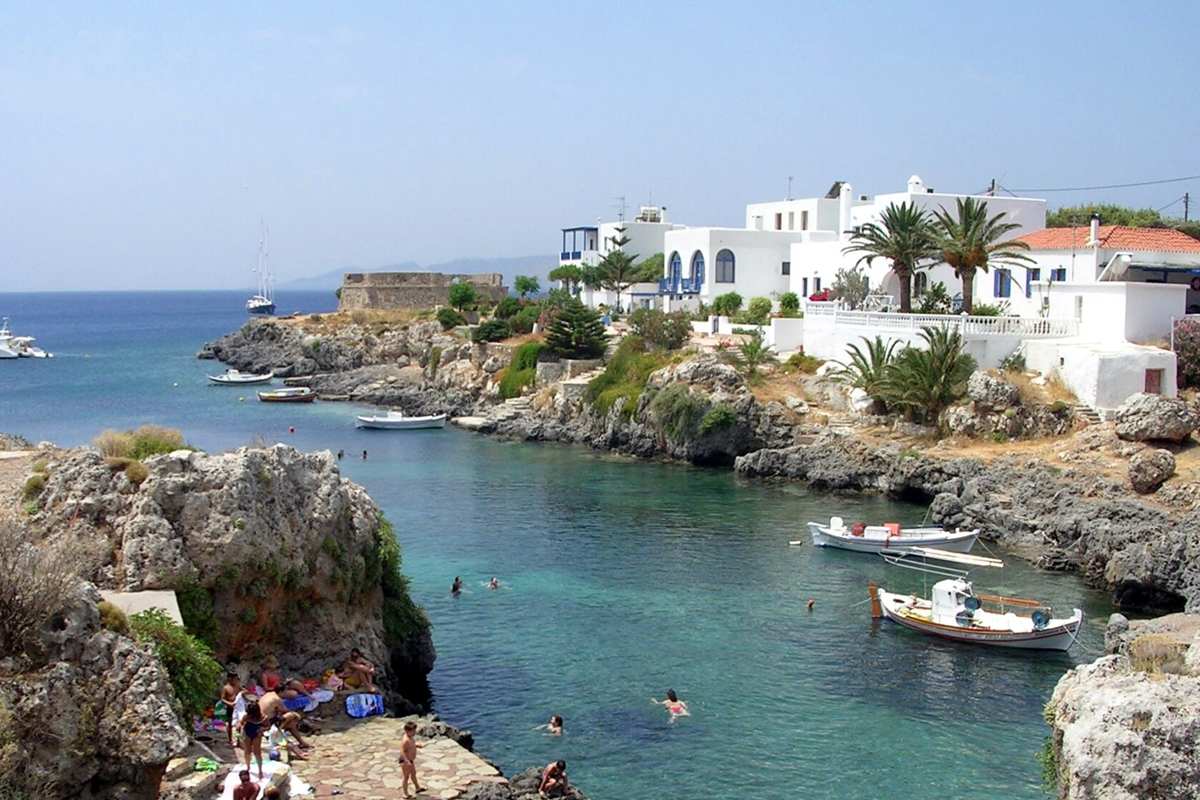
Featured photo: Lapost, CC BY-SA 3.0, via Wikimedia Commons (File:Avlemonas, Kythira.JPG).