
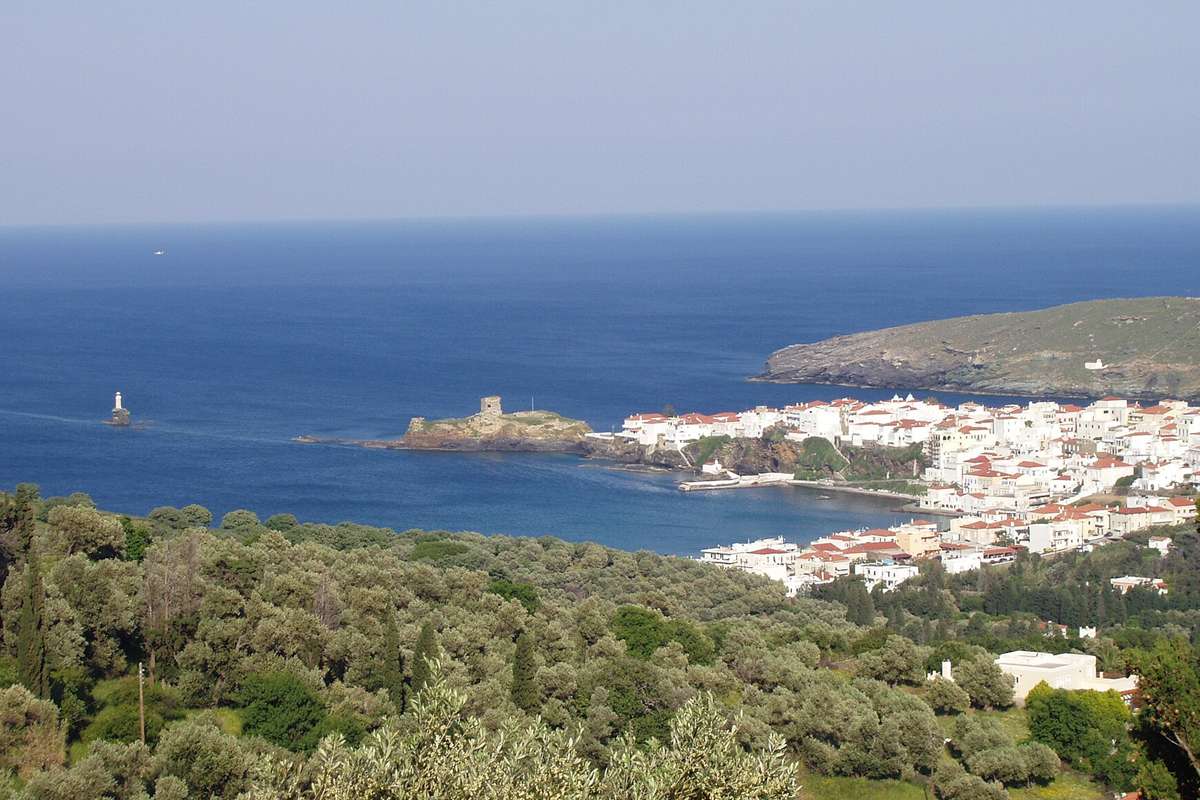
Andros tours are trips across Andros, a Cycladic island of wine, figs and seafaring families. The sections cover the Hermes of Andros, ancient Zagora and the Museum of Contemporary Art Andros. They also cover the Kairis Library in Hora and the port of Gavrio. Short answers follow on Korthi, the plain of Messaria, Strofilas and Palaiopoli. For nearby ideas, see the Best Cyclades islands and Greece hiking tours. Wider choices sit among the full range of Greece tours.
Bookings made through the GetYourGuide widgets on this page earn Classical Greece Tours a commission, at no extra cost to the traveller.
What are Andros tours?
Andros tours are trips on a Cycladic island that sends wine and citrus fruits to other markets. Cycladic marks a place as one of the Cyclades in the Aegean. Andros shares its wine trade with Tinos, Mykonos, Paros, Naxos, Sikinos and Santorini.
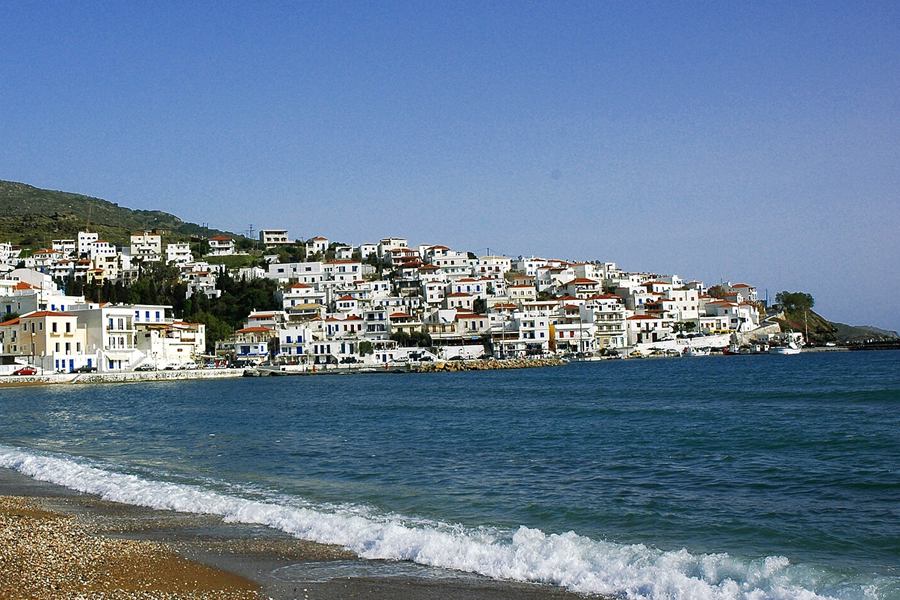
Andros also exports figs, like Syros, Tinos, Mykonos, Naxos and Sikinos. A fig is a soft, sweet fruit packed with small seeds. In the age of the first Cycladic cities, Andros above all had links with Euboea. Naxos and the islet of Donoussa shared those links. Euboea is a large island off the east coast of central Greece.
Among the islands of shipowners, Andros was a rare one that ran steam engines. A steam engine is a machine driven by the force of steam from boiling water. Until the 1960s and 1970s, the island supplied the Hellenic Navy with large numbers of sailors. A navy is the armed sea force of a state.
Andros tours belong to an island where, in 1701, the traveller Tournefort counted at least three Orthodox monasteries. Monks share a monastery as their house of prayer, work and sleep. Of the monasteries he listed, only three were Byzantine foundations. Panaghia Panachrantos on Andros, from the 10th century, was one of them. Byzantine means of the eastern Roman state.
- Name: Arvanites, who speak the Arvanitika tongue, call the island by the name Ëndra.
- Citrus: Citrus fruits are sharp, juicy fruits such as oranges, lemons and limes.
- Hellenic: For Andros tours, Hellenic is a formal word for Greek, as in Hellenic Navy.
Like Hydra and Spetses, Andros put its fleet to work for the national cause. That cause was the Greek fight for independence from Ottoman rule. Andros tours run on an island whose ships once served it.
How does the Hermes of Andros fit into Andros tours?
Andros tours cross the island where the Hermes of Andros came to light. This large marble statue of the god Hermes dates from the Roman era. Today it stands in the Archaeological Museum of Andros, on the island itself.
The statue once left the island for the new National Museum in Athens. That museum then stood in the Temple of Hephaestus, wrongly called the Theseum. Hephaestus, in Greek myth, worked metal at a forge and ruled over fire. A shrine stood near the spot where the statue was found. In all likelihood it served for hero worship.
An inscription found there honoured Egnatia Maximilla and Publius Gleitius Gallus. They were benefactors of the city under the emperor Nero, around 65 AD. Benefactors paid for public works or gifts out of their own wealth. The woman’s statue found beside the Hermes follows the Herculaneum Woman type.
Its sculptor belonged to the school of Praxiteles, as a comparison with Hermes and the Infant Dionysus shows. Praxiteles was a sculptor of ancient Athens. In art, a school means artists who follow one master’s manner. The young god stands nude. His chlamys rests on his left shoulder and falls down his back.
- Feet: For Andros tours, the statue’s feet are restorations, carved without sandals.
- Chlamys: A chlamys was a short cloak, pinned at one shoulder, worn by young men.
- Hero worship: On Andros tours, hero worship means honour paid to a dead hero at a shrine.
The Hermes proved older than the woman’s statue. Scholars argued that it was reused beside her, a common practice with Hermes statues. Reused means set up again for a new purpose. Andros tours run on the island where both statues were found.
What does ancient Zagora add to Andros tours?
Andros tours share their island with Zagora, one of the first towns of the Cyclades. Those towns rose between the 12th and 8th centuries BC. Zagora is a leading example of a town from that age that scholars can study.
A wall surrounded the houses of Zagora. Andros tours run on an island where archaeologists date that wall to 850 BC. An archaeologist reads the past from objects and buildings left in the ground. The building types found at Zagora changed little from the 9th century BC to the 19th century.
Zagora’s houses had flat roofs made of schist slabs, with clay spread on top. Schist is a rock built of thin layers that part into sheets. The corners of the houses were cut back at an angle. That shape let beasts of burden pass by more easily. Donkeys and mules are beasts of burden, animals kept to carry loads.
J. J. Coulton was a British classical archaeologist. His special field was ancient Greek civic and religious architecture. He took part in the digs at Zagora, led by Alexander Cambitoglou. Civic buildings serve public life, such as council halls and market halls. A dig is the slow removal of soil to uncover buried remains.
- Marriage: Coulton met his wife, Mary, during the work at Zagora.
- BC: On Andros tours, BC dates count backwards from the year Christ was born.
- Urban: Urban describes a town or city, as opposed to farms and open country.
Coulton later advised the Zagora Archaeological Project. The Australian Archaeological Institute at Athens runs that project. A consultant is an outside expert whose advice a team seeks. Andros tours unfold on the island where that project works.
Why does the Museum of Contemporary Art Andros matter on Andros tours?
Andros tours belong to the island that holds Greece’s first museum of modern art. Its name is the Museum of Contemporary Art Andros. The shipowner Basil Goulandris founded it. His wife, Elise, born Karadontis in Athens in 1917, was its co-founder.
Miranda Spiliotopoulou-Vazaka designed the outdoor areas around the building. The collection holds work by Greek artists such as Takis, Chryssa, Kounellis and Psychopedis. Contemporary art is art made in living memory, up to the present. Andros tours unfold on an island where such work hangs in a public museum.
Basil and Elise Goulandris became collectors of modern art as a couple. They set up the Basil and Elisa Goulandris Foundation. A foundation is a body that spends donated wealth on a lasting public aim. Elise met and married Basil in 1950. He was a shipowner, owning merchant ships as a business.
Basil Goulandris was born on 6 September 1913 and died on 27 April 1994. His twin brother, Nicholas, known as Nikos, lived from 1913 to 1983. Twins are two children carried and born together. Nikos is the short Greek form of the name Nicholas. Andros tours unfold on the island of this family’s museum.
- Co-founder: Elise Goulandris, art collector and co-founder of the museum, died on 25 July 2000.
- Modern art: On Andros tours, modern art means art that broke with older styles of painting.
- Collector: A collector gathers works of art or rare objects and keeps them together.
In 1990 the museum building took part in a competition in Osaka, Japan. The contest formed part of the International Garden and Greenery Exposition. An exposition is a public show of goods, designs or art. Andros tours start on an island whose museum design went on show abroad.
Which treasures does the Kairis Library give Andros tours?
Andros tours belong to the island of Theophilos Kairis. He was an Orthodox priest, a philosopher and a revolutionary. In Hora, or Andros Town, a neoclassical building holds his library. Neoclassical design borrows columns and pediments from Greek and Roman temples.
Kairis himself gathered roughly 3,000 of the volumes in the library. Art works and a modest set of finds from old sites are on show too. A volume is one bound book. The treatises of Kairis there include work that extends Laplace’s Celestial Mechanics. For Andros tours, a treatise means a long, formal written study of one subject.
Items in the library show that Kairis knew Joseph Fourier’s work on energy. Fourier was a French mathematician and physicist. The shelves also hold books by Professor Mavromatis, who edited the mathematical work of Kairis. Energy, in physics, is the power to do work, such as heat or motion. Mathematics is the science of number, quantity and shape.
From Andros, Kairis kept in touch with Auguste Comte. He also wrote on the treatises of Comte about sociology, then a new subject. Sociology studies how people live together in groups and societies. Kairis taught his pupils the poetry of Lord Byron and Robert Browning. Both were English poets.
- Revolutionary: A revolutionary works to overturn a ruling power and set up a new order.
- Philosopher: For Andros tours, a philosopher is someone who reasons about truth, knowledge and right conduct.
- Celestial mechanics: Celestial mechanics is the science of how the sun, moon and planets move.
Kairis led his pupils on field trips across the island. Their goal was the ruins of a temple to Aphrodite, which he had found before the revolution. In Greek myth, Aphrodite ruled over love and beauty. Andros tours run on the island of that temple.
What role does the port of Gavrio play on Andros tours?
Andros tours run on an island whose port of Gavrio is called the first port of the Cyclades. The northwest side of Andros is where Gavrio stands. It is a traditional village, and ruins from the Hellenistic period lie there.
The Hellenistic age began with the conquests of Alexander the Great and spread Greek ways eastward. Gavrio was the seat of Ydrousa, a former municipality of the island. A local government reform in 2011 made Ydrousa a municipal unit of Andros. Such a unit forms one district of a wider municipality, with its own local name.
Ydrousa had 3,202 inhabitants at the 2021 census. Its land covers 195.367 square kilometres. The state runs a census to tally every resident at set times. On Andros tours, inhabitants means residents of a given area. Picture a field with four equal edges of a kilometre: its area is one square kilometre.
In 1696 the Venetian commander Contarini arrived at Port Gavrion with 22 sailing ships. Gavrion is the older spelling of Gavrio. A sailing ship is a ship driven by the wind in its sails. A commander leads a fleet or an army and gives its orders. Venetian means from the city state of Venice.
- Return: After the battle of 1696, the Venetian ships sailed back to Port Gavrion.
- Traditional village: For Andros tours, a traditional village keeps its old layout and local style of building.
- Port: Harbour towns where vessels take on and set down people and cargo are called ports.
Of the three municipal units on Andros, Ydrousa is the biggest. It covers over half of the island’s territory. Territory means the land under one authority, such as a council. Andros tours unfold on an island that these three units divide between them.
What do travellers ask about Andros tours, and what are the answers?
Andros tours run on an island of old villages, plains and ancient towns. Strofilas dates from the Neolithic, and Palaiopoli from ancient times. The plain of Messaria drew settlers in the 11th century. Korthi is one of the three municipal units on the island.
Before Andros tours, what is Korthi?
Korthi, also written Korthio, is a former municipality on Andros. After the local government reform of 2011, Korthio became a municipal unit of Andros. Its population was 1,706 at the 2021 census. The sculptor Michael Tombros was born in Athens in 1889. His father was a marble sculptor from Korthio.
On Andros tours, why does the plain of Messaria matter?
In the 11th century, islanders left Palaiopoli for the plain of Messaria. At that time, silkworm breeding came to Andros. Silk kept the island wealthy until the 19th century. Andros raised the silkworms, while Tinos and Kea spun the raw silk. A silkworm is a caterpillar that wraps itself in a cocoon of silk.
For Andros tours, what kind of village was Strofilas?
Strofilas was a Neolithic village on Andros, and its houses stood rather close together. Neolithic comes from Greek words for new and stone. The village ranks with the first known fortified places in Greece. Scholars argue that its walls served a military purpose. They make the same case for Makriyalos in Pieria.
On Andros tours, where does ancient Palaiopoli lie?
Palaiopoli lies on the west side of Andros. It is 5 kilometres from Ipsili and 10 kilometres from Zagora. Parts of the site show signs of settlement in the Geometric period. That period takes its name from pottery painted with lines and simple shapes. Building there went on into early Christian times.
Featured photo: Vassilis Kyrtatas, Public domain, via Wikimedia Commons (File:Andros town.JPG).