
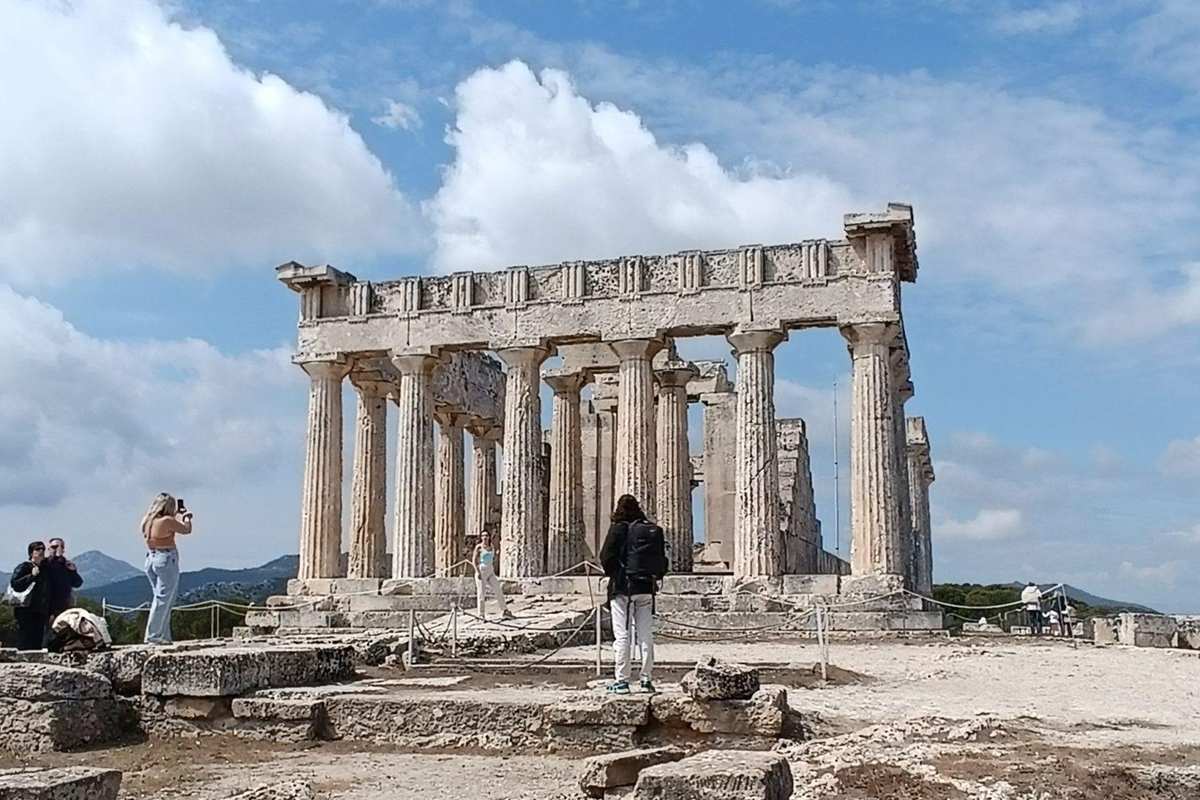
Temples in Greece are the focus of small-group trips across Athens, Attica, Delphi, the Peloponnese and the islands. The answers below open with Athena’s Old Temple on the Acropolis and the moved Temple of Ares. Apollo Zoster, Artemis Amarynthia, Athena Pronaia and Aphrodite on Acrocorinth follow. Athena Alea at Tegea and the Corfu temples of Artemis and Hera come next. Later answers explain column orders, temple parts and building methods. Related trips include a classical Greece tour, Olympia tours and Delphi tours. Every option sits under Greece tours.
Bookings made through the GetYourGuide widgets on this page earn Classical Greece Tours a commission, at no extra cost to the traveller.
What are the temples in Greece?
The temples in Greece were built to house the statues of gods inside holy grounds called sanctuaries. Worship itself happened in the open air. Sacrifices and rituals for each god took place outside the temple, in the wider sacred area.
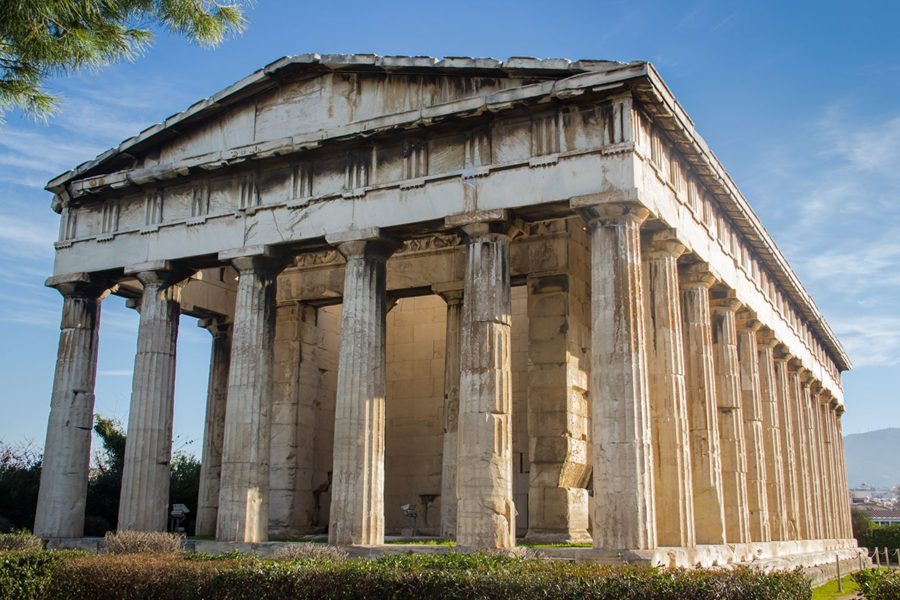
Each main temple stood inside a larger precinct known as a temenos. A temenos is a piece of ground set apart for a god. A fence or wall called a peribolos normally closed it off. The temples in Greece also served as stores. They held votive offerings, meaning presents handed over to a god by worshippers.
Almost all temples in Greece had their main door facing east. Cult custom and the light of the rising sun explain this. Soil studies show that sites were picked with a god in mind. Demeter and Dionysos, gods of farming, received sites on soil fit for crops. Apollo and Artemis, linked with hunting, received sites near rocky soil.
Entry rules at temples in Greece varied. One temple barred anyone who had eaten garlic. Such bans grew from local ideas of ritual purity, meaning religious cleanness. Inside, people were able to pray before the cult image, the holy statue of the god. Cicero saw a bronze Heracles whose foot was worn away by touching hands.
- Builders: Cities or the boards that ran sanctuaries normally organised and paid for new temples.
- Refuge: Certain temples sheltered people fleeing the law, for example runaway slaves.
- Closure: Laws of Theodosius I against pagan cults closed temples or turned them into churches.
In the 2nd century AD, the traveller Pausanias toured Greece on a special mission. He wanted to see the cult images inside the temples in Greece with his own eyes. In his own account, he normally managed to see them.
Which story does the Old Temple of Athena tell about temples in Greece?
Temples in Greece include the Old Temple of Athena, a Doric limestone temple on the Athens Acropolis. Doric is a plain column style. It held the xoanon of Athena Polias, a wooden cult statue of Athena as guardian of the city.
Experts place its building, almost certainly, in the latter half of the sixth century BC. Full-scale digging on the Acropolis began in 1885. In the first year, foundations south of the Erechtheion came to light. The archaeologist Wilhelm Dörpfeld saw that they belonged to a peripteral temple. Peripteral means ringed by columns on all sides.
Among the temples in Greece, this one has odd details. Its foundations leave room for just two steps under the colonnade, not the standard three. The inner foundations are blue Acropolis limestone, while the outer ones come from Mount Hymettos. Pieces of its entablature, the stone band above the columns, were set high in the north Acropolis wall.
The pediments, the triangular gables at each end, held sculpture. One showed a Gigantomachy, a battle between gods and giants, featuring Athena. The other showed two lions attacking a bull. Persian invaders burnt the temple down in 480 BC. The Oath of Plataea required the victors to keep their ruined temples in Greece as a memorial.
- Homer: The poet referred to the temple of Athena and the strong house of Erechtheus.
- Missing room: Not one surviving fragment is firmly assigned to the cella, the inner chamber.
- Burnt shell: Gloria Ferrari argues that the blackened ruin served as both monument and treasury.
By 1887, Dörpfeld had published his view of this ruin among the temples in Greece. He judged that it was restored in ancient times. In his view, it was not swept away in the 5th century but lasted until Pausanias.
Why do temples in Greece include a moved building, the Temple of Ares?
Temples in Greece were at times rebuilt on new ground, as the Temple of Ares shows. This Doric temple had six columns across the front and a colonnade on all four sides. It first stood at Pallene, now Gerakas, honouring the goddess Athena Pallenis.
It is the largest of the itinerant temples. These are temples in Greece that were taken apart and rebuilt elsewhere. They reached the Athenian Agora, the old market square, in the age of Augustus. The link with Ares, god of war, began only with this transfer. A terracotta bowl found in the foundation fill confirms the date.
The first foundations lie at Stavros in Gerakas, a north-eastern suburb of Athens. They measure 16.35 metres by 35.25 metres. Their line points almost perfectly towards the island of Delos. That alignment shows that Apollo was worshipped there alongside Athena. The playwright Euripides called the hill above the site the sacred hill of Athena Pallenis.
As the Pallene building came down, each block received a mason’s mark of two or three letters. A mason is a worker who cuts and lays stone. The marks showed where every block belonged at the new site. They let one of the temples in Greece rise again, block by block.
- Agora dig: Excavators uncovered the Agora foundations in 1937, then reburied them for their protection.
- Pallene dig: The original foundations at Pallene were excavated between 1994 and 1997.
- Plague link: Stewart and colleagues suggest that it rose in response to the Plague of Athens.
It is one of four temples in Greece credited to a builder called the Theseum architect. In the Agora, its northwest corner sits over a Mycenaean tomb. Mycenaean refers to Bronze Age Greece, and the tomb was in use from about 1450 to 1000 BC.
What makes the Temple of Apollo Zoster stand out among temples in Greece?
Temples in Greece reach the shore of Athens at Vouliagmeni, where the Temple of Apollo Zoster lies. Children from the Vouliagmeni orphanage first uncovered the ruins while playing on ground that is now a beach. Inscriptions found in the ruins confirm its name.
The archaeologists K. Kourouniotes and M. Pittidis dug here in 1926 and 1927. Pausanias names Zoster as the chief sanctuary of the deme of Aixonides Halai. A deme was one of the village districts of old Attica. This one covered the modern areas of Voula and Vouliagmeni. Aixonides Halai means the Saltfields of Aixone.
The temple stands on the middle tongue of a three-tongued headland once called Cape Zoster. Herodotus wrote that after the battle of Salamis, the Persians mistook its rocks for Greek ships. It is one of the temples in Greece built in the sixth century BC. Its plan measures 10.8 by 6 metres.
Inside the sekos, three bases once held cult statues of Leto, Apollo and Artemis. A sekos is the inner room of temples in Greece, home to the cult image. Two bases carry the words HALAIES ANETHESAN. The phrase shows that citizens of the deme gave the statues to the gods. The marble throne of the priest also survives.
- Repairs: An inscribed marble altar records repairs in the fourth century BC under the priest Polystratos.
- Priest’s house: A building found in 1936 served as the priest’s house or a pilgrims’ hostel.
- Flooding: The ruins lie almost at sea level, so they flood readily outside the summer months.
A peristyle, a ring of columns around temples in Greece, was added here in the fourth century BC. It had four columns on each narrow side and six on each long side. In the Christian period, the building became a church.
When did the lost Temple of Artemis Amarynthia rejoin the temples in Greece?
Temples in Greece honouring Artemis had a key centre at Amarynthos on the island of Euboea. Its sanctuary of Artemis Amarynthia was arguably the leading seat of her cult in Northern Greece. Excavations place its founding in the 6th century BC.
Long unknown, it was one of the lost temples in Greece. Researchers searched for its remains from the 19th century onwards. Strabo had placed it seven stadia, about 1.5 kilometres, from Eretria. A stadion was an ancient unit of length. That clue misled the hunt; the real site lies about 10 km from the assumed spot.
Digging since 2007 has put the sanctuary back among the known temples in Greece. It lies at the foot of Palaioekklisies hill, near the fishing town of Amarynthos. The remains span the 6th to the 2nd century BC. Diggers found an underground fountain, inscribed bases and sealed tiles. Coins bearing the name Artemis also came to light.
Callimachus, writing in the 3rd century BC, said that Agamemnon established the temple. He also called it the temple of Artemis Kolainis, meaning Hornless. The name came from a hornless ram made of wax that Agamemnon offered her. Every year, a procession from Eretria ended here during the Amarysia, a festival of Artemis.
- Pillar: An Eretrian pillar listed three thousand armoured soldiers, six hundred horsemen and sixty chariots in procession.
- Rival feast: Pausanias judged the Athenian Amarysia no less splendid than the one on Euboea.
- Offerings: Aelian wrote that the people of Eretria sacrificed maimed animals to Artemis here.
Ancient authors wrote about the sanctuary from the 3rd century BC until the 3rd century AD. Later, Christian emperors passed laws against non-Christian sanctuaries, including temples in Greece. If the Amarynthos temple still worked in the 4th century, it closed under those laws.
Why did Athena Pronaia stand first among the temples in Greece at Delphi?
Temples in Greece at Delphi gave the goddess Athena Pronaia the front place. Her name means the one before the temple of Apollo. Her sanctuary was the first that an ancient traveller met when walking into Delphi from the eastern road.
Excavations show an older cult site here, possibly dedicated to Gaia, the Earth. The bulk of the Mycenaean figurines shown in the Delphi Archaeological Museum came from this ground. They include a seated figure on a tripod. Scholars have suggested that they were ex-votos. Ex-votos are gifts left at temples in Greece to fulfil a vow.
Temple A, the first temple here, is thought to be the earliest Doric temple. Doric is the plainest style used for temples in Greece. Twelve columns remain, each with a low capital and shallow fluting. Capitals are column tops, and fluting means vertical grooves. An earthquake possibly destroyed it in the first half of the 6th century BC.
Temple B rose on the same spot around 510 BC. Its pteron, the ring of outer columns, counted 12 columns along each long side. The short sides had 6. Its metopes were made of clay and decorated with figures. Metopes are square panels set in a band above the columns of temples in Greece.
- Roof figures: Temple B showed Athena on a pediment and Nike, goddess of victory, as statues on its roof edges.
- Cult statue: Marble pieces of an Athena head in the museum belong, scholars say, to the cult statue.
- Artemis question: Pausanias wrote that one temple in this sanctuary was dedicated to Artemis.
Pausanias also described two images in the temple of Athena Pronoia. The bronze one in the fore-temple was a gift of the Massiliots and was the larger. The Delphians said that Philomelos stole a gold shield that Kroisos the Lydian had given to Athena.
What did Aphrodite’s summit temple on Acrocorinth add to the temples in Greece?
Temples in Greece for Aphrodite rose high in Corinth, where her main temple crowned the city’s acropolis. It was built in the 5th century BC on the top peak of Acrocorinth. Acrocorinth is the name of that high citadel, which towers over Ancient Corinth.
Aphrodite was the protector goddess of the city of Corinth. She held at least three sanctuaries in the city itself. Besides the summit temple, these included the temple of Aphrodite II and the temple of Aphrodite Kraneion. Of these temples in Greece, the summit one won the widest fame.
In myth, Helius, the sun god, had given the hill of Acrocorinth to Aphrodite. By the measure of temples in Greece, her temple was relatively small, at 10 by 16 metres. Inside stood a famous statue known as Armed Aphrodite. The goddess wore armour and held a shield before her as a mirror.
When Roman Corinth was founded, a number of older sanctuaries were rebuilt. Among the revived temples in Greece there were Apollo’s temple and the Sanctuary of Demeter and Kore. This temple seems to have been rebuilt as well. Pausanias later listed its images as Aphrodite armed, Helius, and Eros with a bow. Eros was the god of love.
- Coins: Large numbers of Roman-era coins show the temple on the summit.
- Old verse: Euripides called Acrocorinth the sacred hill-city of Aphrodite, in lines quoted by Strabo.
- Outlying temples: Beyond the city, she also had temples at Lechaion and at Cenchreae.
Its later history is not clearly established. After Corinth’s destruction in 146 BC, a large share of the Acrocorinth sanctuaries were abandoned, if not destroyed. In the 5th century AD, the remains of the temple became part of a church.
Which myths gave Tegea’s Temple of Athena Alea its place among temples in Greece?
Temples in Greece sometimes honoured a merged goddess, and Tegea’s sanctuary of Athena Alea is one. Its cult joined the Olympian Athena with Alea, a local deity. The temple served the ancient Tegeans as a marker of their identity.
The site was a focal point of its district from the tenth century BC. Pausanias was a Greek travel writer who described temples in Greece. He credited the local hero Aleus, son of Apheidas, with building this one. Herodotus adds that the temple held chains from a failed Spartan attack on Tegea in the sixth century.
Among the temples in Greece, this one was an ancient and revered asylum. An asylum was a holy place where people in danger sought protection. The writer Pausanias names famous refugees there: Chryseis, the Spartan Leotychides and the Spartan general Pausanias. Its priest was a boy, who held the office only until he reached puberty.
The second temple was a Doric building wrapped in a triple row of columns of different orders. An order is a set style of column and beam for temples in Greece. Pausanias lists Doric columns first, then Corinthian, then Ionic. Endoeus made the cult statue entirely of ivory. Augustus later carried it to Rome to adorn his forum.
- Healing gods: Statues of Asclepius and Hygieia, goddess of health, stood on either side of Athena.
- Festivals: The sanctuary held two feasts, the Aleaia for Alea and the Halotia for victory over Sparta.
- Boar relics: Tusks of the mythical Calydonian boar were kept in the temple until Augustus removed them.
Edward Dodwell, an Irish painter and author, found the temple in 1806 by following Pausanias. A German team dug first in the 1870s, and French missions followed in the early 1900s. Since the 1990s, the Norwegian Institute at Athens has controlled the site.
Where does the Gorgon of Corfu’s Temple of Artemis fit among temples in Greece?
Temples in Greece made wholly of stone had an early example in the Temple of Artemis on Corfu. It is one of the first Doric temples of that kind. Fragments of its gable sculpture are the earliest major survivals of Archaic temple relief.
The temple measured 23.46 metres wide and 49 metres long. It faced east, so that the light of sunrise entered its interior. It ranked among the largest temples in Greece of its time. A peristyle, or outer colonnade, of eight by seventeen columns ran around it. A colonnade means a line of standing columns.
The space inside the peristyle left room for a second ring of columns. Builders skipped it to save money. This pseudodipteral plan, one colonnade in space for two, has its earliest known example here. Its cella held two rows of ten columns. It also bears the first known decorated pediment among temples in Greece.
Its pediment figures were carved in high relief, raised from the background. Both pediments seem to have shown a Gorgon Medusa, more than 9 feet high. A Gorgon was a female monster of myth. Panthers flank her as guardians of the temple. These figures were apotropaic. Apotropaic describes images set on temples in Greece to ward off evil.
- Museum: The Archaeological Museum of Corfu exhibits the western pediment and other architectural fragments.
- Imperial digger: Kaiser Wilhelm II, the German emperor, joined the excavations while staying at his Achilleion palace.
- Altar: The altar was 2.7 metres wide and 25 metres long, and 8 metres of it survive.
The site has been excavated from 1911 onwards. The Kaiser’s lifelong obsession with the Gorgon began at archaeology seminars he attended in Bonn. The archaeologist Reinhard Kekulé von Stradonitz gave those seminars and later became the Kaiser’s adviser.
What remains of the Heraion at Mon Repos, one of the early temples in Greece?
The temples in Greece have one of their earliest Archaic examples in the Temple of Hera on Corfu. Builders raised it around 610 BC in ancient Korkyra. Its site lies in today’s Palaiopolis, within the grounds of the Mon Repos estate.
Large terracotta figures decorated its roof, including lions, gorgoneions and Daidala maidens. Terracotta is baked clay; a gorgoneion is a Gorgon-head charm. Craftsmen painted them in vivid colour. The lions served as roof tiles, with water spouts in their mouths to drain rainwater. No roof project among temples in Greece of its time was more ambitious.
The temple crowned Analipsis Hill. Ships nearing ancient Korkyra’s waterfront saw it clearly. It lies about 700 metres southeast of the Temple of Artemis, a neighbour among temples in Greece. A sanctuary existed here by the early 7th century BC. A major fire destroyed the temple by the 5th century BC.
Workers opening a road found the capitals, or tops, of Doric columns. The German archaeologist Wilhelm Dörpfeld then dug here briefly in 1914. Giorgos Dontas and Petros Kalligas led wide-ranging digs from July 1962 until 1967. They published 7 reports. They found that the temple had been looted for its stone in Byzantine or Venetian times.
- Road damage: A road built in modern times destroyed the western and southern flanks of the temple.
- Rebuild: After the fire, the sanctuary grew, and a new temple rose in the 4th century BC.
- Boundary wall: Traces of the wall around the peribolos, the sacred enclosure, stand high in places.
The Greek team found no ruins of these temples in Greece left on top of Analipsis Hill. The stratigraphy, meaning the order of buried soil layers, had been completely disturbed. The architectural fragments they recovered are stored at the Archaeological Museum of Corfu.
Where did the Doric order seen on temples in Greece begin?
Temples in Greece built to the Doric order follow a style from the western Doric region of Greece. An order is a fixed scheme for a column, its top and the beams it carries. Doric ranks as the earliest of the Greek orders.
Greek Doric columns had no base. Each shaft dropped straight onto the stylobate, the flat stone floor of the temple. A shaft is the long round body of a column. On temples in Greece, these columns rose only four to eight times their own diameter. That made Doric the squattest of all the classical orders.
Their shafts carried 20 hollow grooves set side by side. Each groove rose to a sharp ridge called an arris. Higher up ran the frieze, a band of stone above the main beam. There sat triglyphs, blocks cut with upright grooves, and small pegs called guttae. Both shapes recall the beams and pegs of earlier wooden temples.
Builders of temples in Greece placed a triglyph above every column. The Greeks also felt that the corner triglyph belonged at the very corner of the entablature. The entablature is the whole stack of beams resting on the columns. At each corner, this rule pushed the last triglyph off the centre of the column below it.
- Corner contraction: Builders set the last two columns slightly closer together to strengthen the corners to the eye.
- Guttae: The name means drops, and the pegs look as if hammered in from below.
- Earliest in stone: The Temple of Artemis on Corfu is the earliest known Doric temple built of stone.
Among temples in Greece, the Doric order enjoyed its greatest popularity on the mainland. That peak came in the Archaic Period, from 750 to 480 BC. Archaic means early, and the word names this stretch of Greek history.
How does the Ionic order change the look of temples in Greece?
Temples in Greece owe the Ionic order to Ionia, where the style arose in the mid-6th century BC. Ionia lay roughly where the Turkish province of Izmir sits today. Its people spoke Ionic, one of the dialects, or local forms, of Greek.
Ionic capitals on temples in Greece stand out through their volutes. A capital is the carved crown of a column, and volutes are curling scrolls at its sides. To draw them, a designer needed only a straight-edge, a right angle, string and a compass. String helped the designer mark out half-lengths.
The Ionic column is always more slender than the Doric, so it always has a base. On Ionic temples in Greece, columns stand eight or nine times as tall as their width. Slender means narrow for its height. The base is a moulded stone pad that lifts the shaft off the floor.
After a little early testing, the number of flutes in an Ionic shaft settled at 24. Flutes are the hollow grooves cut down a column. Between each pair, carvers of temples in Greece left a narrow flat strip. Doric flutes instead met in a sharp edge, which people brushing past damaged easily.
- Dentils: The cornice, the jutting top band, carries dentils, small blocks like the close-set ends of floor beams.
- Carved frieze: A carved picture frieze, frequently telling a story, is a mark of the Ionic order.
- Corner columns: Angling the volutes on corner columns let them read equally from the front and side.
By the 5th century BC, the Ionic column was in use on the Greek mainland. The mainland means the part of Greece joined to the rest of Europe, apart from the islands. Century here means a block of one hundred years.
What sets the Corinthian order apart on temples in Greece?
Temples in Greece include the Corinthian order, the last of the three main orders to develop. It is also the richest of them in carved ornament. Ornament means carving added for beauty, such as leaves, scrolls and flowers cut into stone.
The name of this order on temples in Greece comes from the city of Corinth. Experts think, though, that the style was invented in Athens. Its earliest use reaches back to the Late Classical Period, from 430 to 323 BC. Late Classical names the closing stage of the Classical age of Greek art.
Corinthian capitals on temples in Greece wear two rows of carved acanthus leaves. Acanthus is a plant with spiny, deeply cut leaves. Eight stalks, called cauliculi, rise among the leaves. Small Ionic scrolls curl out above the leaves at each corner. A capital is the shaped block that crowns a column.
On temples in Greece, the Ionic capital had clear front and side faces. That split created an awkward look on corner columns. Experts think the Corinthian capital was devised to solve this problem. The new design read equally well from every angle. To read well here means to look right to the eye.
- Abacus: The flat slab on top of the capital curves inwards on each of its faces.
- Indoor use: During the century after its first known use, Corinthian columns in Greece all stood inside temples.
- Slim shafts: Of the three Greek orders, the Corinthian has the narrowest columns, with Ionic next.
At Epidaurus, a Corinthian capital was carefully buried in ancient times within the foundations of the round tholos. Modern excavations brought it back to light. A tholos is a round building. Excavations are careful digs that bring buried remains to the surface.
Inside temples in Greece, what was the cella for?
Temples in Greece centre on the cella, also called the naos. It is the inner chamber of an ancient Greek or Roman temple. Cella is Latin for small chamber, while naos is the Greek word for temple. A chamber is a closed room.
As a rule, the cella held a cult statue of the god or goddess of the temple. A cult statue is a sacred figure that stood for the deity. In general, the room was plain, windowless and rectangular. A door or open entrance at the front led in from behind a row of columns.
No gatherings or sacrifices took place inside the cella of temples in Greece. The altar always stood outside the building. A sacrifice is an offering, such as an animal, made to a god. Gifts piled up and turned temples into treasuries in all but name. A good number of them served as real treasuries in ancient times.
On temples in Greece, a porch called the pronaos stood in front of the cella. In Greek, the name means the space before the naos. The side walls of the cella stretched forward to form this porch. Their jutting ends are called antae. Two columns stood between the antae.
- Back room: The opisthodomos, a matching room behind the cella, had no door leading into it.
- Adyton: This inner area of the cella was kept for priests or for the temple guard.
- Offering table: A cella sometimes held a table for gifts such as helmets, swords and precious stones.
Larger temples in Greece, as a rule, split the cella with two rows of columns. These rows created a central nave with an aisle on each side. A nave is the main central space of a hall. Each aisle runs alongside it as a side passage.
How did pediments crown the ends of temples in Greece?
Temples in Greece carry pediments, a form of gable in classical architecture that is triangular as a rule. A gable is the upper end of a wall, shaped by the slopes of a roof. Classical architecture means the building style of ancient Greece and Rome.
On a Greek temple, a broad, low triangular pediment crowned the portico. Its side angles measured between 12.5° and 16°. A portico is a porch with a roof held up by columns. Greek temples, rectangular in plan, as a rule had a pediment at each end. Roman temples tended to have only one.
The tympanum is the triangular area enclosed by a pediment. It frequently held sculpture, either free-standing or carved in relief. Relief means figures that stand out from a flat background. Pedimental sculpture on temples in Greece began as massive relief figures. Massive here means heavy and thick-set. Pedimental means belonging to a pediment.
Earlier temples frequently had hipped roofs, which slope down on all four sides. The gabled roof, a Doric introduction, created the pedimental triangle on the narrow ends. A gabled roof has two slopes meeting at a ridge. On temples in Greece, the narrow ends are the short sides of the rectangle.
- Raking cornice: The cornice runs along the rising sides of a pediment, as well as beneath it.
- Roman pitch: Roman pediments slope slightly more steeply than classical Greek ones.
- Acroteria: These roof ornaments, first geometric and later floral or figure-shaped, decorated corners and ridges.
Over time, myths tied to the local area came to dominate pediment scenes on temples in Greece. Myths are old tales of gods and heroes passed down over time. Local here means belonging to the town or district around the temple.
What did metopes add to the friezes of temples in Greece?
Temples in Greece of the Doric order set a metope between each pair of triglyphs in the frieze. A metope is a rectangular panel. The frieze is the decorative band above the architrave, the main beam over the columns. Each triglyph is a grooved block.
In earlier wooden buildings, the gaps between the triglyphs stood open at first. Builders later closed these open spaces with metopes. Even so, a metope carries no load at all in the structure of temples in Greece. Load-bearing parts, such as columns and beams, hold up the weight resting above them.
Earlier metopes were left plain, with no decoration. Later examples were painted or adorned with reliefs instead. A relief is a carving raised from a flat stone face. Metopes on temples in Greece were made of either clay or stone. Clay here means baked earth, which also goes by the name terracotta.
On temples in Greece, the scenes on metopes rarely ran on from one panel to the next. Instead, a wider story, as a rule a battle, grew from separate scenes set side by side. Each metope acted as a tableau. Tableau is a French word for a framed picture of one moment.
- Slotted panels: At the Temple of Aphaea, stone metopes were cut separately and slid into slots in the triglyph blocks.
- Colour contrast: Builders sometimes cut metopes and friezes from different stone to set off their colours.
- Early survivors: Stone metopes from a temple at Mycenae, late 7th century BC, rank among the earliest known.
Paint has vanished from the majority of metopes that survive. Even so, enough traces remain to give a close idea of how the panels first looked. Traces here means small marks of colour still clinging to the carved stone surface.
Why do stone maidens called caryatids appear on temples in Greece?
Temples in Greece sometimes replace a column with a caryatid. A caryatid is a sculpted female figure that serves as a support. She carries the entablature, the band of beams above, on her head. Sculpted means carved by an artist, here from stone.
The Greek word karyatides literally means maidens of Karyai, an ancient town on the Peloponnese. The Peloponnese is the big southern part of mainland Greece. A maiden is a young woman who has not yet married. The name links the stone maidens on temples in Greece to that town.
The Roman architect Vitruvius was the first to record the term, in the Latin form caryatides. Latin was the tongue spoken by the ancient Romans. Vitruvius gave his own story for the name, but experts doubt it. Female figures already served as decorative supports in Greece and the Near East well before the Persian Wars.
Among temples in Greece, the best-known caryatids come from the Erechtheion in Athens. They have been copied more than any others. Six of them supported its porch, sharing one height, build and style of dress. Even so, they are not the same. The three on the left rest on the right foot, the others on the left.
- Strong hair: The Erechtheion maidens wear bulky hairstyles that support the neck, their thinnest and weakest part.
- Male figures: A male figure doing the same job goes by the name atlas or telamon.
- Basket-bearer: A caryatid who balances a basket on her head bears the name canephora, or basket-bearer.
The Romans also copied the Erechtheion caryatids, carrying the design from temples in Greece to Rome. They set copies in the Forum of Augustus and the Pantheon. More stood at Hadrian’s Villa at Tivoli. In Roman towns, the forum served as the main public square.
What does the stylobate do for temples in Greece?
Temples in Greece stand on a stylobate, the top step of the crepidoma. The crepidoma is the stepped stone platform on which rows of temple columns rest. The stylobate also forms the floor of the temple itself. Such rows of columns are called colonnades.
The word stylobate comes from Ancient Greek. It joins stylos, meaning column, with bainein, meaning to stride or walk. To stride is to step forward with long paces. Ancient Greek is the form of the Greek language spoken in antiquity. Antiquity means the distant past of Greece and Rome.
On temples in Greece, the crepidoma has three levels as a rule, above all in Doric temples. Exceptions are common, however. The Heraion at Olympia has only two steps. The Olympeion at Agrigento, on the island of Sicily, has four. A Heraion is a temple of the goddess Hera. An Olympeion honours Olympian Zeus.
The crepidoma rests on the euthynteria, the foundation layer of temples in Greece. Euthynteria is the Ancient Greek name for this layer. Builders made it from stone found close by, for the sake of economy. Economy here means saving money and effort. A foundation is the solid base beneath a building.
- Early ratio: In certain early Doric temples, the column height equalled one third of the stylobate width.
- Roman approach: Roman builders used a much higher stylobate, with steps only at the front, leading to the portico.
- Shadow lines: Masons cut back the lower edges of crepidoma blocks in small steps, a finish called a reveal.
Builders of temples in Greece hid the clamps of each lower level beneath the next one up. These clamps held the stones of that lower level firmly together. A clamp is a metal fastener that locks two stone blocks tightly together.
What do travellers ask about Temples in Greece, and what are the answers?
Temples in Greece were built from stone blocks cut and bedded with great precision. Builders hardly ever used mortar. Mortar is a paste that sets hard and binds stones together. Bedded means laid firmly in place on the block below.
Were temples in Greece once painted?
Only three basic colours were in use: white, blue and red, with black at times. The stepped base, the columns and the main beam stayed mostly white. Paint went chiefly on parts that carried no weight. Columns and beams of limestone or marble were left bare or given a white plaster coat called stucco.
How were the stone blocks of temples in Greece held together?
Temple walls used the finest ashlar masonry, set in regular courses, or layers. Ashlar is masonry of smooth, squared stone blocks. Blocks of columns and other load-bearing parts were sometimes fixed with iron clamps and dowels. A dowel is a short peg that joins two stones. These fittings sat in lead to limit corrosion.
What covered the roofs of temples in Greece?
Ceramic roof tiles arrived with the rise of stone building. Early tiles reached 90 cm long and 70 cm wide, weighing around 30 kg. The earliest finds come from around Corinth. There, between 700 and 650 BC, tiles began to replace straw thatch on temples of Apollo and Poseidon.
Why do the lines of temples in Greece curve slightly?
Ancient architects knew that long level lines seem to sag towards their centre. To prevent this, builders raised the stylobate or entablature a little towards the middle, by mere centimetres. Columns were set with a slight lean towards the centre of the building. Such changes are called optical refinements, meaning corrections for the eye.