
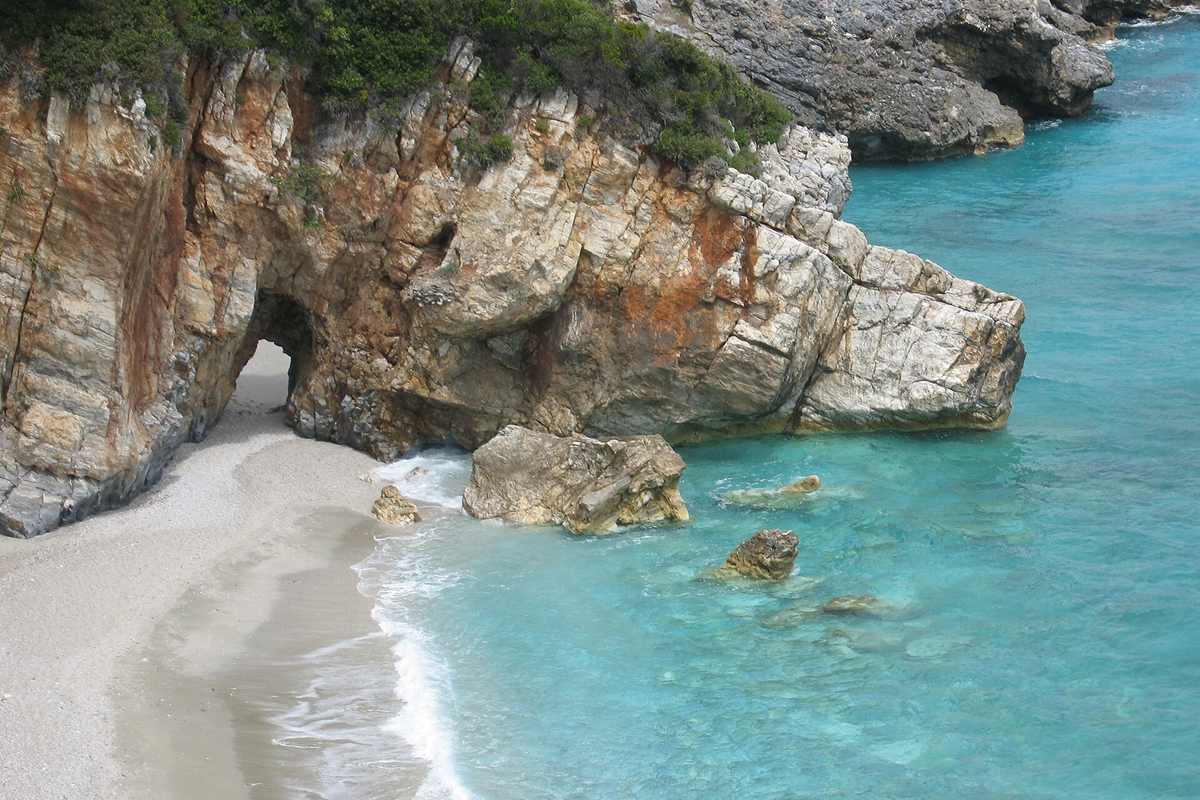
Pelion tours are trips through Mount Pelion and the Volos coast in Magnesia, a unit of Thessaly. The forested range shuts in the Pagasetic Gulf, and its story runs from Neolithic farmers to Ottoman times. Topics include Sesklo, Dimini, ancient Demetrias and Pagasae, and the ship Argo. Agria, Argalasti, the Archaeological Museum of Volos and the Magnetes follow. Wider trips appear under Greece small group tours and the classical Greece tour. The full list of regions sits under Greece tours.
Bookings made through the GetYourGuide widgets on this page earn Classical Greece Tours a commission, at no extra cost to the traveller.
What are Pelion tours?
Pelion tours are trips through Mount Pelion, a range in the Magnesia unit of Thessaly. The range shuts in the Pagasetic Gulf to the east and south. Magnesia has Volos as its capital and hosts two million tourists each year.
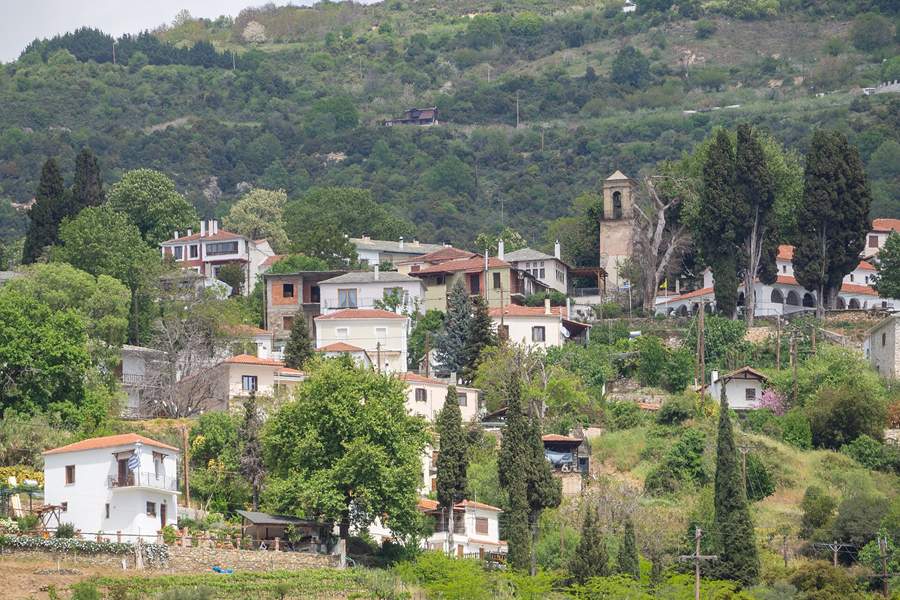
Only a narrow channel near Trikeri is left open between the gulf and the sea beyond. Waters that run off Pelion shape three rivers: the Anavros, the Platanorema and the Xirias. Greek regions divide into smaller districts called regional units. Thessaly is the region, and Magnesia is the unit where Pelion tours take place.
In a Pelian house, the middle floor held the common rooms for social life. The top floor kept the private rooms, which were the bedrooms. Air moved freely through that top level, so the house stayed cool in summer. Magnesia, the unit of Pelion tours, has churches, monasteries and chapels in a style called Pelioritica.
Greek myth makes Pelion the home of the centaur Chiron, a tutor of heroes. His pupils included Jason, Achilles, Theseus and Heracles. A centaur is a creature of myth, half human and half horse. The goddess Eris, kept out of a wedding party on the mountain, brought a golden apple. The apple carried the words To the Fairest.
- Shakespeare: The Merry Wives of Windsor names Mount Pelion in Act II, scene i.
- Melville: Herman Melville used mythological images of Pelion in Book XXV of Pierre.
- Flamouriou: Osios Simeon built the Flamouriou Monastery near Veneto in the 16th century.
Pelion monasteries include Saint Gerasimos in Makrinitsa and the Holy Archangels in Agios Georgios Nilias. Saint John the Baptist is in Siki, and Saint Spiridon is in Promiri. Computers and the Internet reached the land of Pelion tours in the late 1990s.
Why does Sesklo matter for Pelion tours?
Pelion tours belong to the Magnesia area, where the village of Sesklo lies near Volos. The prehistoric settlement there lends its name to Europe’s earliest known Neolithic culture. The word Neolithic refers to the New Stone Age, when farming first took hold.
Sesklo, a landmark of Pelion tours country, was found in the 19th century. Christos Tsountas, a Greek archaeologist, led the first digs. The oldest fragments push the culture back to about 7510 BC. Scholars call those early layers proto-Sesklo and pre-Sesklo. At its height, around 5000 BC, the settlement spread over about 20 hectares.
In the Pelion tours area, Sesklo held about 500 to 800 houses. Estimates put its population as high as 5,000 people. Its people set their villages on hillsides beside fertile valleys and grew wheat and barley. In the later period, every home had adobe walls on stone foundations. Adobe is mud brick dried in the sun.
Potters at Sesklo made fine-glazed earthenware and painted it with red or brown geometric symbols. Earthenware is pottery fired at a low heat. Toward the end of the culture, the painted decoration turned to flame motifs. Shallow, slightly open bowls are a mark of Sesklo pottery in the Pelion tours region.
- Herds: Sesklo farmers kept herds made up mainly of sheep and goats.
- Two levels: Digs at Sesklo found the first houses with two levels.
- Statuettes: Statuettes of women, a number of them pregnant, are abundant in this culture.
The archaeologist Marija Gimbutas noted a gorgon mask of the Sesklo culture from around 6000 BC. A gorgon was a monster of Greek myth with a fearsome face. Research links Sesklo to the Karanovo and Körös cultures, which seem to have grown from it.
Which finds tie Dimini to Pelion tours?
Pelion tours share their home region of Magnesia with Dimini, a village near Volos. No place in the Volos area lies further west than Dimini. Its ground holds two settlements, one Neolithic and one Mycenaean. Mycenaean describes the Greek world of the late Bronze Age.
Christos Tsountas and Valerios Stais carried out the first digs at the Neolithic settlement. In 1886, Lolling and Wolters dug out a Mycenaean tholos tomb in the Pelion tours area, called Lamiospito. A tholos is a round stone tomb with a domed roof. George Chourmouziadis took up the work at the Neolithic site again in 1977.
Scholars believe the palace of ancient Iolcos lay in what is now Dimini. V. Adrimi-Sismani began work on the Mycenaean settlement in 1980. In 2001, digs there uncovered a Mycenaean palace. Finds include a stone weight and a broken piece of pottery with Linear B writing. Linear B is an early Greek script.
Dimini culture of the Pelion tours area is known for vessels painted with abstract designs. Abstract here means patterns rather than pictures of people or things. Dimini ware marks the later Neolithic period in eastern Thessaly. Traded and copied beyond the region, Dimini ware has turned up at Cakran in Albania.
- Discovery: In the Pelion tours area, the Neolithic site at Dimini came to light late in the 19th century.
- Aisonia: Dimini’s old municipality, Aisonia, bears a name that dates back to ancient times.
- Side by side: Lyritzis concluded that the Sesklo and Dimini peoples existed side by side for a period.
The invasion theory holds that Dimini people conquered Sesklo by force around 5000 BC. Lyritzis and Galloway compared pottery from both sites with thermoluminescence, a way to date fired clay. By these results, the first people reached Dimini near 4800 BC, while Sesklo lasted until about 4400 BC.
How does ancient Demetrias fit into Pelion tours?
Pelion tours take place near the site of Demetrias, an ancient Greek city in Magnesia, Thessaly. It stood at the inner end of the Pagasaean Gulf, close to modern Volos. Demetrius Poliorcetes founded the city in 294 BC. Poliorcetes is a Greek nickname meaning the Besieger.
Demetrias soon grew into an important place on the Pelion tours coast. The Macedonian kings made it their favourite residence. In 196 BC the Romans took the city and placed a garrison in it. A garrison means troops posted to hold a town. Four years later, the Aetolian League seized it in a surprise attack.
Under Rome it lost importance but served as capital of the Magnesian League. The Basilica of Damokratia stood in its northern port. The Cemetery Basilica stood south of the city, outside the walls. A basilica is a large hall church. Under Constantine the Great, Demetrias became an episcopal see, a town with its own bishop.
In the Pelion tours region, the ruins lie at Aivaliotika, about 3 km south of Volos. About 11 km of the city walls survive. The acropolis, a fortified high town, held the highest point to the north-west. Digs also uncovered the theatre, an aqueduct and the sacred agora, or public square, with a temple.
- Heroon: The Heroon, a temple above the theatre, was among the buildings uncovered.
- Anaktoron: The Anaktoron, or royal palace, stood on a hilltop to the east of the city.
- Roman cemetery: The palace was in use until the mid-second century BC and later became a Roman cemetery.
In the 1270s, the Byzantines beat the Venetians and the Lombard barons of Euboea at Demetrias. From 1333 on, people began to leave the town for neighbouring Volos. The Ottoman Empire finally captured Demetrias, on the edge of Pelion tours country, in 1393.
What story does Pagasae add to Pelion tours?
Pelion tours and the old town of Pagasae share one region, Magnesia in ancient Thessaly. Pagasae was a town and a polis, a Greek word for a city-state. Its site is now a suburb of Volos, where the bay reaches its northern tip.
One group of ancient writers linked the name to the building of the Argo at the spot. Others traced the name to the plentiful springs found there. Apollonius of Rhodes describes this setting on the Pelion tours coast in the first book of his Argonautica. The Argonautica is an epic poem about Jason and his crew.
Philip II of Macedon conquered Pagasae after the defeat of Onomarchus. Diodorus spells the place Pagai in his account. When Demetrias was founded, the people of Pagasae were moved to the new city. After the Roman conquest, Pagasae on the Pelion tours shore was rebuilt and again became an important place.
In the time of Strabo, Pagasae served as the port of Pherae. Pherae was then the main city in that part of Thessaly. Pagasae lay 90 stadia from Pherae and 20 from Iolcos. One stadion, plural stadia, was a Greek measure of distance. Strabo was a Greek writer on geography.
- Acropolis: Above Cape Angkistri, on the Pelion tours coast, rocky heights carried the town’s acropolis.
- Springs: The springs taste rather salty, so Roman builders brought water from afar by aqueduct, a raised water channel.
- Site: Nees Pagasees, a modern village within the Volos municipality, holds the accepted site.
In the 19th century, ruins of the old city stood in plain sight near Volos. Volos also gives the bay its modern name. The latest digs point to ruins at nearby Soros as a possible Pagasae. Soros, like Nees Pagasees, sits inside the municipality of Volos.
How is the ship Argo linked to Pelion tours?
Pelion tours carry the name of the Thessaly mountain where Greek myth built the Argo. The Argo was the ship of Jason and his crew, the Argonauts. The ship sailed from Iolcos to Colchis in the quest for the Golden Fleece.
Euripides, in his play Medea, says the oars came from pine trees around Mount Pelion. Catullus later wrote that the boat was made of fir-wood. Catullus also called the Argo the earliest ship ever to sail the sea. The Golden Fleece was the wool of a golden ram in Greek myth.
In the Pelion tours region, myth says Argus planned or made the vessel with help from Athena. The ship was meant for the open sea and had a sail for speed. Apollodorus gave it fifty oars, each one worked by an Argonaut. That account makes it an early form of the penteconter, a fifty-oared ship.
Among the legends of the Pelion tours region, the usual account names the ship after Argus, its builder. Diodorus Siculus records a view that the name came from an old Greek word for swift. Cicero, the Roman orator, linked it to the Argives, a people name that Homer used widely. Orator means a public speaker of skill.
- Hera: The goddess Hera gave the crew of the Argo her special protection.
- Nereids: The Nereids, sea nymphs of Greek myth, were said to love the ship.
- Pagasae: The Roman poet Propertius wrote that the Argo left from Pagasae, a port of the Pelion tours coast.
After the voyage, the ship was retired and given to Poseidon, the ruler of the seas. At one stage, the crew had to carry the Argo over land for 12 days. The ship also held stores for the whole crew, such as vases of water.
What makes Agria part of Pelion tours?
Pelion tours unfold on the peninsula that holds Agria, a harbour town about 7 km from Volos. Agria used to be a separate municipality in Magnesia, Thessaly. Under the 2011 local reform, Agria became a unit within Volos municipality.
Opinions differ on the name of this Pelion tours town. One view links it to wild olive trees, called agrielies in Greek. Another points to a small plant named agriada. Patroklos Palamidas, a scholar from nearby Lechonia, traced the name to an ancient temple of Agrea Dimitra. Dimitra is the Greek form of Demeter, the goddess of grain.
Under Ottoman rule, the Pelion tours area around Agria held a caravan hostel and a toll station. Houses went up in the early 19th century, before the Revolution of 1821. The community dates from 1912, which makes the town fairly new. Between 1809 and 1860, local firms sent crafts and copper to Western Europe, Romania and Russia.
In 1920, an English trade paper called Agria the largest port in the world for olives and oil. About 200 tons of table olives leave Agria each year. In 1922, Agria gave shelter to refugees from Asia Minor, chiefly people from Eastern Thrace. Asia Minor refers to the Asian side of modern Turkey.
- Cement: A cement plant founded in 1911 occupies a natural harbour at Agria.
- Rock chapels: Panaghia Tripa, Panaghia Goritsa and Timios Stavros are chapels set within the rocks.
- Summer art: At the end of July, the town holds shows of folk art and local dances.
In midsummer, at a new moon, Agria on the Pelion tours coast honours its fishermen. The night is called psaradiki vradia, Greek for the fishermen’s evening. Fresh kakavia, a traditional fish soup, is served. Agria counts the composer Vangelis among its notable people.
Why is Argalasti a key name for Pelion tours?
Pelion tours run through Magnesia, home to Argalasti, a village and former municipality. Its municipal unit covers 74.820 square kilometres. Greece keeps each former municipality on as a district, called a municipal unit, inside a larger one.
In the Pelion tours region, Argalasti is known for buildings of architectural interest. The walls of village buildings hold fragments taken from ancient and medieval structures. Medieval describes the Middle Ages, the era between ancient and modern times. The monastery of Saint Nicolas looks out over the town.
The municipal unit holds three communities: Argalasti, Metochi and Xinovrysi. The Argalasti community takes in villages such as Kallithea, Myriovryti, Paou and Paltsi. Xinovrysi includes the village of Potistika. A community here is a local district of one or more villages. Lefokastro, a fishing village on the Pagasetic Gulf, also belongs to the Argalasti community.
Near Argalasti lie the Aegean Sea beaches of Potistika, Melani, Paltsi and Mikro. Afetes, in the Pelion tours area, lies 6 km north-west of Argalasti. It sits 2 km from the Pagasetic Gulf coast. Its name comes from Aphetae, the name of an ancient port. Lefokastro lies 8 km from Argalasti and 34 km from Volos.
- Fleet: Persian ships held the bay of Aphetae just ahead of the Battle of Artemisium, fought in 480 BC.
- Neighbours: The Afetes unit includes the communities of Kalamaki, Lampinou and Syki.
- Size: The Afetes municipal unit covers an area of 80.744 square kilometres.
The church tower of Sts. Apostles shows the architecture of the early 20th century. Sts. Apostles means the Holy Apostles, the first followers of Jesus. Since the 2011 reform, Afetes has been part of South Pelion, a municipality of the Pelion tours region.
Which finds make the Archaeological Museum of Volos matter for Pelion tours?
Pelion tours have a neighbour in the Athanasakeion, the Archaeological Museum of Volos. It holds finds from early 20th-century and modern digs across Thessaly. Built in 1909, it ranks among the oldest museums of Greece. Its home is a neoclassical building.
A neoclassical building copies the columns and lines of ancient Greek and Roman design. Alexios Athanassakis, a merchant from Portaria, paid for its construction. Once the work was complete, he handed it to the Greek State. Displays include jewellery, utensils and farm tools from Dimini and Sesklo, Neolithic sites of the Pelion tours area.
From the Geometric period come clay statuettes and a wide range of other items. The Geometric period takes its name from the patterns on its pottery. That age saw great heroic events, among them the Argonaut voyage and the Trojan War. The classical period adds statues and uncommon jointed statuettes. A jointed statuette has limbs that can move.
Rare Hellenistic steles with relief work keep their colours well in this museum of the Pelion tours region. A stele is an upright slab, made mainly of stone or marble. In ancient Greece, such slabs served almost like modern tombstones, in memory of the dead. Hellenistic refers to the Greek world after Alexander the Great.
- Whole tombs: Tombs were moved whole from their sites, along with the skeleton and the offerings around it.
- Houses: The museum grounds hold rebuilt Neolithic homes modelled on those at Sesklo and Dimini.
- Later art: Early Christian and Byzantine reliefs also form part of the displays.
One marble stele from Magnesia honours Aphrodeisia, daughter of Theudotos, and dates to between 276 and 168 BCE. She wears a blue-green chiton, a Greek tunic, and accepts jewellery. The stele is on display today in Volos, in the Pelion tours region.
Who were the Magnetes of the Pelion tours region?
Pelion tours are set in Magnesia, a land named after the Magnetes. The Magnetes were an ancient Greek tribe. In book 2 of the Iliad, Homer counts them in the Greek army that besieged Troy. He also names their homeland, Magnesia in Thessaly.
Ancient Magnesia, the land of Pelion tours, was a long and narrow strip. Mounts Ossa and Pelion formed its western edge, with the sea along its eastern side. It stretched south from the mouth of the River Peneius to the Pagasaean Gulf. In the end, ancient Thessaly absorbed the region.
In the Hesiodic Catalogue of Women, Deucalion’s daughter Thyia has two sons by Zeus, Magnes and Makedon. Hesiodic means linked to Hesiod, an early Greek poet. Magnes gave his name to the Magnetes, and Makedon to the Makedones. Magnes ruled the area and its people under his own name.
The Magnetes of the Pelion tours region took part in the Greek settlement of western Anatolia. In Ionia they set up two thriving cities. One was Magnesia on the Maeander, and the other Magnesia ad Sipylum. Their main colonies were set up before the 7th century BC. A colony was a new city founded by settlers from a home community.
- League: The Magnetes belonged to the Amphictyonic League, a union of neighbouring Greek peoples.
- Magnet: The English word magnet goes back to the Greek magnetes lithos, the stone of Magnesia.
- Elements: The names of magnesium and manganese also trace back to this region or its colony.
The Magnetes had already settled this Pelion tours district by Homeric times. The Iliad is Homer’s long epic poem about the war at Troy. Greek myth also names Magnesia as the homeland of the heroes Jason, Peleus and his son Achilles.
What does the old village of Pinakates bring to Pelion tours?
Pelion tours take place in Magnesia, where Pinakates is a mountain village in the municipal unit of Milies. Such a unit is one section of a wider local council area. The village stands on the southwestern slopes of the Pelion range.
Pinakates first appears in writing in the Modern Geography of Greece, printed in Vienna in 1791. Daniil Filippidis and Grigorios Konstantas wrote this book together. Geography is the study of lands, places and the people who live in them. For Pelion tours, that Vienna book gives the oldest written trace of Pinakates.
In 1828 Pinakates had 1,000 inhabitants. An inhabitant is a person whose home is in a place. By 1860 the count stood at 160 families with 800 residents. A family in this count means one household. Pelion tours take place in the region where Pinakates held those 800 people in 1860.
The production of wine and oil became the main industry of Pinakates. An industry is a branch of work that earns a living. Grapes give the juice from which wine is made. Oil is a thick liquid pressed from plants. Pelion tours take place on the mountain where this village built its trade on wine and oil.
- Distance: Pinakates lies 3 km west of Milies and 15 km east of Volos.
- Union: The village became part of Greece in 1881, when Thessaly was freed.
- Road: Until recently only one road reached Pinakates, and it ends in the village centre.
Pinakates counts among the best kept of the 24 villages on Pelion. It became a category 1 protected landmark. A protected landmark is a place kept safe because of its history. Pelion tours take place among those 24 villages of the mountain.
How does Neochori, a village in the pines, fit into Pelion tours?
Pelion tours are set on a peninsula in eastern Thessaly, where Neochori serves as both village and community. In Greece, a community is a local body that joins a village with its neighbouring settlements. The sea wraps round a peninsula on all sides but one.
People from the settlements around it built Neochori in the Middle Ages. The Middle Ages ran between ancient times and the modern age. The village sits within a vast pine forest, 480 metres above sea level. Pelion tours are set in that forested country, where Neochori stands high above the sea.
The village square has plane trees centuries old and a roofed fountain from 1807. A plane tree is a tall shade tree with broad leaves. Below the square stands the church of Agios Dimitrios, built in 1768. The Greek word agios means saint. Since 1768 this church has stood in the land of Pelion tours.
Inside stand an icon screen of carved wood and wall paintings by Pagonis, a painter from Epirus. An icon screen is a wall of holy pictures that stands before the altar. Epirus is a region in the northwest of Greece. Pelion tours share their region with this church and its wall paintings.
- Slate: Neochori is famed for slate, a layered stone, cut from its quarries.
- Produce: Typical local products of Neochori and its area are honey, apples and olives.
- Volos: Neochori stands about 35 km to the southeast of Volos.
Neochori, as its name says, is a new village. The name joins two Greek words: neo, meaning new, and chori, meaning place. Pelion tours are set on the peninsula where this village carries a name that means new place.
Which facts place Anilio within Pelion tours?
Pelion tours cover Magnesia, and Anilio lies in its eastern part. This village also forms a community within the Mouresi municipal unit. Its Greek name literally means without sun. A literal meaning is the plain, word-for-word sense of a name.
Anilio has an elevation of 296 metres and stands on the Pelion mountains’ eastern slope. Elevation measures how high a spot rises over sea level. Forest covers that slope, which is the tilted side of the range. Pelion tours are set on these mountains, and the village sits on their eastern face.
The village lies 2 km from the Aegean coast. This sea is the arm of the Mediterranean between Greece and Turkey. Anilio belongs to the Mouresi unit. That unit spreads over the eastern flank of the Pelion mountains, down to the Aegean shore. Pelion tours are set on a peninsula that meets this sea.
The Mouresi unit is divided into six communities, among them Anilio, Kissos, Tsagkarada and Xorychti. To divide an area means to split it into smaller parts. In Greek local government, a municipal unit sits inside a bigger municipality. Pelion tours are set in a district where Anilio stands as one of these six communities.
- Agios Dimitrios: Anilio lies 1.5 km northwest of the village of Agios Dimitrios.
- Makryrrachi: Anilio stands 1.5 km southeast of the village of Makryrrachi.
- Zagora: Anilio lies a distance of 4 km southeast of Zagora.
Anilio sits about 18 km to the east of Volos, Magnesia’s capital. A capital is the main town from which a region is run. Pelion tours are set in Magnesia, with Volos as its capital and Anilio 18 km to the east.
Who was Anthimos Gazis, and how does he connect with Pelion tours?
Pelion tours are trips through the home region of Anthimos Gazis, a Greek scholar, revolutionary and politician. A scholar is a person of deep learning. A revolutionary works for a sweeping change in who holds power. A politician takes part in public government.
In 1770 the boy entered the school of his home village. A monk named Anthimos Papapantazis taught him there. Monks are men bound by religious vows, who live apart from everyday life. A vow is a solemn and binding promise. Pelion tours are set in Magnesia, where this village school stood.
In 1774, at the request of his uncle, he became a deacon. A deacon is a member of the clergy below a priest. As a presbyter, he was sent to teach in the village of Vizitsa. A presbyter is an elder of the church who serves as a priest. Pelion tours recall that posting in Vizitsa.
In 1811 he founded Hermes o Logios, the first philological periodical in the Greek language. The title means Hermes the Scholar, and it was printed in Vienna. A periodical is a journal that comes out at regular times. Philological means concerned with language and written texts. Pelion tours are trips through the land of its founder.
- Birth: Gazis was born in Milies in 1758 under the name Anastasios Gazalis.
- Revolt: In 1821 he led the Greek insurgents, or armed rebels, in Magnesia.
- Poverty: He died poor, after giving the larger part of his savings to the army of Greece.
He represented Magnesia in National Assemblies. A national assembly is a gathering of chosen representatives. His will left the school he founded with Konstantas in Milies, and his library, to the Greek state. Pelion tours are trips through Magnesia, the region he spoke for.
Where does Lake Karla stand in relation to Pelion tours?
Pelion tours are set in Magnesia, a region of Thessaly. Lake Karla, in the plain of Thessaly, lies 60 to 80 metres above the sea. No other lake lies in that plain. A plain means broad and level country without hills.
The first name of the lake was Boibeis. It came from Boibe, an ancient city close by. Greek myth tells that the god Apollo took a wife on the shores of this lake. Myths are old tales of gods and heroes, handed down over time. Pelion tours are set beside a lake tied to a divine wedding.
Lake Karla once covered 180 square kilometres. In 1962 it was drained completely to win land for farming. Draining means letting the water run off. Before that, fishermen lived for about nine months of each year in reed huts on the water. Pelion tours are set close to a lake whose fishermen once lived in such huts.
Farming never succeeded in the salty soils of the old lake bed. So local people backed a plan to restore the lake. Soil is the top layer of the earth. A lake bed is the ground under the water of a lake. Pelion tours are set on the mountain that rises beside this lake.
- Setting: The lake lies at the northern end of Magnesia, next to Pelion and the Mavrovouni mountains.
- Kanalia: Kanalia, a town, stands on the eastern side of the lake.
- Restoration: The plan aimed to flood again only 50 of the original 180 square kilometres.
The lake was inaugurated in October 2018 and now holds more water than planned. To inaugurate means to open something with a formal event. Pelion tours are set beside Lake Karla, which has held water again since 2018.
How does Nea Anchialos add ancient history to Pelion tours?
Pelion tours share the Pagasetic Gulf with Nea Anchialos, a town on its shore. The town lies southwest of Volos and north of Almyros. Nea is the Greek word for new. In a gulf, the sea pushes far inland as a wide bay.
The modern town rises on the ruins of an ancient city called Pyrasos. Ruins are what remains when old buildings fall apart. In the Iliad, Homer includes Pyrasos in his list of ships. The Iliad is Homer’s long poem on the Trojan War. Pelion tours are set beside a gulf where Homer’s Pyrasos once stood.
Strabo described the layout of its land and called it well-harboured Pyrasos. Well-harboured means blessed with a good harbour. He placed the city 20 stadia from Phthiotic Thebes; a stadion was an ancient unit of length. A famous temple to Demeter and Kore stood at Pyrasos, so its harbour later became Demetrion. Pelion tours are set by the same gulf.
A dig on Magoula hill found that fishermen and farmers lived there from the earliest Neolithic period. That earliest stage dates to the 6th millennium BC. The Neolithic was the late Stone Age, when farming began. A millennium is one thousand years. Pelion tours share a gulf with this early home of fishermen.
- Statue: An arm from an oversized statue, found in 1965, was linked to Demeter.
- Fire: A great fire in the late 7th century AD destroyed the city.
- People: The municipal unit of Nea Anchialos had 5,881 inhabitants in 2021.
Greeks who left Anchialos, a town on the Black Sea, founded Nea Anchialos in 1906. The settlers named the new town after the home they had left. This town of 1906 shares its gulf with Pelion tours.
Why do Pelion tours recall the painter Giorgio de Chirico?
Pelion tours belong to Magnesia, whose city of Volos was the birthplace of Giorgio de Chirico. He was a Greek-Italian artist and writer. Greek-Italian means that his roots lay in both Greece and Italy. An artist creates works such as paintings.
Before the First World War, de Chirico founded an art movement, the scuola metafisica. The Italian name means metaphysical school. Metaphysics is the part of philosophy that asks what lies beyond the senses. The movement deeply shaped the surrealists, artists who painted scenes drawn from dreams. Pelion tours share a region with his place of birth.
His best-known works show Roman arcades, long shadows, mannequins and trains. Arcades are lines of arches, and a mannequin is a model of the human body. His imagery reflects the mythology of his birthplace. Imagery means the pictures and symbols that an artist uses. Pelion tours and that birthplace share one region.
De Chirico’s mother came from Genoa and held the noble title of baroness. Her Greek roots lay in Smyrna. His younger brother became a writer, painter and composer under the pen name Alberto Savinio. A pen name is a made-up name that an author uses. The elder brother was born in the region of Pelion tours.
- Birth: The painter was born on 10 July 1888, in the city of Volos.
- Training: From 1900 he studied drawing and painting at the Athens Polytechnic school.
- Centaur: His early painting The Dying Centaur, from 1909, shows the pull of the painter Böcklin.
After 1919 he turned critic of modern art and took up the study of traditional painting methods. A critic is someone who judges the worth of works of art. Pelion tours are set in Magnesia, home of Volos, the city of his birth.
Where does the guitarist Dimitris Fampas fit into Pelion tours?
Pelion tours are trips on Mount Pelion, home of Milina, a small village near Volos. Dimitris Fampas was born there. He was a Greek classical guitarist and also a composer. Composers write fresh pieces of music for others to play.
As a child, Fampas played traditional music on the lute and the mandolin. A lute is a stringed instrument with a rounded back. A mandolin is a small instrument of the lute family with paired strings. In 1939 he went to Athens for musical studies. Pelion tours are set near Volos, close to his home village.
In 1955 and 1956 a scholarship from the Italian government let him study guitar with Andrés Segovia. A scholarship is a grant of money that pays for a student’s learning. The lessons took place in Siena, a city in Italy. Pelion tours are set in the home region of this guitarist.
Fampas wrote more than two hundred guitar solos, studies and dances, adding to the guitar literature. Guitar literature is the whole body of music written for the instrument. A solo is a piece for one player alone. A study is a short piece that trains a player’s skill. Pelion tours are set on the mountain where this composer was born.
- Pupils: Students of Fampas won 38 prizes between them in international guitar competitions.
- Style: His guitar music is rich in Greek traditional elements, colours and rhythms.
- Pelion: His Greek Fiesta for 3 Guitars bears the subtitle A Fair of Pilion, another spelling of Pelion.
Fampas taught at the National Conservatory of Athens. There he trained players in the classical guitar. A conservatory is a college where students train in music. Pelion tours are set near Milina, the village where this teacher of the guitar was born.
What do travellers ask about Pelion tours, and what are the answers?
Pelion tours take place on a peninsula whose east coast holds the beach resort of Agios Ioannis. Lafkos was once the seat of a municipality. The saint Apostolos the New came from Agios Lavrentios, and Mouresi stands at 310 metres.
Before Pelion tours, what is Agios Ioannis on the east coast?
Agios Ioannis is a seaside village on the east coast of Pelion and a beach resort. Such a resort earns its living from holiday visitors. The village belongs to the community of Agios Dimitrios Piliou. Piliou means of Pelion in Greek. Agios Ioannis ranks among the popular beaches of Pelion.
Near Pelion tours, which old municipality had its seat in Lafkos?
Sipiada is a former municipality of Magnesia, and its name comes from the ancient city of Sepias. From 1999 to 2010 the municipality had its headquarters in Lafkos. Headquarters means the main office from which a body is run. The municipal unit of Sipiada had 1,687 people in 2021.
For Pelion tours, which saint was born in Agios Lavrentios?
Apostolos the New was born in Agios Lavrentios on Pelion in 1667. Agios Lavrentios means Saint Lawrence in Greek. In 1682 he moved to Istanbul and found work in a tavern. A tavern is a simple place that serves food and drink. The Eastern Orthodox Church honours him as a saint on 16 August.
Before Pelion tours, how high does the village of Mouresi sit?
The village of Mouresi lies 310 metres above sea level. Mouresi is also the name of a former municipality in Magnesia, a region of Thessaly. A former municipality is a council area that has since joined a larger one. The village stands 1.5 km northwest of Tsagkarada and 7 km southeast of Zagora.
Featured photo: Koomni, CC BY-SA 4.0, via Wikimedia Commons (File:ΜΥΛΟΠΟΤΑΜΟΣ ΣΤΟ ΠΗΛΕΙΟ.jpg).