
Greek coffee is a boiled, unfiltered coffee brewed in a briki, a little long-handled pot. It is drunk across Greece and Cyprus. Its story runs through roasting, hand grinders, small cups and the old Greek cups. Cup reading, the Ottoman coffeehouse, the kafeneio, the frappé and the freddo drinks belong to it as well. The wider national table sits in Greek food and Greece food tours. Trips with a host through the rest of Greece sit under Greece tours.
Bookings made through the GetYourGuide widgets on this page earn Classical Greece Tours a commission, at no extra cost to the traveller.
What is Greek coffee?
Greek coffee is prepared much like Turkish coffee. The main difference is that its beans are ground into a finer powder. Sugar also goes into the pot during the brewing process. The drink carries no other flavours and is served without milk as a rule.
The name Greek coffee grew more popular after the 1974 conflict in Cyprus. In Greek, Turkish coffee turned into Greek coffee through the swap of one word for another. The Arabic loan-word for coffee itself stayed unchanged, as Greek has no native equivalent. A loan-word is a term one language borrows from another.
The English word coffee comes from the Turkish kahve, which in turn came from the Arabic qahwah. The Arabic word had a second possible meaning: wine. During the 16th century, the habit of drinking coffee spread across the Islamic world. From the Hijaz, in western Arabia, it reached Cairo, and from there Syria and Istanbul.
When the coffee is poured, much of the fine powder goes into the cup with it. Part of it sinks to the bottom of the cup and stays there. A large share stays suspended in the liquid, so it is swallowed along with the coffee. Suspended means held as tiny solid bits through a liquid, without dissolving.
- Old method: This style is a very early way of making coffee, used in Greece, the Balkans and Russia.
- Coffee tree: The coffee tree was first farmed commercially in Yemen, after arriving from Ethiopian rainforests.
- Breakfast: A Greek-style breakfast or brunch can include Greek coffee, frappé and mountain tea, a herbal drink.
In a 1789 book on the Ottoman Empire, Ignatius d’Ohsson described the Turkish brewing method for French readers. His description closely resembles the present-day version, down to the foam. That same method is the one Greek coffee still follows today.
Which pot brews Greek coffee, and why is it called a briki?
Greek coffee is brewed in a briki, also written ibriki. This is the Greek name for the pot called a cezve in Turkish. A proper briki is made of thick forged copper. Its base is wider than its neck, and a lip helps with pouring.
In Cypriot Greek, the pot for Greek coffee goes by the name tzisves. The Turkish word cezve was borrowed from Arabic jadhwa, which means ember. An ember is a small glowing piece of coal or wood from a fire. The other name, ibrik, also came from Arabic. Its roots reach back to Old Persian words for water and pour.
Pots for Greek coffee are traditionally made of brass or copper, and more rarely of silver or gold. Newer pots also come in stainless steel, aluminium or ceramics. In Turkish, the word ibrik means a plain pitcher or ewer, not a coffee pot. An ewer is a large jug with a wide spout.
For Greek coffee, cold water and at least 7 grams of coffee per cup go in. Sugar is added too, if wanted. The tapering shape of the briki helps foam form and keeps in the aromas. Tapering means narrowing towards the top. Certain drinkers hold that the copper of the pot improves the taste.
- Sizes: A briki for Greek coffee comes in different sizes, each made for a set number of cups.
- Balkan form: In Bulgaria, Albania, Serbia and Slovenia, among others, the cezve is a long-necked coffee pot.
- Early import: The traveller Jean de Thévenot imported authentic ibriks from the Ottoman Empire.
An old method sets the filled pot in a pan of hot sand, heated over an open flame. The sand then takes full control of the heat. Its heat makes the coffee foam up to the top almost at once.
How are beans roasted for Greek coffee?
Greek coffee is ground so finely that its beans give up their flavour intensely. That makes the level of roasting matter a great deal. Medium or medium-dark beans give the best results, while light and dark roasts fall short.
Expert judges of Greek coffee roast green beans to a medium level, in small batches over steady heat. They use a shallow pan of wrought iron, a tough iron shaped by hammering. Stopping at the right moment is crucial. The beans then cool in a wooden box, where they soak up excess oil.
The kind of wood is said to affect the taste, and walnut is claimed to be the best. During roasting, a green bean swells to nearly double its size and changes in colour and density. It turns yellow, then a light cinnamon brown, then a rich dark brown. Oils also rise to its surface.
Coffee beans were already roasted on purpose in Yemen by the 15th century. In that century, the Ottoman Empire and Greater Persia used thin, round roasting pans of metal or porcelain. The pans were frequently pierced with holes. A long handle let the roaster hold such a pan over a brazier, a container of hot coals.
- Spoon: The beans in those early pans were stirred with a slender spoon.
- Cairo roaster: Around 1650, Cairo saw the first cylinder roaster, turned by a crank to keep beans moving.
- Home kitchen: Ordinary kitchen tools such as a frying pan, grill or oven can roast coffee.
In modern coffee drinking, Greek coffee can be bought ready roasted and ground. The old rituals and tools still act on the imagination. For example, the smell of roasting beans builds anticipation for the cup of Greek coffee to come.
How does a hand grinder prepare beans for Greek coffee?
Greek coffee needs grounds that are almost powdery, a fineness beyond the reach of standard burr grinders. Nearly every home model falls short, yet traditional Greek hand grinders are the exception. A burr grinder crushes beans between two hard, rough surfaces.
In a burr mill, the two grinding surfaces revolve, and the user sets the gap between them. A closer gap gives a finer, smaller grind, and a wider gap gives a coarser one. One source puts the ideal particle size for this coffee at 75 to 125 microns. A micron is one thousandth of a millimetre.
A manual burr grinder works by hand, with one grinding surface turning against the other. A handle gives leverage across the long run of turns needed for one cup. Leverage is the extra force a lever or handle provides. The first coffee grinder was made in 1799 by Richard Dearmann, a blacksmith from Birmingham.
Strict experts insist that the beans for this coffee be pounded by hand in a mortar. A mortar is a heavy bowl in which a pestle, a club-shaped tool, crushes food. A uniform fineness is hard to reach this way. A traditional brass mill with steel burrs is the more usual tool, though its particles come out drier.
- Mortar and pestle: Pounding beans this way can turn Greek coffee into a fine enough powder.
- Factory mills: Water-cooled roller grinders produce fine grinds such as those for Greek coffee and espresso.
- Freshness: Such a fine grind means the grounds go stale soon after they leave the mill.
For Greek coffee, the fineness of the powder matters. It affects both the foam and the feel of the drink in the mouth. Ground coffee loses freshness faster than whole roasted beans. Its larger surface area meets more oxygen from the air.
What size of cup holds Greek coffee?
Greek coffee is served in a small cup with a handle. In English, a little cup for serving espresso is called a demitasse, French for half cup. Such cups hold 60 to 90 millilitres, about half a standard coffee cup.
The cups stay small because espresso, a strong and concentrated coffee, is best served in small portions. Espresso is made by forcing hot water through finely ground beans under high pressure. Demitasse cups are ceramic as a rule and come with matching saucers. Certain coffeehouses and china makers also produce brightly decorated versions.
Another type sets a glass cup inside a metal holder, which in Turkey is called a zarf. A cup of demitasse size called a finjan is traditionally used for Turkish and Arabic coffee. In the past, coffee cups were also made of bone, clay and wood. Today, coffee cups can also be glazed ceramic, porcelain, plastic or glass.
The cup does not change the taste of Greek coffee as such. Experts still say it makes a difference. In their view, the best cups are porcelain with a thin rim, shaping the feel in the mouth. A long tradition values being served Greek coffee in fine cups that are family heirlooms.
- Spoon: A demitasse spoon is smaller than a teaspoon and stirs drinks in demitasse cups.
- Length: Such a spoon measures 3 to 5 inches, or 7.6 to 12.7 centimetres.
- Bowl: Its bowl is slimmer and shallower than that of a standard teaspoon, so it fits the cup.
Greek coffee always arrives with a glass of water beside the cup. At times, a small cookie comes with it as well. A cookie here means a small, plain biscuit. In formal dining, demitasse cups and spoons are traditionally brought out only after dinner.
When did porcelain ‘Greek cups’ reach Greece, the home of Greek coffee?
Greek coffee takes its name from Greece, which received large exports of porcelain ‘Greek cups’ in the 1730s. These were small bowls without handles, used for coffee in the 17th century. The very same cups also served for tea.
The original Greek cups were Chinese export porcelain or a Japanese equivalent. In Europe, locally made porcelain cups appeared around 1710. The cups stood tall, as drinkers sipped the top layer of liquid and left the sediment below. Sediment is the layer of grounds that settles, as in Greek coffee.
Handles first appeared on tall European cups in the 1710s. Certain cups from Asia already had handles, but those were made of silver. By the 1730s, handles had become common. Drip coffee, a French invention of the 18th century, later made tall cups unnecessary. Unlike Greek coffee, drip coffee leaves its grounds behind in a filter.
Formal coffee service began in the 16th century, when coffee reached the Ottoman Empire. Coffee service means the customs and dishes for making and serving coffee, Greek coffee included. European coffee service grew in the 17th and 18th centuries, among wealthy classes. Porcelain made in Europe from the early 18th century led to special coffee vessels.
- Middle East: Coffee cups, along with other coffee ware, first came from the Middle East.
- Full set: By the 18th century, a coffee service held cups, saucers, coffeepots, milk pots, sugar bowls and trays.
- Coffee can: In the trade, a coffee can is a small, straight-sided cup that comes with a matching saucer.
In the early 18th century, a single upright handle was added to a slightly taller Chinese-style bowl. The result was the Western coffee cup, together with its matching saucer. The saucer was at first deeper than the ones used today.
How are the grounds of Greek coffee read in kafemanteia?
Greek coffee, called ellinikos kafes in Greek, leaves grains that are used for fortune-telling once the drinker finishes. The Greek word for this coffee reading is kafemanteia. It joins kafes, meaning coffee, with manteia, a word for divination.
Tasseography is the wider name for this practice, beyond Greek coffee alone. It reads patterns in tea leaves, coffee grounds or the sediment of wine. The term joins the French tasse, meaning cup, with Greek endings for writing, divination and study. Divination means seeking hidden knowledge or the future through signs.
Different sources date the first coffee fortune-telling to the Ottoman palaces of the 1500s. Coffee reading relies on Arabic or Turkish coffee, because both leave a very thick sediment. The practice followed the trade routes of tea and coffee. Once the cup of Greek coffee is drunk, the sediment is left to settle.
The cup is then covered with its saucer and turned upside down. In the Turkish tradition, readers divide the cup into two horizontal halves. Symbols on the bottom half speak of the past, and those on the top half of the future. Certain readers believe the cup cannot see events more than forty days ahead.
- Yes or no: Read in vertical halves, the cup can also give yes or no answers.
- Saucer: Whether the saucer sticks to the cup can mark a good or bad outcome.
- Parlour game: Classic image meanings grew in Great Britain in the late 1800s, when cup reading became a parlour game.
In a cup of Greek coffee, the symbols that readers find can be objects or abstract ideas. Readers combine the symbols into one prediction and still note what each one means alone. An abstract idea is one with no physical form.
What went on in the Ottoman coffeehouse, early home of the Greek coffee style?
Greek coffee follows the Turkish style. That style remains the main way of brewing across much of the former Ottoman Empire. There, the coffeehouse, or kahvehane, began in the mid-sixteenth century. It gathered citizens for learning, social life and politics.
Kahvehane is the Ottoman Turkish word for coffeehouse. In time, these houses sold more than the coffee now known in Greece as Greek coffee. They added sweet drinks and sugary treats. There came to be one coffeehouse for every six or seven shops. By the end of the nineteenth century, Istanbul alone had nearly 2,500 of them.
Scholar John Houghton called such a place a penny university, since the learning there was almost free. Literate guests read the news aloud in public. Literate means able to read and write. This kept people unable to read informed. Shadow puppet shows and spoken stories also entertained the guests.
Before coffeehouses, a man’s life moved between work, the mosque and home. The coffeehouse became a Fourth Place, a neutral meeting ground. In Anatolian coffeehouses, guests removed their footwear, as they did at home. Anatolia is the large Asian part of modern Turkey. The front room of these houses looked like the living room of a home.
- No alcohol: Unlike English and French coffeehouses, Ottoman ones served neither alcohol nor meals.
- Music: One scholar, Risto Pekka Pennanen, sees Greek-language café music as a branch of Ottoman popular music.
- Greek word: The Greek coffee house, the kafenio, takes its name from the Turkish kahvehane.
By 1600, coffee and its houses were a key part of Ottoman life. Their traditional culture lasted until cafés arrived in the 20th century. Coffeehouses in the Eastern Mediterranean, home region of Greek coffee, were social hubs. They were also artistic and intellectual centres.
What is the kafeneio, where Greek coffee is the popular drink?
Greek coffee, or ellinikos kafes, is the popular drink of the kafeneio, the Greek coffee house. The word also appears as kafenio, cafenio or cafeneon, and its plural is kafenia. In the Greek language, ellinikos means Greek, while kafes means coffee.
The Greek word grew from the older form kafenes. Its roots go back to the Persian qahveh-khaneh. That name joins the Arabic qahve, meaning coffee, with the Persian khane, meaning house. Other Balkan languages borrowed the Turkish word for coffeehouse as kafana, kavane or kaveana. The Balkans are the peninsula of south-east Europe that includes Greece.
Old gentlemen used to meet in the kafeneio, in gatherings known as the schools of the wise. Whitewashed walls are a common sight in a kafenio. Whitewash is a white lime paint brushed onto walls. In past centuries, women were not welcome there, but today girls and women visit kafenia.
In 1991, Jane Cowan wrote an essay titled Going Out for Coffee?, on gendered pleasures in daily life. Gendered here means shaped by ideas about men and women. The essay appeared in Contested Identities, a book on gender and kinship in modern Greece. Kinship means ties of family and blood.
- Coffee culture: Greek coffee culture is both strong and widely present across the country.
- Other drinks: Besides Greek coffee and frappé, a kafenio also serves beer, retsina and ouzo.
- Village life: On islands and in villages, the kafenio works as a social centre.
In English, café names a spot selling coffee and snacks, and the word comes from French. The first French café is thought to date from 1660. Belgrade, then in Ottoman Serbia, is thought to have had Europe’s first café in 1522.
Which iced drink do Greeks drink more than Greek coffee?
Greek coffee is drunk less in Greece than the frappé, a strong, cold coffee made from instant coffee. The hot drink, Greek coffee, also goes by elliniko, meaning Greek. Frappés rank among the leading forms of coffee in both Greece and Cyprus.
Cold coffee drinks named café frappé are documented from the 19th century onwards. A number were close to slushies, and others were closer to iced coffee. A slushie is a drink of crushed, flavoured ice. In 2006, Nikos Bakounakis became the first to doubt the story of a 1957 invention.
In a 1951 film titled Above All, Stay Calm, one character mentions frappé coffee directly. The two leading characters prepare it with a shaker. The film starred Mimis Fotopoulos and Dinos Iliopoulos. Christos Lenzos owned a coffeehouse in Pangrati. He won recognition for his own self-made version of the drink.
Greek coffee is boiled in a pot, but a frappé is shaken. The shaking happens in a cocktail shaker or, more commonly today, an electric milk frother. Instant coffee, optional sugar and a little water are whipped until a thick foam forms. This foam is then poured over ice cubes and cold water in a glass.
- Foam: Frappé foam is a colloid, a fine mix of air bubbles, coffee solids and water.
- Shaker: Shaking by hand produces finer, longer-lasting and more stable bubbles on top.
- With milk: A frappé with milk can be called a frapógalo, meaning frappé-milk.
Among the young, frappés have become more popular than Greek coffee in the kafeteria. A kafeteria is a modern Greek café. Frappés have also become very popular in Cyprus and Romania. In Cyprus, they are at times made with milk instead of water.
How do freddo espresso and freddo cappuccino differ from hot Greek coffee?
Greek coffee is a hot, boiled brew. Yet iced drinks based on espresso have gained popularity in Greece in recent years. The freddo espresso is one. It is two shots of espresso, blended with ice cubes and then served over ice.
Freddo is the Italian word for cold. Within Greek coffee culture, the freddo espresso is widely seen as a higher quality frappé. Espresso itself originated in Italy and has become a leading brewing method worldwide. It comes in a small serving of 25 to 30 millilitres. A dark body sits under a paler foam called crema.
Among iced coffees in Greek coffee culture, only the frappé outranks the freddo cappuccino and freddo espresso. The freddo cappuccino is made the same way, then crowned with a layer of cold, frothed milk. Greeks call this foam afrógala, joining their words for foam and milk. Espresso also forms the base of cappuccino, caffè latte and americano.
The word espresso comes from the Italian verb esprimere, from the Latin exprimere, meaning to express. Here, to express means to press out. Italians call espresso simply caffè, as it is the ordinary coffee to order. Espresso works with a wide range of beans and roasts, despite a common myth about dark roasts.
- Caffè freddo: In Italy, caffè freddo is espresso chilled in a freezer until it turns to icy slush.
- Salento style: In Salento, in Apulia, fresh espresso is poured into a whiskey glass full of ice cubes.
- Coffee in ice: This Salento drink is called caffè in ghiaccio, which means coffee in ice.
Espresso holds a central place in coffee shop culture and in the third-wave coffee movement. Third-wave coffee is a movement that treats coffee as a craft, with high-quality beans. Greek coffee, by contrast, follows a very early boiled method.
What do travellers ask about Greek coffee, and what are the answers?
Greek coffee comes with cultural traditions that affect how much a guest enjoys it. Story-telling and fortune-telling, for example, add to the conviviality of the occasion. Conviviality means a friendly and lively mood shared by people together.
How did the drink now called Greek coffee reach Corfu?
Armenian settlers brought this coffee to Corfu when they made their home on the island. Corfu was never among the lands held by the Ottomans. Before the Armenians came, it therefore had no established Ottoman coffee culture. On Corfu, the drink is known as eastern coffee, because of its Eastern origin.
How has Greek coffee culture travelled beyond Greece?
In the 1950s, Greek and Italian immigrants gave Australia its first espresso machines. London’s earliest coffeehouse opened in 1652. Its founder, Pasqua Rosée, is described as Greek, Armenian or Turkish. Tourists and immigrants have also helped the frappé spread beyond Greece. Immigrants are people who make a new home in a foreign land.
How is the froth on Greek coffee made?
The moment the mixture starts to froth, it is lifted off the heat. It then returns briefly to the boil twice more, which builds up the froth, before serving. A well-made cup carries as thick a layer of froth as possible on top. Froth means a mass of small bubbles on a liquid.
Which Balkan neighbours brew a cup close to Greek coffee?
In Bosnia and Herzegovina, it is called Bosnian coffee and made slightly differently. Once the water boils, a small amount is kept back. The coffee and that water then go into the pot and boil again. In Serbia, North Macedonia and Croatia, it is called Turkish coffee, domestic coffee or simply coffee.
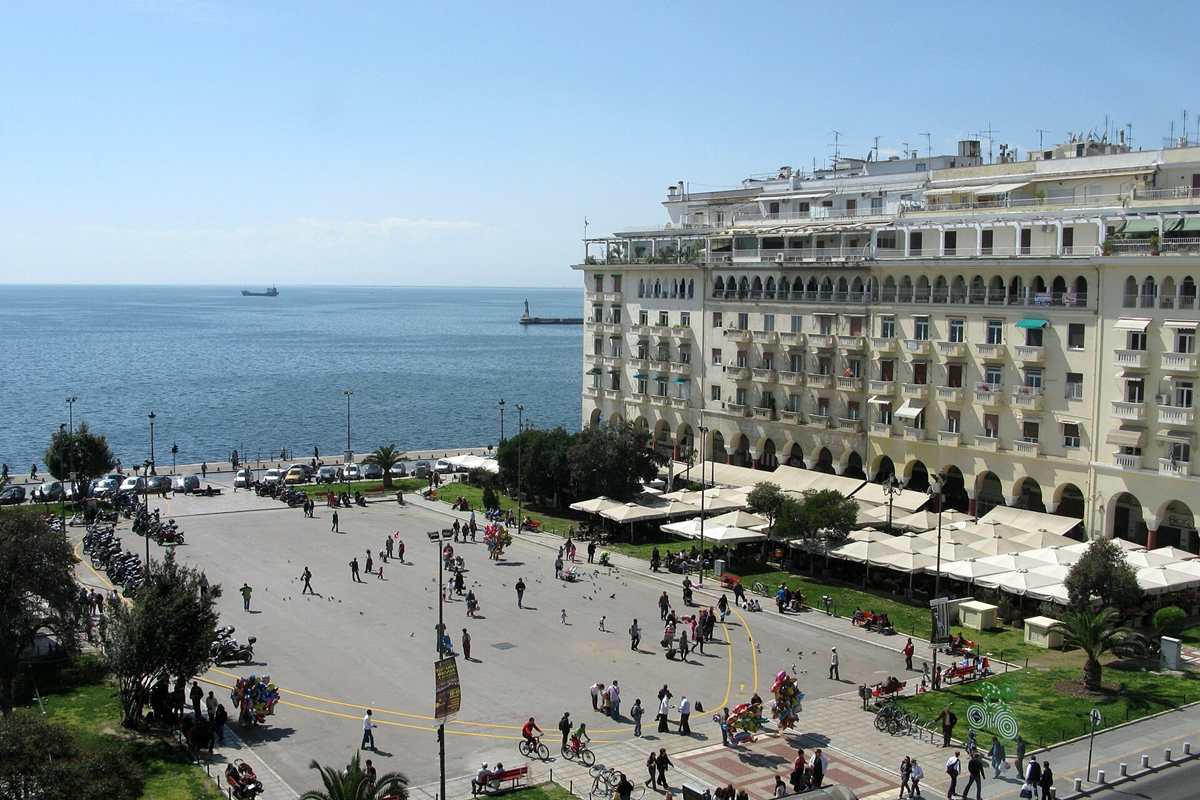
Featured photo: Tilemahos Efthimiadis, CC BY-SA 2.0, via Wikimedia Commons (File:Aristotle Square, Thessaloniki, Greece.jpg).