
Greek festivals are named feasts, carnivals, games and arts events held across mainland Greece and its islands. Small-group trips with a host travel through these same regions. Topics run from the Patras Carnival and the Anthesteria to Saint Spyridon on Corfu and the Lenaia. The Delphic Festival of 1927, the Isthmian Games, the Heraea, a Thessaloniki film festival and the Carneia follow. Rites and seasons continue under Greek Easter traditions, the best time to visit Greece and the Epidaurus tour. Further outings appear under Greece tours.
Bookings made through the GetYourGuide widgets on this page earn Classical Greece Tours a commission, at no extra cost to the traveller.
What are Greek festivals?
Greek festivals are named feasts, carnivals and cultural events held across Greece, from ancient rites to modern fairs. A festival is an event that a community celebrates, centred on its religion, traditions or cultures. Societies in ancient Greece and Rome leaned heavily on such events.
English took the word festival from Latin by way of Old French. From the late fourteenth century, it served as an adjective. In Middle English, a “festival dai” meant a religious holiday. Heortology is the study of religious festivals. It once dealt only with Christian feasts but now covers all faiths, especially ancient Greek festivals.
Classical Athens held Greek festivals for a long list of gods and heroes. Its feasts honoured Athena, Apollo, Artemis, Dionysus, Demeter and Persephone, along with Hermes and Heracles. Other Athenian festivals rested on family, citizenship, sacrifice and women. One Athenian feast, the Boedromia, honoured Apollo Boedromios, a title meaning the helper in distress.
The Athenian Hermaea were loud, unruly contests for ephebes, the young men of the city. Solon tried to keep grown men away from them. The Adonia was run by women and attended by women alone. For this feast, women planted gardens of Adonis in broken pots. They then carried the pots up to the rooftops.
- Heracleia: Athenians marked the death of Heracles at the Kynosarges gymnasium outside the city walls.
- Skira: Its procession moved under a canopy called the skiron, from Athens to Skiron near Eleusis.
- Shared food: A festival in general ends with specially prepared food, which shows its link to feasting.
Greek festivals were not limited to Athens. The Hermaea, yearly feasts for Hermes, stood out at Pheneos, at the foot of Mount Cyllene in Arcadia. As a rule, they took place in gymnasia and palaestrae, the training grounds of athletes.
Why is the Patras Carnival the largest of its kind among Greek festivals?
Greek festivals of the carnival type reach their largest scale in Patras. Known locally as Patrino karnavali, the Patras Carnival is the biggest event of its kind in Greece. It was first held in 1829. Lent is the fasting season before Easter.
Among Greek festivals, this one keeps a fixed opening on 17 January, the day of Saint Anthony. Its events last up to Clean Monday. The start date stays the same whenever the Triodion falls. The Triodion is the three-week period before the first Sunday of Lent. On opening day, a satirical message from a town crier marks it.
The mayor declares the carnival open from the Apollon theatre, speaking from its first-floor balcony. The opening programme stays secret until the last moment, so each ceremony holds a surprise. The weeks that follow bring balls, parades, a hidden treasure hunt and a carnival for children. Spontaneity, improvisation, inspiration and volunteer work mark the whole season.
Carnival groups are made of friends, colleagues, neighbours or long-standing carnival companions. Each group carries a name and a costume theme. A group holds between 50 and 300 people, and at times more. In the treasure hunt of these Greek festivals, groups tackle quiz questions in history, mathematics and philosophy. They also follow hidden clues around the town.
- Night parade: The Saturday evening parade on foot is called the Nihterini Podarati, or Night Parade.
- Grand Parade: Satirical floats built by the municipality lead it on the Sunday before Clean Monday.
- Crowds: In 2019, about 750,000 people took part across the carnival’s events.
These Greek festivals end by setting the Carnival King on fire at the St. Nikolaos Street pier. That closing ceremony at the port on Sunday night adds concerts, dances and countless fireworks. It is also broadcast on television.
Which wine and flower rites did the Anthesteria add to ancient Greek festivals?
Greek festivals in ancient Athens included four feasts for Dionysus, and the Anthesteria was one of them. Scholars link its name with anthos, the Greek word for flower. That word has also been read as the bloom of the grape vine.
Among Greek festivals in Athens, this one began on the 11th of Anthesterion and closed on the 13th. That month fell near a full moon in January or February. Its three days carried the names Pithoigia, Choes and Chytroi. During the feast, social order was paused or turned upside down. Slaves were allowed to join in.
On Pithoigia, the jar-opening day, spring flowers decorated the rooms of each house. They also adorned the drinking vessels and every child over three years old. Athenians believed that the souls of the dead walked abroad on these days. To guard against evil, people chewed hawthorn or buckthorn leaves. They also smeared their doors with tar.
Choes, meaning the pouring, was the second day. Drinking clubs held contests in silence to see who drained a cup fastest. Greek festivals at Athens also held state rites, and Choes brought a secret one. The basilinna, the ritual queen of the city, was married to Dionysus. Fourteen matrons called gerarai, all sworn to secrecy, assisted her.
- Chytroi: Fruit or cooked pulse went to Hermes Chthonios, an underworld figure, and to the dead.
- Keres: A proverb sent the Keres, or spirits, out of doors once the Anthesteria was over.
- Casting: A rehearsal on the last day chose the players for the coming drama festival.
Classical Athenians knew the feast was of great antiquity. Among Greek festivals, it was kept by Athens and all the Ionian cities. Scholars therefore date it before the Ionian migration. That migration came late in the eleventh century BC or early in the tenth.
How do Greek festivals on Corfu honour Saint Spyridon?
Greek festivals on Corfu include feasts for Saint Spyridon, who guards the island as its patron saint. Locals call him the Keeper of the City. The title recalls a miracle in which, by tradition, he drove the plague out of Corfu.
The faithful also credit Spyridon with saving the island during the 1716 siege of Corfu. Venice then added a yearly Litany of St. Spyridon, on 11 August, to the island’s Greek festivals. A litany is a solemn church procession with prayers. The composer Vivaldi was commissioned to write an oratorio, Juditha triumphans, in honour of the victory.
In the Eastern church, his feast day falls on 12 December and on Cheesefare Saturday. Cheesefare Saturday is the Saturday before Great Lent. Among Greek festivals on the island, the relics also leave the church every Palm Sunday. They are carried in procession for veneration. Every philharmonic, or town music society, of Corfu takes part.
The relics reached Corfu once Constantinople fell in 1453. A Corfiot monk named Kalohairetis brought them, and they still lie in Saint Spyridon Church. Earlier, in the 650s, the body was moved from Cyprus to Constantinople. It was found incorrupt, meaning it had not decayed, and it held a sprig of basil.
- Potters: Spyridon also stands as the patron saint of potters, who shape clay into vessels.
- Piraeus: The port of Piraeus also counts Spyridon as its patron saint and honours him every year.
- Right arm: The relic of his right arm returned to Corfu from Rome in 1986.
The plague miracle linked to Greek festivals for Spyridon also left a mark in stone. The faithful believe the plague scratched a stone as it left. The stone sits in the walls of the old citadel, the Palaio Frourio. That scratch is still shown to visitors.
Where did the Lenaia stand among the Greek festivals of drama in Athens?
Greek festivals in ancient Athens included the Lenaia, a yearly feast with a dramatic competition at its heart. Athens and Ionia counted it among their lesser Greek festivals. It fell in the month of Gamelion, which roughly matched January on today’s calendar.
Scholars trace the name Lenaia to lenos, meaning wine-press, or to lenai, another name for the Maenads. The Maenads were the female followers of Dionysus. The feast fell when vines were pruned, not at the grape harvest. The Archon basileus and the epimeletai, both religious officials, led its procession.
The Lenaia first took place in the Lenaion. Its site is unclear, either part of the Agora or a theatre beyond the city. Later, its plays were staged in the Theatre of Dionysus. The audience was local, since sea travel at that season was thought unsafe. Metics, foreign residents, joined in as choregoi, or chorus sponsors.
Around 442 BC, comic contests became an official part of the Lenaia. For a time, its competition covered comedy alone. A contest for tragedy was then added in 432 BC. Among Greek festivals, it hosted the first staging of Knights and other plays by Aristophanes. Dithyrambs, choral hymns for Dionysus, were included in the third century BC.
- Comedies: Five comedies competed as a rule, but only three during the Peloponnesian War.
- Tragedies: Two tragic poets entered the contest, and each presented two plays.
- Vases: Ancient vases show the Lenaia with Maenad scenes and wine-mixing rites.
The date when the Lenaia was abandoned is unknown. Contests of one form or another carried on into the second century BC. Greek festivals of drama in Athens also included the City Dionysia. It came later in the year and staged plays as well.
Which events filled the First Delphic Festival, a modern chapter of Greek festivals?
Greek festivals gained a modern chapter at Delphi in 1927, led by the couple Angelos and Eva Sikelianos. Their First Delphic Festival staged a chain of events across the archaeological site. That site keeps the remains of ancient Delphi and its sanctuary.
The couple chose Delphi as the home of their Greek festivals. The reason was the Amphictyony, an ancient league of states based there for centuries. The first day began with a tour of the ruins and the Museum of Delphi. Villagers then played traditional songs known as kleftika during a meal.
A signal from the top of the Phaedriades called the visitors to the ancient theatre. A choir and orchestra opened these Greek festivals with the hymn to Apollo. Angelos Sikelianos spoke on the aims of the Delphic Organization, past and present. The day ended with a dinner. Boat visitors were escorted down to their ships at Itea.
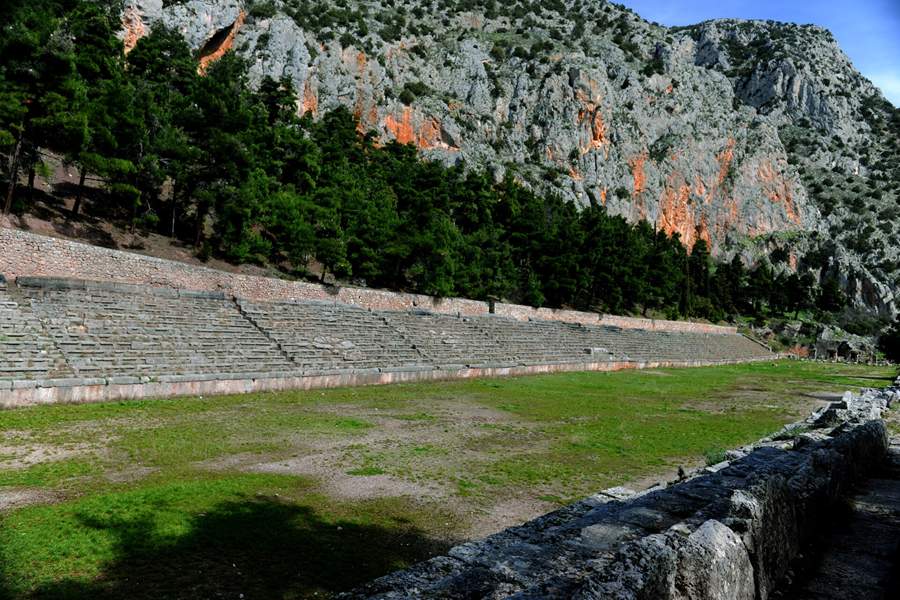
The second morning brought a visit to the Delphi Artisan Fair. There, Eva Sikelianos spoke about folk art and the value of work on the loom. The archaeologist Wilhelm Dörpfeld then gave a talk in German on the Ancient Theatre. In the ancient stadium, students practised the pentathlon beside teams from Thessaloniki and Desfina.
- War dance: Dancers in armour performed the ancient Pyrrhichios to music by Constantine Psachos.
- Torch relay: Athletes carried torches along the Sacred Way to light the path down towards Itea.
- Mime: Two Greek performers living in the United States mimed the battle of Apollo and Python.
These Greek festivals rested on an ideal of solidarity and mutual respect among people across the world. The second day ended with Byzantine choir music in the Ancient Theatre. Byzantine music is the sacred chant of the Orthodox Church.
How did the Isthmian Games join sport and music in Greek festivals?
Greek festivals of sport and song included the Isthmian Games, named after the Isthmus of Corinth. They were held there, on the thin strip of land that links the Peloponnese with Central Greece. Athletic and musical contests honoured Poseidon at his rural sanctuary.
They fell one year before and one year after each Olympic Games. The writer Solinus placed their founding in the 49th Olympiad, a four-year Olympic cycle. Modern reference works accept 582 BC as the first date. A later myth credited Theseus, the legendary king of Athens, with opening the games to all Greeks.
Among Greek festivals, the Isthmia was easy to reach by land and by sea. That made it a natural meeting place. The games were open to all Greeks, and Athenians were especially fond of them. The Eleans, the people of Elis, boycotted them. By tradition, Theseus had won Athenian visitors the honour of front seats, called prohedria.
At least until the time of Pindar, in the fifth century BC, winners received a wreath of celery. Later, the wreath was made of pine and called the Isthmian pine. Victors were also honoured with a statue or an ode, a poem of praise. Women were allowed into the musical and poetical contests of these Greek festivals.
- Triple win: Kleitomachos of Thebes took wrestling, boxing and pankration, an all-in fight, on a single day.
- A philosopher: Plato is said to have entered the wrestling contest at the games.
- Truce: Before the games, Corinth called a truce, giving athletes safe passage across Greece.
Greek festivals on the Isthmus kept going through war. In 412 BC, Athens and Corinth were at war, yet Athens still got its usual invitation. When Corinth was destroyed in 146 BC, the games went on under the control of Sicyon.
What makes the Thessaloniki Documentary Festival stand out among modern Greek festivals?
Greek festivals of film include the Thessaloniki Documentary Festival, an international event for documentaries held in Thessaloniki. A documentary is a film about real people and events. The festival centres on independent documentary film and on new documentary makers from around the world.
Dimitri Eipides added this event to Greek festivals of film in 1999 and led it until 2016. An honorary committee of noted film makers backed its first edition. Its members included Chantal Ackerman, Frederick Wiseman, Robert Kramer and Alexandr Sokurov. Local crowds and press coverage helped its launch. In 2005, the festival recorded 22,000 admissions.
Since 2018, it has been one of 28 events on a qualifying list of the American film Academy. Its Golden Alexander award goes to the best documentary in the International Competition. That winner is automatically eligible to seek an Oscar for documentary feature. A competition section for Virtual Reality films was added in the same year.
The festival uses the historic Olympion theatre on Aristotelous Square, in the centre of Thessaloniki. It also fills four theatres inside two restored warehouses at the city port, plus cinemas across the city. Its yearly audience reaches up to 85,000 people. Among Greek festivals of cinema, it ranks with the leading documentary events of the world.
- Fixed sections: The main programme returns each year with stories to tell, views of the world, memory and portraits.
- Awards: Main programme films compete for the FIPRESCI prize, given by film critics, and the Audience Awards.
- Online edition: In 2020, the 22nd edition moved online for the first time because of the pandemic.
Among Greek festivals, this one has drawn documentary makers such as Barbara Kopple, Kim Longinotto and Nicolas Philibert. The actor Juliette Binoche has attended as well. Each year, the festival also honours acclaimed film makers and documentary movements with tributes.
How did the Heraean Games bring girls into Greek festivals at Olympia?
Greek festivals at Olympia included the Heraea, or Heraean Games, a footrace in which young girls competed. The race took place every four years at the same site as the Olympic Games. Its prizes and rites honoured the goddess Hera.
Nobody knows the start date of these Greek festivals. The main written source is the Description of Greece by Pausanias. He calls the games archaia, a Greek word for old. Pausanias also tells a founding myth. In it, Hippodamia held the first games to celebrate her marriage to Pelops. She chose sixteen women to compete.
A second story by Pausanias dates to around 580 BC. Elis and Pisa were then in a dispute. To settle it, the people of Elis picked sixteen wise elderly women, one from each city. From then on, these Greek festivals were in their hands. They also wove a peplos, a long robe, for Hera and arranged choral dances.
The only event was the stadion, a sprint one sixth shorter than the men’s race. Only parthenoi, or unmarried young women, took part. They raced in three age groups, though their exact ages are unknown. Each runner wore a short chiton, a tunic cut above the knee, with the right shoulder bare. Their hair hung loose.
- Prizes: Each winner gained an olive-leaf crown and a portion of the cow offered to Hera.
- Statues: Victors were allowed to dedicate statues to Hera with their names carved on them.
- A statuette: A Laconian statuette of about 560 BC, now in the British Museum, shows the costume.
The sixteen organisers of Greek festivals for Hera passed through the same purification rite as the Hellanodikai. The Hellanodikai were the judges of the ancient Olympic Games. Like those judges, the women had their quarters in a special building in Elis.
Which Spartan customs shaped the Carneia, one of the Dorian Greek festivals?
Greek festivals of the Dorian peoples included the Carneia, held in honour of Apollo Karneios. It was kept at Sparta, across the Peloponnese and in Doric cities of Magna Graecia, in southern Italy. The name Carneus means the god of flocks and herds.
Sparta held the chief Greek festivals for this god. There the Carneia began yearly on the 7th of Carneus and ended on the 15th. Carneus matched the month of August. The feast mixed farming, military and atoning sides. By tradition, it recalled the death of Carnus, a seer from Acarnania and a favourite of Apollo.
Five unmarried youths from each tribe, chosen by lot for four years, ran these Greek festivals. The priest in charge bore the title agetes, meaning leader. A man decked with garlands started to run. A band of young men called staphylodromoi chased him, holding bunches of grapes. His capture promised good fortune for the city.
In the second part of the festival, nine tents went up in the countryside. Nine citizens feasted in each tent in honour of the god. The writer Demetrius of Scepsis saw the Carneia as an imitation of camp life. Every act followed the command of a herald. At Thurii, a ram was sacrificed.
- Thermopylae: Because of the festival, Sparta sent only a small advance force under Leonidas.
- A paused march: In 419 BC, Spartan moves under Agis against Argos halted until the month ended.
- Cyrene: The Carneia was also kept in Cyrene, a Greek city in North Africa.
Among Greek festivals, the grape chase of the Carneia has parallels in north European harvest customs. There, reapers chased an animal or a man dressed as an animal. In both cases, the hunted figure stood for the vegetation spirit, the life force of the crops.
What do travellers ask about Greek festivals, and what are the answers?
Greek festivals prompt questions that reach from ancient Sparta and Athens to Thessaloniki and Megara. Four common ones concern the Photosynkyria and the Loulouvikos dance. The others concern the Spartan Gymnopaedia and the Plynteria, a washing rite of ancient Athens.
Among Greek festivals, what is the Photosynkyria in Thessaloniki?
The Photosynkyria is the Thessaloniki International Festival of Photography. It runs from February to the middle of April every year. The photographer Aris Georgiou launched it in 1988. Its exhibitions fill galleries, museums, bookshops, cafes and heritage landmarks across the city. It also serves as a meeting point for Greek and international photographers.
At Greek festivals in the carnival season, what is the Loulouvikos dance?
The Loulouvikos is a male dance from Megara in Attica. Its song speaks of Loulouvikos, believed to be the name of a boat. That boat carried the young men away from their village. The dance has a playful spirit. Men perform it during the Apokries, the carnival season of the Greek year.
What was the Gymnopaedia among ancient Greek festivals in Sparta?
The Gymnopaedia was a yearly festival held only in ancient Sparta, and it helped to shape Spartan identity. Its name joins two Greek words: gymnos, meaning naked or unarmed, and pais, meaning child or youth. For the Spartans, it was the first public gathering of each new year.
Why is the Plynteria called a washing rite among Greek festivals?
The Plynteria was a yearly festival at Athens for Athena Polias, or Athena of the city. Its name came from plynein, a Greek verb meaning to wash. During the rite, the statue of Athena lost its garments and ornaments, which were then ritually cleaned. Meanwhile, a cover hid the statue from sight.
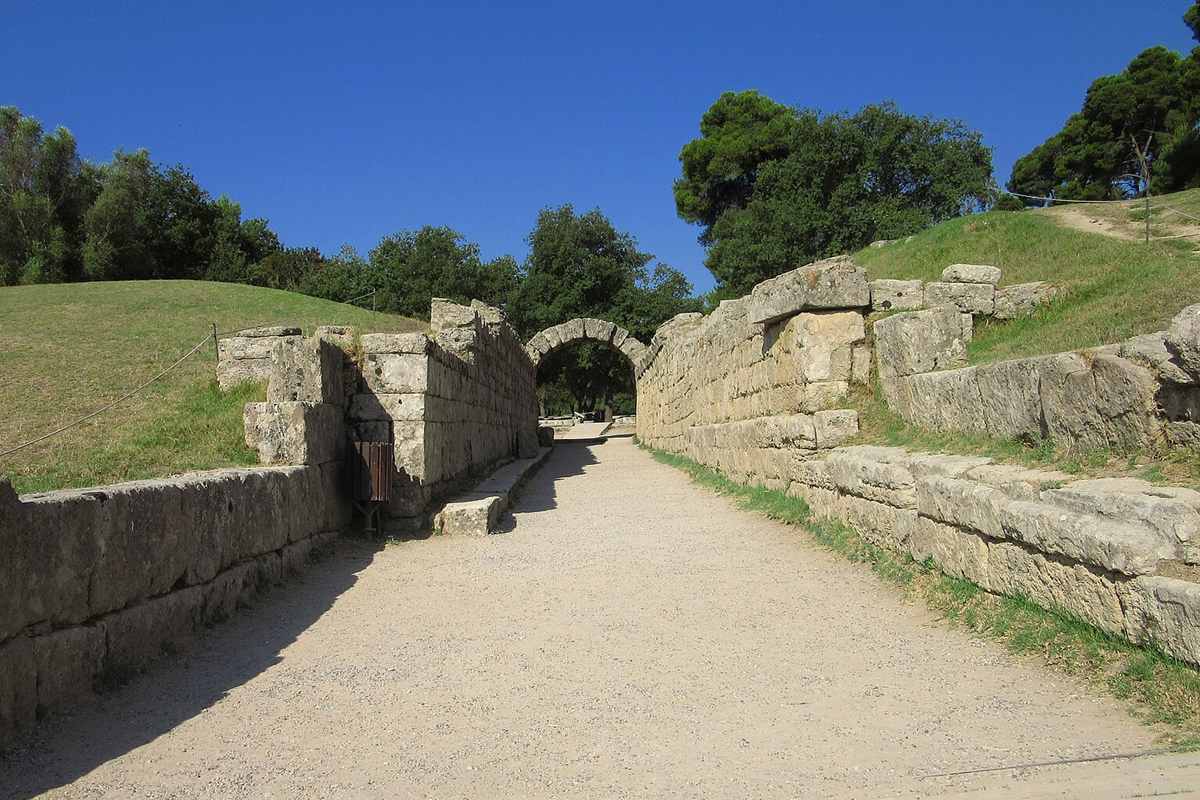
Featured photo: KPFC, CC BY-SA 3.0, via Wikimedia Commons (File:Olympia- Stadium Entrance.JPG).