
Minoan civilization tours run on Crete and Santorini, each one led by a host. Both islands hold remains of a Bronze Age culture. Its palaces stood at Knossos, Phaistos, Malia and Zakros. Towns grew at Hagia Triada, Kommos, Gournia, Palaikastro, Petras and Akrotiri. Art, writing, religion, trade and the end of the Minoans follow, with four short answers. Related pages cover Crete tours, Greece archaeological tours and UNESCO sites in Greece. A wider choice sits under Greece tours.
Bookings made through the GetYourGuide widgets on this page earn Classical Greece Tours a commission, at no extra cost to the traveller.
What was the Minoan civilization?
The Minoan civilization was a culture of the ancient Bronze Age, centred on the large island of Crete. In that long age, smiths cast their tools and weapons in bronze. This alloy blends copper with a smaller share of tin.
The Minoan civilization grew out of the local Neolithic culture of Crete around 3100 BC. In Neolithic times, the final phase of the Stone Age, early farmers still made stone tools. Complex urban settlements began on the island around 2000 BC. Urban means town-like, with houses packed close together along streets.
After about 1450 BC, mainland Mycenaean Greeks came to dominate Crete. Mycenaean names the Bronze Age Greeks linked with the city of Mycenae. A hybrid, or mixed, culture lasted until around 1100 BC. After the Late Bronze Age collapse, the Minoans were largely forgotten. Excavation brought them back to light in the early twentieth century.
The term Minoan is a modern coinage, meaning a word made up in recent times. The people of the Minoan civilization did not use it, and their own name for themselves is unknown. The Biblical term Caphtor has at times been identified with Crete. Biblical means taken from the Bible, the sacred book of Judaism and Christianity.
- First palaces: During Middle Minoan IB, about 1925 to 1875 BC, palaces first rose at Knossos, Phaistos and Malia.
- Site map: The majority of Minoan sites lie in central and eastern Crete, with a smaller share in the west.
- Sea lanes: Crete lies in the southern Aegean, on sea trade routes joining Europe, Africa and the Middle East.
Crete is seismically active, which means that earthquakes strike the island from time to time. Seismic comes from a Greek word for an earthquake. Signs of earthquake damage show at a large share of the sites left by the Minoan civilization.
Which chapters of the Minoan civilization unfold at Knossos?
The Minoan civilization had one of its ancient towns at Knossos, on Crete. The site was settled from Neolithic times until the first millennium AD. The Neolithic, or New Stone Age, was the era of early farming with stone tools.
From this spot, the old town reached the northern shore, its harbour and the roads inland. From about 1450 BC onwards, Knossos served as a key Mycenaean seat of administration. Mycenaean refers to the Greek-speaking culture of the mainland. Administration means the work of officials who keep records and run affairs.
Political conditions in Ottoman Crete blocked any large-scale excavation after the first short dig at Knossos. The Ottoman Empire held power over Crete in that period. After Crete gained autonomy, or self-rule, the site opened up to systematic archaeological work. Systematic means planned and orderly, carried out step by step across the remains of the Minoan civilization.
The Throne Room holds a gypsum seat by the wall, with benches, painted griffins and a lustral basin. Gypsum is a soft, pale stone. A lustral basin is a sunken room linked with washing rites. In the art of the Minoan civilization, a griffin is a legendary beast, part lion and part eagle.
- West Court: This open court formed a major approach to the palace and is thought to have served ceremonies.
- Throne Room: Excavator Arthur Evans read it as the seat of King Minos, though later scholars proposed ritual use.
- Fire: Scholars conventionally place a major fire that wrecked the palace at about 1350 BC.
In the Early Iron Age, Knossos ranked among the leading communities on Crete. The Early Iron Age is the era after the Bronze Age, when iron tools spread. That later town grew on the ground where the Minoan civilization had built its palace.
What made Phaistos stand out in the Minoan civilization?
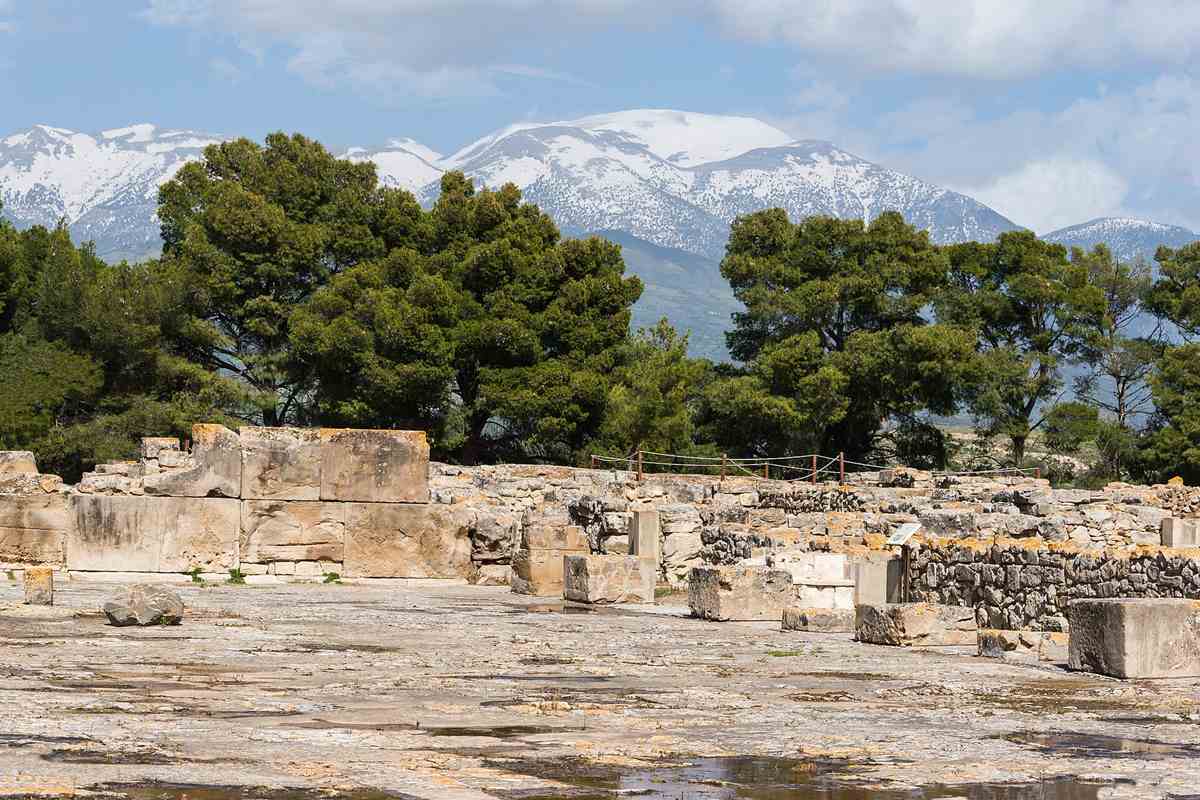
The Minoan civilization built a palace at Phaistos on a hill in the east of the site. An acropolis rose on a hill in the west. An acropolis is a fortified high point, raised above the lower streets of a Greek city.
In the Early Minoan period, people terraced the hills of Phaistos and raised monumental buildings on them. Terraced means cut into level steps, and monumental describes building work of great size. The first palace was later destroyed and rebuilt three times within about three centuries. Three centuries add up to three hundred years.
The palace at Phaistos reached around two-thirds the size of its counterpart at Knossos. Put simply, the Phaistos building was two parts in size for every three at Knossos. A road network joined the cities of the Minoan civilization. Of all its routes, the road between Phaistos and Knossos appears to have been the main one.
The second level of this palace of the Minoan civilization held rooms for servants and guests. The same level also held the commissariat quarter. A level here means one storey of a building that climbs in steps. A commissariat is a store that keeps food and other supplies for a large household.
- Mountain outlook: The royal rooms in the northern part faced the peaks of Psiloritis, also called Mount Ida.
- Clean rebuilds: Minoan builders cleared the old palace ruins thoroughly before rebuilding, so little was left for diggers to find.
- Hill name: Captain Spratt placed Phaistos on a hill then called Kastri, a name meaning fort or small castle.
Phaistos stood in the top three cities of Minoan Crete by size. Minoan Crete names the island in the age of the Minoan civilization, during the Bronze Age. The other two cities in that leading group were Knossos and Malia.
Where does Hagia Triada fit into the Minoan civilization?
The Minoan civilization had a partner town at Hagia Triada, in the Mesara Plain of Crete. It stands about three kilometres away from the bigger palace at Phaistos. The two places shared close political and economic ties. A plain is wide, flat, low land.
The site was founded in the Early Minoan I period, near the start of the Minoan civilization. By Middle Minoan IA, a large round tholos tomb stood in its cemetery. A tholos is a circular tomb built of stone, with a domed roof. A cemetery is a burial ground for the dead of a community.
The ancient name of Hagia Triada is still unknown. Scholars have put forward da-wo as one possible name. That suggestion rests on old records listing large amounts of stored grain. Those amounts match the grain stores dug up at this town of the Minoan civilization. Grain means the seeds of cereal crops such as wheat and barley.
Excavators traditionally divide the site into two areas, called the Villa and the Village. The Villa served as the administrative centre of this town of the Minoan civilization. Administrative means concerned with running affairs, keeping records and managing goods. A villa, in plain words, is a large and grand house.
- Rebuilding: After a fire late in Late Minoan IB, builders rebuilt the site on a grand, monumental scale.
- First record: Luigi Pernier, then digging at Phaistos, first identified the site in June 1900.
- Small finds: Objects include a large bronze cauldron, loom weights, oil lamps and 16 copper ingots.
A Roman villa rose at the site once Rome had conquered Crete in 69 BC. Rome was the Italian city at the heart of a vast ancient empire. That villa came long after the Minoan civilization, on ground once shaped by Minoan builders.
Which role did the harbour of Kommos play in the Minoan civilization?
The Minoan civilization used Kommos as a harbour town for the nearby centres of Phaistos and Hagia Triada. A harbour town is a settlement beside sheltered water, where ships load and unload their cargo. Cargo means the goods that a ship carries.
A wide road laid with stone slabs split the town into two zones. Homes of local residents filled the hilly northern side. Civic buildings rose in the lower and flatter southern part. Civic means public, serving the whole community rather than a single family. Slabs are broad, flat stones cut for paving.
Building T matched the palace at Phaistos in size. Its facade, or front wall, used the largest cut stone blocks known from the Minoan civilization. Ashlar is the name builders give to such neatly squared stone. These huge blocks are called orthostats, since they are long, narrow slabs standing on their edges.
Building AA, the earliest known palace-style building at Kommos, went up shortly after the first palace at Phaistos. That was during Middle Minoan II, the second stage of the Middle Minoan period. Palace-style means built in the same manner as the great palaces of the Minoan civilization.
- Early size: In the Middle Minoan period the town grew to cover roughly 1.5 hectares.
- Later size: After an earthquake, builders rebuilt the town on a larger scale, possibly 3.5 hectares.
- Busy decline: In early Late Minoan III, living standards fell while trade reached its peak.
The site was abandoned around 1200 BC, late in the Minoan civilization’s long story. No later settlement there ever matched its earlier size. Abandoned means left empty by the people who lived there. Settlement is the general word for a lived-in place, from hamlet to city.
What does Malia reveal about the Minoan civilization?
The Minoan civilization left a palace town at Malia, on Crete. The site lies about 3 kilometres east of the modern village of Malia, and inland from it. Inland means away from the coast, towards the interior of the island.
The first signs of the Minoan civilization at Malia are pieces of pottery from Early Minoan IIA. Pottery means pots and other objects made of fired clay. The early town stayed modest in size. Fire destroyed it at the end of Early Minoan IIIB, a late stage of the first Minoan period.
By Middle Minoan IIB the town had grown, and a sizable palace of mudbrick stood there. Mudbrick is clay mixed with straw and dried in the sun. Finds from that level include obsidian from Anatolia, showing wide trade by the Minoan civilization. Obsidian is a black volcanic glass, and Anatolia is the land of modern Turkey.
A geological study at Malia found signs of a modest tsunami. Researchers link the wave to the Thera eruption, a volcanic blast during the Minoan civilization. A tsunami is a fast sea wave raised by an earthquake or eruption. Geological means linked with the study of rocks and the layers of the earth.
- Early explorer: From 1919 to 1922 Joseph Hazzidakis, Ephor, or chief officer, of Ancient Monuments of Crete, explored the site.
- Tool hoards: Quartier Mu yielded two hoards of metal tools, one holding a drill, a saw and an axe-adze.
- Second fire: Fire destroyed the rebuilt town once again around 1370 BC.
Quartier Nu, from Late Minoan III, has three wings around a court and two building phases. Quartier is French for quarter, meaning one district of a town. Wings are side sections that branch off a main building, and a court is an open yard.
How does Gournia show town life in the Minoan civilization?
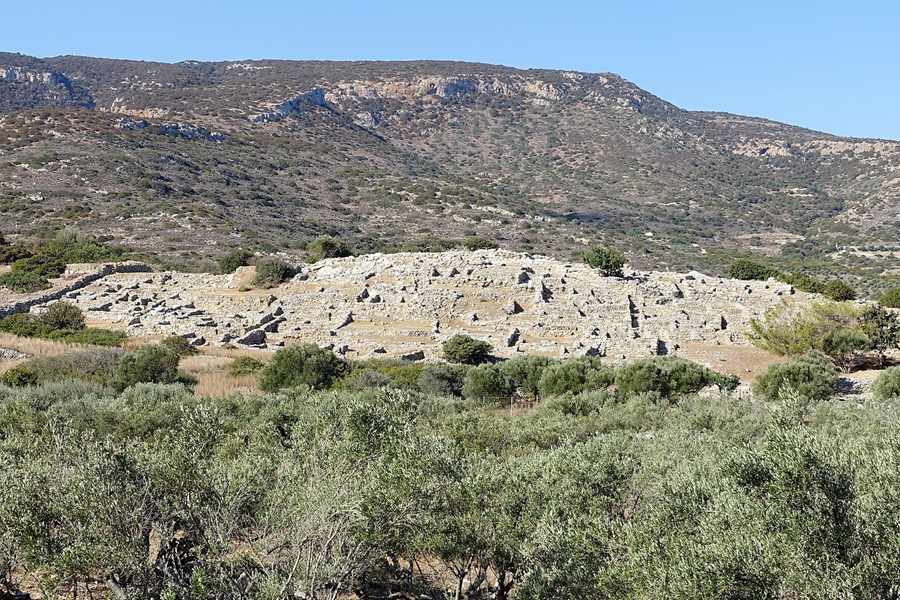
The Minoan civilization had a lasting town at Gournia, first permanently inhabited in the Early Minoan II period. Permanently means all year round and for good, not just for a season. Early Minoan II falls within the opening phase of Minoan history.
By Early Minoan II, Gournia had already grown into a sizable town. Sizable means of fair size, larger than a village. Occupation of the site lasted until the Late Minoan I period. Occupation here means people living on a site. Late Minoan I is the first stage of the last Minoan period.
The town of the Minoan civilization at Gournia centres on its palatial complex, on the central-west side. Palatial means palace-like, and a complex here is a cluster of connected buildings. Scholars D. Matthey Buell and John C. McEnroe give each part of the town its own letter. Their scheme runs from section A to section I.
Harriet Boyd’s team also excavated Vasiliki, a site one mile further inland on the isthmus. On an isthmus, a slim band of ground links two larger landmasses between two waters. Excavated means dug with care to uncover buried remains. Vasiliki is another site of the Minoan civilization only a mile from Gournia.
- Later digs: Jeffrey Soles and Costis Davaras made modest extra excavations in 1971, 1972 and 1976.
- Open question: The causes of the final Minoan destruction at Gournia remain unknown.
- Tomb I: Grave goods include a silver kantharos, a two-handled cup, plus two bird’s nest bowls.
Harriet Boyd and her team first found the North cemetery in 1901. In such a cemetery, the dead of the town were laid to rest. Boyd coined the term house tombs for the built graves of the Minoan civilization that she found there.
When did the Minoan civilization first settle at Zakros?
The Minoan civilization first settled at Zakros around 2000 BC, between Early Minoan III and Middle Minoan IA. These labels name the stages where the early period of Minoan history gives way to the middle one. BC marks years counted backwards to year one.
The Old Palace rose late in the Middle Minoan period. A large earthquake destroyed it around 1700 BC. North of the palace, a large town of the Protopalatial and Neopalatial periods covered the hills. Protopalatial means the time of the first palaces, and Neopalatial means the time of the new palaces.
A paved road from the harbour led up to the north-east gate of the palace. In one of 12 excavated homes, a stone cellar held a small hoard of bronze tools. The hoard included two axe heads and three lances, weapons of the Minoan civilization. A hoard is a hidden store, and a lance is a long spear.
Hogarth’s main pit at this site of the Minoan civilization measured 16 feet across and 18 feet deep. A pit in this sense is a deep hole that diggers cut down through buried layers. Sixteen feet is a little under five metres. Eighteen feet is close to five and a half metres.
- Pit finds: Objects from the pit, mainly pottery, date to the Late Minoan IA period.
- Long service: Archaeologist Nikolaos Platon kept working at Zakros until his death in 1992.
- North-east slope: Much of the later digging focused on the slope north-east of the palace, including the Strong Building.
An Egyptian stone jar with a bridge spout turned up at Zakros, and local craftsmen had altered it. A bridge spout is a pouring lip joined to the rim by a small strip. The jar shows contact between Egypt and the Minoan civilization.
What story does Palaikastro add to the Minoan civilization?
The Minoan civilization had a town at Roussolakkos, close to the modern town of Palaikastro on Crete. People lived there from Early Minoan IIA until Late Minoan IIIB. Those labels mark stages of the early and late Minoan periods, read from pottery styles.
The remains of the town are relatively well preserved. Preserved means kept in good condition through the centuries. Remains means the parts of old buildings that still survive. The ancient site covers an area of 50,000 square metres. One square metre equals a square patch one metre wide and one metre long.
Bosanquet and Dawkins dug this Minoan civilization town from 1902 to 1906, for the British School at Athens. The British School at Athens is a British research institute for the study of archaeology in Greece. L. H. Sackett and M. R. Popham then continued the work in 1962–63.
Today the harbour and coastal buildings of this Minoan civilization town face a threat from rising seas. The cause is local tectonic activity. Tectonic activity means slow movement of the plates of rock that form the earth’s crust. Coastal means lying along the shore. Sea level means the mean height of the sea surface between tides.
- Current team: Since 1983 the work has been directed by MacGillivray, Sackett and Driessen.
- Kastri: A steep headland called Kastri rises 65 m above the coast of the modern town.
- Name: Palaikastro means old fort, a name given in medieval times under Venetian rule over Crete.
In myth, this Minoan civilization site is where Talos, a bronze man, faced Jason and the Argonauts. The Argonauts were the heroes who sailed with Jason on the ship Argo. Myths are inherited legends of gods and heroes, retold over generations.
How has Petras changed views of the Minoan civilization?
The Minoan civilization left a town at Petras, in north-eastern Crete. One building there shows strong likeness to the Minoan palaces, so scholars sometimes call it a palace too. A palace here means a large centre that ran the affairs of a region.
Petras became known through the work of archaeologist Metaxia Tsipopoulou. It entered scholarly discussion only in 1985. Its discovery shifted understanding of what palaces were in the Minoan civilization. An archaeologist studies the distant past through the objects and ruins that people left behind. Scholarly means linked with the work of trained researchers.
The palace building covers over 2000 square metres of ground. Villas, farmsteads and an industrial area surrounded this centre of the Minoan civilization. Villas here are large country houses. A farmstead is a farm with its house and outbuildings. An industrial area is a zone set aside for crafts and production.
House 2 had a reception hall that was later turned into a workshop for dyeing wool. A reception hall is a large room for receiving guests. Dyeing means colouring cloth or yarn by soaking it in coloured liquid. Wool is the soft hair of sheep, spun into thread for weaving.
- Harbour: The bay below the palace gave safe anchorage, and the river possibly served as a transport route.
- Time span: The settlement goes back to the Early Minoan period and was inhabited until 1450 BCE.
- Central court: The court is smaller than at similar palaces, and an enormous staircase led into it.
Twenty-four house tombs make up the Petras cemetery, which lies on the coast. A house tomb is a stone grave built like a small house, with rooms for burials. These tombs belong to the community of the Minoan civilization at Petras.
Which links tie Akrotiri on Santorini to the Minoan civilization?
The Minoan civilization counts Akrotiri, on the island of Santorini, among its major settlements. The town stood near the site of the Thera eruption, a huge volcanic blast. Thera is the ancient name of Santorini, and an eruption is an outburst of lava and ash.
Its name comes from Akrotiri, the modern village close by. The word Akrotiri means a cape or headland in Greek. A headland is high land jutting out into the sea. As the third millennium BC drew to a close, the community had grown and spread widely. One millennium equals ten centuries.
Foreign pottery fragments at the site point to trade between this Minoan civilization town and the wider Aegean. Fragments are broken pieces, and foreign means made elsewhere. The prosperity of the town then lasted for about another 500 years. The Aegean Sea stretches east from mainland Greece, dotted with islands such as Santorini.
Fine pottery and growing specialisation in crafts point to the sophistication of this Minoan civilization town. Sophistication here means a high level of skill and refinement. Craft specialisation means that workers focus on a single skill, such as potting or weaving. A potter is a worker who shapes and fires clay vessels.
- Quick start: Within hours of the start of the 1967 excavation, remains of the buried city came to light.
- Tall walls: Under thick volcanic debris, buildings survived to a height of more than one storey.
- Recent find: In October 2018 diggers uncovered a small shrine holding a woman’s figurine carved from marble.
Clay vessels from Akrotiri include bathtubs, braziers, oil lamps, beehives and flower pots. A brazier is a pan that holds burning coals for heat or cooking. Such everyday objects show home life in a town of the Minoan civilization.
What did Linear A record for the Minoan civilization?
The Minoan civilization kept its palace and religious records in Linear A, its main script. Script here means a system of marks for writing down speech. No Linear A text has been deciphered, or read with certainty, since its rediscovery in 1900.
The archaeologist Sir Arthur Evans gave this script of the Minoan civilization the name Linear. He chose it because the characters were plain lines cut into clay. An archaeologist studies the past through old remains. Linear A holds more than 300 signs. That total includes local forms and signs that turn up only once.
Numbers in Linear A follow a decimal system, built on groups of ten. A vertical dash stands for each unit, and a horizontal dash for each ten. A unit means the number one. Hundreds take the form of circles. Thousands appear as circles with rays, meaning short strokes that stick out from the edge.
Scholars call the full body of known texts the corpus. The Linear A corpus of the Minoan civilization holds roughly 1400 inscriptions. An inscription is writing cut, pressed or painted onto an object. Together those inscriptions carry 7400 sign tokens. A token is one written sign, counted afresh each time it appears in a text.
- Direction: Linear A ran from left to right as a rule, with a handful of exceptions.
- Materials: Writers of the Minoan civilization used it on clay tablets, offering tables, hairpins and pottery.
- Core signs: A central group of 90 signs appears regularly wherever and whenever the script was used.
John Younger measured the Linear A record of the Minoan civilization in printed pages. Printed out, the whole corpus fills just 1.84 pages of letter paper. His count assumes 12 point type and one-inch margins. A point is a unit for the size of printed letters.
At which site of the Minoan civilization was the Phaistos Disc found?
The Minoan civilization built the palace of Phaistos, near Hagia Triada, on Crete’s south coast. The Phaistos Disc lay in a basement cell of room 8, inside building 101. A basement is a storey set below ground level.
The rooms around the find spot formed a group of four. That group also acted as a formal way in to this palace of the Minoan civilization. The basement cell was poor in treasure but rich in black earth and ashes. Burnt bovine bones lay mixed into that dark layer. Bovine means from cattle.
Certain authors state that the clay of the disc does not look local. In their view, the clay is possibly not even from the island of Crete. Local here means taken from the ground close to Phaistos. Clay is a soft, sticky earth that turns hard when baked in a fire.
One sign on side A is too damaged to identify. Damage here means wear or breaks that hide the original shape. Sign 02, known as the plumed head, appears more times than any other sign. It turns up 19 times on the disc. A plume is a large feather worn for show.
- Reading order: Experts on the Minoan civilization agree that the text reads clockwise, moving inward from the rim.
- Word groups: The text falls into 61 word groups, with 31 on side A and 30 on side B.
- Turned signs: Certain signs appear turned by 90 or 180 degrees at different points on the disc.
Scholars of the Minoan civilization still dispute the purpose of the Phaistos Disc. They also dispute the place where it was first made. To dispute means to argue over a question with no agreed answer. A purpose is the use an object was made for.
How do Cretan hieroglyphs fit into the writing of the Minoan civilization?
The Minoan civilization had a picture script, Cretan hieroglyphs, in early Bronze Age Crete. Hieroglyphs are signs drawn as small pictures of things. The script arose about a century before Linear A. Yet the two systems ran side by side for much of their history.
By 1989, the known corpus of this Minoan civilization script had two parts. Seals and sealings gave 150 documents with 307 sign-groups. A sealing is a lump of clay pressed with a seal. Other clay documents added 120 more, with 274 sign-groups. A sign-group is a short cluster of signs written together.
The current list of glyphs, or carved signs, holds 96 syllabograms. A syllabogram marks a syllable, a single sound unit such as the first part of a spoken word. Ten of these syllabograms double as logograms. A logogram, by contrast, represents a whole word or one part of a word.
Hieroglyphic B is the third stage in the growth of this Minoan civilization script. It appears chiefly on clay, and its characters are simplified forms. It possibly served as a prototype for Linear A. A prototype is a first model on which later versions are built. The Cypro-Minoan script possibly grew from it as well.
- New find: A four-sided prism bearing the script turned up at Vrysinas, in the west of Crete, in 2011.
- Zakros find: At Zakros, three sealings with Cretan hieroglyphs lay in one deposit with a Linear A tablet.
- Far afield: Inscriptions in the script also came to light on Samothrace, an island in the northeastern Aegean.
Hieroglyphic A is the best represented stage in the archaeological record of the Minoan civilization. That record is the sum of objects found by digging. The stage resembles the earlier Archanes stage. Its pictures of animals, however, shrink down to the heads and nothing more.
What made Kamares ware the prestige pottery of the Minoan civilization?
The Minoan civilization prized Kamares ware as a prestige style that demanded a high level of craft. Prestige means high standing and respect. Experts suspect that the elite used these pots as tableware. Tableware means the dishes and cups set out for meals.
Kamares ware first came out in the Middle Minoan IA period, around 2100 BCE. Middle Minoan IA marks one early chapter of the Minoan civilization. The letters BCE, like BC, count years before the Common Era. Even at this early point, the style used polychromy. Polychromy means painting in a number of colours at once.
Middle Minoan II examples come chiefly from the palaces of Knossos, Phaistos and Malia. The same period brought the first stylised plants and animals to Kamares pottery. Before that, the painters had kept to abstract motifs. Stylised means drawn in a simple, patterned way rather than true to life. Abstract motifs are plain patterns.
Kamares ware of the Neopalatial period has been dug up in Egypt. Neopalatial means belonging to the age of the new palaces of the Minoan civilization. Part of these finds came from Crete as imports. An import is a good brought in from another land. Other pieces were local copies made in Egypt itself.
- Shapes: Surviving pieces include ridged cups, small round jars with spouts, and large storage jars called pithoi.
- Early finds: The oldest known pieces came to light at Mochlos and Vasiliki in eastern Crete, among other sites.
- Later name: Pots from Middle Minoan III are sometimes called Post-Kamares, meaning after Kamares.
The Minoan civilization kept Kamares ware as a living part of its culture until Late Minoan IA. Scholars date that period to around 1450 BCE. Culture here means the shared customs and crafts of a people. A period is a named span of time.
How did artists of the Minoan civilization make the Bull-Leaping Fresco?
The Minoan civilization painted the Bull-Leaping Fresco over scenes moulded in stucco relief. Stucco is a hard plaster used to coat and shape walls. Relief means forms raised slightly above a flat background. A fresco is paint laid onto wet plaster.
The artist worked high up on the wall. The stucco also had to be moulded and painted while it was still fresh. The panel uses black, blue, white and two reds, one pale and one dark. These hues rule out a date in the Early Minoan or early Middle Minoan periods. A hue means one particular colour.
Flakes of the broken panels fell to the ground from the upper storey. Scholars think an earthquake destroyed the Knossos palace of the Minoan civilization in Late Minoan II. Storeys are the floors stacked up in a tall building. Arthur Evans named the group The Taureador Frescos in his great book on Knossos. A taureador is a bull fighter.
The genders of the figures follow an accepted convention of Minoan art. A convention is a shared habit that the artists of the Minoan civilization followed. Under that rule, painters gave women pale skin and gave men dark skin. Gender here means whether a figure is male or female.
- More scenes: M. Cameron proposed four similar scenes, each with a bull and three human figures.
- Bull-ring: Evans suggested that a palace bull-ring lay on the river flat just below the site.
- Small copies: Sealings and sealstones repeat the bull-leaping scene in miniature form.
The bull in this work of the Minoan civilization shows a pose called the Flying Leap. That pose tells the viewer that the animal is meant to be at full gallop. A gallop is the fastest running pace of a four-legged animal.
Who is the Prince of the Lilies in the art of the Minoan civilization?
The Minoan civilization adorned the palace of Knossos with the painting called the Prince of the Lilies. Diggers found it in pieces. It is also called the Lily Prince or the Priest-King Fresco. Lilies are tall plants with large trumpet-shaped flowers.
Only a handful of pieces of this Minoan civilization image came out of the ground. Experts think it was taken off its wall on purpose during rebuilding or renovation. Renovation means repairing and updating a building. The reconstruction in the museum uses nine fragments in total. A fragment is a part broken off a larger whole.
One fragment holds the torso, the right arm and a clenched fist. It also shows a necklace of waz-lilies, a stylised lily shape. A torso is the body without the head, arms and legs. Evans first thought the fragments came from different figures. He also wrote that the torso suggested a boxer.
The reconstruction reflects the later idea of Evans that the figure was a Priest-King. A priest-king is a ruler who also leads worship. Evans put the image on the cover of every volume of his main work. The crown on those covers was embossed in gold. To emboss means to press a raised design into a surface.
- Rope: Evans thought the invented hand held a rope leading a sphinx or a griffin.
- Field notes: Duncan Mackenzie, the first excavator of this Minoan civilization fresco in 1901, kept notes below modern standards.
- Close look: Maria Shaw studied the fragments from atop a ladder and backed the restored direction of the head.
Sinclair Hood dates this painting of the Minoan civilization to Late Minoan IA, around 1550 BC. That date places it in the Neopalatial, or new palace, period of Crete. Scholars set that period between 1750 and 1500 BC. BC marks dates counted back from the Common Era.
Where were the snake goddess figurines of the Minoan civilization found?
The Minoan civilization left two snake goddess figurines, found in 1903 in the palace at Knossos. A figurine is a miniature statue, carved or moulded by hand. Evans called the larger one a Snake Goddess and the smaller one a Snake Priestess.
Restored, the larger figure of the Minoan civilization pair is about 34 cm tall. Snakes crawl over her arms and climb up to her tall, tube-shaped crown. A snake’s head rears up at the very top of the crown. Restored means rebuilt from broken pieces or with missing parts added.
The smaller one measures about 29 cm after restoration. She holds two snakes in her raised hands. A cat or panther sits on top of her head-dress. A panther is a large wild cat, such as a leopard or jaguar. A head-dress is a covering or ornament worn on the head.
The fame of these Minoan civilization figures quickly led to clever fakes. A fake is a modern copy passed off as ancient. One such fake belongs to the Boston Museum of Fine Arts. It has an ivory body with gold snakes twined round its arms. Ivory is tusk material, taken chiefly from elephants.
- House guardian: Martin P. Nilsson states that the snake protected the house in Minoan religion.
- Cord theory: Emily Bonney argues the goddess holds the ends of a long cord, not snakes.
- Berlin bronze: A bronze figurine in Berlin wears what are possibly three snakes, or just locks of hair.
The larger snake goddess of the Minoan civilization wears a dress with a thick belt. A sacred knot sits on that belt. Sacred means holy, or set apart for the gods. A knot here is a loop of cloth or cord tied in a set shape.
For what purpose did the Minoan civilization carve seals?
The Minoan civilization carved seals from gemstones, metal, ivory and other materials. A seal works like a stamp, leaving its design in soft clay. Gemstones are hard, precious stones that can be cut and polished. These pieces evidently served to identify documents and objects.
A large share of the images on seals of the Minoan civilization match a human fingernail in size. A high proportion match the nail of the little finger. An image here is the picture cut into the face of a seal. The face is the flat or curved side that touches the clay.
Lentoid seals have two faces that curve towards a thin, round edge. Lentoid means shaped like a lentil seed. Prism seals have three flat faces instead. From the Middle Minoan period, carvers of the Minoan civilization used fast rotary drills. A rotary drill spins to bore into hard material. These tools let craftsmen work harder stones.
Large sealings from Zakros show strange hybrid monsters. A hybrid monster mixes parts of different creatures. One type, called the Eagle Lady, shows a winged female chest. It ends either in the head of a bird or in an empty helmet. These designs date to Late Minoan I and possibly reflect a regional style.
- Workshop: Archaeologists excavated a seal-carving workshop from Middle Minoan I at Malia.
- Talismanic seals: From around 1700 BC, talismanic seals appear, thought to have served a purpose in magic.
- Mainland finds: The Griffin Warrior Tomb at Pylos held more than 50 gold or hardstone seal-stones.
Only pottery survives from the Minoan civilization in larger numbers than seals do. Thousands of seals are known, starting from the Early Minoan II phase. Over a thousand impressions survive as well. An impression is the mark a seal leaves in clay.
When did the Minoan civilization make the Hagia Triada Sarcophagus?
The Minoan civilization shaped the Hagia Triada Sarcophagus from limestone, late in its history. It dates to around 1400 BC or decades later. A sarcophagus is a stone chest for a dead body. Limestone is a soft, pale rock formed from the shells of sea creatures.
Unlike the ancient Egyptians, the Minoan civilization kept frescoes for palaces and houses. Those paintings served the enjoyment of the living, not burial rites. Burial rites are the ceremonies held when a body is laid to rest. No other limestone sarcophagus from its era has come to light so far.
Tomb 4, its burial building, has sides of 3.8 and 4.2 metres. Thick walls of small, irregular stones enclose the space. No other building of this type is known in the Minoan civilization or the Mycenaean world. The Mycenaeans were Bronze Age Greeks of the mainland. Irregular means rough and uneven in shape.
The centre of one long side shows a bull sacrifice. The bull lies tied down on an altar shaped like a table. A sacrifice is an offering made to a god, here by killing an animal. An altar is a raised surface used for offerings. Scholars call this the rear side, purely for convenience.
- Music: Behind the altar, a male figure plays the aulos, a double flute.
- Double axe: A pole topped with a labrys, or double axe, holds a black bird.
- Models: Three men in aprons of animal hide carry models of animals and a boat.
Tomb 4, the resting place of this Minoan civilization coffin, resembles two Mycenaean tombs. Those two tombs were found at Farsala, in northern Greece. A tomb is a chamber built for the dead. To resemble means to look much like something else.
What kind of vessel is the Harvester Vase of the Minoan civilization?
The Minoan civilization’s Harvester Vase is a stone rhyton found at Hagia Triada on Crete. A rhyton is a vessel used for drinking or for pouring offerings. The vase dates to about 1550 to 1500 BC, in the Late Bronze Age.
The vase is made of steatite, a soft stone also called soapstone. Its shape copies an ostrich egg. In the Bronze Age Mediterranean, ostrich eggs were rare and exotic objects. People of that age used them to make rhyta. Rhyta is the plural of rhyton. Exotic means coming from a distant land.
Its relief shows a procession of 27 men, possibly a dance. A procession is a group moving forward in an orderly line. The relief wraps round the widest part of this Minoan civilization vase. The bulk of the men are young and dressed alike. They wear short kilts and flat caps with rolled brims.
The discoverers saw these men of the Minoan civilization as warriors. Later writers have favoured that view less. Dieter Rumpel believes the three-pronged tools were stabbing weapons for war at sea. In his view, crews used them in close fighting between boats. Pronged means having sharp spikes, like the end of a fork.
- Leader: An older man with a long staff, curved at the bottom, seems to lead the group.
- Sister cup: The Chieftain Cup, also from Hagia Triada, is thought to be by the same artist.
- Find spot: Diggers found it in 1902 in a room whose walls and floor were covered in pale alabaster stone.
The makers of this Minoan civilization vase built it in three parts. The lowest part is missing today. In modern times, plain plaster without decoration has replaced it. Plaster is a paste that dries hard and fills gaps or missing parts in an object.
Why is the Malia Pendant prized among the jewellery of the Minoan civilization?
The Minoan civilization crafted the Malia Pendant during its Protopalatial, or first palace, period. A pendant is a jewel that hangs from a chain or a cord. Scholars rate it as the best-known single piece of all Minoan jewellery.
This jewel of the Minoan civilization was possibly once part of a necklace, an earring or a pin. It takes the form of two insects arranged in a balanced, heraldic way. Heraldic means set out like the paired beasts on a coat of arms. The rear ends of their bodies almost touch.
A paper suggests that the goldsmith copied a mammoth wasp, Regiscolia maculata. A goldsmith is a craftsman who works in gold. For the three discs that hang below, scholars propose a plant as the model. They point in particular to the fruits of Tordylium apulum. A scientific name like this is written in Latin.
The religion of the Minoan civilization placed weight on renewal, much as Egyptian religion did. This led to a fascination with the life cycle of insects. Insects grow by changing form rather than by simply getting bigger. Renewal means a fresh start of life. A life cycle is the series of stages a creature passes through.
- First account: French archaeologists dug it up, and Pierre Demargne gave the first description of it.
- Find: The gold pendant turned up in a tomb in 1930.
- Goddess: Bees were a symbol of a Minoan goddess, tied to her role in regeneration, or rebirth.
Honey was the main source of sugar for the Minoan civilization. It also supplied a food with a high nutritional index. A nutritional index rates how much nourishment a food gives. Nourishment means what the body needs to live and grow.
Why did the labrys become a sacred sign of the Minoan civilization?
The Minoan civilization of Crete stands at the start of the labrys story. A labrys is a double-bitted axe. Each bit is a cutting blade, so the tool carries one blade on either side of its head. It served first as a holy Minoan symbol.
Other religions and cultures of the ancient world later adapted the labrys. The Greek author Plutarch reports that labrys was the Lydian word for an axe. The excavator Arthur Evans, with other scholars, derives the word labyrinth from labrys. On that view, a labyrinth was a house of the double axe.
In the Minoan civilization, the double axe was not a weapon. It always appears beside goddesses, never beside gods. Small copies served as votive offerings, meaning gifts left for a deity. Such miniature axes survive in considerable numbers. Minoan double axes have also come to light at Akrotiri, a prehistoric town on Santorini.
Men with a special role as priests appear in the art of the Minoan civilization. They wear long robes marked with diagonal bands. Over the shoulder they carry a ritual axe-sceptre, a staff of office with a rounded blade. Far from Crete, at Labraunda in Caria, the double axe accompanied the storm god Zeus Labraundos.
- Lightning: The fairly modern Greek word for lightning, astropeleki, means star-axe.
- Tenedos: Worship of the double axe was maintained on the Greek island of Tenedos.
- Battle use: In reality, double axes were not commonly used as weapons in combat.
A Linear B phrase, written in the Mycenaean Greek script, is conventionally read as mistress of the labyrinth. Greek myth’s labyrinth is tied in this way to Knossos, a palace of the Minoan civilization. Certain modern scholars read the phrase differently.
What did early diggers find inside Psychro Cave, a Minoan civilization shrine?
The Minoan civilization used Psychro Cave, in the Lasithi prefecture, as a holy place from Early Minoan times. Votive objects are gifts offered to fulfil a vow. They show that the cave had become the busiest shrine by Middle Minoan times.
Sir Arthur Evans investigated this Minoan civilization site in 1896. Pierre Demargne followed in 1898 with brief investigations. In 1900, the excavator David George Hogarth led far larger work there. His reports describe crude digging methods. Workers blasted huge blocks fallen from the roof of the upper cave before removing them.
In 1900 the team uncovered a stuccoed altar in the upper chamber of the cave. Stucco is a fine plaster used to coat surfaces. Around the altar lay layers of ash, pottery and votive objects, with other refuse. Those objects were made of bronze, clay, iron and bone. Countless conical clay cups had held food offerings there.
Among sacred caves of the Minoan civilization, only Psychro has yielded a votive body part, a bronze leg. A votive body part is a model of a limb or organ given to a god. Bronze shields from the Orientalising period, an age of eastern styles, were also found there. They point to initiation festivals for young men.
- Museums: Psychro finds sit in the Heraklion Museum, the British Museum, the Louvre and the Ashmolean in Oxford.
- Publication: John Boardman published the finds from these and other excavations in 1961.
- Lamps: Stone and clay lamps rank among the more common finds at Psychro.
Scholars of the Minoan civilization still debate which cave ancient writers meant by Dikte. In 1988, Charles Crowther placed the ancient name Dikte in the region of Palaikastro instead. Mieke Prent and John Boardman think Psychro is possibly the Mount Aegaeon cave of the poet Hesiod.
How is the Idaean Cave on Mount Ida tied to the Minoan civilization?
The Minoan civilization left holy cave sites across Crete. One of them, the Idaean Cave, lies on Mount Ida. At 2,456 metres, Ida stands as the tallest summit on the whole island. Its early name meant cave of the Goddess.
No other mountain in Greece matches the topographic prominence of Mount Ida. Prominence measures how far a summit rises above the lowest ground linking it to a higher peak. Greek myth made Ida a mountain sacred to Rhea, the Titaness who bore Zeus. Legend also names the Idaean Cave as the birthplace of the god.
The cave outlived the Minoan civilization, and by Greek times worshippers had rededicated it to Zeus. It possibly served as the seat of an oracle, where people put questions to a god. A tripod, a three-legged stand, appears again and again on coins of nearby Axos. That town presumably controlled the land around the cave.
Bronze shields and drums from the Orientalising period have come from the cave. They suggest that young men, called kouroi, held a yearly war dance for the birth of Zeus. In the myth, the Kouretes were youthful spirits who guarded the infant Zeus. They clashed weapons on their shields so that Cronus did not hear his cries.
- Dactyls: In legend, the Dactyls, ancient metalworkers, lived on Mount Ida.
- Pythagoras: The philosopher Pythagoras supposedly joined the cult of the Kouretes at Mount Ida as an initiate.
- Watershed: The Ida range splits streams flowing south to the Libyan Sea from those flowing north to the Aegean.
Scholars broadly agree that the Minoan civilization used sacred caves for religious rites. Within the Minoan civilization, certain caves also served as burial places. One author, Tyree, keeps the term sacred cave for caves with paved areas, partition walls or low walls.
Which finds came from the peak sanctuary of the Minoan civilization on Mount Juktas?
The Minoan civilization held religious rites on mountain tops at places called peak sanctuaries. Mount Juktas, south of Heraklion on Crete, held in all likelihood the earliest of them. Each peak sanctuary was a place of worship set high on a summit.
Excavators recovered clay figurines of humans and animals from the summit. They also found horns carved from stone. Bowls and tables at the site carried inscriptions in Linear A. Scholars still cannot read this script of the Minoan civilization. The oldest pottery sherds, or broken fragments, reach back to Middle Minoan IA.
Archaeologists studied the summit over a lengthy period. Their work covered pottery fragments, wall remains and rare kinds of stone. That stone is foreign to the mountain, so people must have hauled it up. A Greek Orthodox chapel stands about a kilometre south of the sanctuary, along the ridge. The mountain still matters in local religious life.
Peak sanctuaries spread widely across the island of Crete. Human and animal figurines and traces of religious buildings appear at the majority of them. Votive clay body parts, or model limbs given to a deity, appear at a large share of them. Scholars of the Minoan civilization have identified a mountain goddess who received worship at such summits.
- Distribution: The majority of known peak sanctuaries lie in eastern and east-central Crete.
- Zeus legend: Greek legend names Mount Juktas as the burial place of Zeus.
- Decline: A large share of the sanctuaries fell out of use once Mycenaean Greeks from the mainland dominated Crete.
Every year, people from towns on the plains below Juktas carry flowers in procession to the chapel. The peak sanctuaries of the Minoan civilization possibly declined in importance in the Neopalatial Period. That name means the period of the new palaces.
What happened at Anemospilia, a temple site of the Minoan civilization?
The Minoan civilization built a temple at Anemospilia, on the northern end of Mount Juktas. The site lies about 7 km from Knossos, and its name means caves of the wind. Fire and an earthquake wrecked it around 1700 BC, as the first palaces fell.
The Greek archaeologist Yannis Sakellarakis first uncovered this Minoan civilization temple in 1979. The excavation revealed stone walls standing only to hip height, with ash and charcoal on the floor. The plan holds three chambers and one annex, a side room that leads into them. In the east chamber stood a stepped altar bearing offerings.
Storage jars on the east chamber floor held traces of milk, honey, grains and peas. In the central chamber, a pair of clay feet formed the base of a statue. That figure, called a xoanon, was life-sized and built mainly of wood. More than 400 pottery vessels lay at the foot of its altar.
Close to the statue sat a mound of hillside rock, a symbol of the earth. The Minoan civilization regarded earth, sea and sky as the eternal elements. Worshippers poured libations, or liquid offerings, over this sacred stone. In the western chamber lay a 28-year-old woman and a man in his late thirties.
- The man: He wore a ring of iron and silver and a finely engraved seal on his wrist.
- Platform: An 18-year-old male lay on a platform, curled on his right side.
- Blade: A blade 40 cm long, with a boar head on each side, lay among his bones.
The excavators saw a human sacrifice here, a view still debated by scholars of the Minoan civilization. Dennis Hughes sees the blade as a spearhead that had possibly fallen from a shelf. Nanno Marinatos holds that the young man died in the earthquake that destroyed the building.
Why did Knossos rely on Amnisos as its harbour in the Minoan civilization?
The Minoan civilization reached the sea at Amnisos, a Bronze Age site on the Cretan north coast. Amnisos served as a port for the palace city of Knossos. No navigable stream, one deep enough for boats, ran inland to Knossos.
The settlement shares its name with the river that meets the sea there. Opposite the river mouth sits a very small island, called Amnisos too. Callimachus, an ancient poet, gives the river nymphs the name Amnisiades in a hymn to Artemis. Nymphs are nature spirits, and he places these among the followers of the goddess.
The road to Knossos was lined with very old cult sites. One of these is the cave of the goddess Eileithyia, who watched over childbirth. Finds from inside the cave go back to Neolithic times, the age before the Minoan civilization. In the Odyssey, Odysseus speaks of a cave like this, and Strabo notes a temple to Eileithyia.
The Minoan civilization left a two-storeyed villa there with ten rooms. Its rooms included a shrine, a bathroom, a kitchen area and a paved court. Its hall had a polythyra, a wall pierced by a row of doorways. Fire destroyed the house during the Late Minoan IA period. Late Minoan refers to the late Bronze Age on Crete.
- Nymph names: Stephanus of Byzantium gives Amnisiades and Amnisides as names for the river nymphs.
- Name: The ending -ssos in Amnisos marks the name as pre-Greek, older than Greek speech on Crete.
- Seafarers: John Chadwick describes the Minoans as extremely influential at sea.
Scholars do not regard the Minoan civilization as warlike, since traces of arms and armour are scarce. Its people instead appear to have built a merchant power. They were secure on their island and shielded by their own fleet.
What do the legends of King Minos reveal about the Minoan civilization?
The Minoan civilization built the palace at Knossos that is sometimes called the Palace of Minos. Minos himself was a king of Crete in Greek myth, the son of Zeus and Europa. Yet no evidence proves that the king ever lived.
Minos appears as king of Knossos, a palace of the Minoan civilization, already in Homer’s Iliad and Odyssey. The historian Thucydides calls him the earliest man known to have built a navy. He used it against pirates to protect his revenue. His reign over Crete and the Aegean islands fell three generations before the Trojan War.
Greek writers also made Minos a lawgiver. Aristotle credits him with a caste system, or fixed social ranks, and with common meals on Crete. Heraclides Lembus says that Minos devised the Cretan constitution. In Homer, Minos speaks with Zeus every nine years, and he receives his laws straight from the god.
Ancient Greeks coined the word thalassocracy, meaning rule by sea, for the government of the Minoan civilization. In their view, its power depended on its navy. Thucydides records that Minos, according to tradition, built a fleet to dominate the Cyclades and the Aegean Sea. Whether that fleet served colonial rule, fighting pirates or trade remains uncertain.
- Judge of the dead: After death, Minos joined Rhadamanthus and Aeacus as a judge and held the deciding vote.
- Sea power: The Minoan civilization on Crete is one of the earliest documented thalassocracies.
- Coins: Cretan coins show Minos bearded and curly-haired, with a diadem, or royal headband.
The historian Diodorus Siculus adds that the body of Minos returned to the Cretans after his death. They buried him with a magnificent ceremony in a two-storey tomb. His bones lay in the underground level, while the upper level served as a shrine for Aphrodite.
How did Egyptian painters picture the Minoan civilization as the Keftiu?
The Minoan civilization appears in Egyptian records under the name Keftiu. The term covered the region of Crete, its people and their trading ships. Scholars still do not know whether the Minoans used the name themselves or whether only outsiders used it.
Tomb reliefs of Theban officials, from the reigns of Hatshepsut to Amenhotep II, show the Keftiu bringing gifts. The earliest images of these Minoan civilization visitors appear in the tomb of Senenmut. There the beardless envoys wear long black hair and have a noble look. Their skin is a brownish red, like an Egyptian’s.
Rekhmire was a top Egyptian official. His tomb first showed the Cretan envoys in Minoan aprons, with long loose hair and forelocks. Later overpainting, finished by 1436 BC at the latest, changed their clothes. The new aprons reach the knee, carry fringes and follow Mycenaean festival style. These repairs prove that Egyptian artists aimed for exact detail.
An inscription there describes Keftiu chiefs and island rulers arriving peacefully, with heads bowed before Tuthmosis III. Tuthmosis III was the pharaoh, or king of Egypt, at the time. A list of Aegean place names under Amenhotep III records Keftiu villages of the Minoan civilization. These include Kenesch for Knossos, Byschty for Phaistos and Amnesch for Amnisos.
- Keftiu Cup: A vessel known as the Keftiu Cup came to light at the palace of Knossos.
- Shift east: In the 13th century BC, Egyptians moved the name Keftiu to the Levant, the eastern Mediterranean coast.
- Caphtor: Scholars have sometimes identified the Biblical name Caphtor with the island of Crete.
Minoan ships first sailed past the Aegean to reach Egypt and Syria during the Early Minoan II phase. Masted ships, a new invention, possibly allowed those voyages. Date palm trees and cats, kept for hunting, came to the Minoan civilization from Egypt.
What part did copper oxhide ingots play in Minoan civilization trade?
The Minoan civilization left the earliest oxhide ingots yet found. They come from Crete and date to the Late Minoan IB phase. An oxhide ingot is a heavy metal slab of 20 to 30 kg. Copper was the common metal, and tin appears too.
Each ingot resembles the hide of an ox. A handle sticks out at each of its four corners. Early scholars thought one ingot equalled the value of one ox. The likeness in shape is in fact a coincidence. The makers possibly designed the handles to let pack animals carry the slabs overland.
Oxhide ingots first appear with the bulk copper trade of the Mediterranean, about 1600 BC. The latest examples, from Sardinia, date to about 1000 BC. That copper trade ran largely by sea. The main find spots lie at sea, on coasts and on islands. The Minoan civilization made fine metalwork from imported gold and copper.
Copper oxhide ingots are highly pure, at about 99 per cent copper by weight. They were cast in multiple pours, leaving clear layers. Ingots from the Late Minoan I phase of the Minoan civilization carry a distinct lead isotope signature. It fits ore sources in Afghanistan, Iran or Central Asia. Lead isotopes act like a chemical fingerprint for an ore.
- Find spots: Ingots have turned up in Sardinia, Crete, the Peloponnese, Cyprus, Sicily, Turkey, Egypt and Bulgaria.
- Money question: Scholars remain unsure whether oxhide ingots ever served as a form of currency.
- Easy to break: A metalsmith was able to break off a piece of an ingot for each new casting.
Ingots dug up at Mycenae are now on show at the Numismatic Museum of Athens. Numismatic means related to the study of coins and money. Cyprus had more copper ore than Sardinia, and far more than Crete, island of the Minoan civilization.
Did the Minoan civilization make purple dye from the Hexaplex trunculus snail?
The Minoan civilization made dyes from Hexaplex trunculus, a medium-sized sea snail also called the banded dye-murex. Canaanites, Phoenicians and classical Greeks used the same snail. Its hypobranchial gland, beneath the snail’s mantle, gives a mucus that becomes a purple-blue dye.
Murex is the old name for this group of rock snails. Archaeologists have found large numbers of murex shells on Crete. The find suggests the Minoan civilization possibly pioneered imperial purple centuries before Tyre. Pottery found with the shells points to production in the Middle Minoan period. Imperial purple is a natural dye with a reddish-purple colour.
The snails use this secretion to sedate prey and to line their egg masses against germs. Dyers collected it by milking the living snails or by crushing them. Murex dyeing had to happen close to where the snails lived, since freshness changed the colours. The chemical steps are thought to have taken days.
Between 10,000 and 12,000 shells gave just one gram of dye. That scarcity made the dye highly prized, and it became known as royal purple. It cost a great deal, and only the highest-ranking aristocracy used it. If the dye met sunlight before it set, it turned indigo blue, like blue jeans.
- Shell: The broadly conical shell measures about 4 to 10 cm and has seven angled whorls, or spiral turns.
- Hunting: These predatory snails attack their prey in groups, whatever the size of the prey.
- Range: The snail lives in shallow waters of the Mediterranean and the Atlantic coasts of Europe and Africa.
Sheep wool was the main fibre in Minoan civilization textiles, and possibly a major export. Linen from flax was rarer in the Minoan civilization, with Egypt as one possible source. No evidence of silk has been found. People in Spain and Portugal still eat the snail.
What did giant pithos jars store for the Minoan civilization?
The Minoan civilization kept its bulk goods in pithoi, the Greek name for large storage jars, singular pithos. Bronze Age palaces relied on them to store or ship wine, olive oil and vegetable products. The goods went out to the people each palace served.
Archaeologists adopted the word pithos for jars found in palaces of the Minoan civilization on Crete. The term covers Mycenaean palace jars on the Greek mainland too. The jars served for bulk storage, mainly of liquids and grains. They did the work that drums, barrels and casks did in recent times.
Pithoi of the Minoan civilization are older by centuries than any pithos named in Mycenaean Greek records. A large number of them carry one or two lines of Linear A writing. The word pithos itself possibly derives from a Linear A word. Julius Pokorny linked it to a root meaning container, related to Latin fiscus, a purse.
In 2003, John Younger used a computer program to measure one Late Minoan I pithos. Its catalogue number is ZA Zb 3, and it stands 1.7 metres tall. The program gave a capacity of 996 litres, a figure slightly too high. Full of water, the contents of such a jar weigh about a tonne.
- Lifting: Lugs, or small knobs, gave a grip for a harness, letting a crane lift the jar.
- Other names: The Hittites used a different word for such jars, harsi.
- At sea: Large pithoi do not appear in the small number of known Bronze Age merchant shipwrecks.
The multi-ton jars sat wholly or partly sunk in the ground of storerooms, like fixed furniture. Workers possibly brought them in empty, set them in place, then filled them from smaller jars. Every palace of the Minoan civilization had large spaces that apparently stored farm produce.
How did the Thera eruption shake the Minoan civilization?
The Minoan civilization came through the Thera eruption, a volcanic blast on the island now called Santorini. The Minoans recovered quickly once it was over. Scholars treat the period that followed as the zenith, or highest point, of Minoan culture.
A caldera is a wide basin that forms when a volcano falls in on itself. Thera held such a basin when the eruption hit the Minoan civilization. Its walls made an almost closed ring of islands. The one gap in that ring opened between Thera and the islet of Aspronisi. Islets are miniature islands.
Latest estimates say the eruption that struck the Minoan civilization threw out 28 to 41 cubic kilometres. The figure is a dense-rock equivalent, the volume as solid stone with no air gaps. The opening Plinian phase was the biggest by volume, with half of the whole output. Plinian names a fiercely explosive type of eruption.
A thin first ash layer on Thera shows little wear from winter rain before the next one fell. Scientists read this as months of warning for the people of the island. The first major phase dropped up to 7 m of pumice and ash. Pumice is a light, glassy rock full of gas holes.
- Anafi: On Anafi, 27 km east of Santorini, ash layers reach 3 m deep.
- Ash trail: Drilled mud from the sea floor and Turkish lakes places the heaviest ashfall east and northeast.
- Lustral basins: In the immediate aftermath, lustral basins, sunken rooms for ritual washing, were filled in.
Dates for the eruption that shook the Minoan civilization come from two methods. Radiocarbon dating, which measures carbon in once-living matter, points to the late 17th century BC. Archaeological evidence argues instead for a date between about 1550 and 1480 BC.
Why does Arthur Evans matter to the story of the Minoan civilization?
The Minoan civilization of Bronze Age Crete was a field Arthur Evans helped to open. This British archaeologist, born in 1851, pioneered study of the Aegean Bronze Age. Bronze, copper hardened with tin, gave the Bronze Age its name. He died in 1941.
Evans was born at Nash Mills, Hemel Hempstead, in Hertfordshire, England. Profits from a family mill helped pay for his digs at Knossos. The same money also helped fund restoration work and the books that followed. Restoration means repairing and rebuilding old remains. Knossos is a palace site of the Minoan civilization on Crete.
Evans became Keeper of the Ashmolean Museum in 1884, when he was 34. A keeper is the person in charge of a museum and its collections. Today the Ashmolean holds the finest finds of the Minoan civilization kept outside Crete. In 1908, at 57, he left the post to spend his time writing about his Minoan work.
In Athens, Evans bought seal stones cut with a strange script said to come from Crete. Each seal stone bore a carved design that left a mark when pressed into soft clay. At Knossos he spotted the sign of the double axe. He knew at once that the script had its home there.
- Knighthood: King George V knighted Evans in 1911 for his services to archaeology.
- Medals: Evans received the Lyell Medal in 1880, then the Copley Medal in 1936.
- Home: Evans lived at his house, Youlbury, from 1894 until he died in 1941.
Evans hired two foremen for the Knossos dig, who then took on 32 diggers. A foreman is a worker who leads a team. Digging on the flower-covered hill began in March 1900. Within months, much of a palace of the Minoan civilization lay bare.
What did Spyridon Marinatos argue about the end of the Minoan civilization?
The Minoan civilization was, in the view of Spyridon Marinatos, brought down by the eruption of Thera. In 1939 this Greek archaeologist argued in the journal Antiquity that the blast destroyed Neopalatial Crete. Neopalatial means the period of the rebuilt palaces.
Marinatos came from Lixouri on Kephallonia, one of the Ionian islands. He was born there in 1901. His father, Nikolaos, worked as a carpenter. In 1919 he joined the Greek Archaeological Service and went first to Crete. There he served as an epimelitis, a junior archaeological official. Crete was the home of the Minoan civilization.
His doctorate of 1925 dealt with marine animals in Minoan art. A doctorate is a university’s top degree. From 1929 until 1937 he directed the Heraklion Museum. He found water-worn pumice and read it as a sign of tsunamis. Tsunamis are giant waves that surge inland. He likened them to the waves after Krakatoa erupted in 1883.
Nikolaos Platon began digging at Zakros in 1961 and found pumice there. Platon told the Greek press this proved the volcanic destruction of the Minoan civilization. At Akrotiri on Thera, Marinatos reached the buried town by tunnelling in from a gully. The ruins lay beneath about 46 metres of pumice.
- Workforce: Forty local pumice miners supported the Akrotiri excavation in its first season.
- Death: Marinatos died at the Akrotiri dig on 1 October 1974, while still at work.
- Tribute: An Athens newspaper headline called him the oak tree of archaeology, now fallen.
Christos Doumas, his deputy at Akrotiri since 1968, took over the site. He published the first full report on the excavation in 1983. Marinatos specialised in the Minoan civilization and in the Mycenaean world of the Aegean Bronze Age.
What did Minos Kalokairinos uncover of the Minoan civilization at Knossos?
The Minoan civilization found its first excavator at Knossos in Minos Kalokairinos, a Cretan businessman from Heraklion. He lived from 1843 to 1907. He was an amateur archaeologist, one who studies the past as a pursuit rather than a paid job.
He was the youngest son of Andreas Kalokairinos, a rich landowner. Andreas owned the ground where the palace of the Minoan civilization lay. Minos went to secondary school on the island of Syros. He then joined the law faculty at the University of Athens. He left after only a year, as his father’s illness called him home.
After his father died, Minos and his brother Lysimachos ran the family soap business. That company went bankrupt in 1895. Digging on Kephala Hill began in 1877, and a full-scale dig followed in 1878. It gave the first good proof that Knossos, the main site of the Minoan civilization, lay there.
The Turkish authorities who then ruled Crete soon made him stop digging. Before that, he reached storage rooms of the Minoan civilization in the palace’s west wing. He also found one corner of its throne hall. News of his work stirred interest among W. J. Stillman, Heinrich Schliemann and, at last, Arthur Evans.
- Family: Kalokairinos wed Skevo Kyriazi in 1869, and they had five children.
- Law again: In 1903 Kalokairinos took up his studies in law once again.
- Loss in 1898: In violent events of August 1898, his house was looted and burnt, and his collection damaged.
The pieces that survived were mainly amphoras from the palace’s west wing. Each amphora was a fired clay jar with a pair of handles. He later gave them to museums in Greece, Paris and London. His aim was to stir public interest in Knossos.
What did Federico Halbherr add to the study of the Minoan civilization?
The Minoan civilization was studied on Crete by Federico Halbherr, an Italian archaeologist and epigrapher. An epigrapher reads and studies old inscriptions. Halbherr lived from 1857 to 1930. Part of his work was paid for by the Archaeological Institute of America.
His fame rests on Minoan civilization digs at the palace of Phaistos and at Hagia Triada. He also carried out major excavations at Gortyn. An excavation is a careful dig into buried remains. He presented the results from all three sites in a run of publications. By letter, he kept Evans informed about events at Knossos.
Halbherr came from a wealthy family in Rovereto, in the Trentino district. The town then belonged to Austria. He studied first in Vienna with his friend Paolo Orsi. He then became a student of Domenico Comparetti at the University of Rome. In 1889 he was made professor of ancient Greek epigraphy.
In 1910 Halbherr founded an Italian body, the Archaeological Mission to Crete, and was its first director. This mission later grew into the Italian Archaeological School of Athens. His chief Greek find was a major inscription holding the Gortyn code on family law. It came to light in digs at Gortyn between 1884 and 1887.
- Students: His students included Luigi Pernier and Margherita Guarducci, who finished and edited his work after he died.
- Monument: A monument in his honour stands at Hagia Triada, a town of the Minoan civilization.
- Cyrene: Halbherr was also one of the pioneers of archaeological study at Cyrene.
Halbherr was a contemporary, friend and adviser of Arthur Evans, the British archaeologist. A contemporary is someone living at the same time. Halbherr began digging at Phaistos before Evans started at Knossos. Both places held palaces of the Minoan civilization.
Which path led Harriet Boyd Hawes into the Minoan civilization?
The Minoan civilization gained a pioneering student in Harriet Boyd Hawes, an American archaeologist born in 1871. She was also a nurse, relief worker and professor. She was the first woman in Greece to lead a major field project. She died in 1945.
Boston, Massachusetts, was the birthplace of Harriet Boyd. She lost her mother as a child. Her father raised her together with her four older brothers. Her brother Alex was the first to lead her towards Classics. Classics is the study of ancient Greece and Rome. She took a Classics degree at Smith College in 1892.
In Athens she studied at the American School, where her professors urged her to become a librarian. In 1899 she became the second holder of the Agnes Hoppin Memorial Fellowship. A fellowship is a grant that pays for study or research. She spent the rest of it searching Crete, home of the Minoan civilization, for remains.
Her fluent Greek won her goodwill from the people of Crete. So did her recent service with the Red Cross. Arthur Evans, then digging at Knossos, advised her to explore the Kavousi area. She became the first to find and fully dig an Early Bronze Age town of the Minoan civilization.
- Finds: Her Gournia finds were shared between the Heraklion Archaeological Museum and the University of Pennsylvania museum.
- First talk: In 1902 she became the first woman to address the Archaeological Institute of America.
- Team: Edith Hall Dohan, who had studied with her at Smith College, assisted her.
Between 1920 and her retirement in 1936, she lectured at Wellesley College in Massachusetts on pre-Christian art. Wellesley began as a college for women. Her 1908 report on Gournia, published by the American Exploration Society, set down her Minoan civilization finds.
How did Michael Ventris change the picture of the later Minoan civilization?
The Minoan civilization drew new light from Michael Ventris, an English architect, classicist and language scholar. He deciphered Linear B, an early script on clay tablets. To decipher a script is to work out what its signs say. Ventris lived from 1922 to 1956.
In 1936 Evans held an exhibition on Cretan archaeology at Burlington House in London. Ventris, then aged 14, came with a group from Stowe School. He later recalled the 85-year-old Evans walking with a stick. After the talk, Ventris confirmed that Linear B was still unread. He resolved to decipher it.
At 18, in 1940, Ventris published an article called Introducing the Minoan Language. At first he wrongly believed Linear B was related to Etruscan, an ancient language of Italy. Alice Kober noticed that certain Linear B words changed their endings. Ventris used this to build grids linking the symbols to consonants and vowels.
Certain symbol groups turned up only on tablets from Crete, the island of the Minoan civilization. Ventris guessed that they were place names on the island, and the guess proved right. From these he showed that Linear B, a script of syllable signs, wrote Greek. He announced his early findings in a radio talk on 1 July 1952.
- Honour: In 1955 he was made an OBE, a British honour, for work on Mycenaean writing.
- Heraklion: Heraklion, the capital of Crete, named one of its streets after him.
- Kenyon Medal: In 1959, after his death, the British Academy awarded Ventris its Kenyon Medal.
The decipherment overturned Evans’s theories on the history of the Minoan civilization. It showed that the Minoan civilization, in its Linear B age, had been part of Mycenaean Greece. Doubt about the decipherment lasted into the 1960s. Today academics accept the Mycenaean Greek reading everywhere.
What do travellers ask about Minoan civilization, and what are the answers?
Minoan civilization questions from travellers turn to its final centuries on Crete. They ask how the palaces fell, who held power next and how long Minoan ways survived. They also ask how archaeologists split its long history into named periods.
How do archaeologists divide the Minoan civilization into periods?
The standard scheme splits Minoan history into three eras: Early, Middle and Late Minoan. Each era carries a short code, such as EM for Early Minoan. Arthur Evans first drew up this framework while digging at Knossos. In 1961 Nikolaos Platon proposed a second scheme, built on the building phases of the palaces.
How did the palace age of the Minoan civilization come to an end?
The Late Minoan IB phase closed with severe destructions across Crete. That ended Neopalatial society, the age of the rebuilt palaces. Scholars think the damage was deliberate, because it spared certain sites in a way natural disasters do not. At Knossos, for instance, flames took the town but spared the palace itself.
Who held power on Crete as the Minoan civilization faded?
In Late Minoan II, Knossos was the only palace in use, a stage called Monopalatial, or one-palace. In Late Minoan III, the language of rule became Mycenaean Greek, written in Linear B. Mainland styles spread too, reflecting a Greek-speaking elite. Researchers link the earlier wreckage to Mycenaean conquerors or to upheavals within Crete.
How long did the ways of the Minoan civilization survive?
The last phase, Late Minoan IIIC, ran from about 1200 to 1075 BC. It coincided with the wider Late Bronze Age collapse. Cretans left their coastal settlements for higher ground, easier to defend. These small villages kept Minoan customs alive until the Early Iron Age. Iron Age means the era of iron tools.
Featured photo: Jebulon, CC0, via Wikimedia Commons (File:Central courtyard Phaistos palace Crete.jpg).