
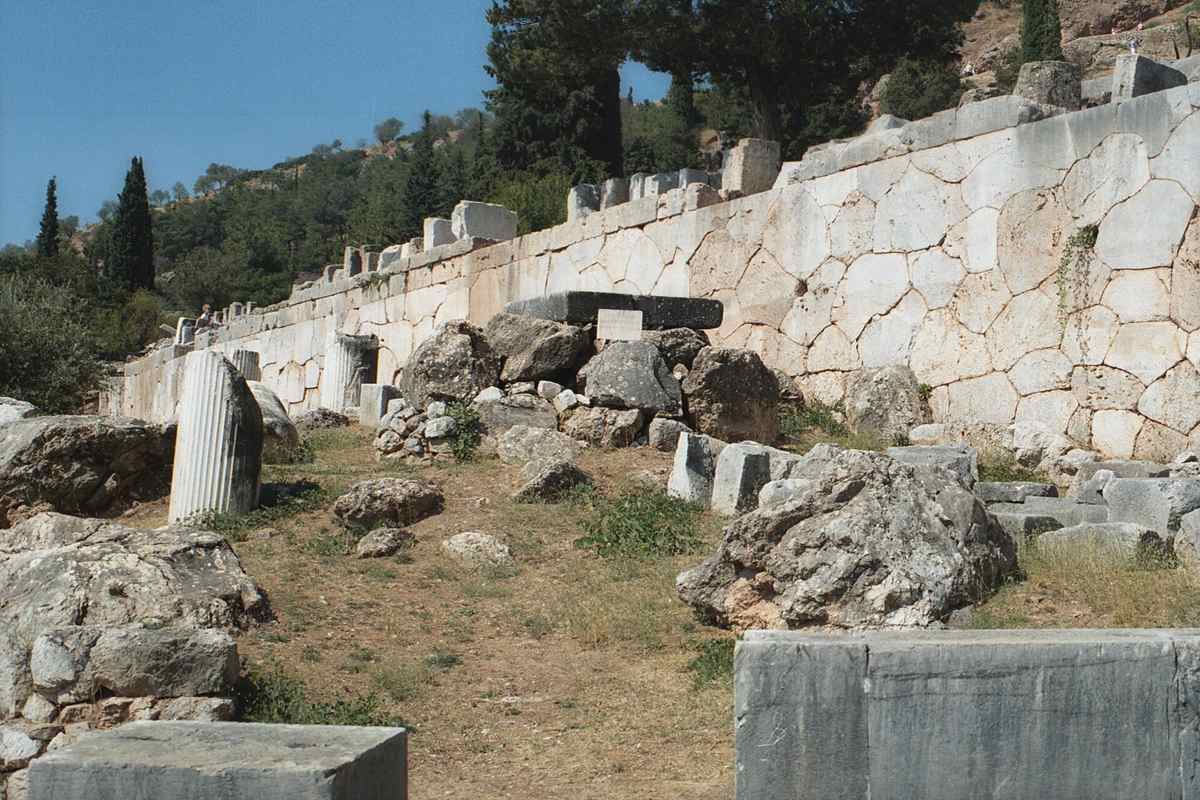
Oracle of Delphi tours take place in central Greece, north of the Gulf of Corinth. There, the sanctuary of Apollo stands on Mount Parnassus. They are small-group or private trips through Greece with a host. Topics include the Pythia, Apollo’s temple, the adyton, laurel and the tripod. Later sections turn to famous answers, such as those given to Croesus, and to the Castalian Spring. Separate pages explain the Delphi day trip from Athens, Delphi tours and Greek mythology places. Wider choices sit under Greece tours.
Bookings made through the GetYourGuide widgets on this page earn Classical Greece Tours a commission, at no extra cost to the traveller.
What was the Oracle of Delphi?
The Oracle of Delphi was another name for the Pythia, Apollo’s priestess at his temple in Delphi. She acted as the mouthpiece through which the god’s oracles reached people. An oracle is a person believed to pass on counsel inspired by a god.
Visitors to the Oracle of Delphi included non-Greeks as well as Greeks. They travelled to Delphi from across the Mediterranean world and from lands farther still. Ancient writers called each visitor a consultant. The word literally means a person who seeks counsel. Counsel is careful advice given before a serious decision.
A goat was placed in front of the altar and sprinkled with water. If the animal shook off the drops, the sign was good for the Oracle of Delphi. If it stayed still, the god was held to have rejected the enquirer, and the consultation ended. An omen is a sign believed to reveal a god’s will.
Next, the goat’s organs were examined, with special care for the liver. The organs were then burned outside on the altar of Chios. An altar is a raised stone block where offerings to a god are made. The rising smoke was the sign that the Oracle of Delphi was now open.
- State questions: Cities asked about public matters such as the founding of new colonies.
- Private questions: Individuals asked about personal matters such as marriage, children and health.
- Surviving answers: Between 535 and 615 Delphic statements survive, and over half are said to be historically accurate.
Ancient Greeks ranked the Oracle of Delphi above every other Greek oracle for prestige and authority. Prestige is the respect that comes from a high reputation. Authority here means the weight that people gave to its answers when they made decisions.
Who was the Pythia who spoke as the Oracle of Delphi?
The Oracle of Delphi spoke through the Pythia, a priestess whose prophecies were credited to possession by Apollo. Greeks called this state enthusiasmos, their word for being filled by a god. A prophecy is a message about events still to come.
The office of Pythia had begun by the close of the 8th century BC. Other estimates date the shrine back to 1400 BC. Married women also held the post. On taking it, each priestess gave up family duties and marital relations. She also set aside her own identity in the service of the Oracle of Delphi.
In its peak years, the Oracle of Delphi is thought to have chosen women from influential families. Such a woman was well educated in geography, politics, history, philosophy and the arts. In later periods, uneducated peasant women filled the role instead. This change is one explanation for a shift in prophecies from verse to prose.
John Hale, an archaeologist, judged that aptitude rather than ascribed status made women eligible. Aptitude means a natural talent for a task, and ascribed status means rank fixed by birth. After Echecrates of Thessaly abducted a young Pythia, the Oracle of Delphi chose women over fifty. They dressed and wore jewellery like young maidens.
- Pay: Priestesses received a salary and housing, both provided by the state.
- Honours: Gold crowns were among the rewards that priestesses frequently received.
- Strain: At the end of each session, the Pythia resembled a runner after a race.
Service at the Oracle of Delphi placed the Pythia among the women of greatest power. That standing held across the classical world, meaning ancient Greece and Rome. Power here means the ability to shape the choices of other people.
How did the Temple of Apollo house the Oracle of Delphi?
The Oracle of Delphi worked inside the Temple of Apollo. Pilgrims who came to consult the Pythia waited for their answers in its main cella. A cella is the central hall of a Greek temple, set behind a covered porch.
The first temple at the Oracle of Delphi was, in tradition, a hut of laurel. Laurel was Apollo’s sacred tree, and this wood came from the Vale of Tempe. One account credits the second temple to a Delphian named Pteras, who built it from ferns. The writer Pausanias rejected that story.
Pausanias offered two endings for the third temple of the Oracle of Delphi. Either fire burned it, or it fell into a deep crack in the earth. The original fifth temple was built in the Doric order, a plain style of Greek columns. Its outer ring of columns, called a peristyle, stood six columns wide and fifteen long.
Before the fifth temple rose, its budget was set at 300 talents. The people of Delphi paid a quarter, and gifts from abroad covered the rest. A talent was a large ancient unit of weight used for silver. The Egyptian king Amasis II gave 1,000 talents toward the new home of the Oracle of Delphi.
- Marble: An unexpected rise in the budget paid for columns of white Parian marble.
- Paintings: Paintings on the cella walls are the work of Aristoclides, according to Pliny the Elder.
- Pindar’s chair: Pindar mentions an iron chair in the temple, offered to him for singing odes to Apollo.
In 1938, French excavators found two small cavities below the temple of the Oracle of Delphi. Inside lay pieces of ivory, bronze and gold. These are thought to be remains of chryselephantine statues, a term for figures of gold and ivory. The statues showed human forms.
Why was the adyton the heart of the Oracle of Delphi?
The Oracle of Delphi had its centre in the adyton, the Pythia’s seat in Apollo’s temple. In Greek, adyton literally means not to be entered. Such rooms were kept for oracles, priests and their helpers, never for the general public.
The adyton of the Oracle of Delphi was a small room, just 9 by 12 feet. In metric units, that is 2.7 by 3.7 metres. The chamber lay below the main temple floor and sat offset to one side. Offset here means set away from the central line of the building.
The room of the Oracle of Delphi is thought to have held a golden statue of Apollo. It also housed sacred armour that no mortal was allowed to touch. A mortal is a human being. An altar there kept a fire of pine wood burning. On it, the Pythia is said to have burned bay leaves and barley meal.
A visitor was led into the temple to reach the adyton and put a question to the Pythia. After hearing the answer, the visitor left. A priest above her listened through a gap in the floor to catch her voice. He then explained the prophecy of the Oracle of Delphi to the enquirer.
- Usual place: An adyton was commonly a small area at the far end of the cella.
- Cult image: Inside, the room tended to house the cult image, or sacred statue, of its deity.
- Apollo’s temples: Adyta, the plural form, appeared frequently in temples of Apollo at Didyma, Bassae, Clarus and Delos.
Plutarch wrote about the room where consultants of the Oracle of Delphi were seated. At irregular moments, it filled with a fragrance and a breeze. He likened the scent to the sweetest and costliest perfumes flowing from a spring.
What part did bay laurel play at the Oracle of Delphi?
The Oracle of Delphi was linked with a laurel tree from its earliest days. Apollo was believed to live inside the laurel, his holy plant. He foretold the future through the rustling of its leaves. Rustling is the soft sound of leaves moving in air.
Laurus nobilis is the scientific name of the bay laurel, also called sweet bay or Grecian laurel. It is a sweet-smelling evergreen, either a tree or a large shrub, with smooth green leaves. In Greek the plant is called daphne. The name comes from a mountain nymph of myth, a nymph being a minor goddess of nature.
Lucian, a poet, wrote that the Pythia chewed laurel leaves picked from a sacred tree in the temple. She did this to bring on the trance in which the Oracle of Delphi spoke. From the fourth century BC, accounts show her shaking a laurel branch while she prophesied. A trance is a dreamlike state.
Consultants walked up the Sacred Way carrying laurel branches, which were sacred to Apollo. The Sacred Way was the winding path that climbed to the temple. For important cases, a priest wrote the reply of the Oracle of Delphi on a laurel leaf. Other replies were spoken aloud to the enquirer.
- Wreaths: People given a hopeful omen by the Pythia were crowned with laurel, a sign of Apollo’s favour.
- Burning: At Delphi, laurel was burned as one part of sacred ritual.
- Oleander: The scholar Harissis found that ancient texts frequently placed oleander, a toxic shrub, under the term laurel.
In myth, Apollo loved Daphne, a priestess of Gaia, the Earth goddess. Gaia carried her away to Crete and left a laurel tree in her place. Apollo, god of the Oracle of Delphi, made wreaths from that tree to comfort himself.
Which tripod did the Oracle of Delphi sit on?
The Oracle of Delphi sat on the Delphic Tripod, the best-known tripod in ancient Greece. The word comes from Greek and means three-footed, a stand resting on three legs. By classical times, this tall seat was sacred to Apollo.
The seat of the Oracle of Delphi was a round slab set on top of the tripod. When the priestess was away, a laurel branch lay on the slab. Her own seat was a tall gilded tripod. It stood above an opening in the inner sanctum. Gilded means coated in gold leaf.
William Godwin wrote that the tripod was pierced with holes. As the Pythia breathed in the vapours, her voice seemed more than human. The scholar Martin West pointed to the Oracle of Delphi sitting in a cauldron on a tripod. He saw this as a trait shared with shamans, healers who enter trances to reach spirits.
Tripods first served a plain purpose. They held a cooking pot over a fire, and that use led to their ritual role. On uneven ground, no seat or stand is steadier than one with three legs. Smaller sacrifices burned in tripods and bowls are tied closely to Apollo and the Oracle of Delphi.
- Early tripods: In the Geometric period, each tripod was fixed to the cauldron it carried.
- Museum pieces: The Museum of Delphi holds fragments of such tripods, one with a ring-shaped handle.
- Gifts and prizes: Tripods were given to temples as offerings and awarded as prizes at festivals.
Herodotus wrote that victory tripods had to stay inside the temple sanctuary. They were left there as dedications, which are gifts set apart for a god. A cauldron, the pot such tripods carried, is a large metal vessel for heating liquids.
Why did Apollo fight the serpent Python for the Oracle of Delphi?
The Oracle of Delphi first belonged, in myth, to Python, a serpent at the centre of the Earth. Greeks placed that centre at Delphi. Apollo slew this chthonic foe and took over its home and its oracle. Chthonic means belonging to the earth beneath.
The name Pytho replaced Krisa, the earlier name of the place. In the Homeric Hymn to Apollo, the god searched for a place to found his shrine. At Delphi he met Python, a serpent that brought harm to the people. After killing it, he named himself owner of the Oracle of Delphi.
The writer Robert Graves read myths as echoes of old political turmoil. In this tale he saw Greek-speaking Hellenes seizing an older, pre-Hellenic shrine. He wrote that regular funeral games honoured the dead Python, so as to calm local opinion. Python’s priestess also kept her office at the Oracle of Delphi.
The scholar Erwin Rohde called Python an earth spirit whom Apollo conquered. For Rohde, the tale showed one god building his temple over the grave of another. Mythologist Karl Kerenyi noted that a number of early accounts merged Python with Typhon. Typhon was the serpent-like monster against which Zeus once fought.
- Nature reading: The myth has been read as sunbeams, Apollo’s arrows, clearing fog rising from marshes.
- Leto’s cry: Clearchus of Soli wrote that Leto, holding the young Apollo, cried out “shoot, child”.
- Snake name: Python, a genus of snakes in the family Pythonidae, takes its name from this serpent.
Another view makes Python the good daemon of the temple, as in Minoan religion. In that reading, Python served the Oracle of Delphi as a kindly guardian spirit. Even so, Python was pictured as a dragon, as in the folklore of northern Europe.
Which poems link Phemonoe to the Oracle of Delphi?
The Oracle of Delphi is tied in tradition to Phemonoe, credited as the inventor of hexameter verse. Hexameter is a type of poetic metre with six measures in each line. Metre is the pattern of beats that gives verse its rhythm.
One tradition makes Phemonoe a daughter of Apollo and his first priestess at the Oracle of Delphi. Another makes her the daughter of Delphus, a possible son of the god. A number of writers placed her at Delos instead of Delphi. The writer Servius identified her with the Cumaean Sibyl, a prophetess of Cumae in Italy.
Ancient writers did not agree that the hexameter began with her. Pausanias called Phemonoe the first poet to use it. Elsewhere he quoted a hexameter couplet credited to the Peleiades, who lived before her. A couplet means two lines of verse that belong together. Poems also circulated under her name, as old religious poems did under Orpheus.
Later ancient authors quoted from works under her name. Melampus cited Phemonoe in his book on twitches, a form of divination from body movements. Pliny quoted her about eagles and hawks. His source appears to be a book of augury, the reading of signs in the flight of birds.
- Know thyself: A number of studies credit Phemonoe with this saying at Apollo’s temple, home of the Oracle of Delphi.
- Statue: An epigram, or short poem, by Antipater of Thessalonica describes her statue in a pharos, a cloak.
- Era: Greek mythology places Phemonoe in the ante-Homeric period, before the time of Homer.
At the Oracle of Delphi, priests were said to recast the Pythia’s words as dactylic hexameter. A dactyl is a long beat followed by two short ones. Verses of this kind survive in large numbers within Greek literature today.
Did Themis hold the Oracle of Delphi before Apollo?
The Oracle of Delphi was built by Themis, according to one tradition, and the goddess was herself oracular. She is linked with oracles and prophecies in Greek religion, the shrine at Delphi among them. Oracular means able to give prophetic answers, as an oracle does.
In one legend, Themis received the Oracle of Delphi from Gaia, the Earth goddess. She later passed it to the goddess Phoebe. Phoebe then handed it on to Apollo, her grandson, as a birthday present. The writer Ephorus says Themis helped Apollo find the oracle, with the aim of helping humankind.
Aeschylus traced the Oracle of Delphi back to prehistoric times, when Gaia was worshipped there. He set out that view in the prologue of his play the Eumenides. Three oracles worked at Delphi in turn, and the first used dreams. In egkoimisi, a person slept in the holy place to receive a revealing dream.
Later the site was believed sacred to Poseidon, god of earthquakes. One reading of the myths has a new site at Troizen given to him as amends. Still later myths said Apollo received the Oracle of Delphi as a gift from Phoebe or Themis. That account made the takeover by the new god’s priests seem lawful.
- Meaning: Her name means divine law, or more literally, what is put in place.
- Role: Themis stands for justice, law, custom and the divine order in Greek religion.
- Title: The Hymn to Apollo calls Themis Ichnaea, which means the Tracker.
Hesiod’s Theogony counts Themis among the twelve Titans born to Gaia and Uranus. As the second wife of Zeus, she bore the Horae, or Seasons, and the Moirai, or Fates. The Titans were the older generation of gods who came before the Olympians.
How do the Thriae and the drawing of lots connect to the Oracle of Delphi?
The Oracle of Delphi owed its art of divination, in one story, to the Thriae. These three winged sisters of Mount Parnassus were said to have taught it to Apollo. Divination is the practice of seeking hidden knowledge through signs.
The Thriae were three nymphs linked with Mount Parnassus above Delphi. Modern accounts make them naiads, or water nymphs, of the springs of the Corycian Cave. Each had a woman’s head and upper body, with the lower body and wings of a bee. The writer Philochorus called them the nurses of Apollo on the mountain.
The Thriae once kept a Kliromanteion, an oracle that worked by lot. This was possibly the first form of the Oracle of Delphi. Lots were thrown into a container and drawn out. The colour and shape of each lot held particular meaning. A lot is a small object chosen by chance to decide a matter.
If the Pythia was unavailable, consultants asked the priests simple yes-or-no questions. The reply came from tossing coloured beans. One colour stood for yes and another for no. Little else is known of the practice at the Oracle of Delphi. A yes-or-no question is one with only two possible answers.
- Names: Pausanias names them Melaina, the Black, Cleodora, and Daphnis, the Laurel, or Corycia.
- Bees: Bees were linked with the Oracle of Delphi, and its prophetess was at times called a bee.
- Pebbles: Another account says the Thriae taught Apollo prophecy by mantic pebbles, meaning thrown stones.
The broader practice is called cleromancy, divination through the casting of lots. Its result comes from a seemingly random means, such as rolling dice. Believers held that such a result revealed the will of a god. The Greek word for a lot was kleros.
Why did the Oracle of Delphi fall silent while Apollo was in Hyperborea?
The Oracle of Delphi stayed closed to consultation through all the winter months. Tradition held that this was the season when Apollo lived among the Hyperboreans. A tradition is a belief that older people pass on to younger ones.
The Hyperboreans were a mythical people of the far north of the known world. Their name appears to mean beyond Boreas, and Boreas was the north wind’s god. Greeks pictured their home as sunny, mild and blessed by the gods. The Riphean Mountains were said to shield them from the cold northern blast.
Alone among the Twelve Olympians, Apollo was worshipped among the Hyperboreans. In winter, the god of the Oracle of Delphi was said to travel north on his white swans. A number of Greek writers held that the Hyperboreans founded Apollo’s sanctuaries on Delos and at Delphi. The Twelve Olympians were the chief gods of Greek religion.
During the winter pause, attention at the temple turned to Dionysus. His female followers, the Thyiades, staged festivals and rituals in his honour. The tomb of Dionysus was also said to lie within the temple of the Oracle of Delphi. Here, tomb means the burial place of the god’s mortal remains.
- Amber: Baltic amber, a fossil tree resin, has been found in the sanctuaries at Delphi and Delos.
- Stars: The season for consulting the Pythia was tied to the constellations Lyra and Cygnus.
- Apollo’s months: For nine months of each year, the cult of Apollo led worship at the temple.
Tradition set Apollo’s return at the start of spring, on day seven of the month Bysios. That day was his birthday. Once a month from then on, purification rites, fasting among them, prepared the Oracle of Delphi to speak.
Can the Kerna spring explain the trances of the Oracle of Delphi?
The Oracle of Delphi seemed to Plutarch to draw power from vapours of the Kerna spring. Its waters flowed beneath the temple. Plutarch served for a number of years as high priest at Delphi. A vapour is a gas rising from a liquid.
From 1892, French archaeologists excavated the site and found no fissure and no source of fumes. A fissure means a deep split in rock. In 1904 Adolphe Paul Oppé argued that the Oracle of Delphi never had a chasm or vapour. Yet neither he nor the later scholar Pierre Amandry was a geologist.
In the 1980s, geologist Jelle Zeilinga de Boer and archaeologist John R. Hale studied Delphi. This formed part of a United Nations study of active faults in Greece. Faults are breaks in the crust where rock shifts. Their survey traced the Kerna fault north to south and the Delphic fault east to west.
A bituminous layer, rich in hydrocarbons, lies far below the region of the Oracle of Delphi. Bitumen is a black, tar-like substance, and hydrocarbons are compounds of hydrogen and carbon. The layer’s petrochemical content reaches as high as 20%. Earthquake friction heats it, and the hydrocarbons turn to vapour and rise through small fissures.
- Ethylene: De Boer proposed ethylene, a sweet-smelling gas, as the vapour of the Oracle of Delphi.
- Effects: Henry R. Spiller, an expert on poisons, said even a little ethylene can bring on trances.
- Test results: Kerna spring water tested in 2001 held ethylene at 0.3 parts per million.
Not every scholar accepts the ethylene theory. Lehoux argues that ethylene is impossible as the cause. Others propose methane, or carbon dioxide and hydrogen sulphide, as the chasm gas of the Oracle of Delphi. Methane is the main gas in natural gas.
Which Delphic maxims greeted visitors to the Oracle of Delphi?
The Oracle of Delphi sat within a temple whose entrance bore its three best-known moral sayings. One said Know thyself, another Nothing in excess, and a third Surety is ruin. A maxim is a short saying that states a rule for living.
Three maxims stood carved on the temple by the 5th century BCE at the latest. Their exact spot is uncertain. Ancient writers name the wall of the pronaos, a column, a doorpost, the temple front or the gateway. The pronaos was the porch before the main hall of the temple of the Oracle of Delphi.
Tradition credited the sayings to the Seven Sages, a legendary group of thinkers and statesmen. They flourished in the 6th century BCE. Plato lists Solon, Thales, Bias, Pittacus, Chilon, Cleobulus and Myson. In all likelihood, they were older common proverbs. Their place on the temple gave them new weight.
In its earliest uses, Know thyself meant understanding one’s limits and one’s place in society. Nothing in excess mainly warned people not to give way to excess emotion, grief in particular. At the temple of the Oracle of Delphi, it is thought to have warned against lavish sacrifices. Worshippers were to give humbly what they had to spare.
- Pledge: The Greek word engya can mean a loan surety, a marriage oath or a strong affirmation.
- The letter E: Plutarch’s essay on the E at Delphi is the only literary source for that inscription.
- Plato: Plato mentions the entrance maxims in six of his dialogues, written conversations on philosophy.
Latin authors read the third maxim of the Oracle of Delphi as advice against giving surety. Surety is a promise to pay or answer for another person’s debt. Eliza Wilkins found Greek writers split between that meaning and a call to commit oneself firmly.
What did the Oracle of Delphi tell Heracles to do?
The Oracle of Delphi told Heracles to serve King Eurystheus for twelve years. The king was to choose ten tasks for him to perform. In the Greek myth, the hero had asked the oracle where to go once he was purified.
Long before he consulted the Oracle of Delphi, Heracles was born with the name Alcides. His later name translates as glory or fame of Hera. Greeks thought of him as both a hero and a god. He was said to possess strength far beyond that of any human. No grave was ever named as his.
One tradition says that Hera drove Heracles mad. In that fit, he killed his wife Megara and their children. Antikyreus, the founder of Antikyra, cured the madness with hellebore. Hellebore is the name of a medicinal plant. To be purified meant to pass through a rite that cleansed a person of guilt.
Eurystheus later added two more tasks, which brought the total to twelve labours. He refused to count the cleaning of the Augean stables, as Heracles had planned to accept pay. The reward promised through the Oracle of Delphi was immortality, if Heracles succeeded. Immortality means a life that never ends in death.
- Omphale: Xenoclea, speaking for the Oracle of Delphi, made Heracles serve this Lydian queen for a year.
- Lion skin: During his service, Omphale dressed in the Nemean Lion’s skin and held his club of olive wood.
- Marriage: After a time, Omphale set Heracles free and then took him as her husband.
Greeks honoured Heracles widely as a protector of young men and of gymnasia. A gymnasium was a place where young men trained their bodies. At certain festivals, Greeks offered him sacrifice first as a hero, then as a god.
How did the Oracle of Delphi shape the fate of Oedipus?
The Oracle of Delphi gave answers to both Oedipus and his father in the Theban myth. Laius had turned to it after a long time without children. Years later, Oedipus came to the same oracle with a question about his parents.
Laius and Jocasta, the king and queen of Thebes, were the parents of Oedipus. In the version told by Aeschylus, the Oracle of Delphi warned Laius in a different way. Laius was able to save his city only if he died without a child. Aeschylus was a Greek writer of tragedies, which are serious plays with sad endings.
Years after his birth, Oedipus heard a drunk call him an illegitimate child, meaning one born outside marriage. His foster parents denied the claim when he asked them. The Oracle of Delphi then told him that he must never go home. Believing that Corinth was his home, he set out instead for Thebes, a city closer to Delphi.
On his way, Oedipus met an older man and killed him in a quarrel. The stranger was Laius, and Oedipus also killed all but one of his attendants. The lone survivor claimed that a gang of men had carried out the attack. Damasistratus later buried Laius at the place where he died.
- Plague: When a plague struck Thebes, Oedipus sent Creon to the Oracle of Delphi for help.
- Answer: Apollo declared that the plague was to end only when the true killer of Laius faced punishment.
- False relief: News that Polybus, his foster father, had died made Oedipus think he had escaped fate.
The messenger who brought that news had once found the baby Oedipus in the pass of Cithaeron. A pass is a narrow route between mountains. The poet Pindar wrote that the son of Laius had fulfilled an oracle given long before.
Did the Oracle of Delphi give Sparta its laws through Lycurgus?
The Oracle of Delphi was consulted by Lycurgus, says Herodotus, before he put his new laws into force. In that account, Lycurgus received the laws from Apollo through the Pythia. Lycurgus was a partly legendary Spartan lawgiver of the 8th century BC.
Lycurgus is remembered as the lawgiver who built a military-minded Spartan society in line with the Delphic oracle. Before his reforms, Herodotus writes, the Spartans had been the worst-governed people among the Greeks. Lycurgus heard the answer of the oracle once he reached the inner sanctum of the temple. An inner sanctum is the holiest room of a shrine.
The Pythia, who served as the priestess of the Oracle of Delphi, greeted him in verse. She hailed him as dear to Zeus and to every god of Olympus. She then said that she doubted whether to name him a man or a god. In the end, she judged him to be a god.
Xenophon and Plutarch both credit Lycurgus with a clumsy coinage made of iron. The coins aimed to stop attachment to wealth. Plutarch and Diodorus tie this to another saying of the Oracle of Delphi. The warning said that love of money alone will bring ruin to Sparta. Coinage, however, had not yet come into use in his lifetime.
- Written record: The priests at Delphi kept a written record of every answer the oracle gave.
- Great Rhetra: Herodotus dates this text of Spartan law to before kings Agasicles and Leon, crowned about 590 BC.
- Fragments: The full Rhetra is now lost, apart from pieces passed down by classical authors.
The word rhetra literally means a saying or proclamation. In a second sense, it names an answer of the Oracle of Delphi. People believed that this answer held the whole Spartan constitution, or basic law of the state, in verse.
What riddle did the Oracle of Delphi give Byzas?
The Oracle of Delphi was asked for advice by Nisos, king of Megara. He then sent his son Byzas to find the land opposite the city of the blind. That phrase worked as a riddle, a puzzle in words with a hidden meaning.
In the 7th century BC, Greek city-states were spreading out and founding new colonies. A colony was a settlement founded by people sent out from a home city. Megara, a city-state near Athens, also wanted a site for one more colony. Its new town grew into Byzantium, later called Constantinople and now Istanbul.
Where the Bosporus meets the Sea of Marmara, Byzas finally grasped the meaning of the Oracle of Delphi. Across the water, on the Asian shore, stood Chalcedon, a colony founded earlier. Byzas decided that Chalcedon was the city of the blind. Its settlers had not made use of the European shore.
For his city, Byzas chose the European shore at the south end of the Bosporus. The Bosporus is a narrow sea channel. He named the new city Byzantion. Its people later honoured him as their oikistes, the Greek word for founder. Chosen after the answer of the Oracle of Delphi, the site guarded the entry to two seas.
- Marriage: Byzas married Phidalea, a daughter of King Barbizos of Thrace.
- Statue: The people of Byzantion raised a statue of Byzas and Phidalea in a prominent place.
- Megabazus: Herodotus wrote that this Persian general called the people of Chalcedon blind for choosing the worse site.
The Greek geographer Strabo recorded the story of the Oracle of Delphi and Byzas. The Roman historian Tacitus told it as well, in the 1st century AD. Geographers write about the lands, seas and places of the earth.
Why did the Oracle of Delphi keep sending Battus to Libya?
The Oracle of Delphi told the people of Thera, again and again, to found a city in Libya. Battus took charge of the task for King Grinus, who was too old to travel. Neither man knew where Libya was.
In the time of Battus, Thera suffered a severe drought, and no rain fell there for seven years. Its people were also growing in number, so the island was no longer able to feed them all. Battus travelled with Grinus, the king of Thera, to seek help from the Oracle of Delphi.
Back home, the drought grew worse, so the king sent Therans to the Oracle of Delphi once more. The priestess repeated her message about a colony in Libya. Grinus then sent men to Crete, where they landed at Itanus. There they met Corobius, a fisherman once blown off course to Platea, an island near the Libyan shore.
After two years on Platea, the settlers went back to Delphi. The priestess told them to settle on the mainland instead. In one version, her reply asked whether the Therans knew Libya, rich in fleeces, better than she did. The Therans then built Aziris and stayed six years there at peace with the Libyans.
- Apollo’s Fountain: The Libyans later led the settlers west, through farmland called Irasa, to a site of that name.
- Hole in the sky: Local Libyans said the site had a hole in the sky, thought to mean heavy rainfall.
- Statue at Delphi: The people of Cyrene dedicated a statue at Delphi showing Battus riding in a chariot.
In 600 BC Battus died, and his subjects in Cyrene worshipped him as a hero. His grave lies near the marketplace, beside a road he ordered built to the temple of Apollo. In all, the Therans brought their troubles to the Oracle of Delphi three times.
Which festival did the Oracle of Delphi mean for Cylon?
The Oracle of Delphi, according to Thucydides, told Cylon to take Athens at a festival of Zeus. Cylon took this to mean the Olympic Games. Thucydides then discusses a festival called Diasia, so certain scholars question whether the coup came at the Olympics.
Cylon, who sought the advice of the Oracle of Delphi, was an Athenian noble. He had won at the Olympic Games in 640 BC. He tried to take power in either 636 BC or 632 BC. His father-in-law, Theagenes, was tyrant of Megara, which backed him. A tyrant was a person who seized power outside the law.
The masses opposed the coup that followed the advice of the Oracle of Delphi. Cylon’s followers fled into Athena’s temple on the Acropolis. A coup is a sudden grab for power. Thucydides says that Cylon and his brother escaped. Plutarch adds that the followers tied a rope to the statue of Athena before going to trial.
When the rope broke on the way, archons led by Megacles saw this as rejection by the goddess. The archons were the nine top officials of Athens. Megacles and his family, the Alcmaeonidae, were later exiled for killing people under divine protection. Epimenides of Phaistos, a Cretan seer or prophet, purified the city.
- Mass graves: In April 2016, two mass graves holding 80 bodies were found at Palaio Faliro.
- Possible link: Kristina Killgrove suggested that the dead were followers of Cylon, but results are not definitive.
- Written law: In 621 BC, about two decades after the coup, Draco drew up the first written laws of Athens.
The killings led to the Cylonian curse, a stain passed down the generations. Sparta later used the curse as a political tool against the families opposing its ally Isagoras. Those families were led by Cleisthenes, who also sought help from the Oracle of Delphi.
Where did Croesus go wrong with the Oracle of Delphi?
The Oracle of Delphi told Croesus that war on the Persians meant the downfall of a mighty empire. The oracle at Thebes gave the Lydian king the same reply. Croesus went to war, yet his own empire was the one that fell.
Croesus, a king of Lydia, was famed for his riches and for his defeat by Cyrus the Great. His great-great-grandfather Gyges had first built close ties between Lydia and Apollo’s sanctuary at Delphi. In return for royal gifts, Lydians gained first place in consulting the oracle and freedom from taxes.
Lydians were also allowed to sit in the front rank and even to become priests of Delphi. In turn, the Delphians had a duty to welcome and protect Lydian envoys. An envoy is a messenger sent by a ruler. Croesus later asked the Oracle of Delphi whether to make war on Persia and whether to seek allies.
Croesus next asked whether his rule was to last long. The Pythia, Apollo’s priestess, told him to flee once a mule became king of the Medes. Croesus judged a mule king impossible. Yet Cyrus was half Mede through his mother and half Persian through his father. That mixed birth made him a kind of mule.
- Allies: Both oracles also told Croesus to seek out the strongest Greek peoples as allies.
- Sparta: Croesus decided that Sparta was the strongest Greek state and turned to it.
- Gold for Apollo: The Oracle of Delphi told Sparta that gold from Croesus was to coat a statue of Apollo.
The meeting of Croesus and the Oracle of Delphi, told by Herodotus, is thought to be legend. His fate after the war is uncertain. In the common versions of the tale, Cyrus kept the fallen king as his adviser.
Why did Cleisthenes turn to the Oracle of Delphi for help?
The Oracle of Delphi was asked by Cleisthenes to persuade the Spartans to help free Athens from tyranny. The Oracle of Delphi accepted his plea. His family had earlier helped to rebuild the Delphic sanctuary after a fire had destroyed it.
Cleisthenes was an Athenian lawgiver who set the government of Athens on democratic lines in 508 BC. Historians call him the father of Athenian democracy. He came from the noble Alcmaeonid clan and was a grandson of Cleisthenes, tyrant of Sicyon. Tyranny was rule by one person who held power outside the usual laws.
Years before the plea to the Oracle of Delphi, Pisistratus had seized power in Athens as a tyrant. He drove the Alcmaeonidae into exile. After his death in 527 BC, Cleisthenes came back and served as eponymous archon. An eponymous archon gave his name to the year. Hipparchus and Hippias, the successors of Pisistratus, then exiled him again.
In 514 BC, Harmodius and Aristogeiton killed Hipparchus, and Hippias grew harsher toward the people of Athens. Urged by the Oracle of Delphi, the Spartans agreed to help Cleisthenes, though they did so with reluctance. In 510 BC, Spartan hoplites, or heavy foot soldiers, helped the Athenians remove Hippias from power.
- Ten tribes: Cleisthenes replaced the four old family tribes with ten tribes based on where people lived.
- Demes: The local districts were called demes, and scholars put their number at 139, though this is debated.
- Ostracism: His reforms set up ostracism, a public vote that banished a citizen, as a punishment.
King Cleomenes I of Sparta had installed an oligarchy, or rule by a small group, under Isagoras. Cleisthenes won the support of the middle class and took over. Cleomenes stepped in during 508 and 506 BC, but he was unable to stop Cleisthenes.
What did the Oracle of Delphi foretell for Leonidas and Sparta?
The Oracle of Delphi gave Sparta two possible fates before the Persian invasion. Either the great town was to be sacked by the sons of Perseus. Or the land of Lacedaemon, around Sparta, was to mourn a king descended from Heracles.
The allied Greek forces asked Sparta to help defend Greece against the Persian invasion. On receiving the request, Sparta consulted the Oracle of Delphi. The reply was said to come in hexameter verse. Hexameter is a form of poetry with six beats in each line. It was the style of Greek epic poems.
A second version warned that the strength of bulls or lions was unable to stop the foe. The enemy was not to stop until he had torn apart either the city or the king. The Spartans left the Oracle of Delphi in dismay, unsure which fate was worse. Dismay is a feeling of shock and worry.
At Thermopylae, troops from other Greek city-states placed themselves under Leonidas, forming an army of 7,000. Herodotus claimed that the Persian army held over two million men. Modern scholars call this an exaggeration and give estimates from 70,000 to 300,000. Xerxes, the Persian king, waited four days, hoping that the Greeks were going to scatter.
- Days five and six: Leonidas and the Greeks drove back the frontal Persian attacks on both days.
- Allies sent home: Herodotus believed Leonidas dismissed the allies because they seemed disheartened, or low in spirit.
- His body: The Spartans recovered the body of Leonidas after driving the Persians back four times.
The entire Spartan contingent, including King Leonidas, lost their lives at the pass. Their deaths matched the warning of the Oracle of Delphi about the loss of a king. The word contingent means a body of troops sent by one city.
How did Themistocles read the wooden wall of the Oracle of Delphi?
The Oracle of Delphi promised Athens that a wall of wood alone was to stay untaken. Themistocles, an Athenian politician and general, argued that the words foretold a naval victory at Salamis. The people of Athens accepted his reading and prepared for war.
Aristonice served as the Pythia, the priestess of the Oracle of Delphi, during the Greco-Persian Wars. Her first answer told a group of Athenian envoys to give up and flee. The classicist A. D. Godley renders her words as an order to flee to the ends of the earth. A classicist is a scholar of ancient Greece and Rome.
A leading man of Delphi named Timon advised the envoys to return with olive branches. They went back to the Oracle of Delphi and received a second answer. The messengers wrote it down and carried it home to Athens. Older Athenians took the wooden wall to mean the one that once ringed the Acropolis.
The second answer spoke of holy Salamis, a place of death between seedtime and harvest. Seedtime is the season for sowing grain. Themistocles argued that the word holy meant the dead were to be enemies of Greece. If Athenians were meant, he said, the oracle needed to call the island cruel Salamis.
- Battle: Athens was then evacuated to Salamis, and the allied fleet destroyed the Persian fleet nearby.
- The winds: Asked how to defeat Persia, the oracle told the Delphians to pray to the Winds.
- Artemisium storm: Violent winds struck the ships off Cape Artemisium for three straight days.
Themistocles belonged to a new kind of Athenian politician who did not come from the nobility. The scholar Noel Robertson offers another reading of the Oracle of Delphi. He links the wooden wall to defences on the Corinthian isthmus, a narrow neck of land.
Who did the Oracle of Delphi name as the wisest of men?
The Oracle of Delphi named no man wiser than Socrates. The question came from Chaerephon, a loyal friend and follower of the Athenian thinker. Chaerephon travelled to Delphi and asked the Pythia, the priestess of Apollo, whether anyone was wiser.
Socrates called Chaerephon impetuous, meaning quick to act without careful thought. The comic poet Aristophanes nicknamed him the bat in his play The Birds. Xenophon placed Chaerephon on his list of the true companions of Socrates. Chaerephon, who questioned the Oracle of Delphi, came from Sphettus, a deme or local district of Athens.
Socrates said that the answer of the Oracle of Delphi astounded him. The oracle was not one to lie, yet he knew that he was not wise. To solve this puzzle, he set out to question politicians, poets and craftsmen. He hoped to find a person wiser than himself.
After one such talk, Socrates judged a politician less wise than himself. The man thought that he knew something when he did not. Socrates was about 30 years old at the time, by one estimate. His fame as a philosopher had yet to come. A philosopher studies big questions about truth and the right way to live.
- Another version: One telling ranks Sophocles as wise, Euripides as wiser and Socrates as the wisest of all.
- At his trial: Socrates told the jury that his duty to the god of Delphi came before his duty to them.
- A friend absent: Chaerephon had died before the trial, though his brother sat among those present.
In Plato’s Apology, Socrates casts himself as a spokesman for the Oracle of Delphi. The Apology is Plato’s account of his trial. His task was to stir the Athenians toward ethics, the study of right and wrong. He vowed never to stop practising philosophy while he lived.
Which order from the Oracle of Delphi did Diogenes take literally?
The Oracle of Delphi, says one legend, told Diogenes to adulterate the currency. He had asked the Oracle of Delphi how to win renown, or fame. To adulterate means to spoil something by mixing in a cheaper substance. Diogenes took the order literally.
Diogenes, also known as Diogenes of Sinope, helped found Cynicism, a school of Greek philosophy. Diogenes called for a return to nature and for giving up wealth. He was born into a prosperous family in Sinope. A scandal over the debasement, or cheapening, of coins later led to his exile.
Another version of the story places the visit to the Oracle of Delphi after his exile. In that telling, the order is tied directly to his mission as a philosopher. Certain accounts name the oracle of Apollo at Delos instead. Diogenes himself claimed that he took up philosophy only later, in Athens.
The story is thought to be apocryphal, or of doubtful truth. It is seen as a possible parody of the answer the Oracle of Delphi gave about Socrates. The tale clashes with the scepticism, or doubt, that Diogenes held toward religion. Jean-Manuel Roubineau thinks later authors made it up to play down his part in any actual fraud.
- Citizen of the world: Diogenes proclaimed himself a citizen of the world, an early form of cosmopolitanism, or belonging to all humanity.
- Ceramic jar: He became famous for living in a large ceramic jar, defying social custom.
- Lantern: He walked through public places with a lit lantern by day, looking for a wise man.
Diogenes reportedly owned a slave from Phrygia named Manes, who ran away. Diogenes said that if Manes was able to live without Diogenes, Diogenes was able to live without Manes. J. Garcia Gonzalez argues that this tale, like other stories about Diogenes, is symbolic rather than factual.
In what way did Zeno of Citium decode the Oracle of Delphi?
The Oracle of Delphi told Zeno of Citium to share the complexion of the dead. Complexion means the colour of the skin. Zeno had asked the Oracle of Delphi how to reach the best life. He read the reply as a call to study ancient authors.
Zeno came from Citium in Cyprus and lived from about 334 to 262 BC. He founded the Stoic school of philosophy and taught it in Athens from about 300 BC. Stoicism placed great weight on goodness and on peace of mind. Stoics sought these through a life of virtue in harmony with nature.
Alongside his search for answers, Zeno grew into a wealthy merchant. On a voyage from Phoenicia to Piraeus, the port of Athens, he survived a shipwreck. In Athens he found a bookseller with Xenophon’s Memorabilia, a work about Socrates. The book pleased him so much that he asked where men like Socrates were found.
Just then, Crates of Thebes walked by, and the bookseller pointed to him. Crates was the best-known Cynic living in Greece at that time. In 301 BC, Zeno began teaching in the Stoa Poikile in the Agora, the public square of Athens. The Stoa Poikile was a colonnade, a long row of columns under a roof.
- Stoics: His followers were first called Zenonians, then came to be known as Stoics.
- Way of life: Zeno lived a spare and simple life, even though he was a wealthy man.
- Biographer: Diogenes Laërtius, an ancient biographer of philosophers, preserved the story of Zeno and the Oracle of Delphi.
Diogenes Laërtius adds that after his answer from the Oracle of Delphi, Zeno became a follower of Crates. Zeno also studied under Stilpo and other thinkers of the Megarian school. He is also said to have studied the philosophy of Plato under Xenocrates and Polemo.
Why did the omphalos stone matter to the Oracle of Delphi?
The Oracle of Delphi kept a stone called the omphalos, Ancient Greek for navel. Accounts mainly place it in the adyton, the closed sacred room of the temple. There it stood near the Pythia, the priestess who gave the answers.
An omphalos is a stone object with a religious purpose. In Latin, the matching term is umbilicus mundi, which means navel of the world. The stone sculpture linked to the Oracle of Delphi carries a carved net of knots over its surface. Its centre is hollow and grows steadily wider towards the base.
Omphalos stones were believed to open a direct line of contact with the gods. A study by Holland in 1933 offered one theory for the stone’s hollow centre. It proposed that intoxicating vapours flowed through the stone to the priestess of the Oracle of Delphi. Intoxicating vapours are fumes that cloud the mind.
Modern understanding of how the Oracle of Delphi used the omphalos remains uncertain. The reason is that Theodosius I and Arcadius destroyed the site. That destruction took place in the 4th century CE. The letters CE mark years of the Common Era. In Greek myth, the stone handed to Cronus also bears the name omphalos.
- Literature: In books and poems, the word omphalos mostly points to the stone at Delphi.
- Writers: Homer, Pausanias, James Joyce and Seamus Heaney all used the term in their work.
- Ulysses: James Joyce brings the word omphalos into the pages of his novel Ulysses.
Omphalos syndrome names the belief that one seat of power outranks every other place in the world. A syndrome is a set of signs that appear together. The phrase borrows the name of the navel stone kept by the Oracle of Delphi.
What role did the Castalian Spring play for the Oracle of Delphi?
The Oracle of Delphi had its place of ritual washing at the Castalian Spring. The Pythia and the priests washed themselves there before giving answers. One version of the myth says Apollo killed the monster Python there while it guarded the spring.
In Greek myth, Castalia was a young nymph whose father was the river-god Achelous. Nymphs are nature spirits shown as young women. Castalia is said to have leapt into the sacred spring at Delphi while Apollo chased her. The spring took her name afterwards. Ancient authors call it sacred to the Muses.
The Archaic fountain house at the spring of the Oracle of Delphi dates from the 6th century BCE. Archaic names the Greek era before the Classical age. Benches ring its basin, which has a marble lining. A short, small aqueduct carried the water to it. An aqueduct is a channel built to move water.
The Roman fountain was built in the 1st century BC. Its position is roughly 50 metres higher than the older fountain. Niches cut into the rock held space for the ex votos of pilgrims to the Oracle of Delphi. An ex voto is an offering given to fulfil a vow. A closed aqueduct brought the spring water to this fountain.
- Courtyard: Stone benches lined three sides of a paved courtyard before the Roman fountain.
- Castalian Band: Poets around King James VI of Scotland named their circle after the spring.
- Modern fountain: A newer fountain stands close to the street that leads to the archaeological site.
Old traditions say the spring already flowed before Apollo reached Delphi in search of Python. Another account says the river Cephisus gave its water to Castalia as a gift. Writers also confused this spring of the Oracle of Delphi with the Spring of Pieris.
How were the Pythian Games tied to the Oracle of Delphi?
The Oracle of Delphi shared its site with the Pythian Games, a dedication to Apollo. Ancient Greece held four Panhellenic Games, and these were one of them. Panhellenic means open to all the Greek cities. Only the Olympic Games outranked them in importance.
The games came round once in four years, two years after each Olympics. In that cycle, they also fell between each Nemean and Isthmian Games. Earlier, an eight-year gap had separated one festival from the next. Other cities staged smaller, informal copies of the games, away from the Oracle of Delphi.
In one version of the legend, the founding of the games follows a wrong done by Apollo. In it, Zeus declared that Apollo had to make amends for slaying Python. Apollo founded the Pythian Games to do so. To make amends means to make up for a wrong. Python was a serpent in Greek myth.
The athletic contests of the games took place in the Stadium. At their peak, they included four track races: stade, diaulos, dolichos and hoplitodromos. The hoplitodromos was a race run with pieces of hoplite armour. A hoplite was a heavily armed foot soldier. Wrestling, boxing and the pentathlon, a contest of five events, also featured.
- Boys’ races: The Pythian programme added extra running races for boys alongside the main events.
- Early prizes: In the first years, winners at the Oracle of Delphi possibly received golden tripods.
- Judges: Winners of the poetry and prose contests were picked by a panel of judges.
Poetry and prose contests met in a theatre above the Temple of Apollo. In 486 BC, Megakles from Athens won the chariot race in the games at the Oracle of Delphi. Pindar honoured him in his seventh Pythian ode, a poem of praise.
Which story does the Athenian Treasury tell beside the Oracle of Delphi?
The Oracle of Delphi had its temple directly above the Athenian Treasury, which sits along the Sacred Way. The Sacred Way is the path that climbs through the sanctuary. Its carved panels hold the earliest known Theseus in large-scale sculpture.
Theseus was the founder and king of Athens in myth. Before this treasury rose at the Oracle of Delphi, he had appeared on painted vases. No earlier image of him on a building is known. The carved panels pair the labours of Theseus with those of Herakles. That is the earliest surviving pairing of the two heroes.
A metope is a carved stone panel set above the columns. Each metope of the treasury stands 67 centimetres tall. Nine ran along each long side, north and south. Six ran along each short side, east and west. The panels also link both heroes through the bull Herakles caught on Crete in his seventh labour.
Pierre de La Coste-Messelière headed the French School at Athens team that excavated the treasury. The building was rebuilt from 1903 to 1906. The panels on it today are copies. The Delphi museum holds the original metopes. At the ruins of the Oracle of Delphi, the structure still stands in situ, or in place.
- Minotaur: One metope shows Theseus facing the Minotaur, a monster that was half bull.
- South ledge: A ledge 0.30 metres wide juts from the south side and holds up the Marathon base.
- Dating: Richard Neer argues that both structures were built after Marathon, a battle of 490 BCE.
Offerings at the treasury of the Oracle of Delphi belonged to Apollo. Rules kept them from ever leaving the sanctuary. Once no longer practical to show, they were buried in votive pits. A votive pit is a hole dug to hold retired sacred gifts.
What made the Siphnian Treasury stand out at the Oracle of Delphi?
The Oracle of Delphi had a treasury built by the city-state of Siphnos to hold its offerings. Scholars favour a date around 525 BC. Before it, no religious structure had been made entirely of marble. Each city-state governed itself and the land around it.
The Siphnians paid for the building with a tithe of their income. A tithe is one tenth of earnings, set aside as a gift. Until recently, scholars mixed it up with its neighbour at the Oracle of Delphi, the Cnidian Treasury. That building was similar but less elaborate. Earlier reconstructions even used parts of both.
The front of the porch rested on two caryatids rather than plain columns. Caryatids are statues of women that take the place of columns. These maidens, called korai, stood between the pilasters. Pilasters are shallow columns attached flat to a wall. They foreshadow the later Caryatids that adorned the Erechtheion in Athens.
Painters once coloured the reliefs gold, red, blue and green. Reliefs are carvings raised above a flat surface. Today, red is the only colour the naked eye can still see. Names of the figures were cut into the background. A large share can still be read in certain light.
- Corner figures: It was among the first Greek buildings to fill gable corners with falling and reclining figures.
- Art history: Its carvings show a shift from Archaic to Classical styles of Greek art.
- Museum: The sculpture and a rebuilt model from the Oracle of Delphi treasury stand in the Delphi Archaeological Museum.
Herodotus is the only classical writer who describes the treasury at the Oracle of Delphi. Neer reads one goddess on the west frieze, a carved band, as Artemis drawing a bow. Earlier scholars saw Aphrodite holding a necklace in the same figure.
Where did the Serpent Column of the Oracle of Delphi end up?
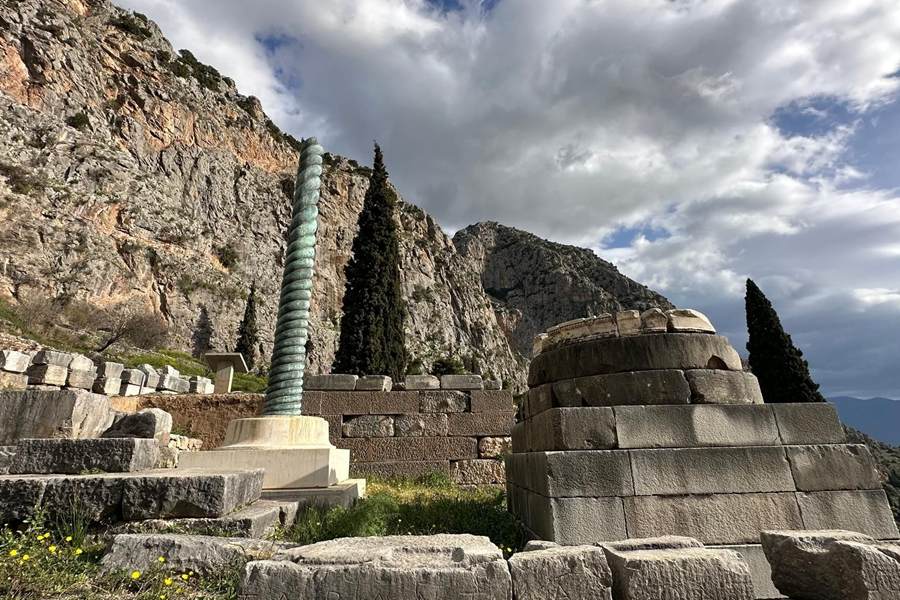
The Oracle of Delphi once held the Serpent Column, also called the Plataean Tripod or Delphi Tripod. The bronze column now stands at the Hippodrome of Constantinople, in today’s Istanbul. A hippodrome was an arena for horse and chariot races.
The Greek city-states made the offering in the spring of 478 BC, months after the Battle of Plataea. Herodotus says they first set apart a tithe of the loot for the god. Loot is property taken from a defeated army. The finished monument stood beside Apollo’s altar at the Oracle of Delphi.
Pausanias, regent of Sparta, led the Greeks at Plataea. A regent governs on behalf of a king. He had a dedication engraved crediting the victory to himself alone. The Lacedaemonians, or Spartans, removed it and carved in the names of the cities instead. Diodorus says a couplet, or two-line verse, by the poet Simonides replaced it.
In the second century AD, a travel writer also named Pausanias saw the bronze part at Delphi. He noted that the Phocian leaders had not left the gold in place. Phocian means from Phocis, the region around Delphi. The original golden tripod and cauldron are long missing. Its base has been found at the Oracle of Delphi.
- Snakes: The 8-metre bronze column is made of three snakes twisted around each other.
- Heads: One account dates the fall of the serpent heads to the night of October 20, 1700.
- Jaw: The upper jaw of one head now sits in the Istanbul Archaeology Museum.
Marcus N. Tod says the ground around it was raised in 1630, hiding the inscribed part. In 1855, Charles Thomas Newton oversaw the excavation of its base. That dig brought the inscription of the old Oracle of Delphi offering back to light.
How does the round Tholos fit the story of the Oracle of Delphi?
The Oracle of Delphi had a round neighbour, the Tholos, inside Athena Pronaia’s sanctuary. A tholos is a circular temple. The carvings on its dome date from between 380 and 370 BC. BC stands for before Christ in the usual dating system.
Inside the Tholos by the Oracle of Delphi, the cella formed the central chamber. Its round wall was crowned by a frieze like the one outside. A frieze is a carved band high on a wall. Ten Corinthian pilasters stood on a stone bench against the wall. Corinthian is a column style topped by carved leaves.
The Tholos near the Oracle of Delphi mixed materials to create a natural polychromatic effect. Polychromatic means multi-coloured. Thin slabs from Eleusis and Pentelic marble went into the upper structure. The platform was made of limestone. The eight-arched roof was also built of marble. Eight female statues in sharp, lively motion decorated it.
Outer metopes showed battles against Amazons and Centaurs. In myth, Amazons were warrior women and Centaurs were half man, half horse. The inner frieze figures allegedly showed labours of Hercules or Theseus. They survive only as small, badly broken pieces. Specialists have pieced fragments together for an incomplete picture of the first design.
- Reuse: In early Christian years, metope figures were smoothed over and reused as tomb covers.
- High relief: The figures were carved in high relief, so they came away from the plates easily.
- Skill: The reliefs show great skill with marble and accurate detail of the human body.
The Tholos belongs to the Delphi UNESCO World Heritage Site, which also covers the Oracle of Delphi. UNESCO, a United Nations body, lists places of outstanding worth to humanity. It shares the spot with further ancient foundations from the Temple of Athena Pronaia.
Why did Naxos raise a sphinx beside the Oracle of Delphi?
The Oracle of Delphi received the Sphinx of Naxos as a votive offering from Naxos. At the time, Naxos ranked among the richest Cycladic islands. A votive offering is a present dedicated to a god. The Archaeological Museum of Delphi now keeps the statue.
The sphinx was raised next to the Temple of Apollo. Its spot lay near the Halos, the holiest ground at Delphi. Its tall column was topped by one of the earliest Ionic capitals. The capital forms the decorated head of a column. It was possibly the oldest Ionic work on the grounds of the Oracle of Delphi.
Diggers lifted the first fragments out of the sanctuary of the Oracle of Delphi in 1860. The remaining pieces came to light in 1893. Fragments are broken bits left from a larger whole. Together, the statue, column and base rose higher than 12.5 metres. The whole monument was made of marble.
The sphinx has the face of a woman with an enigmatic smile. Enigmatic means mysterious and hard to read. Its wings show the feathers of a bird of prey, turned upward. The statue counts as an early case of carving in the round. Such work is finished on every side, unlike relief carving.
- Motion: Carved details of the hair, chest and wings give the statue movement and life.
- Naxian style: The work shows Naxian sculpture in a typical form, at its height.
- Ashoka: One suggestion links such columns to the later pillars of Ashoka in India.
In Greek belief, the sphinx was a creature of ferocious strength. Ferocious means fierce and wild. Columns topped by sphinxes also served elsewhere as funerary steles, or grave markers. The monument at the Oracle of Delphi filled ancient visitors with awe.
Who looked after the Oracle of Delphi through the Amphictyonic League?
The Oracle of Delphi had an official overseer and defender in the Delphic Amphictyony. This league of tribes, religious in purpose, took shape before Greek city-states rose. It is also called the Amphictyonic League. Amphictyony is Ancient Greek for a league of neighbours.
The oldest league of this kind formed around the worship of Demeter at Anthela. Demeter is called a chthonic goddess, meaning one tied to the earth below. Representatives of the member tribes were known as hieromnemones. The word Hellenes, later used for all Greeks, is linked to the league’s members.
The council that oversaw the Oracle of Delphi held the power to punish offenders. Penalties ranged from fines to expulsion from the league. Expulsion means being thrown out. The league also laid down rules of war that shielded sanctuaries. Under league doctrine, war was never to destroy any member completely.
The city of Krissa once imposed a tax on travellers heading to Delphi. The tax drew strong complaints and cut the resources of the Oracle of Delphi. In 279 BC, the Aetolian League joined as new members. The Aetolians had defended the sanctuary against the Gauls. By 191 BC, the league had 17 members.
- Water rule: League doctrine said no member’s water supply was to be cut, even in wartime.
- Roman era: Under Rome, its power shrank to looking after Apollo’s temple at Delphi.
- Nicopolis: Augustus gave Nicopolis the vote once held by the Dolopes, who had vanished.
The league declined gradually over time. Hadrian, a Roman emperor, replaced it with his Panhellenion in the 2nd century CE. No specific date is known for its final end. The council linked to the Oracle of Delphi faded in influence and finally ceased.
Which brothers from Argos were carved in stone for the Oracle of Delphi?
The Oracle of Delphi received two marble youths from Argos, identified with the brothers Kleobis and Biton. These kouros statues date to around 610 BCE. In Greek art, a kouros means a youthful male statue. Legend makes them two brothers of Archaic Greece.
The brothers honoured at the Oracle of Delphi were sons of Cydippe. She served as a priestess at the temple of Hera in Argos. Cydippe prayed for Hera to grant her sons the ultimate gift. After the sacrifices, the two young men fell asleep in the temple. They never woke, dying peacefully in their youth.
Their legend first appears in Herodotus’s Histories of around 440 BCE. Herodotus says the Argives set up their statues at Delphi because they were excellent men. Argos honoured the brothers for strength, devotion to family and piety. Piety means faithful respect for the gods. Their honours matched the worship given to Greek heroes.
Carved from Parian marble, the statues stand side by side on one base. Parian means from the island of Paros. Each nude youth steps one leg forward, arms a little bent and fists closed tight. A partial inscription names the sculptor, Polymedes of Argos. It also says the citizens of Argos dedicated them to Apollo.
- Rare kouroi: The city of Argos seldom produced kouros statues of this kind.
- City pride: Argos possibly placed the pair at Delphi partly to promote the city’s own name.
- Excavation: The Great Excavation at the Oracle of Delphi brought the pair of archaic kouroi to light.
Another view names these statues from the Oracle of Delphi the Dioskouroi, twin heroes of myth. In the legend, Solon argues that nobody alive can be called truly happy before death. He tells the tale to show that a noble death can outweigh fleeting wealth.
What answer did Oribasius bring back from the Oracle of Delphi?
The Oracle of Delphi lay in a rather desolate state when Oribasius, a Greek medical writer, arrived. Desolate means empty and neglected. He served as personal physician to the Roman emperor Julian. A physician is a doctor who treats the sick with medicine.
Oribasius studied at Alexandria under the physician Zeno of Cyprus. He later joined Julian’s retinue, the group of attendants around the ruler. He took part in Julian’s coronation in 361. A coronation is the crowning of a new ruler. He stayed at the emperor’s side until Julian died in 363.
Accounts of saints’ lives say Oribasius came to the Oracle of Delphi in 362, on Julian’s behalf. Another account says he came to ask about the fate of paganism. Paganism means worship of the old gods. He offered the emperor’s services to the temple. In return, he received one of the last prophecies of the Delphic Pythia.
The Oracle of Delphi answered with a message for the king. It said the fine hall had fallen down to the earth. Phoebus, a name for Apollo, had lost his house and his laurel of prophecy. The speaking well had also gone silent. Its last line said the talking water had dried up.
- Medical Collections: Only 25 of the 70 books of his great medical compilation survive today.
- Exile: After Julian’s death, Oribasius was banished to foreign courts, then recalled by the emperor Valens.
- Old faith: Julian’s attempt to revive polytheism, belief in more than one god, did not outlast his reign.
Under anti-pagan laws of the late Roman era, sanctuaries such as the Oracle of Delphi lost their assets. Assets are property and wealth. Oribasius’s Medical Collections keep excerpts from older writers whose works are otherwise lost. That makes them valuable to modern scholars.
What do travellers ask about Oracle of Delphi, and what are the answers?
The Oracle of Delphi was silenced in AD 390 by the Roman emperor Theodosius I. A Roman town later grew over the abandoned sanctuary of Apollo. Cyriacus of Ancona rediscovered the site on 21 March 1436. The Great Excavation began there in 1892.
When did the Oracle of Delphi fall silent?
Throughout the fourth century AD, the oracle remained a centre of worship. Theodosius I then destroyed the temple, together with the bulk of its statues and works of art. He acted to remove every trace of pagan worship. Pagan worship means honouring the old gods of Greece and Rome.
Which buildings rose over the Oracle of Delphi once it closed?
Thermae, or public baths, were built in the northwest part of the temple grounds. At least three basilicas were later raised at Delphi. A basilica is a long hall, here used as a church. The earliest dates to no later than AD 450. They blended Christian imagery with Delphic myth, such as snake worship.
Who rediscovered the ruins of the Oracle of Delphi?
By the time Cyriacus came, the village there was no longer called Delphi but Kastri. Kastri means fort in Greek. Cyriacus was an antiquarian, a scholar of old objects and texts. The English architects James Stuart and Nicholas Revett visited Delphi in 1751. Architects plan and design buildings.
In which year did the Great Excavation of the Oracle of Delphi begin?
The French Archaeological School of Athens ran the dig. Teams laid a Decauville railway, a light narrow track, to carry away the debris. The season from April 1893 revealed much of the Athenian Treasury. The Sibyl rock and the Chian altar came to light as well. Chian means from the island of Chios.
Featured photo: Zde, CC BY-SA 4.0, via Wikimedia Commons.