
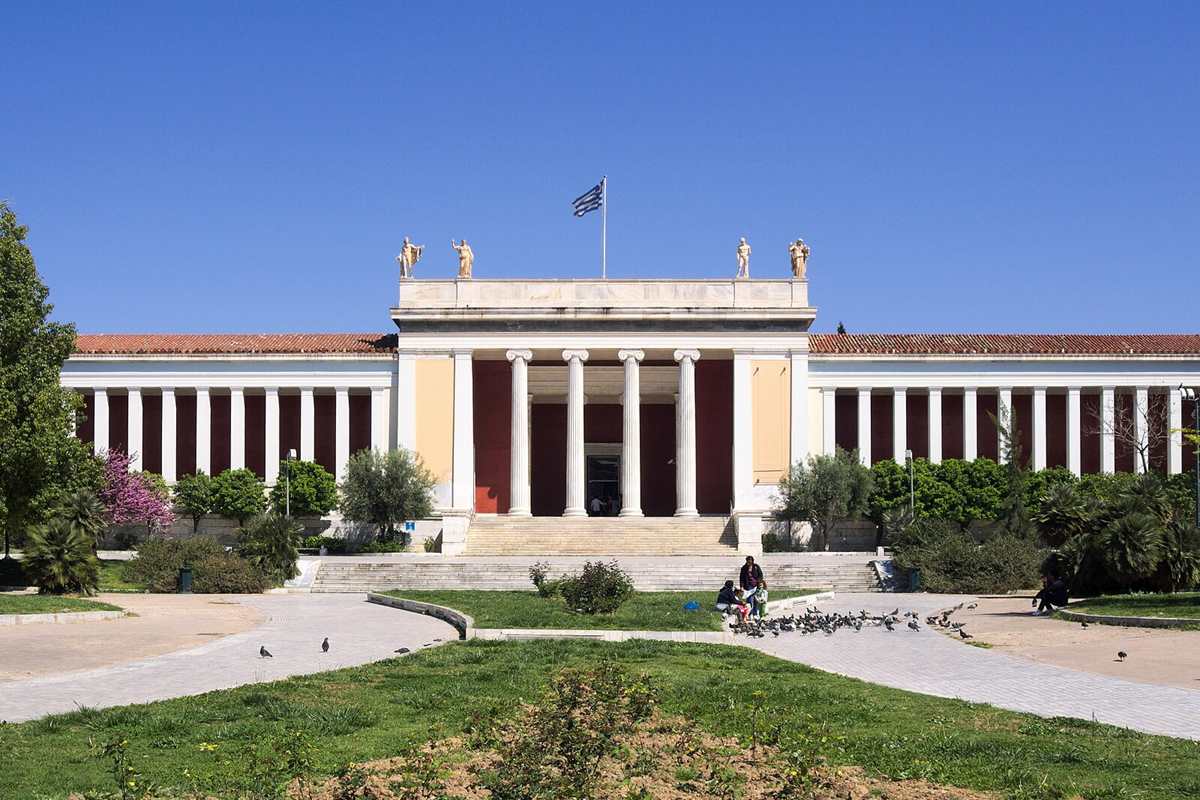
Museums in Greece keep finds from the country’s ancient sites, from Athens to the islands. Small-group trips with a host or tour leader run across Athens, Attica, the mainland and the Aegean islands. Topics include the National Archaeological Museum, the Acropolis Museum, the Kerameikos and the Stoa of Attalos. They go on to Eleusis, Marathon, Brauron, Piraeus, Delphi and Olympia. Related pages cover Greece archaeological tours, Greece tours for seniors and ancient Greek sites. More trips sit under Greece tours.
Bookings made through the GetYourGuide widgets on this page earn Classical Greece Tours a commission, at no extra cost to the traveller.
Which are the museums in Greece?
The museums in Greece include the National Archaeological Museum in Athens, ranked among the world’s greatest museums. West Attica is a regional unit, or local district. It holds two further archaeological museums, one at Eleusis and one at Megara.
Among the museums in Greece, the National Archaeological Museum in Athens keeps a prehistoric collection. Prehistoric means before written records. Part of that collection comes from the Neolithic era, dated 6800 to 3000 BC. Neolithic means the New Stone Age. Ceramic finds come from Dimini, Sesclo and other Neolithic sites. Ceramic describes objects made of baked clay.
Golden masks for the dead in the Mycenaean section once lay over the faces of Mycenaean nobles. These masks are funerary, which means made for a burial. Mycenaean describes the people of Mycenae and their Bronze Age world. Nobles were men and women of high birth and rank. The best-known mask was wrongly given the name of Agamemnon.
Egyptian art also has a place among the museums in Greece, inside the same Athens building. The Egyptian collection began to form in the final two decades of the 19th century. It is counted among the finest Egyptian art collections in the world. Egyptian here means made in ancient Egypt, the land of the pharaohs.
- Warrior’s vase: This famous vase in the Mycenaean section dates from the 12th century.
- Golden jewels: Gold jewels from Karpenissi and Thessaly belong to the Hellenistic age, the years following Alexander’s conquests.
- Troy finds: Objects from the digs of Heinrich Schliemann at Troy are also on display.
Beyond the mainland, the museums in Greece reach the Islands regional unit of Attica. That district holds archaeological museums on the islands of Aegina, Kythera and Poros. Archaeological work recovers the human past from buried objects and ruins.
How did the Acropolis Museum come to join the museums in Greece?
The museums in Greece gained the Acropolis Museum in Athens, founded in 2003. Its organisation was set up in 2008. The building also rises above buried remains of Roman and early Byzantine Athens. Byzantine Athens was the city under the eastern Roman empire.
For this addition to the museums in Greece, a first design contest took place in 1976. A second contest followed in 1979. Neither produced a result, mainly because the chosen plots of land were judged unsuitable. A third, international contest came in 1989. The Italian architects Manfredi Nicoletti and Lucio Passarelli won it.
Among the museums in Greece, this one stands on the lot of a former gendarmerie camp, Camp Makrygianni. A gendarmerie is a police force organised along military lines. The camp faced the Theatre of Dionysus. Its old main building, the Weiler Building, now holds the museum of a centre for Acropolis studies.
Digging on the plot revealed two layers of modest roadside houses and workshops. One layer dates from the classical era and one from the early Byzantine era. On the first gallery level, finds from the Acropolis slopes fill a long hall. Its floor slopes upward, like the climb to the rock. The rock means the Acropolis hill.
- Archaic hall: A large trapezium-shaped hall holds the archaic finds, from the age before classical Athens.
- Parthenon marbles: The sculpted gables, panels and band of carving face outwards, just as on the temple itself.
- First visitors: Within two months of opening, the museum received 523,540 visitors.
This one of the museums in Greece drew a large share of foreign visitors from the start. Of those who came in the first two months, 60 percent were from abroad. The United States President Barack Obama visited the museum in November 2016.
Where did the Old Acropolis Museum sit among the museums in Greece?
The museums in Greece once counted the Old Acropolis Museum in Athens. Its builders set it into a niche on the eastern rim of the Acropolis rock. A niche is a hollow or recess cut into a rock face or wall.
The bulk of the building lies below the hilltop, so it stays largely hidden from view. The architect Panagis Kalkos drew its design. Work on it ran from 1865 to 1874. In the 1950s Patroklos Karantinos enlarged it with a modern design. He was a Greek modernist architect, one who favoured plain modern forms.
Among the museums in Greece, this one held carved stone and bronze pieces from the hill’s monuments. The Parthenon and the Erechtheum supplied finds, as did the Propylaea and the Nike temple. The Propylaea is the great gateway to the Acropolis. Its best-known pieces included the Kritios Boy and the Moscophoros, or Calf-Bearer.
The site limited the size of this one among the museums in Greece. In 1974 Konstantinos Karamanlis, then the Greek Prime Minister, called for a new museum. First plans took shape under Melina Mercouri. In the late 1980s the Greek government chose a larger new museum below the hill.
- Closure: In June 2007 the old building shut, and its contents then moved to the new museum.
- Drainage: Experts link a large part of the decay of the Acropolis to drainage pipes from the old museum.
- Nike sculpture: Highlights also included the sculpture known as Nike Adjusting Her Sandal.
The building occupies the south-eastern corner of the Acropolis, the rocky hill over Athens. It ranked as a major archaeological museum among the museums in Greece. From the start of the digs there, it kept ancient relics found on and around the hill.
How does the Stoa of Attalos hold one of the museums in Greece?
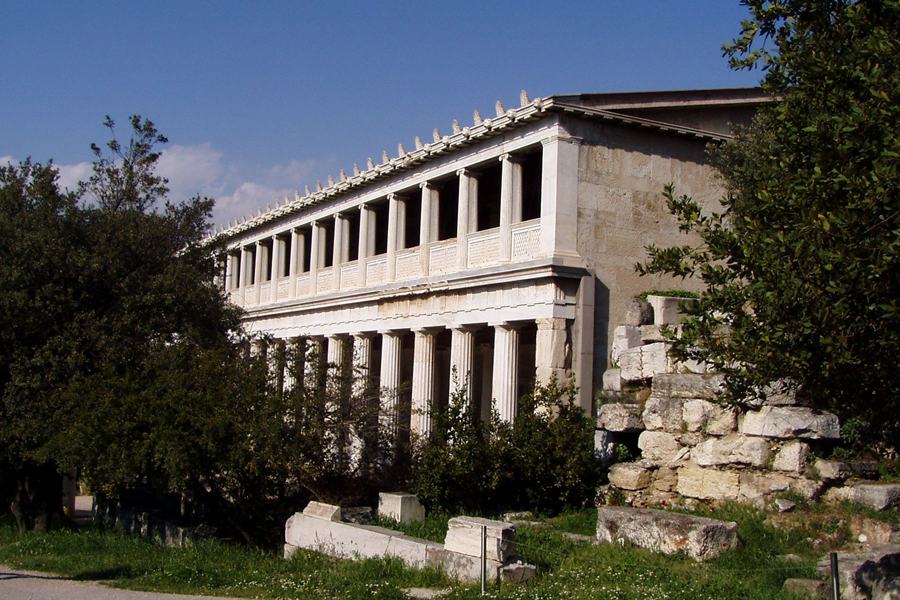
The museums in Greece include the Museum of the Ancient Agora, inside the rebuilt Stoa of Attalos. In a stoa, a roof rests on long rows of columns. Its builder was Attalos II, king of Pergamon from 159 to 138 BC.
Here, among the museums in Greece, an architrave inscription names Attalos II as the builder. The architrave is the main stone beam resting on top of the columns. The stoa rose along the eastern edge of the Agora, the market place of ancient Athens. People used it from about 150 BC onwards, for a range of purposes.
The Greek Archaeological Society cleared the ruins in 1859 to 1862 and again in 1898 to 1902. The American School of Classical Studies later rebuilt the hall from 1952 to 1956. John Travlos, the architect on the Agora digs, drew the plans. Classical studies means the study of ancient Greece and Rome.
Quarries in Piraeus and on Mount Pentelicus were opened to supply stone like the original. Quarrying means cutting building stone out of the ground. The roof tiles used clay from Attica. This home of one of the museums in Greece is a faithful replica of the original stoa. A replica is a close copy.
- Family model: Its basic design follows the stoa of Eumenes II, brother of Attalos, on the Acropolis south slope.
- Light and air: Doorways and small windows in the back wall lit and aired the rooms on both floors.
- Rebuilding feat: Except for the Panathenaic Stadium, no ancient Athenian building had seen so ambitious a rebuild before.
In 1957 it became one of the museums in Greece run by the Greek state. The state also took charge of security at the site. The exhibits also include pottery from the Byzantine period and from the era of Turkish rule.
Which finds give the Kerameikos museum a place among museums in Greece?
The museums in Greece include the Kerameikos Archaeological Museum in Athens, built in 1937 beside the ancient cemetery. Its collection holds early Geometric pieces dating as far back as 860 BC. Geometric art decorates pottery with lines and other regular shapes.
Among the museums in Greece, this one began in 1863 as a small makeshift outpost. Archaeologists stored pottery and other finds from the dig there. Makeshift means simple and temporary. Gustav Oberlander, an entrepreneur from Prussia, paid for the proper museum. Prussia was a German kingdom, and an entrepreneur is a person who starts businesses.
Of the museums in Greece, this is a small open-air one, with four rooms on one floor. Three rooms hold finds from the Kerameikos necropolis, and the fourth shows sculptures from every archaeological era. A necropolis is a large ancient cemetery, a word meaning city of the dead. A garden inside has olive trees and laurels.
Funerary objects fill these halls among the museums in Greece: urns, lekythoi, grave reliefs, stelae and jewellery. Lekythoi are slim oil jars, and stelae are upright stone slabs that mark graves. Notable finds come from offerings left for victims of the Plague of Athens. In a relief, carved figures stand out from a flat background.
- Boxer stele: A marble grave fragment from about 540 BC portrays a boxer whose nose is broken.
- Wall find: The boxer fragment was found in 1953 in the remains of the city walls named after Themistocles.
- Theft: A black-figure lekythos, an oil jar painted with dark figures, was stolen in 1982.
Around April 2003 the museum took in the tomb memorial of Demetria and Pamphile. It had stood in place for over a century before the move. A modern plaster copy now marks the tomb site in the cemetery beside the museum.
What makes the Epigraphical Museum stand out among museums in Greece?
Museums in Greece include the Epigraphical Museum of Athens, a museum with no match elsewhere in the country. It is also the largest museum of its type in the world. Epigraphical means linked to inscriptions, the words carved into stone or metal.
Its collection counts 14,078 inscriptions, and the bulk of them are Greek. They run from early historical times up to the Late Roman age. The Late Roman age is the last stretch of Roman rule in the ancient world. Early historical times are the first ages with written records.
Of the museums in Greece, this one fills the south wing of the National Archaeological Museum. Its spaces include an inner and outer courtyard, a lobby, eleven rooms and a gallery. A lobby is an entrance hall. A large Pi-shaped corridor lined with columns runs through it. Pi is a Greek letter shaped like a gate.
Among the museums in Greece, it holds the stone of the Decree of Themistocles, number EM 13330. A decree is an official order, and Themistocles was an Athenian leader. A local farmer at Troezen, in the north-eastern Peloponnese, found the stone before 1959. For a time he used the marble slab as a doorstep.
- Coffeehouse: In 1959 the farmer gave the stone to a local collection shown in a coffeehouse.
- Debate: Scholars have debated whether the decree is genuine since its text appeared in 1960.
- Expansion: Patroklos Karantinos drew the designs for an expansion between 1953 and 1960.
This one of the museums in Greece also runs a laboratory for conserving inscribed stone monuments. To conserve means to protect old objects from damage and decay. A full photographic archive of the whole collection is also being built up.
Which treasures of coinage does the Numismatic Museum add to museums in Greece?
The museums in Greece include the Numismatic Museum in Athens, on Panepistimiou Street near Syntagma Square. Numismatic means linked to coins and medals. Its objects date from 1400 BC to modern times. Its ancient Greek coins rank with those of the British Museum and the Hermitage.
Among the museums in Greece, this one grew from state coin collecting that began on Aegina after independence. Excavations, purchases and gifts then enlarged the collection. For a time the coins stayed at the Academy of Athens, where they first went on show. In 1946 the collection moved to the National Archaeological Museum.
Of the museums in Greece, this one became independent twice, in 1893 and again in 1965. In 1984 the Iliou Melathron mansion was granted to house the collection. Its use as a courthouse had caused much damage. After a major renovation, the coins went on show there in 1998. The full collection went on view in 2007.
The displays follow the history of coinage. Ancient Greek coins cover the 6th century BC through to the 5th century AD. They include coins of self-ruling Greek cities and of the Hellenistic and Roman periods. Byzantine and medieval coins come from Asia, Western Europe and the Ottoman Empire.
- Hoards: A large share of the coins came from hoards, which are buried stores of treasure.
- Other sources: The rest comes from the first Aegina collection, recent mainland digs and donations.
- Interior: The rooms of the mansion take their style from the architecture of ancient Pompeii.
It counts as one of the leading museums in Greece. Ioannis Svoronos spent his whole working life at the museum. During the renovation, workers restored the floor mosaics and the wall paintings of the mansion. Mosaics are pictures laid out in small coloured stones.
Where does the Museum of Cycladic Art stand among the museums in Greece?
The museums in Greece include the Museum of Cycladic Art. Its main building rose in central Athens in 1985. The Greek architect Ioannis Vikelas designed it. Cycladic refers to the Cyclades, a large ring of islands in the Aegean.
This one of the museums in Greece also uses a second building, the Stathatos Mansion. Othon and Athina Stathatos had it built in 1895 by the architect Ernst Ziller. It stayed the family home until 1938. In 1945 it became a British officers’ club. The Canadian Embassy then rented it until 1970.
In 1982 the Greek state bought the house. The architect Pavlos Kalligas restored it to host official state guests. After the work, the house was judged unfit for that role. The Athens committee bidding for the 1996 Olympic Games also had its headquarters there. A bid is a formal offer to host an event.
Among the museums in Greece, this one holds its temporary exhibitions in the Stathatos Mansion. These shows have featured leading Greek and international artists of modern and contemporary art. Contemporary means of the present day. One show bore the title Picasso and Antiquity, and antiquity means the ancient past. Another featured El Greco and his workshop.
- Wings: Two nearly matching wings meet at a grand entrance and a round central atrium, or hall.
- Columns: Four plain Tuscan and four ornate composite columns hold up a roof of eight vaults, or arched ceilings.
- Stairs: Two Corinthian columns, with leafy carved tops, frame the stairs to the covered entrance.
Among the museums in Greece, this mansion shows neoclassical features: symmetry, geometric order and elegant shapes. It also uses ancient Greek and Roman orders, the classical styles of column. Neoclassical describes a later style modelled on the buildings of Greece and Rome.
Which bronze gods fill the Archaeological Museum of Piraeus, one of the museums in Greece?
The museums in Greece stretch to Piraeus, a port city within the Athens urban area. Its Archaeological Museum holds bronze statues of Apollo, Athena and two figures of Artemis. Bronze is an alloy of copper and tin, meaning a blend of metals.
Among the museums in Greece, this one shows the Piraeus Apollo, a bronze statue in the archaic style. Experts long dated it to the late archaic period, 530 to 480 BC. Newer research sees it as archaizing work of the Hellenistic period instead. Archaizing means copying the older archaic style on purpose.
Of the museums in Greece, this one holds the Piraeus Athena, judged an original work. She wears a Corinthian helmet with griffins at the sides and owls on each cheek guard. A griffin is a mythical beast, part eagle and part lion. The Athena Mattei in the Louvre is the one known statue believed to copy it.
Like the Apollo, two bronze statues of Artemis entered museums in Greece from the same buried cache. A cache is a hidden store of objects. The smaller Artemis is also the smallest of the bronze statues from the Piraeus dig. It is the least well preserved too, and the right side of its head is slightly misshapen.
- Apollo’s stance: Olga Palagia notes its stance differs from kouroi, or standing youths, like the Kroisos Kouros.
- Other finds: The dig also found a bronze tragic mask, two marble herms, or carved pillars, and two shields.
- Sanctuary: The displays include a reconstruction of a typical classical sanctuary, or sacred site, of the goddess Cybele.
One theory traces the statues to Delos, because three of them showed Artemis. Ancient Greeks believed that Artemis was born on Delos, an island of the Aegean Sea. A theory is an idea put forward to explain known facts.
Which sacred rites does the Eleusis museum recall among museums in Greece?
The museums in Greece cover Eleusis, whose Archaeological Museum sits inside the ancient site in West Attica. Its displays centre on two themes, the Eleusinian Mysteries and the town of Elefsina. The Mysteries were secret religious rites in honour of Demeter.
The German architect Georg Kawerau drew the plans for the building, which went up in 1890. In 1892 the Greek architect J. Mousis extended it. Among the museums in Greece, this one keeps a votive piglet. It recalls the sacrifice of piglets to purify believers at Phaleron. Votive means offered to a god.
A kernos, a ceremonial vessel, served at sacrifices and at offerings made at altars and temples. The fleeing kore dates from the archaic period. A kore shows a maiden standing upright. A large headless Demeter is thought to come from the school of Agorakritos, pupil of Pheidias. Demeter was the goddess of farming.
The two greatest finds went to another of the museums in Greece, the National Archaeological Museum. Copies of both stay here. One, a relief 2.20 m high, dates from the 5th century BC. It shows Demeter, the Kore, or Maiden, and Triptolemos. The other is the Ninnion Tablet, a clay plaque of the 4th century BC.
- Eleusis Amphora: This neck amphora, a two-handled storage jar, dates from about 650 to 625 BC.
- Athena: The amphora carries the earliest known picture of Athena in Attic art, the art of Attica.
- Caryatid: The caryatid, a female figure that served as a column, bears a sacred box on her head.
Pottery in this one of the museums in Greece spans the Middle Helladic era to early Christian times. Middle Helladic refers to a Bronze Age phase on the Greek mainland from about 2000 BC. A votive relief gives instructions for bridging the lake of Rheitoi.
How does the Archaeological Museum of Marathon join the museums in Greece?
The museums in Greece extend to the town of Marathon in Attica, home of its Archaeological Museum. Its finds come mainly from the Battle of Marathon, plus an Egyptian temple built nearby. Attica is the region in which Athens stands.
Among the museums in Greece, this one shows finds from the villa of Herodes Atticus. Herodes inherited an estate and a villa at Marathon, south of Oenoe. A villa was a large country house. An inscription shows that the estate covered 680 acres. An estate here means wide farmland held by a single owner.
Of the museums in Greece, this one also keeps parts of the arch over the villa entrance. Inscriptions on the arch call it the Gateway of Immortal Harmony. At Brexiza, Herodes built a sanctuary to the Egyptian goddess Isis in 160 AD. The temple measured 50 by 50 m, with a pyramid at its centre.
Three monuments stand on the plain: the Athenian Tumulus, the Plataean Tumulus and a victory column. A tumulus is a burial mound. Central Greece had dropped such grand burials from the seventh century onwards. Athenians normally buried soldiers killed in war at the Kerameikos cemetery. Scholars have suggested the mounds echoed Homer on purpose.
- Athenian mound: The Athenian Tumulus stands about 12 m tall, and Dimitrios Philios dug it in 1884.
- Plataean mound: The smaller Plataean Tumulus, about 3 m high, was dug by Professor Marinatos in 1970.
- Victory column: The original column collapsed, and a modern replica of the same height replaced it.
Behind this one of the museums in Greece lies a battle between Athens, Plataea and Persia. Athens and its ally Plataea brought about 11,000 hoplites. A hoplite was a heavily armed foot soldier. Herodotus, an ancient Greek historian, says the Plataeans lost 11 men.
Which story of Artemis lives on in the Brauron museum, one of the museums in Greece?
The museums in Greece reach Markopoulo Mesogeias in Attica, home of the Archaeological Museum of Brauron. Its collection comes largely from digs in the Sanctuary of Artemis at Brauron. Artemis was an ancient Greek goddess worshipped across the Greek world.
Among the museums in Greece, this one holds a statue of a small girl, called a bear. In Greek such girls were arktoi, which means bears. Brauron, east of Athens, ranks among the leading sites of Artemis worship. The scholar Hughes links the name Artemis to ark-temnis, meaning bear sanctuary.
Artemis was said to watch over girls from before puberty to the birth of a first child. Puberty is the time when a child’s body becomes adult. The arkteia, a rite in which girls acted as bears, was the high point of the Brauronia festival. A rite is a set religious ceremony. Bear masks were part of these rituals.
This one of the museums in Greece was renovated in 2009, and its exhibits were rearranged. The playwright Euripides says Iphigenia, daughter of Agamemnon, founded the sanctuary at the order of Athena. A playwright writes dramas for the stage. In his play, Athena tells Iphigenia that she will guard the keys of the shrine at Brauron.
- Lysistrata: In a comedy by Aristophanes, a speaker recalls serving as a bear at the Brauronia.
- Marriage rule: A Byzantine word-book called the Suda says girls had to play the bear before they married.
- Groves: Sanctuaries of this kind were commonly groves of trees beside water.
At Brauron, Artemis was worshipped as the great bear. Brauronia is the title of Artemis as honoured at Brauron. Artemis Brauronia also had a sanctuary on the Acropolis of Athens. Finds from it entered another of the museums in Greece, the Old Acropolis Museum.
Why does the Olympia museum stand out among museums in Greece?
Museums in Greece count the Archaeological Museum of Olympia among their principal ones. Its bronze collection ranks among the world’s leading ones. Bronze is copper mixed with tin. The halls keep finds from the surrounding land, including the ancient Olympic Games site.
Among museums in Greece, the main building at Olympia is laid out in twelve rooms for exhibitions. The rooms are arranged by the themes of the objects and by their age. One of the principal pieces is an oenochoe that belonged to Phidias. An oenochoe is a jug used for pouring wine.
An earthquake damaged the first building in 1954. Over time the hall also proved too small to show the growing collections. It then stood unused for a while before it gained a new purpose. Since 2004 the old hall has been one of the museums in Greece on the ancient Games.
Among the terracottas in museums in Greece, one group at Olympia shows Zeus carrying off the boy Ganymede. Terracotta is fired clay. The work dates to around 480-470 BC, between the archaic (early) and classical periods. Experts link it to a workshop in Corinth. It appears to be the earliest Greek artwork with eyes that show feeling.
- Bronze horse: Diggers found it in an archaic fountain, beneath a mosaic floor in the House of Nero.
- Casting: The horse was made from two solid blocks, cast apart and then joined together.
- Helmet: The helmet of Miltiades is listed among the notable holdings of the museum.
Among museums in Greece, Olympia’s collection holds local objects from prehistory to the era of Roman rule. Prehistory covers the ages that came before writing. The state ministry in charge of culture and sports oversees the whole museum.
How did Delphi’s museum change over time as one of the museums in Greece?
Museums in Greece include the Delphi Archaeological Museum, run by the Ephorate of Antiquities of Phocis. An ephorate is a regional office that cares for ancient remains. In 1998 it welcomed more than 300,200 visitors. That nearly matched the National Archaeological Museum in Athens.
Among museums in Greece, Delphi’s first building came from the French architect Albert Tournaire. A trust set up by the Greek banker Andreas Syngros paid for it. Two wings framed a small central block. The excavation leader, Théophile Homolle, wanted the finds shown in their setting. So parts of the main monuments were rebuilt in plaster.
By the 1930s the museum had grown too small for new finds and rising tourist numbers. A new building was finished in 1939 in the style of the Interwar period. The Interwar period is the time between the two world wars. The French archaeologist Pierre de La Coste-Messelière then removed the old plaster restorations.
In the Second World War, part of the collection stayed at Delphi in ancient Roman tombs or pits. The chief treasures went to Athens, locked away in Bank of Greece vaults. Delphi then lay in the combat zone of the Greek Civil War. This kept one of the principal museums in Greece shut until 1952.
- New halls: Architect Patroklos Karantinos added two exhibition halls and let more daylight into the building.
- Reopening: After this phase of works, the museum opened its doors again in 1961.
- Storage: Storage and conservation space for mosaics, pottery and metal finds covers 558 square metres.
Among museums in Greece, Delphi’s Room 4 keeps precious gifts dug from a pit under the Sacred Way. Its chryselephantine figures are believed to stand for Apollo, Artemis and Leto, their mother. Chryselephantine means made of gold and ivory.
What did the royal tombs of Aigai give to the museums in Greece?
Museums in Greece reach Vergina through the Museum of the Royal Tombs of Aigai. It is an underground building. It holds the burial cluster of Philip II of Macedon, father of Alexander the Great. A burial cluster is a group of graves close together.
Of the museums in Greece, this one centres on royal tombs built by the ancient Kingdom of Macedon. Konstantinos Romaios found the first royal tomb there between 1937 and 1940, while working in the palace remains. Greek refugees, resettled there from Turkish Anatolia, had stripped much of that palace for building materials.
Manolis Andronikos took up the digging again in 1949. He completed the palace excavations in 1970. He then turned to the Great Tumulus, a large mound of earth raised over graves. Damage to the right eye of the skull in Tomb II points to a wound from an object. History records that object as an arrow.
Newer research gives firm proof that Tomb II holds Philip II and his Thracian wife, Meda. From 1991 to 2009 over 1,000 tombs were excavated across the site. A royal burial cluster of the Temenids was also revealed. The Temenids were a Macedonian royal house of Dorian Greek origin.
- Shield: In museums in Greece, finds from Aigai include a ceremonial shield of wood, leather, glass, gold and ivory.
- Eurydice I: In 1987 diggers found a burial cluster that held the tomb of this queen.
- Later finds: Five further royal tombs came to light at the site in March 2014.
One view says this is the shield Alexander the Great took from a shrine at Troy. Opponents note it is not suited to battle and link it to festive use. In museums in Greece, its gold handle grip shows two small lions carved near the middle.
Which Pella mosaics count among the treasures of museums in Greece?
Museums in Greece take in the Archaeological Museum of Pella, built on the site of ancient Pella. Architect Kostas Skroumpellos designed it. Work was completed in 2009 with support from Greece’s Third Community Support Framework. It stands near the remains of the old Macedonian palace.
The building has a rectangular atrium, an open central court. It recalls the peristyle, or column-lined, courts of old Pella houses. Among museums in Greece, Pella places two key exhibits at its entrance. One is a head seen as a likeness of Alexander the Great. The other is a statuette bearing the signs of the god Pan.
Daily life forms the first theme of the exhibition. Its chief exhibits are mosaic floors from the House of Dionysus. A mosaic floor is a design set in small pieces of stone. Public life follows, with finds from the Agora, the market square. They cover the city’s government, its trade and its production.
The fourth group comes from the city’s cemeteries. Its graves date from the Bronze Age right through to Hellenistic times. Hellenistic here means the third and second centuries BC. These finds show that residents spoke Doric Greek, a local form of Greek. The last gallery covers the palace’s form and Alexander the Great’s life.
- Stag Hunt Mosaic: In museums in Greece, this floor carries the signature of an artist named Gnosis.
- Pebbles: Its stones were gathered from beaches and riverbanks, then set into cement.
- Shading: Greeks called the shading skiagraphia, and here it models muscles and cloaks.
His name is the earliest known signature left by a mosaicist, a mosaic maker. The right-hand figure is possibly Alexander, judged by the date and swept-up hair. Among museums in Greece, Pella shows this mosaic, which came from a wealthy late fourth-century BC home.
How far back in time do museums in Greece reach at Nafplio?
Museums in Greece cover Argolis through the Archaeological Museum of Nafplio. It stands in the town’s central square. Its exhibits, from all over southern Argolis, run from the Neolithic to the Roman periods. Neolithic points to the New Stone Age of early farmers.
The oldest exhibits are Paleolithic clay hearths found in the Kleisoura Gorge, close to Prosymna. A hearth is a fireplace on the ground. These hearths date from 32,000 to 21,000 BCE. Paleolithic means the Old Stone Age. Tools, shells and jewellery from Franchthi Cave show the shift from hunting and gathering to farming.
Among museums in Greece, Nafplio keeps a small footed clay vase from an infant’s grave. Experts read it as a sign of hereditary status, a rank passed down in families. Middle Neolithic pottery called Urfirnis was baked in larger batches, at about 800 degrees Celsius. This ware is lighter and more even than earlier pots.
Visitors to museums in Greece can see black-burnished ware from the Late Neolithic here. Burnished means polished to a shine. A faint ghost of white paint makes the dark surface look like a photo negative. From the Early Helladic period comes a wine cooler from Tiryns, dated 2700-2200 BCE. That period ran from 3300 to around 2100 BCE.
- Lady of Asine: This sculpture sits among Mycenaean finds from Tiryns, Midea and Asine.
- Cylinder seals: The Mycenaean rooms also hold Mittanian cylinder seals, carved stone rollers, from northern Syria.
- Iron Age helmet: A bronze helmet from an 11th-century BCE tomb at Tiryns marks early Iron Age craft.
Franchthi Cave holds the longest recorded unbroken record of settlement at any one site in Greece. Radiocarbon tests, which date old remains by their carbon, confirmed it. Among museums in Greece, Nafplio shows these Franchthi finds beside later pottery.
What do museums in Greece hold from the excavations at Dion?
Museums in Greece reach Pieria with the Archaeological Museum of Dion. Its finds come from a fortified city on the spot. That city first stood in the sixth century BC and lasted into the fifth century AD. Pieria is a regional unit of Central Macedonia.
Georgios Sotiriadis, rector of the University of Thessaloniki, began the first digs from 1928 to 1931. A rector is the head of a university. Georgios Bakalakis took up the work again 30 years later. From 1973 Professor Dimitrios Pandermalis led the excavation of larger areas of the city. The University of Thessaloniki still directs the work.
Among museums in Greece, Dion shows a gold stater of Philip II on its ground floor. A stater is an ancient coin. It shows Apollo’s head and a racing chariot pulled by two horses. A small cinema plays a video in more than one language about the digs.
In museums in Greece, the basement at Dion tells of daily life in the ancient town. It holds old keys and locks, plus hammers, chisels and other tools for working stone. The Demeter sanctuary is the oldest in Dion found so far, from the sixth century BC. A sanctuary here means a sacred precinct where a deity was honoured.
- Artemis Baphyria: This Roman copy of an Artemis statue was found at the spring of the Baphyras.
- Perseus: A statue shows Perseus, the last king of Macedon, who reigned from 179 to 168 BC.
- Eagles: Two stone statuettes of sitting eagles came from the sanctuary of Zeus Hypsistus, Zeus the Highest.
In 172 BC King Perseus confirmed an alliance with the Boeotians. The Roman historian Livy wrote that the pact stood on three stone steles. A stele is an upright inscribed slab. Among museums in Greece, Dion holds the third, once-missing stele.
Which losses and returns mark Tegea’s place among museums in Greece?
Museums in Greece reach Arcadia at the Archaeological Museum of Tegea. Its displays follow Tegea, once the leading power of Arcadia, and its sanctuaries. The chief sanctuary, that of the goddess Athena Alea, lies 200 metres from the museum building.
Among museums in Greece, Tegea’s began with a gift of land at Piali, today’s Alea. Bishop Neilos donated the plot to the Archaeological Society at Athens in 1906-1907. In 1909 Konstantinos Romaios completed the building and set up the first display. In 1935-36 the roof collapsed and damaged antiquities.
The curator Markelos Mitsos then carried out the hard work of repairs. He also reorganised the exhibition, and Gallery 4 was built at that time. On 3 April 1941 the exhibits were buried in the museum floor. The German invasion of Greece was close at hand. This act is known as the Apokrypsis, Greek for hiding.
Among museums in Greece, Tegea suffered a failed burglary attempt in 1990. In 1992 a real burglary took place. Among the stolen pieces was the head of Telephus, an original work by the sculptor Scopas. In 1994 eight of the stolen exhibits were recovered and returned. A burglary is a break-in to steal goods.
- Returns of 1998: The marble head of Asclepius came back, with a relief of Dionysus, Artemis and Heracles.
- Arcadian Herms: Gallery 2 shows these carved pillars, private gifts to sanctuaries found only around Tegea.
- Early finds: Neolithic and Early Bronze Age items come from Agiorgitika and Asea.
Among museums in Greece, Tegea also keeps early Christian and Byzantine objects from Episkopi Tegeas. The label Byzantine marks the later, Greek-speaking Roman state of the Middle Ages. Outdoors, the museum adds a display on public life and the hereafter. The hereafter means life after death.
What does Amphipolis add to the museums in Greece?
Museums in Greece reach the River Strymon with the Archaeological Museum of Amphipolis. It stands within the walls of ancient Amphipolis, a city founded in 437 BC. Its finds, from the Archaic to the Byzantine periods, come from the city and its surroundings.
The finds were dug from sanctuaries, settlements and tombs. Sanctuaries are sacred places of worship. The main digs ran from 1956 to 1984 under the archaeologist Dimitris Lazaridis. After his death in 1985, his daughter Calliope continued the work until 1989. Among museums in Greece, this one rose between 1984 and 1995.
Its two floors hold display halls, offices, a meeting room for conferences and a storeroom. It sits about 600 metres north of the acropolis, where the modern village of Amfipoli begins. The word acropolis means the upper, walled town of an old city. Among museums in Greece, its basement covers prehistory through to the Byzantine era.
The collection also holds finds from ancient Argilos and from Eion, the port of Amphipolis. Documents include letters about the ancient city from 18th-century historians. Photographs show the Lion of Amphipolis, a tomb sculpture, as it was unearthed and restored. Among museums in Greece, it keeps this record beside wall panels on local history.
- Kasta tomb: Gold jewellery from this tomb counts among the important finds of the museum.
- Byzantine gold: A gold coin of Justinian dates from the years 527 to 565 AD.
- Alexander’s stater: A gold stater, a type of coin, of Alexander the Great sits among the key finds.
Alexander I brought coinage to the Macedonian kingdom in the earlier half of the fifth century BC. Mines near Philippi were estimated to yield one talent of silver, around 26 kilograms, each day. Philip II later added a mint at Amphipolis, beside the one at Pella.
Where do museums in Greece meet a Frankish tower at Thebes?
Museums in Greece cover Boeotia through the Archaeological Museum of Thebes, which is dedicated to that region. Boeotia is the historic region in which Thebes lies. Its new building opened on 7 June 2016. The President of Greece and the Archbishop of Athens attended.
Among museums in Greece, the first Thebes building rose between 1905 and 1912. It stood at the northern edge of the Cadmea hill, the old acropolis of Thebes. During the wartime occupation, the occupying forces closed it and used it as a barracks. It never reopened and was pulled down in the 1950s.
A new single-storey building opened on the same site in 1962. Its display filled four main galleries. In 2007 the museum closed to the public for renovation. Architect Michalis Souvatzidis designed the new complex, built between 2005 and 2010. The works joined the existing buildings around a central atrium, an open inner court.
Covered exhibition space now reaches about 1,000 square metres. A further 1,750 square metres outdoors shows antiquities that weather does not harm. An archaeological excavation area lies beneath the building itself. Excavation means digging up buried remains. Among museums in Greece, Thebes also has rooms for conservation, study, storage and books.
- Frankish tower: A medieval tower from the Frankish, or western European, walls of Thebes stands conserved inside.
- Builder: Nicholas II of Saint-Omer, a Frankish lord, built the tower in 1278.
- Lordship: He was lord of half of Thebes from 1258 until his death in 1294.
His first wife, Mary of Antioch, helped pay for his Castle of Saint Omer on the Cadmea. The Chronicle of the Morea praised it as the strongest and finest castle in Greece. Today only a tower survives, kept within one of the museums in Greece.
How do museums in Greece honour Artemis at Lamia?
Museums in Greece reach Phthiotis at the Archaeological Museum of Lamia, inside the grounds of Lamia Castle. Its antiquities span the Neolithic, Helladic, Archaic, Classical and Hellenistic periods. Lamia is the capital of Phthiotis, a prefecture, or district, of Greece.
The Ministry of Culture took over the old barracks from the Ministry for Defence in 1973. The museum then opened to the public in September 1994. Among museums in Greece, it fills the ground floor and part of the first floor. Barracks are buildings put up to house soldiers.
The north hall holds prehistoric, Bronze Age and Mycenaean finds. Mycenaean describes the culture of Mycenae and its age, the late Bronze Age. The south hall covers the Late Archaic, Classical, Hellenistic and Roman periods. Upstairs, 27 rooms are arranged around twelve themes. They show finds from digs in Phthiotis and Evrytania.
Among museums in Greece, Lamia’s leading statue is a marble votive relief of Artemis Eileithyia. A votive relief is a carved panel offered to a god. It dates from 400 BC and follows the style of Praxiteles. A second relief, 68 by 123 centimetres, shows Artemis Locheia from Achinos. Locheia marks her as a goddess of safe childbirth.
- Mother and child: In the Locheia relief, a veiled mother offers a baby girl to the goddess.
- Kynos ship: A Bronze Age artefact shaped like a warship came from digs at Kynos.
- Kalapodi: Archaic finds include parts of the temple of the Oracle of Apollo at Kalapodi.
An inscription from Achinos records slave owners setting their own slaves free. A mosaic floor among the later Classical and Roman finds pictures the Three Graces. Among museums in Greece, Lamia also shows a bust of Athena holding a pair of scales.
What do museums in Greece show from Argos and Lerna?
Museums in Greece serve the city of Argos through its Archaeological Museum, on the Peloponnese peninsula. Its items run from the Middle Helladic period, about 2000 BC, to Late Antiquity in 600 AD. Helladic is the term archaeologists use for the mainland’s Bronze Age.
The museum’s story began in April 1932. That month the heirs of J. Kallergis gave the building to the Argos city council. On 25 October 1955 the council passed it to the Greek state. Among museums in Greece, Argos then opened its Kallergeio section in 1957. A new section followed in 1961.
The French Archaeological School oversaw the building of the new section. Its digs also produced a large share of the items on show. The bulk of the finds came from the ancient agora and the Roman theatre area. Others came from the Mycenaean grave at Deras. An agora served as the open meeting and market place of a city.
Among museums in Greece, Argos shows a reddish pot of 460-450 BC with Theseus fighting the Minotaur. The Minotaur was a monster, half man and half bull. A house mosaic of the fifth century uses symbols for the twelve months. The Roman Heracles copies a model by Lysippus made for the market of Sikyon.
- Lerna Room: A tiny clay figurine here ranks among Europe’s oldest sculpted human bodies found so far.
- Pomegranates: Clay pomegranate models evoked the goddess Hera and signalled wealth and good fortune.
- Armour: A bronze cuirass, or chest plate, and helmet from a tomb date to the late eighth century BC.
Among museums in Greece, Argos also shows Lerna finds from digs by the American School of Classical Studies. Roman mosaics in the courtyard show Dionysos and the seasons. Winter figures wear cloaks and thick leggings, while summer ones wear light tunics.
Which golden emperor do museums in Greece keep at Komotini?
Museums in Greece reach Western Thrace at the Archaeological Museum of Komotini. Architect Aris Konstantinidis designed it, and it was commissioned in 1976. Its exhibits come from excavated Thracian archaeological sites. They run from the Neolithic era through the Byzantine age.
Among museums in Greece, this building stands out in Komotini for its elegant design. The displays tell of the prehistory and history of Western Thrace. The museum also shows folk art, farm work and basket making. Folk art is the traditional craft of ordinary rural people. Artefacts include Roman coins, gilded wreaths and Byzantine ceramics.
A grave stele of Thracian marble was found at ancient Dikaia in 1927. The word stele means a tall slab of stone, here a gravestone. Its front shows a young person in a himation, a draped cloak, with hair tied at the nape. The back shows an attendant carrying a stool, with a dog.
Among museums in Greece, Komotini’s prize is the golden bust of the Roman emperor Septimius Severus. It shows him in scale armour, a coat of overlapping metal plates. It is one of only two golden busts of a Roman emperor known to survive. The other shows Marcus Aurelius and comes from Avenches in Switzerland.
- Discovery: Greek soldiers digging a trench near ancient Plotinopolis, today’s Didymoteicho, found it in June 1965.
- Metal: The 23-karat bust is over 96 per cent gold, with small amounts of silver and copper.
- Size: It stands 28.4 cm tall and 25.5 cm wide, and weighs around 980 grams.
It lay 1.6 metres down and had only minor damage. Before it reached the authorities, a small piece from its base was cut off and sold. Among museums in Greece, Komotini also keeps a clay figurine from Abdera of early 200 BC.
What makes the Heraklion Archaeological Museum stand out among museums in Greece?
Museums in Greece reach far into the past at the Heraklion Archaeological Museum on Crete. Its artefacts span over 5,500 years. They stretch from the Neolithic period down to the Roman age. The Neolithic closed the Stone Age, the era before metal tools.
Among museums in Greece, this one started out in 1883 as a modest gathering of antiquities. Antiquities are things crafted in the ancient world. The building suffered damage during the Second World War. Even so, the collection survived intact and opened to the public again in 1952. Intact means whole and unbroken.
The architect Patroklos Karantinos brought daylight in through skylights, windows set into the roof. Light also enters along the top of the walls. Among the island museums in Greece, this building also holds laboratories, a drawing room and a library. Finds are kept and studied in a special department named the Scientific Collection.
Room VI gathers objects from the cemeteries of Knossos, Phaistos and Archanes. Its displays include a horse buried in a tholos tomb at Archanes. Such a tomb is circular, built of stone and roofed by a dome like a beehive. Cemeteries are burial grounds, fields set apart for graves.
- Dancers: Room X holds a clay group showing dancers and a lyre player; a lyre is a small harp.
- Coffins: Room XIII displays larnakes, clay coffins of the Minoans, the Bronze Age people of Crete.
- Extension: A new wing joined the building in 1964, adding space for the collection.
English scholarship gives this one of the museums in Greece a short name, AMH. Each letter comes from the full title, Archaeological Museum of Heraklion. At times the institution still uses this short form itself. Such initials take the first letter of each main word.
Which finds give the Delos site museum its place among museums in Greece?
The museums in Greece include a site museum on Delos, an island near Mykonos. Digging there began in 1872, when the French School at Athens opened its excavations. That project still goes on today. Excavation means careful digging to uncover buried remains.
Among museums in Greece, the Delos pottery collection runs from the 25th century BC down to the 1st. Clay figurines, jewellery and mosaics in the museum date to the 2nd and 1st centuries BC. Mosaics are images built up from tiny cubes of stone or glass. Figurines are small modelled figures of people or animals.
A kouros is an early Greek carving of a youth standing upright. In the Sanctuary of Apollo, diggers found the inscribed triangular base of one such statue. That base dates to the 7th century BC. Sanctuary here means holy ground given over to a god. Inscribed means carved with letters or words.
A Corinthian alabastron in the museum shows Potnia Theron between two swans. An alabastron is a small container for perfumed oil. Potnia Theron was the lady of the beasts, who protected hunting. The vessel came from the Heraion, a shrine of Hera, with similar Corinthian vases. They were made late in the 7th century BC.
- Ivory plaque: An ivory plaque found at the Artemision lay with other gold, ivory and bronze objects.
- Woman statue: Among museums in Greece, this one keeps an early, or archaic, statue of a woman from 580 BC.
- Boxer: An inscription reading Kalamodrya is thought to name a leading boxer of the 1st century BC.
Two rooms in the Delos museum hold pottery. In museums in Greece, pottery means vessels of fired clay, such as jars, cups and bowls. Another room keeps objects of daily life from ancient Greece. Daily life here means the ordinary tasks of home and work.
What story does the Mykonos vase tell among museums in Greece?
Museums in Greece keep the famous Mykonos vase at the Archaeological Museum of Mykonos. This pithos, a large ceramic storage jar, was made around 675 BC. That date falls in the Archaic period, when Greek city-states were young.
The vase ranks among the earliest objects known to show the Trojan Horse. In the myth, Greek soldiers hid inside a wooden horse to get into Troy. A local resident found the jar on Mykonos with human bones inside it. Across museums in Greece, the word myth means a traditional tale of gods or heroes.
On the neck of the jar, Greek warriors surround the Trojan Horse. More warriors look out through portholes, small round openings in the horse’s body. Beneath the neck run three lines of metopes. A metope is a square panel that frames a single scene. Each one here holds figures poised for battle.
The museum was first built to hold finds from a burial site on Rineia, also spelled Rhenia. Rineia is a very small island, or islet, close to Mykonos. In the Classical and Hellenistic ages, the necropolis, or cemetery, of Delos lay on Rhenia. Classical and Hellenistic are names for later stages of ancient Greek history.
- Building: Among museums in Greece, the 1905 building copies ancient styles and gained an eastern room in 1972.
- Aegean works: Works made between the 7th and 6th centuries BC come from other parts of the Aegean.
- Trojans: Not a single Trojan warrior appears anywhere on the surface of the pithos.
Around the horse, the warriors carry spears and rounded shields with bosses. A boss is a raised knob at the centre of a shield. Only their heads and legs show behind those shields. Among museums in Greece, the one on Mykonos keeps this jar on display.
What links a knights’ hospital in Rhodes to the museums in Greece?
Museums in Greece gain a medieval home at Rhodes, where the Archaeological Museum sits within the Medieval City. Its monumental building once served the Knights of Saint John as their hospital. Monumental means very large and grand. Medieval refers to the Middle Ages of Europe.
Among museums in Greece, this one fills a building begun in 1440. The work was completed under Grand Master d’Aubusson. He held that office from 1476 to 1503. The title grand master named the chief of the whole order of knights. An order, here, is a society of men living under shared religious rules.
Its collections gather finds from parts of Rhodes and from the neighbouring islands. The Aphrodite of Rhodes, a marble statue in the museum, is among them. She bends low on one leg, her right knee near the floor, and looks to her right. Aphrodite stood for love and beauty in Greek belief.
This crouching pose traces back to a lost Greek original of the 3rd century BC. Scholars credit that original to Doedalsas, a sculptor from Bithynia. Bithynia was a region in north-west Anatolia, the broad peninsula also called Asia Minor. Museums in Greece use the term lost original for a first version that no longer survives.
- Homes: From Hellenistic times, the age after Alexander the Great, rich owners decorated houses with such statues.
- Surface: A very smooth polish gives the marble the look of porcelain, a fine white china.
- Stone: The crystal-white marble is thought to come from the island of Paros.
In modern Rhodes, the Aphrodite ranks among the chief hallmarks of the island. A hallmark, in this sense, means a symbol that marks out a place. Among museums in Greece, the statue belongs to the one in the knights’ old hospital.
Why does a former mosque on Kastellorizo count among museums in Greece?
Museums in Greece include the Kastellorizo Folk Art Museum, also called the Ottoman Mosque Museum. Its building was raised as a mosque in 1775, in the Ottoman era. Muslims gather in a mosque for prayer. Folk art means the traditional crafts of ordinary people.
Among museums in Greece, this one occupies the tip of a small peninsula. The peninsula makes up the Kavos neighbourhood. Peninsula means land with water on three sides. The building’s old name, the Kavos Mosque, means the Mosque of the Peninsula. A neighbourhood is a named quarter within a settlement.
It is the only mosque on the island, painted in beige and red. Builders raised it on the site of an earlier Christian church. That church had been dedicated to Saint Paraskevi. A dedication names the saint whom a church honours. Beige is a pale, sandy shade of brown.
Since July 2007, the building has housed the Historic Collection of Kastellorizo. The collection consists mostly of old photographs, pictures and documents. A document is a written or printed paper that records information. In museums in Greece, a historic collection means objects and papers that record past events.
- Abandoned: Worshippers stopped using the mosque in the 1910s, and it stood empty afterwards.
- Time span: The records follow island life from the 19th century until its destruction in 1943.
- Union: In 1948 the island joined Greece with the rest of the Dodecanese, after brief Italian rule.
A Muslim community lived on Kastellorizo in the Ottoman period. The mosque with its minaret, which still stands, shows this. A minaret is the slim tower of a mosque. By 1929 the mosque no longer served worshippers; it now ranks among the museums in Greece.
Which Chios building earned a name in the story of museums in Greece?
Museums in Greece take a modern form on Chios, whose Archaeological Museum was designed in 1965. Its architects were Souzána Antonakáki, Dimitris Antonakakis and Eleni Gousi-Desylla. An architect plans buildings and shapes how they look and work. They planned it for Chios town.
Among museums in Greece, the Chios building is widely ranked as an important work of modern architecture. Construction ran from 1966 to 1971. Its total area reaches 2500 square metres. One square metre equals a square measuring a metre each way. Modern architecture here means the design style of the twentieth century.
The museum was renovated in 1998. It opened its doors again in November 1999. Renovation, in museums in Greece and elsewhere, means repairing and updating a building. Its displays run from the Neolithic era up to Roman times. The Neolithic was the final era of stone tools, before metal came into use.
Finds come from the ancient sites of Emporio, Kato Fana, Dotia and Aghio Galas. Other pieces were dug up in Chios town itself. Emporio, a prehistoric settlement, was first lived in during the early Neolithic, around 6000 BC. Prehistoric points to times older than any writing. Settlement means a site where a community made its homes.
- Diggers: The British School of Archaeology dug up a large share of the finds.
- Third floor: A periodical, or temporary, exhibition on the third floor bears the title Psara in Antiquity.
- Psara finds: Its objects came from the Mycenaean cemetery of Archontiki on the island of Psara.
The archaeologist Sinclair Hood noted the ruins of Emporio in 1952. His excavations there went on until 1955. Archaeologists learn about past peoples from what they left buried in the ground. Among museums in Greece, the Chios halls hold the results of such digs.
Which Euboean finds place Eretria among the museums in Greece?
Museums in Greece reach Eretria, a town in the Euboea regional unit, through its Archaeological Museum. The unit belongs to Central Greece, one of the regions of the country. A regional unit is a smaller district inside one of those larger regions.
The museum was founded in 1960 and grew larger between 1961 and 1962. Between 1987 and 1991 it was renovated and extended once more. The 11th Ephorate of Antiquities did that work alongside the Swiss School of Archaeology, based in Greece. In the language of museums in Greece, an ephorate is a regional office protecting ancient remains.
A terracotta centaur from Lefkandi was made in the later 10th century BC. Terracotta is baked clay, and a centaur is half man, half horse. The figure was found broken in two. Each half lay in a different grave. Among museums in Greece, Eretria lists this centaur among its pieces of major note.
The temple of Apollo Daphnephoros gave the museum sculptures from its west pediment. A pediment forms the gable, the triangular top at each end of a temple. An Amazonomachy is a battle between Greeks and Amazons, the warrior women of myth. The group of Theseus and Antiope is credited to Antenor, a famous Athenian sculptor.
- Alabastron: A Mycenaean alabastron from Lefkandi, a three-handled jar, dates to the 12th century BC.
- Funerary amphora: A two-handled amphora of 560 BC shows Herakles fighting Centaurs, with Potnia Theron on the back.
- Prize vase: A Panathenaic amphora, a prize jar from games at Athens, dates to around 363-362 BC.
Among museums in Greece, the one in Athens displays a large group of Eretria finds. Others belong to the Louvre in Paris. The Louvre is the national art museum of France. Display, in a museum, means showing objects to the public.
How does an Indus Valley bead reach the museums in Greece on Aegina?
Museums in Greece gained an Aegina member on 21 October 1828, when its Archaeological Museum was founded. Its founder was Ioannis Kapodistrias. As governor, he was the first to lead independent Greece. A governor is the official placed at the head of a state or territory.
One object in the museum is an etched carnelian bead, a typical Harappan piece. Carnelian is a reddish, semi-precious stone used in jewellery. Harappan refers to the Indus Valley Civilization, named after its city of Harappa. Among museums in Greece, the Aegina bead marks the westernmost known find of this type.
Beads of this kind are thought to come from the Indus Valley Civilization. Craftsmen made them during the 3rd millennium BCE. Museums in Greece count a millennium as a span of a thousand years. The Harappans developed the technique, called alkaline etching. Etching means marking a surface with a chemical so that a design appears.
To make the design, workers prepared a sticky etching paste. The paste mixed a washing soda solution with the juice of a plant. Washing soda is sodium carbonate, a salt used for cleaning. A solution is a liquid in which another substance has dissolved. Plant juice is the liquid pressed from leaves or stems.
- Colour: The finished design shows white against the reddish colour of the carnelian.
- Mosaic: A geometric mosaic from a synagogue, a Jewish house of prayer, survives in the courtyard.
- Sign: A museum sign dates a Jewish community on Aegina to the late 2nd and 3rd centuries AD.
Among museums in Greece, the Aegina building has a single ground floor of stone, tiled above. Its plan is equilateral, with sides of equal length. A patio, or open courtyard, lies at its centre. A wooden portico, a covered walkway with posts, surrounds the patio.
What does the Lion of Menecrates bring to the museums in Greece on Corfu?
Museums in Greece on Corfu started with one temple: the Archaeological Museum was first planned around it. Its original task was to house finds from the Temple of Artemis on the island. Hunting and wild creatures were the domain of the goddess Artemis.
In 1994 the museum grew by two exhibit halls. They display the more recent finds from the ancient citadel of Corfu. A citadel is the strongest fort of a town, built on high ground. Other collections cover finds from the region of Cassiope on Corfu. Still more come from digs in the district of Thesprotia.
A well-known sculptor from Corinth carved the Lion of Menecrates in the Archaic period. Archaic describes Greek art of the centuries before the Classical age. It ranks among the earliest funerary lions ever found. Funerary means linked to burial and the honouring of the dead. Among museums in Greece, the Corfu halls keep this lion on show.
A marble torso of Apollo copies the Parnopios Apollo by the sculptor Pheidias. Its type carries the name Kassel Apollo, and the copy dates to the 2nd century AD. A torso is the body of a statue without its head, arms or legs. In museums in Greece, a copy means a later version made from an older model.
- Dionysus pediment: A pediment showing Dionysus, also known as Bacchus, dates to 500 BC.
- Kore: The base of a kore, a carved maiden, came from a pottery workshop at Figareto.
- Artemis figures: Large numbers of terracotta statuettes of Artemis came from her small temple at Kanoni.
Four display cases in the museum hold coins. They were found in excavations at sites across Corfu. Coins were stamped metal pieces that people used as money. Among museums in Greece, Corfu shows these coins beside its stone carvings.
Which ancient Cretan cities fill the Chania showcase among museums in Greece?
Museums in Greece on Crete include the Archaeological Museum of Chania, at 15 Skra Street in Chalepa. It has stood at that address since 2022. Chalepa, also spelled Halepa, is a district of the city of Chania. A district is a named part of a town.
Among museums in Greece, the first Chania museum opened in 1962 and ran until 2020. It occupied a building that once served as a Venetian church. Franciscan friars, members of a Catholic order founded by Saint Francis, lived there. Venetian refers to the people of Venice, an Italian city state.
The collection draws on the ancient cities of Kydonia, Aptera, Polyrinia, Kissamos, Elyros and Lissos. All of them lie around Chania and its regional unit. Further pieces come from Axos and Lappa, two sites in the Rethymno area. Regional units are the official divisions of each Greek region.
The museum holds clay tablets carved with inscriptions. An inscription is writing cut or pressed into a surface. It also keeps stelae, which are upright stone slabs with carving or text. Mosaics, pictures made of small coloured stones, complete this group. Stela is the singular form, and stelae the plural, in the language of museums in Greece.
- Cycladic vessel: From Episkopi in the Kissamos area comes an old pot made in the manner of the Cyclades.
- Sarcophagus: A late Minoan sarcophagus, or coffin, from the Armeni cemetery dates to 1400-1200 BC.
- Flask: A spherical flask of an unusual ceramic type dates to the Late Minoan III period.
Written accounts show the old building still upright in the great earthquake of 1595. They also name it the largest in the city. Earthquakes are violent tremors of the earth’s crust. Among museums in Greece, the Chania finds stayed in this structure until 2020.
Why did a museum of daily life in southern Crete win praise among museums in Greece?
Museums in Greece that study daily life include the Museum of Cretan Ethnology in Voroi. Voroi lies in the Faistos unit of the Heraklion regional unit, in southern Crete. Ethnology is the study of peoples, their customs and their ways of life.
The museum began as an institution in 1973, on the initiative of the Mesara Cultural Association. A cultural association, in the world of museums in Greece, is a local society that guards traditions. The French architect Georges Henri Rivière oversaw the construction. He had created the national museum of folk arts and traditions in Paris.
Formal opening came in 1988, with the first exhibits on show. Among museums in Greece, it has also served as a centre of research since 1980. Its studies follow the civilisations of Crete from the year 1000 to the present day. Civilisation here means the way of life of a people over time.
The collection is rich in objects tied to farming and stock breeding. This means the raising of farm animals, such as sheep and goats. Pottery, basketry and wood carving are well represented too. Basketry is the craft of weaving baskets from reeds or twigs. Other items relate to architecture, music and dancing.
- Award: In 1992 the Council of Europe named it European Museum of the Year.
- Expansion: A complex of 2,800 square metres joined the main building in 2001 for research and conferences.
- Workshop tools: A shoemaker’s bench and a threshing sledge, a board for separating grain, stand in one section.
The displays fall into seven ethnological sections. Each section links to a basic human need to survive and adapt. To adapt means to change in order to cope with new conditions. Among museums in Greece, the Voroi rooms are laid out by these needs.
What do Phylakopi finds add to the museums in Greece on Milos?
Museums in Greece reach Milos through its Archaeological Museum, which stands in Plaka on the island. Its exhibits span the late Neolithic through to the Byzantine period. The Byzantine period was the age of the empire based at Constantinople.
Since 1985 it has used an 1870 neo-classical building on the main square of Plaka. Neo-classical buildings borrow the look of ancient temples. A lapidary fills the porch and the courtyard. This is a display of carved stones, here torsos from late antiquity. In museums in Greece, late antiquity means the closing stage of the ancient world.
The museum holds a collection of ancient Cycladic art. Cycladic refers to the Cyclades, a group of Aegean islands. A large share comes from Phylakopi on Milos, dating from the early to the late Bronze Age. The best Phylakopi pieces, however, sit elsewhere. They include the Ashmolean, the British Museum and the National Museum in Athens.
Room 2 holds the main Bronze Age treasures of Milos. They include Early Cycladic, Minoan and Mycenaean objects from Phylakopi and other places. Minoan names the Bronze Age people of Crete. Mycenaean names Bronze Age mainland Greece, after the city of Mycenae. Among museums in Greece, this room joins three cultures in one display.
- Room 1 vessels: Large pottery vessels span the late Bronze Age to the Archaic period.
- Venus copy: The same room holds a recent replica of the Venus de Milo statue.
- Obsidian: Obsidian tools date from the Neolithic to the early Bronze Age; obsidian is volcanic glass.
Room 4 shows ancient Greek and Roman sculptures. It also holds Greek inscriptions in a local form of the alphabet. A local alphabet is a regional set of Greek letters with its own shapes. Among museums in Greece, Milos keeps these texts in its fourth room.
Which Russian art does MOMus Modern add to museums in Greece?
Museums in Greece include MOMus Modern, a modern art museum based in Thessaloniki. It was founded in 1997, the year Thessaloniki served as Europe’s Capital of Culture. That title is a yearly honour for a city’s cultural life.
Its home is the old Lazariston Monastery, a restored building in Stavroupoli, a district of west Thessaloniki. A monastery is a religious community’s home, where monks pray together. Among museums in Greece, it once went by the name State Museum of Contemporary Art. Contemporary describes works from recent decades, close to today.
Among museums in Greece, its first holdings came from a large part of the Costakis Collection. The Greek state acquired that group on 31 March 2000. It counts 1,275 Russian avant-garde works, meaning art that tested bold new ideas. Paintings, sculptures and drawings sit beside constructions, artworks assembled from separate materials.
Kazimir Malevich, Vladimir Tatlin and Wassily Kandinsky are among the well-known artists in the collection. Works by El Lissitzky and Lyubov Popova belong to it too. The first director was Miltiadis Papanikolaou, a professor at the Aristotle University. He stayed in the post until 2006. Maria Tsantsanoglou, an expert on Russian avant-garde art, took over next.
- Display: More than a hundred works of art appear in the permanent exhibition.
- Biennale: The Thessaloniki Biennale, an art show held every two years, owed its first six editions to the museum.
- Abroad: Shows in Düsseldorf, New York and Athens made the Costakis works familiar in the West.
Among museums in Greece, MOMus Modern also holds two hundred donated paintings and sculptures. They came from the body that ran the 1997 Cultural Capital year. Diaspora artists, Greeks living abroad, also gave their own works to the museum.
How does the Spathario Museum bring shadow theatre into museums in Greece?
Museums in Greece reach into puppet art at the Spathario Shadow Theatre Museum in Maroussi, Athens. Shadow theatre tells stories with flat figures moved behind a lit cloth screen. The museum’s displays consist mostly of objects from shadow puppet shows.
Among museums in Greece, this one is named after Evgenios Spatharis, a leading shadow puppet artist. He was born on 3 January 1924 in Kifissia. His father, Sotiris Spatharis, was a famous puppeteer, a performer who works puppets. The father wished for his son to become an architect, yet Evgenios slowly took up the family art.
Karagiozis is the hero who gives his name to the traditional plays. Spatharis took those plays to huge audiences on television, on records and in cinema. He was also a skilled painter with over 50 exhibitions of his work. In 1991 he founded the Spathario Museum, devoted wholly to his own art.
Among museums in Greece, the Spathario grew from a partnership of Spatharis and the local council. That council is the Municipality of Amarousio. The museum officially opened on 22 June 1995. Its first home was a restored neoclassical house on Kastalias Square. Neoclassical buildings borrow the columns and clean lines of temples from antiquity.
- Courtyard: A plan to grow the museum turned its courtyard into a theatre for Karagiozis shows.
- New home: The collection moved to a bigger neoclassical house in the town centre, held in private hands.
- Festival: Each autumn the Spatharia Festival fills the space outside the museum with Karagiozis performers.
Among museums in Greece, the Spathario draws its largest group of visitors from school trips and educational visits. In 2007 the Greek culture ministry named Spatharis a Grand Master. The title marked his great service to the art of shadow theatre.
What story of Byzantium does Thessaloniki tell among museums in Greece?
Museums in Greece tell the Byzantine story in Thessaloniki, at the Museum of Byzantine Culture. Byzantine names the Greek-language empire once ruled from Constantinople. It opened on 11 September 1994. Its works come mainly from the region of Macedonia.
Among museums in Greece, it received antiquities in June 1994 from the Byzantine and Christian Museum of Athens. Room 1 holds finds of the Protobyzantine period, spanning the 4th century to the 7th. Protobyzantine means the earliest stage of Byzantine times. Antiquities are old objects made by people in past ages.
The finds are shown alongside the church buildings of that age. Rich churches had floors of marble or mosaic and walls clad in marble. Mosaic work sets tiny coloured stones or glass pieces into a picture. Poorer churches had mosaic floors and walls painted with frescoes, pictures painted on wet plaster.
Among museums in Greece, it gives Room 3 to burial: graves, tomb paintings and inscriptions on gravestones. Inscriptions are words carved into stone surfaces. Room 4 covers the 8th to the 12th century. It shows coins, pottery, lead seals and clothing from the Macedonian and Komnenian dynasties. Each dynasty was a royal house whose members ruled one after another.
- Castles: Room 6 shows archaeological finds taken from different castles across Macedonia.
- Late Byzantium: Room 7 looks at the Slavic neighbours of Greece and the monks of Mount Athos.
- Prints: Room 8 keeps more than 200 prints made between the 18th and 19th centuries.
Among museums in Greece, Room 10 here follows the Byzantine legacy after the Ottoman conquest. It shows icons, prints, embroidery, books and fine work in silver and gold. Icons are sacred images on wooden panels, used in prayer.
Where does an old flour mill join museums in Greece at Veroia?
Museums in Greece gained a Byzantine home in Veroia in 2002, inside a former mill. The Byzantine Museum of Veroia focuses on objects from the Byzantine and Ottoman empires. The city’s name also appears as Veria in English writing.
Among museums in Greece, this one fills the old Markos mill, a stone building of four storeys. Its floor area is 720 square metres. Workers built it between 1908 and 1911, and it ground flour until the 1960s. A mill is a building with machines that grind grain, such as wheat, into flour.
In 1981 fire destroyed a large part of the mill. Its value as a piece of history led to repair work and a new role as a museum. The building stands in Kyriotissa, a preserved district of the city. A preserved district is an area whose old buildings are protected from change.
Among museums in Greece, its pieces come mainly from the Veria city area. Mosaic floors on show once lay in the yard of the church of Agios, or Saint, Patapios. A good number of the portable icons carry paintings on both sides. Portable icons are holy panels that people can lift and move, unlike wall paintings.
- First floor: Displays trace Veria’s religious, artistic and trade ties with Constantinople, Thessaloniki and Kastoria.
- Second floor: The rooms deal with city life and private life through the monuments of Veroia.
- Third floor: Religious worship fills this level, from church design to decorative and symbolic elements.
Among museums in Greece, the Veroia collection spans miniatures, burial finds, frescoes, wood carvings, coins and tombstones. A miniature is a very small and finely detailed painting. One further section covers post-Byzantine painting, made after the fall of the Byzantine empire.
Which 2,300-year story do museums in Greece keep at the Jewish Museum of Greece?
Museums in Greece include the Jewish Museum of Greece in Athens, set up by Nicholas Stavroulakis in 1977. He founded it to keep the material culture of Greek Jews. Material culture means the objects a people make, use and keep.
Among museums in Greece, it presents Greek Jewish history across 2,300 years through objects it owns. Its collections and archives hold more than 10,000 artefacts. Artefacts are items crafted by human hands, such as tools, jewels or garments. An archive is a collection of old papers kept for study.
Its first role was a lasting display of personal treasures from Greek Jewish Holocaust victims. The Holocaust was the killing of Europe’s Jews during the Second World War. At first it shared premises with others on Amalias Avenue in Athens. In 1989 the Greek government recognised it as a legal body that does not seek profit.
In 1998 the museum moved into its own building, a 19th-century house. Builders kept the old front, or facade, and reshaped the inside into four storeys. Each storey is a separate level of the house. Among museums in Greece, it saw its visitor numbers double by 2000, after the move.
- Spaces: The museum includes an art gallery, a research library and a photo archive.
- Care: Conservation laboratories, rooms where experts clean and repair objects, sit inside the building.
- Early roots: Displays also reach back to Jewish life in Greece as early as the 6th century BC.
Among museums in Greece, it also keeps a space for periodic exhibitions. Such shows change from time to time, unlike the permanent display of the museum. Its collection grew gradually over the years that followed the founding in 1977.
Why do museums in Greece count a floating warship, the Georgios Averof?
Museums in Greece include a ship, the Georgios Averof, an Italian-built armoured cruiser of a modified Pisa class. She was built for the Royal Hellenic Navy. A class is a group of warships built to one shared plan.
Among museums in Greece, the Averof stands apart as the only armoured cruiser still in existence. A cruiser is a big warship built for speed and long patrols, and armour is thick protective steel. She was also the last armoured cruiser in the world to be commissioned. Commissioned means formally taken into service by a navy.
Among museums in Greece, her fittings mixed Italian engines, French boilers, British guns, and German generators and armour. A boiler heats water into steam that drives the engines. Inside sits a tiny Orthodox chapel for Saint Nicholas, whom sailors honour as their protector. The chapel space was first designed as a store for ammunition.
Her stern, the back end, carries a balcony as a nod to old wooden sailing ships. Her bow, or front, holds a steel ram in honour of the ancient triremes. Triremes were ancient Greek warships driven by banks of oars. After the Battle of Lemnos, her crew called her Lucky Uncle George.
- Poros years: The cruiser lay moored at Poros from 1956 to 1983, before her museum role.
- Berth: She now lies at Trocadero quay in Palaio Faliro, within the Naval Tradition Park.
- Active duty: The ship keeps a crew and counts as a vessel in active service.
Among museums in Greece, the Averof took part in the Coronation Naval Review at Spithead, England, in 1937. A naval review is a formal parade of warships. Of the 150 vessels there, she alone had also attended the previous review in 1911.
What science do museums in Greece offer at the Eugenides Foundation?
Museums in Greece reach into science at the Eugenides Foundation in Athens. This private body for education was set up in 1956. A foundation is a body that uses a gift of money for a lasting purpose. It runs a museum of science and technology.
Among museums in Greece, it follows the will of Eugenios Eugenidis, a benefactor who died in April 1954. A benefactor is a donor who funds good works. A will is a written wish about what happens to a person’s wealth after death. Its task is to help young people in Greece learn science and technology.
A committee of three persons runs the foundation. Each professor elected rector of the National Technical University of Athens sits on it until the term ends. A rector is the elected head of a university. In December 1965 the Academy of Athens awarded the foundation its gold medal for service to Greek society.
Among museums in Greece, it houses a digital planetarium with a dome 25 metres across. A planetarium is a domed hall where images of the night sky are shown overhead. Its total surface is 950 square metres. The foundation has also published over 45 million copies of scientific and technical books.
- Scholarships: Each year the foundation grants 20 scholarships, sums of money that pay for study.
- Library: A scientific and technical library forms part of the foundation’s facilities.
- Talks: Lecture halls and auditoriums, rooms built for audiences, complete the list of spaces.
Among museums in Greece, this one owes its start to Eugenidis, a shipping magnate. He was born in Didymoteicho, Evros, in 1882. A magnate is a rich and powerful business owner. Evgeniko, a village in Thrace, took his name after he secured its water supply.
How do museums in Greece study nature through Crete’s Natural History Museum?
Museums in Greece cover living nature at the Natural History Museum of Crete, in Heraklion. It works under the University of Crete. Its aim is to study, protect and promote wild plants and animals across the Eastern Mediterranean region.
Among museums in Greece, it also guards the geological and palaeontological heritage of the region. Geology is the study of rocks, and palaeontology is the study of fossils. Its research centres on biodiversity, conservation, geology and palaeontology, with stress on the Mediterranean. Biodiversity means the full range of living things in a place.
The museum works with the University of Crete and other institutions on research and on teaching. It offers educational programmes for school pupils. It also holds workshops, seminars and public lectures about the natural world. A seminar is a small class in which a group studies one subject with an expert.
Among museums in Greece, this one won the Benaki award from the Academy of Athens in December 2012. The prize honoured its teaching, research, writing and publishing. It also praised the museum’s exemplary organisation and its drive to advance research and training in science. The Academy of Athens is a national body of leading scholars.
- Nature Overheard: On Earth Day, 22 April 2023, the museum launched this community science project.
- Question: The project studied how noise pollution connects with the numbers of insects.
- Public role: Members of the public joined in by recording the wildlife they observed.
Among museums in Greece, its home is a restored industrial building that once held a power plant. A power plant is a works that makes electricity. The wildlife records sent in by the public gave essential data for understanding the natural world.
What do travellers ask about Museums in Greece, and what are the answers?
Museums in Greece include the Athens City Museum, an art museum set in a former royal home. Its items, all linked to Athens, came from the art collector Lambros Eutaxias. Its furniture sits in rooms set out like 19th-century Athenian upper-class homes.
Among museums in Greece, which one keeps the icons of Kastoria?
The Byzantine Museum of Kastoria holds about 700 icons from 75 Byzantine and post-Byzantine churches there. Post-Byzantine work comes from the centuries after the empire ended. Its own conservators, experts who repair old works, have cleaned and restored almost all of them. Just 35 of those icons hang on permanent display.
Which of the museums in Greece tells the story of Olympic sport?
The Thessaloniki Olympic Museum stands beside the Aristotle University and the Kaftanzoglio National Stadium. It began in 1998 under the name Sports Museum. Its exhibition shows records and objects of Greek medallists, along with medals, torches and athletic gear. A medallist is an athlete who has won a medal in a contest.
Where do museums in Greece link art and ancient science?
Paul and Anna-Belinda Firos set up the Herakleidon Museum in 2004. It stands in Thissio, a historic district of Athens beside the Acropolis. In its first decade it showed works by M.C. Escher, Victor Vasarely, Edgar Degas, Edvard Munch and others. Today it explains science through hands-on displays on ancient Greek achievements.
On Andros, what do museums in Greece offer for contemporary art?
Basil and Elisa Goulandris founded the Museum of Contemporary Art Andros in 1979. They meant it as a home for international exhibitions. The architect Stamos Papadakis designed its building. It holds more than 300 paintings, with Greek artists such as Fassianos and Tetsis among them. Works by Auguste Rodin and Paul Delvaux appear as well.
Featured photo: C messier, CC BY-SA 4.0, via Wikimedia Commons.