
Greek painters trace a line from the icon workshops of Venetian Crete to the galleries of modern Athens. Trips through Greece with a host run across the country where this art took shape. The names here include El Greco, Georgios Klontzas, Nikolaos Gyzis, Konstantinos Volanakis and Nikos Hadjikyriakos-Ghikas. Related reading covers Museums in Greece, Byzantine churches in Greece and Greek folk art. More trips appear under Greece tours.
Bookings made through the GetYourGuide widgets on this page earn Classical Greece Tours a commission, at no extra cost to the traveller.
Who are the Greek painters?
Greek painters are artists from Greece and the wider Greek world, active from Venetian Crete to modern Athens. Their story runs through workshops of holy icons and the academies of Munich and Paris. A 1930s generation then joined European trends with Greek tradition.
Crete and the Ionian islands spent long periods under Venetian or other European rule. The Greek mainland stayed under Ottoman rule for four centuries. The islands therefore took in artistic changes from Europe more easily. Their Cretan and Heptanese schools became two main movements among Greek painters, running parallel to Western Europe. Heptanese means the seven Ionian islands.
After independence, the new state offered little art education, so students left the country. Munich drew the majority of them in the 19th century. The city earned the nickname Athens on the Isar. The Isar is the river through Munich. Greek painters trained there chose everyday life, local customs and living conditions as subjects.
A smaller group studied in Paris and followed the rules of the French academy. Jacob Rizos painted female grace there, while Nikolaos Xydias Typaldos turned to portraits and still life. Pericles Pantazis counts as the first Greek impressionist. Impressionism is a style of quick brushwork that records passing light. He settled in Belgium after Paris.
- Turn to Paris: Greek painters moved their attention from Munich to Paris in the early 20th century.
- Abstract work: Alekos Kontopoulos brought abstraction, meaning art without recognisable objects, into painting in Greece.
- Metaphysical art: Giorgio de Chirico, an influential Greek-Italian painter, founded this movement before Surrealism appeared.
Landscape painting led as the 20th century opened, and attention shifted to light and colour. Demetrios Galanis, a friend of Picasso, won lifelong membership of the Académie française. Nikos Engonopoulos later gained international recognition for surrealist paintings and poems.
What did El Greco bring to the story of Greek painters?
Greek painters count El Greco, born Doménikos Theotokópoulos, among their greatest names, though his career grew in Spain. Art critics now place him with the finest artists in history, citing his originality. His own contemporaries met his dramatic style with puzzlement.
Unlike other Greek painters from Crete who moved to Venice, he changed his style substantially. Rome followed in 1570, where the Palazzo Farnese, a cardinal’s palace, received him as a guest. The Roman scholar Fulvio Orsini later owned seven of his paintings, including a portrait of Giulio Clovio. That collection also held a View of Mt. Sinai.
Giulio Clovio, a friend and painter of tiny book pictures, visited him in Rome on a summer’s day. He found the painter seated in a dark room, because daylight disturbed his inner light. At his death, his working library held 130 volumes. Those books included the Bible in Greek.
Like other Greek painters on Crete, he trained first in the Cretan school, a centre of post-Byzantine art. Post-Byzantine means the time after the eastern Roman empire fell. By September 1579 he had finished nine paintings for Santo Domingo el Antiguo, a church in Toledo. Those works established his reputation there.
- Best-known work: His Burial of the Count of Orgaz was commissioned on 12 March 1586.
- Royal setback: King Philip II of Spain disliked his Martyrdom of St. Maurice and gave no further commissions.
- Later admirers: Pablo Picasso drew on his ascetic figures and cold colours during the Blue Period.
Greek painters of the 19th century drew on his style, above all for religious themes. He died on 7 April 1614, and his burial took place at Santo Domingo el Antiguo. Two Greek friends witnessed his last will.
How did Angelos Akotantos shape Greek painters on Crete?
Greek painters of 15th-century Crete learned from Angelos Akotantos, who lived from 1390 to 1457. He painted icons, which are holy pictures for Orthodox churches, in the maniera greca or Greek manner. That style was then moving from Byzantine habits towards the refined Cretan school.
He was born on Crete. He taught painting to Andreas Pavias, Andreas Ritzos and Antonios Papadopoulos. His style later influenced Georgios Klontzas, Theophanes the Cretan, Michael Damaskinos and El Greco. There are 50 surviving paintings reliably credited to him, and 30 carry his signature. His brother Ioannis Akotantos also won fame among Greek painters.
His will of 1436, written before a planned journey to Constantinople, supplies much of his life story. The document now sits in the State Archives of Venice. He was then married to Eleni Marmara, and they were expecting their first child. The wealthy painter also owned a big and valuable library.
He ranks among the leading Greek painters of the first half of the 15th century. He was also a chanter and a teacher of music. The Venetian authorities made him protopsaltis, or first chanter, an honourable post with a government salary. He sent icons to Greek churches and monasteries on Crete, Patmos and Rhodes.
- Known works: His notable icons include The Virgin Eleousa, Saint Anne with the Virgin and Christ the Vine.
- A copy in Mytilene: The Church of St. Symeon displays a copy of his Saint Anne with the Virgin.
- Shift of centre: The fall of Constantinople in 1453 moved the centre of Byzantine art to Heraklion.
Greek painters of later centuries copied his style, and his paintings remain extremely popular. Copies hang in churches and private collections around the world. Scholars believe the painter known simply as Angelos, credited with countless pictures, is actually Akotantos.
Which crowded icons set Georgios Klontzas apart from other Greek painters?
Greek painters of the Cretan Renaissance included Georgios Klontzas, who lived from 1535 to 1608. Born in Heraklion, he filled his icons with countless figures in extremely complex scenes. All Creation Rejoices in Thee ranks as his best-loved work.
His father Andreas belonged to the cultured circles of Cretan society. Georgios inherited houses from his wealthy parents. By 1564 he worked as a freelance among the Greek painters of Candia, now Heraklion. Two years later he was hired to assess an icon by Domenikos Theotokopoulos, the future El Greco.
The Bishop of Karpathos commissioned him by 1587. Around that time he bought a workshop on the square of Saint Mark in Candia. His patrons included Orthodox and Catholic institutions, Greek townspeople and Venetian noblemen. He married Ergina Pantaleos in 1566. Their three sons Loukas, Maneas and Nicolaus all became Greek painters too.
A leather-bound manuscript from the 1590s holds 217 paper leaves and over 400 miniature drawings. It runs from the Expulsion from the Garden of Eden to the Last Judgment. Its pictures resemble Venetian and Flemish icon painting. His signature stands at the end of the book. Francesco Barozzi, a Venetian nobleman, also ordered two illuminated, or hand-decorated, manuscripts.
- Central figure: The Virgin, holding the infant Christ, sits enthroned at the centre of All Creation Rejoices in Thee.
- Source hymn: The Syrian monk John of Damascus composed the hymn that inspired that icon.
- Follower: Theodore Poulakis painted an In Thee Rejoiceth that can be mistaken for his own work.
The Institute of Neohellenic Research counts fifty-four surviving items by him. His work survives in the Bodleian Library in Oxford, the State Historical Museum in Moscow and the Vatican. Forged signatures also appear on certain icons. Later Greek painters, including Andreas Pavias, copied his crowded compositions.
How did Theodoros Vryzakis help found the Munich School of Greek painters?
Greek painters who trained in Munich formed the Munich School, named after that Bavarian city. Theodoros Vryzakis, born in 1814, was one of its founders. He is best known for historical scenes, especially from the 1821 Greek War of Independence.
He grew up during the war years. The Ottoman army hanged his father in 1821. He fled with his mother into the mountains. By 1832 he lived in an orphanage, where Friedrich Thiersch noticed his talent. Thiersch, a scholar, had helped make the Bavarian prince Otto the new King of Greece.
Thiersch took him to Munich and the Panhellenion, a school for orphans of the revolution. He then entered the Fine Arts school in Athens, which also trained later Greek painters. A scholarship returned him to the Munich Academy in 1844. His teachers there, Carl Wilhelm von Heideck and Peter von Hess, backed Greek independence.
A ten-year journey through Europe included a stay in Greece from 1848 to 1850. At the Exposition Universelle, a world fair, he showed canvases on the Sieges of Messolonghi. Fire destroyed the greater part of those canvases in 1929. From 1861 to 1863 he painted murals, or wall pictures, at a Greek Orthodox church in Manchester.
- Last years: An eye ailment limited his painting during the final decade of his life.
- His will: He left all the works in his studio to the University of Athens.
- Prints: Lithographs, prints made from a flat stone, carried his pictures to a wide public.
Prince Otto of Bavaria was the first King of Greece from 1832 to 1862. That tie between the two lands drew Greek painters to the Munich academy. Histories of Greek painters treat his canvases as defining examples of the period.
What lessons did Nikiforos Lytras pass on to later Greek painters?
Greek painters in Athens learned for 38 years from Nikiforos Lytras, a teacher born on Tinos. He held to Academic Realism, a strict and lifelike style, and painted portraits and everyday scenes. His father worked as a popular marble sculptor.
In 1860 he won a Greek government scholarship to the Royal Academy of Fine Arts in Munich. The scholarship ended in 1862, when King Otto was exiled. Simon Sinas, the Greek ambassador in Vienna, then paid his costs. In summer 1865 he met Nikolaos Gyzis in Munich, and the two Greek painters studied masterpieces together.
Back in Athens he became a painting professor at the city’s School of Fine Arts in 1866. He taught there until his death, and Spyridon Vikatos was among his pupils. His son Nikolaos also joined the ranks of Greek painters, studying in Munich and later heading the school. After his death, Georgios Jakobides took over his post.
From 1873 he spent four years travelling to Smyrna, Asia Minor, Munich and Egypt with Gyzis. Those journeys produced Orientalist works, pictures of the peoples and ways of the East. His closing years brought scenes of ageing, loneliness and the fear of death. An exhibition in 1933 presented 186 of his paintings.
- Famous portrait: His best-known portrait shows the royal couple, Otto and Amalia of Greece.
- Famous landscape: His best-known landscape is a depiction of the region called Lavrio.
- His advice: He urged painters to choose genre scenes, meaning daily life, that move, delight and educate people.
Among Greek painters of his day, Lytras showed work in Paris five times and in Vienna in 1873. The Golden Cross of the Order of the Redeemer came in 1903. A short illness, believed to come from chemicals in his colours, ended his life in 1904.
Where does Nikolaos Gyzis stand among 19th-century Greek painters?
Greek painters of the 19th century include Nikolaos Gyzis, the major representative of the Munich School. From 1886 onward he served as a professor at the art academy in Munich. He slowly moved from detailed realism towards a looser, impressionistic manner.
Tinos, the Greek island of his birth, has a long artistic history. The family moved to Athens in 1850, and he soon studied at the School of Fine Arts there. Munich later became his permanent home until his death, and he quickly joined the German art scene there.
A return to Greece in the early 1870s produced paintings with openly Greek themes. They include Carnival at Athens and the Engagement Ceremony. After the Destruction of Psara came a little later. Among Greek painters, Symbolism and Art Nouveau appear chiefly in his work and that of Aristeas. Both styles arrived as the 19th century closed.
The Munich Academy counted him among its influential teachers, alongside Wilhelm von Diez and Wilhelm von Kaulbach. He soon became a leading figure among Greek painters. His pupils included Ernst Oppler, Fritz Osswald, Alfred Juergens and the Romanian painter Stefan Popescu. The Athens neighbourhood of Gyzi takes its name from the painter.
- War subject: News of Victory, from 1871, takes the Franco-Prussian War as its subject.
- Bavarian subject: Triumph of Bavaria, also called Apotheosis, expresses his place in German painting.
- Religious turn: His themes turned religious in the 1890s, with Triumph of Religion as the best-known late work.
Museums and private collections in Greece and Germany hold his works today. Eros and the Painter, his best-known work, was last shown in Greece in 1928. The Munich School remains the major 19th-century art movement among Greek painters. He lived from 1842 to 1901.
What did Theodoros Rallis add to Greek painters working in Paris?
Greek painters in Paris included Theodoros Rallis, born in Constantinople in 1852. He studied under Jean-Léon Gérôme and became known for Orientalist pictures and scenes of Greek everyday life. His father’s family came from Chios, and his mother from Syros.
His family opposed a painting career, so he first worked in the family business in London. His father died in 1871. He reached Paris by 1873 and enrolled in the studio of Gérôme at the École des Beaux-Arts. The Paris Salon, the official exhibition there, accepted his works in 1875.
In August 1885 he spent fifteen days on Mount Athos to study Byzantine art. His stops in that monastic community included Vatopedi, Esphigmenou, Zographou and Dohiariou. From 1891 to 1904 he spent his winters at a studio in Cairo. He gave private drawing lessons there to the aristocracy. The poet Constantine Cavafy was a close friend.
A small group of Greek painters studied in Paris, and Rallis took up scenes from the Orthodox East. Greek painters there largely stayed loyal to their teachers, and impressionism touched them only lightly. Young Ottoman Woman keeps a smooth academic finish on the face. Its background and garment carry visible brushstrokes, the mark of impressionist work.
- Star pupil: Among Greek painters in Paris, Rallis counted as one of the best students of Gérôme.
- London link: From 1879 he regularly showed his work at the Royal Academy in London.
- French honour: France made him a Knight of the Legion of Honour in 1900.
A dissertation by Maria Katsanaki lists over 400 paintings credited to him. Private collections hold the greater part of them. He died in Lausanne in 1909, with burial in Athens. He was slowly almost forgotten after his death, then rediscovered in the 21st century.
Why do seascapes make Konstantinos Volanakis stand out among Greek painters?
Greek painters of the sea include Konstantinos Volanakis, known as one of the greatest Greek seascape artists. Born at Heraklion around 1837, he finished his basic education on Syros in 1856. A seascape is a picture of ships and open water.
As a young man he went to Trieste as a book-keeping clerk for Greek merchants. He sketched ships and harbours in his account books. The family saw his talent and arranged studies at the Munich academy under Karl von Piloty. Fellow Greek painters there included Nikolaos Gyzis and Polychronis Lembesis.
His teachers there discouraged landscape painting as an art in decline, so he focused on portraits. His break came in 1869, three years after the naval Battle of Lissa. Emperor Franz Joseph held a drawing competition to mark that battle, and Volanakis won. The prize included free cruises with the Austrian navy for three years.
In 1883 he returned to Greece despite warnings from Gyzis about his career. He settled in Piraeus, where his family had a pottery factory. His wife’s health had suffered in the cold German winters. He taught at the Fine Arts school in Athens until 1903. Greek painters among his pupils included Michalis Oikonomou and Sophia Laskaridou.
- Collections: The National Gallery of Greece, the Laskaridis Foundation and the Teloglion Foundation hold his paintings.
- Honour: The Order of the Redeemer gave him its Silver Cross in 1889.
- Frames first: He worked with framers who carved luxury frames, then painted pictures to fit them.
Ioannis Altamouras is another notable name among Greek painters of seascapes. Volanakis grew poor in later years because of his large family and falling interest in his art. He died at Piraeus on 29 June 1907. His funeral fell on an election day, and attendance was low.
What role did Georgios Jakobides play for Greek painters in Athens?
Greek painters of the Munich School included Georgios Jakobides, born in 1853 at Chidira on Lesbos. The Greek government invited him back in 1900 to organise the National Gallery of Athens. Athens then made him director of its School of Fine Arts in 1904.
At the age of 13 he went to Smyrna to live with his uncle. He studied at the Evangelical School there. From 1870 to 1876 he studied in Athens under Nikiphoros Lytras, a leader among Greek painters. A scholarship took him to the Munich academy in 1877. His teachers there included Ludwig von Lofftz and Gabriel von Max.
He lived in Munich for 17 years, painting mythological scenes, genre pictures and portraits. German academic Realism, a carefully trained and lifelike manner, shaped his work. His depictions of children became his best-known paintings. He won awards at five international exhibitions, including Berlin in 1891 and Paris in 1900.
He taught at the Athens school for 25 years and produced official portraits, including Queen Sophia. He opposed Impressionism and Expressionism, a style that bends shapes to show feeling. Even so, he supported younger Greek painters in following their own directions. His son, the actor Michalis Iakovides, gave the National Gallery his personal journal in 1951.
- Coins: He designed Greek coins, including the 1 and 2 drachma coins of 1910 and 1911.
- Overall output: His life’s work comes to around two hundred oil paintings.
- Abroad: The Art Institute of Chicago and galleries in Germany hold examples of his work.
The National Gallery keeps Greek painters beside European artists, covering the 14th century to the 20th century. Its directors began with him, and he held the post from 1900 to 1918. Zacharias Papantoniou succeeded him as director in 1918. He died in Athens in 1932.
Why is Nikos Hadjikyriakos-Ghikas called a leading cubist among Greek painters?
Greek painters of the 1930s generation included Nikos Hadjikyriakos-Ghikas, born in Athens in 1906. He gained recognition as the leading Greek cubist artist during his youth in Paris. Cubism breaks subjects into flat geometric shapes. He applied it to Greek light and landscape.
His family arranged painting lessons with Konstantinos Parthenis, himself a leader among Greek painters, from 1918 to 1922. In 1922 he enrolled at the Sorbonne University in Paris to study French literature and aesthetics. He also studied painting and engraving at the Académie Ranson. He first exhibited at 17, at the Salon des Indépendants in 1923.
He held his first Athens exhibition in 1928 beside the sculptor Michael Tombros. Between 1936 and 1937 he worked on Trito Mati, or The Third Eye, a periodical. The National Technical University of Athens employed him to teach drawing from 1941 to 1958. In 1950 he represented Greece at the Venice Biennale, a major art show, with 17 canvases.
London’s Whitechapel Gallery showed a retrospective, or career survey, of a hundred paintings in 1968. The Academy of Athens awarded him its First Prize in Fine Arts in 1970. In 1973 the National Gallery of Athens opened a series on Greek painters with 164 of his works. He joined the Royal Academy in London in 1986.
- Collections: The National Gallery in Athens, the Tate Gallery in London and the Metropolitan Museum hold his works.
- Family: His father was the admiral Alexandros Hadjikyriakos, and his mother was Princess Eleni Ghika.
- British Museum: A 2018 exhibition there explored his friendship with John Craxton and Patrick Leigh Fermor.
He studied ancient and Byzantine art as well as folk art. His stated aim was harmony and purity. Greece today celebrates him among its leading modern Greek painters. The Benaki Museum runs his former house as a museum.
What do travellers ask about Greek painters, and what are the answers?
Greek painters turned from historical scenes to landscapes in the early 20th century, studying light and colour. Konstantinos Parthenis and Konstantinos Maleas represent that change. Yannis Tsarouchis and Yiannis Moralis came into the limelight during the landmark period of the 1930s.
Which of the Greek painters decorated the Panepistimiou Metro station in Athens?
Yiannis Moralis, born in Arta in 1916, decorated the Panepistimiou Metro station and Athens Central Station. He also designed theatre sets and costumes for the Greek National Theatre and Ballet. His illustrations accompanied poems by Odysseas Elytis and Giorgos Seferis. Two Friends, from 1946, ranks among his best-known paintings.
Which of the Greek painters has a foundation museum in his own house?
Yannis Tsarouchis, born in Piraeus in 1910, has a foundation museum in Maroussi, Athens, inaugurated in 1982. He also designed stage sets. The museum is hosted in the artist’s own house. Photios Kontoglou introduced him to Byzantine iconography, the old tradition of religious pictures. He took part in the Venice Biennale in 1958.
Which of the Greek painters was born in Alexandria?
Konstantinos Parthenis was born in Alexandria in 1878 to an Italian mother and a Greek father. Vienna’s Academy of Fine Arts trained him from 1895 to 1903. He broke with the academic tradition of the 19th century. The Italian government acquired one of his works after the 1938 Venice Biennale.
Which of the Greek painters took influence from Cézanne, Gauguin and Van Gogh?
Konstantinos Maleas, born in Constantinople in 1879, studied painting in Paris with Henri Martin until 1908. Paul Cézanne, Paul Gauguin and Vincent van Gogh influenced his work. Light, bright colours and large brushes mark his paintings. The National Gallery of Athens exhibits his works. He illustrated the first alphabet book in Demotiki, modern Greek.
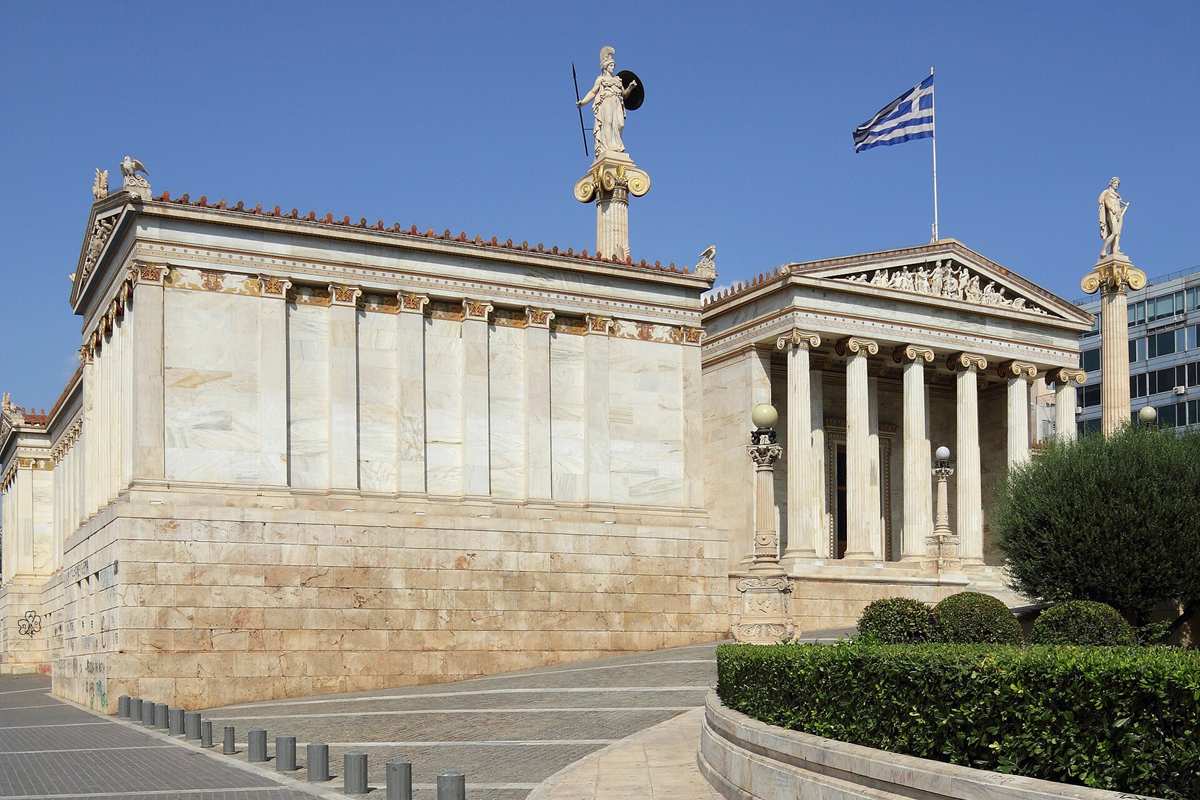
Featured photo: A.Savin, CC BY-SA 3.0, via Wikimedia Commons (File:Attica 06-13 Athens 29 Academy of Athens.jpg).