
Greek honey comes from bees all over Greece. Food outings with a host take place on Crete, Naxos, Paros and Kefalonia, and in Athens. Pine, thyme and fir honey stand beside Hymettus, the Greek bee, old top-bar hives and the Malia Pendant. Honey sweets, drinks and myths follow. Pages on Greek food, Olive oil tours in Greece and Greek souvenirs sit alongside this one. The complete set of trips is gathered under Greece tours.
Bookings made through the GetYourGuide widgets on this page earn Classical Greece Tours a commission, at no extra cost to the traveller.
What is Greek honey?
Greek honey is the honey that bees make across Greece. The main share starts as nectar gathered from the blossoms of fruit and citrus trees. Lemon, orange and bigarade trees, the last also called bitter orange, stand among those citrus sources.
Honey is a sweet, thick substance that bees make. Honey bees are the best-known makers among them. Bees collect sugary plant secretions, above all flower nectar, and then refine them. They also refine secretions from other insects, such as the honeydew of aphids. Greek honey, like any honey, starts from one of these two sugar sources.
Honey bees store their honey inside the hive in honeycomb. Honeycomb consists of hundreds, even thousands, of hexagonal cells. Hexagonal means six-sided, so each cell has six walls. The bees regurgitate honey into these cells for storage. To regurgitate is to bring swallowed food back up through the mouth. Greek honey waits in such cells before harvest.
Flower nectar holds 70 to 80% water as a rule, so it is far runnier than finished honey. Inside the hive, bees remove much of that water by evaporation. Evaporation is the change of liquid water into vapour. The process continues until honey holds between 15.5% and 18% water.
- Monofloral honey: This type comes mainly from the nectar of one single plant species.
- Apiculture: Beekeeping also goes by this name, which means the husbandry, or keeping, of bees.
- Bee smoker: Beekeepers calm the bees with smoke from this tool before they collect honey.
Greek honey owes its sweet taste to high levels of two simple sugars, fructose and glucose. Simple sugars are single sugar units that do not break down into smaller sugars. Each jar of Greek honey carries this same sweet pair of sugars.
Which insect stands behind pine honey in Greek honey?
Greek honey from pine woods starts with Marchalina hellenica, a scale insect of the eastern Mediterranean region. The insect lives mainly in Greece and Turkey. Scale insects form a group of small bugs that feed by drawing sap from plants.
The insect feeds by sucking sap from pine trees. Its main host is the Turkish pine, which botanists name Pinus brutia. A host is the plant on which an insect feeds and lives. To a smaller extent, the insect also settles on Aleppo, Austrian, Scots and stone pines.
Honeydew is a sugar-rich, sticky liquid. Aphids and certain scale insects pass it out as they feed on plant sap. Aphids are tiny insects that live on the sap of plants. The honeydew of Marchalina hellenica is an important food for forest honey bees. Those bees turn it into pine honey, a Greek honey of the pine woods.
The bulk of the Turkish pine’s range lies in Turkey. In Greece, that range reaches the island of Crete and the East Aegean islands. A range means the full spread of land on which a plant grows wild. The East Aegean islands are the Greek islands in the eastern part of the Aegean Sea.
- Tree size: The Turkish pine grows into a medium-sized tree, between 20 and 35 metres in height.
- Harm to trees: In normal conditions, the insect causes no significant damage to its host pine.
- Far from home: Marchalina hellenica is an invasive species, one spreading outside its home, in Melbourne, Australia.
Greek honey made from honeydew belongs to a group called honeydew honey, or forest honey. This kind is notably darker than typical honey. It is also more viscous, which means thicker and slower to pour. Pine honey is one such Greek honey.
How does wild thyme feed into Greek honey?
Greek honey made from wild thyme enjoys wide fame. Greece and Malta are both especially famous for honey from wild thyme. Thyme is a herb, a plant used to flavour food. Honey bees gather nectar from its flowers to make this honey.
Wild thyme, also called creeping thyme, is an important nectar plant for honeybees. Its scientific name is Thymus serpyllum. Nectar is the sugary flower liquid that bees turn into Greek honey and other honeys. Every thyme species gives nectar, not wild thyme alone. Each species is one distinct kind of living thing.
Thyme comes from plants of the genus Thymus. Botanists use the word genus for a cluster of closely linked species. These plants belong to the mint family, which botanists call Lamiaceae. Thyme sold as a herb is the dried upper part of these plants. Greek honey from thyme thus starts in a member of the mint family.
In ancient Greece, people added thyme to their baths. They also burnt thyme in temples as incense. Incense is plant matter that gives off a sweet smoke when burnt. Those Greeks held thyme to be a source of courage. Wild thyme spreads across large stretches of dry, rocky ground in southern Europe.
- Thymus capitatus: Conehead thyme is a compact, woody perennial, a plant living for years, of Mediterranean Europe and Turkey.
- Flowers: Its pink flowers sit in cone-shaped clusters at the stem tips in mid to late summer.
- Leaves: Its narrow, fleshy leaves carry tiny oil glands and reach 12 mm in length.
Greek honey from thyme draws on a plant that is at home around the Mediterranean. Thymes grow wild in Southern Europe, in North Africa and in the Levant. The Levant names the lands that line the far eastern coast of the Mediterranean.
What sets Menalou vanilia fir honey apart in Greek honey?
Greek honey from Arcadia includes Menalou vanilia fir honey. Beekeepers make it within the districts of Gortynia and Mantineia. A district is a local area that a region is split into for government. The honey takes its name from the fir tree.
This fir honey has a pleasant taste. Its look is light in colour, with a soft sheen across the surface. Sheen means a gentle shine. Its moisture content sits between 14% and 15.5%. Moisture content is the share of water held in the honey. In this Greek honey, water makes up a small part of the whole.
Production also spreads to the municipalities of Dimitsana and Lagkadia. In Greece, each municipality handles its own local affairs through a council. Communities that make it include Valtesiniko, Vytina, Elati and Zigovisti. A community here means a smaller village unit. Greek honey from these places carries the Menalou name.
The name of this honey points to the fir, a kind of tree. Greek fir, also called Cephalonian fir, is a native tree of Greek mountains. Native means that it grows there naturally, without being brought by people. The tree grows mainly in the Peloponnese and on the island of Kefalonia.
- Height: This evergreen conifer, or cone-bearing tree, is of medium size and reaches 25 to 35 metres.
- Altitude: Its stands lie between 900 and 1,700 metres up, where rainfall tops 1,000 mm.
- Cones: Its cones measure 10 to 20 cm long and carry about 150 to 200 scales.
Menalou vanilia fir honey also has a sucrose content below 10%. Sucrose is the chemical name for ordinary table sugar. Greek honey of this type thus holds little of that sugar. A content below 10% means fewer than ten parts in every hundred.
Which part does Hymettus play in Greek honey history?
Greek honey has a long link with Hymettus, a mountain range that rises near Athens in Attica. Hymettus won a name for its thyme honey. Bees make this thyme honey by gathering nectar from the flowers of thyme plants.
Greek honey on Hymettus also has a written past at Kaisariani Monastery. In a letter of 1209, Michael Hionati reports on the produce of its beehives. That produce went to the hegumen, the abbot who led the monastery. Four years later, he complained that no income had reached him. The abbot’s excuse was that the beehives had been destroyed.
The ancient name for the top peak of Hymettus was Megas Hymettos. Megas is the Greek word for great or big. Marble has been cut from quarries on the mountain since antiquity. A quarry is a pit where people dig out stone. Antiquity is the name for the long age of Greek and Roman civilisation.
The main forest of Hymettus lies in its northern part. Much of the rest of the mountain is rocky, grassy and deforested. Deforested means that the trees have been cleared away. The mountain that gives this Greek honey is built of limestone. Limestone is a pale rock formed largely from the shells of sea creatures.
- St John the Theologian: This monastery on Hymettus lies between the districts of Cholargos and Papagou.
- Kareas Monastery: It stands on the west flank of the range, near the village of Kareas.
- Excavation: Carl Blegen carried out an exploratory dig, a trial excavation, on the mountain in 1923.
Kaisariani, one of the Byzantine monasteries on Hymettus, reached its peak in the 12th and 13th centuries. It was then a political and spiritual centre. Byzantine describes the eastern Roman state, which had Constantinople as its capital. Its Greek honey records belong to that same era.
How does the Greek bee, Apis mellifera cecropia, fit into Greek honey?
Greek honey has its own native bee, Apis mellifera cecropia, known simply as the Greek bee. This subspecies of honey bee comes from southern Greece and southern Albania, where it is native. A subspecies marks out a separate regional type inside one species.
The Greek bee is very similar to the Italian bee, Apis mellifera ligustica. Both are forms of the same honey bee species. Kiesenwetter classified the Greek bee in 1860 and gave it its scientific name. Lists of honey bee subspecies call it the Greek honey bee. They place it in southern Greece, in the Peloponnese region.
Beekeepers who make Greek honey favour this bee for its extreme gentleness. It also shows little tendency to swarm, a trait beekeepers prize. Swarming is the way new colonies form once a hive has no room left to grow. In a swarm, part of the colony leaves to find a new home.
Greek bee colonies build up at great speed each spring. To build up here means to grow fast in numbers after winter. Their queens are very prolific, which means they lay eggs in great numbers. The result is strong hives. A strong hive holds a large and busy population of worker bees.
- Warmth: The Greek bee prefers warm weather and cannot survive the cooler climate of northern Europe.
- Home range: Beekeepers seldom keep this bee anywhere outside the south of Greece.
- Crete apart: Bees of Thrace, Macedonia, Central Greece and the Peloponnese differ clearly from those of Crete.
Greek honey from this bee comes in quite large amounts, but only in Mediterranean climates. A Mediterranean climate pairs a hot, dry summer season with a mild winter that brings rain. In cooler climates, the same bee does not reach such a large honey yield.
What is the Greek top-bar hive in the history of Greek honey?
Greek honey for centuries came from the tub-shaped top-bar hive, among other hive types. One version, the so-called Greek hive, was first described in the 17th century. Beekeepers on the island of Crete used it until recent times.
The top-bar hive has just one storey and no frames. Instead, its comb hangs from removable bars set across the top. Comb is the wax sheet of six-sided cells in which bees store honey. In other hive types, a frame is a wooden surround in which the comb sits. Removable means each bar lifts out.
In 1676, two travellers, George Wheler and Jacques Spon, watched beekeeping in Greece. Those Greek honey hives were woven and shaped like tubs, with bars on top. Woven means plaited from flexible stems. Wheler gave a detailed account and a drawing of one such hive. Both appear in his book Journey Into Greece, published in 1682.
The beekeeper Zuanne Papadopoli described the same method in clay pots on Crete. These pots had a tub shape and carried bars across the top. Cretan beekeepers used them for Greek honey before 1669. Clay is a soft earth that turns hard as pottery once fired. Firing means baking the shaped clay at great heat.
- Anastomo hives: These Greek hives, of wicker or clay, are round and fitted with top-bar frames.
- Kythira stone hives: Rectangular stone top-bar hives on Kythira are considered the first with fully interchangeable combs.
- Kenyan hive: Early writings on this African hive name the Greek hive as an inspiration.
Modern hives hold movable frames, which lift in and out of the box. These frames are considered an outgrowth of the basket top-bar hives of Greece. Those Greek honey hives let the beekeeper take the harvest without killing the bees.
What does the Malia Pendant tell of Greek honey in Minoan Crete?
Greek honey history reaches back to Minoan Crete through the Malia Pendant. This jewel came from a tomb at Chrysolakkos, at Malia on Crete. Minoan names the early civilisation of Bronze Age Crete. A pendant is a jewel that hangs from a chain or cord.
Its common nickname is the Bees of Malia. It also goes by the name of the bee pendant. Both names grew from the belief that the jewel shows bees. In the design, the wings of the two insects spread backwards. Bees are the insects that make honey, Greek honey among it.
With their legs, the insects grip a circular disc placed at the centre. A second, smaller globule sits above it, between their heads. A globule is a small round drop or ball. This globule is smooth, and the insects appear to be eating it. The paired insects frame both shapes between them.
Not every scholar accepts the bee reading. One paper argues that the insects are not true bees. It places them in the wider insect grouping called Hymenoptera. Hymenoptera is the large insect order that holds bees, wasps and ants. An order is a broad rank used to sort living things.
- Honeycomb images: Certain objects from Minoan tombs resemble honeycomb or include honeycomb imagery.
- Economy: Bees held an important place in the economy of Minoan Crete.
- Gold rings: Beekeeping overseers, the officials in charge, owned gold rings showing beekeeping scenes.
Greek honey has an ancient past on Crete and at Mycenae, with high-status beekeeping. At Knossos, digs have found hives, smoking pots and honey extractors. These finds show this early side of Greek honey. A honey extractor is a tool for drawing honey from the comb.
How does ambrosia, the food of the gods, connect with Greek honey?
Greek honey lies behind ambrosia in the view of the scholar W. H. Roscher. He held that nectar and ambrosia were both kinds of honey. In ancient Greek myths, ambrosia serves as the food or the drink of the gods. Nectar is their other heavenly fare.
In the poems of Homer, nectar is as a rule the drink of the gods. Ambrosia is their food in those poems. The poets Sappho and Anaxandrides reversed this and made ambrosia the drink. Poetry sets words in measured lines that follow a beat. A beat is a regular, repeated pulse in sound.
Both views fit if ambrosia was a liquid treated as a food, in the way Greek honey is. Doves carried ambrosia up to the gods on Olympus. Olympus is the mountain where the Greek gods were said to live. At the heavenly feast, Hebe or Ganymede served it to them.
Ancient art at times showed ambrosia handed out by a nymph who was also named Ambrosia. She served as a nurse of the god Dionysus. Such a nymph, in the old stories, is a young female being tied to woods, springs or hills. A nurse here means a woman who looks after and feeds a young child.
- Seals: Goddesses with the faces of bees, the makers of Greek honey, appear on Minoan seals from Crete.
- Heracles: Athena gave ambrosia to Heracles when he rose to immortal life on Olympus.
- Tantalus: In one myth, Tantalus tasted ambrosia and then tried to steal a share for other mortals.
The Homeric Hymn to Hermes names honey as the food of the gods. Hymns are songs written to honour a god. It also tells of three bee maidens gifted with foresight and truth. Bee maidens are spirits tied to bees, the insects behind Greek honey.
Who was Melissa, the nymph who found Greek honey in myth?
Greek honey has its own discoverer in myth, the nymph Melissa. She found honey and taught its use to others. Her name means honeybee in the ancient Greek language. A myth is a traditional story from long ago that explains how something began.
Bees were believed to owe their Greek name, melissai, to her. Melissai simply means bees. In these stories, the nymphs who nursed the baby Zeus also bear the names Melissae and Meliae. Meliae is simply another title for these nursing nymphs. To nurse a baby means to feed it and care for it.
Another Melissa was the daughter of Melisseus, a king of Crete in Greek myth. With her sister Amalthea, she fed Zeus on goats’ milk. The writer Didymus lived in the late 1st century BC. In his own account, Amalthea and Melissa feed the baby Zeus on goat’s milk and Greek honey.
The name Melissae was later passed on to priestesses in general. Above all, it named the priestesses of Demeter and Persephone, two goddesses, and of Apollo at Delphi. A priestess is a female religious leader at a temple or shrine. In this way, the word for honeybee became a title for holy women.
- Ephesus: Nymphs in the shape of bees were said to have led settlers to Ephesus.
- Offerings: Greek honey was offered to the Greek gods as early as Mycenaean times, a Bronze Age era.
- Melisseus: One tradition names Melisseus as the god of honey and of bees.
Notes on the poets Pindar and Euripides explain where the title came from. Those notes trace the name Melissae to the purity of the bee, which makes Greek honey. Purity means being clean and free from anything bad or harmful.
What part does Aristaeus play in the myths of Greek honey?
Greek honey links to Aristaeus, a culture hero of Greek myth. Ancient tales credit him with rural skills, beekeeping among them. A culture hero is a figure who brings useful skills to people. Beekeeping is the care of bees for Greek honey and wax.
His name, Aristaios, means the best. It served as a cult title in Boeotia, Arcadia and Ceos. A cult title is a name used in the worship of a god or hero. In Boeotia, he was known as the pastoral Apollo. Pastoral means linked with shepherds and the countryside. There he married Autonoe, a daughter of Cadmus.
The poet Pindar sang that Hermes carried the newborn Aristaeus away, to be reared on nectar and ambrosia. The writer Diodorus says nymphs taught the boy to curdle milk, make beehives and grow olive trees. Aristaeus later passed these skills on to humans. A beehive is a home made for bees, from which Greek honey is taken.
Nymphs of Thessaly who raised him taught him further arts. He learned how to tame bees and house them in hives. He also learned to use honey and beeswax. Beeswax is the wax that bees make to build their honeycomb. A honeycomb is a mass of six-sided wax cells that holds Greek honey.
- Loss: In Virgil’s poem the Georgics, his bees fell sick and began to die.
- Cause: The bee deaths were a punishment from Eurydice’s nymph sisters, as he had caused her death.
- Swarms: Back at the place of sacrifice, he found new bee swarms inside one dead animal.
Aristaeus ended his travels on Mount Haemus, in the north of Thrace. From then on, he no longer showed himself to mortals. Mortals are human beings, who die, unlike the gods. Greek and non-Greek peoples alike revered him as a god.
Which ancient offerings poured Greek honey instead of wine?
Greek honey went into nephalia, the wineless offerings of ancient Greek religion. Nephalia was the term used in worship for libations without wine, or with wine banned outright. A libation is a liquid poured out as a gift to a god.
Water, milk, oil or honey, alone or mixed in any way, served for these offerings. One of the commonest was melikraton, a blend of Greek honey with water or milk. Melikraton is the ancient Greek name for that sweet mixture. A blend is a mix of two or more things stirred well together.
Nephalia were held as rituals of their own. They were also joined to other kinds of sacrifice, such as the sacrifice of animals. A ritual is a religious ceremony carried out in fixed, repeated steps. Aeschylus and Porphyry, two ancient Greek writers, both mention the use of nephalia in their works.
The word nephalia comes from a Greek verb for staying sober, that is, drinking no wine. In a wider sense, the verb also meant being self-controlled. Sober means free from the effects of alcoholic drink. Self-controlled means able to hold back from a wish or an urge. The name nephalia itself means calm in ancient Greek.
- Odyssey: In the Odyssey, Odysseus digs an offering pit and pours honey, wine and water in turn.
- Tombs: In care for the dead at the graveside, libations included milk and Greek honey.
- Sophocles: In a play by Sophocles, large pots wreathed in wool are filled with honey and water.
Honey-based libations had a name of their own, melisponda. These offerings of Greek honey included mead and other honey drinks. Mead is an old alcoholic drink brewed mainly from honey. To brew means to make a drink by soaking, boiling or fermenting its ingredients.
What was oenomel, the old blend of grape juice and Greek honey?
Greek honey and grape juice made oenomel, an ancient Greek drink. The honey was mixed with grape juice that had not fermented. The name joins two Greek words, oinos, meaning wine, and meli, meaning honey. Juice that has not fermented has not yet turned into alcohol.
The Geoponica, an old Greek text, describes oenomeli in a different way. One method blends Greek honey and wine with spices, costus among them. Costus is a sweet-smelling dried root used as a spice. The second method mixes honey with must. Must is fresh grape juice that still holds the skins and seeds.
As a word, oenomel suggests a blend of strength and sweetness. The idea can be good, as in a trait of someone’s character. It can also be bad, as in a carrot-and-stick approach. That phrase means mixing rewards with threats to push someone into action. A trait is a quality found in a person.
In ancient Greece, people at times sweetened their wine with Greek honey. Mead is a different drink, an alcoholic one fermented from honey, water and yeast. Fermented means changed by yeast, so that sugar turns into alcohol. Yeast is a tiny living fungus used in baking and brewing. Alcohol is the substance in drinks that makes people drunk.
- Hydromel: Hydromel, another name for mead, comes from the Greek hydromeli, meaning water-honey.
- Omphacomel: Omphacomel blends Greek honey with juice pressed from grapes that are not yet ripe.
- Rhodomel: Rhodomel takes its name from the Greek rhodomeli, which means rose-honey in a literal sense.
Aristotle, the philosopher, wrote about mead from Illyria in his work Meteorologica. He lived from 384 to 322 BCE. Philosophers try to answer deep questions about knowledge, nature and right living. The letters BCE stand for Before Common Era, which matches BC.
Why do teganites, the Greek pancakes, belong to the story of Greek honey?
Greek honey reaches back to teganites, pancakes made by the ancient Greeks. They were also called tagenites or tagenias. All three names come from tagenon, the Greek word for a frying pan. A pancake is a thin, flat cake cooked in a pan.
The earliest known mentions of tagenias come from two poets, Cratinus and Magnes. Both wrote in the 5th century BC. Their batter held wheat flour, olive oil, Greek honey and curdled milk. Curdled milk is milk that has thickened and turned sour. These pancakes were eaten at breakfast, the first meal of the day.
The writer Athenaeus mentions staititas in his work the Deipnosophistae. Staititas were topped with Greek honey, sesame and cheese. Sesame is a plant whose small, oily seeds are eaten. Greek pancakes today are called teganites. They are smaller pancakes, and they can be either sweet or savoury. Savoury dishes taste salty or meaty instead of sugary.
Teganites are drizzled with plain sugar, or with Greek honey and cinnamon. To drizzle is to pour a thin stream of liquid over food. Cinnamon is a sweet spice made from the dried inner bark of a tree. Plain sugar here means white sugar with nothing added to it.
- Toppings: Cheese, nuts, fruits or vegetables can also go on top of teganites.
- Mealtimes: Teganites work as a breakfast dish or as a dessert after a meal.
- Cyprus: In Cyprus, an island in the eastern Mediterranean, pancakes are also called teganites.
In Corfu and Patras, teganites are a custom when Saint Spyridon and Saint Andrew have their feast days. A feast day is the yearly day on which a church honours a saint. A saint is a holy person honoured by the Christian Church.
What do travellers ask about Greek honey, and what are the answers?
Greek honey raises four questions about sweets and drinks: loukoumades, rakomelo, kykeon and plakous. Loukoumades are small balls of fried dough. Rakomelo mixes a grape spirit with honey. Kykeon is an old drink based on barley. Plakous was a flat cake of the ancient Greeks.
In Greek honey sweets, what makes the batter of loukoumades so soft?
The thick, smooth batter rises with yeast and turns very soft and foamy. Yeast is a living raising agent that makes dough swell. Modern cooks at times use baking powder in place of yeast. In Cyprus, they come spiced with cinnamon in honey syrup, with a light dusting of powdered sugar.
How much Greek honey goes into a general recipe for rakomelo?
A general recipe calls for 1 to 2 teaspoons of honey per 4 shots of raki. Raki is a strong grape spirit. The mix also takes a single clove and roughly 1 teaspoon of cinnamon, adjusted to taste. Baked raki holds more spices than rakomelo, which as a rule holds only cinnamon.
What was kykeon, the drink of Homer’s poems sweetened with Greek honey?
The Iliad gives its parts as Pramnian wine, barley and goat’s cheese, grated. In the Odyssey, Circe adds honey and then stirs in her magic potion. A potion is a drink with magic power. Greek peasants counted kykeon among their favourite drinks. Peasants were poor farm workers who lived off the land.
What was plakous, the ancient cake of Greek honey and cheese?
The poet Antiphanes described plakous as built on wheat flour and goat’s cheese. In the Odyssey, thin breads get their sweetness from walnuts and honey. Through its Byzantine name, plakountos, the dessert passed into Armenian cooking as plagindi. Byzantine refers to the medieval eastern Roman state. Plagindi names cakes of bread and honey.
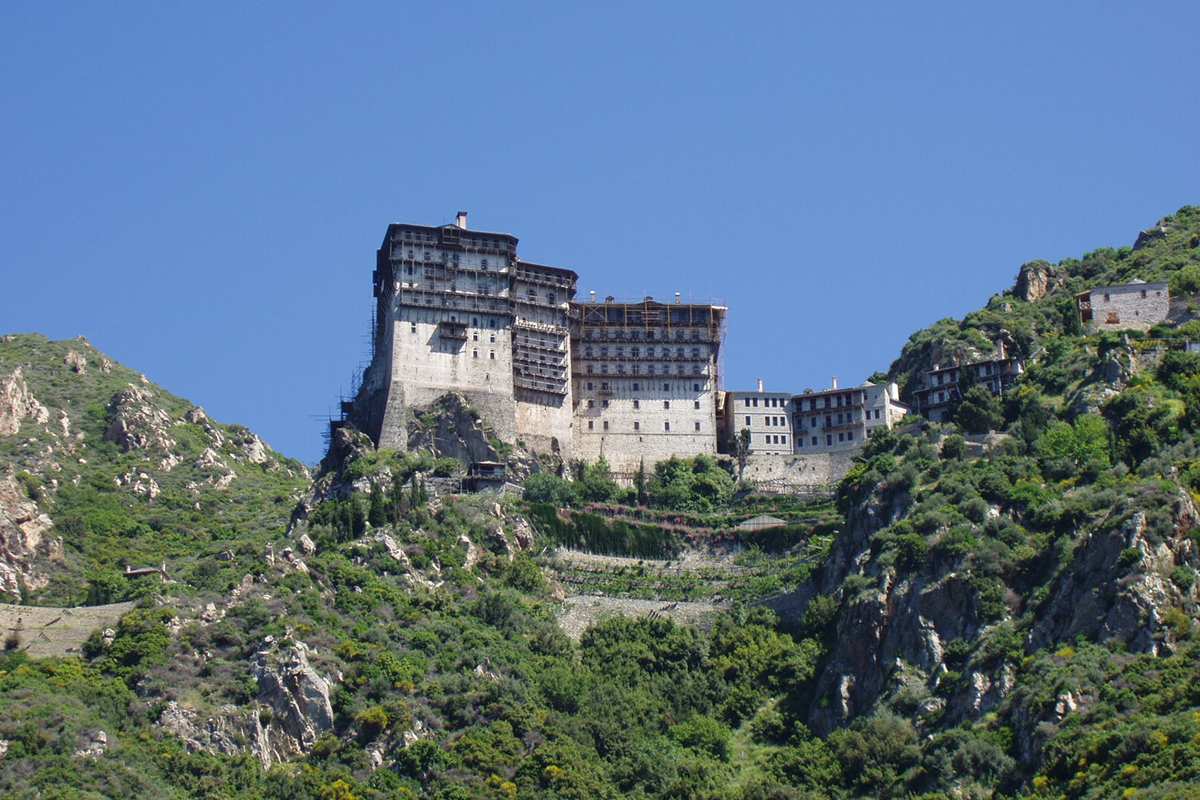
Featured photo: File:Simonopetra.JPG | Ggiannikis, Public domain, via Wikimedia Commons.