
Greece in autumn spans the three months from September to November. Small-group trips take place on the mainland, on Crete and among the islands. Station figures come from Tympaki, Veria, Ios and Amphissa. Moustalevria, the ancient olive harvest, Ano Doliana chestnuts and Krokos saffron follow. Feast days, migrating birds and autumn flowers also appear. Separate pages explain Greece weather in September, then Greece weather in October and finally Greece weather in November. More trips sit on the Greece tours page.
Bookings made through the GetYourGuide widgets on this page earn Classical Greece Tours a commission, at no extra cost to the traveller.
What is Greece in autumn like?
Greece in autumn covers September, October and November, which meteorologists count as autumn in the Northern Hemisphere. Daytime grows noticeably shorter over these weeks, and the temperature cools considerably across the season. A meteorologist is a scientist who studies weather and climate.
Autumn counts as one of Earth’s four temperate seasons. Temperate means mild, between the hottest and coldest belts of Earth. In higher-latitude northern countries, autumn starts with the September equinox, between 21 and 24 September. An equinox is a day when day and night are nearly equal. Latitude measures distance from the equator.
Greece still measures sunshine only with Campbell-Stokes recorders. This device focuses sunlight through a glass sphere to scorch a card. Such recorders underestimate yearly sunshine by around 200 hours against automatic sensors. Across Greece in autumn, a cold semi-arid climate covers parts of Macedonia and Thessaly, Thessaloniki included. Semi-arid means fairly dry, with little yearly rain.
Outside the tropics, autumn marks the change from summer to winter. The tropics are the warm belt of Earth on either side of the equator. For Greece in autumn, that change leads from the summer months towards winter. In autumn, deciduous trees change leaf colour as they prepare to shed their leaves.
- Solstice: In those northern countries, autumn closes with the winter solstice on 21 or 22 December.
- Deciduous: Deciduous trees lose all their leaves each year and grow new ones in spring.
- Word origin: The English word autumn comes from the Latin word autumnus.
Greece in autumn lies in the Northern Hemisphere, the half of Earth north of the equator. Mount Olympus is the highest peak in Greece, at 2,918 metres above sea level. Heights of peaks are measured from sea level, the mean surface of the sea.
Which story do Tympaki Airport records tell about Greece in autumn?
Greece in autumn can be traced at Tympaki, a town on the southern coast of Crete. The Tympaki Airport station gives September an average daily high of 28.8 °C. A daily high is the warmest reading of each day.
The Tympaki Airport station stands 6 m above sea level, with records for 1959-2010. Its data belong to the HNMS, short for Hellenic National Meteorological Service. Hellenic means Greek. In October, the mean temperature at the station is 20.4 °C. A monthly mean blends day and night readings into one average.
September at the Tympaki station averages only 1.2 rain days. On a rain day, the gauge catches enough water to measure. For Greece in autumn, October humidity at Tympaki averages 65.5%. Humidity gauges how much moisture the air carries as unseen vapour. Vapour is water that has turned into a gas.
November lows at Tympaki average 11.9 °C. Each daily low marks the chilliest point between one dawn and the next. In Greece in autumn, the station counts 6.9 rain days in an average November. November rain at Tympaki totals 74.2 mm. Each millimetre stands for a litre of water landing on every square metre.
- November high: November highs at the Tympaki Airport station average 21.2 °C.
- Climate type: The Köppen code for the Tympaki climate is Csa, the hot-summer Mediterranean type.
- Köppen: The Köppen system sorts the climates of the world into lettered groups.
Summers at Tympaki are hot and dry, and its winters are mild and rainy. Mild means neither very hot nor very cold. Greece in autumn at Tympaki sits between those two seasons, from September to November. September lows at the station average 18.2 °C.
How do Veria station figures describe Greece in autumn?
Greece in autumn at Veria opens with a September average daily high of 27.8 °C. By November, the average daily high there drops to 14.3 °C. Two bodies supply the data: the Hellenic National Meteorological Service and the National Observatory of Athens.
Veria has a Mediterranean climate, coded Csa, bordering a cold semi-arid climate with the code BSk. Both codes belong to Köppen’s scheme, a lettered map of world climates. Veria’s climate zone is transitional, mixing continental, semi-arid and Mediterranean traits. Continental describes inland weather with large swings between seasons.
In Greece in autumn, the October mean temperature at Veria is 15.6 °C. Veria’s October record high stands at 33.5 °C. That record marks the hottest October reading ever kept in the station’s books. Winters at Veria run from mid-October to March and are wet and cool.
Veria’s November lows average 5.3 °C. Its November record low is −3 °C, colder than the freezing mark for fresh water. In Greece in autumn, Veria counts 9.9 precipitation days in an average November. Precipitation is the shared term for rain, sleet, snow and hail. Snow comes to Veria once or twice a season.
- September sun: The Veria station logs an average of 224.9 hours of sunshine in September.
- November sun: November sunshine at Veria falls to an average of 118.3 hours.
- September rain: Veria records an average of 16.1 mm of precipitation in September.
For Greece in autumn, November humidity at Veria averages 77.1%. That percentage tells how close the air is to holding all the moisture it can. October brings Veria an average of 7.5 precipitation days. November’s mean temperature there is 9.5 °C.
What does Ios add to Greece in autumn?
Greece in autumn on Ios has September highs that average 26.8 °C at the island station. September lows on the island average 22.4 °C. Both figures are averages for 2019 and 2020 from a station 3 m above sea level.
The climate of Ios is hot semi-arid, coded BSh in the Köppen system. Hot semi-arid means warm and fairly dry, with low yearly rain. Like other Cyclades islands, Ios gets an almost constant north breeze in summer, called the meltemi. That wind moderates temperatures on the island. To moderate means to keep readings from swinging to extremes.
In Greece in autumn, October highs on Ios average 24.6 °C. October lows on the island average 19.7 °C. October precipitation on Ios averages 33.7 mm. Average highs and lows are means of each day’s warmest and coolest readings. The short form mm means millimetres, each a thousandth of a metre.
November highs on Ios average 20.6 °C. November lows average 16.5 °C at the same station. In Greece in autumn, November precipitation on Ios reaches 53.5 mm. Each millimetre in that total equals a film of water that depth on level ground. A rain gauge, a simple open container, collects it.
- BSh: In the Köppen code, B marks a dry climate and h marks a hot one.
- August: Just before autumn, the Ios station logs 0 mm of precipitation in August.
- December: Once autumn ends, December highs on Ios average 17.6 °C.
For Greece in autumn on Ios, September precipitation averages only 1.6 mm at the station. Precipitation covers every form of falling water, from drizzle to downpours. Drizzle is very fine rain, and a downpour is a heavy burst of rain.
How does the Amphissa station measure Greece in autumn?
Greece in autumn at Amphissa, a town in Phocis, begins with September highs averaging 30.6 °C. September lows at the town station average 18.6 °C. Amphissa serves as seat of the Delphi municipality, a unit of local government.
The climate at Amphissa is hot-summer Mediterranean. In the Köppen system, hot-summer marks the warmest type of Mediterranean summer. The town station stands at 168 m above sea level. That height is reckoned from the calm mean surface of the open sea. Its readings are means for 2019 and 2020.
In Greece in autumn, October highs at Amphissa average 25.3 °C. October lows at the station fall to an average of 12.4 °C. October precipitation at Amphissa averages 43.6 mm. The gap between a high and a low is called the daily range. Station thermometers sit in a shaded, ventilated box, so sunlight does not skew readings.
November highs at Amphissa average 19.5 °C. November lows there average 10.1 °C. In Greece in autumn, November brings Amphissa an average of 55 mm of precipitation. By December, lows at the station drop to an average of 6.5 °C. Average means the sum of all readings divided by their number.
- September rain: September precipitation at the Amphissa station averages 82.2 mm across the month.
- August: In August, before autumn begins, Amphissa highs average 34.6 °C.
- December: December precipitation at the Amphissa station averages 73.5 mm.
For Greece in autumn, Amphissa lies 200 km northwest of Athens. Delphi lies 20 km away. Northwest is the compass point halfway from north to west. The municipal unit of Amphissa covers 315.174 square kilometres. Such a unit forms one district inside a larger municipality.
Why does moustalevria belong to Greece in autumn?
Greece in autumn has moustalevria, a pudding in favour at grape-harvest time, while the must is still fresh. Its other names are must jelly, mustpie and mustcake. Grape must is fresh juice pressed from grapes before it ferments. Fermentation turns sugar into alcohol.
To make moustalevria in Greece in autumn, cooks boil the grape must over a low fire. A small amount of argil is then added to clean the must. Argil is a fine white clay. After the boil, cooks stir in flour, sugar, semolina, sesame, nuts or petimezi, a grape syrup. Semolina is coarse flour ground from hard wheat.
In the Byzantine era, moustalevria went by the names mustopita and pastellos. The Byzantine era was the long rule of the eastern Roman Empire. Today Crete calls the pudding kefteria, while Samos calls it kourkouta. Grape syrup itself appears early: Hippocrates, a fifth-century BC Greek physician, mentions it.
Today, Greeks commonly call their grape syrup petimezi. Across Greece in autumn and beyond, from late August to early December, bakeries make petimezi cookies called moustokouloura. These cookies are dark, crunchy and fragrant. Fruits candied by boiling in petimezi are called retselia. Candied means preserved by cooking in sugar syrup.
- Treading: Ancient Greek farmers crushed the grapes by foot in large vats.
- Winemaking: Producing must comes first in winemaking, before any yeast goes in.
- Siraion: Ancient Greeks called must condensed by boiling siraion and used it as a sweetener.
In ancient Greece in autumn, early in the season, farmers gathered the grape harvest. Must keeps the fruit’s skins, seeds and stems. Pomace, the solid share of must, makes up 7–23% of its weight. Stems are the small woody stalks that hold the grapes.
What did the ancient olive harvest mean for Greece in autumn?
Greece in autumn closed with the olive harvest in ancient times. That harvest ran from late autumn to the start of winter. Farmers took the fruit by hand or knocked it down with a pole. A pole is a long stick for beating the branches.
After picking in ancient Greece in autumn, the olives went into wicker baskets. There they were left to ferment before pressing. The oil was stored in terracotta, or baked clay, vases. Pliny the Elder called the screw press the Greek press. Yet it was a Roman invention of the 2nd century BCE.
In Greece in autumn long ago, the olive season was also the time for pruning trees and vines. Farmers harvested legumes at that point too. Pruning means cutting back branches. Legumes are plants with seeds in pods, such as beans, lentils and peas. Olive trees did well along the Mediterranean shores of central and southern Greece.
The wild olive, Olea oleaster, was native to the Mediterranean. Olea europaea, the cultivated olive, came in for large-scale growing in Mycenaean Greece. That happened in the Late Bronze Age. The label Mycenaean takes its name from the site of Mycenae. Today Spain, Italy and Greece are the world leaders in commercial olive growing.
- Oil share: Roughly 80% of the olive crop is pressed for oil, leaving the remainder for eating.
- Triad: The olive joins wheat and the grape as a basic trio of Mediterranean cooking.
- Botany texts: Theophrastus left two surviving botany works, among them Enquiry into Plants.
For ancient Greece in autumn and other seasons, Hesiod’s Works and Days gives information about working the land. Hesiod wrote the poem in about 700 BCE. Xenophon’s Oeconomicus, of about 360 BCE, does the same as a dialogue on running a household.
Where does Ano Doliana fit into Greece in autumn?
Greece in autumn meets the chestnut harvest at Ano Doliana, a stone-built mountain village in eastern Arcadia. Its old school ran in September and October, until farmers finished gathering chestnuts. The harvest there is complete by the first Saturday of November.
Greece in autumn at Ano Doliana unfolds at 900 to 1,150 metres, on Mount Parnon’s northern slopes. Its slopes hold fir, chestnut, plane and cherry trees. A plane tree is a broad-leaved tree with flaking bark. Villagers spend the winter in Kato Doliana, a lower village with a milder climate. Ano means upper and kato lower.
In Greece in autumn, Ano Doliana draws visitors on autumn and winter weekends. Hikers come too, in spring or autumn. The village is a protected traditional settlement. A traditional settlement here is a village protected for its old buildings and layout. The old village school ceased operating in October 1982.
The English word chestnut traces back, through the Latin Castanea, to the Ancient Greek kastanon. Botanists still use Castanea as the tree’s scientific name. A scientific name is the Latin label botanists give each species. The Greek word possibly comes from Casthanaea, an ancient town in Magnesia. Casthanaea stood where the modern village of Keramidi lies.
- Foliage: In Greece in autumn, the changing leaves around Ano Doliana suit leaf peeping, or watching autumn colour.
- Army stores: In 401–399 BC, a retreating Greek army in Asia Minor reportedly lived on stored chestnuts.
- Sprouting: A chestnut can start to grow as soon as it falls to the ground in autumn.
As of 2021, Ano Doliana had 62 inhabitants, or permanent residents. Far beyond Arcadia, Alexander the Great and the Romans spread chestnut trees across Europe during their campaigns. Each campaign was a long run of military marches and battles.
Why is Krokos tied to Greece in autumn?
Greece in autumn has Krokos, a town renowned in Greece and abroad for its saffron. Saffron comes from Crocus sativus, a plant also called the saffron crocus or autumn crocus. For Greece in autumn, its corm plants bloom with purple flowers.
The ancient Minoans grew saffron on Crete during the Late Bronze Age. Minoan is the modern name for that early Cretan civilisation. Saffron growing later vanished from Greece until the 17th century. Human cultivation and trade of saffron have lasted more than 3,500 years. Cultivation means growing a plant on purpose as a crop.
In Greece in autumn, Krokos saffron ranks among the strongest and costliest kinds in the world. A large share of the Krokos crop is certified organic. Organic means grown without synthetic chemical sprays or fertilisers. Between 50,000 and 75,000 plants are needed for about 1 pound of saffron.
The saffron crocus of Greece in autumn belongs to the iris family, Iridaceae. It is a triploid with 24 chromosomes, which leaves it sterile. Triploid means each cell holds three sets of chromosomes. Chromosomes carry a cell’s genes. The plant is unknown in the wild, and each corm gives only one or two flowers.
- Look-alike: Meadow saffron, Colchicum autumnale, resembles the saffron crocus but is toxic.
- Stamens: True crocuses carry three stamens, while colchicums carry six stamens and three styles.
- Corm: A corm is a swollen underground stem base that stores food for the plant.
In 7th-century Crete, locals also called saffron krokon. A Greek legend tells of Crocus and Smilax, in which Crocus is bewitched into the first saffron crocus. Bewitched means changed by a spell. A legend is a traditional story passed down over generations.
Why did the Apaturia festival belong to Greece in autumn?
Greece in autumn once brought the Apaturia, a yearly feast of every Ionian town but Ephesus and Colophon. The Ionians formed one main group of ancient Greeks. At Athens, the clans of Attica, known as phratries, met then to talk over their affairs.
The Athenian Apaturia fell in Pyanepsion, a month of the old Athenian calendar. That month ran from mid-October to mid-November. The feast therefore belonged to Greece in autumn. Its name is a slightly altered form of an older word. That older word meant the festival of common relationship, or shared family ties.
A legend set the start of the Apaturia in 1100 BC. In that tale, Melanthus fought a single combat on behalf of King Thymoetes of Attica. His rival was King Xanthus of Boeotia, a region of ancient Greece. Melanthus cried that a man in a black goatskin was helping him. The trick threw Xanthus off his guard.
On the first day of this Greece in autumn feast, called Dorpia, banquets began towards evening. Members met at their phratry’s meeting place or in private homes. The second day was Anarrhysis, from a Greek verb for drawing back the sacrificed animal’s head. On that day, oxen were sacrificed at public cost to Zeus Phratrius and Athena.
- Third day: On Koureotis, fathers presented new children, and after an oath their names entered the register.
- School prizes: Schoolboys recited poems on the same day and won prizes for their efforts.
- Wine for Hercules: Children reaching their teenage years also offered wine to the hero Hercules.
Folk etymology tied the name of this Greece in autumn festival to apate, the Greek for deceit. Folk etymology is a popular guess about where a word comes from. Such guesses rest on the sound of a word rather than its true history.
What makes Cyclamen graecum a flower of Greece in autumn?
Greece in autumn is when Cyclamen graecum, the Greek cyclamen, opens its flowers. Each flower has five white or pink petals with a darker blotch at the nose. The nose is the narrow mouth of the flower. The plant is prized for its variable leaf forms.
Across Greece in autumn, the plant climbs as high as 1,200 metres. Its range takes in southern mainland Greece, the Peloponnese, the Aegean Islands and Crete. The Peloponnese is the large peninsula in the south of the Greek mainland. The Aegean Islands lie in the sea between Greece and Turkey.
Cyclamen graecum grows from a tuber, a swollen stem below the ground that stores food. Its tuber is corky, with a thick, strong and fleshy anchor. Roots sprout from the centre of the tuber’s base. The leaves are heart-shaped and toothed. Toothed means the edges carry small points like a saw.
In Greece in autumn, the bases of the petals curl outwards into auricles. Auricles are small lobes shaped like ears. After pollination, the stem of the flower twists in both directions, beginning at the centre. Pollination is the moving of pollen between flowers so that seeds form. In Cyclamen hederifolium, by contrast, the twisting starts from the top.
- Cretan subspecies: Subspecies candicum, a local form found only in western and central Crete, has white or pale pink flowers.
- All-white form: A form with pure white flowers grows in the Peloponnese and on Crete’s Rhodopou Peninsula.
- Eastern relative: Cyclamen maritimum, once counted as a subspecies, grows in the eastern Aegean Islands, including Rhodes.
In Greece in autumn, the flowers of this plant are frequently fragrant. Fragrant means sweet-smelling, with a pleasant scent that carries in the air. Cyclamen graecum is the scientific name used by botanists, and graecum is Latin for Greek.
How does the lesser white-fronted goose connect with Greece in autumn?
Greece in autumn ties into the yearly journey of the lesser white-fronted goose. Its Fennoscandian population breeds in northern Norway and spends the winter in Greece, Bulgaria and Turkey. Fennoscandia is the region of Norway, Sweden, Finland and nearby lands.
This goose nests in the far north of the Palearctic, but breeding pairs in Europe are scarce. The Palearctic is the wildlife region covering Europe, northern Africa and northern Asia. The scientific name erythropus means red-footed. It comes from the old Greek words eruthros, meaning red, and pous, meaning foot.
In 1758, the Swedish naturalist Carl Linnaeus formally described the goose for science. A naturalist is an expert in wildlife and nature. The bird measures 53 to 66 centimetres in length, with wings spanning 120 to 135 centimetres. The goose is only a little larger than a mallard, a common wild duck.
Adults have an obvious yellow ring around the eye. Their white facial blaze runs right up to the crown. A blaze is a patch of white on the face. The crown is the top of the head. Both white-fronted geese, the lesser and the greater, show bright orange legs and mouse-coloured upper wing feathers.
- Autumn stop-over: Hortobágy National Park in Hungary is a major rest stop on the flight to Greece in autumn.
- Tiny flock: The Norway-bred group that heads for Greece in autumn numbers 20 breeding pairs, or 60 to 80 birds.
- Endangered: The species counts as endangered, and programmes return birds to the wild to strengthen numbers.
Not every Fennoscandian goose flies to Greece in autumn. A second part of the population breeds in northern Sweden. These birds take a western migration route instead. Their winter quarters lie in the Netherlands and Germany. Migration means a seasonal journey between nesting and wintering places.
Who was Saint Menas, whose feast day falls in Greece in autumn?
Greece in autumn includes the feast of Saint Menas on 11 November. Julian-calendar churches mark it on 24 November, so both dates fall in Greece in autumn. A feast day is a saint’s yearly day of honour in the church calendar.
The Julian calendar is an older system of dates, used before the modern Gregorian one. Greece in autumn remembers Menas, an Egyptian Christian martyr killed for refusing to give up his faith. He was also a wonder-worker, a person credited with miracles. Tradition holds that he served as a soldier in the Roman army.
Menas was born in 285 in Nikiou, an Egyptian city near ancient Memphis. Memphis was a capital of ancient Egypt, close to the modern city of Cairo. The spelling Minas comes from the modern Greek form of his name, Minás. In Greek, agios means saint, so Agios Minas simply means Saint Menas.
Agios Minas Cathedral in Heraklion covers 1,350 square metres inside. Following plans by the architect Anastasios Orlandos, a marble icon screen replaced the old carved wooden one. An icon screen is the wall of holy pictures in front of the altar. The bishop’s seat received the same change to marble.
- Young soldier: At fifteen, Menas joined the Roman army and received a high rank.
- Wall paintings: The church paintings went to Kartakis, who kept to the principles of Byzantine holy art.
- Old texts: Writings about Menas survive in Koine Greek, Coptic, Old Nubian, Ge’ez, Latin, Syriac and Armenian.
Agios Minas Cathedral carries the name of Heraklion’s patron saint, honoured in this Greece in autumn feast. A patron saint is believed to protect a particular place or group. The cathedral ranks among the largest church buildings in all of Greece.
What story does the sea squill tell about Greece in autumn?
Greece in autumn links with the sea squill, Drimia maritima. This plant flowers once its leaves die away by autumn. Its bulbs still appear in Greek Christmas and new year customs, gathered and shown in winter. It is native to southern Europe, western Asia and northern Africa.
In Greece in autumn, the sea squill rises from a large bulb, an underground food store. The bulb can measure up to 20 centimetres across and weigh 1 kilogram. In spring, every bulb puts out a rosette of roughly ten leaves, each up to a metre long. A rosette is a circle of leaves spreading from one point.
During Greece in autumn, its flower spike can stand 1.5 to 2 metres tall. Botanists call such a spike a raceme, a stem with flowers along its length. Each flower has six tepals, and a dark stripe runs along the centre of each. Tepals are petal-like parts of a flower.
Pythagoras, the Greek thinker, wrote about the sea squill in the 6th century BC. Hippocrates, the Greek doctor, used it against jaundice, convulsions and asthma. Jaundice is a yellowing of the skin, and convulsions are violent shaking fits. Asthma makes breathing hard. Theophrastus, a Greek writer on plants, knew it too.
- Door charm: Pythagoras and Dioscorides recorded bulbs hung outside doors in spring to keep away evil spirits.
- Old medicine: Its main medicinal use was against edema, a swelling of the body once called dropsy.
- Pollinators: Insects such as the western honey bee and the Oriental hornet carry its pollen.
Its leaves come in spring and its flowers in autumn, an adaptation to hot, dry Mediterranean summers. An adaptation is a feature that helps a living thing survive in its home. This split makes the plant a flower of Greece in autumn rather than of spring.
What links Colchicum, the autumn crocus, to Greece in autumn?
Greece in autumn falls in the flowering season of Colchicum. Its bare, crocus-like flowers appear in late summer or autumn, before the spring leaves. The genus name comes from Colchis, the Ancient Greek name for a region that is now in Georgia.
Botanists use the word genus for a cluster of related species. Colchicum holds around 160 perennial species, which grow from bulb-like corms. A corm is a short, thick stem base below ground that holds food. Perennial plants live for years. The genus is native to West Asia, Europe and parts of the Mediterranean coast.
In Greek mythology, Colchis was the land the Argonauts sailed to in search of the Golden Fleece. The Argonauts were the heroes who crewed the ship Argo. The Golden Fleece came from a magic ram with golden wool. At Colchis, the hero Jason met Medea, a princess skilled in magic.
In Greece in autumn, colchicum and crocus look alike, and autumn-flowering crocuses add to the confusion. A colchicum flower has 3 styles and 6 stamens. A crocus has 1 style with 3 long stigmas, and only 3 stamens. Styles carry the stigmas, which catch pollen, while stamens make the pollen grains.
- Long styles: The ovary, the part that makes seeds, sits underground, so styles can exceed 10 cm.
- Corm shape: A colchicum corm is irregular, while a crocus corm looks like a flattened ball.
- Poison: Every species in the genus is toxic, including those that bloom in Greece in autumn.
Among the colchicums of Greece in autumn is Colchicum cupanii, the Mediterranean meadow saffron. Its small pink to purple flowers appear in abundance in the fall, or autumn. Plants of the genus also contain colchicine, a drug used against gout, a painful joint swelling.
Why is Saint Luke remembered in Greece in autumn?
Greece in autumn brings the feast day of Saint Luke the Evangelist, held on 18 October. Luke was one of the Four Evangelists. An evangelist here means the writer of one of the gospels, the accounts of the life of Jesus.
Early Church Fathers credited Luke with his gospel and with the book called Acts of the Apostles. The Church Fathers were leading Christian writers of the first centuries. The Epistle to the Colossians calls him a physician, from the Greek for one who heals. An epistle is a letter in the New Testament.
A fairly early tradition holds that Luke died at the age of 84 in Boeotia. Boeotia is part of central Greece, north-west of Athens. The 14th-century Greek historian Nikephoros Kallistos Xanthopoulos placed his tomb in Thebes. From Thebes, his relics were taken to Constantinople, today’s Istanbul, in the year 357. Relics are a saint’s bodily remains.
In 1992, Metropolitan Ieronymos of Thebes and Livadeia asked Padua for a fragment of the relics. A metropolitan is a senior bishop in charge of a church province. Luke’s body now rests in the Abbey of Santa Giustina in Padua, a city in Italy. A rib remains at his tomb in the Holy Church of Luke in Thebes.
- Patron saint: Among the saints of Greece in autumn, Luke is a patron of artists, physicians, notaries and brewers.
- Martyr: Tradition holds that he died a martyr, reportedly hanged from an olive tree.
- Icon painter: Eastern Orthodox tradition honours Luke as the first painter of icons, or holy images.
Greece in autumn shares the date of 18 October with other churches. The Roman Catholic Church and the Church of England also commemorate Luke on that day. A feast day, like this one in Greece in autumn, is a yearly date for honouring a saint.
Where does Sternbergia lutea grow wild during Greece in autumn?
Greece in autumn matches the season of Sternbergia lutea, whose yellow flowers appear in autumn. Its subspecies sicula grows in Greece and on Crete. It also grows in Italy, Sicily and western Turkey. Subspecies means a separate local type within one species.
Its English names include winter daffodil, autumn daffodil, fall daffodil, lily-of-the-field and yellow autumn crocus. The Latin word lutea, in its scientific name, means yellow. Fall is the American word for autumn. It belongs to the amaryllis family, Amaryllidaceae, and to the tribe Narcisseae. A tribe is a smaller grouping of plants inside a family.
Its wild range stretches from the Balearic Islands to Tajikistan in Central Asia. In summer, the plant dies back to a bulb. In its native habitats, the leaves first show from September to November, the months of Greece in autumn. These glossy green leaves, up to 12 mm wide, last through the winter.
Deep yellow flowers open soon after the leaves. Each has six tepals around 3 to 3.5 cm long, six yellow stamens and a single stigma. A tepal is a flower part that looks like a petal. On Crete, the subspecies greuteriana grows. Smaller forms with narrower leaves have carried the name graeca, Latin for Greek.
- Genus: The genus Sternbergia holds eight recognised species across the Mediterranean Basin and Asia.
- Flower shape: In Greece in autumn or early winter, Sternbergia opens golden-yellow, goblet-shaped flowers.
- First record: The botanist Clusius first described Sternbergia lutea in 1601, placing it in the genus Narcissus.
For good flowering, Sternbergia lutea needs a warm, dry period in summer. Its golden blooms in Greece in autumn rather resemble those of a crocus. A crocus is a small flower that grows from a corm, a short underground stem.
What do travellers ask about Greece in autumn, and what are the answers?
Greece in autumn links to a crocus found only in Greece and Greek notes on bird migration. It also links to a modern saint’s feast and a wading bird whose Greek breeders migrate. The crocus is Crocus goulimyi, and the saint is Iakovos of Evia.
In Greece in autumn, which crocus grows wild nowhere but Greece?
Crocus goulimyi, called the fall crocus, is endemic to Greece. Endemic means it grows wild in one country and nowhere else. Its small, rounded lilac flowers have paler throats and open in autumn. The name honours Constantine Goulimis, a Greek amateur botanist who lived from 1886 to 1963. A botanist studies plants.
For Greece in autumn, what did Aristotle say about migrating birds?
Ancient Greek writings recognised that birds come and go with the seasons. Aristotle wrote that cranes flew from the Scythian steppes to marshes where the Nile begins. Steppes are treeless grasslands, and Scythia lay north of the Black Sea. Aristotle believed that swallows and other birds spent the winter in hibernation, a deep sleep.
Which modern saint has a feast day during Greece in autumn?
Iakovos Tsalikis, or Iakovos of Evia, was an Ottoman-born Greek saint of the Eastern Orthodox Church. He was born on 5 November 1920. In 1975 he became abbot of the Monastery of Saint David the Elder. The abbot of a monastery is its head monk. His feast day falls on 22 November.
When Greece in autumn arrives, do Greek spur-winged lapwings stay or migrate?
The spur-winged lapwing breeds around the eastern Mediterranean, as well as across Africa to Arabia. Its Greek and Turkish breeders are migratory, so they move away for part of the year. Other populations are resident and stay put. Its name comes from a small claw, or spur, tucked away in each wing.
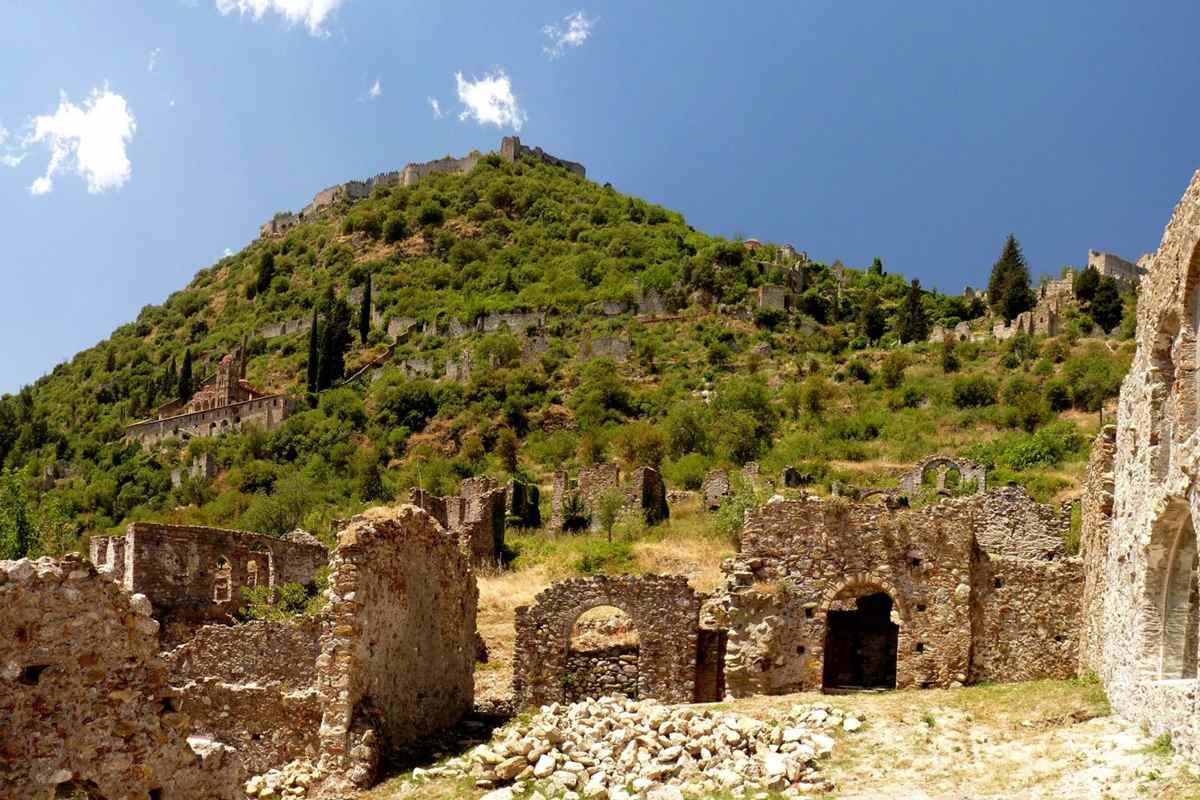
Featured photo: Ronny Siegel, CC BY 3.0, via Wikimedia Commons (File:Mystras – Citadel – Pantanassa.jpg).