
Greek folk art covers the embroidery, costumes, weaving, painting and household crafts of village Greece. Small-group trips with a host run through mainland Greece and its islands. The sections cover Angeliki Hatzimichali, the painter Theophilos and the Peloponnesian Folklore Foundation in Nafplion. A mansion museum in Makrinitsa and four short answers follow. Further reading covers Greek souvenirs, Museums in Greece and Villages in Greece. More trip ideas sit on the page about Greece tours.
Bookings made through the GetYourGuide widgets on this page earn Classical Greece Tours a commission, at no extra cost to the traveller.
What is Greek folk art?
Greek folk art had its first exhibit in 1921. The folklorist Angeliki Hatzimichali organised it. She spent much of her life in rural Greece, recording the daily customs and crafts of its peasants. A folklorist is a scholar of the traditions passed down among ordinary people.
Hatzimichali also set up workshops to keep traditional crafts alive. Her father was a professor of Greek literature, and she grew up in Plaka. Her neoclassical mansion there is now a museum, the Centre of Folk Art and Tradition. It holds handwoven fabrics, embroideries and costumes, along with ceramic plates from Skyros.
Greek folk art sits within a wider field. Folk art in general covers every form of visual art made within folk culture. Its objects tend to have a practical use and are not purely decorative. Their makers train inside a popular tradition rather than the fine art tradition. As an idea, folk art belongs firmly to the 19th century.
Folk objects are made one at a time, by hand or by hand and machine together. They are not mass-produced, so each piece differs a little from the next. In the past, crafts passed on through apprenticeships with local craftsmen such as the blacksmith or stonemason. Family lines also hand down skills and tools.
- State museums: Only four Greek folk museums count as state museums, the Museum of Greek Folk Art among them.
- Public Baths: One annex of the Athens folk art museum is the city’s only surviving old Public Baths building.
- Pottery: The Tzistarakis Mosque annex houses the V. Kyriazopoulos Collection of Folk Pottery.
Greek folk art reached readers abroad through Hatzimichali’s writing. Her work appeared in folk-art journals in Greece and beyond. She was born in 1895 and died in Athens in 1965. Her life was devoted to the study of Greek tradition.
Where does Theophilos fit in Greek folk art?
Greek folk art reached the Louvre in 1961, when works by Theophilos went on show there. The Paris museum presented him as a genuine folk painter of Greece. His grandfather taught him the first steps of painting when he was a boy.
His early life was hard. People mocked him because he regularly wore the fustanella in public. The fustanella is a pleated skirt of traditional Greek men’s dress. At the age of 18 he left his home and family. He then served the Greek consulate in Smyrna as a gate-keeper, or kavasis.
In about 1897 this painter of Greek folk art settled in the city of Volos. There he took occasional work, painting inside the houses and shops of the area. Plenty of his murals exist today. A mural is artwork applied to the surface of a wall. He spent the greater part of those years in Ano Volos.
Beyond Greek folk art, he also staged popular theatre acts for national ceremonies in the town. At carnival he dressed as Alexander the Great, with pupils marching as a Macedonian phalanx. A phalanx is a close block of soldiers. At other carnivals he became a hero of the Greek Revolution, in costumes of his own making.
- Film: Lakis Papastathis directed Theofilos, a 1987 Greek drama film on the life of the painter.
- Berlin: The film competed at the 38th Berlin International Film Festival.
- Oscars: Greece chose it for the Best Foreign Language Film award, though it gained no nomination.
Greek folk art from his Volos years now has a museum of its own. His protector there was the landholder Giannis Kontos, for whom he painted a great deal. Today the house of Kontos serves as the Theophilos Museum.
What does the Peloponnesian Folklore Foundation keep of Greek folk art?
Greek folk art fills the Peloponnesian Folklore Foundation, a nonprofit museum in Nafplion. It is also called the Basil Papantoniou Foundation. Its collections hold about 50,000 items. More than 27,000 of them link directly to popular and modern Greek culture, including traditional costumes.
The costume designer Ioanna Papantoniou founded it in 1974, in memory of her father. Its aim is to research and keep modern Greek culture in all its forms. Since 1981 the museum has occupied an early 20th-century house of the Papantoniou family. That same year it was named European Museum of the Year.
In the 1970s and 1980s, its teams studied Greek folk art and traditional culture across Greece and Cyprus. They also visited Griko communities of southern Italy, where people speak a Greek dialect. They gathered records of music, dance, preindustrial technology and old children’s toys. Culture minister Melina Mercouri placed the Hellenic National Costume Archives in its care.
In 1989 the foundation set up Greece’s first Childhood Museum, housed in Nafplion’s old railway station. In 2013 the Academy of Athens honoured it for its cultural work. Its folk costumes come from mainland Greece, Crete, the Aegean and Ionian Islands, Cyprus and Asia Minor. Its pieces have also travelled to exhibitions in Brussels, Dallas, Limassol and London.
- Fashion: A separate collection of 5,500 items traces the history of fashion.
- Partners: Its Greek folk art exhibitions have partnered with the Benaki Museum and the Municipality of Nafplio.
- Renovation: The foundation’s facilities in Nafplion went through a renovation in 1999.
Greek folk art research there has left its own archive. A photography, sound and film collection keeps the results of the foundation’s past fieldwork. It also runs a library of 10,000 titles and a publishing house of its own.
How does a Makrinitsa mansion show Greek folk art from Pelion?
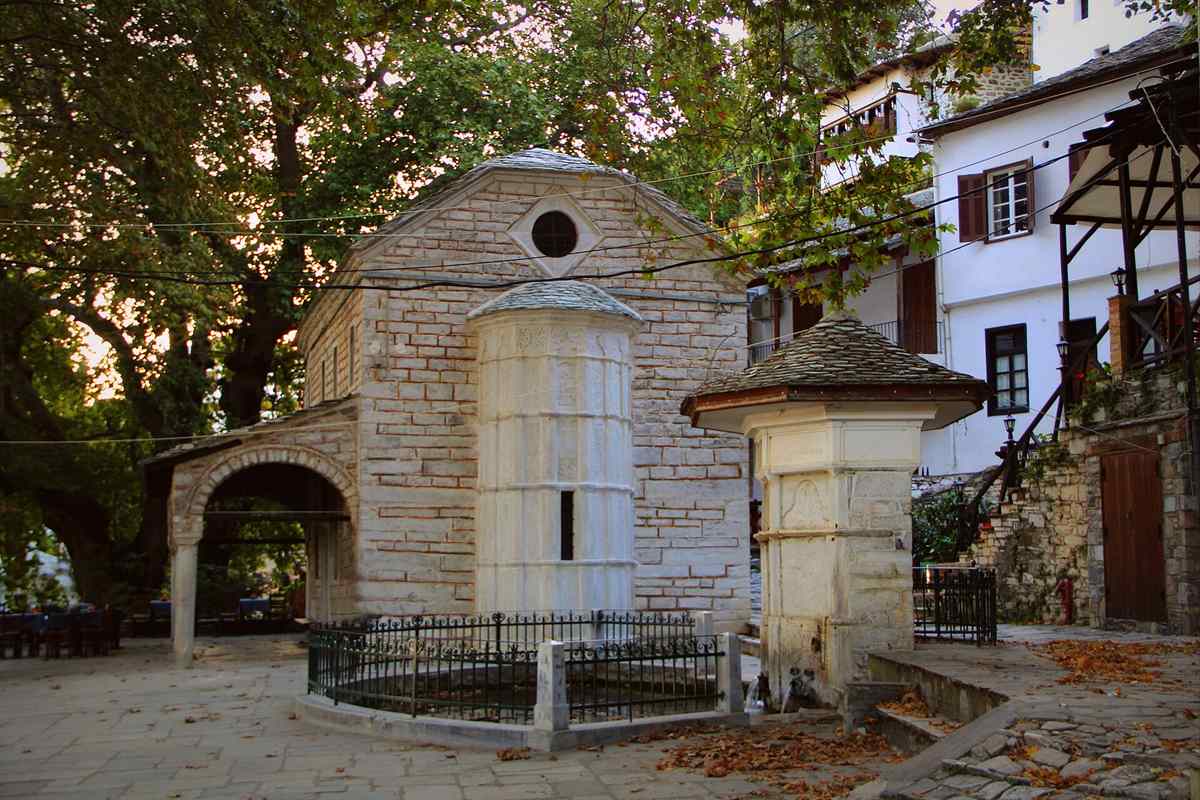
Greek folk art from the Pelion area is the subject of a museum in the village of Makrinitsa. Its large collection gathers everyday objects and folk art made there in the 18th and 19th centuries. Housing it is the Topali Mansion, a grand family house.
The mansion sits next to the Metamorfosi church, a short way below the main square. It is a fortified stone building of three storeys, typical of its period. Battlements and a defensive turret crown the roof. Battlements are notched walls for defenders. The ground floor has only small windows with iron bars.
In winter the household used the first floor, moving up to the second floor for summer. The small wooden doors are reinforced with iron bars. Above the first-floor windows sit false windows, added for decoration. Wooden ceilings and a turret with loopholes, narrow slits for firing, are also well preserved.
Over 1,500 pieces of Greek folk art and history make up the collection. They include frescoes, folk paintings, religious pictures, engravings and traditional costumes. Frescoes are paintings on wet plaster. Among the historical relics is a banner from the revolution of 1878. Equipment for distilling raki stands beside tools for spinning and weaving.
- Listed: In 1985 the state listed the mansion as a protected historical monument and work of art.
- Restoration: Builders restored the house extensively between 1988 and 1994, and the present museum opened in 1994.
- Seascapes: Seascapes painted by N. Christopoulos, a local painter of Greek folk art, form one set.
Greek folk art first went on show in this mansion in the 1960s. First repairs came in 1957, and the museum then ran for ten years. The building was partly repaired and reinforced in 1977. Houseware in bronze, wood and ceramics also fills its rooms.
What do travellers ask about Greek folk art, and what are the answers?
Greek folk art sits within a wider family of folk arts. These include performance as well as objects, and they reflect the cultural life of a community. Age is no requirement, since craftspeople still make folk art by hand today.
What makes a flokati rug part of Greek folk art?
Greek rules require each flokati to pass through a water friction process. That step creates its shaggy pile, or raised surface. A similar style of rug also goes by the name velentza, from Turkish velense. The word flokati first appeared in English in 1967, and such rugs became popular in the 1970s.
Which museum of Greek folk art stands in Avlonas?
The Zygomalas Museum stands in Avlonas, a town in Attica, the region around Athens. It was established in 1937. Its collection covers applied arts and traditional costumes. Applied arts are crafts that give everyday objects a decorative form. It also shows objects tied to the life of schools.
Which Athens museum shows Greek folk art through costume and dolls?
A costume history museum run by the Lyceum Club of Greek Women does. The club, a nonprofit society, was founded in 1911. Culture minister Melina Mercouri opened the museum in 1988. Its rooms hold traditional costumes, jewellery and copies of Minoan, classical and Byzantine clothes. It also shows porcelain dolls in Greek dress.
Where does Thessaloniki keep its Greek folk art?
The Folk Life and Ethnological Museum of Macedonia and Thrace holds it. The Macedonian Educational Association founded the museum in 1973. It occupies Villa Modiano, which the architect Eli Modiano built for a banker in 1906. About 15,000 objects, from woven textiles and embroidery to woodcarving tools, fill its collections.
Featured photo: Tevfik Teker, CC BY 3.0, via Wikimedia Commons.