
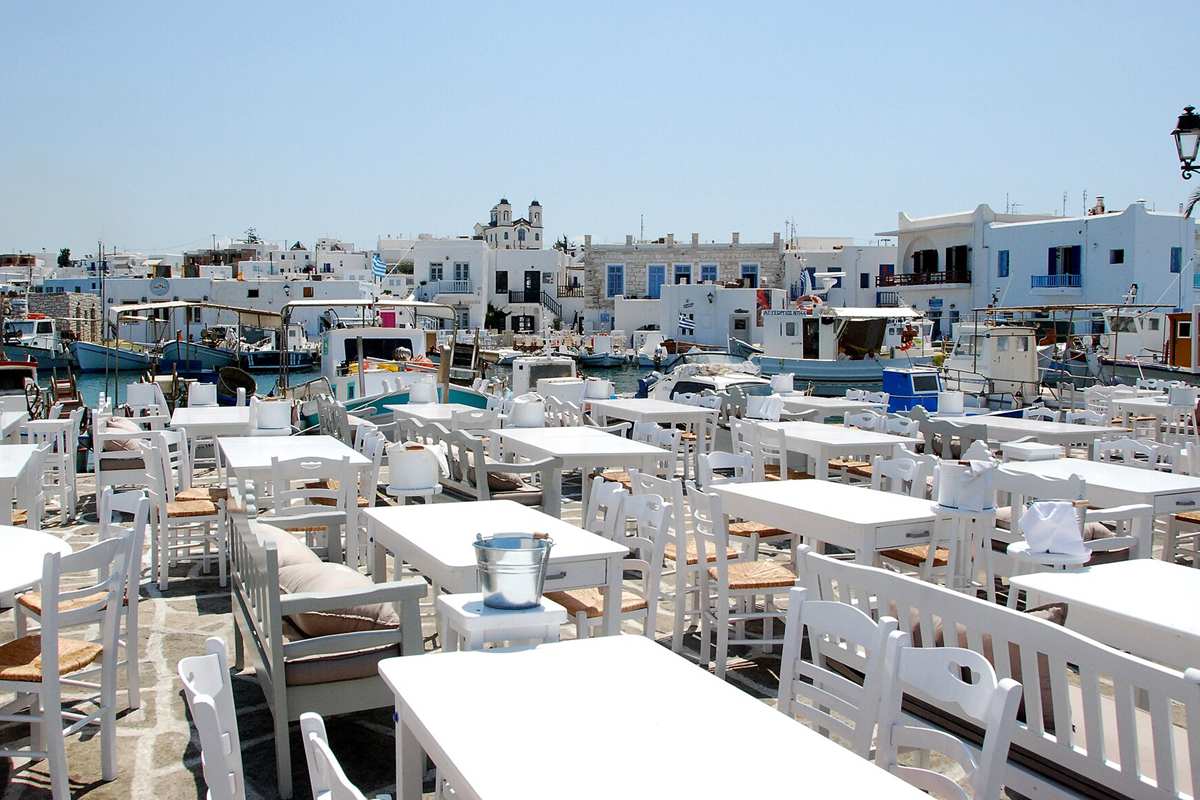
Greek mezedes are small plates shared over ouzo or tsipouro. Tours on this theme are food trips with a local host in Athens, Thessaloniki, Crete and Santorini. Topics run from tzatziki, melitzanosalata and dolmades to keftedes, gigantes plaki and pastourma. Toursi pickles, the spicy tirokafteri spread and four short answers follow. Related pages cover Greek food, Greek drinks and Greek seafood. Further trips appear among Greece tours.
Bookings made through the GetYourGuide widgets on this page earn Classical Greece Tours a commission, at no extra cost to the traveller.
What are Greek mezedes?
Greek mezedes are small savoury plates set beside spirits such as ouzo, raki, arak and grappa. Mezedes is the Greek plural, and a single plate is a meze. Ouzeria, which are ouzo taverns, are one setting for them in Greece.
The habit of serving small dishes with alcohol goes back to medieval times. That era, the Middle Ages, followed the end of Roman rule in western Europe. In Greece and its Balkan neighbours, Greek mezedes take in hard or creamy cheeses, salami and ham. Cured pork or beef joins them, along with savoury pastries.
Greek cooking counts salads among its appetisers as well. An appetiser is a small dish served before or instead of a main course. Lists of meze plates name sliced hard-boiled eggs, garlic bread and fried vegetables. Kolokithakia tiganita is one such fried plate, made from cucurbita, the squash and courgette group.
Skordopsomo is the Greek name for garlic bread among Greek mezedes. It combines sliced bread with olive oil and garlic. Salt, pepper, oregano and basil finish the seasoning. A plainer plate is feta topped with olive oil and oregano. Feta is a white brined cheese, and oregano is a sharp-tasting herb.
- Bourekakia: These mini rolls hold a filling of cheese, ground meat or vegetables.
- Fish: Fried whitebait and calamari, a name for squid, appear on wider meze lists.
- Ofti potato: Cooks bake this potato with coarse salt, olive oil and dried oregano.
Greek mezedes such as the ofti potato come to the table with olives, chopped dried onion and lemon. In English texts, the word meze is also spelled mezze or mezé. The accent mark over the final letter shows where the stress falls when the word is spoken.
Which history lies behind tzatziki among Greek mezedes?
Greek mezedes include tzatziki, a dip of yogurt blended with herbs like mint, dill, thyme and parsley. In the regular Greek recipe, the yogurt comes from sheep or goat milk. A dip is a soft mixture for scooping with bread.
The word behind tzatziki, one of the Greek mezedes, draws on herb names from West Asia. In Persian, zhazh refers to herbs used in cooking. In Kurdish, jaj means caraway, a plant with small seeds of sharp flavour. Turkish then added its small-form ending -cık and produced cacık, the Turkish name for the same yogurt dish.
In 1665, the Ottoman traveller Evliya Çelebi wrote a travelogue. It names cacıg as a herb added to food. A travelogue is a written account of journeys. The modern term cacık reached print in 1844. The book that carried it was the first Ottoman cookbook. It described cacık as yogurt mixed with cucumber and garlic.
Yogurt sauces such as tzatziki were central to Ottoman cooking and to its meze tradition. The Ottoman Empire was a vast realm centred on what is now Turkey. In Iraq, the dish called jajeek is served as meze, much as tzatziki is among Greek mezedes. There it can accompany arak, an anise drink close to ouzo.
- Translator: Daniel Newman links the old dish to Armenian jajik, Turkish cacık and Greek tzatziki.
- Tarator: This related name entered Turkish from the Venetian word trattor, meaning cook.
- Cyprus: Talattouri there mixes strained yogurt, sliced cucumber, minced garlic, lemon juice and dried mint.
Greek mezedes serve tzatziki cold, and the same bowl also works as a side dish for meals. Food writer Marianna Yerasimos traces such yogurt sauces to earlier Central Asian origins. Central Asia is the inland region east of the Caspian Sea.
What does melitzanosalata bring to Greek mezedes?
Greek mezedes include melitzanosalata, a dish of Greece and Cyprus whose name means eggplant salad. Cooks dress the eggplant with olive oil and lemon juice. Garlic, onion and parsley are the other regular ingredients, and eggplant is the vegetable also called aubergine.
For Greek mezedes, cooks sometimes add spices such as cumin and red pepper flakes. Cumin is a seed spice with a warm, earthy taste. Feta cheese or olives can top it as a garnish. A garnish is a small finishing touch on a dish. Eggplant flesh soaks up oils and flavours as it cooks.
In Greece, melitzanosalata is a popular choice among Greek mezedes during the 40-day Lenten fast. Lent is the fasting season before Easter. The dish then offers a choice free of animal products. It replaces dips such as tzatziki, which is made with yogurt. The custom reflects the strong Orthodox Christian faith of Greece.
The word for eggplant reached Greek from Arabic bāḏinjān by the eleventh century. Greek versions began with the letter m. One reason was that Greek lacked a b sound at the start of words. Another was a link with the Greek word melas, meaning black. The form melintzána is recorded from the fourteenth century.
- Plant family: Eggplant, known to botanists as Solanum melongena, belongs to the nightshade family.
- Botany: By botanical definition, the eggplant fruit counts as a true berry.
- Imam: Greeks call the Turkish eggplant stew imam bayildi simply imam.
Greek mezedes also include melitzanes tiganites, which are fried eggplants. The stew imam bayildi is cooked with olive oil, onions and tomatoes. The eggplant shares its genus, Solanum, with the tomato and the potato. A genus is the rank in plant naming just above a species.
Where do dolmades fit among Greek mezedes?
Greek mezedes include dolmades, leaves rolled around a filling of minced meat, rice or both. Grapevine leaves are one wrap, and cabbage, chard, kale and collard leaves are others. Collard is a leafy green from the cabbage family of plants.
Sarma, another name for the dish, is a Turkish word meaning wrap or wrapped thing. In Greek, the common names for the rolls are sarmathes and sarmathakia. Yaprakia and dolmathakia yalandzi are further Greek names. Rolls without meat are sometimes called yalancı dolma, which is Turkish for liar’s dolma. The Greek name dolmathakia yalandzi borrows that same word.
In parts of Greece today, fig leaves still wrap the filling. Fillings vary from cook to cook, as they are thought to have done in ancient times. Rice is the leading filling of these Greek mezedes today. Scholars have suggested spelt as an ancient grain for the dish. Spelt is an old type of wheat.
In Cyprus, the rolls are called koupepia and are also known as dolmades. They hold ground beef and pork with rice, wrapped in a grape leaf. A tomato and cinnamon sauce goes with them. Greek mezedes pair dolmades with avgolemono instead, a sauce of eggs mixed with lemon. Koupepia reached Cyprus with Greek settlers in 1200 BC.
- Celery root: Vine leaves can also wrap celery root that has been stuffed first.
- Grapevine roll: This form uses cooked grapevine leaves wrapped around a range of fillings.
- Reach: Stuffed leaves remain popular in Greek, Turkish, Armenian, Egyptian and Bulgarian cooking, among others.
Wrapped leaf dishes belong to a wider group of stuffed foods known as dolma. Lists of common meze features name stuffed leaves among the snacks. Within Greek mezedes, dolmades fill that role, served as small bites with other plates.
Which keftedes and fritters belong to Greek mezedes?
Greek mezedes include keftedes, the Greek name for fried meatballs, which comes from the Turkish word köfte. Stewed meatballs carry a different name, yuvarlakia. That word comes from the Turkish yuvarlak, meaning round. A meatball is minced meat shaped into a ball.
The wider kofta family takes its name from Persian koofta, meaning pounded meat. Persian is the language of Iran. Kofta were also known in the Byzantine Empire, which ruled from Constantinople. The earliest recipes describe large lamb meatballs. Cooks glazed them three times in a mix of saffron and egg yolk.
That glazing method later spread to the West, where it took the names gilding and endoring. Gilding means covering with a golden layer. Kofta dishes appear in the traditional cooking of Greece, Turkey, Armenia, Egypt and Iran, among others. Greek mezedes add meatless versions too. Tomatokeftedes use tomatoes, and kolokithokeftedes use courgettes with feta cheese.
Among Greek mezedes, tomatokeftedes are served as a starter on Santorini and across the Cyclades. The Cyclades are a circle of isles lying at the heart of the Aegean. Cooks knead tomatoes and flour into a dough with spices, parsley, onion and mint. Tomatoes grown on Santorini are preferred. Rugged ground and pumice-laced soil give the island sturdier fruit.
- Patatokeftedes: These are potato fritters, named among the selected appetisers of Greek cooking.
- Tirokeftedes: Also called tirokroketes, these are cheese fritters, fried as small cheese balls.
- Meatless balls: The term meatball also stretches to versions built on legumes, vegetables or mushrooms.
The ancient Roman cookbook Apicius already held a number of meatball-type recipes. Kofta dishes now stretch from India through Central Asia and the Middle East. They reach the Balkans and North Africa too, and Greek mezedes carry them in Greece.
How is gigantes plaki cooked for Greek mezedes?
Greek mezedes include gigantes plaki, which can be a main course or a meze. Cooks build it from dried giant runner beans, tomatoes, onions, olive oil, parsley and carrots. In Greek, gigantes means giants, and plaki names the baking method.
Plaki is a Greek cooking method for dishes baked in a roasting tin in the oven. The beans are first soaked, then boiled until tender. Cooks then sauté the aromatics into a sofrito and mix it with the beans. A sofrito is a base of aromatics, strong-smelling vegetables gently fried in oil.
The dish then bakes until its top layer turns brown. As with other plaki dishes, olive oil, tomatoes, vegetables and herbs go into the oven with the beans. Among Greek mezedes, gigantes plaki arrives warm or at room temperature. Feta cheese and bread are common partners on the same table.
The basic recipe is vegan, meaning it holds no meat, dairy or other animal products. That makes it suitable for Orthodox Christian fast days. Orthodox fast days are dates when the faithful give up animal foods. Even so, sausages or cubes of smoked pork are added at times. The dish is especially popular in autumn and winter.
- Swap: Large lima beans sometimes take the place of the giant runner beans.
- Extras: Garlic and celery are further vegetables that cooks sometimes stir into the dish.
- Serving heat: Among Greek mezedes, the beans reach a shared meze table at room temperature.
On lists of Greek mezedes, the dish also appears as gigandes plaki. Greek cooking lists it among its selected appetisers. It is described there as baked Gigantes beans with tomato sauce and herbs. Tomato sauce is a cooked sauce made from crushed tomatoes.
What links pastourma in Greek mezedes to Byzantine cooking?
Greek mezedes include pastourma, one of the names of pastirma. This cured meat is made from beef or water buffalo. Versions of it belong to the cooking of Greece, Cyprus, Armenia, Turkey and Bulgaria. Cured means preserved with salt and drying.
A leading food encyclopedia says pastırma was the Ottoman word for a Byzantine cured beef called paston. Byzantine describes the eastern Roman realm, whose capital was Constantinople. The scholar Johannes Koder notes that paston covered both salted meat and salted fish. A related Greek word, akropaston, meant salted meat.
Food historian Andrew Dalby defines akropaston apakin as a well-salted fillet steak. Fillet is a lean, tender cut of meat. Gregory Nagy calls apakin a salami sausage and likens it to the pastourma of Greek mezedes. Another reference work calls a Byzantine dried meat delicacy an early form of today’s Turkish pastirma.
The pastourma of Greek mezedes begins as meat that is salted, washed with water and left to dry. Then the blood and salt are pressed out. Next comes a coat of çemen, a paste of crushed cumin, fenugreek, garlic and hot paprika. Fenugreek is a bitter seed spice. A thorough air-drying finishes the process.
- Meats: Beef leads today, but camel, lamb, goat and water buffalo are also cured this way.
- Çemen: The name of this cumin paste literally means fenugreek in Turkish.
- Armenia: A form of the dish, called aboukh, existed in ancient Armenian cooking.
Greek mezedes share pastirma with wider meze lists, which place it among the meat dishes. In Serbia, Bosnia and Croatia, a similar cured beef made without çemen is called suho meso. In the local languages, suho meso simply means dried meat.
Which pickles called toursi join Greek mezedes?
Greek mezedes include toursi, the Greek name for pickles. It is a traditional meze to go with strong drinks such as ouzo, tsipouro, raki, arak and rakia. Greek cooking lists pickled peppers and mixed pickle as its best-known forms.
The word toursi is the Greek form of the Persian term torshi. Torshi covers pickled vegetables in Middle Eastern, Caucasian, Slavic and Balkan cooking. The Caucasus is the mountain region between the Black and Caspian Seas. Tsipouro, one partner of these Greek mezedes, is a strong spirit distilled from grape leftovers.
Across these regions, torshi is a pickled mix of cucumbers, turnips, onions, carrots and olives. Other local vegetables go in as well. In the Middle East and the Balkans, peppers, carrots and cauliflower lead the list. Spices such as mustard seed, garlic, cinnamon or cloves are added to fight germs.
Pickling keeps food longer by fermenting it in brine or by covering it in vinegar. Brine is water with a heavy load of salt. The pickling liquid is strongly acidic, at pH 4.6 or below. pH is a scale of acidity. Acid and salt stop enzymes, proteins that speed chemical change, and block microbes from multiplying.
- Ancient roots: Texts and finds show salting and pickling in the Greek and Roman world, long before Greek mezedes.
- Flavour: Pickling changes the texture and flavour of the food it preserves.
- Nutrition: Pickling can raise food value by adding B vitamins made by bacteria.
Pickles are made and eaten for their taste, not only to keep food from spoiling. The English word pickle first appears around 1400 CE, meaning in the Common Era. Among Greek mezedes, toursi brings that sharp taste beside the drink.
What gives tirokafteri its heat among Greek mezedes?
Greek mezedes include tirokafteri, a cheese-based spread from Greece. It is also known as ktipiti or htipiti. Another name for it is kopanisti, which differs from the cheese of that name. A spread is a soft food for smearing on bread.
Recipes for this one of the Greek mezedes vary from kitchen to kitchen. Feta cheese is the leading ingredient, sometimes mixed with other soft white cheeses. Hot peppers such as the red cherry pepper bring the heat. A cherry pepper is a small round chilli. Roasted peppers, olive oil, lemon juice, garlic, yogurt or oregano can join the mix.
Among Greek mezedes, tirokafteri is eaten as part of a meze platter or on its own. Slices of warm pita bread go with it. Pita is a flat round bread. Greek cooking also lists it among its spreads and dips. That list describes it as feta, yogurt, hot peppers, olive oil and vinegar.
In Greek cooking, spreads and dips also count as Greek sauces. A paprika spread blends sweet paprika, tomato paste, roasted Florina pepper, feta and olive oil. Paprika is a ground red pepper spice. A feta sauce mixes feta with garlic, olive oil, lemon juice, oregano and thyme. Thyme is a small-leaved herb.
- Hot pepper plate: Kafteri piperia is a chilli pepper, grilled or roasted and served with olive oil and vinegar.
- Olive paste: Greek cooking also lists olive paste, known as tapenade, among its spreads and dips.
- Sound: The name tirokafteri is spoken with the stress on its final syllable.
Among Greek mezedes, a kopanisti spread joins feta, grilled red sweet peppers, olive oil and fresh garlic. Sweet peppers are mild peppers without the burn of chillies. Garlic is a strong-flavoured bulb related to the onion.
What do travellers ask about Greek mezedes, and what are the answers?
Greek mezedes also take in flogeres, crisp filo wrapped around goat cheese and herbs. Other fillings are sun-dried tomato or ground meat. Filo is paper-thin pastry dough. Sikotakia are small slices of lamb or chicken liver, fried with olive oil and oregano.
Which spirit is poured with Greek mezedes, and how is it served?
Ouzo, a Greek anise spirit, starts as rectified spirits, meaning alcohol purified by repeated distilling. Distilling turns a liquid to vapour and cools it back. Flavourings are then added. For Greek mezedes, ouzo is served with ice cubes in a small glass. It can also be drunk straight from a shot glass.
What is tarama, the base of one of the Greek mezedes?
Tarama is the salted fish roe itself, and roe means fish eggs. The finished dish, taramasalata, is sometimes called tarama. Its spelling taramosalata reflects the Greek form. Almonds sometimes replace bread or potato as its starchy base. Smoked cod’s roe is not a traditional Greek choice. It is easier to find in certain places.
Which wild greens go into horta, a salad among Greek mezedes?
Horta salad, or greens salad, is a dish of boiled Greek edible greens. Cooks dress them with fresh lemon juice and olive oil. The greens can be antidia, which are endives, or vlita, which are amaranth leaves. Myronia, or wild chervil, also qualifies. Radikia, meaning chicory, seskoula, meaning chard, and asparagus join the choices.
Where is sfougato, an oven-baked omelette among Greek mezedes, best known?
Sfougato is an omelette baked in the oven with eggs, grated courgette, spring onions and dill. Feta, kefalotyri or another cheese goes into the mix. Kefalotyri is a hard, salty Greek cheese. The best-known versions come from the islands of Mytilene, Santorini and Crete. Sfougato is also served at breakfast.
Featured photo: Redonnets, CC BY-SA 3.0, via Wikimedia Commons.