
Greek drinks include grape spirits, anise aperitifs, island liqueurs, wines and beers made across Greece. Tours on this theme are hosted trips through Greece, from Athens to Crete, Rhodes and the Cyclades. Topics run from ouzo and the town of Plomari to tsipouro and Cretan tsikoudia. Chios mastiha, the mastic villages, soft drinks and herbal teas follow. Related pages cover Greek coffee, Greek wine regions and Greece wine tours. More trips sit among Greece tours.
Bookings made through the GetYourGuide widgets on this page earn Classical Greece Tours a commission, at no extra cost to the traveller.
What are Greek drinks?
Greek drinks cover the wines, beers, spirits, liqueurs, coffees and herbal teas of Greece. Of these, wine still records the highest consumption rate in the country. In ancient times, grapes and olive trees spread around the Mediterranean alongside Greek colonisation.
Colonisation meant founding new Greek cities on distant shores. Greek cooking has always given wine and olive oil a central role. Beer belongs among Greek drinks as well. Items for making beer found in Greece date back to the Bronze Age. That age ran from 3,300 to 1,200 BC.
The first modern Greek brewery was set up in 1864. A brewery is a works that makes beer. Beer has gained a larger market share among Greek drinks. Market share means a product’s slice of all sales. Brewing is now an important industry and provided more than 60,000 jobs in 2005.
Among Greek drinks, ouzo, tsipouro and tsikoudia hold a protected Geographical Indication from the European Union. Ouzo is an anise-flavoured spirit, while tsipouro and tsikoudia are distilled from grape leftovers. A Geographical Indication is a legal label that ties a product’s name to its home region. Distilling means boiling a liquid and collecting its cooled vapour.
- Liqueur: A liqueur is a spirit sweetened and flavoured with fruit, herbs or spices.
- Corfu: Kumquat liqueur, named after a small citrus fruit, is produced mainly on Corfu.
- Kythira: Fatourada is an orange-flavoured liqueur that comes from the island of Kythira.
In garides saganaki, cooks deglaze shrimps with ouzo, then cover them in tomato sauce and feta cheese. Garides means shrimps in Greek. To deglaze is to loosen browned pan juices with a liquid. Saganaki names the small frying pan used for such dishes.
Which part does ouzo play among Greek drinks?
Greek drinks include ouzo, a dry aperitif that takes its flavour from anise. It is widely drunk in both Greece and Cyprus. An aperitif is a drink served to open a meal. Anise is a flowering plant whose seeds carry a liquorice-like taste.
Among Greek drinks, ouzo gained its first distillery in 1856, in the town of Tyrnavos. A distillery is a spirit-making works. Ouzo yeast is the name Greeks give to the flavoured alcohol that starts production. A majority of makers blend it with plain alcohol carrying 0.05 percent natural anethole. Anethole is the scented oil of anise.
Mixed with water, ouzo clouds over to white, at times with a faint blue tint. Anethole dissolves fully in alcohol at about 38% strength or more. It does not dissolve in water, however. Water therefore drives the oil out of solution. A solution is a liquid that holds another substance fully dissolved.
The freed oil forms an emulsion, a mix of tiny droplets held inside another liquid. Those fine droplets scatter light. In Greek drinks such as ouzo, this clouding is called louching. The same louching is also seen when absinthe is prepared. Absinthe is a strong herbal spirit from France and Switzerland.
- Taste: Ouzo tastes much like absinthe, with a liquorice flavour that is smoother.
- Second run: In ouzo making, the first and last spirit from the still is mixed and distilled again.
- Museum: Plomari, a town on the island of Lesbos, has a museum devoted to ouzo.
Greek drinks such as ouzo also follow detailed written rules. For blended ouzo, Greek law requires the ouzo yeast to form at least 20 percent of the drink. Blended here means made with added plain alcohol. Percent means parts out of every hundred.
What links the town of Plomari to Greek drinks?
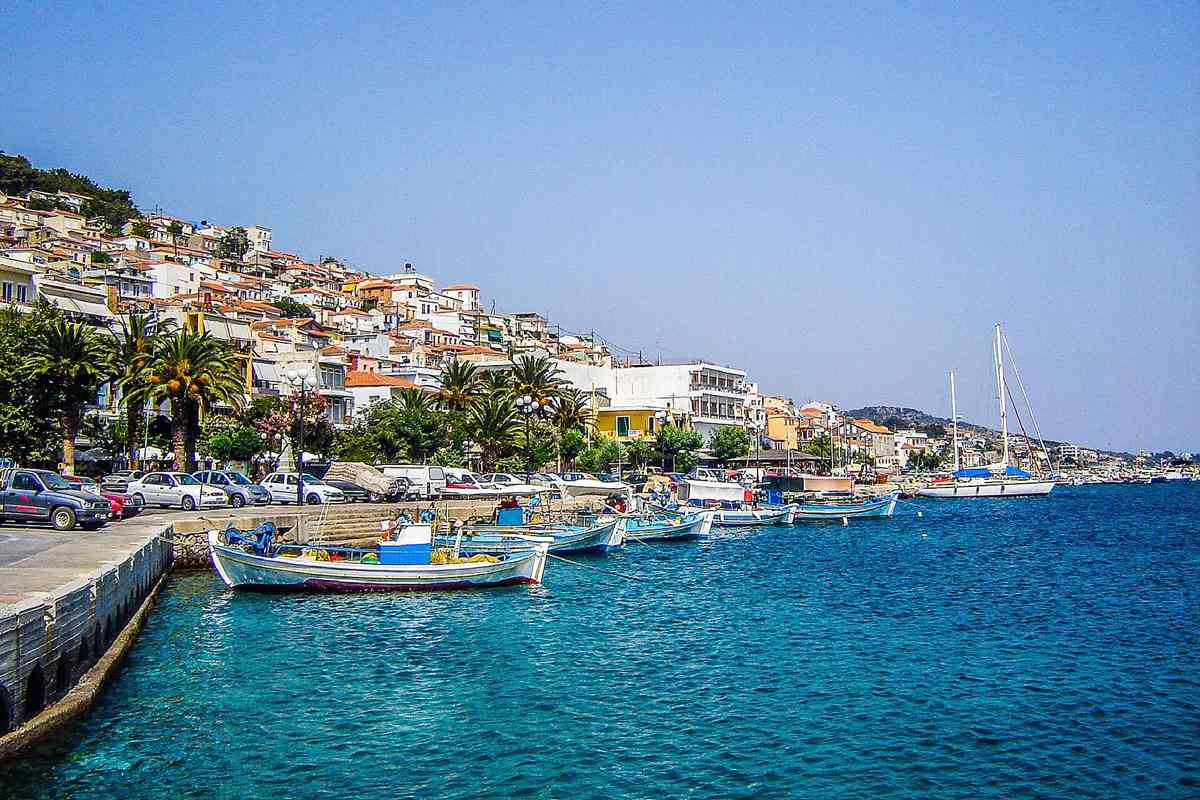
Greek drinks connect with Plomari, a town and former municipality on Lesbos, an island of the North Aegean. Its local feast season begins with an ouzo festival in the middle of July. As a municipality, Plomari once ran its own local affairs.
Since the 2019 local government reform, Plomari has formed a municipal unit of Mytilene. A municipal unit is a former council area now joined to a larger one. Mytilene is the main town of Lesbos. The Plomari unit is the southernmost on the island, covering 122.452 square kilometres.
The 2021 census recorded 4,852 people in the unit. Such a census is a nationwide count of residents. A province of Plomari also existed until it was abolished in 2006. Agios Isidoros, a seaside resort, lies two kilometres east of the town. In Greek, agios means saint.
The economy of Lesbos rests mainly on farming, with olive oil as its chief income. Among Greek drinks, ouzo is named the national liqueur of Greece. Ouzo making on Lesbos brings further income, alongside fishing and soap making. For Greek drinks such as ouzo, liqueur here simply means a strong flavoured spirit.
- Panigiri: Locals call each village feast a panigiri, held in honour of a saint.
- Season close: The feast season ends with celebrations for Agios Haralambos, including horse races.
- West side: Ammoudeli, a seaside quarter west of Plomari, holds the church of Agios Panteleimonas.
In Plomari, Greek drinks such as ouzo can be sampled by brand in the traditional kafenia. A kafenio, plural kafenia, is a simple Greek coffee house. A brand is the trade name under which a maker sells a drink. To sample is to taste a little.
How does tsipouro fit into Greek drinks from the mainland?
Greek drinks from the mainland include tsipouro, an un-aged brandy from Thessaly, Epirus and Macedonia. Brandy is a spirit distilled from grapes or wine. Un-aged means bottled without resting in wooden barrels. Thessaly, Epirus and Macedonia are regions of central and northern Greece.
Once the grapes are crushed, the mass rests just long enough for fermentation to start. Fermentation is the change of grape sugar into alcohol by yeast. In the past, makers drew off the wine first, and only the solid residue went into tsipouro. This residue of the winepress is called pomace.
Among Greek drinks, tsipouro passes through distillation units where temperature and pressure are closely watched. Such a unit heats the fermented mass and collects the spirit it gives off. Ouzo starts from a very pure alcohol that keeps none of the primary flavours. Tsipouro is distilled to a lower degree, so it keeps the aroma of the pomace.
Volos is well known for its mezedes and for tsipouro, one of the clear Greek drinks. Mezedes are small shared dishes served with drinks, and one such dish is a meze. Tsipouro, with the seafood served beside it, ranks among the best-known specialities of Volos. Seafood means fish, shellfish and other food taken from the sea.
- Gatherings: Like all alcoholic drinks in Greece, tsipouro is mainly drunk at social gatherings.
- Serving: Tsipouro comes in shot glasses with meze such as nuts, cheese, olives or halva, a dense sweet.
- Water or ice: Certain drinkers dilute tsipouro with water, while others add ice.
Among Greek drinks, tsipouro counts as a strong distilled spirit, at 40 to 45% alcohol by volume. Alcohol by volume is the share of pure alcohol in the whole drink. At 40%, two parts in every five of the liquid are alcohol.
Where does tsikoudia stand among Greek drinks on Crete?
Greek drinks from Crete include tsikoudia, a pomace brandy. In the east of the island, its informal name is raki. Pomace is the skins, pips and stalks left after grapes are pressed for wine. Brandy, in this sense, means a strong spirit made by distilling.
Among Greek drinks, tsikoudia has a name that literally means terebinth. The terebinth is a small tree of the pistachio family that grows around the Mediterranean. Every part of the terebinth gives off a strong resinous smell. Resinous means smelling of resin, the sticky sap of trees. In Crete, the plant itself also goes by the name tsikoudia.
The pomace first ferments inside a barrel sealed tight, and only then goes to the still. A still is the vessel used for distilling. Among Greek drinks, tsikoudia passes through the still just once. That single run preserves a fuller taste of the original grapes. It also leaves less alcohol in the finished spirit.
Fermented pomace makes good brandy material, since it is soft, dry and rich in alcohol. Fermented here means the grape sugars in it have already turned to alcohol. Unlike wine brandy, pomace brandies are mostly neither aged nor coloured. Aged means stored for years in wooden casks before sale.
- Family: Tsikoudia belongs to a Mediterranean family of grape spirits that includes Italian grappa and Georgian chacha.
- Strength: The alcoholic strength of tsikoudia ranges from 40% to 65%.
- Table custom: Cretan restaurants commonly offer tsikoudia free after the meal, with fruits and sweets.
Among Greek drinks, tsikoudia is a home product, distilled by households in Cretan villages. Its strength therefore varies from one producer to another. The name raki, used in the east, traces back through Turkish to the Arabic arak, meaning distilled.
What makes mastiha different from other Greek drinks?
Greek drinks gain a resin flavour in mastiha, a liqueur made with mastic from the island of Chios. Within the European Union, the name Chios Mastiha carries a protected designation of origin. Mastic is the hardened sap of the mastic tree.
Such a designation reserves a product name for goods from one defined place. Among Greek drinks, Chios Mastiha takes its flavour only from mastic distillate or mastic oil. A distillate is the liquid gathered from distilling. A body within the Greek ministry for rural development and food certifies the island’s mastic.
Mastic has been harvested for at least 2,500 years, reaching back to Greek antiquity. Antiquity means the ancient era of Greek and Roman history. In Bulgaria and North Macedonia, the name mastika belongs to a separate anise drink. Among Greek drinks, mastika is a distinct liquor, flavoured with mastic crystals instead.
Wildfires swept across Chios in August 2012 and scorched 12,740 hectares. One hectare equals a square plot one hundred metres on each side. Over half of the mastic orchards on the island burned. An orchard is a planted field of fruit or resin trees. The fire also disrupted the global supply of mastic.
- Crop loss: Local farmers lost about 60 percent of their crops in the 2012 fires.
- Novel: In 2013, Greek writer Zoe Rapti released a novel called Love with Mastic Liqueur.
- Film: Work is under way to turn that book into a film.
Among Greek drinks, mastiha rests on a resin with a long written history. Hippocrates, a physician of ancient Greece, gave the first mention of mastic tears. Tears are the small drops of resin that seep from the bark of the tree.
Which villages of Chios supply the mastic behind Greek drinks?
Greek drinks flavoured with mastic trace back to the Mastichochoria, a former self-governing district on Chios. In Greek, the name stands for the mastic villages. Mastic is a fragrant resin, a sticky tree sap that hardens in the open air.
Under a 2011 change to local government, the area became a municipal unit of Chios. Such a unit keeps its old borders inside a larger council area. On the coast, the small village of Emporeios holds an archaeological site. Archaeologists dig and study the remains of earlier peoples at such sites.
For Greek drinks with mastic, a co-operative of medieval villages controls the island’s output. A co-operative is a body that its members both own and manage. Medieval refers to the Middle Ages, about the fifth to fifteenth centuries AD. The growers’ association that unites them has nearly 5000 members.
The growers’ body holds exclusive management of Chios mastika, both in Greece and abroad. Mastika is another spelling of mastiha, a name shared by the resin and Greek drinks made from it. Exclusive means that no other body shares the role. Its work covers farm production, support for growers, research and legal help.
- Pyrgi: The village of Pyrgi keeps a small Museum of Mastic.
- Rachi: In Rachi, the Chios Mastic Museum first opened on 11 June 2016.
- Exhibition: Its permanent display covers the history, farming methods and present-day uses of mastic.
Mastic, the flavour behind Greek drinks such as mastiha, forms a major part of the local economy. In the Chios Massacre of 1822, under Ottoman rule, the people of the Mastichochoria were spared. Their survival underpinned the wealth of the island and its tax payments.
Why does Greek mountain tea hold a place among Greek drinks?
Greek drinks include a herbal tea from Sideritis scardica, a plant commonly called Greek mountain tea. It is native to Greece and nearby Balkan lands, above all to the area around Mount Olympus. Botanists first described this plant in 1844.
Among Greek drinks, this tea comes from Sideritis, a genus, meaning a group of related kinds of plant. Sideritis plants are commonly used as a herbal tea. In Greece and nearby lands, these plants serve for herbal teas or for their aroma in local cooking. A fine, woolly layer of tiny hairs coats the plants.
A species means one distinct kind of plant or animal. The ancient Greek writer Dioscorides describes three species under this name. Only one of them is thought to belong to Sideritis. In 2002, research tracing family links through genes looked at Sideritis. It placed Sideritis and five other genera, the plural of genus, inside another genus, Stachys.
Greece is home to more than one kind of Sideritis. Sideritis purpurea grows in western Greece, on the Ionian Islands and on Crete. Sideritis theezans is found in the Peloponnese. Sideritis lanata is native to the Balkans, including Greece, and also to Turkey. Botanists find Sideritis varieties hard to name and sort, because their differences are subtle.
- Planting: Growers are advised to plant Sideritis in October to November or in February to March.
- Drying: Before use, the plant behind these Greek drinks is first dried out.
- Compounds: Diterpenoids and flavonoids, two groups of natural plant chemicals, are found in the plant.
Greek drinks made from Sideritis start with xerophytic plants, meaning plants suited to dry conditions. The genus is made up of subshrubs, which are low woody plants, and herbs. Each is either annual, living for one year, or perennial, living for longer.
What is salepi, the warm winter cup among Greek drinks?
Greek drinks include salepi, a hot cup thickened with flour from orchid tubers. In Greece, it is sold on the streets during the cold months of the year. Salep, sahlep and sahlab are other spellings of the same name.
A tuber is a swollen underground part that stores food for the plant. The tubers hold glucomannan, a starchy substance that thickens liquids. Rising consumption causes local extinctions of orchids, meaning they vanish from parts of Greece, Turkey and Iran. The harvesting of orchid tubers is also on the rise in Greece.
Orchid bulbs went into ancient Greek drinks too, since Greeks and Romans ground them to make drinks. They called these drinks by a number of names, satyrion among them. Today, salep flour goes into drinks and desserts, above all in former Byzantine and Ottoman lands. The English word salep comes from Arabic sahlab and from Greek salepi.
Beyond Greek drinks, the same cup was known in England as saloop. Its preparation added salep powder to water until the mix thickened. The cook then sweetened it and added rose water, or else orange flower water, as flavouring. Orange flower water is water scented with the blossom of the orange tree.
- Tubers: Making one kilogram of salep flour takes from 1,000 to 4,000 orchid tubers.
- Word route: The name salep reached English through French and Turkish in the mid 18th century.
- Spread: Salep spread to England and Germany before coffee and tea grew popular there.
Greek drinks in the cuisine of Greek Macedonia include salepi, which appears on its list of selected drinks. Salep is drunk in Albania as well as in Greece. In modern use, the drink called sahlab is frequently made with hot milk instead of water.
How did kykeon, a stirred barley cup, fit into ancient Greek drinks?
Greek drinks of the ancient world included kykeon, and one kind mixed water, barley and natural ingredients. The name kykeon grew out of a Greek verb for stirring or mixing. Accounts of the drink describe it in varied ways.
Kykeon was both a drink and a meal. At heart it was a barley gruel, a thin porridge, with water and herbs added. A kykeon also marked the climax of the Eleusinian Mysteries, where it broke a sacred fast. The Mysteries were yearly initiations, or entry rites, for the worship of Demeter and Persephone at Eleusis.
Ancient Greek drinks appear in the Homeric Hymn to Demeter, where the goddess turns down red wine. She accepts a kykeon of water, barley and pennyroyal instead. Pennyroyal is a type of mint. A hymn means a song that praises a god. Homeric here means in the style of Homer’s poems.
In his book Characters, Theophrastus describes a peasant who reaches the Ecclesia after drinking much kykeon. The Ecclesia is also called the Assembly. In that sketch, the peasant bothers the Assembly with his bad breath. A peasant is a poor farm worker of the countryside. Aristocrats, the rich ruling families, shunned kykeon as a peasant drink.
- Other versions: Other ancient Greek drinks of this name mixed wine and grated cheese.
- Famous rites: The Eleusinian Mysteries are seen as the best known of the secret religious rites of ancient Greece.
- Vigil: On arrival at Eleusis, an all-night vigil, the pannychis, took place.
One theory about Greek drinks at Eleusis says ergot grew on the kykeon barley. Ergot is a fungus that infects cereal grains. Walter Burkert rejected the idea that ergot was used. He believed fasting, then a meal after a sacrifice, was enough to create shared bliss.
Which part did plain water play in ancient Greek drinks?
Greek drinks in ancient times centred on water, the commonest drink. Wells were common, yet spring water was preferred. Greeks saw spring water as nutritious, because it made plants and trees grow. A spring is a spot where groundwater rises naturally to the surface.
Pindar called spring water as agreeable as honey. Greeks described water with words such as robust, heavy, light, dry, acidic, pungent or wine-like. Pungent means sharp in smell or taste. A character of the comic poet Antiphanes claimed to know Attic water by taste alone. Attic water means water from Attica, the region of Athens.
Athenaeus states that a number of philosophers drank nothing but water. They paired that habit with a vegetarian diet, meaning a diet without meat. Milk, which came chiefly from goats, was not widely drunk, as it was considered barbaric. Country dwellers did drink milk, called gala, but it was seldom used in cooking.
For Greek drinks, the usual vessel was the skyphos, made of wood, terracotta or metal. Terracotta is baked clay. The kothon was a Spartan goblet, from the city of Sparta. It hid the colour of the water and trapped mud in its edge. The hydria was a pot for fetching water.
- Mixing: As a rule, Greeks cut wine with water, mixing the two Greek drinks together.
- Authepsa: The authepsa was a vessel for heating water or for keeping it hot.
- Phiale: The phiale was a broad, flat dish used for drinking and for poured offerings, called libations.
Greek drinks of water began with a daily task, as women fetched water each day. Spring water was also recognised as a desirable drink. Desirable means wanted or worth having. Olympic trainers also told athletes not to drink cold water.
Where does vyssinada, the sour cherry cooler, sit among Greek drinks?
Greek drinks include vyssinada, a chilled drink of sour cherry syrup stirred into ice-cold water. The syrup comes from stoned cherries boiled slowly with sugar. In Greece, these cherries are prized for spoon sweets, fruit kept in thick syrup.
The sour cherry carries the scientific name Prunus cerasus. It is also called the tart cherry or the dwarf cherry. Its cultivars fall into two main groups, the dark-red Morello and the lighter-red Amarelle. A cultivar is a plant variety bred and kept by growers. Its fruit is more acidic than that of the sweet cherry.
Cultivated sour cherries were known to the Greeks in 300 BC. They were selected from wild trees around the Caspian and Black Seas. The species is thought to have begun as a natural hybrid of Prunus avium and Prunus fruticosa. A hybrid is a cross between two kinds of plant. Prunus avium is the sweet cherry.
Behind these Greek drinks stands a tree smaller than the sweet cherry, growing 4 to 10 metres high. Its crimson to near-black cherries hang on shorter stalks. Sour cherries are self-fertile, unlike the majority of sweet cherry varieties. Self-fertile means a flower can fertilise itself. They also suffer fewer pests and diseases than sweet cherries.
- Juice: Sour cherry fruits average 84.9% water, and each fruit always bears one seed.
- Syrup use: Sour cherries also flavour liqueurs, or sweet spirits, in Romania and Portugal.
- Neighbours: Iran and Turkey make drinks from the same kind of syrup as these Greek drinks.
Greek drinks such as vyssinada use a fruit found in much of Europe, North Africa and West Asia. Truly wild trees of the species are thought not to exist. One form of the species, called acida, easily spreads out of orchards and settles in the wild.
What did Pontic Greek drinks of the Black Sea shore include?
Greek drinks of the Pontic Greeks included tan, a fermented dairy drink served cold. Fermented means changed by yeasts or bacteria. Pontians also drank tea and coffee. These Greek speakers have their roots on the southern shore of the Black Sea, in modern Turkey.
Pontic Greek drinks also include salep, made from ground orchid tubers. Pontians use, in particular, the roots of the early purple orchid. This plant carries the scientific name Orchis mascula and belongs to the orchid family. Its root system holds two tubers, rounded or oval in shape. The species is widespread across Europe, Greece included.
For Pontic Greek drinks, the koukoum served as a metal water jug. Water or milk went into the parchats, a pail used for storage. The tsagianiko was the Pontian teapot. Pontian cookware was made of brass, copper or iron. Brass is a yellow metal made from copper and zinc.
The Pontos region has a distinct winter and summer. Pontians prepared for winter by drying fruit and pickling vegetables. Pickling means keeping food in salty water or vinegar. Because of its remote location, Pontic cuisine has a number of differences from other Greek cuisines. The migration of different ethnic groups to the Pontos also shaped its cooking heavily.
- Chosaf: Pontians make chosaf, a fruit compote they share with Turkish cooking.
- Grapes: Pontic grapes went into wine and into petimezi, a syrup made from grapes.
- Broth: Fruits also served Pontians as the base for a broth, a thin soup.
Greek drinks and dishes of the Pontians belong to a cuisine now found mainly in northern Greece. Cooking traditions have played a key part in keeping Pontic Greek identity alive. Dairy products, grains and vegetables are common in it.
What do travellers ask about Greek drinks, and what are the answers?
Greek drinks without alcohol include herbal teas. These are made by soaking or boiling herbs, spices or other plant parts in water. The cuisine of Greek Macedonia lists Greek mountain tea among its drinks. It also lists sparkling mineral water from Greek sources.
Where does the word tisane, used for herbal Greek drinks, come from?
A tisane is another name for a herbal tea. The word came into English from French, and before that from the Latin ptisana. Latin took it from the Ancient Greek ptisane, which meant peeled barley, or pearl barley. It also named a drink made from that barley, close to modern barley water.
Which almond drink of Neapoli, in Crete, joins the list of Greek drinks?
Neapoli is a small town in Lasithi, in eastern Crete. A traditional local product there is soumada, a drink made from almonds. It is a very sweet soft drink with an almond flavour and no alcohol. It can also be gently flavoured with flowers, which change its aroma and taste.
What is malotira, the Cretan mountain tea among Greek drinks?
Malotira is the shared name for three Sideritis plants found in Crete. One of them, Sideritis syriaca, grows on wet ground and high pastures above 1,500 metres. A pasture is grassland where animals graze. The plant is similar to chamomile and is used in the Balkans to make a tisane.
Why is chamomile, a herbal tea among Greek drinks, named after an apple?
Chamomile, known to botanists as Matricaria chamomilla, is commonly used to make a tea. The name goes back to the Greek word chamaimelon, meaning earth-apple. That word joins chamai, meaning on the ground, with melon, meaning apple. The plant earned the name because of its apple-like scent.
Featured photo: Tryfon Manolis, CC BY-SA 4.0, via Wikimedia Commons.