
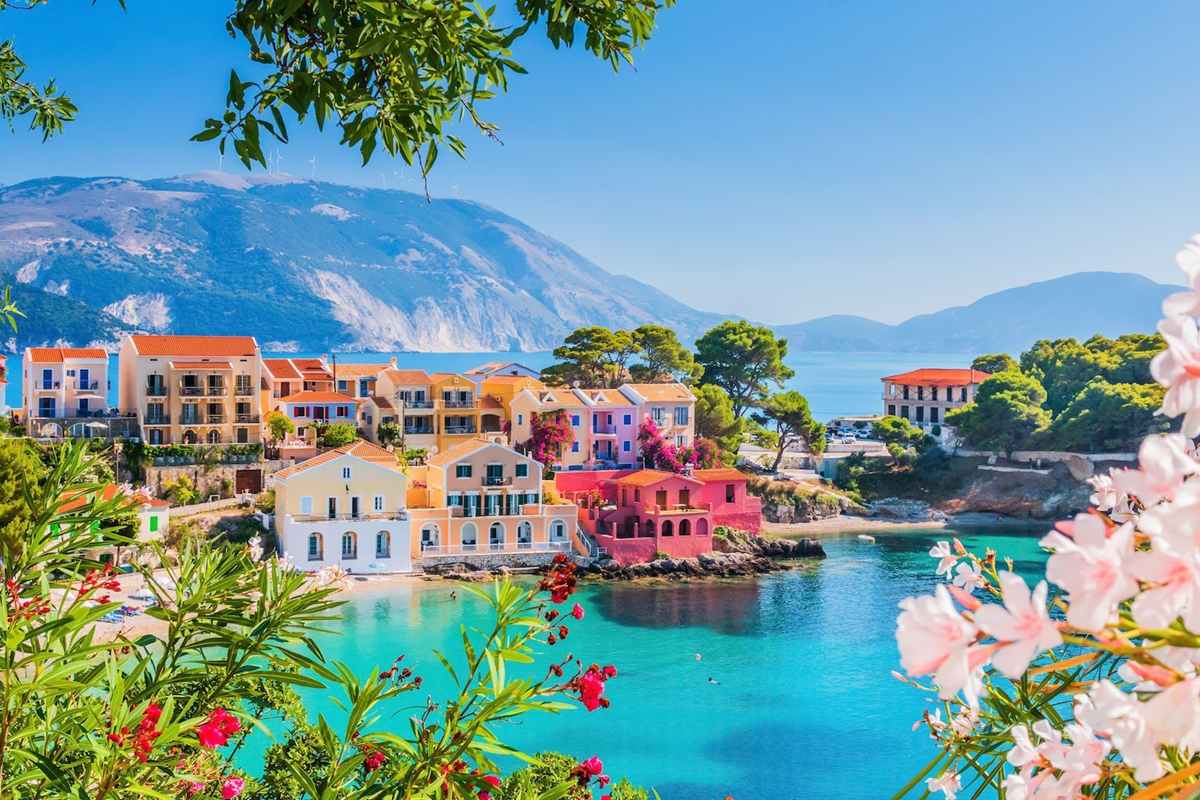
Ionian islands tours are small-group trips with a local host across a chain of Greek islands. The chain stretches south from Corfu down to Kythira. Sections below explain Kastro on Kefalonia, a medieval county and the composer Pavlos Carrer. Lefkada City, the Galatis family of Ithaca, ancient Cythera, Paxos, Meganisi and smaller islands follow. Related pages cover Corfu tours, Greece sailing tours and Greece and Italy tours. Further trips sit among the site’s Greece tours.
Bookings made through the GetYourGuide widgets on this page earn Classical Greece Tours a commission, at no extra cost to the traveller.
Which are the Ionian islands?
The Ionian islands are a group of seven main islands of Greece. Corfu and Paxos lie in the north, then come Lefkada, Ithaca, Kefalonia and Zante, with Kythira last. Greeks settled the Ionian islands at an early date, possibly as early as 1200 BC.
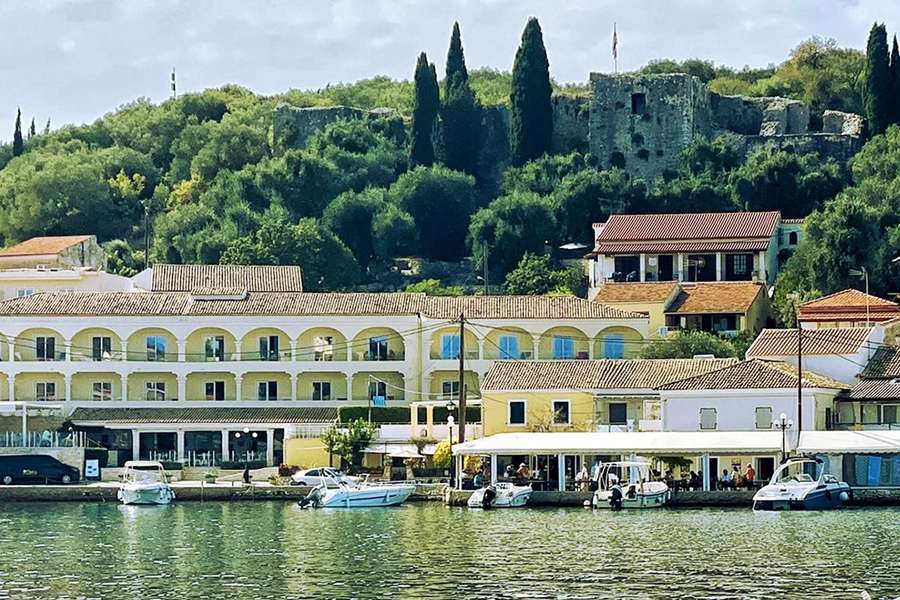
In ancient Greek times, the Ionian islands were mostly a backwater. A backwater means a calm spot that big events pass by. The group played little part in Greek politics. In 734 BC, colonists from Corinth pushed out an earlier settlement on Corfu. That earlier settlement had been founded by people from Eretria.
From the mid-8th century, the islands made up the theme of Cephallenia under Byzantine rule. Theme was the Byzantine word for a province. Later, Venice gained the islands one by one. Zakynthos passed to Venice for good in 1482. Kefalonia and Ithaca followed in 1483, and Lefkada joined them in 1502.
Among the Ionian islands, Corfu, counted together with Paxos, has a population of 103,300. Zante has 40,650 residents. Kefalonia counts 39,579 people, a figure that includes Ithaca. Lefkada has 22,536 residents, while Ithaca on its own has 3,052. Kythira has 3,000 people, and Paxos has 2,438.
- Early Venetian hold: Kythira, the southern island of the group, had been in Venetian hands since 1238.
- Venetian names: Venice called Ithaca Val di Compare and gave Lefkada the name Santa Maura.
- French districts: French rule split the islands into departments called Mer-Egee, Ithaque and Corcyre.
In recent decades, the Ionian islands have lost a large share of their people through emigration. Emigration means moving abroad to live. The decline of their old trades, fishing and marginal farming, also drove people away. Marginal farming means farming on poor land that yields little.
What story does the Castle of Saint George tell about the Ionian islands?
The Ionian islands hold the Castle of Saint George on Kefalonia, also called Kastro, which means fortress. From the Middle Ages to the 18th century, this fortified settlement was the main town of the island. A fortified settlement is a town ringed by walls.
The castle crowns a limestone hill 320 metres high in southwestern Kefalonia, in the Ionian islands. It sits about 7 kilometres southeast of Argostoli, the island’s modern capital. The castle commands the fertile valley of Livatho. It also dominates the Bay of Livadi, the island’s main anchorage. An anchorage is a sheltered place where ships drop anchor.
The castle first appears in records in 1085, when Italo-Normans under Roger Borsa besieged it without success. The Italo-Normans were Normans who had settled in southern Italy. In the mid-12th century, the geographer al-Idrisi visited this part of the Ionian islands. He described the island and its castle town as flourishing.
The castle seems named after Saint George because of a small church inside the original Byzantine fort. The Tocco family, who ruled the island as counts, lived in the castle. Under the Tocco, the castle was rebuilt and extended to serve as the seat of a feudal court. A feudal court was a lord’s household and council.
- Earthquake: An earthquake in 1469 caused heavy damage to the castle and its settlement.
- Rebuilding: From 1504 to 1594 the castle was rebuilt on a larger scale, with new outer defences.
- Census: A census of 1583 counted 859 people living in the castle and its settlement.
The Venetian walls survive in good condition in this corner of the Ionian islands. They keep a single gate and three bastions. Bastions are angled sections that jut out from a fortress wall. The churches of Saint Mark and Saint Nicholas survive as well.
How did the medieval county of Cephalonia and Zakynthos shape the Ionian islands?
The Ionian islands of Kefalonia and Zakynthos formed a county palatine from 1185 to 1479. Its title joined Cephalonia, another spelling of Kefalonia, with Zakynthos. The county lay within the Kingdom of Sicily. A county palatine was a territory ruled by a count with wide powers.
Margaritus of Brindisi was the first to receive the right to rule the two islands. He was a pirate and the admiral of the Sicilian fleet. An admiral is a naval commander of high rank. In Latin documents of 1192 and 1193, he signed in Greek. He styled himself Admiral and Count of Malta.
In 1195, Matthew Orsini took over from Margaritus as ruler of the Ionian islands. He accepted the overlordship of Venice in 1209 and of the Pope in 1216. Overlordship means the authority of a higher ruler. Under his successor Richard, Ithaca had become a refuge for pirates. A refuge is a safe hiding place.
The Orsini also conquered Epirus, on the mainland, in the early 14th century. With it, they took the title of despot. A despot here means a ruling prince. In 1357, Robert of Taranto handed Cephalonia, Zakynthos and Ithaca to Leonardo I Tocco. Leonardo was then governor of Corfu, another of the Ionian islands.
- Mainland gains: The Tocco used the county as a springboard to win lands on the Greek mainland.
- Conquests: Carlo I Tocco took Ioannina in 1411 and Arta in 1416.
- Title: Carlo I received the title of despot from the Byzantine emperor Manuel II Palaiologos.
Leonardo III was the last ruler of the Tocco line. He restored the Orthodox bishop’s seat of Cephalonia, in the Ionian islands. The earlier Orsini rulers had abolished it. A bishop’s seat means the office and throne of a bishop.
Why does Pavlos Carrer matter to the music of the Ionian islands?
The Ionian islands gave Greece the composer Pavlos Carrer, from the town of Zakynthos. He was the first to write national operas and songs on Greek plots, Greek librettos and Greek verses. A libretto is the written text of an opera.
Carrer studied music in his birthplace with two Italian teachers, Giuseppe Cricca and Francesco Marangoni. He possibly also took lessons in Corfu from Nikolaos Mantzaros. At that time, Italian opera and western European culture ruled cultural life in the Ionian islands. He wrote his first small pieces of music in the late 1840s.
In 1850 Carrer left the Ionian islands for Milan, then the operatic capital of Europe. He went there to deepen his music studies. He made his debut as an opera composer in August 1852. That first opera, Dante e Bice, tells of the poet Dante Alighieri. It follows his unfulfilled love for Beatrice Portinari.
His three-act opera Isabella d’Aspeno seems to have been one model for Verdi’s opera Un ballo in maschera. Carrer married the soprano Isabella Giatrà, who performed his works. A soprano is a singer with the highest female voice. His national opera Marco Bozzari opened in Patras in April 1861.
- Record run: In the 19th century, Marco Bozzari led all Greek operas in popularity, with over 45 stagings.
- Late premiere: His opera Marathon-Salamis was first staged in Athens 115 years after he wrote it.
- Home stage: Maria Antonietta opened at the Foskolos theatre of Zante, another name for Zakynthos, in January 1884.
This son of the Ionian islands was one of the best-loved and widely performed composers of 19th-century Greece. He also won fame in Italy. His style draws on Verdi’s middle period and on late bel canto. Bel canto is an Italian style of smooth, lyrical singing.
What past lies behind Lefkada City in the Ionian islands?
The Ionian islands include Lefkada City, the chief town and capital of the island of Lefkada. It lies in the north and northeast of the island. The word capital here means the town that holds the island’s government.
Around 1530, under Ottoman rule, the town of Lefkada in the Ionian islands had about a thousand inhabitants. It was the largest settlement in its sanjak, an Ottoman district. It was also the main military base there, with 111 soldiers and 9 artillerymen. Artillerymen are soldiers who work large guns such as cannons.
The traveller Evliya Çelebi visited this part of the Ionian islands in 1670 and 1671. He left a long, accurate account of the island’s forts and town. The walled town then had 200 stone houses. Two suburbs, to the east and west, were built of wood. A suburb means an outer district beside a town.
Another suburb, with about 700 houses, stood on the island itself. It held 20 churches. Only this island suburb survived the Venetian conquest, and until the 19th century it was called Amaxiki. People driven from the old town settled there. Amaxiki then grew into the island’s chief town and, in time, the modern city.
- Building methods: Houses are built with wood, whole logs, stone chips and other light materials.
- Street plan: The city plan follows the medieval layout that took shape under Venetian rule.
- Old churches: Panagia ton Xenon, Agios Spyridon and Agioi Anargyroi stand out among its old churches.
Today, the buildings of Lefkada City are a typical sample of anti-earthquake building in the Ionian islands. Anti-earthquake means made to withstand the shaking of the ground. At the 2021 census, the city had 9,253 inhabitants. A census is a headcount made by the state.
Who were the Galatis family of Ithaca in the Ionian islands?
The Ionian islands count the Galatis family among the old noble houses of Ithaca. Its members rose as nobles under the Tocco family in the 14th and 15th centuries. Their first noble rights came from service to the Tocco, rulers of Ithaca, Kefalonia and Zakynthos.
Writers suggest the family first came to the Ionian islands from Italy, possibly from Apulia. A family of that name has lived there for centuries. Galati is the Venetian Italian form of the family name. On Ithaca, Leonardo Tocco granted the Galati rights, privileges and property. He named Caesar Galatis among the nobles of the state.
After a short Ottoman occupation, the Venetians took control of Ithaca, in the Ionian islands, in 1503. The island was then given new settlers to promote farming. The Galati, however, were already resettling it of their own accord. With them, they brought livestock and seeds to establish farming on the island. Livestock means farm animals.
In 1558, Zuan Dolfin, the provveditor of Cephalonia, confirmed the family’s noble status. A provveditor was a Venetian governor. Twenty of his successors restated it. A Venetian record says they were treated as citizens and bore no burdens. The Galati were the only holders of noble privileges on Ithaca, under both the Tocco and Venice.
- Home village: The family was first based in the old village of Anogi, near Mount Neriton.
- Second branch: A branch of the family later settled in the nearby village of Kioni.
- Secret society: Nikolaos Galatis, who lived from 1792 to 1819, belonged to the Filiki Eteria.
The family appears in the 1803 and 1804 registers of nobles on Ithaca. These registers are called the Libri d’Oro, or Golden Books. The Galati of Ithaca, in the Ionian islands, have no known link to the Galatis family of Chios.
What does ancient Cythera reveal about the Ionian islands?
The Ionian islands hold the ancient town of Cythera, named like the island that is now called Kythira. In antiquity, the town was part of Laconia, the region ruled by Sparta. Antiquity means the age of ancient Greece and Rome.
In 424 BCE, the Athenians sent sixty ships against this corner of the Ionian islands. It happened during the Peloponnesian War, the long war that set Athens against Sparta. When they reached the island, the Athenians first captured Scandeia. They then marched on Cythera town, which at that time stood far from the sea.
The people resisted for a time, then agreed to submit. The Athenians then placed a garrison there. A garrison means troops stationed to guard a place. Part of the population was moved for safety. The rest paid a tribute of four talents, a talent being a large weight of silver.
The Peace of Nicias in 421 BCE required Athens to hand Cythera back to the Spartans. Even so, in the Athenian expedition to Sicily in 415 BCE, the Cythereans fought beside the Athenians. Cythereans were the people of Cythera, in the south of the Ionian islands. Sicily is the large island at the toe of Italy.
- Later conquest: In 393 BCE, forces under Pharnabazus II took Cythera and sent its people to Laconia.
- New walls: Pharnabazus repaired the walls and left a garrison under the Athenian Nicophemus.
- Distance: The ancient writer Pausanias placed the city ten stadia, a Greek unit of length, from Scandeia.
Pausanias also noted that the townsfolk worshipped Aphrodite Urania, the goddess of love. He traced this worship to the Phoenicians, seafarers of the eastern Mediterranean. The site of the town lies at Paleokastro, on Kythira in the Ionian islands.
What part does Paxos play among the Ionian islands?
Ionian islands history on Paxos centres on Gaios, its chief town, serving as seat of the Paxoi municipality. In Greece, a municipality is a self-governing district with its own mayor. The word seat names the town where such a council meets.
Lakka is the second largest village of Paxos in the Ionian islands, on its northern end. Its natural harbour is almost circular, and two headlands create it. A headland is a raised tongue of coast pushing out into open water. Inside a harbour, boats find shelter from the waves beyond its mouth.
In 1814 Paxos, one of the Ionian islands, surrendered to a frigate and 160 troops. That frigate was a fast sailing warship of its era. The troops came from Cephalonia, as part of the 2nd Greek Light Infantry. Infantry means foot soldiers, and light infantry carried little gear so they moved quickly.
John Gough founded the annual Paxos Festival in the Ionian islands. Today a music and drama school in London organises the event. A festival is a series of public shows held over set days. A drama school trains actors, while a music school trains players and singers for the stage.
- Rulers: Romans held Paxos in the 2nd century BC, and later pirates and Crusaders ruled it.
- Hamlets: The interior of Paxos holds scattered hamlets, small clusters of houses smaller than villages.
- Resident: Audrey Good, once commander of United Nations refugee bases in Epirus, lived on Paxos semi-permanently.
Within the Ionian islands, Corfu lies roughly 17 kilometres north of Lakka on Paxos. At sea, that gap equals 9 nautical miles. Sailors measure distance in nautical miles, each a little over a land mile. One kilometre is a thousand metres.
Which sea battle off Paxos belongs to the story of the Ionian islands?
Ionian islands history recalls the Battle of Paxos, a sea fight in the spring of 229 BC. It grew directly out of the siege of Corcyra, today Corfu, by the forces of Queen Teuta. Besiegers ring a town with soldiers to make it give in.
Off Paxos in the Ionian islands, Illyrians and Acarnanian allies met the Achaean and Aetolian Leagues. A league was a union of Greek cities that acted together in war. Acarnanian means from Acarnania, a coastal region of mainland Greece. Achaean and Aetolian refer to Achaea and Aetolia, two regions of ancient Greece.
To relieve Corcyra in the Ionian islands, the two Leagues manned the 10 decked ships of the Achaeans. To relieve a city under siege means to break the attack around it. A decked ship had a solid deck above the rowers, unlike an open boat. To man a ship is to give it a crew.
The Illyrians lashed their ships together in batches of four. To lash means to tie firmly with rope. With this method they captured four quadriremes and sank a quinquereme with all hands. Both kinds were large ancient warships driven by banks of oars. With all hands means the whole crew sank with the ship.
- Queen: Teuta, the widow of the Illyrian king, became regent and ruled the Illyrian kingdom.
- Reinforcements: The Acarnanians sent seven decked ships to strengthen the Illyrian fleet before the fight.
- Casualty: Margos of Keryneia was on board the quinquereme that went down with all hands.
After the battle, Corcyra had to accept a garrison commanded by Demetrius of Pharos. Garrison troops stay inside a town to hold it for their side. Corcyra was the ancient name of Corfu, an island among the Ionian islands. Command means the right to lead and give orders.
How did families shape the Diapontian Islands of the Ionian islands?
Ionian islands geography includes the Diapontian Islands, also called the Othonoi Islands. Administratively, the group belongs to the Corfu regional unit. Regional units are the layer of Greek administration just below the regions. The word administratively refers to how a place is governed.
In the Diapontian part of the Ionian islands, each village bears the surname of its resident family. A surname is the family name shared by parents and children. Only a small number of villages break this naming pattern. Argyratika, for example, takes its name from the surname Argyros.
In the 1960s the folklorist Dimitrios Loukatos researched the Diapontian Islands. A folklorist studies the customs, songs and stories of ordinary people. Loukatos found that local daily life and costumes resembled those of Epirus. He also noted that the islanders were not exactly the same as Corfiots. Corfiots are the people of Corfu in the Ionian islands.
Franks conquered the islands in the 11th century, and Venetians took them in the 12th century. Franks here means knights from Western Europe, and Venetians came from Venice in Italy. Pirates of Barbary and Algeria also raided this corner of the Ionian islands. Barbary was the old European name for the coast of North Africa.
- Islets: The group also holds small islets and rocks such as Karavi, Kastrino, Leipso, Ostrako and Plateia.
- Lizard: The lizard Lacerta trilineata turned up only on Othoni and on no other island of the group.
- Seaman: The Montgomery, Alabama house of Othonian seaman Alexandros Markou Kasimis is a designated monument.
About 50 Othonian families live in the American state of Pennsylvania. Othonian means from Othoni, the island also called Othonoi in the Ionian islands. A family here means a household of parents, children and relatives. Pennsylvania is in the eastern United States.
Who were the Taphians of Meganisi in the Ionian islands?
Ionian islands myth places the Taphians on Taphos, which modern scholars identify as Meganisi, just east of Lefkada. The Taphians were a seagoing people with a name for piracy. Pirates seize ships, goods and captives by force on the water.
Penelope, queen of Ithaca in the Ionian islands, mentions the Taphian sea-robbers in the Odyssey. She does so while scolding the leading man among her suitors. A suitor is a man who seeks to marry a woman. The Odyssey is a long Greek poem about the hard voyage home of Odysseus after Troy.
In the Odyssey, the goddess Athena disguises herself as Mentes, a Taphian lord. In this form she accepts the hospitality of Telemachus on Ithaca, in the Ionian islands. Hospitality means a warm welcome with food and shelter for a guest. She then hurries him off on a voyage from Ithaca to Pylos.
The Taphians of the Ionian islands also played a crucial role in the metal trade. Iron was then becoming the new metal for weapons and tools, in place of bronze. Control over its distribution gave the Taphians power far beyond their small territory. Distribution means the way goods pass from maker to buyer.
- King: Pterelaos, their best-known king, became immortal through a single golden hair given by Poseidon.
- Kinsmen: The Teleboans, an Acarnanian tribe, settled on Taphos among their own relatives.
- Island: Meganisi, today a municipality of its own, spreads over 22.356 square kilometres.
In Homeric Greece, Taphos and its islands lay in the Ionian Sea, off Acarnania. Homeric Greece means the world described in the poems of Homer. Acarnania is a region on the western coast of mainland Greece, facing the Ionian islands.
Which facts set the Echinades apart within the Ionian islands?
Ionian islands maps split the Echinades between two regional units, Ithaca and Cephalonia. Petalas is the largest island of this archipelago. Archipelago is the term for islands grouped closely in one area of sea. Each regional unit forms one of the districts of a Greek region.
Pausanias explained why these Ionian islands had not joined the mainland, as earlier writers expected. He blamed the uncultivated state of Aetolia, which sent less silt down the Achelous. Uncultivated land is land left without crops or care. Silt is fine soil that a river washes down and leaves at its mouth.
According to Strabo, Homer called the Oxeiae islands by the name Thoae. The Oxeiae form the southern cluster of the Echinades in the Ionian islands. Strabo was an ancient Greek geographer, and a geographer describes lands, seas and places. A cluster is a small, close group of things.
Artemita, another of the Echinades, became joined to the mainland. The mainland is the main land mass of a country, apart from its islands. In this part of the Ionian islands, two of the four Modia islands are mere rocks. A rock in this sense is a bare stone too small for farming.
- Private: Petalas is the largest private island in Greece, held by private owners rather than the state.
- Olives: Petalas holds around 4,000 olive trees, which give the fruit used for olive oil.
- Landscape: The geographer Strabo described the Echinades as barren and rugged, meaning bare and rough.
A later account says the sea around these Ionian islands keeps getting deeper. That growing depth keeps the Echinades apart from the mainland. Depth measures the drop from the water’s surface to the seabed. A seabed is the ground at the bottom of the sea.
What past does Lazaretto Island hold in the Ionian islands?
Ionian islands waters hold Lazaretto Island, formerly called Aghios Dimitrios, two nautical miles northeast of Corfu city. Aghios Dimitrios means Saint Demetrius in Greek. A nautical mile is the distance unit used at sea and in the air.
In the Ionian islands, Lazaretto Island takes its name from the lazaretto that stands there. A lazaretto is a quarantine station, where sea travellers and goods were kept apart to stop disease. Quarantine means a set period of isolation to stop an illness from spreading. Lazaretto is an Italian word, and Lazareto is another spelling of the name.
Under the Venetians, early in the 16th century, builders raised a monastery on the islet. Monks live, work and pray together in a monastery. In 1798 a Russo-Turkish fleet in the Ionian islands occupied the island and ran a military hospital there. Russo-Turkish means Russian and Ottoman Turkish forces acting together.
In 1814, during the British occupation of the Ionian islands, the leprosarium opened again after renovations. A leprosarium is a hospital for people with leprosy. Leprosy is a long-lasting infection that harms the skin and the nerves. Renovation means repair work that brings an old building back into use. Occupation means control of a land by a foreign power.
- Size: The island covers 7 hectares, and one hectare equals ten thousand square metres.
- Wartime: In the Second World War, Italian occupation authorities set up a camp there for resistance prisoners.
- Remains: The two-storey former headquarters of the Italian army and a small church still stand there.
After the union of the Ionian islands with Greece in 1864, the leprosarium saw occasional use. Union here means the joining of the islands to the Greek state. Occasional use means that the building opened only now and then.
What do travellers ask about Ionian islands, and what are the answers?
The Ionian islands include Antipaxos, which belongs to the Paxoi municipality, and Mathraki, one of the Diapontian Islands. They also include Arkoudi, an uninhabited islet, and the Echinades off the coast of Acarnania. Islets are the smallest class of island.
Among the Ionian islands, how big is Antipaxos?
Antipaxos is a small island of 5 square kilometres, about 3 kilometres south of Paxos. As of 2021, the island had 21 residents. A resident is someone whose home is in that place all year. Vineyards cover large parts of Antipaxos. Vineyards are plots of grapevines, grown for fruit and wine.
Which school news comes from Mathraki in the Ionian islands?
The Mathraki municipal unit covers 3.532 square kilometres. Municipal units are the former communities now joined into larger municipalities. In 2021 the only elementary school on Mathraki reopened after 21 years, with one student. Elementary schools teach young children. Apart from hikers on its rocky coast, the island stays clear of tourists.
Where does Arkoudi lie within the Ionian islands?
Arkoudi, whose name means bear, is a small island of Greece in the Ionian Sea. It lies 5 kilometres south of Lefkada and 6 kilometres northeast of Ithaca. Meganisi lies 7 kilometres to its northeast. The municipality of Ithaca administers the island. To administer means to run the local affairs of a place.
What happened at the Battle of the Echinades in the Ionian islands?
In 1427 Carlo I Tocco’s fleet clashed with a Byzantine fleet among the Echinades. It proved the final naval triumph in the long history of the Byzantine Empire. That empire, the eastern half of the Roman world, had its capital at Constantinople. Over 150 men from the losing fleet were taken prisoner.