
Greek seafood joins Greek kitchens to the Aegean and Ionian seas. Small-group cooking classes and fishing trips with a host take place in Athens, Crete, Rhodes, Kos and Santorini. Topics run from the common octopus and calamari to red mullet, lavraki, sardines, marida, swordfish and soupies. Kakavia, garum, sponge diving and the Trata fishing dance follow. Related reading covers Greek food, Greece food tours and Greek islands near Athens. Each one belongs to the wider choice of Greece tours.
Bookings made through the GetYourGuide widgets on this page earn Classical Greece Tours a commission, at no extra cost to the traveller.
What is Greek seafood?
Greek seafood is the fish and shellfish of Greek seas, eaten as food. Seafood means any sea life that humans treat as food. On the islands and coasts of ancient Greece, people widely ate fresh fish, octopus, squid and shellfish.
Shellfish covers three groups of sea animals. Molluscs, such as clams, mussels, octopus and squid, are soft-bodied animals. Crustaceans, such as shrimp, crabs and lobster, have a hard shell. Echinoderms, such as sea urchins and sea cucumbers, have spiny skin. Ancient Greek meals rested on wheat, wine and olive oil, and fish was eaten more than meat.
Fishing scenes are rare in ancient Greek culture, a sign of the low social rank of fishing. Social rank means a person’s standing among others in society. In ancient Greek seafood, how much fish a household ate depended on its wealth and location. Wealth means the money and goods that a family owns.
Greek seafood from the coast was eaten locally, but a larger share travelled inland. Inland means the parts of a country away from the sea. Freshwater fish also reached ancient Greek tables. They included pike, carp and the less admired catfish. Freshwater means the water of rivers and lakes, which holds little salt.
- Sea fish: Yellowfin tuna, red mullet, ray and swordfish were common salt-water fish in ancient Greece.
- Sturgeon: This fish was a prized delicacy of ancient Greek seafood, eaten in salted form.
- Eels: Lake Copais was famous across Greece for its eels, praised by the hero of The Acharnians.
Ancient Greek cooking was marked by frugality, meaning a plain and careful use of food. In Cyprus, the ancient Greek seafood habit of eating more fish than meat changed only fairly recently. The change came when new technology made meat easier to obtain.
How does the common octopus reach the table in Greek seafood?
Greek seafood names grilled octopus htapodi sti schara, which means octopus on the grill. In Greece, spear fishing close to the shore is a common way to catch octopuses. Spear fishing means taking sea animals with a long, pointed shaft.
In Greek seafood, octopus takes classic local seasoning. The common mix holds lemon juice, olive oil, oregano, pepper and cloves of garlic. Oregano is a dried leafy herb. In Greece, octopus counts as a superb meze, above all beside ouzo. A meze is a small plate set out to share with drinks. Ouzo is an aniseed-flavoured spirit.
Within Greek seafood, htapodi ksidato is a dish of octopus marinated in vinegar. Marinating means leaving food to soak in a liquid. Stifado, a Greek stew, can be cooked with octopus instead of meat. The pot also takes tomatoes, baby onions, olive oil, bay leaf and wine or vinegar. A stew is food cooked slowly in liquid.
Octopus vulgaris, the common octopus, ranges across the Mediterranean, the Black Sea and the eastern Atlantic. It ranks among the octopus species studied in greatest depth. It also ranks among the cleverest octopuses. The mantle is the soft body sac behind the head. The mantle grows to 25 cm, and the arms reach 1 m.
- Lifespan: The common octopus lives for one to two years and can weigh up to 9 kg.
- Hunting: The common octopus hunts at dusk, and crabs and lobsters are its preferred prey.
- Camouflage: The octopus changes the colour of its skin to match its surroundings and ambush prey.
The octopus in Greek seafood has a large brain and nervous system. One animal holds about 500 million neurons, close to the number in dogs. Neurons are nerve cells that carry signals. It favours shallow, rocky coastal waters, mostly above 200 m deep.
Where does the word calamari come from in Greek seafood?
Greek seafood shares the word calamari with English, which borrowed it from Italian, Spanish and Modern Greek kalamari. All these words trace back to the Greek kalamos, meaning a reed or a pen. Calamari is the kitchen name for squid dishes in English.
Midway along the chain sits the Late Latin calamarium, meaning a pen case or ink pot. The name came from the squid’s shape and from the inky fluid it squirts out. Latin calamarius meant linked to a writing reed. Reeds are tall water grasses whose stems are hollow.
In Greek seafood, cooks coat squid rings and arms in batter and fry them in oil. Batter is a runny mix of flour and liquid. A short time in the pan keeps fried squid tender. In Greece and Cyprus, fried squid also comes with tzatziki. This dip blends Greek yoghurt, cucumber and mint.
Other Greek seafood recipes simmer squid slowly with squash or tomato. Simmering means cooking gently, just below the boil. Long cooking at a lower heat makes the flesh more tender. A squid’s mantle, arms, tentacles and ink can all be eaten. Only the beak and the gladius, or pen, are left uneaten.
- Range: The European squid lives throughout the Mediterranean and down to 500 m deep.
- Size: The mantle of the European squid reaches up to 40 cm in length.
- Eggs: A female lays up to 20,000 tiny eggs, packed inside jelly tubes on the seabed.
Fried squid is common across the Mediterranean, and Greek seafood shares that habit. The European squid has ten limbs around its mouth. Eight are short arms, and two long tentacles catch prey. Females live about 2 years, and males about 3 years.
Which ancient stories surround the red mullet of Greek seafood?
Greek seafood links the red mullet to Demeter, the Greek goddess of farming. The writer Claudius Aelianus called it sacred to her in On the Nature of Animals. In ancient times, red mullet ranked among the best-known and highest-valued fish.
At Eleusis, the initiated held the red mullet in honour. Initiated means admitted to secret religious rites. Two reasons were given for this honour. One said the fish gives birth three times a year. The other said it eats the sea hare, a creature deadly to humans. A sea hare is a large sea slug.
In Greek seafood, the name red mullet covers two goatfish, Mullus barbatus and Mullus surmuletus. Goatfish are bottom-feeding fish with feelers on the chin. The pair look alike and are cooked in the same ways. Ancient Romans kept red mullets in ponds and stroked them. The fish learned to come at the keeper’s voice or bell.
Among Greek seafood mullets, Mullus barbatus reaches 30 cm, though a common length is near half that. Its colour is rose-pink, with no clear markings on the fins. It lives 10 to 328 m down, over mud, sand or gravel. There it hunts worms, bivalve molluscs and crustaceans. Bivalves are shellfish with two hinged shells.
- Fishing: Red mullet is caught mainly by trawling, which drags a net along the seabed.
- Overfishing: Mediterranean catches show overfishing, with large numbers of fish under 15 cm in length.
- Spawning: In the Adriatic Sea, red mullet spawn in April and the fifth month, 60 to 70 m down.
Outside Greek seafood, Mullus barbatus ranges from Scandinavia south to Senegal in the Atlantic. It also lives in the Black Sea and the Sea of Marmara. Senegal is a country on the west coast of Africa. Fishers target it for its highly esteemed flesh.
How does the gilt-head bream fit into Greek seafood?
Greek seafood includes the gilt-head bream, a fish that Greece farms on a large scale. Greece ranks second in world seabream production, behind Turkey. In the wild, the species lives in the eastern Atlantic and across the Mediterranean Sea.
Its genus name, Sparus, comes from sparos, the Ancient Greek seafood name for this fish. Genus is the rank that groups closely linked species. The species name aurata means gold. It refers to the gold band on the head between the eyes. The back is blue-grey, and the silvery sides carry a dark spot behind the eye.
Gilt-head bream were long raised in coastal lagoons and saltwater ponds. A lagoon is a shallow body of sea water cut off by sand or rock. Intensive rearing systems arrived during the 1980s. Intensive rearing means raising large numbers of fish close together. Production reached 140,000 tonnes in 2010, far above the wild catch.
This farmed Greek seafood fish reaches a top length of 70 cm, though 35 cm is more typical. The heaviest published weight is 17.2 kg. It feeds mainly on shellfish, along with a little plant matter. Gilt-head bream mature as males by age 2. Later, a share of them grow ovaries and become female.
- Habitat: It lives over sandy seabeds and seagrass beds, at depths of 1 to 150 m.
- Water: The species is euryhaline, so it copes with changing saltiness and enters brackish water.
- Wild catch: Wild catches stayed modest, between 6,100 and 9,600 tonnes, mainly from the Mediterranean.
Among seabreams, the gilt-head bream is held in highest regard for cooking. Its flesh tastes mild and sweet and falls apart in small flakes. That flesh is popular in Southern Europe, the region that is home to Greek seafood.
What links the European seabass, or lavraki, to Greek seafood?
Greek seafood knows the European seabass as lavraki, its Greek name. Greece stands among the leading countries that farm this fish, alongside Turkey, Italy, Spain, Croatia and Egypt. It ranks first in importance among fish farmed in the Mediterranean.
The European seabass was among the earliest fish farmed for sale in Europe. Farmers once kept this Greek seafood fish in coastal lagoons and tidal reservoirs. A tidal reservoir is a pool filled and drained by the tides. Mass-production methods arrived in the late 1960s. Output passed 120,000 tonnes in 2010, and Turkey is the biggest producer.
The genus name Dicentrarchus comes from Greek, after two spines on its belly-side anal fin. Di means two, and kentron means sting. Adult lavraki of Greek seafood weigh around 2.5 kg. The biggest reach 1 m and 12 kg. Its body is silvery grey, sometimes dark blue on the back.
Young seabass form schools and eat invertebrates. An invertebrate is any animal that lacks a backbone, such as a worm. Adults live more alone and hunt other fish. The species hunts as much by day as by night. Fish heavier than 4 kg hunt mostly at night. Spawning runs from February to June, mostly in inshore waters.
- Status: A global conservation list ranks the species as Near Threatened, as its numbers fall.
- Range: It lives across the whole Mediterranean and the southern Black Sea, but not the Baltic.
- Habitat: An estuary, where a river meets the sea, is one of its habitats.
Beyond the farmed fish of Greek seafood, wild European seabass form two genetically distinct populations. One lives in the northeast Atlantic, the other in the western Mediterranean. The Almeria-Oran front, a narrow sea boundary east of the Spanish city of Almeria, divides them.
How long have sardines been part of Greek seafood?
Greek seafood has counted small oily fish such as sardines as a staple since antiquity. A staple is a basic food eaten again and again. In Greek seafood, sardines are especially popular in the summer months of July and August.
In Greek seafood, Lesvos is the place linked above all others with sardines eaten as ouzomeze. Ouzomeze means a small plate served alongside a glass of ouzo. A fine kind of sardine called papalina thrives in the wide bay of Kalloni there. A bay is a wide inlet of sea curving into the land.
On Lesvos, a small number of makers can and export sardines, prized as a local delicacy. Athenaios quotes a passage of Aristotle that names a fish called sardinos. The name refers to the sardine or the pilchard. The English word sardine came from Ancient Greek, passing through Latin and then French.
The European pilchard, Sardina pilchardus, lives in the northeast Atlantic, the Mediterranean and the Black Sea. It swims at depths of 10 to 100 m. It grows to 27.5 cm and eats mostly planktonic crustaceans. Plankton is the mass of tiny drifting life in the water. Each female lays 50,000 to 60,000 eggs.
- Colour: Its upper side is green or olive, its flanks golden and its belly silvery.
- Size rule: One rule names fish shorter than 15 cm sardines and larger fish pilchards.
- Name: The English term sardine possibly points to the island of Sardinia.
Beyond Greek seafood, sardines are canned, pickled, smoked or eaten fresh. Pickling means keeping food in vinegar or brine. Brine is strongly salted water. Their chief use is as food for people, while fish meal made from them feeds farm animals.
What is marida, the small picarel of Greek seafood?
Greek seafood calls the picarel marida. In Greece and Cyprus, cooks dip marida in batter and fry it. The picarel, Spicara smaris, belongs to the seabream family. It is a popular food in Greece, southern Italy and Dalmatia, the Adriatic coast of Croatia.
Smaris is an Ancient Greek seafood name for this fish, used since at least Aristotle’s time. Aristotle was an ancient Greek thinker who studied animals and wrote about them. In Cyprus, picarel ranks among the five fish caught in the largest numbers. In Dalmatia, salted picarel, called slana gira, is popular.
Spicara smaris grows to 20 cm, though 15 cm is a more common top size. Its back is grey-brown, and its flanks are silvery. A large black spot sits above the tip of the pectoral fin. Pectoral fins sit just behind the gills. It keeps to meadows of seagrass and to seabeds of sand or mud.
The picarel of Greek seafood matures as a female and later turns male. Every fish over about 17.9 cm is male. Males live up to six years, and females up to four. At breeding time, the male scoops a round nest in the soft seabed. The female lays her eggs there, and he guards them.
- Depth: Picarels have been recorded 328 m deep in the eastern Ionian Sea.
- Groups: Spicara smaris is a sociable fish that gathers in large groups of its own kind.
- Colonies: Breeding colonies of this fish can cover wide areas of seabed, an exceptional habit.
Beyond Greek seafood, the picarel lives in the subtropical eastern Atlantic, off Portugal, Morocco and the Canary Islands. Its range also takes in the Mediterranean and Black seas. The Canary Islands are a Spanish group of islands off the north-west coast of Africa.
Which traits set the swordfish apart in Greek seafood?
Greek seafood lists the swordfish as xiphias or xifias. That Greek seafood name comes from the word xiphos, meaning a sword. The fish is named after its long, flat and pointed bill. A bill is the long, beak-like snout of the fish.
Science names the fish Xiphias gladius, after the Greek seafood word xiphias. Gladius is the Latin word for a sword. Swordfish commonly reach 3 m in length. The largest reported fish measured 4.55 m and weighed 682 kg. Females grow larger than males. Mediterranean swordfish stay smaller than those of the Pacific.
Swordfish are cold-blooded, yet special heater organs sit next to their eyes. Cold-blooded means the body takes the temperature of the water around it. These organs warm the eyes and the brain. The eyes run 10 to 15 degrees Celsius warmer than the surrounding water. This warmth greatly sharpens their sight when they hunt.
Swordfish do not swim in schools. They travel alone or in loose groups, up to 10 m from a neighbour. They are frequently seen basking at the surface with the first dorsal fin in the air. The dorsal fin is the tall fin on the back. They reach maturity at 4 to 5 years of age.
- Steaks: Because the fish is so large, its meat is sold as steaks, and grilling is common.
- Skewers: The firm meat holds together on skewers over a grill, unlike more fragile fish.
- Stock: Parasite studies support the existence of a separate Mediterranean swordfish stock.
Beyond Greek seafood, the flesh of certain swordfish takes on an orange tint, reportedly from eating shrimp. Such fish are sold under the name pumpkin swordfish. The oldest swordfish in one recent study were a female aged 16 and a male aged 12.
What do soupies, or cuttlefish, bring to Greek seafood?
Greek seafood calls the cuttlefish soupies. The common cuttlefish, Sepia officinalis, is fished widely across the Mediterranean, in countries such as Greece and Spain. A cuttlefish is a soft-bodied sea animal with eight arms, two feeding tentacles and an inner shell.
In Greek seafood, as across its native range, the mantle is the main cut. The mantle is the thick body tube that holds the organs. Before cooking, the cuttlebone and the guts come out. The cuttlebone is a chalky internal shell. The head and tentacles also go into dishes, once the beak is cut away.
Cuttlefish ink also serves as a food ingredient. It stains a dish a deep black. The word sepia names the cuttlefish in both Greek and Latin. In English, sepia now means a reddish-brown colour. The ancient Greeks and Romans prized the brown pigment the animal releases when alarmed. A pigment is a substance that gives colour.
The cuttlefish of Greek seafood grows to 49 cm in mantle length and 4 kg in weight. It spends spring and summer inshore to spawn. In autumn and winter, it moves to depths of 100 to 200 m. At breeding time, males show a black and white zebra pattern. Females turn plain grey when ready to mate.
- Eggs: A female carries between 150 and 4000 eggs and fixes them to seaweed or shells.
- Lifespan: Cuttlefish live up to 2 years, and a large number die after spawning.
- Seabed: It lives on sand and mud seabeds and copes with slightly salty brackish water.
Beyond Greek seafood, Mediterranean languages hold a long list of names for the cuttlefish. Heavy fishing presses wild stocks in places, yet numbers are not falling. The species is rated Least Concern. Least Concern means the species faces no serious threat of dying out.
Which ancient names does the European anchovy carry in Greek seafood?
Greek seafood words gave the European anchovy both of its scientific names. Engraulis and encrasicolus come from Ancient Greek and mean anchovy and small fish. In ancient Athens, sardines and anchovies were regular fare, sold salted more than fresh.
The Ancient Greek seafood term for the fish was aphye. Latin later turned it into apiuva, which gave the Italian word acciuga. The species has been fished since ancient times. People can catch it from the shore with simple gear, such as beach seines. A beach seine is a long net hauled in from the beach.
The European anchovy of Greek seafood has a deeply cleft mouth that opens behind the eyes. Its record length is 21 cm, though 13.5 cm is more typical. The heaviest fish on record weighed 49 g. Its back and sides are blue, green or grey above a silver belly.
In summer, it keeps to water less than 50 m deep. In the Mediterranean, it drops to 200 m in winter. It feeds on plankton, above all copepods, which are tiny shrimp-like animals. In the 1980s, an invasive comb jelly badly cut Mediterranean anchovy numbers. This jellyfish-like animal, Mnemiopsis leidyi, eats anchovy eggs and young.
- Schools: European anchovies form large schools and bunch into tight balls when threatened.
- Sale: The fish is sold fresh, dried, smoked, salted, frozen, canned or packed in oil.
- Range: It lives off Europe and Africa, from the Mediterranean to the Black Sea and Sea of Azov.
Beyond Greek seafood, anchovies count as an oily fish with a salty, strong taste. Ease of preservation made them a traditional item of long-distance trade. Preservation means keeping food safe from spoiling for a long time. Certain people even eat the fish raw.
Why does kakavia stand among the oldest soups in Greek seafood?
Greek seafood includes kakavia, a fish soup named after a cooking pot. The pot was the kakavi, a tripod that ancient Ionian fishermen used. A tripod is a vessel or stand on three legs. Ionia was a region of ancient Greek cities.
Kakavia has been described as the oldest fish soup in Greek seafood. It is also related in lineage to bouillabaisse, a fish stew from France. A lineage is a line of descent, much like a family tree. Here it means the two dishes share old roots. Stews simmer slowly in a liquid.
Like that French stew, kakavia is made with a flexible mix of fish. Flexible here means the cook can change the kinds of fish from pot to pot. In the old tradition, fishermen made the soup from the smallest fish they caught. A tradition is a custom that parents pass on to their children.
The old recipe joined those small fish with olive oil, onions and saffron. Olive oil comes from crushed olives. Saffron is a yellow spice made from parts of the crocus flower. Onions are a bulb vegetable with a sharp taste. In Greek seafood terms, that recipe rests on four parts: fish, oil, onions and saffron.
- Modern recipe: One version uses whitefish, prawns, tomatoes, onions, potatoes, olive oil, lemon juice and parsley.
- Second recipe: Another version poaches three or four kinds of fish, with white wine, water and toasted croutons.
- Close relatives: Kakavia resembles Italian cacciucco, Spanish zarzuela and Portuguese caldeirada, other Mediterranean fish stews.
In Greek seafood, kakavia is associated with fishing villages. A fishing village is a small settlement whose people live mainly from the catch of the sea. Settlement here means a group of houses and the people in them. The catch is the fish a boat brings back.
Which regional versions of psarosoupa appear across Greek seafood?
Greek seafood gives the name psarosoupa to fish soup. Psarosoupa is the Greek word for that dish, and the soup is traditional to Greek cuisine. Cuisine means the cooking style of a country or a region. Traditional means handed down over time.
In Greek seafood, psarosoupa comes in more than one version, and every version holds both fish and vegetables. The types of fish in it vary. Possible fish include carp, cod, hake, mackerel, skate and turbot. Perch and swordfish are also on the list. A version here is one local way of making the soup.
Certain cooks choose grouper, snapper or rockfish, which have firm, white flesh. They avoid the more oily kinds. Oily fish have rich, fatty flesh. Firm flesh holds together when cooked. In Kastoria, a traditional recipe called garoufa uses a fish named grivadi. Garoufa is one of the named varieties of psarosoupa.
Psarosoupa avgolemono is a version made with avgolemono. Avgolemono is a broth made with eggs and lemon. Regular avgolemono soups use chicken broth or stock. This fish version uses fish fumet or court bouillon in their place. Fumet is a stock made from fish. Court bouillon is a light broth used to poach fish.
- Patmos: In Greek seafood, Psarosoupa Patmou is a simple soup of fish, potatoes, tomatoes, onions, celery and rice.
- Crete: The Cretan version, psarosoupa me chorta kritiki, is a thick, rich soup with a red colour.
- Agios Nikolaos: The Cretan soup began there, with fish slices, carrots, celery, tomatoes and zucchini, or courgettes.
In Greek seafood, psarosoupa can be served with retsina. Retsina is a Greek wine flavoured with pine resin. Resin is the sticky sap that seeps from pine trees. Serving a wine beside a dish in this way is called a pairing.
How did garum, an ancient fish sauce, enter Greek seafood history?
Greek seafood history reaches back to garum, a fermented fish sauce. Cooks in ancient Greece, Rome and later Byzantium used it to flavour food. Fermented means changed slowly by tiny living things such as bacteria. Byzantium was the Greek-speaking eastern Roman empire.
In Greek seafood history, the Latin word garum comes from the Greek word garos. Aristophanes, Sophocles and Aeschylus all named garos as a food. They were three ancient writers of plays. The exact meaning of garos is uncertain. It was either a kind of fish or a fish sauce close to garum. The Romans spoke and wrote in Latin.
A 10th-century Byzantine farming manual sets out a Greek seafood recipe for liquamen, a sauce close to garum. A manual is a book of practical instructions. In the recipe, fish intestines and small fish are salted in a vessel. The mixture then rests in the sun and is turned frequently. Intestines are the guts of a fish.
Garum, like modern fish sauce and soy sauce, was a rich source of umami flavour. Umami is a savoury taste, listed with sweet, sour, salty and bitter. Glutamates in the sauce produced that taste. A glutamate is a natural salt of an amino acid. Soy sauce is a salty sauce brewed from soya beans.
- Taste: The flavour of garum is thought to resemble that of today’s Asian fish sauces.
- Trade: Making and exporting garum helped coastal Greek trading posts prosper from Gaul, old France, to Hispania, old Spain.
- Later use: In medieval Byzantine and Arab cooking, garum joined murri, another sauce, for savoury flavour.
Garum reached its greatest popularity in the Roman world and the western Mediterranean. Even so, the Greeks used it earlier, as part of Greek seafood cooking. The western Mediterranean is the part of that sea nearest Spain, France and Italy.
What does an ouzeri put on the table for Greek seafood lovers?
Greek seafood has a place in the ouzeri, which serves fish-based and meat-based meals. A traditional kafenio, or Greek café, does not offer such meals. Fish-based means that fish forms the main part of the meal. Meat-based means the same for meat.
Ouzo, the drink served in an ouzeri, is a Greek liquor. A liquor is a strong alcoholic drink made by distilling. Distilling means heating a liquid and gathering the vapour as it cools. The cooled vapour becomes a stronger drink. In Greek seafood settings, ouzo is the drink that names the ouzeri itself.
In an ouzeri, the meals are prepared on site, unlike in a traditional kafenio. Kafenia, the plural of kafenio, rarely serve full meals. They offer free snacks instead. On site means in the same place where guests eat. A café is a small place that sells drinks and light food.
Traditionally, the ouzo is sipped slowly, with water or ice in the glass. Sipping means drinking in small mouthfuls. The ouzo is taken alongside mezedes in the afternoon. Mezedes are small dishes eaten with a drink, and a single one is a meze. In Greek seafood custom, those dishes and the drink are taken side by side.
- Cheeses: The ouzeri menu lists feta, kefalotyri and graviera among its Greek cheeses.
- Vegetables: Olives, tzatziki, a yoghurt and cucumber dip, and Greek salad appear among the salads.
- Oven dishes: Ready-made meals include dolmades, which are stuffed vine leaves, and broad beans baked in the oven.
Marinated, broiled and boiled dishes on the ouzeri menu include mussels, sardines and anchovies. These three are the Greek seafood items named on that list. Marinated means soaked first in a flavoured liquid. Broiled means cooked close to strong, direct heat.
Where does the ancient word opson sit in Greek seafood?
Greek seafood held top rank in the ancient idea of opson. Opson meant a relish, and the word was commonly used for the relish held in highest esteem: fish. A relish is a tasty food eaten to add flavour to plainer food.
In Greek seafood history, opson and sitos formed an important division in ancient foodways. Foodways are the habits and customs of a people around food. Opson was the relish that complemented the sitos. To complement something means to complete it or to round it out. Division here means a split into two kinds.
Opposite Greek seafood and other relishes stood sitos, the staple of the meal. It meant grains like wheat or barley. It also meant pulses like chickpeas and fava beans. A staple is the basic food eaten in the largest amount. Pulses are edible seeds from pod-bearing plants of the pea family. Fava beans are also called broad beans.
Ancient Greek moralists coined the term opsophagia. It named the vice of eating too much opson with the sitos. A vice is a bad habit. Greek personal morality centred on sophrosyne, meaning moderation and self-control. That focus made opsophagia a concern in the classical period. A moralist is a person who writes about right and wrong behaviour.
- Salt: Any side food for the staple, even plain salt, qualified as opson.
- Opsophagos: Classical authors used this word, meaning opson-eater, for people fanatical about seafood.
- Other cuisines: Opson is somewhat like banchan in Korean cooking and okazu in Japanese cooking, both side dishes.
A diminutive of opson, opsarion, gives modern Greek its word for fish, psari. A diminutive is a word form for a smaller or dearer version of something. In Greek seafood today, the word psari still carries that ancient root.
Who was Oppian, and what did his fishing poem add to Greek seafood?
Greek seafood lore has an epic poem, the Halieutica. Oppian, a Greco-Roman poet of the 2nd century, composed it in five books about fishing. An epic is a long poem in a grand style. Greco-Roman means both Greek and Roman in culture.
Oppian wrote while the emperors Marcus Aurelius and Commodus ruled Rome. An emperor rules over an empire, a group of lands and peoples. His birthplace was Anazarbus or Corycus, according to medieval records. Both towns lay in Cilicia, a Roman province in what is now southern Turkey. A province was one district of the Roman lands.
The Halieutica is a Greek poem in hexameter, about 3500 lines long. In hexameter, each line holds six beats, or feet. In books 1-2, Oppian describes fish and other sea animals. Books 3-5 then set out fishing techniques. For Greek seafood, those later books record how the ancient catch was made.
Oppian gives the fish in his poem human feelings. Their behaviour springs from hate, love, greed, jealousy and friendship. Giving animals human traits is called anthropomorphism. Greed is a strong wish for more than a fair share. Jealousy is resentment at what another has. In Greek seafood writing, the fish thus act like people.
- Book 1: Its first half holds a catalogue of marine species, sorted by the places where they live.
- Book 3: This book closes with a section on tuna fishing, the hunt for a large sea fish.
- Book 5: It teaches the catching of the largest sea animals, including whales, sharks and dolphins.
Byzantine copies of this Greek seafood poem carry anonymous biographies of Oppian. They say Marcus Aurelius paid him one gold piece per line. Anonymous means written by an unknown author. A biography is a written account of a person’s life.
What does sponge diving on Kalymnos share with Greek seafood traditions?
Greek seafood is one harvest of the Aegean Sea. Sponges were another, and Kalymnos was the main centre of their production. Sponges are simple sea creatures, and the soft kind has a springy frame. The Aegean washes the coasts of both Greece and Turkey.
On Kalymnos, people once lived chiefly by trade, boat building and sponge fishing. Sponge fishing means gathering sponges from the sea floor, a harvest separate from Greek seafood. Trade means buying goods and selling them on. Boat building is the craft of making boats. Kalymnos is a Greek island in the Dodecanese, in the southeast Aegean.
On a sponge-diving trip, a small boat carried the crew out onto the Mediterranean Sea. Peering through a glass-based cylinder into the water, the crew scanned the seabed. A cylinder is a tube shape with flat, round ends. The glass let them see the bottom, home to sponges and to Greek seafood alike.
When the crew spotted a sponge, a diver went overboard to fetch it. Overboard means over the side of a boat and into the water. His lung capacity set both his depth and his bottom time. Bottom time is the time a diver spends at the bottom. Lung capacity is the amount of air the lungs can hold.
- Freediving: Kalymnos divers first used freediving, which means diving on a single breath without air tanks.
- Depth: The divers frequently went down to about 30 metres beneath the surface of the sea.
- Uses: Before synthetic sponges, natural ones served as cleaning tools and applied paints and ceramic glazes.
On Kalymnos, sponge diving lives on as a traditional occupation, though less common today. An occupation is the work by which a person earns a living. Next to the Greek seafood catch, sponges remain a second harvest of the island’s waters.
Which Megara dance carries the fishing roots of Greek seafood?
Greek seafood culture has a dance in Megara, a town in Attica: the Trata. It is a traditional commemorative dance, performed there every two years. Commemorative means held in memory of an event. Athens sits at the heart of the Attica region.
On the Tuesday after Easter, in alternate years, Megara’s women perform the Trata. Alternate years means every other year. They dance on the open space before a tiny church called Saint John the Dancer. Easter is a major Christian festival held in spring. An open space is a clear area of ground with no buildings.
A popular belief links the dance to this chapel, said to have been built in a single day. The story places that building in the years of Ottoman rule over Greece. A chapel is a small church. Ottoman rule means the centuries when Greece lay inside the Ottoman Empire. Popular here means held by ordinary people.
The Trata symbolises fishing, the trade that brings in Greek seafood. A symbol is something that stands for another thing. The dance is said to celebrate the success of fishing, each day. In Greek seafood life, success means boats coming home with a good catch. To celebrate means to mark good news with joy.
- Aegean Islands: The Trata is danced in the Aegean Islands as well as in Megara.
- Syrtos form: On the islands it is a Syrtos, a Greek line dance, set to one particular song.
- Ikaria: Dancers on this North East Aegean island add specific movements in the chorus.
Folklorists, who study folk customs, note that the Trata’s movements copy the hauling in of fishing nets. To them, this points to a very ancient dance, older than the Ottoman period. They hold that it first served to bring success to the fishermen behind Greek seafood.
How do the Missolonghi-Aitoliko lagoons feed Greek seafood?
Greek seafood comes in part from the Missolonghi-Aitoliko lagoons. For the local community, the area ranks as a very important fishing ground. A lagoon is shallow salt water set apart from the sea. A fishing ground is a stretch of water where fish are caught.
The Missolonghi-Aitoliko complex ranks among the key lagoons of the Mediterranean. A complex here means a group of linked lagoons. The whole lagoon system is the property of the Greek State. That means the nation, not private people, owns these Greek seafood waters. The Mediterranean Sea touches three continents: Europe, Africa and Asia.
Greek seafood from these waters rests on young fish entering the lagoons each season. It also rests on the autumn-to-winter migration of fish out to sea. The barrier traps are passive gear, meaning they stay fixed in place. Their position and nature have stayed the same for centuries. A barrier trap blocks fish as they swim past.
Tholi and Palaiopotamos, the western lagoons of the complex, are closed type lagoons. A closed lagoon is linked to the sea only through narrow channels. Fresh water reaches these two from the region’s network of drainage pumps. A drainage pump moves surplus water off wet land. Fresh water has no sea salt in it.
- Nets: Gill nets trap fish by the gills, and dip nets scoop them up; both work all year.
- Catch: Eel, four mullets, two breams and one red mullet form over 92% of the fish landed.
- Water flow: With no significant tides, wind strength and direction mainly drive the water’s circulation.
The closed Greek seafood lagoons of the complex resemble the typical lagoons of north Italy. In those Italian lagoons, people practise vallicultura, meaning lagoon aquaculture. Aquaculture is the farming of fish and other water animals. To practise means to carry out a skill.
What do travellers ask about Greek seafood, and what are the answers?
Greek seafood links four names from across Greece. The Modiano Market is a closed-in market hall in Thessaloniki. A skandalopetra is a diving stone of sponge fishermen. Bourdeto is a Corfu fish dish. Gerolimenas is a small coastal village on the Mani Peninsula.
In Thessaloniki, how does the Modiano Market tie into Greek seafood?
The Modiano Market went up between 1922 and 1925. This stoa, or covered arcade, holds fish markets and butcher shops, along with tavernas and bars. A taverna is a simple Greek eating house. After restoration, the building reopened on 5 December 2022. Restoration means repair to an earlier condition.
Which old diving stone belongs to the story of Greek seafood?
The skandalopetra was the only tool of divers from the time of Alexander the Great. In July 1913, sponge fisherman Stathis Chantzis reached 83 metres with one, the first freediving world record. Freediving means diving on one breath. In modern contests, a noseclip is allowed, but a wetsuit, mask or fins are not.
For Greek seafood on Corfu, what is bourdeto?
Scorpion fish is rated the best fish for bourdeto. Scorpion fish are spiny sea fish. In Patras and Western Greece, the dish goes by bourgeto or bourjeto. These are local forms of the same name. Corfu lies off north-west Greece, in the Ionian Sea. Patras is a port city in western Greece.
What fishing past does Gerolimenas give Greek seafood?
Gerolimenas sits at the far south of the Mani Peninsula, within Laconia. Until the 1970s, people reached it mainly by boat. It was once a major centre of fishing. It had a shipyard, ice supplies and a fish market. A shipyard is where boats are built. Laconia is a region of the Peloponnese.
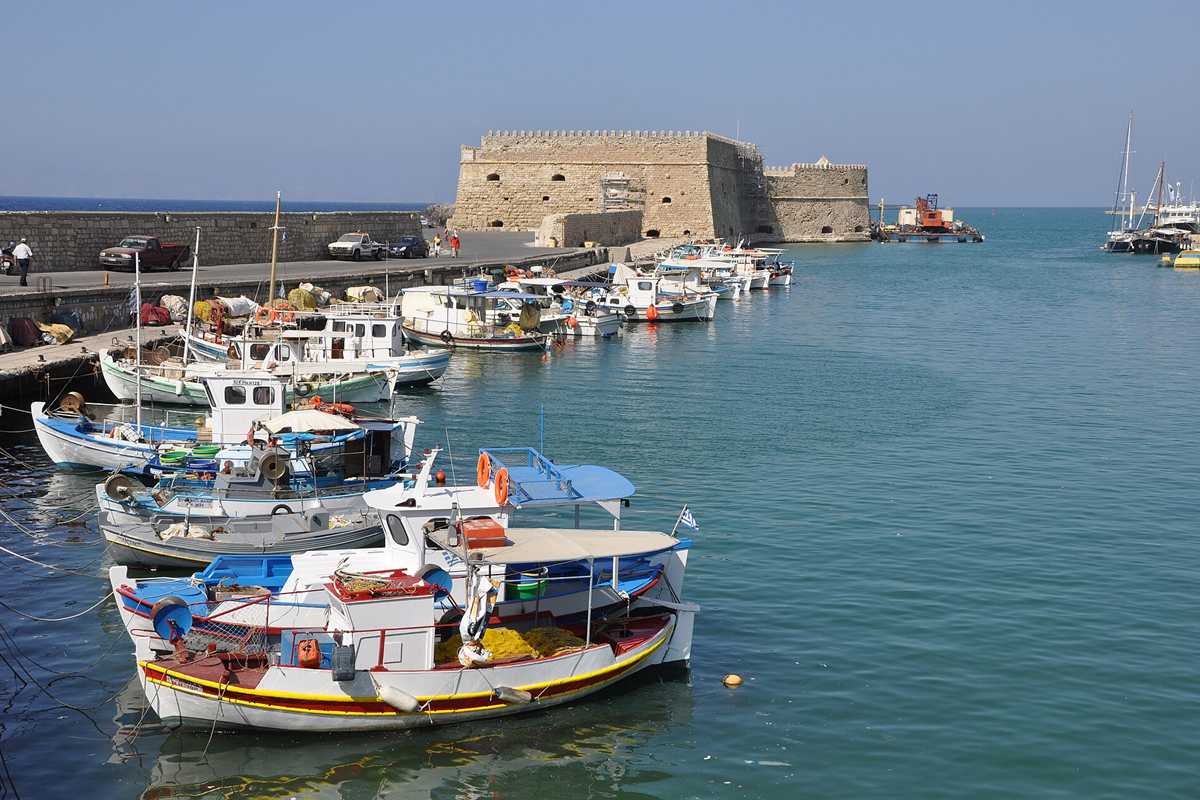
Featured photo: Marc Ryckaert ( MJJR ), CC BY-SA 3.0, via Wikimedia Commons (File:Iraklion haven R02.jpg).