
Greek music has deep roots on the mainland and across the islands. Expert-led trips through the country take place in both settings. This page looks at the two branches of the music, Mikis Theodorakis and the Byzantine lyra. It then covers entekhno and four short answers on Vangelis, Iannis Xenakis, the aulos and Nikos Skalkottas. Related pages cover Traditional Greek dances, Greek traditions and Greece cultural tours. Trips in other regions appear under Greece tours.
Bookings made through the GetYourGuide widgets on this page earn Classical Greece Tours a commission, at no extra cost to the traveller.
What is Greek music?
Greek music separates into two great branches, traditional music and Byzantine music. The Byzantine Empire was the Eastern Roman state, with its capital at Constantinople. Traditional music here means folk music handed down among ordinary people. Byzantine music grew from the sacred chant of that empire.
In ancient Greece, music held a major place in the theatre. Theatre here means drama performed for an audience. Greek music also formed a key part of education in ancient times. Boys began their music lessons at the age of six. Education is the teaching of knowledge and skills to the young.
Ancient theory of Greek music set out musical modes. Theory here means the study of how music is built. A mode is a fixed pattern of notes that gives a melody its character. Those modes later formed the basis of Eastern and Western church music. They also shaped the roots of classical music.
By the early 20th century, live music cafés were popular in Constantinople and Smyrna. In these cafés, small groups of musicians from Greece performed. Their improvised songs cried out amán amán. This cry gave such places the name café-aman. To improvise is to make up music while playing it.
- Akritic songs: Akritic music comes from the akrites, 9th-century border guards of the Byzantine Empire.
- Klephtic songs: Klephtic songs, linked to klepht warriors, use one melody line and no harmony.
- Ancient strings: Ancient players used the lyre, above all a special kind called the kithara.
Within Greek music, Manolis Kalomiris founded the national school. A school here means a group of composers who share one style and aim. Kalomiris, a Greek composer, lived from 1883 to 1962. Composers are people who create new pieces of music.
Why does Mikis Theodorakis stand out in Greek music?
Greek music gained over 1,000 works from Mikis Theodorakis, a Greek composer and lyricist. A lyricist writes the words that go with a tune. Theodorakis lived from 1925 to 2021. Works here means finished pieces, from short songs to long scores.
Chios, an island of Greece, was the birthplace of Theodorakis. As a child, he grew up surrounded by the folk side of Greek music. Byzantine liturgy also left its mark on his early years. Liturgy means the fixed order of public worship in a church. Byzantine here refers to the old chant tradition of the Greek Church.
From 1943 to 1950, he trained at the Athens Conservatoire, under the teacher Filoktitis Economidis. A conservatoire is a college that trains musicians. In Paris, he later studied musical analysis under Olivier Messiaen. Musical analysis is the close study of how a piece of music is built.
Theodorakis developed what he called metasymphonic music. It mixed symphonic elements with popular songs, a Western orchestra and Greek popular instruments. Symphonic means written for a full orchestra. An orchestra is a large group of musicians playing together. In this way, the idea carried Greek music beyond the usual classical concert form.
- First concert: At the age of seventeen, he gave his first concert in Tripoli, in the Peloponnese.
- Moscow award: In 1957 he won the Gold Medal at the Moscow Music Festival.
- Orchestra: He founded the Athens Little Symphony Orchestra to bring symphonic music to the public.
Theodorakis became the first composer to bring the bouzouki into entekhno, a style of Greek music. Entekhno means art song. The bouzouki is a long-necked string instrument plucked with a pick. He aimed to place this instrument in mainstream culture.
How does the Byzantine lyra fit into Greek music?
Greek music traces a bowed string sound back to the Byzantine lyra. This medieval instrument came from the Byzantine Empire. A bowed instrument is played by drawing a bow of horsehair across its strings. Medieval means from the Middle Ages.
In its popular form, this Greek music instrument had three to five strings and was held upright. Scholars trace its origin to the pandura, a long-necked, pear-shaped instrument. The pandura was a lute-like instrument whose strings were plucked, not bowed. Adding a bow changed the size and build of the new instrument.
For Greek music, the oldest known picture of the lyra appears on a Byzantine ivory casket. The casket dates from about 900 to 1100. A casket is a small decorated box for precious things. Ivory is carved tusk material, hard and creamy white. The picture gives the earliest visual record of this instrument.
Experts widely regard the lyra as an ancestor of modern European bowed instruments. An ancestor is an earlier form from which later ones developed. In the 11th and 12th centuries, European writers used fiddle and lira as words for the same thing. A fiddle is an everyday name for a violin-type instrument.
- Museum: The ivory casket is kept in the Museo Nazionale del Bargello in Italy.
- Novgorod finds: Lyras found at Novgorod, dated to 1190 AD, were pear-shaped and 40 cm long.
- Drone string: On those lyras, the middle string sounded a steady drone under the melody.
Within Greek music, lyras still come from Karpathos, Macedonia, Thrace and Mount Olympus. Each is carved from a single block of wood. Makers shape that block into a pear-shaped body. This build links them to the old lyras found at Novgorod.
Which place does entekhno hold in Greek music?
Greek music took a new orchestral form in entekhno, which blends in Greek folk rhythm and melody. Orchestral means written for an orchestra, a large group of mixed instruments. The Greek word entekhno translates as art song, a song of artistic aim.
Entekhno arose in the late 1950s as a strand of Greek music. It drew on the Westernisation of rebetiko by Vassilis Tsitsanis and Manolis Chiotis. Rebetiko is the urban folk music of Greek cities, linked to the bouzouki. Westernisation means taking on styles from Western Europe. Its lyrics frequently came from poems by well-known Greek poets.
Entekhno concerts frequently took place in the open air. They were not held only inside a hall or a nightclub. That set them apart from other urban folk forms of Greek music. Open air means outdoors, under the sky. A nightclub stays open late for music, dancing and drinks.
In the mid-1960s, a New Wave mixed entekhno with chansons from France. A chanson is a French song with clear, poetic lyrics. Dionysis Savvopoulos, one of its first voices, blended Macedonian folk music with Bob Dylan and Frank Zappa. Macedonian folk music is the traditional music of the Macedonia region of northern Greece.
- Lyricists: Leading entekhno lyricists include Nikos Gatsos, Manos Eleftheriou and the poet Tasos Livaditis.
- Early work: Six folk paintings, a work by Manos Hatzidakis, dates from 1951.
- Southern Cross: Thanos Mikroutsikos wrote Stavros tou Notou in 1979, setting poetry by Nikos Kavvadias.
By the 1960s, film makers used entekhno in their soundtracks. A soundtrack is the music recorded to go with a film. Innovative albums had by then brought this Greek music close to the mainstream. Mainstream means the taste of the wide public.
What do travellers ask about Greek music, and what are the answers?
Greek music raises questions about four names. They are the composers Vangelis, Iannis Xenakis and Nikos Skalkottas, plus the ancient aulos. The aulos was a wind instrument of ancient Greece. A wind instrument makes its sound from air that a player blows into it.
What shaped Vangelis as a composer of Greek music?
Music first caught the interest of Vangelis when he was four. Reading and writing music were skills he never learned; he played from memory instead. To read music is to follow notes written on paper. With Irene Papas, he made two albums of traditional and sacred Greek songs.
Why is Iannis Xenakis known in Greek music?
Xenakis was a pioneer in applying mathematical models to music. A model here is a set of rules drawn from mathematics. His orchestral work Metastaseis, from 1953 to 1954, gave every musician an independent part. In Terretektorh, from 1966, he placed the musicians among the audience.
What was the aulos in ancient Greek music?
An aulete was the musician who played the aulos. The aulos accompanied sports such as wrestling, the broad jump and the discus throw. Players wore a strap device called the phorbeia, or capistrum. One strap went over the head and one around the back to support the cheeks.
Who was Nikos Skalkottas in Greek music?
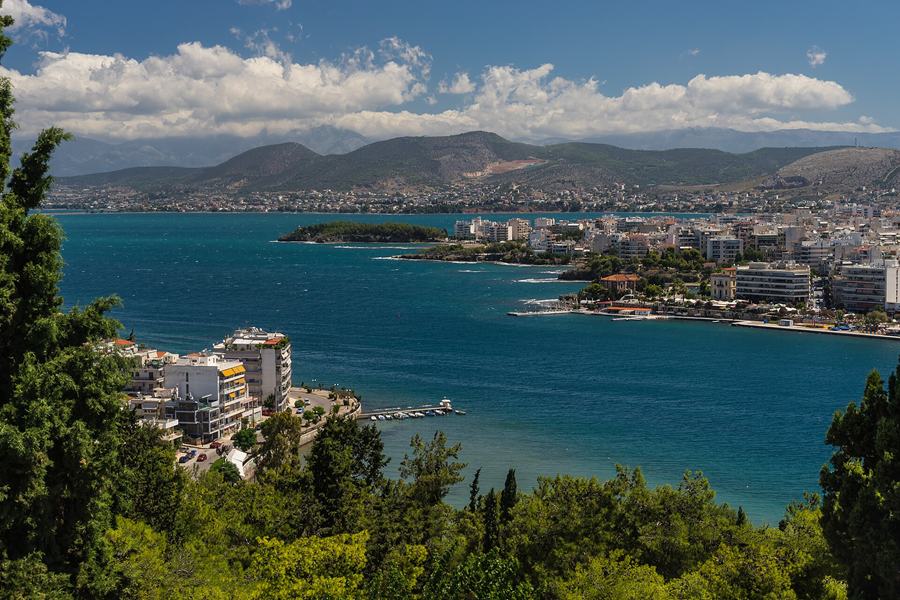
Chalcis, a town on the island of Euboea, was the birthplace of Nikos Skalkottas. From 1927 to 1932, he belonged to the composition masterclass of Arnold Schoenberg. A masterclass is a class taught by a leading expert. In Athens, he wrote Greek folk songs down as Western scores for the music scholar Melpo Merlier.
Featured photo: Maksym Kozlenko, CC BY-SA 4.0, via Wikimedia Commons.