
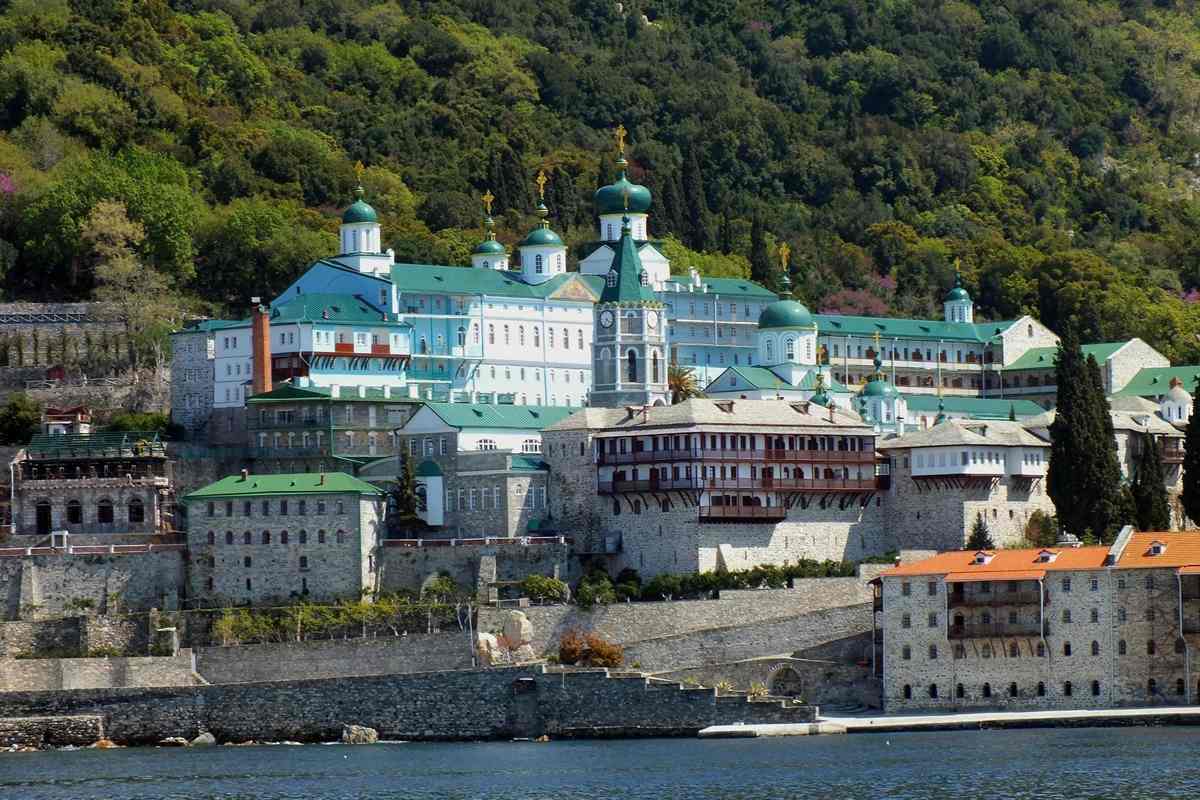
Byzantine Greece is the setting for small-group trips with a host through the mainland and the Aegean islands. Topics here include Irene of Athens, the siege of Patras and the sacks of Thessalonica. Others are Leo Sgouros, Nea Moni and its mosaics, and the Despotate of Epirus. Related reading covers Byzantine churches in Greece, Greece religious tours and Museums in Greece. For the wider picture, see these Greece tours.
Bookings made through the GetYourGuide widgets on this page earn Classical Greece Tours a commission, at no extra cost to the traveller.
What was Byzantine Greece?
Byzantine Greece means the Greek peninsula and islands under rule from Constantinople. That city held the court of the eastern Roman state. Its history mainly follows the history of the empire itself. Greek cities shared in its wealth, its wars and its losses.
Late antiquity means the last centuries of the ancient world. Hierocles, an author of that age, wrote a text called the Synecdemus. Together with other texts of the period, it presents Byzantine Greece as a highly urban land. The count of cities in these records stands at about 80.
Written records say Slavs invaded and settled in parts of Byzantine Greece from 579. The same records show the empire close to losing the whole peninsula during the 580s. Thessalonica rose in rank after the Arabs took Alexandria and Antioch. It became the second largest city of the empire, and its nickname was the co-regent, meaning joint ruler.
A dynasty is a family of rulers. The Macedonian dynasty held the throne from 867 to 1056. Leading aristocrats of that era came from the Greek provinces. Towns and cities flourished across Byzantine Greece at the same time. Thessalonica is thought to have reached 100,000 people. Other cities are believed to have passed 10,000 residents.
- Language: Greek became the official language of the whole empire during the reign of Emperor Heraclius.
- Thebes: this major city, estimated at 30,000 people, was the centre of a large silk industry.
- Fourth Crusade: the Crusaders divided Greece among themselves after they conquered Constantinople in 1204.
A despotate is a land under a prince titled despot. The Despotate of the Morea, on the Peloponnese peninsula, was the last Byzantine territory in Greece. It passed to the Ottomans in 1460, and that event ended Byzantine Greece.
How did the Theme of Hellas organise Byzantine Greece?
Byzantine Greece included the Theme of Hellas, a province in the south of the country. The word theme means a Byzantine district under military and civil rule. Hellas was an ancient term for this part of the Greek mainland.
Historians date the creation of this province to between 687 and 695. Those years fall in the first reign of Emperor Justinian II, who held the throne twice. His campaign against the Slavs in 688 or 689 is seen as the direct cause. Slavs were newcomers who had settled across Byzantine Greece from the late 6th century.
The early province looked mainly towards the sea. It held the coastal areas that the imperial navy was able to control, with little land behind them. Justinian II also settled thousands of Mardaites in Byzantine Greece. These newcomers supplied garrisons, meaning troops posted to guard towns, and crews for the local naval squadrons.
A capital, in this sense, meant the seat of the provincial governor. Records leave open whether Athens or Thebes first held that role in this part of Byzantine Greece. Thebes certainly served as capital in the early 10th century. The seat then moved to Larissa during the second half of that century.
- Artisans: Emperor Constantine V summoned 500 craftsmen from Hellas and the islands to Constantinople in 766.
- Silk: Normans under Roger II of Sicily plundered Thebes in 1148 and took its silk workers to Palermo.
- Jewish communities: the traveller Benjamin of Tudela recorded them at Thebes, Krisa, Euripus, Ravenica and Zetouni.
Crusaders were western Christian soldiers fighting a holy war. An army of them under Boniface of Montferrat took the Theme of Hellas in 1205. That loss ended rule from Constantinople over this province. The southern part of Byzantine Greece then passed to new lords.
What does the siege of Patras reveal about Byzantine Greece?
Byzantine Greece faced a test at Patras in 805 or 807. Slavic tribes of the Peloponnese laid siege to this city on the north-western coast. Reports add an Arab fleet as their helper. To besiege a town means to ring it with troops.
A medieval text called the Chronicle of Monemvasia claims that Patras was once abandoned. It says the people fled to Rhegion in Calabria, in southern Italy. Scholars treat the Chronicle as a source of disputed accuracy. Digs tell a different story of Byzantine Greece. Finds show the city under Byzantine control throughout that period.
During this crisis in Byzantine Greece, the hungry people of Patras sent a rider towards Corinth. That city was home to the strategos, the regional military governor. On his return, a dipped flag was to mean that help was on its way. An upright flag was to mean the opposite.
The rider learned that the governor was delayed. On the way back, he fell from his slipping horse, and the flag went down with him. The people took the fall to mean that relief was close, and they charged out at the Slavs. Tradition in Byzantine Greece placed Saint Andrew, the city’s patron, at their head on horseback.
- Penalty: the Slavs afterwards paid the costs of officials and envoys passing through Patras.
- Sea route: holding the city secured the main sea link between the empire and Italy.
- Church rank: the see of Patras, once under Corinth, became a metropolis, a leading church district.
The Slavic failure strengthened imperial rule across the whole peninsula. Sources count two centuries of Slavic occupation in its western half before this event. Byzantine Greece held the Peloponnese more securely from then on. The word Slavic refers to peoples who settled the Balkans in earlier centuries.
Why does Irene of Athens matter to Byzantine Greece?
Byzantine Greece produced an empress who ruled the whole empire alone. Her name was Irene, and she held the throne as sole ruler from 797 to 802. Empress regnant is the title for a woman who reigns in her own right. Her reign was without precedent.
Irene was born in Athens between 750 and 756. Later writers know her as Irene of Athens because of that birthplace. Her surname was Sarantapechaena, a form of her family name. The Sarantapechos family were noble Greeks. Their political influence was strong in the central mainland of Byzantine Greece.
Emperor Leo IV died in 780, and Irene became regent for their young son, Constantine VI. A regent is a person who governs for a ruler too young to reign. She kept this role until 790. In 787 she called the Second Council of Nicaea, which condemned iconoclasm, the rejection of holy images.
Her official Staurakios held the post of logothete, a senior minister of state. In 783 he campaigned with success against the Sclaveni in Thessaly, in the Peloponnese and elsewhere in Greece. Sclaveni is a Byzantine name for Slavic groups in these lands. He returned from Byzantine Greece with booty, meaning goods taken in war, and with captives.
- Coins: her earliest coins showed her holding the orb, and her name alone stood on the front.
- Charlemagne: Pope Leo III named him emperor at Christmas in 800, claiming that the throne stood vacant.
- Exile: a revolt in 802 sent her to the island of Lesbos, where she died within a year.
Sources do not explain why she was chosen as a bride. Historians point to the influence of her family in the Theme of Hellas. The match with Leo IV, the emperor’s son, suggests a wish to restore order in Byzantine Greece.
Which disaster struck Byzantine Greece at Thessalonica in 904?
Byzantine Greece saw its leading city fall for a time in 904. A fleet led by Leo of Tripoli captured Thessalonica and sacked it. To sack a city means to plunder it after capture. Arab powers, the Abbasids and Tulunids, stood behind the raid.
Thessalonica ranked as the greatest city of the empire after Constantinople itself. Leo of Tripoli was a recent convert to Islam, and his fleet held 54 ships. It sailed from Syria with the imperial capital as its first target. The fleet turned aside and made for this northern city of Byzantine Greece instead.
John Kaminiates, the Greek chronicler of the event, recorded an old tradition about the defences. The wall facing the sea was low and poorly suited to any attack. An imperial messenger named Petronas proposed an underwater fence to hold ships away from the walls. Petronas held the rank of protospatharios, a senior court title.
A French abbot named Belley wrote about the city in 1777. He reported that inscriptions had been thrown into the sea to stop the Saracen fleet landing. Saracen is an old word for Arab or Muslim fighters. An inscription is writing carved on stone. His note supports the account Kaminiates gave of this crisis in Byzantine Greece.
- Fall of the city: the attackers stormed the seaward walls on 29 July, after less than four days.
- Captives: the raiders took 22,000 people, mostly young, and freed 4,000 Muslim prisoners of their own side.
- Ransom: the empire bought back the majority of captives, including Kaminiates, through exchanges of prisoners.
Only two major primary sources survive for this event, the writings of Kaminiates and of the historian al-Tabari. A primary source is a record from the time itself. Scholars question parts of these accounts, yet the majority accept that Byzantine Greece did suffer this sack.
How did the Battle of Spercheios change Byzantine Greece?
Byzantine Greece saw a decisive clash in 997 on the Spercheios, a river near Lamia in central Greece. A Byzantine army faced the Bulgarian forces of Tsar Samuil there. Tsar is a Slavic title meaning emperor. His raids had reached deep into the south.
In 996 Tsar Samuil beat the army of the strategos at Thessalonica. A strategos was a Byzantine military governor. The Bulgarian ruler then marched south through Byzantine Greece and threatened Larissa and Corinth. The Bulgarian Empire lay to the north of these Greek lands. Its rulers had fought Constantinople for generations.
Emperor Basil II gave his general Nikephoros Ouranos command of all Balkan and Greek territories. Ouranos followed the Bulgarians through Byzantine Greece to the river. Heavy rain had swollen the water and flooded both banks. The two armies camped on opposite shores for days, and Samuil took no steps to guard his camp.
A ford is a shallow place where people can cross a river. Ouranos searched for one, found it and took his army over during the night. His men attacked at dawn, and the Bulgarians failed to organise an effective defence. Samuil was wounded, and he and his son escaped capture by lying among the dead as if slain.
- Prisoners: sources report that around 12,000 of Samuil’s men were taken captive after the battle.
- Result: the win ended Bulgarian raids in the southern Balkans and in Greece.
- Source: the Greek historian John Skylitzes gave the main account, in his Synopsis of Histories.
Emperor Basil II later completed his long war against the Bulgarian Empire. A triumph was a public celebration of a military victory. He held his own triumph in Athens, a leading city of Byzantine Greece, before returning to Constantinople.
What do the Nea Moni mosaics add to the story of Byzantine Greece?
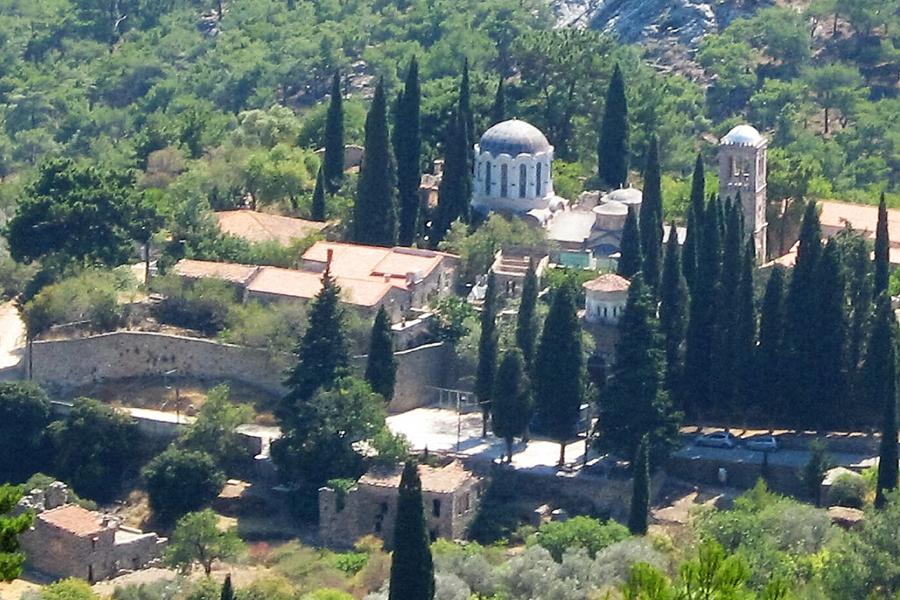
Byzantine Greece is known for the mosaics at Nea Moni on the island of Chios. Daphni and Hosios Loukas hold works of the same rank. All three sets are counted as top Greek works of Macedonian Renaissance art. Mosaics are images built from tiny cut pieces.
Constantine IX Monomachos, the emperor, built the monastery with Empress Zoe, his wife, in the mid-11th century. Macedonian Renaissance is the name for the rise of classical Greek learning in Christian art. The name comes from the Macedonian dynasty of emperors. The mosaics of Chios belong to that flowering of Byzantine Greece.
A chrysobull was a formal imperial decree. One issued in July 1049 gave the monastery the head tax of all Jews on Chios. A head tax is a charge on each person. Its estates covered one third of the island by about 1300. Its community in Byzantine Greece is estimated at up to 800 monks.
The late 16th-century traveller Samuel Purchas recorded a special right. In all Greece, only these monks were allowed to use bells. The decline of the house began after Ottoman forces destroyed Chios in April 1822. A crowd of 2,000 people sought safety within the walls of this foundation of Byzantine Greece.
- Main church: the katholikon, the chief church of a Greek monastery, was inaugurated here in 1049.
- Earthquake: a tremor in 1881 damaged the main church further and brought down its dome.
- Convent: a shortage of monks led to the change to a house of nuns in 1952.
UNESCO, a United Nations body, deals with culture and learning. In 1990 it placed this monument of Byzantine Greece on its World Heritage List. This list names sites of special value to all people. The complex is renowned above all for its mosaics.
Why did the Norman sack of 1185 shake Byzantine Greece?
Byzantine Greece suffered a heavy blow in 1185, when Thessalonica fell to the Normans. Sources class it among the worst disasters of the empire in the 12th century. These Normans came from the Kingdom of Sicily, a rival power in the central Mediterranean.
King William II of Sicily sent the force against Byzantine Greece. His stated goal was to replace Andronikos with a pretender, a man posing as the deposed Alexios II. Andronikos Komnenos was then emperor in Constantinople. William saw this as a reply to imperial meddling in his own dynasty in Sicily.
David Komnenos governed the city at the time. He failed to prepare, and he barred defenders from disturbing the siege works of the Normans. Siege works are trenches, towers and tunnels built to attack a wall. The attackers dug under the eastern wall and entered this great city of Byzantine Greece through the gap.
Relief armies came from the empire, but they failed to coordinate. Only two forces reached the city, one under Theodore Choumnos and one under John Maurozomes. The archbishop, Eustathius, stayed during and after the siege. He wrote a long account of these events. An archbishop is a bishop of high rank.
- Losses: estimates suggest that 7,000 to 8,000 bodies were found after the city fell.
- Withdrawal: the Normans left in mid-November, after their defeat at the Battle of Demetritzes.
- Emperor: the disaster led directly to the fall and execution of Andronikos, and Isaac II Angelos took the throne.
Western Christianity follows the Pope in Rome, and Eastern Christianity follows the Orthodox patriarchs. A massacre of Latins, meaning western Christians, in Constantinople in 1182 had already strained relations between them. The events in Byzantine Greece in 1185 then deepened that rift.
Who was Leo Sgouros, the breakaway lord of Byzantine Greece?
Byzantine Greece broke into local domains around the time of the Fourth Crusade. Leo Sgouros was one of the new lords. He ruled independently in the northeastern Peloponnese in the early 13th century. His house, the Sgouros family, were magnates, meaning great landowners.
Sgouros succeeded his father Theodore around 1198 as governor of Nauplia and the Argolid. These were districts of Byzantine Greece that gathered taxes and supplied ships to the navy. A rebellion in Thessaly and Macedonia then cut the south off from Constantinople. He seized his chance and took the citadels of Argos and Corinth.
His next goal in Byzantine Greece was Athens. He first launched sea raids with help from pirates of Salamis and Aigina. In 1203 his men took the city itself. Led by their bishop, Michael Choniates, the people held out on the Acropolis under heavy bombardment. The Acropolis is the old rock citadel at the heart of Athens.
Sgouros left a blockade at Athens and moved on through Thebes to Thessaly. Near Larissa he met Alexios III Angelos, an emperor who had fled the Crusaders. He offered protection, and in return he married Eudokia, the emperor’s daughter, and gained the title of despotes. This word is the Greek form of despot, a top rank at court.
- Isthmus: the Crusader advance forced him back to the Peloponnese and a defence line at Corinth.
- Acrocorinth: he endured a blockade in this fortified citadel during a siege of five years.
- Legend: tradition says he leapt from the tall cliffs on horseback in 1208.
Resistance went on under a certain Theodore until the citadel fell in 1210. Its fall removed one of the last large centres opposing the Frankish Principality of Achaea. Frankish here means the western European knights who won this part of Byzantine Greece.
Where does the Despotate of Epirus fit in Byzantine Greece?
Byzantine Greece kept a western foothold in Epirus after Crusaders took Constantinople in 1204. The Despotate of Epirus was a rump state, meaning the surviving remainder of a larger one. Its rulers claimed to be the lawful heirs of the Byzantine Empire.
Michael Komnenos Doukas, a cousin of two emperors, founded the state in 1205. Refugees from Constantinople, Thessaly and the Peloponnese soon made their home in this corner of Byzantine Greece. One writer called him a second Noah, rescuing people from a Latin flood. Noah is the Bible figure who survived a great flood. Latin here means the western Crusaders.
A despot held the highest rank at the Byzantine court, awarded by an emperor to close relatives. Michael himself never used the title, although later western European sources gave it to him. His son, Michael II, became the first ruler here to receive it, in the 1230s. The name of the state rests on later usage.
Theodore Komnenos Doukas, the next ruler, captured Thessalonica in 1224 and crowned himself emperor. Ivan Asen II, the Bulgarian emperor, defeated him at the Battle of Klokotnitsa in 1230. Ivan captured Theodore and later blinded him. The state then shrank back to its core in Epirus and Thessaly, a smaller part of Byzantine Greece.
- Capital: Arta was the seat of Michael II, who recovered it by 1260 after a Nicaean capture.
- Hellenes: the 13th-century court used this old Greek name in place of the earlier word Romans.
- Conquest: the restored Byzantine Empire took the state around 1337, ending its self-rule.
Carlo Tocco, Count of Cephalonia and Zakynthos, reunited the core lands in the 1410s. His heirs lost them step by step to the advancing Ottomans. Vonitsa, the last stronghold in this part of Byzantine Greece, fell in 1479.
What did the Battle of Pelagonia decide for Byzantine Greece?
Byzantine Greece reached a turning point in 1259 at the Battle of Pelagonia. The Empire of Nicaea, a Greek state in Asia Minor, fought an alliance there. Its opponents were the Despotate of Epirus, the Kingdom of Sicily and the Principality of Achaea.
The exact time and place of this fight in Byzantine Greece remain disputed. Modern scholars favour July or September, and the plain of Pelagonia or the area near Kastoria. Two researchers, Rochontzis and Mihajlovski, suggest the plain between Florina and Kaimakchalan. That ground lies near the modern settlement of Vevi, north of Kastoria.
A medieval text, the Chronicle of the Morea, gives huge totals for the armies. Modern historians regard these figures as much exaggerated. John Palaiologos, brother of the Nicaean ruler, commanded on the other side. He wore the allies down by attrition, meaning slow loss of men and supplies. Heavy troops held the hills while light troops raided.
The Epirotes were the Greek troops of Epirus, and Latins meant the western knights in Byzantine Greece. Rivalries divided the two, and the Epirote army slipped away the night before the fight. John Doukas, a son of Michael II of Epirus, went over to the Nicaeans. The Latins tried to withdraw the next morning, but the Nicaeans were upon them.
- Prince William: he was found hiding near Kastoria, and about thirty senior barons were also captured.
- Ransom: he went free in 1262 after giving up three fortresses on the south-eastern Morea.
- New foothold: a century later, these fortresses had expanded to form the Despotate of the Morea.
The battle cleared the last obstacle to Nicaea’s return to Constantinople in 1261. That event re-established the Byzantine Empire under the Palaiologos dynasty. Nicaean forces also held Epirus and Thessaly briefly. Michael II then reversed these gains in Byzantine Greece.
Who were the Zealots who ran a city of Byzantine Greece?
Byzantine Greece saw a political party called the Zealots dominate Thessalonica from 1342 until 1350. A zealot is an intensely devoted supporter of a cause. This group ran the second city of the empire during a long civil war.
Thessalonica ranked second only to Constantinople among the cities of the empire. Its wealth was great, and its population nearly matched that of the capital. Its people resented rule from so far away, and they had already ousted one despot in 1322. A despot was a high-ranking prince sent to govern a province of Byzantine Greece.
Real power lay with the Zealot leader, a man named Michael Palaiologos. He shared the title of archon with the governors, and an archon was a leading city magistrate. The movement drew its strength from the port workers, although its leaders belonged to the aristocracy. Aristocracy means the ruling noble class of Byzantine Greece.
The Zealots seized the property of the aristocracy and shared out its wealth. Scholars once saw a social reform programme in this, but the evidence is scant. They still recognised John V Palaiologos as the legitimate emperor. They possibly sought semi-autonomous status for the city, meaning partial self-rule.
- Sources: surviving accounts oppose the Zealots and give little detail on their government.
- Archbishop: the party rejected Gregory Palamas in that post, ignoring orders from Constantinople.
- Andreas Palaiologos: this leader fled to Mount Athos and became a monk at the Great Lavra.
The people of Thessalonica turned against the party at the end of 1349 and defeated it. They also plundered the property of its members. Talks followed, and this chapter of Byzantine Greece ended with Emperor John Kantakouzenos entering the city in triumph.
How did Gregory Palamas shape faith in Byzantine Greece?
Byzantine Greece was the setting for the career of Gregory Palamas, a theologian born around 1296. He spent years among the monks of Mount Athos and rose to be archbishop of Thessalonica. A theologian is a scholar of religious teaching. He died on 14 November 1359.
Palamas was barely 21 years old when he left for Mount Athos in 1316. Mount Athos, a centre of monks, lay within Byzantine Greece. He began as a novice, meaning a monk in training, at the Vatopedi monastery. Later, at a small monks’ settlement called Glossia, he taught hesychasm, an old practice of inner prayer.
The threat of Turkish invasions drove him and his fellow monks to Thessaloniki in 1326. The city, a great port of Byzantine Greece, had strong defences, and he was ordained a priest there. He later served as abbot, or head, of the Esphigmenou Monastery. Discontent over his strict rule forced him to resign in 1335.
A synod is a meeting of senior clergy called to settle questions of faith. Palamas wrote a number of works in defence of hesychasm. He then argued its case at six different synods in Constantinople. The synod of 1351 ended the dispute in his favour, and his followers became known as Palamites.
- Captivity: Turkish pirates seized his ship in 1354, and he spent a year at the Ottoman court.
- Sainthood: the Eastern Orthodox Church has honoured him as a saint since 1368.
- Feast day: Great Lent, the Orthodox fasting season, gives its second Sunday to his memory.
A ransom, a payment for the release of a captive, eventually set him free. He returned to Thessaloniki and held the post of archbishop for his last three years. An archbishop is a leading bishop. His church served a major city of Byzantine Greece.
What happened to Byzantine Greece under Thomas Palaiologos?
Byzantine Greece reached its last years under Thomas Palaiologos, born in 1409. He held the title Despot of the Morea from 1428 until that territory fell in 1460. The Morea is the medieval name of the Peloponnese, the southern Greek peninsula.
Emperor John VIII appointed his brother Thomas to the post in 1428, when Thomas was 19. Two other brothers, Theodore and Constantine, already governed parts of the peninsula. Constantine later became the last Byzantine emperor. A despot was a prince who held a province of Byzantine Greece for the reigning family.
The Principality of Achaea was a Crusader state set up during the Fourth Crusade. Thomas ended it by marrying Catherine Zaccaria, heiress to its last prince, who died in 1432. Together with Constantine, he brought nearly all of the peninsula back under imperial rule. Byzantine Greece had not held so much of it since 1204.
Ottoman forces captured Constantinople in 1453, ending the empire. Sultan Mehmed II allowed Thomas and his brother Demetrios to go on ruling as vassals. A vassal is a ruler who owes loyalty to a stronger power. Constant quarrels followed between the brothers, and Demetrios favoured the Ottomans. Mehmed then invaded and conquered the Morea in 1460.
- Kalavryta: Thomas received lands in the north and based himself in this castle.
- Exile: his family escaped first to Venetian-held Methoni and then to the island of Corfu.
- Rome: Thomas sought support for a crusade there, and Pope Pius II received him.
Thomas went on claiming the title of despot after the fall. His hope of winning back the Morea never came true. His death came in Rome in the fifth month of 1465. His son Andreas inherited the claim, but no land in Byzantine Greece came with it.
What do travellers ask about Byzantine Greece, and what are the answers?
Byzantine Greece raises frequent questions from travellers. Two of them concern an empress born in Athens and a defensive wall at Corinth. The others concern the last siege of Thessalonica and two brothers from that city who devised an alphabet.
Which empress of Byzantine Greece began life in Athens?
Aelia Eudocia, wife of Emperor Theodosius II, was born in Athens under the name Athenaïs. Her father, Leontius, taught rhetoric, the art of persuasive speech, at the Academy of Athens. Scholars came to that school from all over the Mediterranean. She became a Christian before the wedding, which took place on 7 June 421.
What did the gates of the Hexamilion wall do in Byzantine Greece?
The Hexamilion was a wall across the Isthmus of Corinth, with gates to north and south. The northern gate served as the official way into the Peloponnese. Its guarded gateways let officials tax trade moving in both directions. Under Justinian, a professional garrison, or body of soldiers, replaced the local farmers who had manned the fortress.
How did Byzantine Greece lose Thessalonica for the last time?
Andronikos Palaiologos, ruler of the city, lacked troops and gave it to Venice in September 1423. Sultan Murad II of the Ottomans imposed a blockade, meaning a closure of all supply routes. His troops took the city by storm on 29 March 1430. Its population fell from an estimated 40,000 to about 2,000.
Which brothers from Byzantine Greece gave the Slavs an alphabet?
Cyril and Methodius were born in Thessalonica, then part of a Byzantine province with that name. Tradition credits them with creating the Glagolitic alphabet. It was the first alphabet used to write Old Church Slavonic, an early language of Slavic Christians. In 1980, Pope John Paul II named both brothers co-patron saints of Europe.