
Cycladic civilization names the Bronze Age world of the Cyclades, Greek islands in the Aegean Sea. Outings with a host run across these islands and the wider Greek world. Topics here include folded-arm figures and frying pans. Others are the Keros-Syros stage, Kastri on Syros and obsidian from Milos. Related reading sits in Best Cyclades islands, Minoan civilization and Museums in Greece. More trip ideas sit under Greece tours.
Bookings made through the GetYourGuide widgets on this page earn Classical Greece Tours a commission, at no extra cost to the traveller.
What was the Cycladic civilization?
The Cycladic civilization was a Bronze Age culture of the Cyclades islands in the Aegean Sea. It lasted roughly from 3100 BC until 1000 BC. Its dates roughly match those used for mainland Greece and Crete in the same centuries.
Scholars split the Cycladic civilization into three long stages, named Early, Middle and Late Cycladic. The Early stage opened around 3100 BC and gave way to the Middle stage around 2000 BC. Two dating schemes exist, one cultural and one chronological, and scholars disagree on how they fit. Chronological means arranged by date.
Theodore Bent and other antiquaries, or students of old objects, made the first digs in the 1880s. More systematic work then came from the British School at Athens. Christos Tsountas examined burial grounds on the islands during 1898 and 1899. He is also the scholar who coined the term Cycladic civilization.
Pottery found at Knossos on Crete shows that the Cycladic civilization influenced that city. Each small island supported only a small population, a handful of thousands at best. Boat models from the Late Cycladic stage point to crews of twenty-five oarsmen, drawn from scattered communities. An oarsman is a rower who drives a boat with oars.
- Kea, Naxos and Delos: These three kept their standing while the other islands faded beside Minoan Crete.
- Delos: Its ancient standing as a holy sanctuary lasted into the period of Classical Greece.
- Late Cycladic: By around 1000 BC, Cycladic and Minoan ways of life had largely come together.
Interest in the Cycladic civilization faded after those digs and returned in the mid-twentieth century. Part of that return came from collectors who wanted objects from Early Cycladic cemeteries. On Naxos, a town of the mainland Mycenaean culture stood around 1300 BC.
What do folded-arm figures reveal about the Cycladic civilization?
The Cycladic civilization left marble figures with arms folded across the body. Specialists label them FAF, for folded-arm figure. Experts still dispute what purpose they served. Suggested meanings include images of gods, images of death and children’s dolls.
The common names for these carvings both fall short. An idol is an object of worship, yet experts have not agreed on any religious function. The word figurine means a small figure, yet the largest examples reach nearly life size. The Cycladic civilization carved them from the pure white marble of its islands.
Excavated examples have all come from graves, in burials of men and women alike. Not every grave in the Cycladic civilization held one. Repairs on certain figures point to objects valued in life, not carved only for burial. Diggers find them chiefly on their backs, though larger pieces had a possible place in shrines or homes.
Spedos figures, named for a Naxos burial ground, have U-shaped heads and a deep cut between the legs. All known Spedos works are female, except a male statue now held by the Museum of Cycladic Art. Spedos figures also spread widest in the Cyclades and beyond, and stayed in use longest.
- Kapsala: Arms sit low, and the face carries little beyond a nose and, at times, ears.
- Dokathismata: Broad, angular shoulders and a nearly triangular head give this late type a strong geometry.
- Chalandriani: Arms sometimes reverse the old order or leave the folded pose altogether.
The Cycladic civilization also carved musicians around 2500 BC, including one with a harp and one with pipes. Paint once marked the eyes on Kapsala figures, in place of carved detail. Evidence shows the sculptures were first brightly painted, so the plain white look misleads modern eyes.
Which early carvings open the Cycladic civilization at Grotta and Pelos?
The Cycladic civilization opens with the Grotta-Pelos culture, running from about 3300 BC to about 2700 BC. Colin Renfrew named it after Grotta on Naxos and Pelos on Milos. Its figures came in a plain style, a more lifelike style and a blend of both.
The label Grotta-Pelos is a cultural dating name, and it marks the starting point of the Cycladic civilization. Other archaeologists prefer the plain term Early Cycladic I, a name based on time alone. Knowledge of Neolithic, or late Stone Age, island art comes almost wholly from Saliagos off Antiparos.
Pelos figures are schematic, meaning reduced to plain, simple shapes. The best-known group suggests a violin, with a long implied head and no legs at all. Scholars cannot settle the gender of the larger share of Pelos pieces. In the Cycladic civilization, such figures are very flat in profile and lack a clear head.
No Cycladic type is more lifelike than Plastiras, though its proportions are exaggerated. Its oval head has carved features, ears included. Sculptors cut the legs apart along their full length, a choice that led to frequent breaks. Surviving examples are marble, but scholars have proposed wooden versions as well.
- Louros shoulders: They tend to run wider than the hips on these long-necked figures.
- Louros legs: Carvers separated the legs only as far as the knees or the middle of the calf.
- Saliagos bowl: A bowl on a high foot stands out among the Neolithic pottery shapes.
The Cycladic civilization in this phase shows both men and women in the standing Plastiras pose. Male figures here have narrower hips than female ones. Lifelike figures stay small. Neolithic pottery found earlier in the islands resembles wares from Crete and mainland Greece.
What were the so-called frying pans of the Cycladic civilization?
The Cycladic civilization made flat round disks with a handle, which scholars nickname frying pans. About 200 have been unearthed, nearly all of them pottery. They date from around 2700 BC to 2200 BC, and their true purpose remains unknown.
The name comes from the shape, a raised lip and a handle on a round body. Widths run from 20 to 28 centimetres. Not one found so far shows wear from cooking. They turn up mainly in graves, though graves rarely hold one. That rarity in the Cycladic civilization makes their function harder to identify.
A 2009 experiment showed water or olive oil turning a pan into a working mirror. Christos Doumas proposed in 1993 that they served to process sea salt. Nikolaos Kontoleon read them as palettes, flat surfaces for mixing paints from crushed pigments, after finds on Syros. Pigments are coloured powders.
Scholars sort the pans into two types, named Kampos and Syros. The Syros type has a concave plain side and a two-pronged handle. Pan 4974, kept at the Athens National Archaeological Museum, came from grave 74 at Chalandriani. At least ten pans with ships are known from that Syros cemetery of the Cycladic civilization.
- Ship: Pan 4974 shows the only known ship with its high prow, or front, at left.
- Emblems: A fish symbol and two banners rise from the prow of that same ship.
- Spirals: A central spiral on one stone pan links to seven more, then fourteen smaller ones.
The Cycladic civilization rarely made these pans in stone, and one greenschist example came from Naxos. Greenschist is a green rock from that island. It left a museum in Karlsruhe, Germany, and returned to Athens on 6 June 2014.
Why does the Keros-Syros culture count as the peak of the Cycladic civilization?
The Cycladic civilization reached its high point, in the view of scholars, in the Keros-Syros culture. This stage lasted from about 2700 BC to 2300 BC. The name joins two islands, Keros and Syros. Its trade stretched from mainland Greece to Crete and Asia Minor.
Colin Renfrew proposed four Early Cycladic stages, named Grotta-Pelos, Keros-Syros, Kastri and Phylakopi I. Keros-Syros follows Grotta-Pelos as its clear successor. Researchers in Europe are split, since certain ones place Keros-Syros and Kastri in one phase. Cemeteries of this stage lie on Amorgos and Naxos, including Dokathismata, Aplomata and Spedos.
Grave goods, the objects buried with the dead, show the metal skills of the Cycladic civilization. Finds from each settlement include daggers, fishhooks, chisels and tweezers. Brooches, used to pin clothes, were made of bronze and silver. Specialised workers included founders, who cast metal, along with blacksmiths, potters and sculptors.
Figurines of the Cycladic civilization reached Crete as exports, and local artists copied them. Cycladic goods also reached Troy, where finds belong to the city’s first two phases. Asia Minor is the large peninsula of modern Turkey. The cemetery of Aghios Kosmas in Attica held objects showing strong Cycladic influence. Attica is the region around Athens.
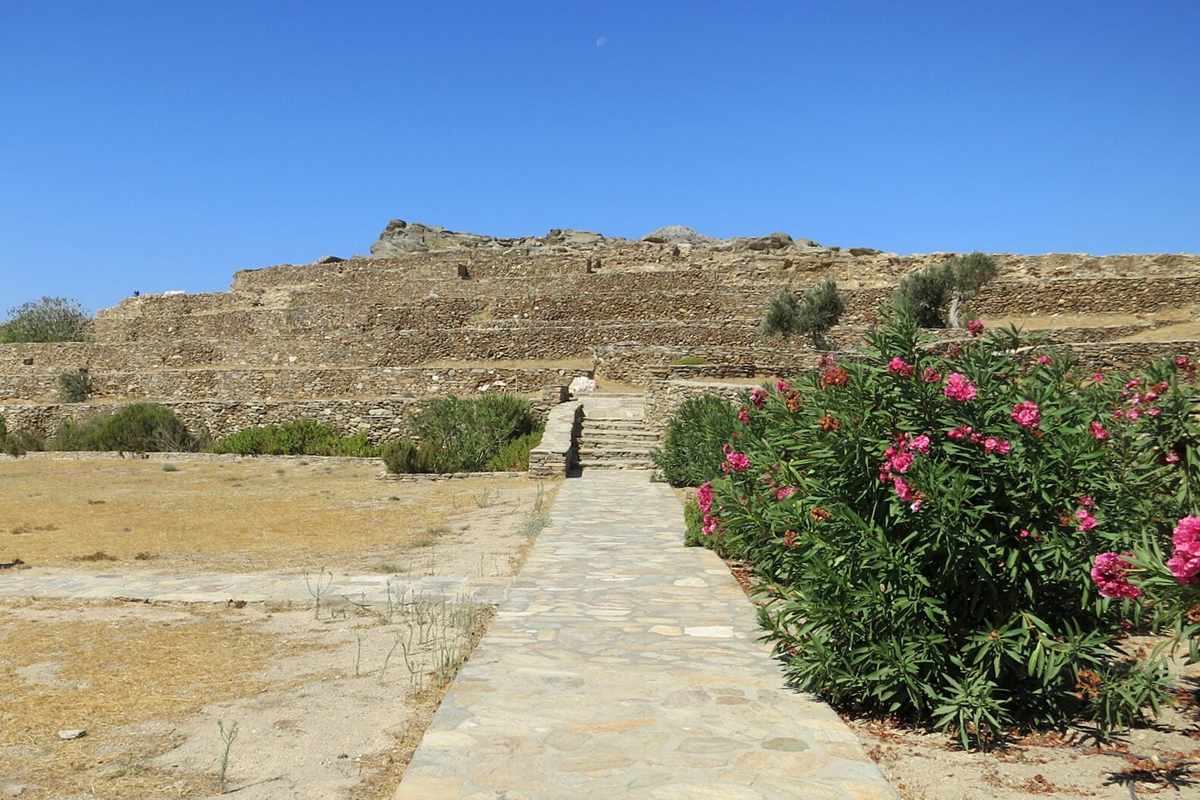
- Dhaskalio: Massive terraced walls on this Keros headland used 1,000 tons of stone.
- Syros: Chalandriani on this island ranks among the important sites of the culture.
- Crete: Evidence at Aghia Photia, Knossos and Archanes supports Cycladic influence on early Minoan Crete.
The Cycladic civilization is slightly older than the Minoan culture of Crete. Islanders of this period lived chiefly near the shore and worked as skilled sailors and merchants. Wood was more plentiful than today, so they built house frames and boats.
Which Anatolian links tie Kastri on Syros to the Cycladic civilization?
The Cycladic civilization has a stage called the Kastri culture, dated about 2500 BC to 2200 BC. Colin Renfrew named it after a fortified settlement on Syros, near Chalandriani. Finds from that settlement point east to Anatolia, the land of modern Turkey.
For the Cycladic civilization, Kastri gives evidence that the Anatolian Trade Network reached the Cyclades. This trade network crossed all of Anatolia and Thrace, then headed towards Mesopotamia. Thrace lies north of the Aegean Sea, and Mesopotamia lay around modern Iraq. A trade network is a chain of routes and partners.
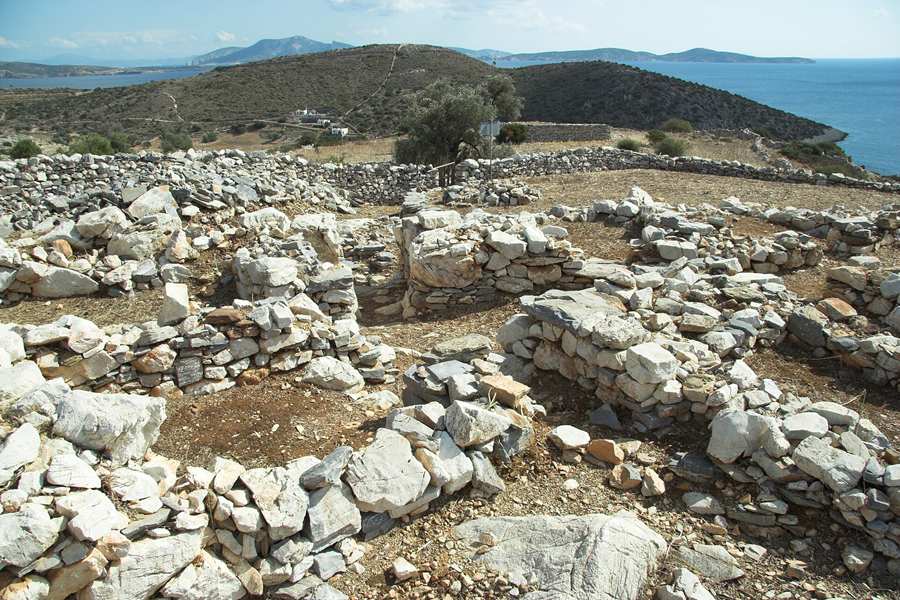
Kastri was a small town inside a wall with horseshoe-shaped bastions. A bastion is a tower that juts out from a wall. The fortifications at Liman Tepe, near Izmir on Turkey’s western coast, show quite a similar plan. Liman Tepe’s walls were much bigger and date to the same time.
Pottery from Kastri comes very close to Anatolian wares. Depas vessels, bell-shaped cups and engraved pyxides have been called entirely Anatolian in character. A depas is a tall cup with two handles. Pyxides are small lidded boxes. Tin bronzes are also close to Anatolian ones. Large numbers of metal objects link Kastri to making and trading metal goods.
- Order: In Renfrew’s scheme of the Cycladic civilization, Kastri follows Keros-Syros.
- Delos and Naxos: Mount Kynthos on Delos and the Panormos fort on Naxos are quite similar settlements.
- Skyros: Palamari on Skyros also shows links with the same Anatolian trading routes.
Later in the Cycladic civilization, people left the shore for island summits inside walls with round corner towers. Scholars suggest that piracy first appeared in the islands around this time. Chalandriani’s tombs mostly predate the first houses at Kastri.
How did Milos obsidian power trade in the Cycladic civilization?
The Cycladic civilization made its tools chiefly from obsidian, a dark volcanic glass from Milos. Obsidian kept this lead even after metalworking spread, because it cost less. Milos also stayed the main supplier for the Cyclades and passed goods on across the group.
Long before the Cycladic civilization, Melos obsidian had crossed the sea to Franchthi Cave on the mainland. Melos is another name for Milos. It appears there by 13,000 BC, the earliest sign of seafaring by modern humans in Greece. Trade in the stone spanned at least 150 kilometres.
Early metal tools of the Cycladic civilization used a basic bronze of copper and arsenic. Arsenic is a grey poisonous element found in metal ores. The copper came from Kythnos, and it already held a large share of arsenic. Tin arrived only after the civilization ended, and its origin remains unknown.
These tools shaped marble, above all from Naxos and Paros. Emery from Naxos, a hard grinding stone, polished the carved pieces. Islanders also worked local pigments, coloured powders used as paint: azurite for blue and iron ore for red. Silver mines on Siphnos also have a possible start in the Neolithic period.
- Routes: Pottery at Phylakopi, Aghia Irini and Akrotiri proves sea routes from mainland Greece to Crete.
- Kea: It served as the first stop for ships sailing out from the mainland.
- Santorini: It played the same role for Crete that Kea played for the Attica region.
Pottery ranked as a main trade good of the Cycladic civilization, shipped to and from the islands. No boats of the period survive, and evidence for sailing comes from other finds. Scholars picture two kinds of ship, a small boat and a longboat.
What do travellers ask about the Cycladic civilization, and what are the answers?
The Cycladic civilization in its middle centuries is known mainly through pottery and graves. Changes in pottery style help historians narrow the dates of that Middle Cycladic period. Walls from the same period show older Cycladic walls being extended in a number of areas.
Why do figures of the Cycladic civilization so rarely have a known find spot?
Around 90% of known figures were looted or dug up without scientific recording. Private collectors have chased them since the early 1900s, which fed a huge illegal trade. In 2009 and 2010, researchers spoke with a man known only as the forger. His inside knowledge now helps experts spot fakes more accurately.
How large was the biggest known cemetery of the Cycladic civilization?
Chalandriani on Syros holds the record among Early Cycladic cemeteries, with more than 600 known tombs. At its peak, the community using it is estimated at 75 to 150 people. Marble figures are rare there, unlike at other sites of that age. Grave goods also point to differences in social status between burials.
What was daily town life like at Skarkos in the Cycladic civilization?
Skarkos, an early settlement on Ios, was home to an estimated 200 to 300 people. Houses kept their cooking and food work on the ground floor. Differences in house size reveal social ranks in the community. Clay seals, stamped marks on pottery, show control over farm goods and their sharing out.
What did people eat and how long did they live in the Cycladic civilization?
Barley led the grain crops, since it needs less water than wheat, alongside vines and olives. Herds were chiefly goats and sheep, with a small number of pigs. Fish added to the diet, helped by the regular passage of tuna. Skeletons show men living to forty or forty-five, but women only to thirty.
Featured photo: Zde, CC BY-SA 3.0, via Wikimedia Commons.