
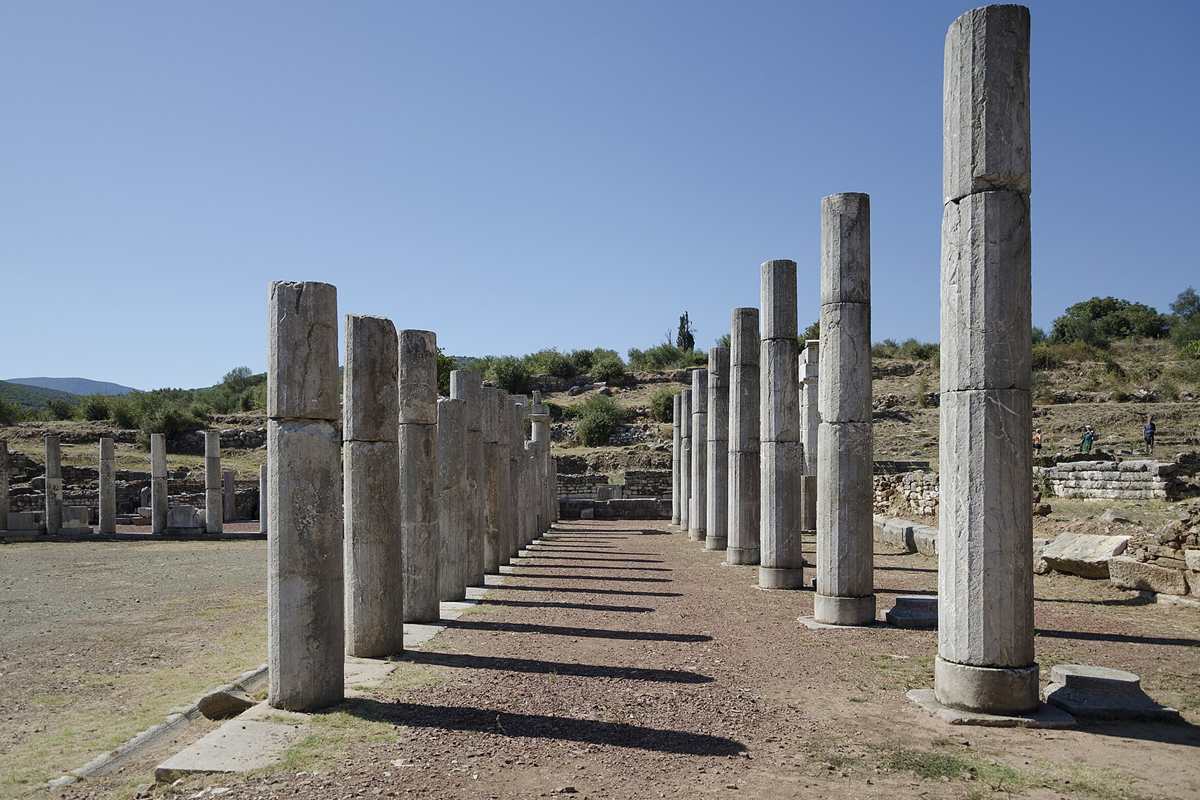
Hellenistic period history gives context to outings with a host across Greece. Events move from Macedon and Thessaly to the Peloponnese and the Aegean islands. Topics include Antigonus Gonatas, the Aetolian League, Philopoemen, the Battle of Corinth, Menander and Koine Greek. Related pages cover Alexander the Great in Greece, Ancient Greek sculpture and ancient Greek sites. More trips appear among these Greece tours.
Bookings made through the GetYourGuide widgets on this page earn Classical Greece Tours a commission, at no extra cost to the traveller.
What was the Hellenistic period?
The Hellenistic period begins in 323 BC, when Alexander the Great died and left a sprawling empire. It runs until the Roman conquest of Egypt in 30 BC. Greek leadership, culture and language shaped life in the Eastern Mediterranean and West Asia across those centuries.
The word goes back to Hellenistes, an ancient Greek term for one who uses the Greek language. The German historian Johann Gustav Droysen, working in the 19th century, gave this era its modern label. He used the word Hellenistic for the age when Greek culture spread among non-Greek peoples. Related words such as Hellenist are far older.
Greek kingdoms arose across West Asia, Northeast Africa and South Asia during the Hellenistic period. Settlers from Greece moved into these realms and carried their language as far as modern India. The new kingdoms also adopted local customs that they judged useful. The culture that resulted blended the Greek world with its African and Asian neighbours.
Mainland Greece counted for far less in the Greek-speaking world during the Hellenistic period. The main centres of culture lay at Alexandria and Antioch, capitals of Ptolemaic Egypt and the Seleucid kingdom. The polis, meaning a Greek city state, still formed the basic unit of political and social life. Athens still grew and thrived.
- Federal leagues: The Aetolians and Achaeans formed leagues, called koinon, run by councils and citizen assemblies.
- Learning: The arts, theatre, mathematics, philosophy and science all prospered and advanced across this era.
- Architecture: Builders of the era favoured grand monuments and ornate decoration, as the Pergamon Altar shows.
Scholars disagree over the exact end of the Hellenistic period. Proposed dates include 146 BC, when Rome finally conquered the Greek heartlands, and the close of Hadrian’s reign. Wide agreement now settles on 31 or 30 BC, after the Battle of Actium.
Who was Antigonus Gonatas in the Hellenistic period?
The Hellenistic period gave Macedon a lasting royal house through Antigonus II Gonatas, born around 320 BC. He steadied the Antigonid dynasty after years of disorder. His fame grew from a victory over Gauls, the northern warriors who invaded the Balkans.
Nobody knows where the nickname Gonatas came from. His father was Demetrius Poliorcetes, and his mother Phila was a daughter of the regent Antipater. A regent governs in place of a monarch. Cassander, who became king of Macedon in 305 BC, was his uncle. That family link helped reconcile old supporters of those kings to his father.
Antigonus served his father at the siege of Thebes, a stubborn fight of the Hellenistic period. Heavy losses distressed him there. He reportedly asked why these lives were being thrown away. He also held Greece for Demetrius in 288 BC, when rival kings attacked Macedonia from both sides.
Demetrius died in captivity in Syria in 283 BC, early in the Hellenistic period. Antigonus took his entire fleet out to meet the ships carrying the remains near the Cyclades. He brought these remains to Corinth in a grand ceremony. They were later buried at Demetrias, the town in Thessaly that his father had founded.
- Lysimachia: In 277 BC he abandoned his camp as bait and trapped Gauls against the sea.
- Cassandreia: After ten months of siege, 2,000 men with ladders took the walls by surprise.
- Corinth: He placed a garrison at Corinth, called the strategic centre of Greece.
Antigonus likened his rival Pyrrhus to a dice player who threw well but wasted the throws. A soldier of Antigonus killed Pyrrhus at Argos in the Hellenistic period. Antigonus wept at the news, then ruled Macedon until his death in 239 BC.
Why did the Aetolian League rise during the Hellenistic period?
The Hellenistic period saw the Aetolian League cover much of Central Greece at its 3rd-century BC peak. This ancient confederation bound together tribal communities and cities. Its meeting place was Thermon, and it ranked among the major powers of Greece.
In the classical period, other Greeks looked down on the Aetolians, calling them semi-barbaric and reckless. Their mountain tribes included the Ophioneis, Apodotoi, Agraeis, Aperantoi and Eurytanians. They called Apollo and Artemis the Laphrios gods, meaning patrons of war spoils. Two meetings a year took place, at the Panaetolika and Thermica festivals.
Around 301 BC, early in the Hellenistic period, the Aetolians seized Parnassus and the sanctuary of Delphi. They held Delphi for over a century. In 281 BC they alone beat back a Sacred War led by King Areus I of Sparta. Control of Heraclea in Trachis then gave them the pass at Thermopylae.
In the Social War of 220 to 217 BC, the league fought Macedon and the Achaean League. Philip V of Macedon invaded Aetolia and sacked Thermon in reply to Aetolian attacks on Dodona and Dion. The league also became the first Greek ally of Rome on the mainland. It helped defeat Philip at Cynoscephalae in 197 BC.
- Reach: At its height in the Hellenistic period, territory took in Malis, Doris, Phocis, Cephalonia and Ambracia.
- Outside members: Lysimachia in Thrace, Mantineia and Tegea in Arcadia and Kydonia on Crete also joined.
- Worship: Apollo Thermios had a shrine north of Lake Trichonis, a key religious centre for the league.
The end came when the league sided with Antiochus III against Rome in the Aetolian War. Defeat left it a Roman client state in 188 BC, well into the Hellenistic period. A client state follows the orders of a stronger power.
How did Philopoemen change the Peloponnese in the Hellenistic period?
The Hellenistic period in the Peloponnese produced Philopoemen, a general from Megalopolis born in 253 BC. He served as strategos, or chief commander, of the Achaean League on eight occasions. His reforms helped make the league an important military power in Greece.
His father Craugis died early, and a leading citizen named Cleander adopted him. Two local philosophers, Ecdemus and Demophanes, taught him about freedom and democracy. Philopoemen modelled himself on the Theban general Epaminondas. He wore humble clothes all his life and spurned costly ornaments. Personal virtue, he believed, was essential to public service.
Cleomenes III of Sparta seized Megalopolis in 223 BC, during the Hellenistic period. Philopoemen lost his horse and took a wound, yet fought on to the end. His stand gave citizens time to leave the city. From 221 BC he spent ten years on Crete, leading hired soldiers in the Lyttian War.
Appointed strategos in 209 BC, he enlarged the Achaean army and updated its equipment and tactics. His efforts bore fruit at the Battle of Mantinea in 207 BC. There he killed the Spartan ruler Machanidas in single combat. The Achaeans later marked that Hellenistic period duel with a bronze statue at Delphi.
- Sparta joined: After the Aetolians murdered Nabis, he entered Sparta and forced it into the league.
- Spartan law: In 188 BC he abolished Spartan law and education, and demolished the city wall.
- Crete again: In 199 BC the Cretan city of Gortyna asked for his help, and he returned.
In a revolt of the Hellenistic period, Messeneans captured him in 183 BC and offered poison. The historian Polybius carried his urn at the public funeral that followed. Pausanias wrote that Greece stopped producing good men after his death.
What did Agis IV try to reform in Sparta during the Hellenistic period?
The Hellenistic period found Sparta in crisis when Agis IV took the throne in 245 BC. Fewer than 700 citizen families remained, and fewer than 100 held estates. The poor carried heavy debts, so the young king proposed sweeping reform.
Agis belonged to the Eurypontid house, one of the two royal families of Hellenistic period Sparta. He was about 20 when he succeeded his father. Reports said wealth and luxury had eroded old Spartan simplicity. His grandmother Archidamia and mother Agesistrata were among the richest people in the city, according to Plutarch.
His programme during the Hellenistic period had four points. Debts on citizen land plots were to be cancelled, and land shared out in 4,500 new lots. The agoge, the rigorous military education of Sparta, was to return. So were the syssitia, shared citizen messes that had grown into lavish banquets.
Agis offered up his own lands and money first, and his relatives were to follow. Leonidas II, co-king from the other royal house, won a senate vote against it by one. Leonidas was then deposed on a charge of breaking the law. Debt records were piled in the market place and burned.
- Perioikoi: Another 15,000 equal lots were planned for the remaining Perioikoi, a class outside the citizen body.
- Uncle: His uncle Agesilaus backed the plan because deep debts gave him a reason to profit.
- Army: Sent to aid the Achaean League, Agis earned credit for the discipline of his troops.
In 241 BC friends betrayed Agis, and the ephors, or elected officials, tried him in prison. He became the first Spartan king put to death by them. His story caught the imagination of ancient writers on the Hellenistic period, including Phylarchus in a lost biography.
Which battle at Thermopylae belongs to the Hellenistic period?
The Hellenistic period has its own Battle of Thermopylae, fought in 279 BC against invading Gauls. Aetolians, Boeotians, Athenians, Phocians and Locrians held the pass together. Brennus, the Gallic leader, won there and pushed on towards Delphi, where his army was completely defeated.
Gallic groups moved south-east into the Balkans from the 4th century BC, settling northern Illyria and Pannonia. Early in the Hellenistic period, in 280 BC, an army of about 85,000 warriors approached from Pannonia. It split into three divisions. Bolgios led one against Macedon, where the young king Ptolemy Keraunos was captured and decapitated.
A Hellenistic period coalition of Greeks took its stand at the narrow pass in central Greece. Brennus lost heavily in the first assault. He then sent Acichorius with a large force against Aetolia, hoping to draw Aetolian fighters home. The Aetolian detachment did leave Thermopylae to defend its people.
Old people and women joined the fight in Aetolia. Fighters there used skirmishing, meaning quick hit-and-run attacks, because the Gallic sword was dangerous only at close range. Resistance at Kokkalia dealt the decisive blow. Pausanias reports that only half of those sent into Aetolia came back. Brennus found a way around, but the Athenian fleet rescued the Greeks.
- Delphi: Brennus was beaten at Delphi and died of wounds from that battle.
- Spercheios: Thessalians and Malians routed the retreating army by the river Spercheios.
- Tyle: Survivors under Comontoris settled in Thrace and founded a short-lived city-state called Tyle.
Victory in this Hellenistic period struggle strengthened the Aetolian League in mainland Greece. Its members built the Portico of the Aetolians close to the sanctuary of Apollo. Games known as the Aetolian Soteria took that name in 246 BC.
What did Cynoscephalae decide for Macedon in the Hellenistic period?
The Hellenistic period saw Rome and Macedon clash at Cynoscephalae in Thessaly in June 197 BC. A Roman and Aetolian army under Titus Quinctius Flamininus faced Philip V. The decisive Roman victory brought that Second Macedonian War to an end.
By early 197 BC, Philip held little beyond Macedonia and parts of Thessaly. In this Hellenistic period campaign, the two armies first camped near Pherae. Philip needed food and level ground for his phalanx, a dense block of spearmen. He marched west towards Scotussa and its grain stores. Romans followed on the far side of the Cynoscephalae Hills.
A rainstorm during the march left fog over the hills the next morning. Light infantry from both sides stumbled into each other in the murk. The Hellenistic period battle thus opened as a confused hand-to-hand fight. Exaggerated reports of a Roman rout led Philip to send 8,000 phalanx soldiers and 4,000 peltasts. Peltasts were light infantry.
Flamininus placed war elephants from Numidia at the front of his right wing. These elephants smashed into the unformed Macedonian left as it climbed the ridge. An unnamed tribune, a Roman officer, sent 20 maniples, or small units, into the phalanx’s rear. The inflexible formation was quickly cut down and fell apart.
- Losses: Polybius and Livy record 8,000 Macedonian dead, while Rome lost between 700 and 750 men.
- Surrender: Phalanx soldiers raised their long pikes upwards to surrender, but Romans ignored or misunderstood the sign.
- Escape: Plutarch blamed Aetolians for sacking the enemy camp, which allowed Philip to escape.
The result was a fatal blow to the political hopes of Macedon in the Hellenistic period. The kingdom never again challenged the expansion of Rome. Under the peace of 196 BC, Philip kept his kingdom but gave up earlier conquests.
Why does the Battle of Corinth matter to the Hellenistic period?
The Hellenistic period in Greece drew towards its close at the Battle of Corinth in 146 BC. Rome fought Corinth and its allies in the Achaean League. The Roman victory ended the Achaean War and began the era of Roman domination in Greek history.
Also known as Leucapetra, the clash grew from a quarrel over Sparta. The Achaeans wished to absorb the Spartan cities into their league, and relations with Rome broke down. Rome sent Lucius Mummius, one of its consuls, or top magistrates, for that year. Before his arrival, Metellus marched from Macedonia and defeated Critolaos of Megalopolis at Scarpheia.
Mummius gathered 23,000 infantry and 3,500 cavalry for this Hellenistic period campaign. At Corinth, the Achaean general Diaeus had 14,000 infantry and 600 cavalry. A night raid by the Achaeans hit the Roman advance camp, because Italian lookouts kept a careless watch. Mummius came out and drove the pursuers back.
The next day the Achaean cavalry scattered before the Roman charge. The infantry held until 1,000 picked Romans struck its flank. Diaeus fled to Arcadia and took his own life. The Romans waited three days before entering Corinth, fearing an ambush. Then they killed the men, enslaved women and children, and destroyed the city.
- Art: Polybius, writing on this Hellenistic period sack, records soldiers destroying artworks or treating them as entertainment.
- Statues: Roman soldiers respected the statues of Philopoemen, for his fame and as a Roman ally.
- Contract: Mummius warned the art carriers that lost pieces had to be replaced with new ones.
The Achaean League was dissolved and Greece joined the new province of Macedonia during the Hellenistic period. Recovery took Corinth over a century. Julius Caesar re-established the city as a Roman colony in 44 BC, shortly before his assassination.
How did Menander shape theatre in the Hellenistic period?
The Hellenistic period gave Athens its best-known New Comedy writer, Menander, who died around 290 BC. He composed 108 comedies and won the prize at the Lenaia festival eight times. New Comedy was a more realistic form of Athenian drama.
Menander was born to well-to-do parents, and his father was called Diopeithes. His taste for comic drama is thought to come from his uncle Alexis. He was a friend and possible pupil of Theophrastus. He also kept close company with Demetrius of Phalerum, the Athenian ruler of his day.
Ptolemy Soter invited him to his court during the Hellenistic period. Menander refused, preferring an independent life at a villa in the Piraeus. His stage rival Philemon appears to have been more popular. Menander thought himself the better dramatist and reportedly asked Philemon if his victories brought shame.
His work, admired long after the Hellenistic period, was judged lost before the early Middle Ages. A find in 1907, the Cairo Codex, restored large parts of three plays: Samia, Perikeiromene and Epitrepontes. In 1959 the Bodmer papyrus brought out Dyskolos, whose title means The Grouch, the best preserved of all. Papyrus was an ancient writing material.
- Story shape: New Comedy plots featured two lovers, a blocking character and a helpful servant.
- Saying: His line on bad company and good character appears in a letter of Paul the Apostle.
- Caesar: Plutarch says Julius Caesar quoted Menander’s Arrhephoros at the Rubicon: let the die be cast.
Terence and Plautus adapted his plays in Latin, keeping his Hellenistic period comedy alive for Roman audiences. Menander’s One-Verse Maxims later served as a moral textbook in schools. He drowned while bathing, by one account, and his tomb stood on the road to Athens.
What ties the Laocoön Group to the Hellenistic period?
The Hellenistic period lends its dramatic baroque style to the Laocoön Group, one of the famous ancient sculptures. Sea serpents attack a Trojan priest and his two sons in it. Pliny named three sculptors from Rhodes as its makers.
Each figure is close to life size, and the full group rises slightly above 2 metres. It was dug up in Rome in 1506 and then displayed in public. Pliny, the main Roman writer on art, praised it in the highest terms. He credited Agesander, Athenodoros and Polydorus of Rhodes, an important city of the Hellenistic period.
Its date remains open in modern study of the Hellenistic period. Suggestions run from 200 BC to the 70s AD. A Julio-Claudian date, meaning 27 BC to 68 AD, is now preferred. Nobody knows whether it is an original or a copy of an older bronze. Scholars suggest a commission for the home of a wealthy Roman.
Laocoön’s tale belongs to the Epic Cycle of Greek poems about Troy, though Homer omits it. Sophocles wrote a tragedy on it, now lost. In his version, Laocoön was a priest of Apollo and only the two sons died. Virgil instead made him a priest of Poseidon who died with both sons.
- Agony: Writers call the group the prototypical image of human suffering in Western art.
- Faces: Duchenne de Boulogne noted that the bulging eyebrows of Laocoön cannot occur on a real face.
- Palace: Pliny placed the work in the palace of the Roman Emperor Titus.
Those who call it an original link it to the Hellenistic period style of Pergamon. Others treat it as a copy from the early Imperial era. Today it stands in the Museo Pio-Clementino, a part of the Vatican Museums.
Where does Philitas of Cos stand in the Hellenistic period?
The Hellenistic period found its first scholar-poet in Philitas of Cos, born around 340 BC. He is regarded as the man who began the Hellenistic poetic school. His fame rested on his study of words and on verse in elegiac metre, a poetic rhythm.
Ancient sources describe him as a native or long-time resident of Cos, one of the Dodecanese islands. Ptolemy had captured Cos from Antigonus in 310 BC during the Hellenistic period. His son, Ptolemy II Philadelphus, was born there in 308 BC. Philitas later became tutor to that prince.
His vocabulary Disorderly Words explained rare literary terms, local dialect words and technical language. One surviving example says pella meant wine cup in Boeotia, whereas in Homer it meant milk pail. His elegiac poem Demeter appears to have told of the grain goddess hunting for her daughter Persephone. No more than fifty of his verses survive.
Philitas also taught the poets Hermesianax and Theocritus and the language scholar Zenodotus. Back on Cos, he led a brotherhood of thinkers and poets for at least ten years. As royal tutor he is assumed to have influenced the Mouseion at Alexandria. That scholarly body of the Hellenistic period included the Library of Alexandria.
- Frailty: Aelian passed on a tale of lead weights in his shoes against stiff wind.
- Statue: The people of Cos set up a statue of him under a plane tree.
- Portrait: A small marble bust found at Crest in 1770 is his only known portrait.
Philitas directly influenced Callimachus and Apollonius of Rhodes, major poets of the Hellenistic period. Quintilian ranked him second among elegiac poets, behind only Callimachus. His poetic fame lasted at least three centuries, yet nearly all of his writing vanished within two.
Why did Koine Greek spread in the Hellenistic period?
The Hellenistic period spread Koine Greek, whose name means the common dialect, across the Mediterranean and Middle East. It grew from the armies of Alexander the Great and became a shared language there for centuries. Attic and related Ionic speech formed its base.
The new form replaced older Greek dialects with everyday speech that people anywhere understood. Its common name in English comes from koine, the Greek word for common. The linguist Georgios Hatzidakis showed that Attic, the dialect of ancient Athens, forms its stable core. Ionic and other dialects added further elements.
During the Hellenistic period, scholars thought Koine was a mixture of the four main Greek dialects. Regional varieties differed, so speech in Laconia kept Doric traits and speech in Cyprus kept Arcadocypriot ones. Doric and Arcadocypriot were older local dialects of Greek. Literary Koine resembled Attic so closely that it earned the name Attic Koine.
Plutarch and Polybius wrote post-classical works in literary Koine. The Septuagint, a Greek version of the Hebrew Bible from the 3rd century BC, used it too. The Christian New Testament used it as well. Roman Emperor Marcus Aurelius set down his private thoughts in Koine, in the work now called Meditations.
- Church: The Greek Orthodox Church still uses Koine as the language of its services.
- Reach: Its speakers ran from Ptolemaic Egypt to Seleucid Mesopotamia during the Hellenistic period.
- Later: As the main language of Byzantium, it developed into Medieval Greek and shaped Modern Greek.
Modern Greek speakers call the language of the Hellenistic period by the name Hellenistic Koine. Post-Classical Greek is dated from 323 BC, the year Alexander died. The Roman Empire later communicated almost entirely in Greek across its eastern provinces.
What earned Demetrius his nickname in the Hellenistic period?
The Hellenistic period gave Demetrius I the name Poliorcetes, meaning the Besieger of Cities. He earned it at his failed siege of Rhodes in 305 BC. Born in 337 BC, this son of Antigonus I became a king of Asia and Macedon.
Demetrius devised new siege engines for the attack on Rhodes. One was a battering ram 55 metres long, worked by 1,000 men. Another was Helepolis, or Taker of Cities, a wheeled tower 38 metres tall. When the siege failed, the Rhodians used the abandoned bronze to build the Colossus of Rhodes.
In 307 BC a fleet of 250 ships carried him to Athens, where he expelled Cassander’s garrison. Athenians then worshipped him as a protective god, under the title Soter, meaning Saviour. He also married the Athenian noblewoman Eurydike. In 304 BC, in the Hellenistic period, he revived the Corinthian League, a union of Greek states.
He gained the Macedonian throne in 294 BC by murdering Alexander V, son of Cassander. Boeotian rebels resisted until he captured Thebes in 291 BC. He also changed the government of Athens, ending allotment for electing archons, the chief magistrates. Allotment means choosing officials by lot. Pyrrhus, Ptolemy and Lysimachus drove him out in 288 BC.
- Sieges: His Hellenistic period sieges used large engines, careful supply work and attacks launched from the sea.
- Walls: He fortified Athens, Sicyon and Corinth with new defensive designs as a military architect.
- Heir: His son Antigonus II Gonatas later secured the dynasty across much of Hellenistic Greece.
Famine and pestilence destroyed much of his army in Asia, late in his Hellenistic period career. His own troops forsook him on the field, and he surrendered to Seleucus. He died after three years in confinement, in 283 BC.
What did Praxagoras of Kos add to medicine in the Hellenistic period?
The Hellenistic period drew on the medicine of Praxagoras, who was born on Kos in about 340 BC. Both his father Nicarchus and his grandfather were physicians. None of his writings survive, and little is known of his private life.
Greek medicine had slipped into speculation after the death of Hippocrates in 375 BC. Anatomy, the study of the body, was then taken up by four men. They were Diocles of Carystus, Herophilos, Erasistratus and Praxagoras. Galen, a famous later physician, placed Praxagoras in the logical or Dogmatic school of medicine.
Humours were the body fluids that physicians of the Hellenistic period linked to health and to disease. Other physicians counted four: blood, phlegm, yellow bile and black bile. Praxagoras insisted on eleven. He also treated digestion as a kind of decomposition, an idea that lasted until the 19th century.
Praxagoras improved the anatomy of Aristotle by telling arteries from veins. He saw arteries as air tubes carrying pneuma, a mystic force of life. Veins, in his view, carried blood made from digested food. He thought the arteries grew from the heart and the veins from the liver. Blood and pneuma together, he believed, made body heat.
- Teaching: Praxagoras taught Herophilos, who practised human dissection in Hellenistic period Alexandria.
- Thought: He placed intelligence in the heart, the view Aristotle and Diocles also held.
- Epilepsy: He blamed epilepsy on phlegm blocking the aorta, the great artery of the body.
Breathing, in his account, fed the psychic pneuma instead of cooling inner heat. Later Arabic physicians preserved writings from the Alexandrian school, so ideas from the Hellenistic period lived on. Greek scholars later carried them back to Renaissance medical schools.
What do travellers ask about the Hellenistic period, and what are the answers?
The Hellenistic period opened with the Wars of the Diadochi, contests among former generals of Alexander the Great. Those wars lasted until 272 BC. Within about two decades of conquering Macedonia in 168 BC, Rome controlled all of Greece.
What was the Chremonidean War of the Hellenistic period?
The Chremonidean War of 267 to 261 BC set Greek cities and Ptolemaic Egypt against Antigonid Macedonia. Its name comes from the Athenian leader Chremonides. Scholars treat it as the last credible Greek effort to recover independence. Athens was starved into surrender, and the city lost the last of its old political freedom.
Which mosaic from Pella belongs to the early Hellenistic period?
The Stag Hunt mosaic, dated to around 300 BC, comes from a wealthy house in Pella. An intricate floral pattern frames the scene, with stylised waves beyond it. Its light figures on a darker ground recall red-figure vase painting. One hunter wields a double-headed axe and has been linked to the general Hephaestion.
How did Athens honour its allies in the Hellenistic period?
Athens named its 13th phyle, or civic tribe, Ptolemais in 224/223 BC to reward Ptolemaic Egypt. It also set up a cult called the Ptolemaia. The Ptolemaic kingdom had been its main ally, sending troops, money and material. Later, the Attalids of Pergamon became patrons, and Athens founded a cult for Attalos I.
How did Epirus fare in the Hellenistic period?
King Pyrrhus made Epirus a powerful state between 297 and 272 BC, comparable to Macedon and Rome. After his death it remained a minor power. In 233 BC the Aeacid royal family fell, and a federal state called the Epirote League replaced it. Rome conquered that league in the Third Macedonian War.
Featured photo: Peulle, CC BY-SA 4.0, via Wikimedia Commons.