
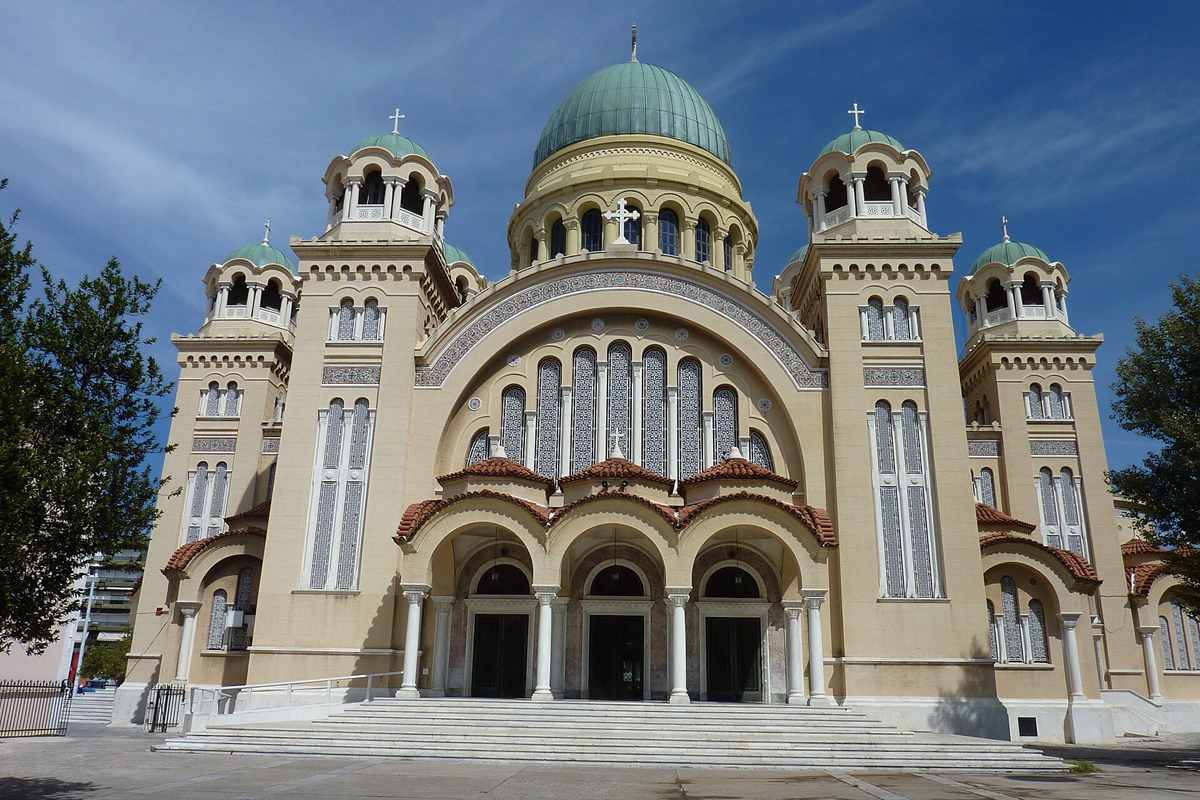
Greek Orthodox Church history is a theme of trips with a host through the Greek mainland and islands. Topics here include the Archbishopric of Athens, Archbishop Damaskinos and the Old Calendarists. Others are the Akathist hymn, the iconostasis, Panagia Vlacherna, Penteli Monastery and Kosmas the Aetolian. Related pages cover Greek Easter traditions, Byzantine churches in Greece and Greece religious tours. Wider outings appear under Greece tours.
Bookings made through the GetYourGuide widgets on this page earn Classical Greece Tours a commission, at no extra cost to the traveller.
What is the Greek Orthodox Church?
The Greek Orthodox Church, in its narrowest sense, is the Church of Greece. That Eastern Orthodox body works within the modern borders of the country. Its leader carries the title Archbishop of Athens and All Greece, and 81 dioceses make up its structure.
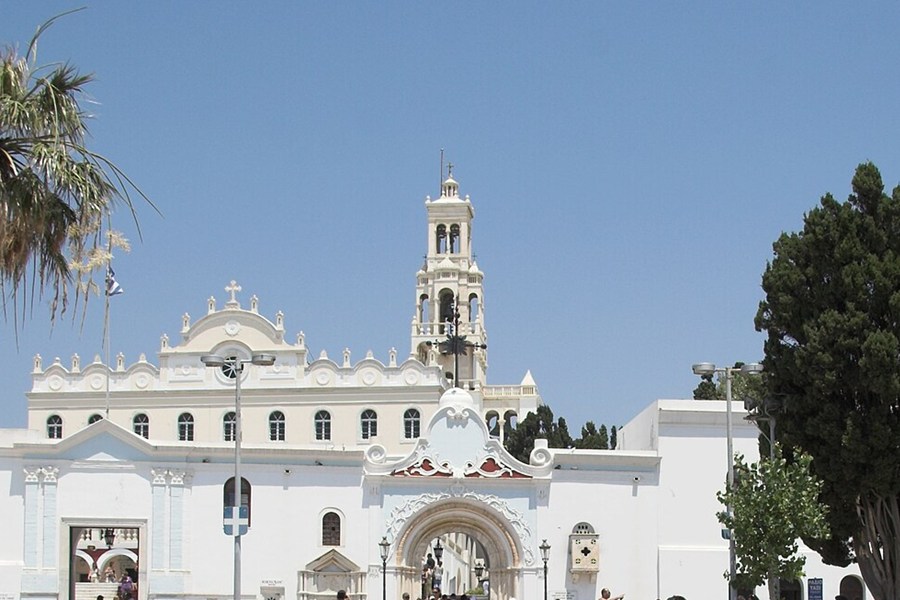
The name has two wider meanings as well. In the broadest use, the phrase covers the whole body of Orthodox Christians, also called Eastern Orthodox. A narrower use points to independent churches that keep Greek in formal church settings. Those bodies include Constantinople, Alexandria, Antioch, Jerusalem and the Church of Cyprus.
Within Greece, the Greek Orthodox Church was declared self-governing in 1833 by Bavarian regents acting for King Otto. The Greek term for that status is autocephalous. Relations with the Patriarchate of Constantinople were strained at first. The Patriarchate then recognised the status in 1850 through a Tomos, a formal church decree.
Authority rests with the Holy Synod, a council of all diocesan bishops with metropolitan rank. A metropolitan is a senior bishop. A smaller Standing Synod of the primate and 12 bishops handles administrative matters. Crete, the Dodecanese and Mount Athos stay directly under Constantinople, so they sit outside the Church of Greece.
- Marriage: Greek Orthodox Church clergy can marry before ordination as deacons, but not after it.
- Pay: The Greek state pays mainstream Orthodox clergy salaries and pensions at rates close to those of teachers.
- Law: Religious weddings and baptisms carry the same legal weight as their civil counterparts in Greece.
A 2022 United States estimate put Greek Orthodox identity at 81 to 90 percent of people in Greece. The Greek Orthodox Church there credits the Apostle Paul with first bringing Christianity to the region. By the late 2nd century, senior bishops sat at Corinth and Athens.
How did the see of Athens rise inside the Greek Orthodox Church?
The Greek Orthodox Church in Greece has its senior see in Athens. A see is the official seat of a bishop. The Athens see also serves as the seat of the whole Church of Greece. Ieronymos II has held this office since 2008.
The Athens community dates from the second missionary journey of St Paul. He preached at the Areopagus, a hill in Athens, around 50 or 51 AD. Dionysius the Areopagite became the first Bishop of Athens. Athens later stood beneath Corinth as a suffragan see, meaning one under a senior bishop.
In the medieval Greek Orthodox Church, Athens had become an autocephalous, or self-governing, archbishopric by 819. The long struggle with Corinth ended in 975, when Athens became a separate metropolis for good. A metropolis is a leading see over a wider district. Church lists placed Athens 28th by about 901, and it held that place for three centuries.
The Florentine Acciaioli family gained Athens in 1388 and let an Orthodox metropolitan named Dorotheus live there again. The Ottoman conquest of 1456 ended the Latin see. Greek Orthodox Church metropolitans then regained their former position. The Ottoman millet system grouped subjects by faith. Under it, the metropolitan also chaired the council of the Athens community.
- Reorganisation: After 1833 the church restructured, and a new Bishopric of Attica took charge of the Attica Prefecture.
- Metropolis: Recognition from Constantinople in 1850 raised the see to metropolitan rank under the name Metropolis of Athens.
- Synod: The Athens holder gained the permanent presidency of the Holy Synod in the independent kingdom.
In 1922 every see in Greece rose to metropolitan status. A charter of 31 December 1923 then made the bishop of Athens Archbishop of Athens and All Greece. The Greek Orthodox Church in Greece still uses that title for its leader.
Who was Damaskinos in the Greek Orthodox Church?
The Greek Orthodox Church in Greece had Damaskinos as its archbishop from 1941 until his death in 1949. Born Dimitrios Papandreou, he also served as regent of Greece from 1944. King George II returned in 1946, when that role ended.
He was born in Dorvitsa and had no family link with the political Papandreou family of Achaea. The Greek Orthodox Church ordained him a priest in 1917, and he became Bishop of Corinth in 1922. He spent the early 1930s in the United States as an envoy of the Ecumenical Patriarch.
In 1938 the metropolitans elected him Archbishop of Athens, and he took the name Damaskinos. Ioannis Metaxas, then ruling Greece as dictator, objected and forced the cancellation of that election. Metropolitan Chrysanthus received the post instead. Damaskinos returned to the throne of the Greek Orthodox Church in Athens after the German invasion of 1941.
In March 1943 he published open letters protesting the deportation of Greek Jews. A group of 19 Greeks from the arts, law, academia and business co-signed. He also told churches under him to hand baptismal certificates quietly to Jews fleeing the Nazis. Yad Vashem, a Holocaust remembrance body, named him among the Righteous Among the Nations.
- Army: Damaskinos enlisted in the Hellenic Army while the Balkan Wars were being fought.
- America: While in the United States, he helped to organise the Greek Orthodox Archdiocese of America.
- Charity: In 1947 he became a founding member of a charity for children left homeless by civil war.
His new Statutory Charter of 1943 governed the Greek Orthodox Church in Greece, with minor amendments, until 1977. A food network called the National Organisation for Christian Solidarity also grew under him. He recalled the king on 28 September 1946.
Which path did Archbishop Christodoulos take through the Greek Orthodox Church?
The Greek Orthodox Church in Greece was led by Christodoulos from 28 April 1998 to 28 January 2008. Born in Xanthi in 1939 as Christos Paraskevaidis, he took office at 59. That age made him the youngest archbishop to head the church.
When he was two, his family left Xanthi for Athens to escape the wartime occupation. His father later returned and ran a successful bid for mayor of Xanthi. Christodoulos went to the Roman Catholic Marist Leonteion Lyceum in Athens. He then read law at the University of Athens and graduated in 1962.
The Greek Orthodox Church ordained him a deacon in 1961 and a priest in 1965. He finished the School of Theology in 1967. He served as a parish priest in Palaio Faliro, an Athens suburb, until 1974. He also became Chief Secretary of the Holy Synod, the council of bishops.
As archbishop he launched services for drug addicts, immigrants, single mothers and abused women. He also set up a chain of nurseries and infant schools. In 2000 the government moved to remove the religion field from national identity cards. The Greek Orthodox Church came to favour an optional entry, but the government removed it from new cards.
- Bishop: He was elected bishop of Demetrias in Volos, Thessaly, in 1974 and held that post until 1998.
- Languages: He held a degree in French and English and also spoke Italian and German.
- Honours: The universities of Craiova and Iasi each awarded him an honorary doctorate.
Pope John Paul II visited Athens, and Christodoulos later visited Pope Benedict XVI in Rome. Both visits were steps towards church unity for the Greek Orthodox Church. Ieronymos of Thebes, a rival in the 1998 ballot, succeeded him in 2008.
Why did Old Calendarists part from the Greek Orthodox Church?
The Greek Orthodox Church in Greece moved to the Revised Julian calendar in 1924. Traditionalist groups called Old Calendarists, Old Feasters or Genuine Orthodox Christians stayed with the Julian calendar. They are not in communion with any mainstream Eastern Orthodox church.
Until 1924 the Greek Orthodox Church, like every Eastern Orthodox body, used the Julian calendar. The Roman Catholic Church had moved to the Gregorian calendar in 1582 under Pope Gregory XIII. Between 1900 and 2100, the two systems stand 13 days apart. In the fifth month of 1923, a council in Constantinople adopted the Revised Julian calendar.
That new system stays level with the Gregorian calendar for a further 800 years. For Easter dates, the Julian calculation was restored. Old Calendarists in Greece were at first a small number of laymen, priests and monks. Hundreds of monks from Mount Athos also stood with them. Their number grew over the years.
In 1935 three Greek Orthodox Church bishops joined the movement and consecrated four new bishops. Metropolitan Chrysostomos Kavourides of Florina became its leader. A schism followed in 1937 over the validity of sacraments in churches using the reformed calendar. A bishop named Matthew then led a breakaway group with its own Holy Synod.
- Not the same: The Russian Orthodox Church follows the Julian calendar yet is not Old Calendarist.
- Division: By 1999 at least five separate Greek Old Calendarist churches each had its own archbishop of Athens.
- Groups: The main Greek groups in 1999 were the Chrysostomites, the Matthewites and the Cyprianites.
In 1971 the Russian Orthodox Church Outside of Russia tried to unite the Greek factions, without success. Earlier, in 1960, two of its bishops had consecrated Akakios as an archbishop for one group. Adoption of the new calendar by the Greek Orthodox Church was the cause of that separation.
Which twelve feasts mark the year of the Greek Orthodox Church?
The Greek Orthodox Church places Pascha, the Orthodox name for Easter, above every other holy day. Directly below it sits a group of Twelve Great Feasts. Eight honour Jesus Christ, and the other four are dedicated to the Virgin Mary, also called the Theotokos.
The liturgical year of the Greek Orthodox Church, its cycle of worship, opens in September. Its opening great feast is the Nativity of the Theotokos, on 8 September by the old calendar. The Presentation of the Theotokos comes on 21 November in that reckoning. The Nativity of Christ falls on 25 December in the same dating.
The Exaltation of the Cross honours the cross of Christ, taken by Persians in Jerusalem in 614. Forces of the Eastern Roman Empire recovered it in 629. Theophany recalls the baptism of Christ by John the Baptist in the River Jordan. Believers in the Greek Orthodox Church also call that feast Epiphany, a word meaning manifestation.
The Presentation of Jesus at the Temple also carries the name Meeting of the Lord, or Hypapante. The Annunciation is set exactly nine months ahead of Christmas. The Entry into Jerusalem falls on the Sunday before Easter. The Ascension comes forty days after Easter, and Pentecost fifty days after it.
- Transfiguration: The Transfiguration of Jesus stands on 6 August in the old-style dating.
- Dormition: The Greek word for this feast of Mary is Kimisis, meaning falling asleep in death.
- Other feasts: Five further feasts rank as great, including that of Saints Peter and Paul.
Hymns appointed for eleven of the twelve feasts appear in the Georgian Iadgari, a Jerusalem chant book. It was compiled around the middle of the 6th century. Those eleven were kept in the Greek East for a time before. The Greek Orthodox Church keeps all twelve.
What makes the Akathist hymn special in the Greek Orthodox Church?
The Greek Orthodox Church sings the Akathist, a hymn whose Greek name means unseated. Worshippers remain on their feet throughout the chanting. Only the aged or infirm stand excused from that rule. Each akathist honours a saint, a holy event or a person of the Trinity.
The chief example was written for the feast of the Annunciation on 25 March. It opens with an address to Mary as an invincible champion. The Synaxarion, a church book of saints’ lives, links the feast to 626. In that year the Persians and Avars attacked Constantinople, in the reign of Heraclius.
Authorship remains uncertain in the Greek Orthodox Church tradition. Romanos the Melodist, a hymn writer, was the traditional choice, but recent scholarship rejects that claim. Other names include Patriarch Sergius I and George Pisida, a deacon and archivist of Hagia Sophia. Recent opinion favours a date between the Councils of Ephesus and Chalcedon.
The Greek original holds 24 oikoi, or stanzas, each opening with the next letter of the alphabet. The hymn falls into thirteen parts, each made of a kontakion and an oikos. A kontakion is a form of church hymn. Alleluia closes a kontakion, and a choir repeats it in full settings.
- Standing rule: Standing is mandatory for all only at Gospel readings, the Six Psalms and Akathists.
- Lent: The Greek Orthodox Church has sung the whole hymn in four sections through Lent since the 14th century.
- Service: The Salutations to the Theotokos, a Great Lent service, includes the Akathist in the Byzantine tradition.
When chanted alone, an akathist can open with a series of prayers. These include the Trisagion, meaning thrice-holy. The hymn can also join another service, such as Matins, the morning prayer. The Greek Orthodox Church thus uses it in more than one setting.
How does an iconostasis divide a Greek Orthodox Church?
A Greek Orthodox Church separates its nave from its sanctuary with an iconostasis. That screen carries icons and religious paintings as one wall. The Greek word means icon stand. The term also covers a portable stand placed anywhere inside a church.
The nave of a Greek Orthodox Church is the main body of the building, where worshippers stand. The sanctuary is the area around the altar, east of the nave. It stands one to three steps higher in the common layout. The screen grew from the Byzantine templon, an older barrier, by the 15th century.
In front of the screen runs a walkway for clergy called the soleas. Its central extension is the ambon, where the deacon stands to give litanies, or series of prayers. The screen rarely touches the ceiling, so the voices of the clergy reach the congregation. Small modern buildings can leave it out altogether.
A standard Greek Orthodox Church screen has three openings, with the Holy Doors at the centre. Those central doors remain shut whenever no service is under way. Greek practice places the Archangel Michael on the north door and Gabriel on the south. Deacons pass through the side doors, hence the name Deacons’ Doors.
- Bottom tier: An icon of Christ stands right of the central doors, with the Theotokos on the left.
- Greek tiers: Modern Greek screens commonly hold only the bottom tier, at times with a second row of smaller icons.
- Entry: Eastern Orthodox custom admits men behind the screen, though women serve there at female monasteries.
Slavic churches developed five tiers in the fullest form, and only the largest screens hold all five. A cross can stand above the central doors when the screen stops short. A small Greek Orthodox Church without a screen uses small icons on stands called analogia.
What do icons mean to the Greek Orthodox Church?
The Greek Orthodox Church treats an icon as a visible gospel. Such a religious image is commonly painted on a wood panel. Greek uses one word for both icon painting and writing. Orthodox sources therefore speak of icon writing in English.
Orthodox tradition traces Christian images to the very early days of the faith. Modern art historians can follow them no further back than the 3rd century. Images were widely destroyed in the Byzantine Iconoclasm, which ran from 726 to 842. Iconoclasm means the rejection and breaking of religious images.
Within the Greek Orthodox Church, an icon leaves very little room for artistic licence. Gold stands for the radiance of Heaven, while red signals divine life. Blue marks human life, and white is kept for the Uncreated Light of God. Angels have wings because they are messengers, and a written text names the person shown.
Basil of Caesarea wrote that honour paid to an image passes to its original. In Orthodox teaching, kissing an icon of Jesus shows love for him, not for wood and paint. The Seventh Ecumenical Council forbade worship of an icon treated as separate from its original. An ecumenical council is a gathering of bishops from across the church.
- Light: A Greek Orthodox Church prefers beeswax candles and olive oil lamps before icons, because they burn cleanly.
- Crete: Crete, under Venice until the mid-17th century, ranked as a major home of icon painting.
- Revival: Photis Kontoglou was among reformers who tried to revive Greek icon painting through earlier styles.
Heraklion on Crete once counted at least 120 painters and fell to the Turks in 1669. Greek icon painting declined from that time. In Greek Orthodox Church teaching, people also count as living icons. Prayer services cense them, meaning they wave incense towards them.
How is the Divine Liturgy structured in the Greek Orthodox Church?
The Greek Orthodox Church calls its Eucharistic service, the rite of bread and wine, the Divine Liturgy. That service has a fixed format, while readings and hymns change with season and feast. It moves through three linked parts: Preparation, Catechumens and Faithful.
The Liturgy of Preparation is a private opening, carried out by the priest and deacon alone. They enter the church, venerate the icons and put on vestments. Then they prepare the bread and wine at the Table of Oblation, called the Prothesis. In Greek Orthodox Church symbolism, this part recalls the hidden years of Christ on earth.
The Liturgy of the Catechumens takes its name from people preparing for baptism. Traditionally they attended only this part. It holds scripture readings like those in a synagogue, and at times a sermon. The Liturgy of the Faithful rests on the Last Supper and early Christian Eucharistic gatherings. Today only holy communion remains limited to baptised members.
The Byzantine Rite, followed by the Greek Orthodox Church, keeps three liturgies in common use. The Liturgy of St Basil the Great dates from the 4th century. It serves the five Sundays of Great Lent and the feast of the saint on 1 January. It appears 10 times during the year.
- Presanctified: The Liturgy of the Presanctified Gifts, from the 6th century, is used on Lenten Wednesdays and Fridays.
- Rare forms: The Liturgy of St James and the Liturgy of St Mark appear only locally and rarely.
- Bishop: A service led in person by the diocesan bishop is more complex and festive.
Eastern tradition holds that the roots of the liturgy lie in Jewish worship adapted by early Christians. Greek Orthodox Church believers hold that the bread and wine truly become the Body and Blood of Christ. They see the Eucharist as the central part of the service.
Why does the Panagia Portaitissa matter to the Greek Orthodox Church?
The Greek Orthodox Church honours the Panagia Portaitissa, an icon of the Virgin Mary. It stands at Iviron monastery on Mount Athos. Believers hold that it has been there since 999. Church tradition credits Luke the Evangelist with painting it.
Within the Greek Orthodox Church, the icon belongs to the Hodegetria family of images. Hodegetria is Greek for she who leads the way. In these images the Christ Child sits on the left arm of his mother. A silver and gold cover, called a riza, hides nearly everything except the faces.
A mark like a scar shows on the right cheek or chin of the Virgin. The commonest Greek Orthodox Church account says a soldier in Nicaea stabbed the icon under Emperor Theophilus. Theophilus reigned from 829 to 842. Tradition adds that a widow there prayed all night and then cast it into the sea.
Gabriel the Iberian, a Georgian monk, recovered it from the sea around 1004. Monks carried it to the main church, yet found it hanging next day on the monastery gates. That happened repeatedly, and so the icon went into a small chapel beside the gates. The name Portaitissa means Gate-Keeper.
- Feast days: The icon is honoured on 12 February and on Bright Tuesday, in the week after Easter.
- Moscow copy: Patriarch Nikon commissioned an exact copy in 1648, while still head of a Moscow monastery.
- Chapel: The Iverskaya Chapel went up in 1669 beside the Kremlin walls to house that copy.
Orthodox monks and nuns worldwide set copies of this icon on monastery gates. A Greek Orthodox Church building can also place the image inside the iconostasis, above the Holy Doors. There it looks towards the altar table. The icon has served as a prototype for copies.
What history does Saint David Monastery hold for the Greek Orthodox Church?
The Greek Orthodox Church keeps the Monastery of Saint David the Elder on Euboea. The house stands near the village of Drimona and the town of Limni. The young ascetic David built it in 1520 with gifts from monks and Christians.
In Greek Orthodox Church usage, an ascetic is a person who lives with strict self-denial. David drew contributions from Greece, Moldovlachia and Russia. Under Ottoman rule, the house sheltered local people and ran a hidden school for non-Muslims. In 1824 the monks were killed and the monastery was burnt.
A new monastery rose after the Greek War of Independence. An earthquake destroyed its main church, or Katholikon, in 1870, and Abbot Anthimos Aggelis rebuilt it in 1877. That church honours both the Transfiguration of Jesus and the founder. The largest estate of the house was expropriated, or taken over by law, in 1933.
A broad restoration began in 1951 under Archimandrite Nikodemos Thomas. An archimandrite is a senior monastic priest. New chapels followed, including those for Archangel Michael, Saint Varvara and Saint George. Elder Iakovos Tsalikis led the house as abbot from 1975 to 1991. The Greek Orthodox Church in Greece recommended his recognition as a saint, which came in 2017.
- Holy water: Tradition says David struck a rock with his stick, and curative holy water gushed out.
- Cave: A cave south of the house served as David’s training room, or asceterion, by tradition.
- Chapel: A Byzantine chapel of Saints Anargyros lies under the former cell of David, with 18th-century wall paintings.
Ecumenical Patriarch Bartholomew led the celebration there on 3 June 2018, with 30 bishops serving alongside. The museum of this Greek Orthodox Church house keeps the stole, censer and staff of David. Old icons and three woodcut crosses stand there too.
Which features define Panagia Vlacherna for the Greek Orthodox Church?
The Greek Orthodox Church world includes Panagia Vlacherna, an imposing Byzantine building in a village outside Arta. Work on it spans the 10th to the 13th century, with later changes. It began as the catholicon, or main church, of a monastery.
The church housed burials of the Comnenos-Doukas family, who ruled the Despotate of Epirus. Its ruler, the despot, was a medieval lord with his own state. The first building dates from the end of the 9th or beginning of the 10th century. It was a wooden-roofed basilica with three aisles, a long hall-shaped church.
The Greek Orthodox Church building standing today is late Byzantine, after a rebuilding in the early 13th century. Builders gave each aisle a dome in the middle of that century. A furnace also went into the north aisle. That work left a vaulted basilica with three domes, an unusual form.
A narthex, or entrance hall, came late in the 13th century. The dating of its frescoes shows this. Frescoes are wall paintings done on wet plaster. Colonnades separate the three aisles, which differ in width. Pilasters, or flat wall columns, divide the narthex into three sections. Walls with arched openings mark off the transepts.
- Decoration: Frescoes, sculptures, marble inlays and mosaics originally decorated this Greek Orthodox Church building.
- Roof: The roof and dome of the central aisle rise higher than those of the other two.
- Entrances: Five entrances existed originally, yet only the central west door remains open today.
Gables with brick-framed windows mark the narrow sides of each roof. Later gables on the long sides meet the side domes, which suggests a cross-roofed temple. The Greek Orthodox Church building keeps a separate transverse roof over its narthex.
What place does Penteli Monastery hold in the Greek Orthodox Church?
The Greek Orthodox Church in Attica counts Penteli Monastery, founded in 1578, among its monasteries. Its formal dedication is to the death of Mary, known as the Dormition of the Theotokos. Saint Timotheos of Euripos founded it on the southern side of Mount Penteli.
Almost from the start, the house held stauropegic status within the Greek Orthodox Church. That term means a direct link to the Patriarch of Constantinople rather than to a local bishop. Greek usage calls such houses Stauropegiac, or springs of the Cross. The Archbishopric of Athens has held jurisdiction over Penteli since 1858.
During the Ottoman period the monastery owned lands on Mount Penteli and elsewhere in Attica. It suffered destruction after the Venetian occupation of Athens in 1688 to 1690. The Greek War of Independence brought further destruction. In 2010 the monastery had 58 monks, of whom 17 lived there permanently.
The Greek Orthodox Church house stands at an altitude of about 430 metres. Its high walls and heavy doors make it resemble a fortress from outside. The main church, known as the Katholikon, follows a post-Byzantine style. That means a style from after the fall of the Byzantine Empire. The buildings have room for 120 monks.
- Collections: The monastery also holds a museum and a library within its buildings.
- August: Feast days fall on 15 August for the Dormition and 16 August for Saint Timotheos.
- Holy Spirit: The house also marks the Holy Spirit feast on its Monday each year.
St Porphyrios of Kafsokalyvia tried in 1955 to found a convent through this house, without success. The monastery belongs today to the Archbishopric of Athens, within the Greek Orthodox Church. It remains a men’s monastery, with a community of monks.
Who founded Phaneromeni Monastery for the Greek Orthodox Church on Salamis?
The Greek Orthodox Church owes Phaneromeni Monastery on Salamis to Lambros Kannelos, a devout resident of Megara. In 1682 he restored a ruined church on the north-western coast and founded the house there. He later took the monastic name Lavrentios.
Church tradition says the Virgin Mary, called the Panagia, appeared to Kannelos in his sleep three times. She ordered him to go to Salamis. He dug in the ruins of a very old church and found her icon. Within the Greek Orthodox Church, the icon carries the name Panagia Phaneromeni.
Kannelos became a monk together with his wife. He then withdrew to a hermitage, or hermit’s retreat, named after the prophet Elias. That small church stayed intact until the Germans destroyed it in 1944. Lavrentios died on 6 March 1707 and was buried at the monastery. The Greek Orthodox Church remembers him on 7 March.
The main church, or Catholicon, carries post-Byzantine sacred paintings dated to 1735. Georgios Markou, a painter from Argos, made them with his students. The cycle holds about 3,530 figures and scenes. The house also keeps old documents and historical relics. Post-Byzantine describes art made once the Byzantine Empire had ended.
- Diocese: The Metropolis of Megara and Salamis, a regional church district, has authority over the house.
- Feast: The house honours the Dormition of Mary, with its feast on 23 August.
- Archbishop: Archbishop Damaskinos remained under restriction here through the Metaxas regime and the Greco-Italian War.
The Greek Orthodox Church in Greece declared Lavrentios Blessed, a title of honour for a holy person. The faithful attribute a large number of miracles to him. Church writers call him Osios Lavrentios, and Osios is a Greek title meaning a holy monk.
How did Kosmas the Aetolian serve the Greek Orthodox Church?
The Greek Orthodox Church honours Kosmas the Aetolian, a monk born about 1714, as a saint. He came from the village of Mega Dendron in Aetolia. Patriarch Serapheim II authorised his missionary tours in 1760. His work reached Thrace and later western and northern Greece.
Kosmas studied Greek and theology, and a trip to Mount Athos led him to become a monk. He attended the Theological Academy on Athos and left after two years. He then studied rhetoric in Constantinople for a time. Rhetoric is the art of public speaking. He is also called Patrokosmas, meaning Father Kosmas.
Over sixteen years he set up church schools in villages and towns. He urged Christians to learn Biblical Koine Greek, the Greek of the New Testament. In 1779 he reportedly founded a Greek school in Venetian-ruled Preveza. Within the Greek Orthodox Church, he counts among the originators of twentieth-century religious movements in Greece.
Ottoman authorities seized him, accused of being a Russian agent. He was executed at Kolkondas in 1779, near the mouth of the Seman river, in present-day Albania. No formal charges or trial preceded his death. Theories about who wanted him dead persist to this day. In 1813 Ali Pasha had a church built near the site.
- Sainthood: The Orthodox Church of Constantinople proclaimed him a saint on 20 April 1961.
- Feast: The Greek Orthodox Church marks his feast on 24 August, the date of his execution.
- Relics: Relics of the saint rest in the Metropolitan Cathedral of Athens, and others reached the museum at Fier.
Popular religious texts attributed to him include five Didaches, or teachings, and the Prophecies. No original manuscript written by him survives. These texts reached the Greek Orthodox Church world through second- or third-hand transcriptions. Orthodox Albanians also hold him in high regard today.
What do travellers ask about the Greek Orthodox Church, and what are the answers?
The Greek Orthodox Church prays with a knotted cord and follows a main liturgy named after John Chrysostom. Its history includes the Kollyvades movement of Mount Athos. It also honours a modern saint who worked as a chaplain at an Athens hospital.
Before a trip through Greece, what is a prayer rope in the Greek Orthodox Church?
A prayer rope is a loop of woven knots tied in a cross pattern. The typical rope has thirty-three knots, one for each year of the life of Christ. Monastics use it to count repetitions of the Jesus Prayer, a short plea for mercy. Its traditional colour is black, for mourning over sins.
Which liturgy of the Greek Orthodox Church carries the name of John Chrysostom?
This service is the leading liturgy of the Byzantine Rite. Its name comes from its core prayer, the anaphora, credited to Saint John Chrysostom. He led Constantinople as archbishop in the 5th century. It became the usual liturgy in churches across the Byzantine Empire. Leo Tuscus translated it into Latin in the 1170s.
Who were the Kollyvades of the Greek Orthodox Church?
The Kollyvades formed a movement on Mount Athos in the eighteenth century. Their name comes from kollyva, the boiled wheat of memorial services. A dispute arose in 1754 at the Skete of St Anne, a monastic settlement. Its subject was holding memorials for the dead on Sundays. They also favoured frequent communion.
Why does the Greek Orthodox Church honour Porphyrios of Kafsokalyvia?
Porphyrios was a Greek hieromonk, meaning a monk ordained as a priest. He was born on Evia in 1906 and attended only 2 years of school. He served as a hospital chaplain in Athens for around 33 years, from 1940 to 1973. The Ecumenical Patriarchate declared him a saint on 27 November 2013.
Featured photo: Xocolatl, Public domain, via Wikimedia Commons (File:Hagios Andreas Seitenansicht.jpg).