
Greek language records span at least 3,400 years. Trips through Greece are outings with a host across the mainland and the islands. Greek is the official tongue of the country. The story runs from Mycenaean tablets and Homer to Koine and Medieval Greek. Dialects include Cretan, Tsakonian and Pontic, alongside Katharevousa, Demotic, the Gortyn code and English loanwords. Related pages cover the Greek alphabet, Greek phrases for travellers and Ancient Greek philosophers. More trips appear under Greece tours.
Bookings made through the GetYourGuide widgets on this page earn Classical Greece Tours a commission, at no extra cost to the traveller.
What is the Greek language?
The Greek language holds the longest written record of any Indo-European tongue, a family that also holds English. Its texts span no less than 3,400 years. It is native to Greece, Cyprus, Egypt, Turkey and southern Albania, and to Calabria and Salento in Italy.
A clay tablet found in Messenia gives the earliest written evidence of the Greek language. Its date falls between 1450 and 1350 BC. That find makes Greek the oldest recorded living language in the world. Within its language family, only the now-extinct Anatolian tongues reach back to so early a written date.
Two older scripts carried the Greek language before the alphabet. One was Linear B, an early set of written signs. The other was the Cypriot syllabary, a script in which each sign stands for a whole syllable. Today, the speakers of Greek number at least 13.5 million. The European Union counts it among its 24 official languages.
In antiquity, Greek was by far the widest-spoken lingua franca of the Mediterranean. A lingua franca is a shared tongue between people with different home languages. Greek and Latin remain the main sources of scientific words used across the world. Roots from the Greek language are still used to coin new words in other tongues.
- Homer: Epic poems by Homer open the long story of ancient Greek literature.
- Scripture: The Christian New Testament had Greek as its original language.
- Continuity: One estimate sets Homeric Greek nearer to modern spoken Greek than 12th-century English is to today’s English.
Its stages run from Mycenaean tablets through Koine, a shared everyday form, to Medieval Greek. Greek speakers still tend to treat ancient works as part of their own language. The Greek language also holds official minority status in Apulia and Calabria in Italy.
How does Mycenaean Greek open the written Greek language?
The Greek language first appears in writing as Mycenaean Greek. People spoke it on the mainland and on Crete from the 16th to the 12th centuries BC. Its signs survive in Linear B, a script known from clay tablets and broken pots.
The bulk of the surviving inscriptions are clay tablets from Knossos and Pylos. Knossos stands in central Crete, and Pylos lies in the southwest of the Peloponnese. Further tablets have turned up at Mycenae, Tiryns, Thebes and Chania. This stage of the Greek language takes its name from Mycenae, a major centre of the period.
The tablets long stayed unread, and scholars proposed a range of languages for them. The final reading built on extensive work by Alice Kober. The Greek language then proved to lie behind the signs. An object called the Kafkania pebble has been claimed as older, but its authenticity is widely doubted.
The texts are mainly lists and inventories. No prose story survives, and no myth or poetry either. Around 6,000 tablets and broken pieces of pottery form the whole body of Mycenaean Greek writing. The earliest tablets accepted by scholars come from a room at Knossos, the Room of the Chariot Tablets.
- Script gaps: Linear B does not mark the length of vowels or breathy sounds at word starts.
- Uniform speech: The Mycenaean dialect stays fairly uniform at every centre where scribes left tablets.
- Later kin: Mycenaean and Arcadocypriot, the old speech of Arcadia and Cyprus, form one group called Achaean.
After the palaces fell, Linear B went out of use. Local dialects then kept developing on separate paths. That view comes from the linguist Antonin Bartonek. He treated palace speech as an official form of the Greek language for records and rulers.
Which poems gave the Greek language its Homeric form?
The Greek language of the Iliad and the Odyssey is called Homeric Greek. The Homeric Hymns use it too. This literary dialect rests mainly on an archaic form of Ionic, with touches of Aeolic. Both names belong to ancient Greek dialects.
A small share of features comes from Arcadocypriot, an old dialect of the Greek language. The written form shows the mark of Attic, the speech of Athens. Later readers called the same style Epic Greek, because epic poetry used it. Epic poets favoured dactylic hexameter, a line of verse built on six beats.
Homer was not its only user. Hesiod and Theognis of Megara also composed in this form of the Greek language. Later names include Apollonius Rhodius, Quintus Smyrnaeus and Nonnus. Epic Greek compositions were still being written in the 5th century CE. The style fell out of use only when classical antiquity ended.
Homer uses about 9,000 words in the Iliad and the Odyssey. Proper names account for 1,382 of that total. Of the remaining 7,618 words, 2,307 appear only once in the poems. Scholars call such a word a hapax legomenon, a Greek phrase for something said a single time.
- Rare words: Clyde Pharr counted 1097 one-time words in the Iliad and 868 in the Odyssey.
- Lower counts: Others define the term differently and count only 303 in the Iliad and 191 in the Odyssey.
- Little words: Homeric Greek had no true definite article, the job done by “the” in English.
The Iliad opens by asking a goddess to sing of the wrath of Achilles. In 1860 Theodore Buckley put those lines into English. The Greek language of epic also turns almost every long a sound into eta, a long e.
Why did scholars once dismiss the Koine form of the Greek language?
The Greek language took a shared everyday form called Koine, which early scholars dismissed as a decayed variety. Those classicists, experts in ancient texts, measured everything against the literary Attic of Athens. A fresh look at it began only in the early 19th century.
Two kinds of text lead the evidence for the Greek language in this period: post-classical inscriptions and papyri. Papyri are writings on sheets made from a reed plant. Both kinds hold authentic content that can be studied directly. Local elites in Asia Minor, Arabia, Judaea, Syria and Egypt used Greek for inscriptions and official announcements.
Popular painters wrote inscriptions on vases, and those lines count as evidence too. Slips by Atticists help as well. Atticists were writers who imitated old Attic, and their imperfect knowledge of it shows in errors. Surviving word lists from Roman times pair Greek with Latin. One sample line reads: Indeed, what does he have?
The living dialects of the Greek language act as a further record. Pontic and Cappadocian Greek kept the ancient sound of eta as a short e. Tsakonian kept a long a where other forms have eta. Speakers in the Dodecanese and Cyprus still pronounce double consonants in full. These traits point to variety inside Koine itself.
- Old sense: Apollonius Dyscolus and Aelius Herodianus used the word koine for the Proto-Greek ancestor language.
- City name: Other writers named Koine the dialect of Alexandria, or simply the universal speech of that age.
- Mixed or Ionic: Paul Kretschmer saw a mixture of four dialects, while Wilamowitz and Meillet saw simplified Ionic.
Even the word koine moved with the Greek language, its sound shifting from koi-nay towards kee-nee. The next stage, Medieval Greek, is sometimes dated from the founding of Constantinople in 330 AD. Other scholars place the break at the end of late antiquity.
How did Medieval Greek carry the Greek language through the Byzantine Empire?
The Greek language in its medieval stage runs from the end of classical antiquity to 1453. That year brought the Ottoman conquest of Constantinople. Scholars also say Byzantine Greek, because it served the government of that empire from the 7th century.
Latin came first at the imperial court. When Constantine moved the capital to Byzantium in 330, Latin remained the tongue of court and army. Laws then shifted, and amendments were mainly in Greek from the start of the 6th century. Emperor Heraclius took the Greek title Basileus, meaning monarch, in 610, and the Greek language became official.
Latin did not vanish at once. It stayed on coins and in certain court ceremonies up to the 11th century. Native speakers of the Greek language were also a minority at first. One estimate puts them at under one third of the eastern empire, around eight million people. Its people still called themselves Rhomaioi, or Romans, until 1453.
Spoken and written forms drew apart in this period. Documents from southern Italy in the tenth century give the earliest evidence of vernacular prose. Vernacular means the everyday speech of ordinary people. The Digenes Akritas, a 12th-century set of heroic sagas, became the first literary work written wholly in it.
- Chronicle of the Morea: This 14th-century verse chronicle also survives in French, Italian and Aragonese versions.
- Sicily: Greek was spoken by one third of Sicily at the Norman conquest, then slowly died out.
- Verse form: The Digenes Akritas uses fifteen-syllable blank verse, known in Latin as versus politicus.
Alexandria, a centre of Greek culture, fell to Arab forces in 642. Arabic then replaced Greek by degrees in conquered lands such as Egypt. One Greek state lasted long enough that the Greek language did not split into separate tongues.
What makes Cretan Greek stand out within the Greek language?
The Greek language on Crete appears as Cretan Greek, a modern variety grown from Koine. Cretans normally speak it with each other today. Distance from the main Greek centres left features that set it apart from the standard form.
Outside rule shaped the local vocabulary of the Greek language on this island. The Andalusian Moors conquered Crete in 824 and left mainly place names behind. Venetian rule lasted nearly five centuries and had a stronger effect on names and local words. Turkish words arrived once the Ottomans took the island in 1669.
These borrowings into the Greek language of Crete were mainly words. Arabic, Turkish and Venetian barely touched grammar and syntax, the rules for building sentences. A goat is aiga in Cretan, while the standard word is katsika. The Cretan word for instantly, de logo, comes from a medieval Italian phrase, di longo.
The first writing in Cretan that counts as modern Greek literature came in the 16th century. Poets of the 15th to 17th centuries wrote in the spoken dialect. Cretan comedies mixed Italian forms, Latin forms and local speech. Antonios Achelis wrote the Siege of Malta in 1570, shortly before Chortatzis and Kornaros.
- Diaspora: The dialect survived among emigrants in the United States, Australia and Germany.
- Ayvalik: Descendants of Cretan Muslims in Ayvalik and Cunda Island still use it, though rarely.
- Kazantzakis: His novel Captain Michalis uses Cretan Greek words and idioms, and its popularity spread them.
Cretan stays close enough to the standard for a fairly high level of mutual understanding. It is rarely written down today. Organisations of Cretans work to preserve the dialect. This branch of the Greek language does not seem in danger of dying out.
How far has Tsakonian moved from the rest of the Greek language?
The Greek language reaches a highly divergent form in Tsakonian, spoken in a region of the Peloponnese. Scholars treat it as a dialect, although certain reference works list it as a separate language. Its fluent speakers are mainly elderly, and it is critically endangered.
The name itself has a Spartan link. Byzantine chroniclers explained Tsakonas as a corruption of Lakonas, a person from Laconia, the land of ancient Sparta. Today the speech survives in mountain towns and villages a little inland from the Argolic Gulf. Barriers to travel kept its speakers cut off from other Greeks up to the 19th century.
Mass education and better travel after the War of Independence ended the old isolation. A rapid decline in numbers followed. Electricity reached every village in Tsakonia by the late 1950s. Mass media followed and changed the speech of younger people. Efforts to teach this part of the Greek language in schools have not had much success.
Within the Greek language, Tsakonian holds three dialects: Northern, Southern and Propontis. Southern Tsakonian lives in Melana, Prastos, Vaskina, Tiros and Leonidio. Northern Tsakonian belongs to Sitena and Kastanitsa. Propontis Tsakonian came from a colony on the Sea of Marmara. That branch seems to have vanished from use around 1970.
- Daily words: Tsakonian says amera for day, where standard Modern Greek says imera.
- Capital: During the war for independence, the working capital of the Tsakonians moved from Prastos to Leonidio.
- Status: Tsakonian has no official status, although Greek Orthodox prayers have been translated into it.
Its core vocabulary remains recognisably Doric, the speech of old Sparta. Experts disagree on how far other Doric traits survive. Contact with nearby Greek dialects also marked this corner of the Greek language. It also borrowed words from Turkish and Arvanitika, a speech based on Albanian.
Which events set Pontic Greek apart within the Greek language?
The Greek language reached the southern shores of the Black Sea, where Pontic Greek took shape. A Seljuk Turkish invasion in the 11th century cut Pontus off from other Byzantine lands. Pontic then developed on its own, apart from mainland speech.
The variety is listed as endangered, yet about 778,000 people worldwide speak it. Around 200,000 to 300,000 count as active speakers. Pontians now live mainly in Northern Greece, where the 1923 exchange of populations brought them. Pockets of speech also remain in the old Pontus region, in eastern Trabzon Province.
Speakers historically called their tongue Romeika, a term from Byzantine times tied to the Greek word for Romans. The label Pontic began among scholars, and Pontic Greeks in Greece have since adopted it. Pontic Greek is not fully understood by users of the standard Greek language. It carries influences from Russian, Turkish, Georgian and Armenian.
Ophitic, spoken in the Of valley of Turkey, has kept the infinitive. The infinitive is a basic verb form. Other modern forms of the Greek language have lost it, except Italiot Greek of southern Italy. Ophitic has been called the living speech closest to Ancient Greek. Reports put its speakers at about 5,000, though other estimates run higher.
- Two groups: Manolis Triantafyllidis split the Pontic of Turkey into Western and Eastern groups.
- Nea Trapezounta: About 400 speakers of a very similar dialect live in this village in Pieria.
- Scripts: Pontic is mainly written in Greek letters, with Latin script sporadically used in Turkey.
The language enjoyed literary use in the 1930s, including a school grammar. Chaldiot, from the inland area around Argyroupolis, had the largest number of speakers among Pontic groups. Mariupol Greek, a northern branch of Pontic within the Greek language, began in Crimea.
What part did Katharevousa play in the Greek language?
The Greek language once carried Katharevousa, a formal written style whose name means purifying. The word shares a root with the English catharsis. Its first known use appears in a 1796 work by the Greek polymath Nikephoros Theotokis.
Katharevousa aimed at a compromise between two camps in the Greek language debate. Archaists demanded a full return to archaic Greek, and modernists opposed them. The name suggests a pure Greek, as if it had grown from ancient speech with no outside influence. Today the word has also come to mean formal language.
Katharevousa appeared in politics, letters, official documents and news broadcasts, while Demotic stayed the daily speech. Demotic means the popular tongue of ordinary Greeks. Those who did not adopt the formal style were shut out of public life and advancement in education. Greeks without higher education followed this Greek language style only in part.
Katharevousa promoted compounds built from classical roots for things unknown in earlier times. Examples include the Greek words for newspaper, police, automobile and television. These words took the place of direct borrowings from other tongues. Its supporters also discarded words the Greek language had borrowed from Turkish, Latin and Italian.
- No single form: Katharevousa was never standardised, and its backers kept putting forward changing variants.
- Fish word: Its users replaced the everyday psari for fish with the ancient word ichthys.
- Print sample: The Great Greek Encyclopedia, published in 1930, holds a sample passage written in Katharevousa.
Georgios Rallis, as minister of education, made Demotic the official language in 1976. In 1982, Prime Minister Andreas Papandreou abolished the polytonic system, a way of writing with extra accent marks. The old full style was obsolete when the 20th century closed.
Which habits of speech define Demotic in the Greek language?
The Greek language of ordinary people took the name Demotic, which literally means language of the people. It served the vast majority of Greeks through the 19th and 20th centuries. Katharevousa stood as its formal rival during the same period.
Demotic builds sentences by setting simple clauses side by side, a habit linguists call parataxis. It also leans on redundancy, as in the phrase small little-girl. Diminutives, the word forms for small things, appear with great frequency. The everyday word for island, nisi, descends from an ancient diminutive of the old word nisos.
Nouns grew more regular in the spoken Greek language. Native words came to end mainly in a vowel, s or n. Loans such as bar break that pattern. The old future tense and the infinitive gave way to small helper words, tha and na. Demotic also took in words from Italian and Turkish, which Katharevousa avoided.
Giannis Psycharis, a radical voice for the Greek language of the people, lived in France. My Voyage, his work of 1888, brought him fame. He pressed for spelling reform, including the removal of double consonants. He aimed to cut down the six ways of writing the vowel i. His own name appeared with a single n in Greek.
- Old forms: The everyday word for percent, tois ekato, is an old form meaning in a hundred.
- Wing words: Ftero means a bird’s wing, while pteryx means the wing of a building or aeroplane.
- Extra vowel: Dialects that add a final e say grafoune instead of grafoun for they write.
A standard Demotic became the official form of the Greek language in 1976. The law required use without dialectal and extremist forms. That wording rejected the ideals of Psycharis outright. Demotic has kept evolving and is now called Standard Modern Greek.
Which laws at Gortyn preserve the written Greek language?
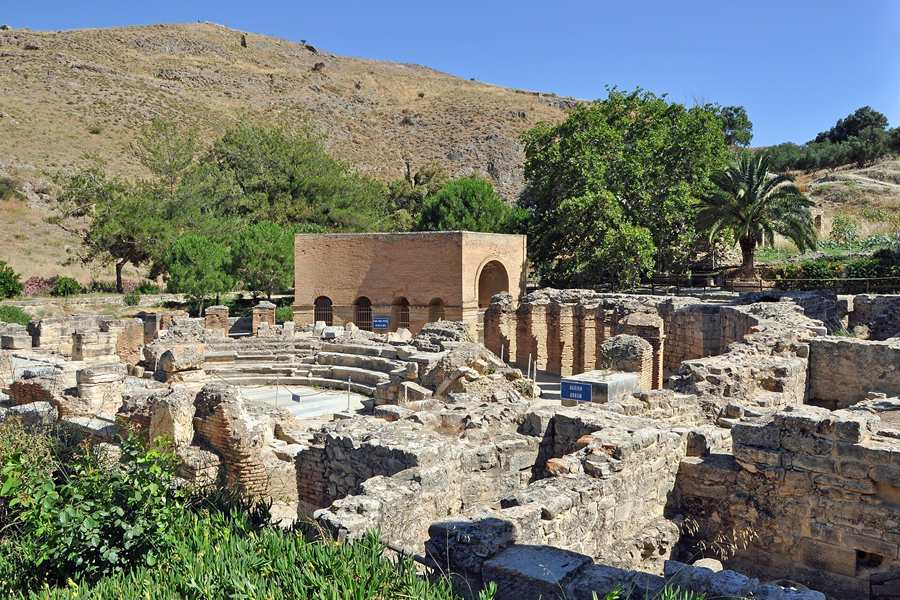
The Greek language survives in southern Crete in the Gortyn code, also called the Great Code. Only the inscription of Diogenes of Oenoanda runs longer among ancient Greek carvings. Its columns set out the laws of this ancient city-state.
The text stood on a public building in the agora, the main square of Gortyn. That building measured 30 metres across. Its 12 surviving columns of Greek run 10 metres in length and 1.5 metres in height. Evidence points to one sculptor behind the whole work. A further broken text, known as the second text, also survives.
Georges Perrot and Louis Thenon found the first fragment of this Greek language text in 1857. The Italian archaeologist Federico Halbherr found four more columns near a mill in 1884. He and Ernst Fabricius then dug the site and uncovered 8 further columns. Those stones had been reused in the foundations of a Roman Odeion, a small theatre.
The Great Code is in the Dorian dialect of the Greek language. Cretan cities such as Knossos, Lyttos and Axos also used Dorian at that time. The code belongs to a Cretan legal tradition, the only large body of Greek law found outside Athens. Very little non-legal writing from ancient Crete survives.
- Family law: The code sets out the rights of a wife when divorced or widowed.
- Children: A child conceived before a divorce but born after it falls under the father’s custody.
- Social classes: The document recognises free people, serfs, slaves and foreigners as distinct legal groups.
The wall carrying this stretch of the Greek language has now been partly rebuilt. Adopted children receive the same inheritance rights as natural children under its terms. Earlier Cretan laws were cut into the temple of Apollo Pythios, on its steps and walls.
How did words from the Greek language reach English?
The Greek language fed English by five main routes. Newly coined words built from Greek roots far outnumber all the others. Telephone is one, made from the Greek parts for far and voice. Those inventions never existed in Greek before their coining.
Living Greek and English had no direct contact until modern times, so early loans came through Latin. The word butter passed from Greek bouturon into Latin butyrum, then into English. Olive has a similar story, starting from the archaic form elaiwa. Place traces back to a Greek word for a broad street, and so do piazza and plaza.
Church vocabulary forms a large early group of loans from the Greek language. Bishop comes from episkopos, meaning overseer, and priest comes from presbyteros, meaning elder. Chair goes back to kathedra. Church itself came into Old English as cirice through a West Germanic language. Its proposed Greek source means the lord’s house.
Scholars writing Medieval and Renaissance Latin took a larger group from the Greek language, including topic and type. Scribal errors also left a mark. Encyclopedia grew from a phrase meaning the circle of learning, which was not one word in Greek. Acne comes from a mistaken copy of acme, a high point.
- Telescope: The root means far-seeing, yet the English word names an optical instrument.
- Bacterium: The source word meant a small stick, yet science uses it for a microorganism.
- Ouzo: The name of this drink is a direct borrowing from Modern Greek into English.
The coined words reach the Greek language itself in the end. Utopia dates from 1516, built from parts meaning not and place. Such coinages spread freely among European tongues and enter Modern Greek. There they count as reborrowings, words that have returned home.
What do travellers ask about the Greek language, and what are the answers?
Greek language forms include Cypriot Greek and Cappadocian Greek, which grew apart from Byzantine speech. The tongue also went through a long dispute over written style, settled in 1976. Early law stones from Dreros on Crete also show a new way of laying out text.
How far does Cypriot Greek stand from the standard Greek language?
Cypriot Greek derives from Byzantine Medieval Greek, not from the ancient Arcadocypriot dialect of the island. Speakers of Standard Modern Greek cannot follow it without prior exposure. Arab attacks cut Cyprus off from other Greek speakers from the 7th to the 10th centuries AD. Crusader rule from 1191 brought further isolation.
Has Cappadocian Greek vanished from the Greek language?
Cappadocian Greek was thought extinct from the 1960s onward. In June 2005, two researchers found fluent speakers in Central and Northern Greece. They were Mark Janse of Ghent University and Dimitris Papazachariou of the University of Patras. Among all Greek dialects, Cappadocian shows the strongest influence from Turkish.
What was the quarrel known as the Greek language question?
The dispute set Demotic, the everyday speech of Greeks, against Katharevousa. Katharevousa was a cultivated literary form based on Ancient Greek. The argument ran hot through the 19th and 20th centuries. Versions of ancient and biblical works in everyday Greek even sparked riots. The Gospel riots and the Oresteia riots are two examples.
What does the Dreros inscription show about the written Greek language?
Thirteen stones with archaic letters came out of an ancient water tank at Dreros on Crete. The longest law bars a holder of the office called kosmos from serving again for ten years. Its fourth line starts a new clause from the right, the first known paragraph system in Greek.
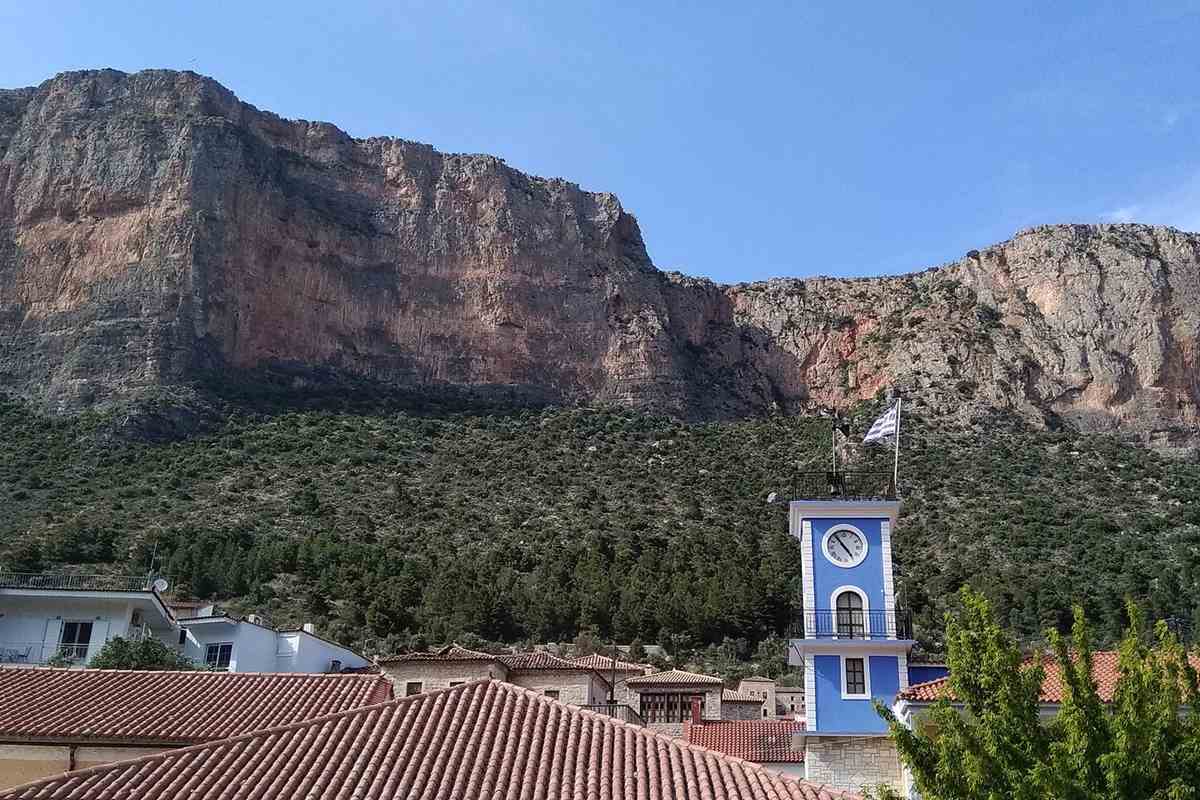
Featured photo: Patrice78500, CC BY-SA 4.0, via Wikimedia Commons.