
Ancient Greek philosophers taught in cities and sanctuaries across Greece, from Athens to Elis and Nicopolis. Small-group trips run across this same country, on the mainland and on the islands. Topics include Socrates, Plato and Aegina, the Academy, the Lyceum and the Stoa Poikile. Epicurus, Diogenes at Corinth, Protagoras, Pyrrho of Elis, Euclid of Megara and Epictetus follow. Separate pages cover Greece archaeological tours, on Ancient Greece tours and on the classical Greece tour. Each one is part of the site’s full list of Greece tours.
Bookings made through the GetYourGuide widgets on this page earn Classical Greece Tours a commission, at no extra cost to the traveller.
Who were the ancient Greek philosophers?
The ancient Greek philosophers were thinkers whose movement arose in the 6th century BC. Their subjects included astronomy, mathematics, ethics, logic, biology and aesthetics, the study of beauty. They stood apart by replacing mythical explanations with reasoned argument about the world.
The philosopher Isocrates said the earliest Greek thinkers went to Egypt for knowledge. One of them was Pythagoras of Samos. Athens became a centre of learning for the ancient Greek philosophers. Sophists and philosophers travelled there from across Greece to teach rhetoric, astronomy and geometry. A sophist was a teacher of rhetoric, the art of persuasive speech.
The Roman orator Cicero said Socrates was the first to bring philosophy down from the heavens. Socrates placed it in cities and families and made it examine life and morals. Socrates, Plato and Aristotle formed what came to be called the Athenian school. Among the ancient Greek philosophers, this group marked the rise of a new approach.
Scholars call the ancient Greek philosophers active before the death of Socrates the pre-Socratics. The label spread after Hermann Diels published Fragmente der Vorsokratiker in 1903. The title means fragments of the pre-Socratics. Greek philosophy continued through the Hellenistic period, the era that followed Alexander the Great. It later evolved into Roman philosophy.
- Influence: Greek philosophy has shaped Western culture and still appears in public education.
- Spread: Movements inspired by Socrates were absorbed by the Muslim world from the 7th to 10th centuries AD.
- Cynicism: Antisthenes, a follower of Socrates, founded Cynicism, a school of living by nature.
The schools that later led thinking across the Roman Empire took shape in the period after Socrates. Each of these movements of the ancient Greek philosophers felt his influence, directly or indirectly. Indirect influence passes through other people rather than straight from the teacher.
What part did Socrates play among the ancient Greek philosophers of Athens?
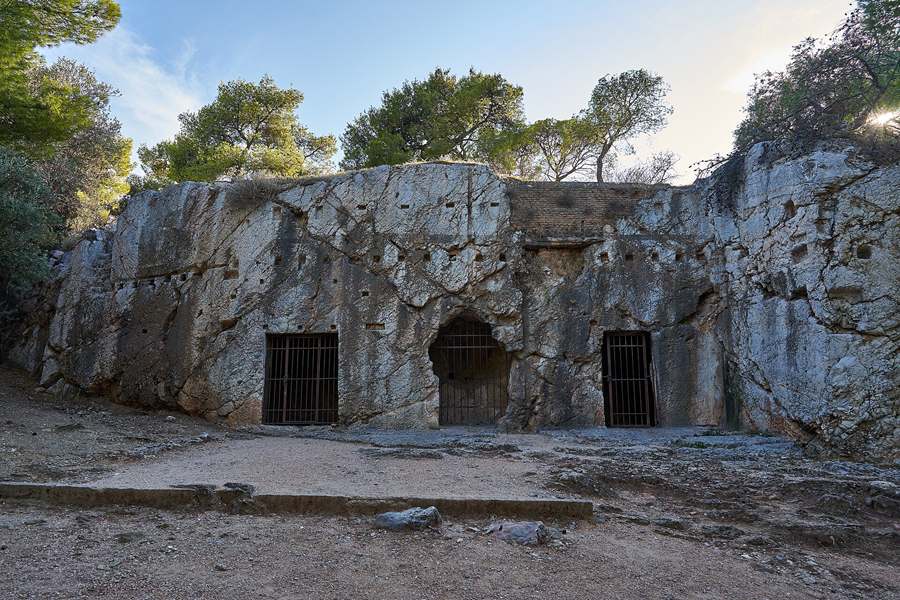
The ancient Greek philosophers of Athens included Socrates, who spent his last day in an Athenian prison. Friends and followers offered him a way to escape, but he refused it. He died the next morning after drinking hemlock, a poison made from a plant.
Socrates inherited part of his father’s estate, as custom required in Athens. This left him reasonably free of money worries. An estate is the land and goods a person leaves behind. Like the wealthy Athenians of his day, he learned reading and writing. He also took extra lessons in gymnastics, poetry and music.
Socrates married Xanthippe when he was already in his fifties. The couple had three sons together. He also married a daughter of Aristides, an Athenian statesman. Which marriage came first is not clear. Plato, another of the ancient Greek philosophers, reports that Socrates served as a soldier during the Peloponnesian War. He distinguished himself in three campaigns.
In 404 BC the Thirty Tyrants took power in Athens. Tyrants, in the age of the ancient Greek philosophers, were rulers who held power unlawfully. Their agents summoned Socrates and four others to the Tholos, a round building. They were told to arrest Leon of Salamis for execution. Socrates alone refused, risking the anger of the tyrants.
- Last words: In Plato’s Phaedo, Socrates reminds Crito that they owe a rooster to Asclepius, the healing god.
- Appearance: His friends joked about his flat turned-up nose, bulging eyes and large belly.
- Youth: Socrates drew great interest from the Athenian public, above all from young Athenians.
Among the ancient Greek philosophers, Socrates held that no person desires what is bad. Anyone who does wrong, he taught, acts unwillingly or out of ignorance. For him, all virtue, meaning moral goodness, was knowledge. Ignorance is simply a lack of knowledge.
How does Aegina enter the story of the ancient Greek philosophers through Plato?
The ancient Greek philosophers include Plato, whose life touched the island of Aegina. A scroll from Herculaneum, by the philosopher Philodemus, says Plato was sold into slavery there. It possibly happened in 404 BC, when the Spartans conquered the island, or else in 399 BC.
After 360 BC, Plato lived out his life in Athens among its ancient Greek philosophers. His final works possibly include the Timaeus, Critias, Sophist, Statesman and Philebus. The list possibly also includes his longest work, the Laws. These works share language, themes and style, as if published together on purpose.
Plato left the Laws unfinished at his death. Philip of Opus, a student at the Academy, edited the text. Scholars also believe Philip wrote the Epinomis, an extra section added to the Laws. Among the ancient Greek philosophers, Plato is credited by ancient tradition with thirty-six dialogues and thirteen letters. A dialogue is a written conversation.
The same scroll describes the last evening of Plato’s life. Feverish, he listened to a Thracian slave girl playing the flute. He complained that she lacked rhythm. Thracian means from Thrace, a region north of the Aegean Sea. At his death, Plato seems to have been self-sufficient but not wealthy. Self-sufficient means able to meet one’s own needs.
- Will: A will kept by an ancient biographer discusses his estate but never mentions the Academy.
- Setting: The Laws does not take place in Athens, and Socrates is absent from it.
- Socrates: Plato’s dialogues feature Socrates, though not always as the leader of the talk.
Among the ancient Greek philosophers, Plato and Xenophon are the main sources on the life of Socrates. Separating the ideas of Socrates from those of Plato is not always easy. Much of what is known of Plato’s teaching comes from Aristotle’s reports.
Why did the Academy matter to the ancient Greek philosophers?
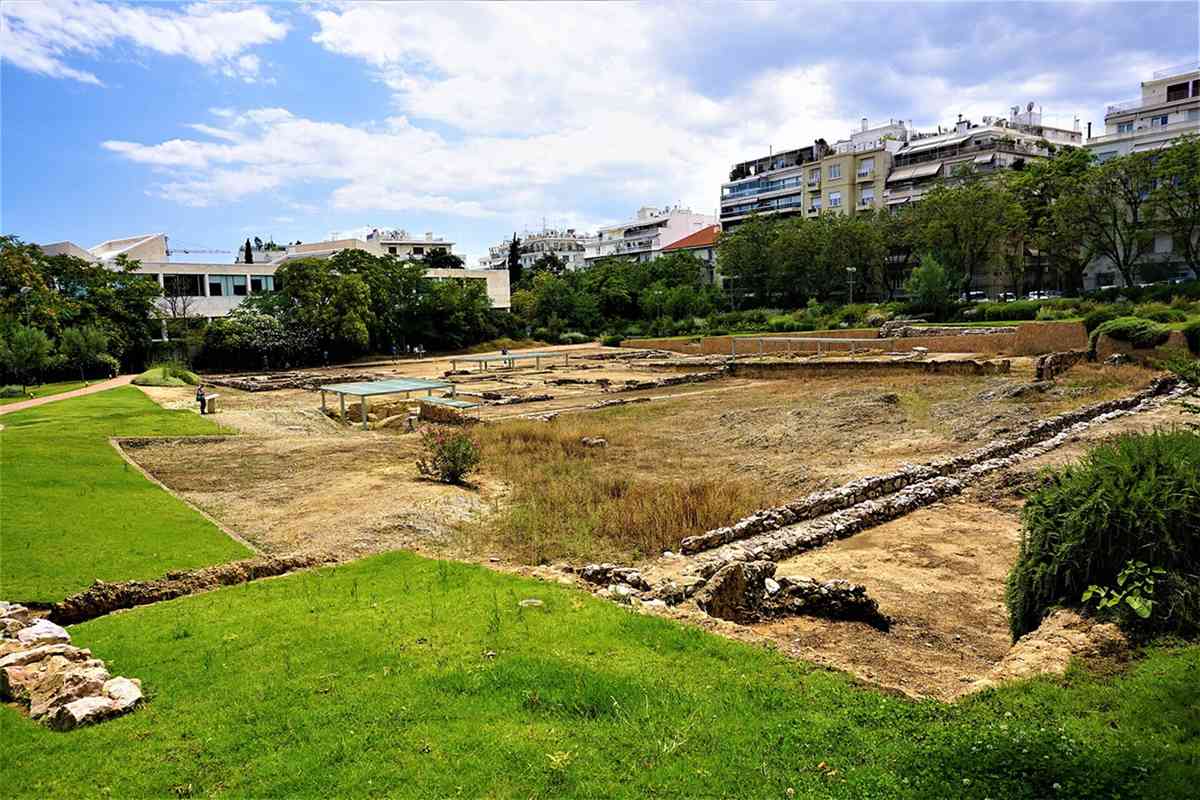
The ancient Greek philosophers of Plato’s circle met at the Academy, a site sacred to Athena. Her worship had gone on there since the Bronze Age, a time of early metalwork. Even before the school existed, Cimon enclosed its grounds with a wall.
Akademos, the hero linked with the site, was credited with helping the Dioscuri. These divine twins were Castor and Polydeuces. He revealed to them where Theseus had hidden Helen. Out of respect for this tie and the long tradition, Spartan invaders spared the groves. Attica is the home territory of Athens.
The school seems to have started when Plato inherited property at thirty. Informal gatherings came first, with Theaetetus of Sunium and Leodamas of Thasos among the ancient Greek philosophers present. In Plato’s time the school taught no fixed doctrine, or official set of beliefs. Plato instead set problems for the other members to study and solve.
Among the ancient Greek philosophers, Philo of Larissa was the last undisputed head of the Academy. A head, or scholarch, led the school and its members. Around 90 BC his student Antiochus began teaching a rival form of Plato’s ideas. When the First Mithridatic War broke out in 88 BC, Philo left Athens for Rome.
- Revival: Proclus reached Athens in the early 430s and found Plutarch of Athens teaching there.
- House: The revived Neoplatonic school met in a large house that Proclus later inherited.
- Last head: Damascius, the final scholarch of the revived Academy, died in 540.
The revived Academy of the ancient Greek philosophers reached its peak under Proclus, who died in 485. Its last members later sought protection from the Persian king Khosrau at Ctesiphon, his capital. They carried precious scrolls of literature and philosophy with them.
What did the Lyceum give the ancient Greek philosophers?
The ancient Greek philosophers of Athens knew the Lyceum as a temple of Apollo Lyceus. Before the Pnyx hill became the official meeting place, the Athenian Assembly met there too. The Assembly was the gathering where citizens voted on public matters.
Scholars think the Lyceum of the ancient Greek philosophers reached north to modern Kolonaki square. Its roads ran east to west through today’s Syntagma Square and Parliament. In Plato’s dialogue Lysis, Socrates walks from the Academy to the Lyceum. He meets two friends near the Panops springhouse, a shelter over a spring.
Xenophon wrote that Athenian troops met at the Lyceum during a Spartan raid. The raiders had set up camp at Dekelaia. The Lyceum gymnasium is thought to date back to Pericles or Pisistratus. A gymnasium was a training ground where young men exercised. Among the ancient Greek philosophers, Isocrates taught rhetoric there in the fourth century BC.
Aristotle was a metic, a foreigner living in Athens. The law barred metics from owning property, so he rented the Lyceum building. There he gathered books for the first European library in history. Later travels of the collection cost one fifth of his works. Tradition credits Andronicus of Rhodes, the eleventh head, with editing what survived.
- Departure: Leaving Athens, Aristotle vowed not to let the Athenians sin twice against philosophy, recalling the fate of Socrates.
- Theophrastus: Though not an Athenian citizen, he bought land near the Lyceum gymnasium in 315 BCE.
- Ruler: Demetrius of Phaleron, who studied at the school, ruled Athens from 307 BCE.
One view holds that the Lyceum was founded afresh in the first century CE. The school of the ancient Greek philosophers then flourished again in the second century. It lasted until 267 CE, when invading Heruli and Goths looted Athens.
Why did the Stoa Poikile give a group of ancient Greek philosophers the name Stoics?
The ancient Greek philosophers known as Stoics took their name from the Stoa Poikile. The word had earlier described poets who gathered there, in the Agora of Athens. Stoa Poikile is Greek for painted porch, a roofed walkway lined with columns.
Alongside his studies, Zeno of Citium became a wealthy merchant. On a voyage from Phoenicia to Peiraeus, the port of Athens, he survived a shipwreck. Diogenes Laertius, a biographer of the ancient Greek philosophers, describes him as haggard and dark-skinned. Despite his wealth, he lived a spare, ascetic life. Ascetic means giving up comforts by choice.
His teacher Crates of Thebes set out to cure his shyness. He gave Zeno a pot of lentil soup to carry through the Ceramicus, the potters’ district. When Zeno tried to hide it in shame, Crates broke the pot with his staff. Among other ancient Greek philosophers, Zeno studied under Stilpo of the Megarian school.
King Antigonus II Gonatas of Macedonia visited Zeno whenever he came to Athens. Zeno declined an invitation to visit the king in Macedonia. He sent his friend and pupil Persaeus instead. He also declined Athenian citizenship, so as not to seem disloyal to his homeland. Citizenship is full legal membership of a city.
- Pupils: Aristo of Chios and Sphaerus were among the students who learned from Zeno.
- Funeral: Athens honoured Zeno with a public funeral after his death.
- Statue: Greeks called him the noblest man of his age and raised a bronze statue to him.
Stoicism, the school of these ancient Greek philosophers, flourished across the Greco-Roman world until the 3rd century CE. Greco-Roman refers to the lands shaped by both Greek and Roman culture. Among its followers was the Roman emperor Marcus Aurelius.
Where did Epicurus set his Garden among the ancient Greek philosophers?
The ancient Greek philosophers who followed Epicurus met in a school he called the Garden. Its name came from a garden he owned, about halfway between the Stoa and the Academy. Epicurus had returned to Athens in about 306 BC and stayed until his death.
Among the ancient Greek philosophers, Epicurus studied on Samos under Pamphilus, a follower of Plato. Once Alexander the Great had died, Perdiccas drove the Athenian settlers off Samos. They were moved to Colophon, on the coast of modern Turkey. Epicurus joined his family there after completing his military service.
Around 311 BC, at about thirty, Epicurus began teaching in Mytilene. His ideas stirred up strife in the city, which forced him out. He next founded a school at Lampsacus. Around then, Zeno of Citium, another of the ancient Greek philosophers, reached Athens aged about twenty-one. Their schools seem to have become rivals only after Epicurus died.
In the first generation, members of the Garden lived as a community with all property held in common. No rigid ranking separated teachers from students. They shared celebrations, festivals, banquets and funerals. The Garden also welcomed women students, among them Themista, Leontion and Nikidion. A banquet is a large formal meal.
- Birthday: An annual rite honoured Epicurus on his birthday, the 20th of the month Gamelion.
- Self-taught: Epicurus denied any debt to earlier thinkers and insisted that he was self-taught.
- Honesty: He taught that honesty must go together with courtesy and kindness.
His successor Hermarchus said Epicurus died slowly and in great pain. A stone had blocked his urinary tract, the passage that carries urine. Even so, he is said to have stayed cheerful. He went on teaching the ancient Greek philosophers of the Garden to the end.
How did Corinth shape the last years of Diogenes among the ancient Greek philosophers?
The ancient Greek philosophers include Diogenes, who spent his later years in Corinth. After his master freed him, he lived alone near a gymnasium called the Craneum. It stood in a cypress grove on the edge of the city, above the harbour.
A doubtful story says pirates seized Diogenes, one of the ancient Greek philosophers, on a voyage to Aegina. They sold him at a slave market on Crete. He asked the auctioneer to sell him to Xeniades, a Corinthian bidder who needed a master. Xeniades then gave him charge of his sons’ education and household.
Dionysius the Stoic says Philip II of Macedon captured Diogenes at Chaeronea, in Boeotia, in 338 BC. Amused by his daring, Philip set him free. In July 336 BC, Diogenes attended the 111th Olympic Games. At the Isthmian Games he even named himself the winner and wore a crown of pine. Corinthians tried to remove it.
Among the ancient Greek philosophers, Diogenes is said to have met Alexander the Great. This is dated to 336 BC, when Alexander took command against Persia at the Isthmus of Corinth. This slim land bridge links the Peloponnese with mainland Greece. Asked his wish, he told the king to stand a little out of his sun.
- Age: Censorinus says Diogenes died aged 81, while Laertius says he lived to about 90.
- Burial: The Corinthians arranged his funeral and buried him outside the walls near the western gate.
- Tomb: Pausanias, writing in the 2nd century AD, noted his tomb among those near Corinth.
The death of one of the ancient Greek philosophers was seen as a final statement on his teaching. Dramatic accounts of Diogenes dying from raw octopus or a dog bite appear to be fictions. The scholar Roubineau sees old age as the best explanation.
What tie does Abdera in Thrace give the ancient Greek philosophers through Protagoras?
The ancient Greek philosophers of Thrace include Protagoras, born in Abdera around 490 BC. His home town lay on the coast opposite the island of Thasos. Plato credits him with inventing the role of the professional sophist, a paid teacher of argument.
Aulus Gellius writes that Protagoras first earned his living as a porter, carrying loads. One day Democritus saw him carrying small pieces of wood. The load was bound with a short cord in a pattern of exact geometry. Seeing a mathematical talent, Democritus, another of the ancient Greek philosophers, took him in and taught him philosophy.
Protagoras became well known in Athens and a friend of Pericles. Plutarch tells of a whole day the two men spent on one legal puzzle. At an athletic contest, a javelin had struck and killed a man by accident. They asked whether the javelin, the thrower or the officials of the games bore the blame.
Among the ancient Greek philosophers, Protagoras taught that the human being is the measure of all things. Plato read this as a denial of objective truth, truth that holds for all. Protagoras seems to have meant that each person’s experience shapes his judgments. He argued that respect for differing opinions lets a community decide through open, democratic debate.
- Speech: Protagoras sorted speech acts into types such as assertion, question, answer and command.
- Grammar: Aristotle says Protagoras studied the classification and correct use of grammatical gender.
- Teaching: He claimed to teach how best to run a household and the affairs of a city.
Plato’s Meno says this early figure among the ancient Greek philosophers died at about 70. His death is presumed to fall around 420 BC. A story of his trial in Athens for impiety, or disrespect to the gods, appears to be fake.
Which link between Elis and Olympia does Pyrrho give the ancient Greek philosophers?
The ancient Greek philosophers include Pyrrho of Elis, a city on the Ionian Sea. He is credited as the first Greek sceptic philosopher and founder of Pyrrhonism. A sceptic is a thinker who doubts that certain knowledge can be reached.
Pyrrho seems to have belonged to the Klytidiai, a clan of seers in Elis. Seers were people thought to read signs from the gods. At Olympia, the clan interpreted the oracles, or divine answers, given at the Temple of Zeus. Pyrrho himself served there as a high priest. The Klytidiai traced their line to Klytios, grandson of Amphiaraus.
His student Timon of Phlius first met Pyrrho at an Amphiareion, a temple of Amphiaraus. Both men were then on a pilgrimage to the sanctuary at Delphi. A pilgrimage means travelling to a sacred site for religious reasons. With Anaxarchus, another of the ancient Greek philosophers, Pyrrho travelled with Alexander the Great to India.
Pyrrho wrote nothing, and his ideas come down mainly through Timon. His chief goal was ataraxia, a Greek word for freedom from mental disturbance. Later Pyrrhonists sought this calm through epoche, the suspension of judgment about beliefs. To reach it, they gathered arguments of equal strength on both sides of a question.
- Socrates: Unlike other Hellenistic founders among the ancient Greek philosophers, Pyrrho was not deeply shaped by Socrates.
- Revival: Centuries after Pyrrho, the thinker Aenesidemus led a revival of his philosophy.
- Outlines: Sextus Empiricus wrote Outlines of Pyrrhonism over 400 years after Pyrrho died.
Pyrrhonism became one of the two major sceptic schools among the ancient Greek philosophers of the Hellenistic age. The other was Academic scepticism, named after Plato’s Academy in Athens. It is uncertain whether Pyrrhonism survived as a small movement or died out and returned.
How did Megara become a home of the ancient Greek philosophers through Euclid?
The ancient Greek philosophers of Megara trace their school to Euclid, who was born in that city. A follower of Socrates, he founded the Megarian school of philosophy. He held that the supreme, or highest, good is one, eternal and unchangeable.
For a time, Athens banned every citizen of Megara from entering the city. Euclid was eager to hear Socrates all the same. He crept into the city after dark dressed as a woman. The preface of Plato’s Theaetetus credits Euclid with writing down a talk between Socrates and young Theaetetus. A preface is the opening part of a book.
Socrates is said to have scolded Euclid for loving eristic disputes. Eristic means arguing in order to win rather than to find truth. Euclid was present at the death of Socrates in 399 BCE. In Megara he offered refuge to Plato and other frightened ancient Greek philosophers from the circle of Socrates.
This school of ancient Greek philosophers at Megara flourished for about a century. His pupils were said to include Ichthyas, the second leader of the school. Eubulides of Miletus, Clinomachus and Thrasymachus of Corinth are named as well. Thrasymachus taught Stilpo, and Stilpo in turn taught Zeno of Citium. Zeno went on to found the Stoic school.
- Writings: Euclid wrote six dialogues, among them the Crito and the Alcibiades, but none survive.
- Names of the Good: He taught that the one Good goes by names such as wisdom, God and Reason.
- Mix-up: Medieval editors confused him with Euclid of Alexandria, author of the Elements.
Euclid rejected argument from analogy, which reasons from the likeness between two cases. Among the ancient Greek philosophers, his heirs the Stoic logicians founded the leading school of logic besides Aristotle’s. Logic is the study of sound reasoning and valid proof.
Why does Nicopolis in Epirus matter to the ancient Greek philosophers?
The ancient Greek philosophers of the Roman age include Epictetus, a Stoic teacher. After his banishment from Rome, he spent the rest of his life in Nicopolis. The city lay in Epirus, in northwestern Greece. Banishment means being forced to leave a place.
Epictetus was born into slavery at Hierapolis in Phrygia, today Pamukkale in western Turkey. The name his parents gave him is unknown. Among the ancient Greek philosophers, Epictetus bore a name meaning gained or acquired. As a youth in Rome, he was the slave of Epaphroditus, a wealthy freed slave.
With his master’s permission, he studied Stoic philosophy under Musonius Rufus. This education raised his social standing. He became disabled at an unknown point in his life. The writer Celsus claimed that his master had broken his leg on purpose. He gained his freedom after Nero died in AD 68 and began to teach in Rome.
Arrian, his best-known pupil, studied with him as a young man around AD 108. Arrian called Epictetus a powerful speaker who made listeners feel what he intended. Emperor Hadrian was friendly with him and possibly heard him at the school in Nicopolis. Among the ancient Greek philosophers, Epictetus lived a life of great simplicity.
- Way of life: He taught that philosophy is a way of living, not only a theory.
- Self-knowledge: For Epictetus, the base of all philosophy was knowing oneself, including one’s ignorance.
- Books: Only four of the original eight books of the Discourses survive today.
In old age, this Stoic among the ancient Greek philosophers adopted a friend’s child who faced death. He raised the child with the help of a woman. His teachings influenced later thinkers, from Marcus Aurelius to Pascal, Montesquieu and Samuel Johnson.
What do travellers ask about ancient Greek philosophers, and what are the answers?
The ancient Greek philosophers of the Cynic school included a woman, Hipparchia of Maroneia, in Thrace. Little of her own thinking survives. Her influence lies in the example of her life. She chose a way of living then considered unacceptable for respectable women.
Which of the ancient Greek philosophers was born in Maroneia?
Hipparchia, a Cynic thinker, was born around 350 BC in Maroneia, Thrace. Her family later moved to Athens. Despite her parents’ disapproval, she married the Cynic Crates of Thebes. She then took up the Cynic life and dressed as her husband did. A Cynic rejected wealth and custom to live by nature.
Why do the ancient Greek philosophers link Crates with Thebes?
Crates was born around 365 BC in Thebes, heir to a large fortune. One account says he gave his money to the people of Thebes. He did so after watching the beggar king Telephus in a tragedy, a serious play. People welcomed him gladly into any house, so he was nicknamed the Door-Opener.
Who among the ancient Greek philosophers founded the school of Eretria?
Menedemus was born at Eretria, on the island of Euboea, and founded the Eretrian school. Like his father Cleisthenes, he worked as a builder and tent maker. A military expedition took him to Megara, and from there he visited the Academy in Athens. He then resolved to devote himself to philosophy.
Which of the ancient Greek philosophers made Rhodes a centre of teaching?
Posidonius, born in Apamea in Syria, settled as a teacher in Rhodes. His fame drew scholars to the island. He gained citizenship there and ran his own school. It became the leading institution of the time. He also served as one of the Prytaneis, the highest political office on Rhodes.
Featured photo: Joyofmuseums, CC BY-SA 4.0, via Wikimedia Commons.