
Greek pies set fillings of greens, cheese, meat or honey inside pastry, from Crete up to Epirus. Cooking classes and food walks with a host run in Athens, Thessaloniki, Nafplio and Chania. Topics stretch from kalitsounia, Sfakianopita and Batzina to placenta cake and melopita of Sifnos. Ionian, Macedonian and Milos pies close the page. More sits under Greek food, Greek cheese and Greek street food. For trips across the whole country, browse Greece tours.
Bookings made through the GetYourGuide widgets on this page earn Classical Greece Tours a commission, at no extra cost to the traveller.
What are Greek pies?
Greek pies, known locally as pitas, set a filling inside pastry. Hortopita holds wild or cultivated greens. Kolokithopita sets pumpkin and feta between two layers of filo, a very thin pastry sheet. Regional versions exist beyond the mainstream forms across the country.
Greek pies built on spinach carry two names. Spanakopita is the plain term for spinach pie, and spanakotiropita means spinach-cheese pie, especially in northern Greece. Not every recipe uses thin filo. Village-style pastry, called horiatiko, gives a thicker crust, and puff pastry serves as another option. Tsouknidopita is a nettle pie.
A cheese pie in Greek cooking is called tiropita, and the filling is feta. Related to these Greek pies is börek, a wide family of pastries. It spreads across the Balkans, the Middle East and Central Asia. It is also tied to Armenia. Its thin flaky dough takes fillings such as meat, cheese, spinach or potatoes.
Filo, the thin sheet dough behind Greek pies, has a disputed origin. One camp credits the ancient Greeks, and another credits the imperial kitchens of Topkapı Palace in Istanbul. The Turkish word yufka is a modern term for the same dough. Yufka is thicker, though, and prepared differently from filo.
- Mini pies: Tiropitakia are mini cheese pies, made from filo triangles and stuffed with feta.
- Kourou dough: One version of tiropitakia swaps the filo for a pastry called Kourou dough.
- Sweet pumpkin: Kolokythopita also comes as a sweet pie, made with yellow or red pumpkin.
Greek pies also have relatives abroad. In Romania, plăcintă counts as a variation of the filo-wrapped pie, traditionally stuffed with cheese. Börek was a popular part of Ottoman cooking. Other earlier versions go back to Greek and Roman times in the Classical era.
How do kalitsounia belong among Greek pies?
Greek pies on Crete include kalitsounia, small snacks of cheese or herbs tied to the island. Cooks either bake or fry them, depending on whether the wrapping is dough or filo. They are served across all of Crete.
The Chania region makes salty kalitsounia with mizithra, a mild whey cheese produced locally. Whey is the watery part of milk left after cheese making. Other salty versions from Chania drop the cheese and use herbs from the Cretan land. Sweet kalitsounia also hold mizithra, but cooks pour honey on top.
Greek pies of the Lasithi region lean towards the sweet side. Kalitsounia there are mainly sweet, with a dough case around mizithra and cinnamon. Lemon zest, the grated outer peel of the fruit, sometimes joins the mix. In the Chania prefecture, small mountain villages and popular restaurants alike serve them.
For cheese kalitsounia, cooks grate the whey cheese and mix it with eggs and finely chopped herbs. The eggs help the filling of these Greek pies hold together. With no salt added, fresh mizithra tastes almost sweet and milky. It is sold fresh, much like Italian ricotta, and also as a salt-dried cheese for grating.
- Everyday uses: Besides pastries, mizithra appears as a table cheese and in salads and baking.
- Meze: With olives and tomato, mizithra serves as meze, a spread of small dishes.
- Dessert: Mizithra also comes to the table as a dessert with honey.
Greek pies such as kalitsounia count as a treat, and both filling and serving style vary. Cretan cuisine lists them among its appetisers, which are small starters. Stafidota, cookies with a raisin stuffing, and apáki, a smoked meat, sit on the same list.
What does the Sfakian pie add to Greek pies?
Greek pies from Sfakia, in Crete, include Sfakianopita, also called Sfakiani pita. It is a thin flat pie fried in a pan, filled with mizithra and topped with honey. Sesame seeds sometimes go on too, and it also serves as a dessert.
Cooks twist sarikopita, a cheese pie, into a shape that resembles the sariki. The sariki is a type of traditional headwear on Crete. These Greek pies sit with appetisers in Cretan cooking, along with mizithropita, a flatbread stuffed with mizithra. Marathopita and kolokythopita, the pumpkin pie, also appear on that list.
Meat also fills Greek pies on this island. Kreatotourta is a meat pie linked to western Crete. Tzoulamas, another traditional meat pie, comes from Messara. In the traditional Cretan diet, red meat appeared only a small number of times a month. Poultry and fish came weekly in moderate amounts.
Mizithra goes notably into little cheese pies the size of a handful and into Sfakiani pita. Traditional Cretan pastry based on honey was eaten a small number of times a week. Among Greek pies of a sweet kind, amygdalopita, or almond pie, is listed as a Cretan speciality. Yogurt and fresh fruit were the commonest dessert.
- Sweet specials: Patouda and xerotigana appear among the dessert specialities of Cretan cooking.
- Sfakia cooking: Tsigariasto, a dish of lamb or goat, is also tied to the Sfakia region.
- Cretan cheeses: The Cretan list of appetisers also names the cheeses xygalo and pichtogalo.
Greek pies of Crete sit in a wider local kitchen. Moderate alcohol, mainly red wine, accompanied meals. Hirino me selino pairs pork with celery, and cuttlefish meets fennel in soupies me maratho. Gamopilafo uses a goat and rooster broth for its rice.
Which Greek pies come from Epirus and Aspropotamos?
Greek pies run deep in Epirus. The traditional cooking of this region rests mostly on butter, cheese and other dairy foods. Local pites, or pies, include kasiopita, kothropita, kimadopita, pepéki, kasiata and blatsariá. Stegnopita is known as the dry pie.
Among these Greek pies, kasiopita also goes by the name kikitsopita. Another entry, kassiopita, appears on the regional Epirus list of desserts as a flour pie. Blatsara and amygdalopita share that list. Flogera, from Metsovo in the same region, sits beside them too. Spoon sweets also belong to that list.
Aromanians are a small Balkan ethnic group scattered through the region. Among their villages in Greece, Metsovo stands out for its cheeses. Metsovone and Metsovela lead in popularity, and Graviera is also made there. Typical Metsovo dishes include pies filled with vegetables and mushrooms, along with meats and sausages.
Greek pies of Aromanian origin include Batzina, popular in the area of Aspropotamos. One published book covers the local cooking there. Aromanian cooking as a whole draws strongly on both Mediterranean and Middle Eastern food. Aromanians in Romania also make vegetable pies, especially ones with leek. Those Aromanians also make cheese and eat poultry on normal days.
- Cheese factory: A foundation factory running since 1958 makes a large share of Metsovo cheese.
- Epirus cheeses: Anthotyros, galotyri, kaskavali, kefalotyri and vasilotyri all appear among the cheeses of Epirus.
- Frog legs: Frog legs rank among the listed specialities of Epirus, next to the local pies.
Greek pies at Metsovo share the table with bean soup, and local wine can go with them all. Aromanians live in Serbia, Romania, North Macedonia, Greece, Bulgaria and Albania. Greek wine also appears on the Epirus list of desserts and drinks.
How does placenta cake connect to Greek pies?
Greek pies have an ancient relative in placenta cake, a dish of old Greece and Rome. Layers of dough alternated with a cheese and honey mixture, flavoured with bay leaves. Baking came next, then a covering of honey.
In the word history of Greek pies, Latin placenta comes from the Greek plakous. That word meant thin or layered flat breads. Its root, plakoeis, means flat. The placenta of mammal pregnancy takes its name from a perceived likeness to the cake. Classical texts mention the dish, including Greek poems by Archestratos and Antiphanes.
An early Greek mention of plakous as a dessert comes from the poems of Archestratos. He describes it served with nuts and dried fruits, and he praises the honey-drenched Athenian version. Andrew Dalby places the later recipe of Cato the Elder in the Greek tradition. Dalby also sees it as possibly copied from a Greek cookbook.
Greek pies on Lesbos keep the old name alive. There, plakous means a baklava-type dessert of layered pastry leaves holding crushed nuts. It is baked, then covered in honey. Thin leaves of crumbly dough, soaked in simple syrup, form the base. Ouzo, a Greek spirit, goes into the dough.
- Byzantine sweet: Koptoplakous, a sweet of the Byzantine era, is named by scholars as an ancestor of baklava.
- Cato critic: Food writer Mark Kurlansky calls the recipe of Cato incomprehensible and inedible if followed literally.
- Viennese link: The Viennese palatschinke, a very thin crepe-like pancake, counts as a surviving variant of the dish.
Greek pies aside, placenta cake is thought to be related to baklava. A later Arabic name for the dessert, iflaghun, appears in a medieval Arab cookbook. The dish possibly reached the Levant, the eastern Mediterranean coast, in the Middle Ages.
Which sweet Greek pies follow melopita from Sifnos?
Greek pies turn sweet with melopita, or honey pie, a honey cheesecake tied to the island of Sifnos. Other sweet versions carry syrup, fruit or milk. Giaourtopita, for one, is a yogurt pie in the form of a cake with syrup.
Petimezopita, named after petimezi, comes as a cake of grape syrup. Sousamopita, the sesame pie, also comes as a cake with syrup. Sokolatopita follows the same form with chocolate. Milopita means apple pie, though it takes the form of an apple cake. Each of these Greek pies sits in the dessert section of the national cuisine.
Patsavouropita is a traditional filo pie that goes two ways. One version is sweet with custard, the other savoury with cheese. Copenhagen is a Greek cake of two filo layers, with syrup and butter. A cream filling sits between those layers. The ancient Greek name for grape syrup was siraios, in a group called hepsema, meaning boiled.
Petimezi, the syrup behind petimezopita, also goes by the name epsima. Cooks reduce it until it turns dark and thick, and it keeps indefinitely. Before cheap cane sugar, Greek cooks relied on it as a sweetener, with carob syrup and honey. Beyond Greek pies, it still appears in desserts and as a sweet topping.
- Galatopita: Galatopita translates as milk pie, and it takes the form of a milk cake.
- Ancient writers: Playwright Aristophanes and the physician Galen both make a reference to grape syrup.
- Grape syrup: Cooks make grape syrup by boiling grapes, removing the skins and sieving out the juice.
Greek pies named after petimezi carry a Persian word, since petimezi comes from petmez. Turkey calls the same syrup pekmez. Grape syrup also commonly tops sweet cakes. Its thick sweetness comes from a high share of sugar against water.
What do travellers ask about Greek pies, and what are the answers?
Greek pies in Macedonia belong to a kitchen close to wider Greek, Balkan and Mediterranean cooking traditions. It also inherits much from Ottoman cuisine. Asia Minor Greek, Aromanian, Pontic Greek, Armenian and Sephardi Jewish communities all shaped its dishes.
Which Greek pies belong to the Ionian Islands?
Cephalonia lists kreatopita, a meat pie, among its notable dishes. The same island has tsouknidopita, the nettle pie. On Othonoi, the local list includes patatopita, or potato pie. Lefkada adds galatopita, served as a dessert. Corfu has pastitsio, a baked pasta dish, on its own list. The cooking of the group is called Heptanesean cuisine.
Which Greek pies come from Greek Macedonia?
Kolobarina, from Chalkidiki, is a kolokythopita, or pumpkin pie, made without filo. Manitaropita is a mushroom pie. Galatopita, a milk pie, has a well-known Sarakatsani version from Pieria. Moustopita also features on the regional dessert list. Greek refugees from Asia Minor brought Anatolian elements to the region in the early 20th century.
Which Aegean islands add Greek pies to the list?
Pitarakia are mini pies shaped like half-moons, and they come from Milos. Their filling is mizithra cheese. Karpouzopita, the watermelon pie, also comes from Milos and takes the form of a cake. On Skopelos, local feta goes into cheese pie and other vegetable pies. Olive oil forms the basis of all traditional recipes there.
How does the word pita travel beyond Greek pies?
In Bosnia and Herzegovina, burek also goes by the name pita. It is made with yufka, the Turkish name for filo. The same spiral pastry holds cottage cheese as sirnica and spinach with cheese as zeljanica. With potatoes, it becomes krompiruša. All of them are generically called pita.
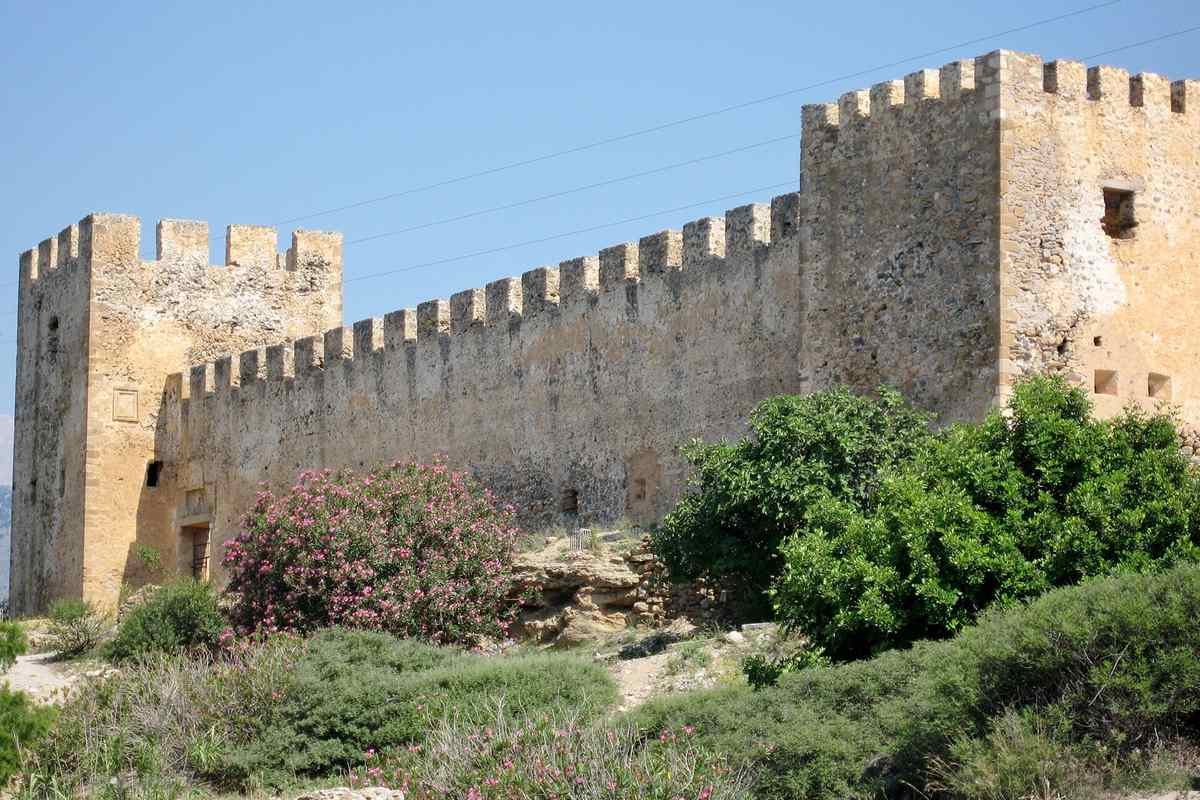
Featured photo: Olaf Tausch, CC BY-SA 3.0, via Wikimedia Commons (File:Frangokastello Südseite.jpg).