
Saronic islands travel centres on the scattered isles of the Saronic Gulf, just off Athens. Small-group trips there run with a local host. Topics run from Aegina, the Temple of Aphaia, King Aeacus and Telamon to Salamis and Cychreus. Ajax the Great, the Battle of Salamis, Revythousa, Poros, Hydra, Spetses and Dokos follow. Nearby reading covers Greek islands near Athens, day trips from Athens and a 5 day Greece itinerary. Wider options sit under Greece tours.
Bookings made through the GetYourGuide widgets on this page earn Classical Greece Tours a commission, at no extra cost to the traveller.
Which are the Saronic islands?
The Saronic islands lie in the Saronic Gulf, near Athens. Attica, the region that also contains Athens, takes in Salamis, Aegina, Angistri, Poros, Hydra and Spetses. Its island list also names Kythira and Antikythera, which belong to the same region.
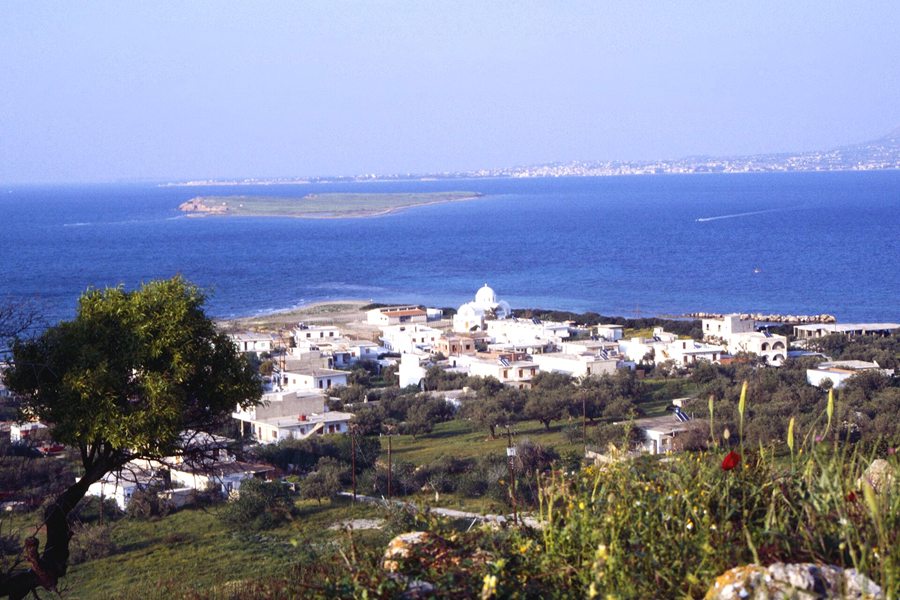
Another name for the Saronic islands is the Argo-Saronic Islands, and they form an archipelago. That word means a cluster of islands spread across one stretch of sea. It began as the ancient Greek name for the Aegean Sea. Later the name passed to the islands inside the Aegean. It now serves for any group of islands.
Patroklos is a smaller island in the same gulf. In ancient times people called it Patroklou Charax, the Camp of Patroclus. A second old name was Patroklou Nesos, the Island of Patroclus. Both names honour Patroclus, an admiral who built a fortified base there. A fortified base is a camp protected by walls.
The refineries of the gulf around the Saronic islands make the larger share of Greece’s refined petroleum products. A refinery is a plant that turns crude oil into fuels and similar goods. Petroleum is the oil drawn up from under the ground. A large part of the refined output then leaves Greece as exports.
- Location: Patroklos lies about 65 km from Athens and 3 km from Sounion.
- Old port: Cenchreae, a harbour of ancient times, once stood on the shores of the Saronic Gulf.
- Province: The old province of Aegina covered today’s Aegina and Agkistri municipalities until 2006.
Salamis, one of the Saronic islands, lent its name to a naval clash with the Persians. That win turned the course of the wars between the Greeks and Persia. It also lifted Athens to the rank of a leading power in classical Greece.
What layers of history does Aegina add to the Saronic islands?
The Saronic islands include Aegina, whose story runs back to the Bronze Age. Digs at Cape Kolonna found a purple dye workshop from the 16th century BC. A dye workshop was a place where cloth or thread took on colour.
Aegina, one of the Saronic islands, gave Persia earth and water in 491 BC. These were symbols of submission. Submission here means yielding to a stronger ruler. The Spartan king Cleomenes I later seized ten leading citizens of Aegina. He left them at Athens as hostages, people held to force a promise.
Athens also plotted with Nicodromus, leader of the democratic party on Aegina. The plot aimed to hand the island over to Athens. A democratic party sought rule by the citizen body. A treaty of 445 BC, the Thirty Years’ Peace, later promised Aegina its autonomy again. Autonomy means self-rule. That clause never took effect.
In 431 BC, during the first winter of the Peloponnesian War, Athens set up a cleruchy on Aegina. The old Aeginetan population was expelled at the same time. Expelled means forced to leave. A cleruchy was a settlement of Athenian citizens on land that Athens held abroad. The Peloponnesian War set Athens against Sparta and its allies.
- Spartan base: During the Corinthian War, Sparta ran its campaigns against Athens from Aegina in the Saronic islands.
- Refuge: The Chronicle of Monemvasia says Corinthians fled to Aegina from Slavic raids on the mainland.
- Venice: In 1425 Alioto Caopena, ruler of Aegina, put the island under Venetian protection by treaty.
The Orphanage of Kapodistrias on Aegina, one of the Saronic islands, served wider needs. Its rooms held a military academy and the National Printing Office. The National Public Library and the National Archaeological Museum also found space there.
What makes the Temple of Aphaia a landmark of the Saronic islands?
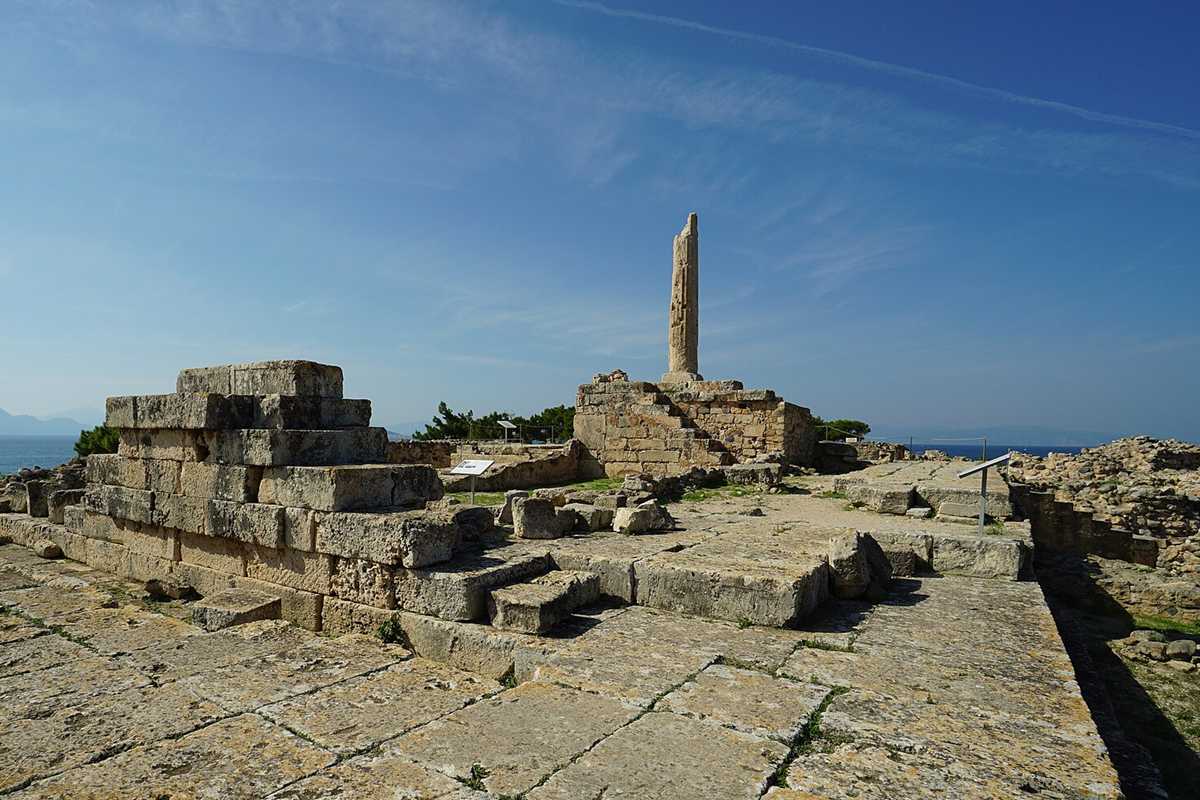
The Saronic islands hold the Temple of Aphaia on Aegina. Its pediment sculptures are thought to show the shift from Archaic to Early Classical carving. A pediment means the triangular space under each end of a sloping temple roof.
The poet Pindar wrote an ode for Aphaia at the wish of the Aeginetans. An ode is a formal poem of praise. Later, Aphaia came to be linked with the goddesses Athena and Artemis. She was also identified with Britomartis, a nymph. A nymph is a minor goddess of nature in Greek myth.
Bronze Age figurines found at this sanctuary of the Saronic islands outnumber the pottery remains. The Bronze Age was the long era when tools and weapons were made of bronze. A figurine is a small statue. Diggers also found large numbers of tiny pottery chariots and thrones. Miniature vessels, meaning toy-sized pots and cups, turned up too.
During the Persian Wars, part of the east pediment on this temple of the Saronic islands was destroyed. The ancient damage was possibly the work of a thunderbolt. A thunderbolt is a sudden strike of lightning. The Persian Wars set the Greek city-states against the Persian Empire. A city-state ruled itself and its own lands.
- Bassae: A 5th-century BC potsherd, a broken bit of pottery, from Bassae possibly bears a dedication to Aphaia.
- Roof statues: Each central roof ornament had a pair of kore statues, meaning maiden figures, one either side.
- Appearance: Aeginetans claimed that Britomartis had once appeared to them in person on Aegina.
On Aegina, in the Saronic islands, the local people gave Britomartis their own title, Aphaia. On Crete the same goddess bore the title Diktynna of the Nets. An epithet is such a title, added to a name to describe a god.
Which legends of King Aeacus belong to the Saronic islands?
The Saronic islands claim King Aeacus, the mythical ruler of Aegina. Legend says he was called on to settle disputes among men and even among the gods. A dispute is a quarrel that needs a fair and final decision.
The poet Pindar kept a legend that links the Saronic islands to Troy. Apollo and Poseidon took Aeacus on as their helper in raising the walls. When the work ended, three dragons rushed at the wall. Two fell dead at the parts the gods had built. The third broke into the city through Aeacus’s stretch.
The poet Ovid placed a disaster on Aegina, one of the Saronic islands, under Aeacus. Hera, jealous of the nymph Aegina, struck the island named after her. She sent a plague or a terrible dragon, killing nearly everyone. These legends seem to recall how Aegina was settled. Pelasgians came first, then colonists from Phthiotis and Phlius.
Apollo then made a prophecy about Troy. He foretold the city’s fall at the hands of the Aeacidae, the descendants of Aeacus. A prophecy is a statement about the future, here from a god. His sons Telamon and Peleus later joined Heracles against Troy. His great-grandson Neoptolemus was among those inside the wooden horse.
- Symbols: Artists gave Aeacus a royal staff, or sceptre, plus the keys of Hades, the realm of the dead.
- Plato: Plato made Aeacus the judge of souls from Europe arriving in the underworld.
- Homer: The Iliad calls Achilles Aiakides, a name marking him as a descendant of Aeacus.
Royal families later traced their roots to this king of the Saronic islands. The kings of Epirus claimed to belong to his line. So did Olympias, whose son was Alexander the Great. Epirus was a kingdom in the north-west of the Greek world.
How does Telamon link two of the Saronic islands?
The Saronic islands claim Telamon as a hero of Aegina. Myth made him the son of King Aeacus of Aegina and Endeis, a mountain nymph. A nymph is a nature spirit in female form, and this one dwelt on a mountain.
The name of this Saronic islands hero means broad strap in ancient Greek. Telamon and Peleus were close friends of the hero Heracles. Together they aided him on his campaigns against the Amazons. The Amazons were a people of women warriors in Greek myth. Heracles was a great hero of Greek legend, famed for his strength.
An earlier account by Pherecydes of Athens tells the story differently. In it, Telamon and Peleus were friends rather than brothers. Telamon’s parents were Actaeus and Glauce. Glauce was the daughter of Cychreus, king of Salamis, one of the Saronic islands. In that account he married Periboea, daughter of King Alcathous of Megara.
Apollodorus recorded a story from the siege of Troy. Telamon was the first man to break through the Trojan wall. Heracles had wanted that glory for himself and flew into a rage. During a siege, troops ring a walled city and cut it off from supplies. Apollodorus was a Greek writer whose Library gathers old myths.
- Song: An ancient Greek song called the Telamon survives only as a name in plays.
- Opening words: The song began by hailing the son of Telamon, warlike Ajax, as bravest after Achilles.
- Temple scene: On the Aphaia temple’s east pediment, Telamon battles King Laomedon of Troy at the side of Heracles.
Heracles lifted his sword to strike Telamon down. This hero of the Saronic islands acted quickly. He piled nearby stones into an altar in honour of Heracles. An altar serves as a raised table for offerings to a god.
What stories does Salamis Island hold among the Saronic islands?
The Saronic islands include Salamis, an island with a long shared past. Settlers from Aegina are thought to have colonised it first. The city of Megara later occupied the island. To colonise means to found a settlement in a new land.
Among the Saronic islands, Salamis has moved its capital over the ages. Strabo placed the ancient capital in the south of the island. In modern times the capital lies on the west side. Strabo wrote about geography, the study of lands and places, in Greek. A capital is the chief town, where the island’s leaders sit.
One find from the Saronic islands is a marble counting board from Salamis. It is thought to have served the Babylonians in about 300 BC. It seems closer to a games board than a calculating tool. Carved Greek symbols and parallel grooves mark its surface. A groove is a long, narrow cut in a hard surface.
Village names on Salamis carry plain meanings. Psili Ammos means Fine Sand, a name earned by its covering of sand. Peristeria takes its name from the dove, the bird of peace. The village earned that name as a quiet spot, far from cars and noise. The Greek word peristeri means dove.
- Batsi cave: A mountain cave near Batsi, in the north of Salamis, awaits its first archaeological study.
- Vasilika: By population, Vasilika ranks third on Salamis, behind Salamis City and Aianteio.
- Poet’s cottage: The poet and playwright Angelos Sikelianos kept a cottage near the Monastery of Faneromeni.
Salamis marks its famous sea battle every year. The annual festival called the Salaminia commemorates that naval battle. To commemorate is to keep an event alive in public memory. Other festivals on this member of the Saronic islands include the Carnival and a Fisherman’s Festival.
Why does Cychreus matter to the Saronic islands?
The Saronic islands remember Cychreus as a legendary king of Salamis Island. Legendary describes a figure from old tales, not from written history. His tales come from Greek mythology, the body of old Greek stories about gods and heroes.
Among the Saronic islands, one version makes Cychreus a dragon-slayer. A serpent named Cychreides was terrorising Salamis, and he killed it. After that deed he was made king. Another version has him raise the serpent as a pet. The creature later caused havoc across the island. Havoc means wide damage and disorder.
In that second story, a man named Eurylochus captured the serpent or drove it away. He then gave it to Demeter, who kept it for herself. A serpent is a large snake. Demeter was the Greek goddess of grain and the harvest. A third version calls Cychreus himself the dragon, because of his short temper.
In that third version, Demeter later received Cychreus at Eleusis. There, this king from the Saronic islands served as her high priest. A priest leads worship and makes offerings to a god. A high priest ranks above every other priest of that god. Offerings are gifts, such as food, wine or animals, given to a god.
- Solon: Seeking Salamis from Megara, Solon of Athens asked the oracle, a shrine of prophecy, at Delphi.
- Sacrifices: On the oracle’s instructions, Solon made sacrifices to Cychreus and to other heroes of Salamis.
- Sanctuary: Themistocles later set up a sanctuary for Cychreus on Salamis, a holy place in his honour.
Herodotus reports a sign seen before the Battle of Salamis, beside the Saronic islands. A serpent appeared on the Athenian ships, and people saw Cychreus in it. Herodotus was a Greek historian who wrote the story of the wars with Persia.
Which tales tie Ajax the Great to the Saronic islands?
The Saronic islands claim Ajax the Great as a hero of Salamis. Tradition says the hero helped the Greek side during the Battle of Salamis. A tradition is a belief passed on between generations. That battle was a sea fight against Persia.
Folk etymology explained his name through the verb aiazo, meaning to lament. On that reading, the name of this Saronic islands hero means one who laments, or mourner. Folk etymology is a popular guess about a word’s origin. Such guesses link a name to a familiar word that sounds alike.
In Homer’s Iliad, this Saronic islands hero is never wounded in any battle the poem describes. He also meets the Trojan hero Hector in a duel. Heralds acting for Zeus finally declare a draw. The two men then swap gifts. Ajax hands over a purple war-belt, and Hector gives a silver-studded sword. A herald is a messenger.
Ajax and his brother Teucer fought as a pair. Teucer was famed for his skill as an archer, a fighter armed with a bow. In battle, Ajax held his great shield in front. Teucer stood behind it and picked off Trojan fighters one at a time. Trojans were the people of Troy.
- Battle record: The writer Hyginus says Ajax killed 28 people in total at Troy.
- Solon’s line: Solon is said to have added a line to the Iliad to back Athens’ claim to Salamis.
- Palace: An ancient palace near Kanakia on Salamis covers 750 square metres, with an estimated 30 rooms.
An Etruscan tomb in Bologna, dated to the 5th century BC, names the hero of the Saronic islands. Its inscription reads aivastelmunsl, meaning family of Telamonian Ajax. The Etruscans were an ancient people of Italy. Telamonian means son of Telamon.
How did the Battle of Salamis unfold beside the Saronic islands?
The Saronic islands recall a famous sea battle fought in narrow waters. Before Salamis, the Athenian leader Themistocles argued that battle in close conditions favoured the Greeks. Close conditions means cramped sea space, where big fleets lose room to turn.
Not every commander in the Saronic islands agreed. The Corinthian commander Adeimantus wanted the fleet to gather off the coast of the Isthmus. That isthmus, near Corinth, links the Peloponnese with mainland Greece by a thin strip of land. On the Persian side, Xerxes and his chief adviser Mardonius pressed for an attack.
Artemisia, a queen serving in the Persian fleet, gave Xerxes different advice. She urged him to wait, judging a battle in the straits to be an unneeded risk. Straits are tight sea passages between two shores. Xerxes meant to watch closely and note the names of commanders who fought well.
Off the Saronic islands, historians think the allied Greek fleet formed two ranks. A single line of ships did not fit the cramped straits. A rank is a row of ships set side by side. Each rank stood behind the one in front. The allies were Greek city-states that joined forces against Persia. An ally is a partner in war.
- Psyttaleia: Xerxes posted about 400 troops on Psyttaleia to kill or capture shipwrecked Greeks.
- Egyptian ships: Diodorus says the Egyptian fleet sailed round Salamis to block the northern exit.
- Battle line: Athenian ships held the left of the allied line, with Spartan ships thought to hold the right.
The Greeks pushed back the first line of Persian ships in the Saronic islands’ narrow waters. Those ships then fouled the second and third Persian lines still moving forward. To foul means to tangle with another ship, so oars and hulls clash.
What role does Revythousa play among the Saronic islands?
The Saronic islands include Revythousa, a tiny island of the gulf where nobody lives at all. Since 1999 it has hosted a terminal for liquefied natural gas. That terminal ranks among the key national infrastructures in all of Greece.
Liquefied natural gas, or LNG, is natural gas cooled until it turns into a liquid. Infrastructure means the basic works a country relies on. This terminal of the Saronic islands is one of three supply sources for the National Gas Transmission System. It also counts among ten similar stations across the Mediterranean and Europe.
Tankers carry the gas to Greece in liquid form. At this Saronic islands terminal the cargoes are unloaded and received. A tanker is a ship that carries liquids in bulk. The liquid gas then goes into two storage tanks. The tanks hold 130,000 cubic metres in all. A cubic metre is a unit for measuring volume.
Special units on this Saronic islands site then turn the liquid back into gas. That gas powers the National Natural Gas System of Greece. A gas system is a network of pipes that carries gas to users. Warming the liquid reverses the cooling that made it liquid in the first place.
- Location: Revythousa sits in the bay of Pachi Megara, off the coast of Agia Triada.
- Upgrade: Work to upgrade the Revythousa terminal reached completion in October 2007.
- Capacity: The plant’s gasification rate rose to 1,000 cubic metres of gas per hour, from 271.
The upgrade lets the station take in and process up to triple its earlier amount of gas. It now supplies the national system with 5.2 to 5.3 billion cubic metres a year. A billion is a thousand million.
What does Poros add to the long story of the Saronic islands?
Saronic islands archaeology on Poros starts at Kavos Vasili, in the northeast. There, digs uncovered remains of an Early Bronze Age settlement. No older settlement is known in the wider Trizinia area. Bronze, the metal of that age, mixes copper with tin.
Within the Saronic islands, the Kavos Vasili settlement is believed to be tied to a wreck near Dokos. That wreck dates to the same period. The death of Alexander the Great came in 323 BC. After it, the Ptolemies of Egypt occupied Calauria, the northern part of Poros. The Ptolemies were the royal house that ruled Egypt.
From 86 BC to 395 AD, Poros sat inside the Roman Empire alongside Trizina. Poros was a tributary of Trizina. A tributary is a place that pays regular dues to a stronger neighbour. Ottoman rule came to Poros in 1715. Elsewhere in Greece, it had begun far earlier. The Ottomans were a Turkish ruling dynasty.
Among the Saronic islands, Poros had its own fleet. Hydra and Spetses had fleets of greater fame. The Poros fleet took little part in sea battles. Russia later kept a naval base on Poros. By the early 20th century, a single Russian watchman was left to guard it.
- Farming: Early 20th-century islanders grew wheat, grapevines and olives, and also fished and kept livestock.
- Arvanites: Records from 1688 list Arvanites, Greeks of Albanian descent, among the people of Poros.
- Pirates: Pirates ruled the Aegean in Byzantine times and struck Poros and other islands again and again.
In 1484, Venetian forces seized this Saronic islands port. They made it a strategic base for their sea war against the Ottomans. The Venetians came from Venice, a sea republic in northern Italy. Strategic means important for war plans.
How did Hydra become a sea power among the Saronic islands?
Saronic islands seafaring took root on Hydra because the island’s ground was infertile. Infertile ground is poor for growing crops. Farmers and herders had settled Hydra again in the 8th century BC. They possibly sailed over from Ermioni, a port on the mainland.
In ancient times, the population of Hydra was very small. Apart from brief mentions by Herodotus and Pausanias, it left little record. Herodotus wrote history, while Pausanias described the places he visited. Pirates later threatened the islands of the region. On other islands, people escaped by moving inland. On Hydra, that was essentially impossible.
Among the Saronic islands, Hydra drew big families at the end of the 16th century. They came from Greek lands and from Asia Minor. Asia Minor is the broad peninsula of western Asia, now within Turkey. Fighting between Venice and the Ottoman sultans slowed shipping on Hydra. Growth came only after 1718 and the Treaty of Passarowitz.
During the first half of the 18th century, Hydriots kept their trade within the Aegean. Hydriots are the people of Hydra, one of the Saronic islands. Their ships went as far as Constantinople, now called Istanbul. By 1771, up to 50 vessels from across Greece lay in Hydra’s roads. Roads are sheltered waters where ships anchor offshore.
- Enterprise: Each Hydriot vessel turned into a small trading business in its own right.
- Steam: The old shipowning families of Hydra failed to foresee the gains of steam-powered shipping.
- Sponges: After the old fleet faded, fishing for sponges became the mainstay of the island’s economy.
The province of Hydra sat within the Argolis and Corinthia Prefecture between 1833 and 1942. A prefecture was a regional district run by the Greek state. The province of Hydra, in the Saronic islands, was later abolished in 2006.
Why does Dokos matter to the archaeology of the Saronic islands?
Saronic islands maps show a thin strait that parts Dokos from the Peloponnese. On certain maps, that strait carries the name Hydra Gulf. Such a strait is a slim passage of sea between two coasts. Dokos itself covers 13.5 square kilometres.
Within the Saronic islands, Dokos belongs to the municipality of Hydra. That municipality lies in the Islands regional unit, one tier of Greek local government. The 2011 census counted 18 people on Dokos. The only residents are Orthodox monks and perennial sheep herders. Perennial here means lasting from year to year.
In the Saronic islands group, Dokos is rocky and climbs to 308 metres. Since ancient times, people have seen it as a strategic location. Strategic means important in war and defence. Ruins of a great castle rise on the eastern side. The castle dates from Byzantine and Venetian times. Byzantine describes the eastern Roman world, ruled from Constantinople.
In the Middle Ages, Albanian settlers used Dokos as a refuge for their animals. A refuge is a safe place of shelter. The Middle Ages were the centuries between ancient and modern times. Archaeological studies trace human life on Dokos back to the early Bronze Age. That period is named for bronze tools and weapons.
- Excavation: At Dokos, Dr George Papathanasopoulos directed Greece’s first complete dig of an ancient wreck.
- Anchors: The stone anchors at the wreck were two large boulders with holes bored through them.
- Millstones: The team also found millstones at the wreck, possibly cargo or ballast to steady the ship.
Finds raised from the Dokos wreck were sent to the Spetses Museum. There they are studied and conserved. Conserving means protecting old objects. The museum stands on Spetses, another of the Saronic islands. Over 500 clay vases came up from the site.
What turned Spetses into a seafaring name among the Saronic islands?
Saronic islands trade on Spetses owes its revival to settlers from the facing Peloponnese coast. They re-occupied the island in 1774, after a spell when it lay deserted. Their ships then flew the Russian flag to open trade routes with neighbouring countries.
Artefacts from late Mycenaean settlements have turned up at Saint Marina and Saint Anargyroi. Artefacts are objects made by people. The Mycenaeans were Bronze Age Greeks, named after the city of Mycenae. During the Peloponnesian War, stone observatories were built at Prophet Elias and Zogeria. That war set Athens against Sparta. Observatories here are lookout posts.
Among the Saronic islands, Spetses came under Venetian rule in 1220. Until 1948, Spetses belonged to the old Argolis and Corinthia Prefecture. That prefecture is now split into Argolis and Corinthia. An Arvanite community still lives on Spetses today. Arvanites descend from Albanian settlers who came to Greek lands.
In the Greek War of Independence, Spetsiot ships fought at Samos in 1824. In 1825, they fought again at Kafireas. Spetsiot means from Spetses, one of the Saronic islands. Greek warships have since carried the island’s name. One was a modern frigate, another a Second World War destroyer. A historic battleship also bore the name.
- Woodland: Early 21st-century Spetses stands out as a heavily wooded island of the southern Aegean.
- Regatta: In June, the Spetses Classic Yacht Regatta holds a weekend of sailing races.
- Statesman: Diomidis Kyriakos, a writer who also served as Greek Prime Minister, is listed among notable residents of Spetses.
A raid by the Goths on the Eastern Roman Empire sent a wave of refugees to Spetses. The Goths were an ancient Germanic people. Refugees are people who flee danger or war. Those refugees resettled this corner of the Saronic islands.
What does the Armata festival recall in Saronic islands history?
Saronic islands festivals include the Armata of Spetses, held in memory of the Battle of Nauplia. That battle is also called the Battle of Spetses. Its sea clashes ran from 8 to 13 September 1822, in the Gulf of Nauplia, or Argolic Gulf.
An Ottoman fleet of eighty-four vessels sailed under Kara Mehmet Pasha. Pasha was a rank given to senior Ottoman officials. Andreas Miaoulis, from Hydra in the Saronic islands, led the Greek fleet. He based his plan on Themistocles, the ancient admiral, at the Battle of Salamis. He hoped to lure the larger fleet into a narrow strait.
Miaoulis formed three squadrons from sixteen fireships plus fifty-six vessels. A fireship was a vessel set alight and steered into enemy ships. Each squadron was a unit of warships given its own job. The Ottomans tried three times to break through and failed. They pulled back, and the battle is seen as a Greek win.
Spetsiot historian Anastasios Orlandos gave credit to Kosmas Barbatsis. In his account, the fireship of Barbatsis attacked the Ottoman flagship, which fled. A flagship carries the commander of a fleet. The European Network of Historical Reconstructions counts Spetses as a member. Its nine member cities include two Saronic islands, Spetses and Hydra.
- Re-enactment: The festival ends by setting a mock Turkish flagship alight, an event absent from historical accounts.
- Calm: On 8 September, calm winds stopped the Greek ships from making their planned withdrawal.
- Film: In 2005, a documentary about Laskarina Bouboulina had its debut at the Armata Festival.
The Ottoman fleet had orders to destroy Greek forces on Hydra and Spetses, two Saronic islands. It also aimed to relieve the besieged Ottoman garrison at Nauplia. A garrison means soldiers stationed to hold a town. Nauplia is today’s Nafplio.
Who was Andreas Miaoulis in the naval story of the Saronic islands?
Saronic islands history remembers Andreas Miaoulis of Hydra as a merchant captain turned naval leader. When the islands rose against the Sultan’s government, they picked him to command their ships. The Sultan headed the Ottoman state as its monarch.
As early as 1822, the Saronic islands captain was appointed navarch. Navarch is the Greek word for admiral, a fleet’s top commander. In 1825 and 1826, he won skirmishes off Modon and Cape Matapan. Further wins came off Suda and Cape Papas. A skirmish is a small fight between armed groups.
In 1825, Miaoulis brought stores and fresh troops to Missolonghi, then under its third siege. A siege means troops surround a town to make it yield. He remained leader of the Greek navy until 1827. That year the role passed to Thomas Cochrane, who had served as a British Royal Navy officer.
His first grave lay in Piraeus, close to the tomb of Themistocles. Piraeus is the port of Athens. His bones now lie on Hydra, one of the Saronic islands. They rest under a large bronze statue above the port. His heart is kept in an urn at the Ministry of Commercial Navy. An urn is a tall vase.
- Honour: King Otto awarded Miaoulis the Grand Cross of the Order of the Redeemer.
- Warship: In 1879, the Hellenic Navy gave his name to a cruiser, a kind of large warship.
- Family: His son Athanasios held the office of Greek Prime Minister from 1857 to 1862.
Seamen from Hydra and Spetses, two Saronic islands, made up the heart of the Greek fleet. As the war went on, Greek naval power shrank. Falling treasury funds and rising piracy both played a part. Piracy is robbery at sea.
How did Georgios Kountouriotis rise from the Saronic islands to lead Greece?
Saronic islands history includes Georgios Kountouriotis, born on Hydra in 1782 to an Arvanite family. His family was said to be the richest in independent Greece. Arvanites are a Greek community with Albanian roots. Independent Greece means the state formed after the revolution.
The line was founded by a younger son of Albanian peasants. He settled on Hydra as a boatman after the Venetians left the Peloponnese in 1715. The family used the Albanian dialect of Hydra widely. Two letters from Georgios to Ioannis Orlandos record it in Greek letters. Georgios spoke Greek only with difficulty.
When the War of Independence broke out, the family backed it with generous donations and ships. On Hydra, one of the Saronic islands, Georgios was at odds with other sea captains at times. Yet he was the wealthiest. From 1823 to 1826 he presided over the executive committee of the revolution. An executive committee runs daily government.
After independence, the Saronic islands shipowner joined the cabinet of Ioannis Kapodistrias. Kapodistrias was the first governor of the Greek state. A cabinet means a government’s leading ministers. From March to October 1848, he served as prime minister. His grandson Pavlos Kountouriotis became the first President of the Second Hellenic Republic, from 1924 to 1926.
- Brother: Georgios was the brother of Lazaros Kountouriotis, another shipowner of the War of Independence.
- Mansions: On Hydra, the Kountouriotis mansions of Lazaros and George keep 18th-century island furniture in their collections.
- Death: Georgios Kountouriotis died in the Greek capital, Athens, in the year 1858.
In politics, Georgios leaned towards the French Party. He disliked the Russian Party and the English Party, which other Hydriots from the Saronic islands supported. A party is a group that seeks power in government. Hydriots are people from Hydra.
Why is Laskarina Bouboulina a heroine of the Saronic islands?
Saronic islands history ties Laskarina Bouboulina to Spetses, yet she came into the world in Constantinople in 1771. At four years old, she went with her family to live on Spetses. Constantinople was the Ottoman capital, known today as Istanbul. She became a naval commander.
As a girl on Spetses, in the Saronic islands, she enjoyed swimming, fishing, riding horses and sailing. She also sang klepht songs. Klephts were Greek mountain fighters who resisted Ottoman rule. Her home held a library of Enlightenment writers, among them Schiller and Voltaire. In the Enlightenment, European thinkers placed reason above tradition.
In 1811, Dimitrios Bouboulis, a shipowner and her second husband, drowned off Lampedusa. He died fighting Algerian pirates. Lampedusa is a small island south of Sicily. Bouboulina then took over his fortune and his trading business. She also gained shares in other Spetsiot ships. A share is a part of the ownership of a ship.
During the War of Independence, revolutionaries held her in great respect. Their nicknames for her were Kapetanissa, or Captain, and Kyra, or Lady. In 2018, the Hellenic Navy granted her the title of Rear Admiral. Rear admiral is a high naval rank. The Hellenic Navy is the navy of Greece.
- Statue: A statue of Bouboulina by the sculptor Natalia Mela-Konstantinidou stands on Spetses in the Saronic islands.
- Money: She appeared on the old Greek 50-drachma note of 1978 and the 1-drachma coin of 1988 to 2001.
- Family: Lela Karagianni, who led a Greek Resistance cell in the Second World War, was her great-granddaughter.
Her father, Stavrianos Pinotsis, was a sea captain from Hydra, another of the Saronic islands. Her mother, Skevo, came from the Byzantine Kokkinis family. Byzantine means from the old eastern Roman state. Her descendants maintain a museum dedicated to her.
How did John Fowles turn a Saronic islands school into fiction?
Saronic islands literature includes John Fowles, an English novelist who taught on Spetses. He worked as an English master at the Anargyrios and Korgialenios School of Spetses. A master, in British use, is a schoolteacher. His time there inspired the novel The Magus.
After Oxford, Fowles spent a year at the University of Poitiers in France. He then received two job offers. One came from the French department at Winchester. The other came from a school in Greece. By his own account, he went against common sense and took the Greek post.
On Spetses, one of the Saronic islands, Fowles met his future wife. He was happy in Greece, above all outside the school. He wrote poems there that he published later. He also grew close to his fellow expatriates. An expatriate has left a home country to live in another.
In 1953, the school dismissed Fowles along with the other masters for pushing reforms. Reforms are changes meant to improve a system. The Magus was the first book he wrote, though the third to be published. In it, Nicholas Urfe teaches English at the Lord Byron School on Phraxos, a fictional Greek island.
- Villa: The novel’s Villa Bourani matches a real house on the south side of Spetses, in the Saronic islands.
- Article: Fowles later wrote an article on his time on Spetses and its influence on the book.
- Film: The 1968 film version of The Magus was shot on the island of Mallorca.
The school and the villa both still exist on Spetses, in the Saronic islands. The villa is in private ownership. Back in England, Fowles began drafting The Magus. A draft is an early version of a text. He first called it The Godgame.
What do travellers ask about Saronic islands, and what are the answers?
Saronic islands such as Spetses have island neighbours, and Velopoula lies southeast of Spetses. Velopoula sits in the Greek region of Attica and in the Aegean Sea. A lighthouse stands on the island. A lighthouse is a tower whose strong light warns ships.
Among the Saronic islands, what is Spetsopoula?
Spetsopoula is a small island with an area of about 2 square kilometres. The 2011 census found nobody living there. The earlier 2001 census had counted 8 inhabitants. Stavros Niarchos, a Greek shipping magnate, bought Spetsopoula in 1962. A magnate is a person of great wealth and power in business.
In the Saronic islands, what is the Spetses Museum?
The Spetses Museum is a diachronic museum. Diachronic means it covers history across all periods. Its displays span 4000 years of cultural life on Spetses. The building is the mansion of Chatzigiannis-Mexis, which dates from 1798. Hatzigiannis Mexis was a shipowner and the first Governor of Spetses.
Which Saronic islands captain was Antonios Kriezis?
Antonios Kriezis served as a naval captain for Greece during the War of Independence. His first known ancestor was a prisoner in Venetian Crete. That ancestor turned to shipbuilding and settled on Hydra in 1650. In 1822, Kriezis took part in the naval battle of Spetses. Venetian Crete means Crete under Venetian rule.
Who was Ioannis Koutsis, a painter of the Saronic islands?
Ioannis Koutsis was a Greek painter of the Munich School, a 19th-century Greek art movement. He studied under Konstantinos Volanakis and Ioannis Altamura. Altamura also lived on Spetses for a while. His key work shows the sea battle of Armata, fought near Spetses. It hangs in a small family church above the Old Harbour.
Featured photo: George E. Koronaios, CC BY-SA 4.0, via Wikimedia Commons.