
North Aegean islands stretch from Samothrace in the north to Fournoi in the south. Tours here are small-group outings led by a local host. Topics include the Vatera fossils on Lesbos, prehistoric Emporio on Chios and the Kouros of Samos. Medieval Lemnos, the pilgrims of Samothrace and the Principality of Samos follow, with four short answers. Related reading covers Greece and Turkey tours, the Dodecanese islands and the best Greek islands. More trips appear on the main page for Greece tours.
Bookings made through the GetYourGuide widgets on this page earn Classical Greece Tours a commission, at no extra cost to the traveller.
Which are the North Aegean islands?
The North Aegean islands are the chief Greek islands scattered across the north-east of the Aegean. They are Samos, Ikaria, Chios, Lesbos, Lemnos, Agios Efstratios, Psara, Fournoi Korseon and Oinousses. All nine lie close to the Turkish coast of the Aegean.
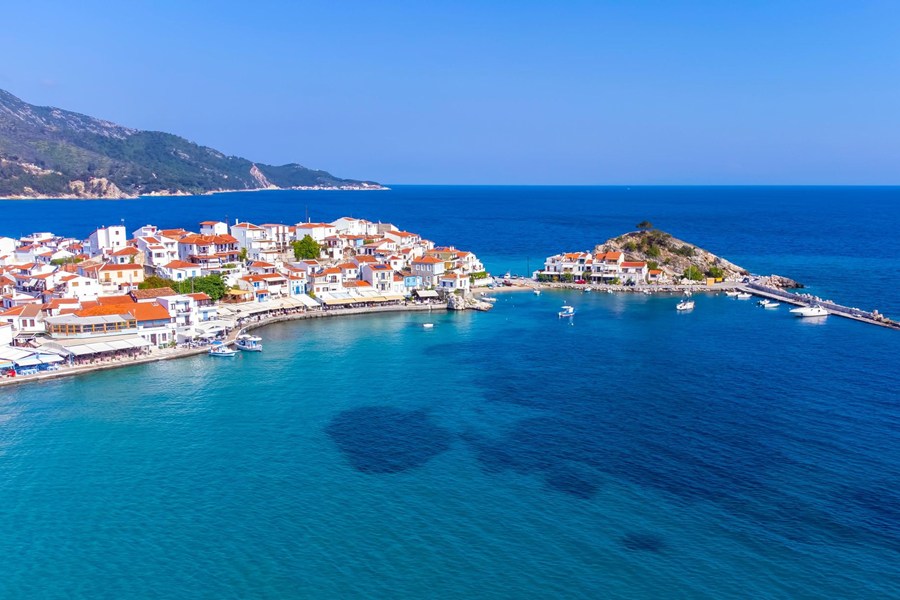
The North Aegean islands are not a physical chain, nor one natural group of land. People link them together for reasons of tourism and administration. Administration means the way a state runs its regions and public offices. On the map, the Dodecanese islands lie to their south. The Cyclades and the Sporades lie to their west.
From the Mesolithic Age, the North Aegean stopped acting as a barrier. Instead, the sea became a bridge that joined the people of the region. Mesolithic means the Middle Stone Age. People settled the islands for good around 5000 BC. The culture of the North Aegean islands reached its height around 3000 BC.
By around 2000 BC, Ionians had made their home on Chios. At the same time, the Achaeans held both Samos and Lesbos. In the late 12th and early 11th centuries BC, the Aeolians reached Lesbos. Large numbers of people were moving into Greece in those years. Ionians, Achaeans and Aeolians were all groups of early Greek people.
- Golden age: From the 8th to the 5th century BC, the islands thrived in trade, economy and the arts.
- Frankish era: After 1204, Venetians, Genoese and Frankish princes divided the North Aegean islands between them.
- Union with Greece: In 1912, amid the First Balkan War, the islands became part of the Greek state.
The North Aegean islands also go by the name Northeastern Aegean islands. The greater part of the group lies inside the North Aegean administrative region of Greece. A region of this kind is a large district that the state runs as one unit.
What do the fossils of Vatera reveal about the North Aegean islands?
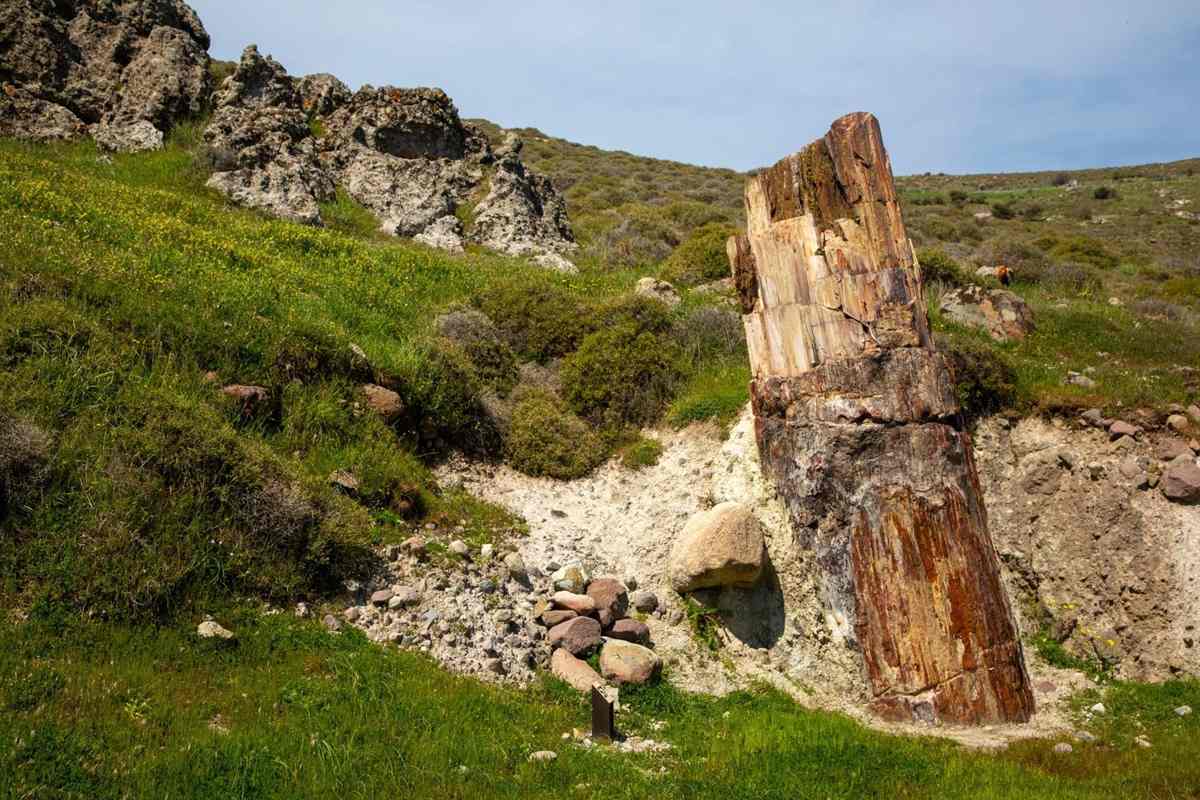
The North Aegean islands include Lesbos, where Vatera forms an 8-kilometre sandy beach on the south coast. The same area holds fossils around two million years old. Scholars date them to the Late Pliocene, an epoch of the Earth’s deep past.
Vatera takes its name from vata, Greek for bramble, a prickly shrub. Such bushes once blocked the old mule track to the beach. Agios Fokas, another spot on the North Aegean islands, lies 3 km away. Foundations of a temple of Dionysos and an early Christian basilica survive there. A basilica is a long, hall-like church.
In 1997 the palaeontologist Michael Dermitzakis announced a rich store of fossils at Vatera. A palaeontologist is a scientist who studies the remains of ancient life. Local farmers had turned up bones for years and long suspected the truth. His announcement confirmed their belief. The find brought this part of the North Aegean islands into the Greek news.
Bones from Vatera belong to stenoid horses, an extinct kind of horse, and to mastodons. A mastodon was a large, elephant-like animal. Remains of a baboon-like monkey, Paradolichopithecus, also came to light. A giant tortoise named Cheirogaster lay among them too. That tortoise reached the size of a small car.
- Ancient landscape: Around two million years ago, Lesvos was no island but part of the Asian mainland.
- Old sea: The gulf of Vatera was then a shallow subtropical sea, warm like waters near the tropics.
- Fossil collection: In nearby Vrissa, the University of Athens keeps a natural history collection of the finds.
Water once carried the bodies of these animals downstream. They caught at a river bend, where sediments, or layers of mud and sand, covered them. Vrisa, a village of the North Aegean islands, takes its name from a girl Agamemnon took from Lesbos.
Which prehistoric story does Emporio on Chios add to the North Aegean islands?
The North Aegean islands hold Emporio, a prehistoric settlement in the south-east of Chios. It belongs to the Mastichochoria municipality, near the large village of Pyrgi. The modern coastal village of Emborios, close by, had 47 inhabitants in 2011.
Fertile land, fresh water and a natural harbour drew settlers to this spot on the North Aegean islands. Late in the Chalcolithic, people walled a settlement on a peninsula to the south of Emborios Bay. Chalcolithic means the Copper Age, when copper tools joined stone ones. A second settlement grew near the beach outside the walls.
Life at Emporio flourished in the Copper and Bronze Ages, during the 3rd and 2nd millennia BC. The beach settlement lasted until the last phase of Mycenaean culture. That culture belonged to late Bronze Age Greece. Around 1100 BC the people left, and signs point to a fire that destroyed the place.
In 1952 the British School at Athens sent Sinclair Hood to work on Chios. He spotted the ruins of Emporio in that same year. His excavations, or careful digs to uncover remains, went on until 1955. After the old site fell, Ionian settlers built Lefkonio in this corner of the North Aegean islands.
- Walled acropolis: The upper town of Lefkonio held a megaron, or great hall, and a Temple of Athena.
- Rampart: A defensive wall around that upper town enclosed about 25,000 square metres of ground.
- Long life: People went on living at the site until the 7th century AD, in Byzantine times.
Remains of the megaron and the Temple of Athena still show on a hill. Locals call this hill Prophet Elias. Kato Phana, another ancient site of the North Aegean islands, lies nearby in south-western Chios. Parts of the old rampart also stay visible.
How does the Kouros of Samos fit into the North Aegean islands?
The North Aegean islands hold the Kouros of Samos, a Greek marble statue of the 6th century BCE. In Greek art, the word kouros means a standing figure of a youth. This one stands 5.25 metres tall, with its body mostly intact.
Its style points to a Samian artist. Samian means from Samos, one of the North Aegean islands. In September 1980, German archaeologists found the marble figure in the Heraion, the sanctuary of the goddess Hera. They were working on a routine topographical dig, a survey of the ground, along the Sacred Way.
At first the statue had no head. Searchers found the head only in autumn 1984, and experts joined it to the body. Today the whole figure stands in the Samos Archaeological Museum on the North Aegean islands. The scholar Aideen Carty links the man who offered it to the gods with the Geomori.
The name Geomori means land-sharers in Greek. These rich nobles governed Samos, one of the North Aegean islands, as an oligarchy. An oligarchy puts power in the hands of a small elite. Plutarch, a writer of the Roman Imperial period, gave the main account in his Greek Questions. Carty dates their rise to about 590 BC.
- Klima cemetery: Carty also links the rise of the Geomori to the decline of the Klima cemetery near the Heraion.
- Lasting force: The Geomori kept real weight in the politics of Samos into the fifth century BC.
- Last king: Plutarch says the Geomori killed Demoteles, the last king of Samos, and set up their rule.
Carty sees the Geomori as a lower rank of nobles. Their land lay in territory the Samians took on the Asian mainland. Between 600 and 570 BC, they sent thirty ships under nine generals to aid Perinthus. Perinthus was a colony, or settler town, of Samos.
What happened to Lemnos, one of the North Aegean islands, after the Fourth Crusade?
The North Aegean islands include Lemnos, which Western Europeans called Stalimene after the Fourth Crusade. The island then passed to the Latin Empire. It became a fief of the Navigajoso family. A fief was land held from a ruler in return for service.
Filocalo Navigajoso, lord of this corner of the North Aegean islands, died in 1214. His son Leonardo and his daughters then split Lemnos into three fiefs. Leonardo kept half the island and its capital, Kastro. Kastro means castle. His sisters and their husbands each took a quarter. These shares held the forts of Moudros and Kotsinos.
In 1278 the Navigajosi had to hand Lemnos back to Byzantium. Byzantium means the eastern Roman Empire. In the 1320s the empire lost Anatolia. After that loss, Lemnos served as the granary of Constantinople. A granary is a store of grain. Lemnos, one of the North Aegean islands, was a major source of food in that era.
In the late 16th century, a record named Lemnos and Chios the only prosperous islands of the Archipelago. Archipelago here means the Aegean islands. Lemnos then counted 74 villages. In 1920, after the Russian Civil War, 18,000 Kuban Cossacks landed on the island. The greater part of them left after a year.
- Australian namesake: Lemnos in Victoria, Australia, founded in 1927 for returning soldiers, takes the island’s name.
- Stone houses: In 2001 the island had 12,116 dwellings, and 65% of them were stone-built.
- Island scholar: Peter Charanis, born on Lemnos in 1908, later taught Byzantine history at Rutgers University.
Red tiles topped the pitched roofs of 90.2% of those homes. The road network of Lemnos has eight numbered provincial roads. They date from 1956, when the island belonged to the Lesbos Prefecture of the North Aegean islands.
Why did Samothrace draw pilgrims to the North Aegean islands?
The North Aegean islands include Samothrace, whose economy today rests chiefly on fishing and tourism. In the Roman imperial period, pilgrims flocked to its sanctuary from all over the Roman world. A pilgrim journeys to a holy place for reasons of faith.
The Sanctuary of the Great Gods held secret rites called the Samothracian Mysteries. Mysteries were secret rites open only to initiated, or formally admitted, members. Demetrios of Skepsis wrote about these rites. The playwright Aristophanes mentions them in his comedy Peace. Lucius Calpurnius Piso Caesoninus, father-in-law of Julius Caesar, came to be initiated.
Philip II of Macedon brought this corner of the North Aegean islands under his control. From then until 168 BC, the island stayed under Macedonian rule. After the battle of Pydna that year, it became independent. Its two ports stood on the sea route linking Troas with Macedonia. Troas was the land around ancient Troy.
Byzantine rule over this northern part of the North Aegean islands lasted until 1204. Then the Venetians took their place. In 1355 the Gattilusi, a noble family from Genoa, pushed the Venetians out. Under Sultan Suleyman, the island became a vakif for the Suleymaniye Mosque in Istanbul. A vakif was an endowment whose income served a religious body.
- Roman holdings: Inscriptions of the 1st century AD record its lands in Perea, a mainland area granted by Rome.
- Pirate years: In the mid-17th century, Bernard Randolph found only two or three villages on the island.
- Local scholar: Nikolaos Fardys, who lived from 1853 to 1901, was a Greek scholar from Samothrace.
Ruins of Genoese forts still stand on this part of the North Aegean islands. Chora, Paleapolis and waterfalls also rank among its sights. Its Mediterranean climate brings hot summers. Winters are cool and rainy, with heavy snowstorms at times on high ground.
When was Samos a self-governing principality among the North Aegean islands?
The North Aegean islands saw Samos run as a self-governing principality from 1834 to 1912. Samos paid a yearly tribute, or set sum, to the Ottoman Empire. Its ruler held the title Prince of Samos, so the state was called a principality.
In 1821 Samos, one of the North Aegean islands, entered the Greek War of Independence. Yet it stayed outside the new Greek state. Its old capital, Chora, lay about 3.2 km from the shore. The seat later moved to Vathy, a port at the inner end of a deep northern bay.
A Senate of 4 members helped the Prince run the state. The Prince chose them from eight candidates put forward by four districts. Those districts were Vathy, Chora, Marathokampos and Karlovasi. Real lawmaking power lay with a chamber of 36 deputies. The Greek Orthodox Metropolitan, the senior bishop, presided over it.
Wine was the chief export, prized since ancient times and still valued in the Levant. The Levant is the old name for the eastern Mediterranean shore. Silk, oil, raisins and other dried fruits also left the island. In 1900 Samos, among the North Aegean islands, had about 54,830 residents. Another 15,000 Samians lived on the Greek mainland.
- Foreign residents: In 1900 the island counted 634 foreigners, and 523 of them were Greek citizens.
- Church district: The metropolitan district, the area under one senior bishop, covered Samos and Ikaria in the North Aegean islands.
- Union declared: On 24 November 1912, the parliament of Samos declared enosis, or union with Greece.
Union with Greece became official on 2 March 1913. Themistoklis Sofoulis then led the interim government of Samos until April 1914. In that year he became Governor of Macedonia. An interim government is a temporary one that rules until a lasting order begins.
What do travellers ask about North Aegean islands, and what are the answers?
The North Aegean islands include Agios Efstratios, called Ai Stratis in everyday Greek. In English its name is Saint Eustratius. On Lesbos, the Saint Ignatios Monastery holds important relics gathered over the years. Relics are holy objects linked to saints or sacred events.
Among the North Aegean islands, why is Agios Efstratios linked with exile?
The first communists exiled to Agios Efstratios came under the Idionymon law of Venizelos. The Idionymon was a law aimed at ideas judged a danger to the state. Exiles held on the island included Dimitris Glinos and Kostas Varnalis. Under the junta, an army-led regime of 1967 to 1974, it again held dissidents.
In the North Aegean islands, which old names and admirals belong to Psara?
In ancient times Psara went by the names Psyra and Psyrie. The island was also home to two admirals. An admiral is a senior commander at sea. Nikolis Apostolis was born in 1770 and died in 1827. Dimitrios Papanikolis lived from 1790 to 1855. Both men were natives of Psara.
On the North Aegean islands, what is the Limonos Monastery near Kalloni?
Outside Kalloni on Lesbos rises the Saint Ignatios Monastery. It also goes by Limonas or Limonos, after the field it occupies. Saint Ignatios Agallianos set it up in 1526. Its library now keeps more than 2,500 books and 450 manuscripts, or handwritten texts. The collection also holds Greek and Ottoman documents.
Which town of the North Aegean islands sits beside the Bay of Kalloni?
Polichnitos, a town of Lesbos, lies on the island’s central south coast. Its municipal unit touches the Bay of Kalloni on that bay’s southern side. In 2021 the unit had 3,438 people. Euterpi Koutzamani, the first woman Prosecutor General of Greece, is a notable person of Polichnitos. That post heads the public prosecution service.