
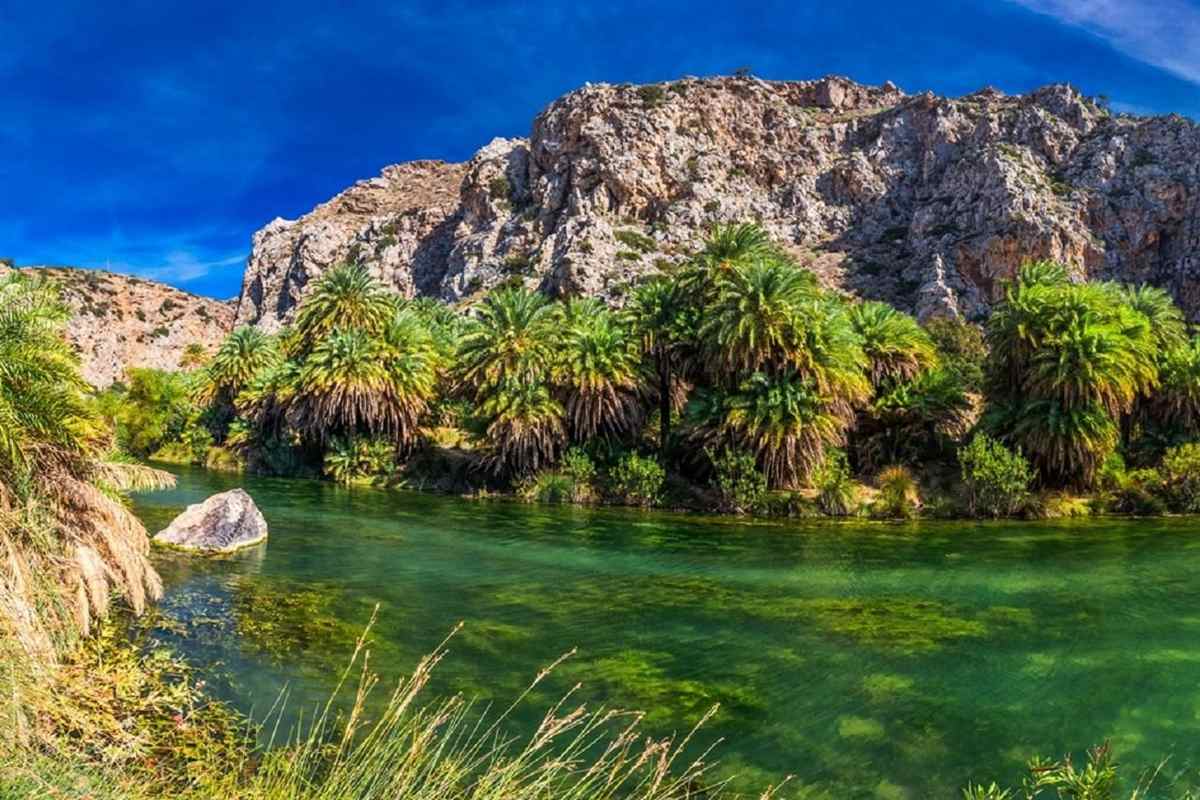
Wildflowers in Greece grow from the cliffs of Crete to the limestone of Mount Olympus. Trips through Greece with a tour leader cross this land of mountains, gorges and islands. The asphodel, the Greek peony, the scarlet martagon lily, orchids, the rock-rose and the corn poppy feature here. Related reading covers Greece in spring, national parks in Greece and Greece hiking tours. Other outings with a host appear under Greece tours.
Bookings made through the GetYourGuide widgets on this page earn Classical Greece Tours a commission, at no extra cost to the traveller.
What are the wildflowers in Greece?
Wildflowers in Greece are plants that grow in the wild, not from seed sown on purpose. They sit inside a national list that held 6,695 taxa, or named plant groups, by June 2018. Arne Strid, a Swedish botanist, is an expert on this flora.
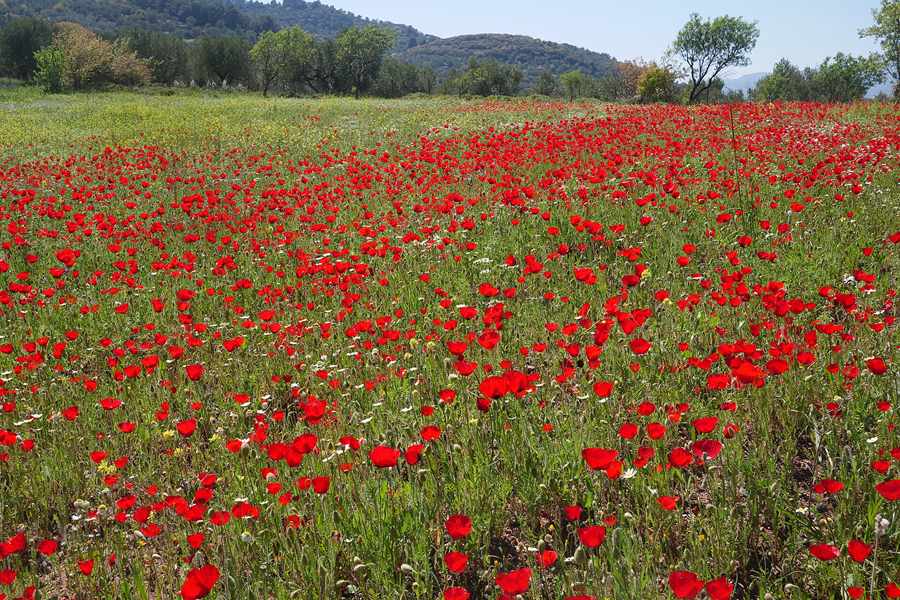
The word wildflower also implies a plant that is neither a hybrid nor a selected cultivar. A hybrid is a cross between two kinds of plant. A cultivar is a form bred by growers. For wildflowers in Greece, the label can cover the whole plant, even outside its time in bloom.
The June 2018 figure holds 5,828 species and 1,982 subspecies. Each species counts as a separate type of organism, and a subspecies is a local branch. Wildflowers in Greece and other listed plants fall into 1,073 genera and 185 families. A genus is a group of close relatives, and a family is a wider group.
An earlier count, from 2013, gave 1,278 endemic species, plus 452 endemic subspecies. Endemic means found naturally in one area of the world and nowhere else. Greece was joined to western Turkey during the Pliocene, a distant geological age. Wildflowers in Greece and in western Turkey now include identical plants.
- Native: A native species is one that occurs naturally in the area where it grows.
- Introduced: An exotic or introduced plant is not native to the area where it grows.
- Naturalised: A naturalised plant came from elsewhere, but the public has come to consider it native.
Arne Strid’s doctorate studied a group of plants called the Nigella arvensis complex in the Aegean archipelago. With Barbro Jende Strid, a biologist, he edited an annotated re-issue of the Flora Graeca. Annotated means supplied with notes. The word wildflower itself counts as an imprecise term.
Why does the asphodel stand out among wildflowers in Greece?
Wildflowers in Greece include the asphodel, a plant Homer placed across the great meadow haunted by the dead. Its genus name, Asphodelus, comes from the Greek word asphodelos. A genus gathers closely related plants, and this one holds 16 species.
In Greek legend, the asphodel ranks among the best known wildflowers in Greece tied to death. It was planted on graves. Persephone appears in a garland of asphodels worn as a crown. Its grey leaves and yellowish flowers were said to suggest gloom and the pallor of death.
Wildflowers in Greece even lent a name to the ancient underworld. The Asphodel Meadows form a section of it, where ordinary souls go after death. They are one of three main divisions, beside Elysium and Tartarus. Elysium rewards righteous souls, while Tartarus punishes vicious ones. Ancient Greek poets read the word asphodelos as flowery, fragrant or fertile.
Poorer Greeks ate the roots, so the food was thought fit for the shades. Shades are the spirits of the dead. Among wildflowers in Greece, the asphodel was also supposed to cure venomous snake bites and ward off sorcery. It was said to kill mice but to keep pigs free of disease.
- Branched asphodel: Asphodelus ramosus carries large white flowers, each segment marked with a reddish-brown central line.
- Home ground: The branched asphodel is especially common on grazed Mediterranean coasts with occasional fire.
- Survival: An underground storage organ carries the branched asphodel through excessive heat and drought.
The leaves of the branched asphodel reach a height of 60 to 80 centimetres. They hold alkaloids, natural plant poisons, that harm sheep and goats in wet winter months. The leaves lose that poison when they dry out in the summer months.
Which of the wildflowers in Greece takes its name from Mount Parnassus?
Wildflowers in Greece include Paeonia parnassica, the Greek peony, whose scientific name points to Mount Parnassus. This endangered perennial is native to the mountains of south-central Greece. Perennial means a plant that goes on living beyond two years.
Its flowers are dark, close to blackish-red, and measure 8 to 12 centimetres across. Each bloom holds between nine and twelve petals. The plant grows 35 to 65 centimetres tall on hairy stems that bear a single flower. Among wildflowers in Greece, this one has compound leaves with silvery-haired undersides, and compound means split into leaflets.
The Greek peony grows chiefly on Mount Parnassus in Phocis and on Mount Helicon in Boeotia. It occupies forest clearings within Greek fir woodland. Damp grassy meadows and limestone rocks also hold it, between 800 and 1,300 metres above sea level. These wildflowers in Greece open in the fifth month and June.
The species first received a description from Dimitris Tzanoudakis, a Greek botanist, in his 1977 doctoral thesis. His specimens came from above the village of Agoriani, at about 1,100 metres in fir forest. William Stearn and Peter Davis published the formal description in 1984 in Peonies of Greece.
- Earlier label: Pierre Edmond Boissier once placed these plants under Paeonia peregrina var. latifolia.
- Collectors: Theodor von Heldreich and Theodoros G. Orphanides gathered the plants in the mid-19th century.
- Styles: Inside each flower, the styles, which are thin female stalks, are curled.
Wildflowers in Greece under protection in the Parnassus park include this peony, listed beside the Cephalonian fir. Young peony leaves carry a purple hue. With age they turn green above and greyish-green beneath. Its roots are plentiful, long and spindle-shaped.
How does Ramonda heldreichii fit into wildflowers in Greece on Mount Olympus?
Wildflowers in Greece include Ramonda heldreichii, a small perennial plant of Mount Olympus. It grows wild only on that mountain’s northern and eastern slopes. Botanists once named it Jankaea heldreichii, and it then stood alone in its genus.
A rosette of egg-shaped leaves sits at its base, clad in long, thick hairs. A rosette is a ring of leaves spreading from one point. Short stalks hold one to three nodding flowers above the leaves. The corolla, the ring of petals, is violet and has four or five lobes.
It grows in damp cracks on limestone rocks, especially close to running streams. It ranges from 400 to 2,400 metres, and is commonest from 700 to 1,400 metres. Among wildflowers in Greece, this plant once had a wider distribution. As the climate changed, suitable habitat shrank and left it in its present range.
Bumblebees visit these wildflowers in Greece, yet the flowers produce no nectar. A study of its flowering, pollination and breeding success found it not seriously endangered at present. The main threat comes from tourist pressure on Mount Olympus and uncontrolled collecting of the plant. Its range lies mostly inside the Olympus National Park.
- Status: The IUCN, a world nature conservation union, lists it as near threatened.
- Law: The plant is protected under the Bern Convention, a treaty on European wildlife.
- Family: Ramonda heldreichii belongs to the Gesneriaceae, a family of flowering plants.
Wildflowers in Greece on upper Olympus share a treeless zone of alpine, or high-mountain, meadows. Meadows, rocks and steep slopes there hold the endemic plants. Arne Strid, a Swedish botanist, wrote an important book on the plants and flowers of Olympus in 1980.
What does the scarlet martagon lily bring to wildflowers in Greece?
Wildflowers in Greece include Lilium chalcedonicum, the scarlet martagon lily, native to Tuscany, Greece and Albania. Carl Linnaeus first described it in 1753 on Mount Chalcedon in Thessaly. Its red flowers reach up to 10 centimetres in length.
This perennial stands 35 to 70 centimetres tall, and up to 1.5 metres at its tallest. Its stem is green and wholly covered by narrow, slightly twisted leaves. The yellowish-white bulb is wide. Among wildflowers in Greece, it carries one to six flowers, and up to 12 in cultivation.
The flowers face downwards, and their petals turn backwards. They carry a heavy scent and orange pollen. Stamens, the pollen-bearing parts, stick out beyond the petals. These wildflowers in Greece open rather late in the year, with July the regular month. The bloom resembles a turban, and that look gives the lily the nickname the Turk.
In the Balkans, it spreads from southern Albania across much of mainland Greece. Islands of the Ionian and Aegean seas also hold it. It favours cool areas, such as glades in deciduous and boxwood mountain forests. Meadows on limy, rocky soils at 600 to 1,700 metres also suit it.
- Oldest image: Its earliest known depiction is a 3,500-year-old Minoan fresco from the island of Santorini.
- Hybrid: It crosses with Lilium candidum and creates the hybrid lily Lilium x testaceum.
- Cultivation: Gardeners have grown it since at least the 16th century for its striking appearance.
Among wildflowers in Greece, this lily strongly resents being moved. That trait is the main suspected reason for its rarity in trade. Botanists once named two varieties, maculatum and heldreichii, but no longer recognise them. The first had denser flowers, and the second bore one flower.
Which of the wildflowers in Greece honours the botanist Theodoros Orphanides?
Wildflowers in Greece include Tulipa orphanidea, a tulip named after Theodoros Orphanides, a pioneer of 19th-century Greek botany. Pierre Edmond Boissier and Theodor von Heldreich described the species in 1862. It belongs to the lily family, the Liliaceae.
Among wildflowers in Greece, this bulb-forming perennial reaches 10 to 20 centimetres in height. Its stem bears one to four flowers, shaped from globes to stars. The tepals, which are petals and sepals that look alike, are copper-red, or rarely yellow and red. A black or sometimes yellow blotch marks the base inside each tepal.
The tulip grows in the south-east Balkans, Bulgaria, Greece, the Aegean Islands, Crete and western Turkey. Black pine forests, fields and roadsides form its habitat, at heights up to 1,700 metres. These wildflowers in Greece bloom in April and the fifth month. Six dark olive stamens sit inside each flower.
Orphanides became Professor of Botany at the university in Athens in 1850. He gathered plants from all over Greece and pressed them for classification. His herbarium, a stored collection of dried plants, held over 45,000 specimens. He published his findings as an exsiccata work, a series of dried specimens, called Flora Graeca Exsiccata.
- Garden use: Tulipa orphanidea has served as an ornamental garden plant since 1861.
- Colour forms: The Whittallii Group has burnt orange inner tepals with a black blotch at each base.
- Naming: Its scientific grouping is complex, since the plant forms a variable population.
Campanula orphanidea, Viola orphanidis and Nepeta orphanidea also carry his name. He oversaw the creation of the National Garden of Athens. He also started a journal called Geoponika in 1872. Wildflowers in Greece formed part of his 1867 speech as rector, or university head, on Greek vegetation.
Where do orchids sit among wildflowers in Greece?
Wildflowers in Greece include orchids such as Orchis italica, called the naked man orchid. Ophrys cretica, native to Crete, belongs to the Orchidaceae, the orchid family. Orchis italica flowers in April, and its native range includes Greece and Crete.
Orchis italica takes its common name from the lip of each flower, the labellum. The lobed lip resembles a naked man wearing a hat. Plants grow up to 50 centimetres tall, with bright pink flowers in dense clusters. Among wildflowers in Greece, this one prefers partial shade and soil low in nutrients.
Ophrys cretica grows wild on Crete and the East Aegean Islands, north as far as Chios. On the mainland, these wildflowers in Greece cover Attica, Aigina and the Peloponnese. It grows on lime-rich soils from sea level up to 1,000 metres. Its habitats include grassland, pesticide-free olive groves and garrigue, a low, open scrub.
Ophrys cretica reaches 10 to 40 centimetres and holds two to ten flowers in a spike. The sepals, the outer flower parts, run from green to brownish violet. The lip has a base colour of dark brown to purple black. Its speculum, or mirror, is a patch roughly shaped like the letter H, with a white border.
- Pollinators: Bees of the genus Melecta, especially M. albifrons and M. tuberculata, pollinate Ophrys cretica.
- Naming: Friedrich Vierhapper first described it in 1916 as a form of Ophrys spruneri.
- Full species: Erich Nelson raised the plant to the rank of full species in 1962.
Orchis italica, one of the wildflowers in Greece, commonly forms large clusters in the Mediterranean region. Its range also reaches Portugal, Spain, Cyprus, Lebanon, Israel, Algeria and Morocco. Ophrys cretica has also been treated as part of Ophrys kotschyi, as one or two subspecies.
What makes the rock-rose part of wildflowers in Greece?
Wildflowers in Greece include rock-roses, shrubs of the genus Cistus, whose name comes from the Greek word kistos. About 34 species belong to the genus. They grow on dry or rocky soils throughout the Mediterranean region, with Greece named among their lands.
These wildflowers in Greece have evergreen leaves in opposite pairs, measuring 2 to 8 centimetres. A slightly rough surface marks the leaves. As wildflowers in Greece, rock-roses have showy flowers with five petals, in white, purple or dark pink. Certain species add a dark red spot at the base of each petal.
Certain rock-roses have leaves coated in a highly aromatic resin called labdanum. Gum cistus is another common name, applied to the resin-bearing species. The genus also counts a similar number of natural hybrids. Related plants called Helianthemum and Tuberaria share the name rock-rose, and all sit in the family Cistaceae.
Cistus creticus, the pink rock-rose, has flowers 4.5 to 5 centimetres across. Carl Linnaeus first used this name in 1762. Its native range covers the central and eastern Mediterranean Basin, including south-eastern Europe. A cultivar named Lasithi has compact, rounded flowers. The species is very variable in form.
- Other names: Cistus creticus also goes by the name hoary rock-rose, beside pink rock-rose.
- Confusion: The species is frequently called Cistus incanus, though that name belongs to a hybrid.
- Clade: It belongs to the purple pink clade, a branch of Cistus species with purple and pink flowers.
Gene studies from 2005 to 2011 split Cistus species into two clear groups, called clades. One group has purple and pink flowers. The other has white flowers, with Cistus parviflorus a pale pink exception. These wildflowers in Greece also appear commonly as garden flowers.
How does the corn poppy join the wildflowers in Greece?
Wildflowers in Greece include Papaver rhoeas, the corn poppy, an annual flowering plant. The word rhoeas means the corn poppy in Greek, and papaver is Latin for poppy. Greece appears in its European range. An annual lives for one year.
These wildflowers in Greece grow to about 70 centimetres in height. Its single large flowers measure 5 to 10 centimetres across. The four petals are vivid red, and a black spot commonly marks their base. The petals slightly overlap one another. Coarse hairs, held at right angles to the surface, cover the flower stem.
A warm season can bring up to 400 flowers on one plant. A long-lived store of seeds in the soil germinates when the ground is disturbed. Before herbicides, or weed-killing chemicals, farm fields held it in abundance. Among wildflowers in Greece, it is able to flower and seed before crops are harvested.
Its leaves and latex, the milky sap, taste acrid and are mildly poisonous to grazing animals. The plant also holds rhoeadine, an alkaloid that acts as a mild sedative. A UK study of meadow plants placed it first for pollen per flower. It makes no significant quantity of nectar, so its visitors are pollen-gathering insects.
- Habitat: The corn poppy grows in fields, beside roads and on grasslands.
- Subspecies: Papaver rhoeas subsp. polytrichum is native to the eastern Mediterranean.
- Author: Carl Linnaeus formally described the species in his Species Plantarum of 1753.
The origin of this species is not known for certain. Its link with farming in the Old World goes back to early times, along with symbols of fertility. Cultivated forms of these wildflowers in Greece come in yellow, orange, pink and white.
What do travellers ask about wildflowers in Greece, and what are the answers?
Wildflowers in Greece prompt questions about four plants. They are Cretan ebony, a possible wild parent of saffron, the striped Fritillaria graeca and Jerusalem sage. All four are plants native to Greece or its islands, and each carries a distinct flower colour.
Among wildflowers in Greece, what is Cretan ebony?
Cretan ebony, or Ebenus cretica, is native to the Mediterranean island of Crete. Bright pink or purple flowers grow on racemes measuring 5 to 20 centimetres. A raceme is a stem carrying flowers along its length. The shrub grows on rocky hillsides and steep cliffs, at heights up to 600 metres.
For wildflowers in Greece, how does Crocus cartwrightianus connect to saffron?
Crocus cartwrightianus is possibly a wild ancestor of the saffron crocus, a farmed plant. Its wild range covers the Greek mainland, Euboea, Crete, Skyros and part of the Cyclades. In the 19th century, people on Andros harvested it for medicine. Its stigmas, the pollen-catching tips, also gave a pigment called Zafran.
What does Fritillaria graeca look like among wildflowers in Greece?
Fritillaria graeca has red and white striped flowers that resemble small bells, with one on each stem. The plant reaches a height of around 25 centimetres. Its subspecies graeca grows in eastern and southern Greece, including Crete. A subspecies is a local branch of a species.
Which of the wildflowers in Greece is Jerusalem sage?
Jerusalem sage, or Phlomis fruticosa, is native to Albania, Croatia, Cyprus, Greece, Italy, Montenegro and Turkey. It forms an evergreen shrub up to 1 metre tall and 1.5 metres wide. Deep yellow, tube-shaped flowers, 3 centimetres long, grow in summer. Whorls of 20 hold them, and a whorl is a ring around a stem.