
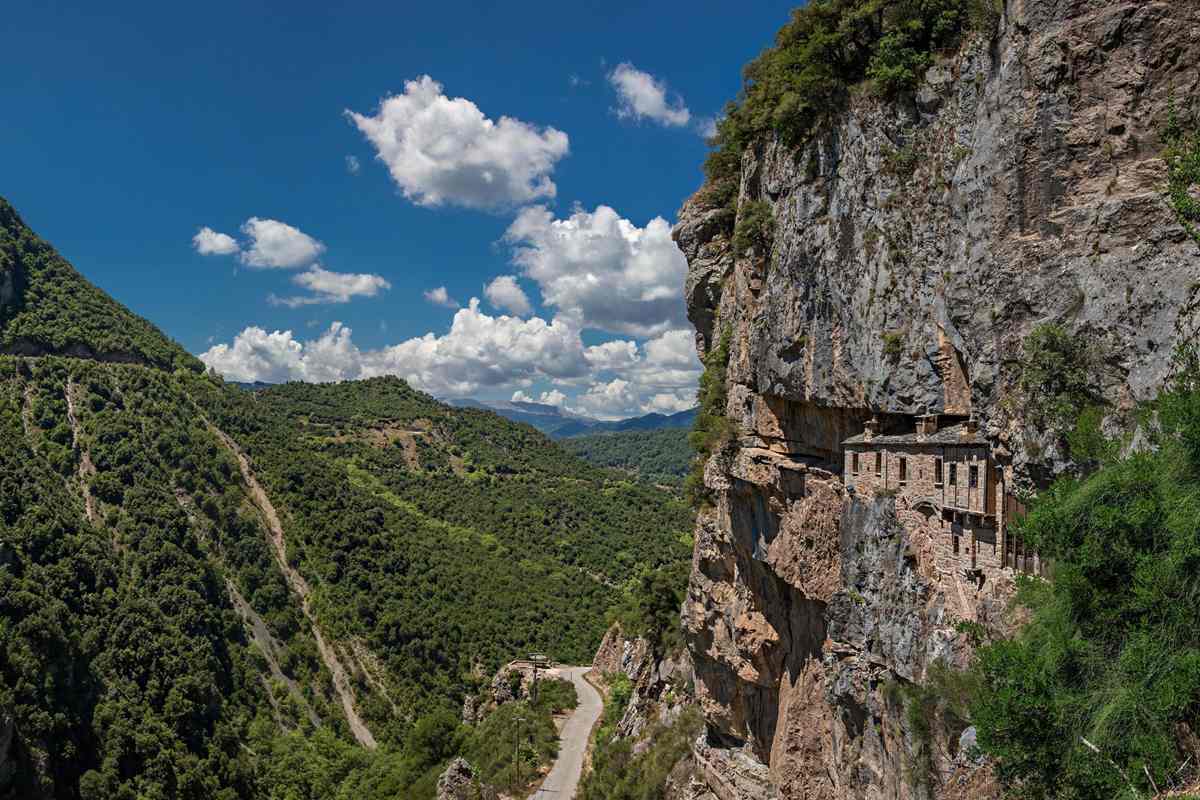
Forests in Greece run from pine hills beside Thessaloniki to palm groves on Crete. Hiking outings with a host run in Zagori, Crete, Rhodes, Naxos and around Delphi. Topics here are Seih Sou, Dadia, and Valia Calda with its Bosnian pine. The Crete Mediterranean forests and the Cretan date palm follow. Greek fir, Mount Parnitha and the rare trees of Rhodes come next. Further reading sits under national parks in Greece, Mountains in Greece and Greece hiking tours. Wider trips appear among Greece tours.
Bookings made through the GetYourGuide widgets on this page earn Classical Greece Tours a commission, at no extra cost to the traveller.
What are the forests in Greece?
Forests in Greece sit inside ecoregions, meaning wide areas that share similar plants and climate. One such area carries the name of the Aegean and western Turkey. It spreads over the bulk of the Greek mainland and the Aegean Islands, with Crete left out.
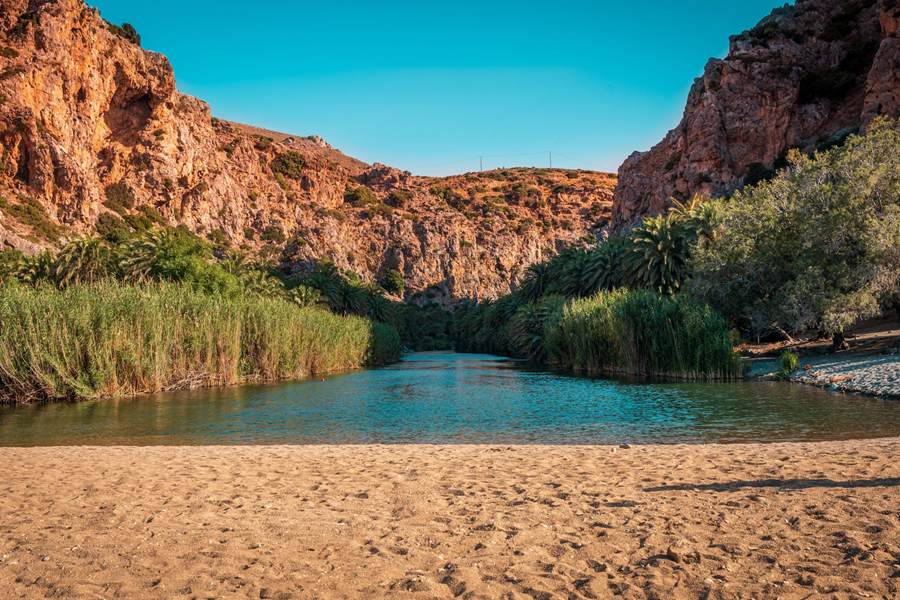
That ecoregion also takes in the Heptanese Islands, the Greek group in the Ionian Sea. It belongs to a biome, a major world type of living community, called Mediterranean forests, woodlands and scrub. Forests in Greece of this type share the land with maquis and low shrublands. Pine woods form the third main plant community.
Maquis means woody shrubland made up of low trees, shrubs and soft-stemmed plants. Aleppo pine forms whole forests in central Greece and the Peloponnese. Stone pine takes a different setting, growing on stable coastal dunes of the Peloponnese. Kermes oak and holm oak grow within the maquis and also form oak woodlands.
Higher ground carries another ecoregion, the Pindus Mountains mixed forests, spread over 39,500 km2 in three countries. Elevations above 1,000-1,400 m hold coniferous, or cone-bearing, forests. A mixed zone of broadleaved trees lies below them. Forests in Greece also include adjacent parts of the Rodope montane mixed forests, lying almost entirely in Bulgaria.
- Protected land: In 2017, protected areas held 23,189 km2 of the Aegean ecoregion, which equals 18%.
- Mammals: Wild boar, red fox, golden jackal and wolf all live in the Aegean ecoregion.
- Crete: A separate ecoregion, the Crete Mediterranean forests, covers the whole island of Crete.
Forests in Greece around the Aegean grow under a Mediterranean climate. The Pindus ecoregion has mostly the same climate type, marked by hot summers. The Aegean ecoregion also serves as important habitat for birds of limited range. These include the olive-tree warbler and the masked shrike.
How does Seih Sou fit among the forests in Greece?
Forests in Greece reach the very edge of a city at Seih Sou. This hilltop woodland lies just north and northeast of Thessaloniki. It rises west of Mount Chortiatis, spreads across 2,979 hectares and climbs to 563 metres.
Among named forests in Greece, Seih Sou takes its title from Turkish, meaning the Sheikh’s Water. The name points to a spring beside a mausoleum, or stately tomb. A second name, Kedrinos Lofos or Cedar Hill, dates from 1987. Local author Georgios Vafopoulos proposed it to the city council of Thessaloniki.
An oak forest once covered this hill and fed all the rivers of Thessaloniki. Logging, grazing and farming during the Ottoman era stripped the land. One southwestern part escaped and was called Chilia Dentra, or Thousand Trees. A 1921 ministry decision ordered replanting. The university forestry school then set nearly 5 million trees between 1929 and 1989.
This corner of the forests in Greece holds 277 plant species, led by three kinds of pine. Cypress and plane trees stand scattered between them. Around 80 types of birds use the woods, from the short-toed snake eagle to nightingales and owls. Hares, foxes, martens, squirrels, weasels and hedgehogs are among its mammals.
- Fire: A large fire on 7 July 1997 burned 55% of the forest down.
- Museum and zoo: The forest holds the main zoo of Thessaloniki and its natural history museum.
- Theatres: Two open-air theatres, Theatro Dasous and Theatro Gaias, overlook the city of Thessaloniki.
Beekeeping is widely practised here, with honey farms scattered through these forests in Greece. An insect called the pine processionary has infested the pines and caused leaf loss. The congested Thessaloniki Inner Ring Road borders the southern side of the woodland.
What lives in Dadia, one of the forests in Greece?
Forests in Greece include Dadia in Eastern Macedonia and Thrace. Here 72.9 km2 sit under strict protection. The climate is Mediterranean with continental influences. Winters stay relatively cold and summers warm and dry. Yearly rain and snow average around 730 mm.
Mixed forests at Dadia fill the transitional zones between the cone-bearing and broadleaved woods. These forests in Greece also hold riparian vegetation, meaning riverbank plants, such as Alnus glutinosa and Populus nigra. Hard-leaved shrubs, including Arbutus andrachne and Cistus creticus, grow mainly in the southwest of the park. Seventeen fish species live in its streams.
Reptiles number 29 species at Dadia, among them turtles, lizards and snakes. Amphibians add 12-13 species, such as the fire-bellied toad and the fire salamander. The count of invertebrates, animals without backbones, stands at 283 or more. Butterflies alone account for over 100 species. Among birds of prey, the park also hosts Egyptian vultures and griffon vultures.
Ecotourism means travel that supports nature and local life. It began at these forests in Greece in 1992, first aimed at birds of prey. A women’s cooperative followed in 1993, selling local food products. A community-run municipal enterprise dates from 1994. The ecotourism centre near Dadia village was completed in 1995.
- 2023 fire: A major blaze in August 2023 burned wide parts of the park area.
- EU record: European officials called it the biggest wildfire on record in the European Union.
- Threats: Wildfires, climate change and human activities count as the main threats to the park.
Conservation work at these forests in Greece covers habitat protection, species monitoring and environmental education. It also manages visitor pressure in sensitive areas. Vultures rank among its key concerns. Trained local hosts explain the wildlife and teach visitors how to behave around it.
Which pines give Valia Calda its place among forests in Greece?
Forests in Greece reach high ground at Valia Calda, whose core zone covers 3,360 hectares. Bosnian pine woodland leads on the slopes at 1,600 to 1,900 m. Elevations in the park run from 1,076 to 2,177 m.
Bosnian pine, also called Heldreich’s pine, grows up to 25-35 metres tall with a trunk 2 m wide. Its bark starts smooth and pale grey. In old trees the bark hardens into small plates that recall crocodile skin. The cones begin a deep blue-purple and go brown as they ripen.
Swiss botanist K. Hermann Christ described the species in 1863, naming it for Theodor von Heldreich. The specimens came from Mount Olympus, collected by von Heldreich himself. Among forests in Greece, this pine appears at Valia Calda, Smolikas, Vasilitsa and Mount Olympus. It climbs as far as the alpine tree line, the point where trees stop growing.
Dating work in 2016 put one northern Greek specimen at 1,075 years old. Around Valia Calda, these forests in Greece hold 86 species of mushroom and 415 types of plants. Lynxes live here too, and roe deer and wildcats keep to the Flegga forest. The Balkan chamois, found only in the Balkans, holds the steep rocky parts.
- Treeless top: Only bushes survive in the treeless alpine meadows between 1,900 and 2,177 m.
- Rainfall: Yearly rain in the park totals between 1,000 and 1,800 mm.
- Protection: The core zone bans woodcutting, grazing, hunting and fishing, and it also keeps out cars.
Earlier fires, set by cattle breeders to open meadows, destroyed large parts of these forests in Greece. Since 1960, no fire has struck, helped by new forest roads. An observation post also stands near Avgo peak. Local law forbids collecting any organism in the park.
What does Crete add to the forests in Greece?
Forests in Greece take a separate form on Crete. Its ecoregion holds 1,600 plant species, and about 10% are endemic, meaning limited to one area. Evergreen and semi-evergreen oaks form woodlands and forests at lower elevations there.
Crete once carried forest across the island. Centuries of human settlement turned much of that cover into shrubland, woods, fields, orchards and pasture. Low shrubland at lower elevations is called phrygana, and it holds aromatic plants such as Thymus capitatus. Taller shrubland, called maquis, is led by carob, juniper and tree-spurge.
Three ranges form the spine of Crete: the White Mountains, Psiloritis and the Dikti Mountains. Along their slopes, these forests in Greece change with height. Calabrian pine and Kermes oak form woodlands at middle elevations. Mediterranean cypress and Cretan maple take over at high elevations. Thorny cushion scrublands cover the highest peaks, above a tree line of 1600-1800 metres.
Two mammals occur only on Crete: the Cretan shrew and the Crete spiny mouse. The kri-kri, a feral goat subspecies, lives only in the mountains of Crete and on nearby islands. Resident birds of these forests in Greece include the bearded vulture, griffon vulture and golden eagle. In all, 66 land bird species breed on Crete and adjacent islands.
- Dwarf elephants: Dwarf elephants and a dwarf hippopotamus lived on Crete until the Pleistocene, a past geological age, ended.
- Giant owl: A giant flightless owl called Athene cretensis also died out at that time.
- Protection: Protected areas cover 35.26% of the ecoregion, including Samaria Gorge National Park.
Forests in Greece here grow on an island cut off by sea for at least five million years. Its high mountains rose 1.5 million years ago. Mount Ida, in the Psiloritis range, is the highest point at 2,456 m.
Where do palm trees form forests in Greece?
Forests in Greece include palm groves of the Cretan date palm, known to science as Phoenix theophrasti. Only this species and the European fan palm count as native palms of the Mediterranean basin. Their stands form the only palm forests in Europe.
Vai in Lasithi and Ayios Nikitas in Heraklion Prefecture are two sites on Crete. Preveli gorge and Souda, near Plakias, sit on the south coast in Rethymnon Prefecture. Prefecture here means a Greek administrative district. Beyond Crete, the palm also grows on Amorgos, on Halki and along the south coast of Anafi.
On the mainland, the only natural stand holds around 10 trees, inside an ancient palm forest near Epidaurus. Ancient forests in Greece held a wider range of this palm, according to one proposal. It stretched between Crete and Thebes, and between the Peloponnese and Delos. The species also reaches scattered places on the Turkish coast.
This palm reaches up to 15 m in height, with slender stems. Its leaves are pinnate, meaning feather-shaped, and measure 2-3 m in length. These forests in Greece bear oval yellowish-brown fruit 1.5 cm long, each holding one large seed. The thin, fibrous pulp has no agricultural value, and it tastes acrid.
- Withered leaves: Withered leaves keep hanging on the palm stem for years afterwards.
- Date science: A genomic study found North African date palms, such as Medjool, are hybrids involving this species.
- Local use: Locals sometimes eat the fruits of the Cretan date palm despite the poor pulp.
Forests in Greece of this palm keep to a restricted range. A handful of sites on Crete and nearby islands hold it. Upright fruit clusters and largely inedible dates set it apart from the cultivated date, which it can resemble.
What do travellers ask about forests in Greece, and what are the answers?
Forests in Greece border other ecoregions around the Pindus Mountains mixed forests, which span the southern Balkans. Its neighbours are the Aegean, Illyrian deciduous, Dinaric Mountains and Balkan mixed forests. The Pindus ecoregion itself is landlocked, meaning it has no coastline.
How does the Greek fir fit into forests in Greece?
Greek fir is near-endemic to the Pindus ecoregion, meaning almost limited to it. With black pine and Balkan fir, it dominates conifer forests from 1,200 to 2,500 m. The species name refers to Cephallenia, the largest Ionian island. It once mattered for building timber, but it is now too rare.
Which forests in Greece carry the name lungs of Athens?
People know the national park on Mount Parnitha as the lungs of Athens. Above 1,000 m, the mountain is covered mainly in Greek fir, grasses and shrubbery. The mountain carries about 1,000 plant species, including crocus and tulips. Red deer, known there since ancient times, also live on the range.
Which trees of Rhodes belong to forests in Greece?
Oriental sweetgum grows wild only in a small part of southwestern Turkey and on Rhodes. Its largest remaining stands lie near Köyceğiz, on the Turkish side. Bozpirnal oak, another endemic tree, is native to Rhodes, Kos and the facing Turkish coast. People gather its sweet, edible acorns locally for use as coffee.
What does the Rodope ecoregion add to forests in Greece?
The Rodope montane mixed forests hold four national parks. Three lie in Bulgaria, and the Rodopi Mountain Range National Park is the Greek one. Beech, hornbeam and oak lead the mixed woods of the lower areas. Scots pine, Bosnian pine and Norway spruce belong to the higher zones. Brown bears, wolves and wildcats live here.