
Lighthouses in Greece are towers that mark capes, harbours and islets for passing ships. Tours on this theme are boat trips and coastal outings with a local host. They run from the Saronic Gulf to Crete, Rhodes and the Ionian Sea. Topics include Stylianos Lykoudis, the towers of Alexandroupolis and Patras, Megalonisi off Lesbos, Cape Araxos and Cape Sidero. Four short answers come last. Related reading covers the best Greek islands, Greece photography tours and Greece sailing tours. Wider choices sit among Greece tours.
Bookings made through the GetYourGuide widgets on this page earn Classical Greece Tours a commission, at no extra cost to the traveller.
Which are the lighthouses in Greece?
Lighthouses in Greece include the port lighthouse of Alexandroupolis and the landmark tower of Patras. Another stands on Megalonisi, also called Nisiopi, an islet off Lesbos. In modern Greek, the word for lighthouse is fáros, taken from the name Pharos.
Before clear harbours existed, sailors steered by fires lit on hilltops. Raising such a fire onto a platform led step by step to the lighthouse. In antiquity, a lighthouse marked the way into a port more than it warned of reefs. Reefs are rocky ridges lying just under the surface.
Today a lighthouse is defined as a structure that sends out light from lamps and lenses. It serves as a beacon, a fixed signal that helps sailors find their way. Lighthouses mark dangerous coasts, shoals, reefs and rocks. They also mark safe entries to harbours. A shoal is a stretch of shallow water.
The name Pharos belonged to the best-known lighthouse of antiquity, at Alexandria in Egypt. From it, the modern Greek word fáros came to mean any lighthouse. Lighthouses in Greece carry that name today. The same root passed into French as phare. Italian and Spanish took it as faro. Root here means the source of a word.
- Navy ships: The Hellenic Navy runs two lighthouse tenders, ships that serve lighthouses in Greece.
- Light station: A full station holds the tower plus outbuildings such as keeper’s quarters, a fuel house and a boathouse.
- Decline: Working lighthouses have grown fewer as cheaper electronic navigation systems spread.
Lighthouses in Greece also stand on tiny islands such as Pasas, in the Oinousses group near Chios. Its old lighthouse was built in 1863 and stands 8.5 metres high. Since 1995 it has run on solar power.
How did Stylianos Lykoudis shape the lighthouses in Greece?
Lighthouses in Greece were in the care of Stylianos Lykoudis for a long stretch of his career. This rear admiral of the Royal Hellenic Navy headed its Lighthouse Service. A rear admiral is a senior naval officer. He was also a scholar and historian.
Lykoudis was born in Ermoupolis, on the island of Syros, on 23 March 1878. He entered the Navy Academy at the age of 13. In 1895 he graduated as an ensign, a junior officer rank. At that time he was the youngest officer in the Royal Hellenic Navy.
As a young officer, he studied the Greek seas and coasts. On his own initiative, he wrote the first studies for a network of lighthouses in Greece. His first proposals were ignored. In 1910, after a run of ship sinkings, a new law set out to reorganise the lighthouse service. His reports then reached Prime Minister Eleftherios Venizelos.
In 1911 he joined the service as research officer and soon became its head in practice. The post was made formal in 1915. During his 25 years in charge, 191 new lighthouses in Greece were installed. That was 140% more than in the previous 85 years of the service. As Greece gained territory, 35 existing lighthouses were added.
- Modern kit: He brought electricity and plumbing to lighthouse stations and used Dalén lights from 1912.
- Automation: The first automatic lighting installation in the service followed in 1915.
- Book: In 1917 he published a history of lighthouses on the Greek shores from antiquity onwards.
Lykoudis retired as a rear admiral on 5 April 1939, after over 53 years of service. The Navy later named a lighthouse tender Lykoudis, A-481, which entered service in 1976. A tender is a ship that supplies lighthouses in Greece and their crews.
What makes the Alexandroupolis tower one of the tallest lighthouses in Greece?
Lighthouses in Greece include the Alexandroupolis tower, a central attraction and symbol of that city. It stands on the promenade along Megalou Alexandrou Street. In 2013 it was recognised as a cultural heritage monument. Alexandroupolis is a city on the Thracian coast of Greece.
This entry among lighthouses in Greece was built on the harbour’s west side. Its purpose was to help local sailors with coasting towards the Hellespont. Coasting means sailing close along the shore. Hellespont is the old name for the Dardanelles strait, which links the Aegean to the Sea of Marmara. A promenade is a paved walk along the sea.
The tower rests on a cylindrical pedestal. A pedestal is a base that lifts a structure up. Cylindrical means shaped like a tube. The light stands 27 metres above average sea level and 18 metres above the ground. These figures make it one of the tallest lighthouses in Greece. It runs on electricity.
Alexandroupolis began as a settlement founded under the Ottoman Empire in the 19th century. It grew into a fishing village named Dedeağaç. A railway station later turned the village into a town and a minor trade centre. Since 1930 the city has belonged to the Evros regional unit.
- Myth: Odysseus and his men clashed with the Cicones, a Thracian people of this area, in myth.
- Church seat: In 1889 the Greek archbishopric of Aenus, a senior church seat, moved to Dedeağaç.
- Region: The city lies in the historical region of Western Thrace, in north-eastern Greece.
Among lighthouses in Greece, this tower serves a city whose wider urban area holds about 70,000 people. That area stretches from the Rhodope regional unit to the Evros Delta. A delta is the fan of land where a river splits before the sea.
Why was the Patras tower rebuilt among the lighthouses in Greece?
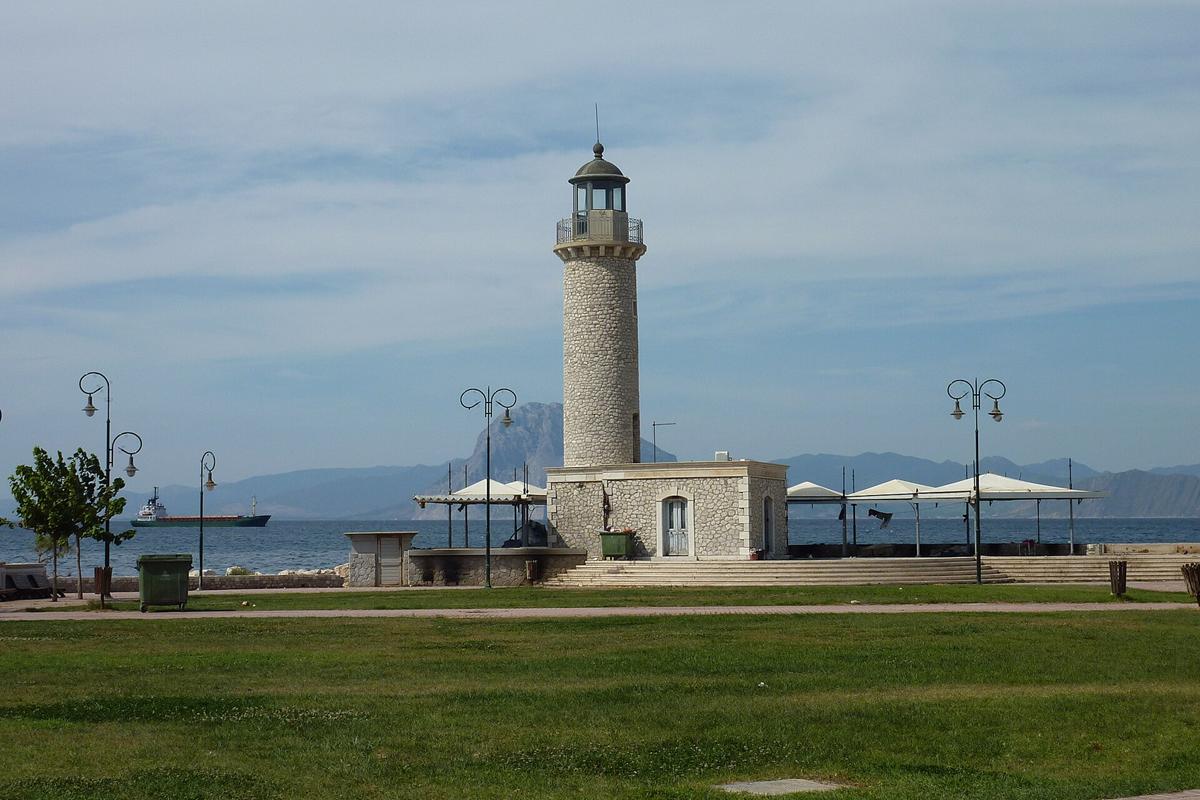
Lighthouses in Greece include the Patras tower on the seafront, at the start of Trion Navarchon street. It faces the temple of Saint Andrew. Patras is a port city in the western Peloponnese, on the gulf that bears its name.
Among lighthouses in Greece, the Patras story starts with a wooden tower. It went up in 1858 in the dock of Agios Nikolaos. A dock is a basin for ships. A storm destroyed that wooden tower in 1865. An old stone lighthouse followed in 1878. Its base covered 4 to 5 square metres, and it rose 17 metres.
The stone tower was pulled down in 1972, during the period of the military junta. The work formed part of the modernisation of the port. A junta is a group of officers ruling a country. In 1999 the coastal zone council decided to build the lighthouse again. The new site lay further south, near Saint Andrew’s cathedral.
The rebuilt Patras tower stands apart from working lighthouses in Greece, since it has no maritime use. Maritime means to do with shipping. Even so, it counts among the symbols of the city. It is also one of the main sights of Patras. A seaside park surrounds the tower today.
- Replica: This tower, one of the lighthouses in Greece, is a replica of the city’s emblematic old one.
- Square: Trion Symmachon Square links a pedestrian way with the seafront and the dock of Agios Nikolaos.
- Stairs: Outdoor grand staircases, one named after Trion Navarchon, divide the upper town from downtown.
Patras grew as the main export port for farm produce of the Peloponnese. Its lower town, Kato Poli, holds the 19th-century core and the port beside the sea. At the west end, a 15-metre cliff rises above pedestrian Trion Navarchon Street.
What keeps the Megalonisi light working among lighthouses in Greece?
Lighthouses in Greece include the Megalonisi Lighthouse, which people wrongly call the Sigri Lighthouse. Sigri is the nearby village on Lesbos. The light is still used today for safe navigation. Navigation means steering a ship on a set course.
On this one of the lighthouses in Greece, the focal plane stands 53 metres above the sea. The focal plane is the height at which the light itself shines. A one-storey house for the keeper is attached to the tower. A keeper is the person who once tended the lamp. In 1989 an electric light replaced the old petroleum lantern.
Among lighthouses in Greece, this light has gone dark only once, during the Second World War. It was repaired in 1945, once the war had ended. Its luminous range is 21 nautical miles. Luminous range is the distance at which a light can be seen. A nautical mile is a sea unit a little longer than a land mile.
Megalonisi, among the working lighthouses in Greece, sends out two white flashes every 15 seconds. The area around Sigri is sparsely populated. It is quite windy compared with eastern Lesbos. The village beach sweeps in a near half circle of volcanic grey sand. Volcanic sand forms from rock that old eruptions threw out.
- Museum: Sigri’s natural history museum was set up in 1994 to study the Lesvos Petrified Forest.
- Halls: Its first permanent hall covers the Petrified Forest and the evolution of plants on earth.
- Partners: The museum works with the Global Geoparks Network of UNESCO and the European Geoparks Network.
The museum at Sigri shows petrified trunks, branches, roots, seeds and leaves. Petrified means turned to stone over a very long time. Its displays also cover flint tools of the Stone Age. Flint is a hard stone that early people chipped into tools.
Why did Cape Araxos need one of the lighthouses in Greece?
Lighthouses in Greece include the light on Cape Araxos, also called Cape Pappas. The cape lies in the north-western Peloponnese. A cape is a headland reaching out into open water. A stone lighthouse first rose there in 1877.
The cape that holds this one of the lighthouses in Greece is the north-western tip of the Peloponnese. It divides the Ionian Sea from the Gulf of Patras. Patras lies 30 kilometres to the east, and the village of Akrotirio Araxou sits very close. The Peloponnese is the large peninsula forming the south of mainland Greece.
The waters off the cape are dangerous. Sediment keeps building up there, washed down from the uplands of Aetolia-Acarnania. The Acheloos and Evinos rivers carry it to the sea. Sediment is sand and mud that water moves and drops. Uplands are areas of high ground. In places the water is quite shallow.
Among lighthouses in Greece, the stone tower of 1877 at Araxos was destroyed in the Second World War. A modern lighthouse replaced it later. In that war, the sea near the cape was a naval minefield. Losses of ships and human lives were heavy. In 1945, a Dutch cargo ship struck a mine there and sank.
- Wreck: That Dutch ship now ranks among the best-preserved shipwrecks of the Gulf of Patras.
- Naval fort: The land around the cape belongs to the Greek Navy, which runs a small base there.
- Radio: The base hosts the Naval Radio Transmitter Facility of Araxos, a sending station for signals.
Among lighthouses in Greece, Araxos also sits beside a remote radar site of the Hellenic Coast Guard. It belongs to the national system that manages vessel traffic. Radar finds distant ships by bouncing radio waves off them.
What history does Cape Sidero give the lighthouses in Greece?
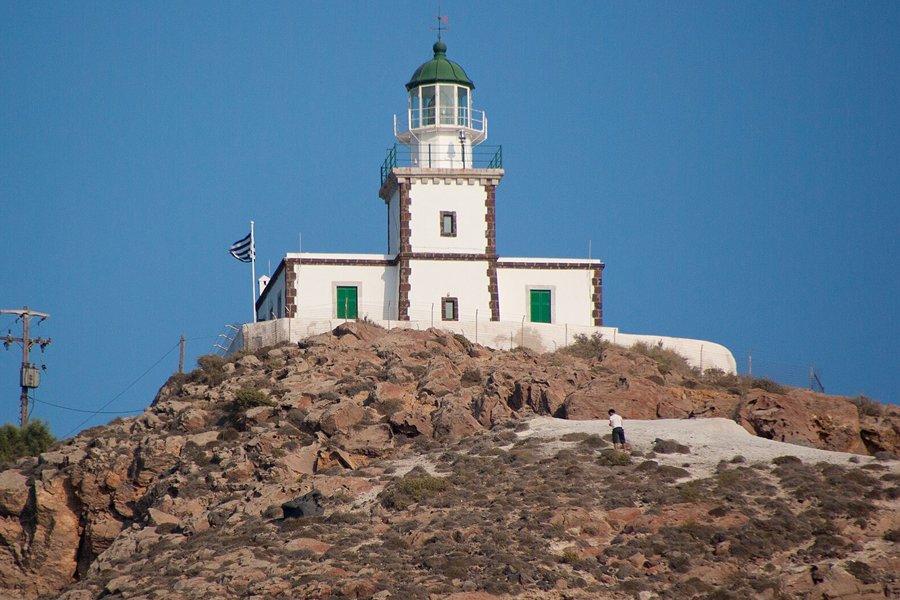
Lighthouses in Greece include the Cape Sidero light, at the eastern end of Crete. A French lighthouse company built it in 1880 under contract with the Ottoman Empire, which then held Crete. The tower reaches a height of 15 metres.
The cape, now home to one of the lighthouses in Greece, had other names in antiquity. These were Samonium, Sammonium, Salmonium and Salmone. The cape shares the name Sidero with the peninsula from which it projects. The name can also cover the whole north-eastern promontory. A promontory is a raised headland pushing out to sea.
Among lighthouses in Greece, it has worked since 1880, except for ruin and neglect from 1941 to 1948. That spell covered the German occupation and the Greek Civil War. Rebuilt in 1948, the lighthouse is now the duty of the Hellenic Navy Hydrographic Service. Hydrographic means concerned with mapping seas and coasts.
Today the lighthouse stands within the Naval Station of Kyriamadi. This small base has a building and a harbour. The site is normally closed to the public. It lies near the church of Agios Isidoros, and agios means saint in Greek. During his festival in February, the Greek Navy opens the lighthouse to the public.
- Lens: From the start, the Cape Sidero light featured a Fresnel lens, a lens built from thin rings.
- Signal: Among lighthouses in Greece, Cape Sidero flashes white once in every 10 seconds.
- Charts: Ships at sea identify each lighthouse at night by its recorded pattern of flashes.
Sailors first identify a light and find it on the chart. A handful of bearings then fix the ship’s exact position. A bearing is the direction of an object measured from north. Satellite navigation, known as GPS, can make this older method unnecessary.
What do travellers ask about lighthouses in Greece, and what are the answers?
Lighthouses in Greece each show a light characteristic, a pattern of bright flashes set for one tower alone. An observer sees short bursts of strong light, not a weak steady glow. Certain lights add coloured sectors to separate safe water from shoals.
Which island tower built in 1864 counts among the lighthouses in Greece?
Kalolimnos, an island in the municipality of Kalymnos, has an old lighthouse. A French company that ran Ottoman lighthouses built it in 1864. That means Kalymnos governs it locally. The island also holds a military building with a permanent army garrison. Its slopes are steep and rocky, and wild goats roam them.
Who once tended the lamps of lighthouses in Greece?
A lighthouse keeper is a person who tends a lighthouse, especially its light and lens. The role dates from the days of oil lamps and clockwork. Keepers trimmed wicks, added fuel, wound clockwork and cleaned lenses. On Pasas, near Chios, a lighthouse guard frequently lives on the island. Its light also keeps a permanent staff.
Why does the Fresnel lens matter for lighthouses in Greece?
A Fresnel lens is a compact lens split into a set of ring-shaped sections. This design needs far less material than a normal lens. Augustin-Jean Fresnel, a French physicist, reinvented it for use in lighthouses. Lighthouse use earned it praise as an invention credited with saving a million ships. A physicist studies matter and energy.
What is the Dalén light once used at lighthouses in Greece?
A Dalén light flashes by burning acetylene, a gas made from carbide. A sun sensor lets it work only in darkness. Gustaf Dalén invented a valve that sends pulses of gas to the lamp. A pilot flame lights them. The system won him the 1912 Nobel Prize in Physics. It served lighthouses into the 1960s.
Featured photo: Xocolatl, public domain, via Wikimedia Commons.