
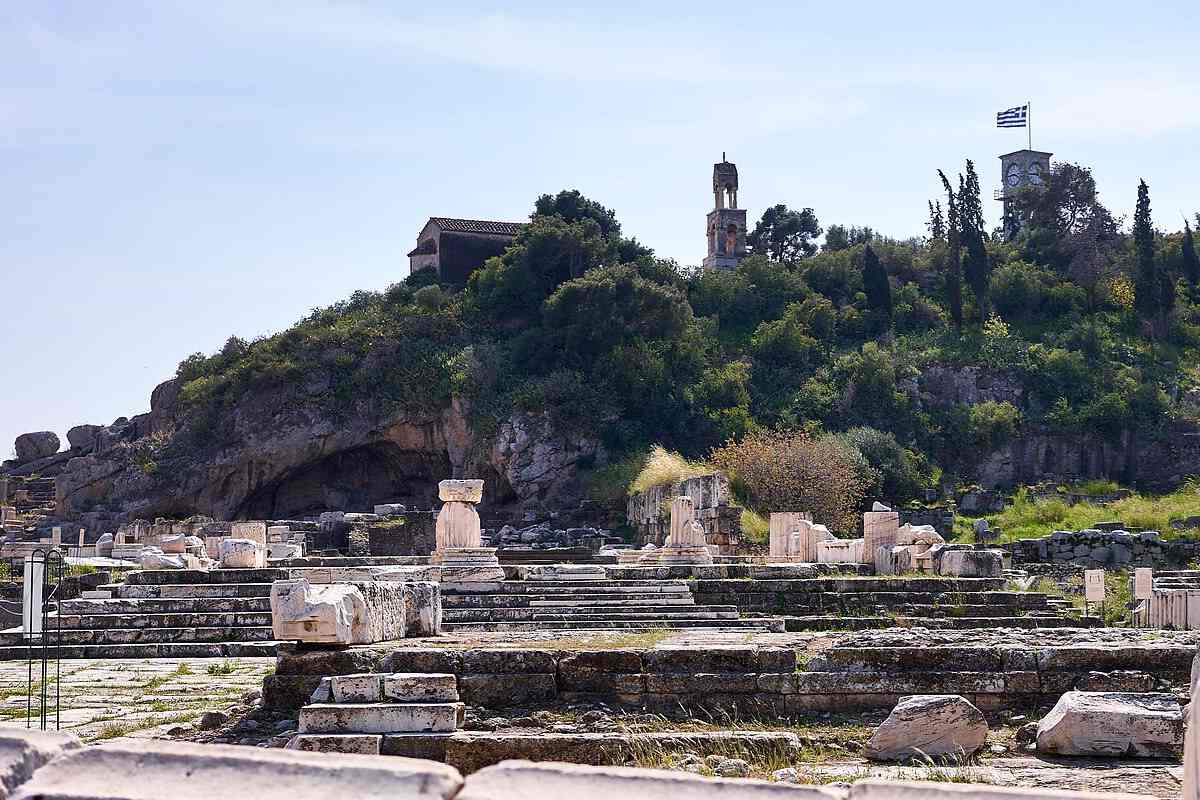
Ancient Greek religion forms a theme for trips through Greece, outings with a host on mainland and islands. Its rituals, priests, festivals and oracles include the Eleusinian Mysteries, Orphism, the Cabeiri and the hierophant. Votive offerings, the sibyls, the pharmakos and the Daedala of Plataea follow. Related stories concern the Greek gods, the Oracle of Delphi and temples in Greece. All of these belong to the wider world of Greece tours.
Bookings made through the GetYourGuide widgets on this page earn Classical Greece Tours a commission, at no extra cost to the traveller.
What was ancient Greek religion?
Ancient Greek religion honoured a large number of gods and goddesses, a belief called polytheism. It joined beliefs, rituals and myths in public worship and in cult practice. No central authority ran it, and each city alone controlled any change to practice.
The ancient Greeks had no term matching the modern idea of religion. No known Greek author divided gods or rites into distinct faiths. The writer Herodotus instead described Greeks as sharing shrines, sacrifices and customs. Ancient texts say plenty about cult, meaning acts of worship. They say very little about creed, meaning fixed belief.
Doing the right act mattered far more in ancient Greek religion than holding the right belief. No text counted as revealed scripture of sacred origin. Priests were normally magistrates of a city or village, or drew their authority from a sanctuary. The traveller Pausanias recorded a boy as priest of Athena Alea at Tegea, in office until puberty.
Rituals in ancient Greek religion took place at altars, which stood outside temples, never within them. A girl carrying a basket with a hidden knife led the sacrificial animal in procession. Its blood was poured over the altar after slaughter. Bones and inedible organs burned as the god’s share, while worshippers ate the meat.
- Victims: Sheep were the commonest sacrifice, and piglets were the cheapest mammal to offer.
- Libations: These ritual pourings of fluid came with a prayer, using part of a cup of wine at home.
- Festivals: The Athenian year held about 140 days of religious festivals, of very different importance.
Ancient Greek religion gave less weight to reading the organs of sacrificed animals than Roman religion did. Greeks placed more faith in the behaviour of birds. Temples commonly sold the hide of a sacrificed animal to tanners, the craftsmen who make leather.
Why did the Eleusinian Mysteries matter in ancient Greek religion?
Ancient Greek religion drew pilgrims from Greece and beyond to the Eleusinian Mysteries. Peisistratos of Athens turned these secret rites into a pan-Hellenic event, shared by all Greeks. Initiates, the people admitted to the rites, believed these earned them a reward in the afterlife.
The English word mystery comes from the Greek mysterion, a secret rite. Its relative mystes named an initiated person. Entry to this branch of ancient Greek religion required freedom from blood guilt, meaning never having committed murder. Candidates also had to speak Greek. Men, women and even slaves gained admission, and each took a vow of secrecy.
Six categories of priests served at the Eleusinian rites of ancient Greek religion. The dadouchos, a male torch bearer, held the second-highest male role. Two married priestesses called hierophantides served Demeter and Persephone separately. A group of priestesses called panageis, meaning the holy ones, lived secluded from men.
The High Priestess matched the hierophant, or chief priest, in rank. She played Demeter and Persephone in the acted story during the rites. Events at Eleusis took their dates from the name of the serving High Priestess. At the feast’s start, priests emptied two special vessels, one to the west and one to the east.
- Lesser Mysteries: Candidates sacrificed a piglet to Demeter and Persephone, then purified themselves in the river Ilisos.
- Secret objects: Only initiates knew what lay inside a sacred chest, the kiste, and a lidded basket, the calathus.
- High point: The celebration peaked with a silently cut ear of grain, standing for the force of new life.
The state assumed control around 300 BC, leaving the Eumolpidae and Kerykes families in charge. A hymn of ancient Greek religion counts King Celeus among the first to learn Demeter’s rites. It also names him as one of her original priests.
Where does Orphism fit within ancient Greek religion?
Ancient Greek religion included Orphism, a set of beliefs and practices. Its writings were credited to the mythical poet Orpheus, said to have returned from the underworld. Scholars have described it as a reform of the older worship of Dionysus.
The central myth of Orphism told of the infant Dionysus killed and eaten by the Titans, elder gods. Zeus answered with a thunderbolt that reduced them to ash. Humanity arose from those ashes, according to the story. One Orphic view gave people a body from the Titans and a divine soul from Dionysus.
Salvation in this strand of ancient Greek religion required initiation and a rite called telete. Telete meant ritual purification and a reliving of the god’s suffering and death. Those left uninitiated, Orphics believed, returned to life again and again. That endless return is called reincarnation. Plato referred to Orpheus-initiators, people who led these rites.
Orphic poetry within ancient Greek religion reaches back to the 6th or at least the 5th century BC. Herodotus, Euripides and Plato all attest Orphic views and practices. Ion of Chios claimed that Pythagoras wrote poems and credited them to the mythical Orpheus. Cicero reports Aristotle as saying that Orpheus never existed.
- Gold leaves: Thin gold tablets from graves in Thessaly and Crete gave instructions to the dead.
- Two pools: Those tablets warned the dead to avoid Lethe, or Forgetfulness, and drink from Mnemosyne, or Memory.
- Bone tablets: Tablets found at Olbia, from the 5th century BC, carry brief words such as life and death.
Orphic theogonies, accounts of the gods’ origin, opened differently from one poem to another in ancient Greek religion. In the Eudemian Theogony, Night came first. Elsewhere, the deity Phanes hatched from an egg and then created the other gods.
Who were the Cabeiri in ancient Greek religion?
Ancient Greek religion honoured the Cabeiri, mysterious deities of the underworld, in a secret cult linked with Hephaestus. Worship centred on the north Aegean islands of Lemnos and possibly Samothrace, and on Thebes. Greek myth pictured them as divine craftsmen.
Lemnos held its own cult of the Cabeiri, a branch of ancient Greek religion local to the island. An ancient sanctuary on Lemnos can be identified from traces of inscriptions. Walter Burkert, a scholar, records wine jars as the only distinctive finds at this Cabeirium, or shrine. Initiation into a secret cult took place there.
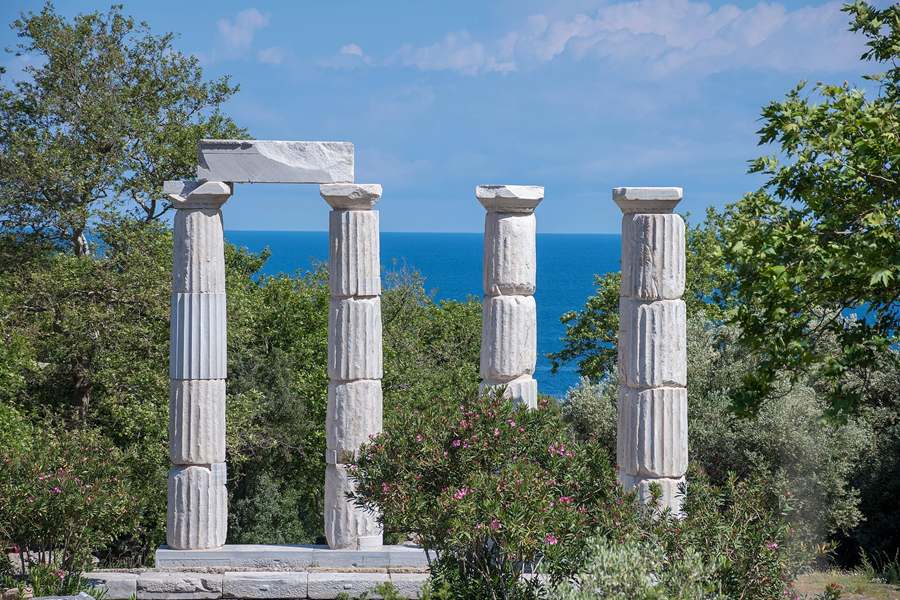
Ancient sources disagree on whether the gods of Samothrace were Cabeiri. Accounts commonly give two to four Samothracian gods of either sex. In ancient Greek religion, that island’s cult spread quickly across the Greek world in the Hellenistic period. During that period, Alexander’s successors competed in generous gifts to the sanctuary.
Worship on Samothrace combined prayer with blood sacrifices of sheep and pigs, burnt in sacred hearths called escharai. Libations, or ritual pourings, went to underworld gods in pits, each called a bothros. A sacred play staged there included a ritual wedding. Around 200 BC, a competition in honour of Dionysus joined the festival, helped by a new theatre.
- Head priestess: The head priestess of Samothrace, at times also a prophetess, carried the title Sybil or Cybele.
- Temple gifts: Statues of bronze, marble or clay stood in a building beside the great altar.
- Kadmilos: The spouse of Axieros, this fertility god was identified by the Greeks as Hermes.
Ancient Greek religion also reached the stage in The Kabeiroi, a tragedy by Aeschylus. The play apparently made these deities a chorus greeting the Argonauts, Jason’s crew, at Lemnos. Myth named the Cabeiri as sons or grandsons of Hephaestus.
How did votive offerings work in ancient Greek religion?
Ancient Greek religion included votive offerings, objects left in a sacred place with no plan to recover them. Givers commonly waited until a wish came true before making the gift. Other offerings seem to have been plain gifts to a deity, tied to no particular need.
The term ex-voto names an offering made after a wish came true. At Greek altars, worshippers left food, drinks and precious objects as votive deposits. Votive gifts in ancient Greek religion also served as atonement for sins against a god or goddess. Atonement means making amends for a wrong.
Treasuries served ancient Greek religion at Olympia and Delphi, built by city-states to hold their own offerings. Two examples are the Siphnian Treasury and the one built by Athens. Money and precious metal filled these buildings. Votive sculptures there also glorified each city before its rivals, while giving thanks to the gods.
At Olympia, small figurines, mainly of animals, were thrown onto the huge ash pile from sacrifices. That heap belonged to the outdoor altar of the Temple of Zeus. Bronze tripods, three-legged stands, apparently stood on show at Delphi before burial in groups. Excavated deposits like these supply much of today’s knowledge of Greek art in non-precious metal.
- War gifts: Helmets above all, along with other arms and armour, went to the gods after a victory.
- Sparta: Offerings from the 5th century BC there give evidence of literacy in Spartan culture.
- Diogenes of Sinope: Told of wonder at the Samothrace offerings, he said the total lacked gifts from those not saved.
Ancient Greek religion saw devotees donate real jewellery for cult images, or temple statues. A bronze Heracles seen by Cicero had one foot largely worn away by worshippers’ touch. A giver with an injury was allowed to have another person make the gift.
Which role did the hierophant play in ancient Greek religion?
Ancient Greek religion gave the title hierophant to the chief priest of the Eleusinian Mysteries in Attica. The word joins the Greek for the holy with the verb to reveal. Its holder acted as an interpreter of sacred mysteries.
The post passed by inheritance within the Eumolpidae, one of two main clans running the Eleusinian cult. The other clan was the Cerycids. From the first century BC, holders of this office in ancient Greek religion consistently dropped their personal names. That custom, called hieronymy, left them known in life simply as hierophant.
The known list of hierophants at Eleusis opens with Zacorus, in the early 5th century BC. Theodorus held the post before 415 BC, and Archias around 379 BC. One holder around 86 BC also served as eponymous archon, the magistrate naming the Athenian year. Titus Flavius Straton held it around 125 AD.
In Athens, ancient Greek religion also placed duties on the archon basileus, meaning king magistrate. He served as high priest of the city-state and presided over homicide trials. Modern scholars widely treat the post as the last remnant of monarchy in Classical Athens. He also directed the Lesser Mysteries, a rite that prepared candidates for the Greater Mysteries.
- Wealth rule: After the reforms of Solon, holders came from the richest Athenians, called 500-bushel men.
- Selection by lot: After 487 BC, archonships in Athens were assigned by lot.
- Nestorius: Last on the known list of hierophants, he served before 355 AD and initiated Eunapius.
Ancient Greek religion sometimes handed a priestly duty, such as a local festival, to one family. Without scriptures, ritual in Greece drew its authority from tradition. Any omission or departure from set practice caused deep anxiety and brought penalties.
What part did the sibyls play in ancient Greek religion?
Ancient Greek religion knew sibyls as prophetesses, or women who foretold events, speaking at holy sites. Their number grew over the centuries. By the first century BC, at least ten are known, in Italy, Greece, Asia Minor and North Africa.
Varro, an ancient scholar, traced the name to an Aeolic Greek phrase for divine counsel. Modern handbooks instead list its origin as unknown. The earliest Greek reference comes from Heraclitus, active around 500 BC, according to Plutarch. His line pictured a frenzied, unperfumed woman whose voice lasted a thousand years through the god’s aid.
Early sibyls in ancient Greek religion carried no personal name. Each took a name from the location of her shrine, until Roman authors reworked the tradition. Pausanias, the traveller, places an early sibyl at Delphi in his second-century AD writings. Local tradition there set her back to the eleventh century BC.
Apollodorus of Erythrae claimed the Erythraean Sibyl of ancient Greek religion as his own countrywoman. He said she predicted the Trojan War, the fall of Troy and the falsehoods of Homer. Her prophecies, written on leaves, had initial letters that formed a word. The term acrostic was first applied to those prophecies.
- Delphic Sibyl: She prophesied before the Trojan Wars, hundreds of years before the priestess called the Pythia.
- Herophile: Pausanias ties this second sibyl to Samos, with visits and songs at Clarus, Delos and Delphi.
- Hellespontine Sibyl: Also called the Trojan Sibyl, she presided over the oracle of Apollo at Dardania.
Ancient Greek religion at first seemed to know one sibyl, according to the scholar James Frazer. Heraclides Ponticus was the first ancient writer to name more, listing the Phrygian, Erythraean and Hellespontine. Plato, like Heraclitus, spoke of only one sibyl.
Why did ancient Greek religion expel a pharmakos?
Ancient Greek religion used the pharmakos, a human scapegoat, to cleanse a community in hard times. The chosen person was a slave, a criminal or someone disabled, and was driven out. People believed this removal brought purification after famine, invasion or plague.
A scapegoat carries a group’s hardship away, and Greeks hoped trouble left with the outcast. The rite also fell at crisis points in the calendar. At Athens, two men became pharmakoi, the plural form, on the first day of the Thargelia festival. They were led out as if for sacrifice, an act of expiation, or making amends.
Scholars of ancient Greek religion dispute whether the rite ended in death. Scholia, notes added to old texts, speak of victims thrown from a cliff or burned. Modern scholars reply by citing Hipponax, a satirical poet and the earliest source. His verses show pharmakoi beaten and stoned, yet not executed.
Walter Burkert, writing on ancient Greek religion, showed that victims were sacrificed or expelled after being well fed. According to certain sources, their ashes were then scattered over the ocean. Burkert read this as purification, a kind of catharsis for society. Catharsis means a cleansing release. René Girard also tied catharsis, sacrifice and purification together.
- Ostracism: Scholars have compared the rite with the Athenian vote on pottery pieces that exiled a leading politician.
- Time limit: Ostracism exile ran for a fixed time, unlike the finality of the pharmakos expulsion.
- Aesop: Anton Wiechers compared the legend of Aesop, executed by the people of Delphi, with this rite.
Daniel Ogden and Todd Compton, two modern authors on ancient Greek religion, examine poets as pharmakoi. Compton surveys poets exiled, executed or unjustly tried in history, legend and myth. Gregory Nagy compared the death of Aesop with Thersites, the Iliad’s worst of the Achaeans, or Greeks.
How did the Daedala of Plataea serve ancient Greek religion?
Ancient Greek religion honoured Hera at Plataea in Boeotia through the Daedala, a festival of reconciliation. It ranked among the major cults of the city. A lesser festival belonged to the Plataeans, while a greater one drew all of Boeotia.
Ancient Greek religion’s lesser Daedala took Plataeans into an ancient oak grove, where ravens received cooked meat. They watched which tree a bird chose after taking a piece. The chosen tree supplied a carved wooden figure, one of the xoana, also known as daidala. A cheering crowd seems to have followed it to the Asopus riverbank and back.
After fourteen cycles, about 60 years, all Boeotia joined the great Daedala of ancient Greek religion. One stored figure was chosen as the bride. It was bathed in the river Asopus, decked out and lifted onto a wagon beside an attendant. The procession then climbed to the summit of Mount Cithaeron with the other images.
A wooden altar of square timber stood on the summit, piled with dry wood. Towns, persons of rank and wealthy citizens each gave Hera a heifer and Zeus a bull. Those with less gave small sheep. Wine and incense were added, and the fire consumed offerings and altar together.
- Quarrel: Hera, angry with Zeus, withdrew to Euboia, according to the story told by Pausanias.
- Trick: Zeus carried a wrapped wooden image in a wagon, claiming to wed Plataia, daughter of Asopus.
- Name: Daedalus, the famed inventor, shares the root daidalos, meaning cunning worker.
In ancient Greek religion’s version, the quarrel ended at that wagon. Hera tore away the image’s dress, found wood and no bride, and reconciled with Zeus. Kithairon, then ruler of Plataea, gave Zeus the idea, although Plutarch named Alalcomenes as the adviser.
What do travellers ask about ancient Greek religion, and what are the answers?
The ancient Greek religion set local rules on entry to temples, shaped by ideas of ritual purity. One temple banned garlic-eaters, and visitors elsewhere had to prove they spoke Greek. In another place, Dorians, a branch of the Greek people, had no right of entry.
In ancient Greek religion, what was miasma?
Miasma was a contagious power of ritual pollution, described as having an independent life of its own. Society stayed infected by catastrophe until the wrongdoer died in sacrifice. People so polluted faced exclusion from ceremonies, public gatherings and everyday contact. Severe cases brought exile or death.
Which Athenian festival of ancient Greek religion closed the old year?
The Skira marked the close of the old Athenian year. Its main feature was a procession from Athens to Skiron, near Eleusis. The priestess of Athena and the priest of Poseidon walked under a canopy called the skiron. Women gathered to eat garlic and feast at men’s expense.
How did ancient Greek religion honour Apollo in the Daphnephoria?
Thebes in Boeotia staged this festival of Apollo every ninth year. A boy of good family, with both parents alive, was the chief figure, called the laurel bearer. A relative carried an olive branch with bronze balls for the sun, stars and moon. Ribbons, 365 in number, stood for the days of the year.
What happened in the Dionysian Mysteries of ancient Greek religion?
These rites used dance, music and other trance-inducing methods to remove inhibitions. They gave a measure of freedom to slaves, outlaws and non-citizens on the edge of Greek society. Drinkers credited the effects of wine to possession by the spirit of the god. Bacchic gold tablets, found by archaeologists, help reconstruct initiation practices.
Featured photo: File:At the archaeological site of the Sanctuary of Demeter at Eleusis.jpg | George E. Koronaios, CC BY-SA 4.0, via Wikimedia Commons.