
Ancient Greek mathematicians worked in cities from Anatolia and Italy to North Africa. Small-group trips with a host run across Greece, from Athens to Corinth and the Saronic islands. The topics run from Thales, Pythagoras and Euclid to Archimedes, Eudoxus and Apollonius. Later sections take in Diophantus, Hypatia and the Archimedes Palimpsest. Related pages cover Ancient Greek philosophers, Ancient Greek inventions and Museums in Greece. Wider trips appear under Greece tours.
Bookings made through the GetYourGuide widgets on this page earn Classical Greece Tours a commission, at no extra cost to the traveller.
Who were the ancient Greek mathematicians?
Ancient Greek mathematicians lived in cities around the Mediterranean, from Anatolia across to Italy and North Africa. The Greek language and Greek culture joined them together. Their work ran mainly between the 5th century BC and the 6th century AD.
The word mathematics comes from the Greek for a lesson and from a verb meaning to learn. A lesson in this old sense covered any branch of study. Four subjects earned special status among ancient Greek mathematicians: arithmetic, geometry, astronomy and harmonics. Harmonics is the study of musical notes as number ratios.
The Minoan and Mycenaean peoples had writing, yet no mathematical text of theirs has come to light. The first known Greek treatises began with Hippocrates of Chios in the 5th century BC. A treatise means a full written account of a single subject. Those books are lost, so later authors supply the record of early ancient Greek mathematicians.
Proof is the mark that set these thinkers apart from earlier peoples. A proof is a chain of reasoning that shows a statement must be true. Euclid’s Elements stands as the earliest complete work on the subject. Later ancient Greek mathematicians peaked in the Hellenistic and early Roman periods. The Hellenistic period followed the conquests of Alexander.
- Main centre: The Mouseion in Alexandria ranked first among the new centres of learning after Alexander’s conquests.
- Circulation: Hellenistic authors shared results by letter and by copying each other’s work among colleagues.
- Later sources: Plato, Aristotle and quotations from Eudemus of Rhodes preserve much of the early record.
Byzantine scribes copied the works of ancient Greek mathematicians, and translators carried them into Arabic and Latin. Those versions shaped study in the Islamic world and in medieval Europe. In the Renaissance, the texts of Euclid, Archimedes, Apollonius and Pappus fed early modern mathematics.
What did Thales of Miletus give the ancient Greek mathematicians?
Ancient Greek mathematicians trace a famous circle theorem to Thales of Miletus. Miletus lay in Ionia, part of Asia Minor, at the mouth of the Maeander River. It was a trading city, and its site lies close to modern Didim in Turkey.
A theorem is a statement proved by reasoning. This one takes three points A, B and C on a circle, with AC as a diameter. A diameter runs straight across a circle through its centre. The angle at B then forms a right angle. Euclid set it out as the 31st proposition of Book III in his Elements.
Stories about Thales also reached later ancient Greek mathematicians. Pamphila, writing in the 1st century AD, said he first drew a right-angled triangle inside a circle. He was also said to have worked out the height of the pyramids. The same reports credit him with finding how far ships stood from the shore.
No writing by Thales survived even by the 5th century BC. Later authors credited wise men with ideas on the strength of hearsay. Hearsay means reports passed along by word of mouth. Modern scholars date the deductive geometry of ancient Greek mathematicians to the 4th century BC. Deductive geometry builds each result from earlier ones through strict reasoning.
- Sage: Thales stands among the Seven Sages, half-legendary wise men counted as founders of ancient Greece.
- Eclipse: Herodotus wrote that Thales foretold a solar eclipse, dated to 585 BC.
- Poetry: Dante’s Paradiso mentions the theorem of Thales during a speech in the poem.
The main source for his life is Diogenes Laertius, a 3rd-century AD biographer. Diogenes wrote about eight centuries after Thales died. For later ancient Greek mathematicians, tradition named either Thales or Pythagoras as the origin of their whole subject.
How did the Pythagorean theorem reach the ancient Greek mathematicians?
Ancient Greek mathematicians linked one famous rule of right triangles with Pythagoras, a philosopher born around 570 BC. A right triangle has one square corner. The square on the longest side equals the two squares on the other sides added together.
The rule is far older than the ancient Greek mathematicians. An Egyptian text of about 1800 BC is the Berlin Papyrus 6619. It sets a problem on two squares whose areas add up to a third. Its answer is the set 6, 8 and 10. Papyrus is a paper-like sheet pressed from a reed plant.
The Mesopotamian tablet Plimpton 322 was written near Larsa at about the same date. Its entries read today as 15 Pythagorean triples. A Pythagorean triple is three whole numbers that fit the rule. Plutarch said the Egyptians knew the triangle with sides 3, 4 and 5. He linked those sides with Osiris, Isis and Horus.
The credit to Pythagoras rests on late sources. Thomas Heath found no direct credit to him in Greek writing from the five centuries after his life. Plutarch and Cicero later named him as if the link were widely known. Among later ancient Greek mathematicians, Proclus reported a rule for triples ascribed to Pythagoras.
- Oldest proof: Euclid’s Elements, from around 300 BC, holds the oldest surviving proof built on stated basic rules.
- India: The Baudhayana Shulba Sutra, an old Indian text, holds a list of Pythagorean triples.
- China: The Chinese text Zhoubi Suanjing gives its reasoning for a right triangle measuring 3, 4 and 5.
Proofs of the rule include geometric and algebraic kinds, reaching back thousands of years. Its count of proofs is possibly the highest for any theorem. Modern work extends the rule known to ancient Greek mathematicians into higher-dimensional spaces, meaning spaces beyond three dimensions.
Which place does Euclid hold among the ancient Greek mathematicians?
Ancient Greek mathematicians include Euclid, a geometer and logician active around 300 BC. A geometer studies shapes and space, while a logician studies sound reasoning. Euclid holds the title father of geometry, chiefly through his treatise called the Elements.
Little survives about his life, as with other ancient Greek mathematicians. His birthplace is unknown. The main details come from Proclus and Pappus, writers of much later centuries. He spent his career in Alexandria, the city Alexander the Great founded in 331 BC. Medieval scholars mixed him up with an earlier philosopher, Euclid of Megara.
The Elements runs to thirteen books. Books 1 to 6 treat plane geometry, which deals with flat shapes. Books 7 to 10 cover basic number theory, the study of whole numbers. Books 11 to 13 turn to solid geometry, which deals with shapes in three dimensions. Its theorems come with proofs and diagrams.
Much of the content came from earlier ancient Greek mathematicians, including Eudoxus, Hippocrates of Chios, Thales and Theaetetus. The Elements is the oldest surviving deductive work on mathematics at large scale. Deductive means each result follows by logic from the ones before. Later writers ranked it first among all textbooks for its success.
- Papyrus: The oldest physical copies, from around 100 AD, lay in an old rubbish heap at Oxyrhynchus.
- Prime numbers: Euclid’s theorem shows that prime numbers, divisible only by themselves and one, never run out.
- Optics: Euclid also wrote Optics, a central early text on the science of light and sight.
A story from Proclus has King Ptolemy asking Euclid for a quicker path to learning geometry. Euclid replied that no royal road existed. Among ancient Greek mathematicians, a similar tale links Menaechmus with Alexander the Great, so doubt remains.
What methods did Archimedes bring to the ancient Greek mathematicians?
Ancient Greek mathematicians gained a way of naming huge numbers from Archimedes of Syracuse. His short work The Sand Reckoner runs to about eight pages in translation. He addressed the text to Gelo II, the king of Syracuse.
The Greek number system of his day stopped at a myriad, the word for 10,000. Archimedes extended it with powers of a myriad of myriads, or 100 million. He then sought an upper limit for the grains of sand that fit in the universe. His total reached 8 vigintillion, an 8 followed by 63 zeros.
The method of exhaustion finds an area by fitting a run of polygons inside a shape. Polygons are flat figures with straight sides. Earlier ancient Greek mathematicians had applied it, and Archimedes used it in Measurement of a Circle. There he matched a circle’s area to a right triangle built from its radius and circumference.
The same work gave a range for pi, the number linking a circle’s width to its edge. He drew regular polygons inside and outside a circle, doubling their sides step by step. At 96 sides each, the polygons gave him his result. Proposition II placed pi above 223/71 and below 22/7.
- Spirals: On Spirals, a work of 28 propositions sent to Dositheus, defines the Archimedean spiral.
- Sphere: Archimedes took special pride in relating a sphere to the cylinder that encloses it.
- Cattle: A 44-line poem challenges ancient Greek mathematicians to count the cattle in the Herd of the Sun.
Archimedes sent the cattle puzzle to Eratosthenes and the ancient Greek mathematicians in Alexandria. Gotthold Lessing found the text in a manuscript in Germany in 1773. A. Amthor first solved the harder version in 1880. Its answer runs to a very large number.
Where does Eudoxus of Cnidus stand among ancient Greek mathematicians?
Ancient Greek mathematicians had a leading figure in Eudoxus, born in the city of Cnidus. Cnidus stood on the southwest coast of Anatolia, the land of modern Turkey. Later opinion counts him second only to Archimedes in all antiquity. His name means honoured.
Eudoxus studied mathematics with Archytas, one of the older ancient Greek mathematicians, and medicine with Philiston the Sicilian. At the age of 23 he reached Athens with the physician Theomedon. A physician is a doctor. He lodged in Piraeus and walked 7 miles each way to hear the Sophists. Sophists were paid teachers of argument and public speaking.
His friends then paid for a trip to Heliopolis in Egypt to study astronomy and mathematics. From there he moved on to Cyzicus, on the Sea of Marmara. Around 368 BC he came back to Athens with students of his own. Back home in Cnidus, he served in the city assembly and built an observatory.
Scholars name Eudoxus as the probable source for the bulk of Book V of the Elements. Book V deals with proportion, meaning equal ratios between quantities. He tightened the method of exhaustion that ancient Greek mathematicians took from Antiphon. With it he showed that a cone holds one-third of the volume of its matching cylinder.
- Pyramid: Eudoxus proved that a pyramid holds one-third of a prism with the same base and height.
- Circles: He showed that circle areas compare as the squares of their radii, the centre-to-edge lengths.
- Magnitude: His idea of magnitude treated lines, angles and areas as continuous quantities without fixed numbers.
Eudoxus moved the focus of ancient Greek mathematicians from number and arithmetic towards geometry. That change opened a divide in the subject lasting two thousand years. Techniques in arithmetic and algebra then fell back sharply among later Greek thinkers.
How did Apollonius of Perga extend the work of ancient Greek mathematicians on cones?
Ancient Greek mathematicians studied conic sections, and Apollonius of Perga became known for that work. He was born around 240 BC. Perga was a Hellenised city in Pamphylia, Anatolia, where ruins still stand. Hellenised means shaped by Greek language and culture.
A conic section is the curve made where a flat plane cuts through a cone. Apollonius gave the terms ellipse, parabola and hyperbola the definitions still in use. An ellipse is a closed oval, while a parabola and a hyperbola are open curves. He built on earlier ancient Greek mathematicians, including Euclid and Archimedes.
Little detail of his life remains. His own writings imply that he lived and worked in Alexandria. His book Conics carries prefaces, which are letters to influential friends. The first two went to Eudemus of Pergamon, a city known for books and parchment. The word parchment, for treated animal skin used in writing, derives from that city’s name.
A geometer and house guest named Naucrates first asked for the Conics in Alexandria. Apollonius gave him a first draft of all eight books. His son, also named Apollonius, carried the second preface to Eudemus. The ancient Greek mathematicians of his age exchanged visits, read one another’s books and recommended students.
- Size: Books I to VII of the Conics set out 387 propositions, or statements to be proved.
- Tangencies: This lost work asked for a circle touching three given points, lines or circles.
- Moon: A crater on the Moon carries the name of Apollonius in his honour.
Apollonius also proposed eccentric orbits, or off-centre paths, to explain the odd motion of the planets. The idea held until the Renaissance replaced it. Little of his other work survives, apart from fragments cited by ancient Greek mathematicians such as Pappus.
What is the sieve that ancient Greek mathematicians linked to Eratosthenes?
Ancient Greek mathematicians passed down a simple test for primes under the name of Eratosthenes. He came from Cyrene and worked as a Greek mathematician in the 3rd century BC. The method is a sieve, a process that filters out every number except the prime ones.
A prime number has exactly two divisors, the number 1 and itself. A divisor is a number that goes into another without a remainder. For ancient Greek mathematicians, the sieve found all primes up to a chosen limit. It marks the multiples of each prime as composite, meaning not prime, and begins with 2.
The method starts with a list of whole numbers from 2 up to the limit. Each round takes the smallest unmarked number as the next prime. A number such as 15 gets marked twice, once for 3 and once for 5. The numbers left unmarked at the end are all primes.
Among ancient Greek mathematicians, the first known mention of the sieve comes from Nicomachus of Gerasa. His Introduction to Arithmetic dates from the early 2nd century AD. The book credits Eratosthenes, yet it sieves by odd numbers and not by primes. The Greek name, koskinon Eratosthenous, means the sieve of Eratosthenes.
- Arithmetic only: The sieve needs only additions, with no multiplication or division at any step.
- Speed: It remains a highly efficient way of finding the smaller prime numbers.
- Method: Its marking of multiples differs from trial division, which tests each candidate number in turn.
A run up to 30 crosses out the multiples of 2, then 3, then 5. By 7, every multiple is already gone. The original form known to ancient Greek mathematicians listed odd numbers only. Modern work has added segmented sieves, which treat the range in portions.
What made the Pythagorean school at Croton a home for ancient Greek mathematicians?
Ancient Greek mathematicians have an early chapter in the community Pythagoras set up at Croton. Croton was a Greek colony in modern Calabria, and the group dates from about 530 BC. Later groups spread across Magna Graecia, the Greek settlements of southern Italy.
Members came to form two camps. The akousmatikoi held the oral sayings of Pythagoras to be fixed, sacred teaching. They lived by silence, simple dress and avoiding meat. The mathematikoi treated study and learning as part of their practice, and their research was largely mathematical. Among ancient Greek mathematicians, this second camp counted as the progressive side.
Pythagorean philosophers showed numbers as dots, known as psiphi or pebbles. The dots formed triangles, squares, rectangles and pentagons. Numbers then meant positive whole numbers, since no zero existed. They gave special status to any number equal to the sum of its divisors. One example is 28, the sum of 1, 2, 4, 7 and 14.
Early Pythagoreans proved that a triangle’s angles add up to two right angles. They also revered the pentagram, a five-pointed star, because its diagonals cut each other at the golden ratio. The golden ratio is a special proportion between two unequal lengths. These ancient Greek mathematicians also placed the Earth in orbit around a central fire.
- Monochord: Ancient sources credit Pythagoras with this straight rod carrying a string and a movable bridge.
- Number four: Pythagoreans tied four to justice, because two times two makes an equally even number.
- Number three: The group saw three as the whole, made up of end, middle and beginning.
Political trouble in Magna Graecia drove members to mainland Greece and to Rhegium. By about 400 BC the majority had left the Italian peninsula. Through Plato, the ideas of these ancient Greek mathematicians reached all of Western philosophy.
What did the Archimedes Palimpsest reveal about ancient Greek mathematicians?
Ancient Greek mathematicians left a famous survivor in the Archimedes Palimpsest, a Byzantine manuscript. A palimpsest is a parchment page scraped and written on again. Its hidden layer holds two works of Archimedes once thought lost. They are the Ostomachion and the Method of Mechanical Theorems.
Archimedes wrote his proofs as letters to ancient Greek mathematicians and other contemporaries. His dialect was Doric, a regional Greek. Isidore of Miletus, architect of the Hagia Sophia, first gathered them around AD 530. A scribe copied that edition around AD 950 in Constantinople. Study of Archimedes flourished there at the Magnaura, a school of Leo the Geometer.
In 1229 a scribe unbound this book and scraped and washed its pages. The leaves were folded in half and rebound for a book of church services. That book ran to 177 numbered leaves, and 174 of them survive. It stayed at Mar Saba, a Greek Orthodox monastery near Jerusalem, through at least the 16th century.
The scholar Constantin von Tischendorf noticed the work of ancient Greek mathematicians on the pages in the 1840s. He removed one leaf, which Cambridge University Library now holds. Johan Heiberg, the authority on Archimedes, studied the palimpsest in Constantinople in 1906. His transcriptions, or written copies of the text, appeared between 1910 and 1915.
- Floating bodies: The book keeps the sole original Greek text of On Floating Bodies that still survives.
- Other leaves: The reused parchment came from at least six other manuscripts, one with works of Hypereides.
- Study: The Walters Art Museum in Baltimore ran an imaging study of the book from 1999 to 2008.
A forger later added gold-leaf portraits to four pages to raise the sale value. X-ray imaging at a Stanford laboratory revealed the text beneath them. Images and transcriptions are now free on the web for students of ancient Greek mathematicians.
How did Diophantus of Alexandria bring algebra to ancient Greek mathematicians?
Ancient Greek mathematicians met algebra in written form through Diophantus of Alexandria, active around 250 AD. His Arithmetica first ran to thirteen books. Ten of those books still survive. Its pages set out problems solved by algebraic equations.
Among books by ancient Greek mathematicians, Arithmetica is the earliest surviving one to solve sums by algebra. Algebra finds unknown numbers through equations. The collection holds 290 problems. Diophantus did not invent algebra, which others already passed on by word of mouth. Its problems mainly lead to quadratic equations, with an unknown multiplied by itself.
His dates fall anywhere between 170 BC and 350 AD. He quotes Hypsicles, one of the older ancient Greek mathematicians, and Theon of Alexandria quotes him. The main clue is a puzzle in book 14 of the Greek Anthology, a poetry collection. It sets out his life in fractions. Solved, it gives an age of 84 years.
Diophantus used an abridged notation, a kind of shorthand, for common operations. He also gave a short sign for the unknown and for its powers. Six books of the Arithmetica survive in Greek. Four more survive in Arabic, and these came to light in 1968. The Neoplatonic schools, followers of Plato’s ideas, took his treatment as their standard.
- Arabic: An Arabic translation of the 9th century AD shaped the growth of later algebra.
- Modern names: Diophantine equations seek whole-number answers, using whole-number coefficients, the numbers set before each unknown.
- Title: Joseph-Louis Lagrange called him the inventor of algebra, and others have called him its father.
The 1621 edition by Bachet won fame for the book. Pierre de Fermat wrote his Last Theorem in the side margin of his own copy. Among ancient Greek mathematicians, Diophantus also lends his name to Diophantine geometry and Diophantine approximations.
Which texts did Hypatia of Alexandria edit among the ancient Greek mathematicians?
Ancient Greek mathematicians of the later period included Hypatia of Alexandria. Her suggested birth dates run from 350 to 370 AD. Her known work centres on editing and explaining older mathematical texts. A commentary is a book that explains another book.
Book III of the Almagest, by the astronomer Ptolemy, carries her editing. The Almagest is a major Greek work on astronomy. Her father Theon, also among the ancient Greek mathematicians, wrote that his daughter had revised this edition. Scholars once read that as a change to his commentary alone. They now conclude she corrected the Almagest text itself.
Her part is thought to be a better method for the long division used in astronomy. Long division splits a hard sum into smaller steps. Ptolemy, among the later ancient Greek mathematicians, set a division problem on the Sun’s daily motion. Theon had tried to improve that sum. The text she edited sets out a method using tables.
The Arabic text of the Arithmetica holds additions not found in the Greek. Alan Cameron names Hypatia as their probable source. Paul Tannery, in the nineteenth century, was the first to make that link. Thomas Heath argued that the surviving text is a school edition she made for students. Wilbur Knorr, a historian of mathematics, challenges that view.
- Conics: Hypatia also wrote a commentary on the conic sections of Apollonius, now lost.
- Canon: Her Astronomical Canon was either a new edition of the Handy Tables or her Almagest commentary.
- Division: Mary Ellen Waithe says her unusual division method, counting in sixties, marks her parts of the text.
Knorr suggests she also edited the Measurement of a Circle by Archimedes. Comments on the advanced work of Apollonius demanded a high degree of skill. Scholars today rank her with the foremost ancient Greek mathematicians of her own time.
Which riddle from Delos did ancient Greek mathematicians try to solve?
Ancient Greek mathematicians knew doubling the cube as the Delian problem, named after the island of Delos. The task starts with the edge of one cube. It then seeks a second edge, for a cube with twice the volume.
The name comes from a story about the citizens of Delos. They asked the oracle at Delphi how to end a plague sent by Apollo. An oracle, in Greek religion, gave the answers of a god to questions. The reply told them to double the altar of Apollo, which had the shape of a cube.
Plutarch, a Greek writer, gives a different reason for the visit. In his version, the citizens wanted a cure for political quarrels at home. The reply puzzled the Delians, so they turned to Plato. He explained it as Apollo’s advice to study geometry and mathematics and so calm their passions.
Plato then passed the task to three ancient Greek mathematicians: Eudoxus, Archytas and Menaechmus. Plutarch says they solved it with mechanical means. Plato scolded them for this, because he wanted pure geometry, which uses reasoning about shapes alone. Another version, credited to Eratosthenes, says all three found answers too abstract for practical use.
- Hippocrates of Chios: He reduced it to finding two middle lengths, called mean proportionals, between a line and its double.
- Archytas: He solved it in the 4th century BC with a construction in three dimensions.
- Pandrosion: Among ancient Greek mathematicians, this one found an accurate approximate answer, which Pappus criticised for lacking proof.
Pierre Wantzel proved in 1837 that compass and straightedge alone cannot double a cube. A straightedge is a ruler without any marks on it. Ancient Greek mathematicians also used curves such as the conchoid of Nicomedes and the cissoid of Diocles.
How did ancient Greek mathematicians attack the puzzle of squaring the circle?
Ancient Greek mathematicians proposed the challenge known as squaring the circle. It asks for a square with the same area as a given circle. The builder has only a compass and a straightedge, and must finish in a finite number of steps.
Greek geometers already knew how to turn any polygon into a square of equal area. A polygon is a flat shape with straight sides. They compared areas in this way, through drawings and not through number work. That skill drove ancient Greek mathematicians to seek a method for curved shapes as well.
Anaxagoras is the earliest Greek known to have studied the problem, and he did so in prison. Hippocrates of Chios then found a shape bounded by circular arcs, now called the lune of Hippocrates. Unlike the full circle, that shape allowed a square of equal area. Antiphon the Sophist gave ancient Greek mathematicians a different route through polygons.
He drew regular polygons inside a circle and doubled their sides repeatedly. In his view, the polygons eventually filled the circle, so it also had a square. Eudemus replied that magnitudes, meaning sizes, divide without limit, so the area never runs out. Bryson of Heraclea reasoned that larger and smaller circles exist, so one of equal area must exist.
- Oenopides: The goal of using only compass and straightedge is credited to him, on circumstantial evidence.
- Angle trisection: This task, which splits an angle into three equal parts, was another classical problem of antiquity.
- Modern metaphor: The phrase squaring the circle now serves as a metaphor for attempting the impossible.
Dinostratus, one of the ancient Greek mathematicians, squared the circle with an extra curve, the quadratrix. Ferdinand von Lindemann proved in 1882 that compass and straightedge alone cannot do the same. His proof depended on the nature of the number pi.
Why did Chios matter to ancient Greek mathematicians through Oenopides?
Ancient Greek mathematicians on Chios included Oenopides, a geometer and astronomer born on that island around 490 BCE. Proclus described him as a little younger than the thinker Anaxagoras. His birthplace is the only fact known about his early life.
The Eudemian Summary, a sketch of early geometry, lists him among the famous ancient Greek mathematicians. Modern writers speculate that he was a close friend or colleague of Hippocrates of Chios. Plato mentions him in a work called Rivals. Diodorus Siculus says he studied under priests in Egypt, though scholars doubt such travel stories.
As a geometer, Oenopides cared about method and wanted higher standards of theoretical purity. His followers, called his succession, gave ancient Greek mathematicians the split between a theorem and a problem. A theorem seeks out the attributes of a thing. A problem asks whether a thing can be constructed under set conditions. Euclid’s Elements kept the same split.
He was the first, says Proclus, to examine proposition 12 of Euclid’s Elements. It asks for a line at right angles, drawn from a given point to a given line. He called that line gnomonwise, after the gnomon, the sundial rod set at right angles to the horizon. He saw the problem as useful for astronomy.
- Zodiac angle: He found the angle between the celestial equator and the yearly path of the Sun.
- Lasting value: His figure stayed standard for two centuries, until Eratosthenes measured the angle more precisely.
- Great Year: He set this cycle of Sun and Moon at 59 years, matching 730 lunar months.
The Great Year offered ancient Greek mathematicians a way to predict eclipses of the Sun and Moon. Oenopides also set the length of the year at 365 and 22/59 days. Meton, Euctemon and Callippus later tried to improve his result.
What puzzle did Zeno of Elea pose for ancient Greek mathematicians?
Ancient Greek mathematicians inherited hard questions about infinity from Zeno of Elea, a student of Parmenides. He came from a town in what is now southern Italy. His paradoxes, arguments ending in contradictions, challenge motion and plurality, the existence of more than one thing.
Zeno lived from about 490 BC to about 430 BC. He is known to have written only one book, and none of its text survives. Plato reports that someone stole the book and published it without his permission. Aristotle recorded the paradoxes in his Physics. Simplicius of Cilicia, a 6th century AD writer, is another main source.
The Achilles paradox pits a swift runner against a tortoise with a head start. Zeno held that the gap divides without end, so the runner never catches up. Ancient Greek mathematicians also met the Dichotomy, a cutting in two, where Atalanta walks a path. She must first reach the halfway point, then a quarter, then an eighth.
Zeno’s arguments gave ancient Greek mathematicians early examples of proof by contradiction, reductio ad absurdum in Latin. This method disproves an idea by showing where it ends in illogical conclusions. Aristotle called Zeno the inventor of dialectic, which is reasoned debate between opposing views. He also drew on infinitesimals, quantities that are infinitely small yet above zero.
- Forty arguments: According to Proclus, Zeno built forty separate arguments against plurality.
- Nine paradoxes: Nine paradoxes survive today through Aristotle’s Physics and the commentary written by Simplicius.
- Legacy: The paradoxes influenced ancient Greek mathematicians, and modern answers rely on calculus.
Diogenes Laertius, an ancient biographer, tells how Zeno joined a plot against the tyrant Nearchus. After his capture he refused to name the others. He then asked to whisper the names, and bit the ear of Nearchus instead.
How did Pappus of Alexandria preserve the work of ancient Greek mathematicians?
Ancient Greek mathematicians survive in part through the Collection of Pappus, a summary of mathematics in eight volumes. The greater part of that work still exists. Pappus taught advanced students of mathematics in Alexandria, and one of them was named Hermodorus.
His dates rest on one firm clue, a solar eclipse named in his own writing. He describes it in a commentary on the Almagest, the astronomy book by Ptolemy. Calculation places that eclipse on 18 October 320. He also quotes Ptolemy, and Proclus quotes him, so he falls between those two writers.
The Collection covers geometry, astronomy and mechanics, all in the curriculum of ancient Greek mathematicians. Its first book is lost. Book III sets out ten kinds of means, which are types of average. Book V includes remarks on the hexagonal cells of honeycombs. Book VIII turns to mechanics and the properties of the centre of gravity.
The Collection sets out the main results of earlier writers in a systematic order. The scholar Heath called it a substitute for treatises lost over time. Book VII lists works by four ancient Greek mathematicians, Euclid, Apollonius, Aristaeus and Eratosthenes, thirty-three books in all. He also summarised two lost works by Apollonius, Plane Loci and On Determinate Section.
- Lost titles: The Suda, a Byzantine encyclopaedia, credits him with a book called The Rivers in Libya.
- Latin edition: Federico Commandino translated the Collection into Latin in 1588, and it then shaped 17th-century mathematics.
- Analytic geometry: Later readers of ancient Greek mathematicians included Descartes, whom the problem of Pappus led to this field.
How to Solve It, a 1945 book, saw Book VII as a first attempt at heuristics. That word names the art of solving problems. Pappus described working backwards, a method that treats the required result as already done at the start.
In what way does Gerasa connect Nicomachus with ancient Greek mathematicians?
Ancient Greek mathematicians in the Roman period include Nicomachus, a Neopythagorean from Gerasa, now Jerash in Jordan. A Neopythagorean was a later follower of the ideas of Pythagoras. His Introduction to Arithmetic and Manual of Harmonics both survive complete.
He lived from about 60 to about 120 AD, and little else is known about his life. A lady of noble birth asked him to write the Manual of Harmonics, a music book. The book mentions journeys that left him short of time. His dates rest partly on the authors he names, such as Thrasyllus.
The Introduction to Arithmetic has two books, with twenty-three and twenty-nine chapters. It describes natural numbers as eternal and unchanging, placed in an abstract realm. Its method is less strict than that of Euclid, one of the earlier ancient Greek mathematicians. Nicomachus states a claim, illustrates it with one example, and offers no proof.
He argued that arithmetic comes before music, geometry and astronomy, and that it causes them. He wrote at length on the meaning of prime numbers. He also produced one of the earliest multiplication tables among ancient Greek mathematicians. The Manual of Harmonics gives the earliest surviving account of Pythagoras at a smithy, a metalworking shop.
- Late antiquity: Neoplatonic schools, which followed the ideas of Plato, used his arithmetic as a standard textbook.
- Commentators: Iamblichus in the 3rd century and John Philoponus in the 6th wrote commentaries on it.
- Medieval Europe: A Latin paraphrase by Boethius turned his arithmetic and music works into standard medieval textbooks.
Later writers on ancient Greek mathematicians drew on his Life of Pythagoras, now surviving only in fragments. Porphyry and Iamblichus both used it as a main source for their own lives of Pythagoras. His Introduction to Geometry has not survived.
Why is Hero of Alexandria counted among ancient Greek mathematicians?
Ancient Greek mathematicians of the Roman era include Hero of Alexandria, also an engineer. He is mostly remembered for one result in geometry. Heron’s formula gives the area of a triangle from the lengths of its three sides alone.
Little has come down about his life, including his birthplace. Scholarly estimates of his dates run from 150 BC to 250 AD. Otto Neugebauer matched an eclipse in his book Dioptra to one in 62 AD. The earliest surviving mention of him appears in Book VIII of the Collection by Pappus.
By his time, Alexandria was a cosmopolitan city within the Roman Empire. Its learned community, including ancient Greek mathematicians, spoke Greek and centred on the Mouseion, home of the Library. Historians infer that he taught there, because his writings resemble lecture notes and textbooks. Those writings cover mathematics, mechanics, physics and pneumatics, the study of air and pressure.
His book Metrica explains how to calculate the surface areas and volumes of geometrical objects. The same book holds Heron’s method, a repeating procedure for finding square roots. He also reported a way to calculate cube roots. He added to the work of ancient Greek mathematicians with a commentary on the Elements of Euclid.
- Shortest path: He found the point on a line that gives the shortest route between two other points.
- Light: This led to his principle that a ray of light follows the shortest path within one medium.
- Mirrors: His Catoptrica, which survives only in Arabic, covers light, reflection and the use of mirrors.
Later manuscripts from the Byzantine Empire preserved part of his writing for modern readers of ancient Greek mathematicians. The Heronian mean, named after him, helps find the volume of a cut-off pyramid or cone. His Mechanica, written for architects, explains ways to lift heavy objects.
What did Theon of Alexandria change in the texts of ancient Greek mathematicians?
Ancient Greek mathematicians reached later readers partly through Theon of Alexandria. He edited and arranged the Elements of Euclid, the famous geometry textbook. He also wrote commentaries on Euclid and on Ptolemy. His daughter Hypatia won fame as a mathematician too.
Readers of ancient Greek mathematicians had only his version of the Elements until 1808. In that year François Peyrard found an older copy in the Vatican Library. Comparing the two shows that Theon tried to ease the path for learners. He expanded arguments he found too brief and corrected mistakes, adding errors of his own at times.
The Suda, a tenth-century Byzantine encyclopaedia, calls Theon a man of the Mouseion. The original Mouseion had closed in the third century AD. The historian Edward J. Watts sees him as head of a later school with that name. That school was exclusive, highly prestigious and conservative in doctrine. Hypatia later succeeded him as its head.
Theon predicted and observed solar and lunar eclipses in 364, which shows he was active then. His commentary on the Almagest grew out of his own lecture notes. It keeps material from lost works by writers such as Pappus. It also records how ancient Greek mathematicians calculated in the sexagesimal system, which counts in sixties.
- Astrolabe: Arabic sources and the Suda credit him with a treatise on the astrolabe, a star-measuring instrument.
- Later influence: John Philoponus and Severus Sebokht drew heavily on his astrolabe work in their own treatises.
- Lost titles: The Suda lists On the Inundation of the Nile, a book on its floods, among his works.
A crater on the Moon, Theon Junior, now carries his name. His Little Commentary on the Handy Tables, a primer for students, survives complete. The Handy Tables were astronomical tables first compiled by Ptolemy, one of the ancient Greek mathematicians.
Which ancient Greek mathematicians does Proclus list in his commentary on Euclid?
Ancient Greek mathematicians linked with Plato appear in a list by Proclus, who led the Academy in Athens. He was a Neoplatonist, a member of a later school that revived the thought of Plato. The list sits in his commentary on Euclid’s Elements.
Proclus was born in 412 AD in Constantinople and raised in Xanthus. He studied rhetoric and philosophy in Alexandria, and then worked as a lawyer. A teacher named Heron, no relation of Hero of Alexandria, taught him mathematics there. He moved to Athens in 431 to study at the Neoplatonic school.
The headship of the Academy passed from Syrianus to him in 437. Marinus of Neapolis followed him in that post. Marinus reports that Proclus wrote seven hundred lines each day. His Elements of Theology contains 211 propositions, each followed by a proof. He lived in Athens as a vegetarian and a bachelor, generous to his friends.
His commentary sorts these ancient Greek mathematicians into three age groups around Plato. The mature group holds Theaetetus, Archytas of Taras and Leodamas of Thasos. The second group holds Neoclides and Eudoxus of Cnidus. The youngest holds Philip of Opus, Hermotimus of Colophon, Theudius of Magnesia, Amyntas, Menaechmus and his brother Dinostratus.
- Eudemian summary: He sketched early geometry from the lost History of Geometry by Eudemus of Rhodes.
- Historical value: His commentary on the first book of Euclid’s Elements is a prized source on ancient Greek mathematicians.
- Euclid’s text: Members of these groups helped to arrange the text that Euclid later published.
This passage fixes rough dates for ancient Greek mathematicians that otherwise remain unknown. He later influenced Byzantine philosophy, early Islamic philosophy and scholastic philosophy. Hegel, a German philosopher, called his Platonic Theology a true turning point between ancient and modern times.
How did Anthemius of Tralles carry the work of ancient Greek mathematicians into Byzantine times?
Ancient Greek mathematicians had a late heir in Anthemius of Tralles, a Byzantine Greek geometer. A geometer is an expert in the study of shapes. He also worked as an architect in Constantinople, and designed the Hagia Sophia with Isidore of Miletus.
His father, Stephanus, was a physician in Tralles and had five sons. Dioscorus, one brother, stayed in Tralles as a doctor, while Alexander won fame for medicine in Rome. A third brother, Olympius, became a noted lawyer. Metrodorus worked in Constantinople as a grammarian, which means a teacher of language.
A story says he annoyed a neighbour called Zeno in two ways. He sent steam through leather tubes under the parlour floor, which produced a miniature earthquake. He also imitated thunder and lightning for the same neighbour. A slightly hollowed mirror then flashed harsh light into the eyes of Zeno.
His treatise On Burning Mirrors looked for surfaces that send light to a single point. It describes how to draw an ellipse, an oval curve, with a string. It also uses a property of ellipses absent from the work of ancient Greek mathematicians such as Apollonius. Arab mathematicians such as Alhazen later knew this treatise.
- Parabola: He made the first practical use of the directrix, a fixed reference line for parabolas.
- Dedication: Eutocius of Ascalon, a commentator on ancient Greek mathematicians, dedicated his notes on the Conics to Anthemius.
- Flood defences: Reports also credit him with repairing the flood defences at Daras.
Justinian I gave him the commission soon after an earlier church on the site burned in 532. Isidore of Miletus shared the task. Anthemius died early in that project. His interest in conic curves continued a subject opened by ancient Greek mathematicians such as Apollonius.
What do travellers ask about ancient Greek mathematicians, and what are the answers?
The ancient Greek mathematicians came from towns across the Greek world, and travellers ask about four lesser names. Menaechmus, Conon of Samos, Hippias of Elis and Hypsicles each left a result that later writers recorded. Samos and Elis were two of their home towns.
Among ancient Greek mathematicians, who is linked with conic sections?
Menaechmus, born around 380 BC in the Thracian Chersonese, is linked with that discovery. Conic sections are the ellipse, the parabola and the hyperbola. He reached them during his search for an answer to the Delian problem. An anecdote has him tell Alexander the Great that geometry holds one road for all.
Which of the ancient Greek mathematicians named a constellation?
Conon of Samos named the constellation Coma Berenices, meaning Berenice’s Hair, after the wife of Ptolemy III. She gave up her hair in exchange for her husband’s safe return from war. When the lock vanished, Conon said a goddess had placed it in the sky. A constellation is a named group of stars.
Did a sophist stand among the ancient Greek mathematicians?
Hippias of Elis, a sophist or travelling teacher, stood among them. He was born at Elis around 460 BC. The discovery of a curve called the quadratrix, around 420 BC, is credited to him. His lost list of Olympic victors placed the win of Coroebus in 776 BC.
Where do ancient Greek mathematicians first show a circle of 360 degrees?
Hypsicles, who lived in Alexandria from about 190 to about 120 BCE, gives the earliest surviving example. His book On Ascensions is the earliest surviving Greek book with a circle of 360 degrees. The same text uses the Babylonian split of the zodiac into 12 signs of 30 degrees each.
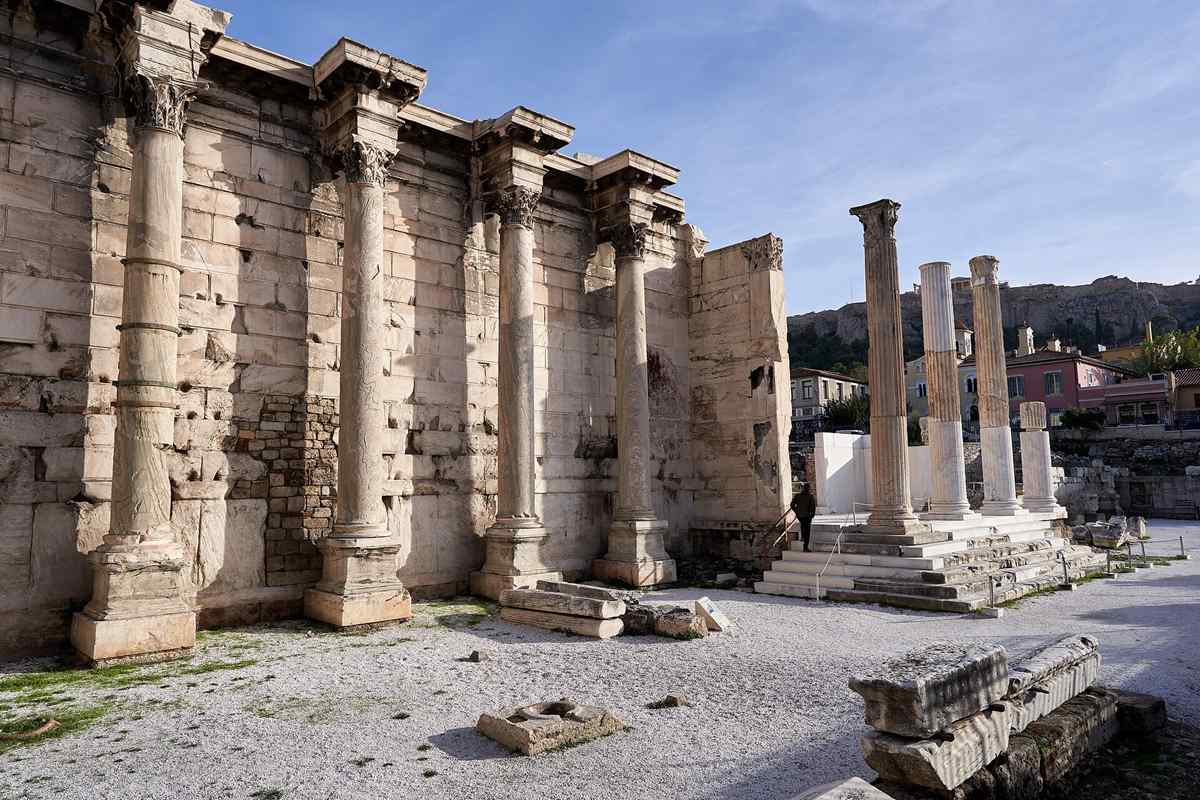
Featured photo: George E. Koronaios, CC BY-SA 4.0, via Wikimedia Commons (File:The Library of Hadrian in Athens on November 7, 2019.jpg).